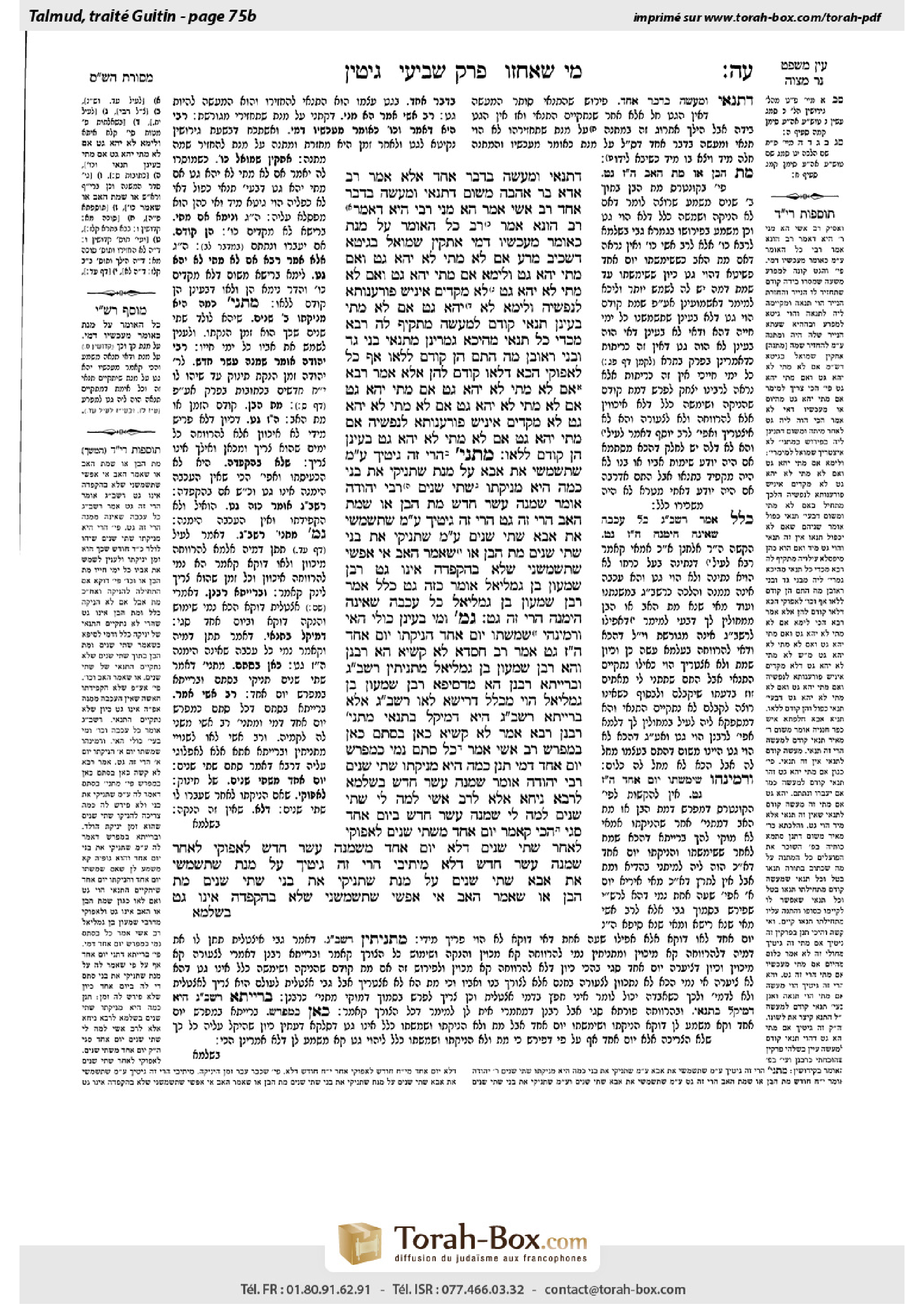
Gittin 75b: Talmud study for Daf Yomi
Study the Talmud for Daf Yomi with scanned pages, Hebrew text, English translations from Sefaria and AI-generated French translations.
Passage selection and English or AI-generated French translation are available where the scan has annotations. Daf Study is independent of Torah-Box and Sefaria.
Browse Gittin · גיטין · All tractatesGittin 75b text and translations
This page of Gittin includes the Aramaic text, an English translation and an AI-generated French translation, alongside the scan above.
גיטין ע״ה ב · Aramaic and Hebrew text
דִּתְנַאי וּמַעֲשֶׂה בְּדָבָר אֶחָד! אֶלָּא אָמַר רַב אַדָּא בַּר אַהֲבָה: מִשּׁוּם דִּתְנַאי וּמַעֲשֶׂה בְּדָבָר אֶחָד.
רַב אָשֵׁי אָמַר: הָא מַנִּי – רַבִּי הִיא, דְּאָמַר רַב הוּנָא אָמַר רַב: כׇּל הָאוֹמֵר ״עַל מְנָת״ כְּאוֹמֵר ״מֵעַכְשָׁיו״ דָּמֵי.
אַתְקֵין שְׁמוּאֵל בְּגִיטָּא דִּשְׁכִיב מְרַע: ״אִם לֹא מַתִּי לֹא יְהֵא גֵּט, וְאִם מַתִּי יְהֵא גֵּט״.
וְלֵימָא: ״אִם מַתִּי יְהֵא גֵּט, וְאִם לֹא מַתִּי לֹא יְהֵא גֵּט״! לָא מַקְדֵּים אִינִישׁ פּוּרְעָנוּתָא לְנַפְשֵׁיהּ.
וְלֵימָא: ״לֹא יְהֵא גֵּט אִם לֹא מַתִּי״! בָּעֵינַן תְּנַאי קוֹדֵם לְמַעֲשֶׂה.
מַתְקֵיף לַהּ רָבָא: מִכְּדֵי כֹּל תְּנָאֵי מֵהֵיכָא גָּמְרִינַן – מִתְּנַאי בְּנֵי גָּד וּבְנֵי רְאוּבֵן; מָה הָתָם – הֵן קוֹדֵם לְלָאו, אַף כֹּל [תְּנָאֵי, הֵן קוֹדֵם לְלָאו].
אֶלָּא אָמַר רָבָא: ״אִם לֹא מַתִּי לֹא יְהֵא גֵּט, אִם מַתִּי יְהֵא גֵּט, אִם לֹא מַתִּי לֹא יְהֵא גֵּט״ –
״אִם לֹא מַתִּי לֹא יְהֵא גֵּט״ – לָא מַקְדֵּים אִינִישׁ פּוּרְעָנוּתָא לְנַפְשֵׁיהּ; ״אִם מַתִּי יְהֵא גֵּט, אִם לֹא מַתִּי לֹא יְהֵא גֵּט״ – בָּעֵינַן הֵן קוֹדֵם לְלָאו.
מַתְנִי׳ ״הֲרֵי זֶה גִּיטִּיךְ עַל מְנָת שֶׁתְּשַׁמְּשִׁי אֶת אַבָּא״; ״עַל מְנָת שֶׁתָּנִיקִי אֶת בְּנִי״ – כַּמָּה הִיא מְנִיקָתוֹ? שְׁתֵּי שָׁנִים. רַבִּי יְהוּדָה אוֹמֵר: שְׁמֹנָה עָשָׂר חֹדֶשׁ. מֵת הַבֵּן אוֹ שֶׁמֵּת הָאָב – הֲרֵי זֶה גֵּט.
״הֲרֵי זֶה גִּיטִּיךְ עַל מְנָת שֶׁתְּשַׁמְּשִׁי אֶת אַבָּא שְׁתֵּי שָׁנִים״; ״עַל מְנָת שֶׁתָּנִיקִי אֶת בְּנִי שְׁתֵּי שָׁנִים״ – מֵת הַבֵּן, אוֹ שֶׁאָמַר הָאָב: ״אִי אֶפְשִׁי שֶׁתְּשַׁמְּשֵׁנִי״ שֶׁלֹּא בְּהַקְפָּדָה – אֵינוֹ גֵּט.
רַבָּן שִׁמְעוֹן בֶּן גַּמְלִיאֵל אוֹמֵר: כָּזֶה – גֵּט. כְּלָל אָמַר רַבָּן שִׁמְעוֹן בֶּן גַּמְלִיאֵל: כׇּל עַכָּבָה שֶׁאֵינָהּ הֵימֶנָּה – הֲרֵי זֶה גֵּט.
גְּמָ׳ וּמִי בָּעֵינַן כּוּלֵּי הַאי?! וּרְמִינְהִי: שִׁמְּשַׁתּוּ יוֹם אֶחָד; הֱנִיקַתּוּ יוֹם אֶחָד – הֲרֵי זֶה גֵּט!
אָמַר רַב חִסְדָּא, לָא קַשְׁיָא: הָא רַבָּנַן, וְהָא רַבָּן שִׁמְעוֹן בֶּן גַּמְלִיאֵל –
מַתְנִיתִין רַבָּן שִׁמְעוֹן בֶּן גַּמְלִיאֵל, וּבָרַיְיתָא רַבָּנַן.
הָא מִדְּסֵיפָא רַבָּן שִׁמְעוֹן בֶּן גַּמְלִיאֵל הָוֵי, מִכְּלָל דְּרֵישָׁא לָאו רַבָּן שִׁמְעוֹן בֶּן גַּמְלִיאֵל! אֶלָּא בָּרַיְיתָא – רַבָּן שִׁמְעוֹן בֶּן גַּמְלִיאֵל הִיא, דְּמֵיקֵל בִּתְנָאֵי; מַתְנִיתִין – רַבָּנַן.
רָבָא אָמַר, לָא קַשְׁיָא: כָּאן בִּסְתָם, כָּאן בִּמְפָרֵשׁ.
רַב אָשֵׁי אָמַר: כׇּל סְתָם נָמֵי כִּמְפָרֵשׁ ״יוֹם אֶחָד״ דָּמֵי.
תְּנַן: כַּמָּה הִיא מְנִיקָתוֹ? שְׁתֵּי שָׁנִים. רַבִּי יְהוּדָה אוֹמֵר: שְׁמֹנָה עָשָׂר חֹדֶשׁ. בִּשְׁלָמָא לְרָבָא – נִיחָא; אֶלָּא לְרַב אָשֵׁי, לְמָה לִי שְׁתֵּי שָׁנִים? לְמָה לִי שְׁמֹנָה עָשָׂר חֹדֶשׁ? בְּיוֹם אֶחָד סַגִּי!
הָכִי קָאָמַר: יוֹם אֶחָד – מִשְׁתֵּי שָׁנִים; לְאַפּוֹקֵי לְאַחַר שְׁתֵּי שָׁנִים – דְּלָא. יוֹם אֶחָד – מִשְּׁמֹנָה עָשָׂר חֹדֶשׁ; לְאַפּוֹקֵי לְאַחַר שְׁמֹנָה עָשָׂר חֹדֶשׁ – דְּלָא.
מֵיתִיבִי: ״הֲרֵי זֶה גִּיטִּיךְ עַל מְנָת שֶׁתְּשַׁמְּשִׁי אֶת אַבָּא שְׁתֵּי שָׁנִים״; ״עַל מְנָת שֶׁתָּנִיקִי אֶת בְּנִי שְׁתֵּי שָׁנִים״ – מֵת הַבֵּן, אוֹ שֶׁאָמַר הָאָב ״אִי אֶפְשִׁי שֶׁתְּשַׁמְּשֵׁנִי״ שֶׁלֹּא בְּהַקְפָּדָה – אֵינוֹ גֵּט.
Gittin 75b · English translation
where the condition and the action are about the same matter, the giving of the bill of divorce. Accordingly, the condition would not be valid even if one were to disregard the concern of the action preceding the condition. Rather, Rav Adda bar Ahava said that this condition is void because the condition and the action are about the same matter, and therefore the bill of divorce is valid even without fulfillment of the condition.
Rav Ashi said: In accordance with whose opinion is this baraita? It is in accordance with the opinion of Rabbi Yehuda HaNasi, as Rav Huna says that Rav says: Anyone who states a condition employing the language: On the condition, is like one who states: The agreement will take effect retroactively from now, even though the condition is fulfilled only later on. Consequently, the bill of divorce is effective immediately, even if the woman will later be required to return the document itself to him.
§ With regard to conditions in a bill of divorce, Shmuel instituted that in a bill of divorce of a person on his deathbed the following expression should be written: If I do not die this will not be a valid bill of divorce, and if I die it will be a valid bill of divorce.
The Gemara asks about the wording used here: But let us say this statement in a more intuitive order: If I die it will be a valid bill of divorce, and if I do not die this will not be a valid bill of divorce. The Gemara explains: A person does not hasten a calamity upon himself. Consequently, he does not wish to mention his death first.
The Gemara asks: Why did Shmuel use this phrasing? But let us say the condition using the following formulation: It will not be a valid bill of divorce if I do not die, and it will be a valid bill of divorce if I do die. The Gemara asks: When stipulating a condition, we require the condition to come before the action, but in this formulation the resultant action, that the bill of divorce is not valid, precedes the condition, if I do not die.
Rava objects to this explanation: Now, from where do we learn the principles of all conditions? They are derived from the condition of the children of Gad and the children of Reuben. Just as there, the affirmative precedes the negative, meaning that the positive portion that speaks about what will occur if the condition is fulfilled appears before the negative portions that describe what will exist if the condition is not fulfilled, so too, all conditions must be formulated in this manner. This serves to exclude the case here, instituted by Shmuel, where the negative precedes the affirmative.
Rather, Rava said that the condition in the bill of divorce of a dying man should be worded in the following manner: If I do not die this will not be a bill of divorce. If I die this will be a bill of divorce, and if I do not die this will not be a bill of divorce.
The Gemara explains the necessity for such a formulation: The husband first says: If I do not die this will not be a bill of divorce, because a person does not hasten a calamity upon himself. Therefore, he first mentions the possibility that he will not die. Then he states the compound condition in the following order: If I die this will be a bill of divorce, and if I do not die this will not be a bill of divorce. This is because we require that the affirmative precedes the negative.
MISHNA: If a husband says to his wife: This is your bill of divorce on the condition that you will serve my father, or: On the condition that you will nurse, i.e., breastfeed, my son, without specifying a time period, how long is she required to nurse him in order to fulfill the condition? She is required to nurse the baby for two years from his birth, which is the length of time generally designated for nursing. Rabbi Yehuda says: The time for nursing is only eighteen months. If the baby son died or the husband’s father died, this is a valid bill of divorce, even though the condition was not fulfilled.
But if the husband said to his wife: This is your bill of divorce on the condition that you will serve my father for two years, or: On the condition that you will nurse my son for two years, and the son died before she nursed him for two years, or the father said: I do not want you to serve me, then even if the father did not say this in anger and she did everything she was expected to do, it is not a valid bill of divorce because the condition was not fulfilled.
Rabban Shimon ben Gamliel says: In a case like this it is a valid bill of divorce. Rabban Shimon ben Gamliel stated a principle: If there is any hindrance to the fulfillment of the condition that does not result from her, then it is a valid bill of divorce.
GEMARA: But do we require that she serve the father or nurse the son for all of this time that was stipulated? And the Gemara raises a contradiction based on what was taught in a baraita (Tosefta, Nidda 2:2): If she served the father for one day or she nursed the son for one day it is a valid bill of divorce.
Rav Ḥisda said that this is not difficult: This baraita is in accordance with the opinion of the Rabbis, and this mishna is in accordance with the opinion of Rabban Shimon ben Gamliel, who disagreed in the previous mishna (74a) with regard to a coat that was lost. According to the opinion of the Rabbis there, if there is no possibility that the wife can fulfill the condition by returning the coat, as it was lost, the bill of divorce is not valid. According to the opinion of Rabban Shimon ben Gamliel there, she can give the husband the coat’s value and the bill of divorce is valid.
The Gemara explains: The mishna is in accordance with the opinion of Rabban Shimon ben Gamliel, who claims that the wife can give the husband the equivalent of the stipulated item to render the bill of divorce valid, as the primary factor is his receiving the benefit he intended when stating his condition. Therefore, she must nurse the child for the standard length of time, as that is the benefit he intended when stating his condition, or else the bill of divorce is not valid. And the baraita is in accordance with the opinion of the Rabbis, who hold that the wife must fulfill the literal terms of the condition. If she nurses the baby for even one day, or serves the father for a single day, the literal terms of the condition have been fulfilled.
The Gemara challenges: Is this explanation possible? But from the fact that the latter clause of the mishna is attributed to Rabban Shimon ben Gamliel, it can be derived by inference that the first clause is not in accordance with the opinion of Rabban Shimon ben Gamliel. Rather, the baraita is in accordance with the opinion of Rabban Shimon ben Gamliel, who is lenient with regard to a condition, and interprets it so that it can be fulfilled. The mishna is in accordance with the opinion of the Rabbis, who interpret the condition in an expanded manner.
Rava offered an alternative explanation and said that the apparent contradiction is not difficult: Here, in the mishna, where the husband spoke without specification and did not set a time, the Sages assigned what they understand to be the standard time for the stipulated action. There, in the baraita, it is referring to where the husband said explicitly that she should perform the action for only one day.
Rav Ashi offered a different alternative explanation and said: Any unspecified statement is also considered to be as though he explicitly said one day. Since the husband did not mention a specific amount of time in which to perform the action, one day should be sufficient.
The Gemara challenges Rav Ashi’s explanation: We learned in the mishna: How long is she required to nurse him in order to fulfill the condition? She is required to nurse the baby for two years from his birth. Rabbi Yehuda says: The time for nursing is only eighteen months. Granted, according to the opinion of Rava, it works out well that if the husband does not specify the length of time, the wife must nurse the baby for the generally accepted time. But according to the opinion of Rav Ashi, why do I need her to nurse the baby for two years or why do I need her to nurse him for eighteen months? One day should suffice to fulfill the husband’s condition.
The Gemara answers: This is what the mishna is saying according to the opinion of Rav Ashi: How long is the wife required to nurse the baby? One day from within the two years of the baby’s birth, to exclude the case where the one day that she nursed him occurred after he was two years old, in which case the husband’s condition would not be fulfilled, for that is the accepted length of time for a mother to nurse a baby. Or according to Rabbi Yehuda one day from within the eighteen months of the baby’s birth, to exclude the case where the one day that she nursed him occurred after he was she nursed him occurred after he was eighteen months old, in which case the bill of divorce would not be valid.
The Gemara raises an objection to the opinion of Rav Ashi from the latter clause of the mishna: If a husband said to his wife: This is your bill of divorce on the condition that you will serve my father for two years, or: This is your bill of divorce on the condition that you will nurse my son for two years, and the son died or the father said: I do not want you to serve me, then even though the father did not say this in anger, it is not a valid bill of divorce.
Gittin 75b · Traduction française (IA)
où la condition et l'action concernent la même chose, l'émission du document de divorce. Ainsi, la condition ne serait pas valide même si l'on négligeait l'inquiétude liée à l'action précédant la condition. En revanche, Rav Adda bar Ahava a dit que cette condition est nulle car la condition et l'action concernent la même chose, et par conséquent, le document de divorce est valide même sans accomplissement de la condition.
Rav Ashi a dit : Selon quel avis est-ce que ce baraïta ? C'est selon l'avis de Rabbi Yehuda HaNasi, comme Rav Huna dit que Rav dit : Quiconque formule une condition en utilisant la formule : sous condition, est comme si l'on disait : l'accord prend effet rétroactivement à partir de maintenant, même si la condition est remplie plus tard. Ainsi, le document de divorce est efficace immédiatement, même si la femme devra ultérieurement lui rendre le document lui-même.
§ En ce qui concerne les conditions dans un document de divorce, Shmuel a institué que dans un document de divorce d'une personne sur son lit de mort, on doive écrire : Si je ne meurs pas, ce ne sera pas un document de divorce valide, et si je meurs, ce sera un document de divorce valide.
La Guemara pose une question sur la formulation utilisée ici : Mais disons cette déclaration dans un ordre plus intuitif : Si je meurs, ce sera un document de divorce valide, et si je ne meurs pas, ce ne sera pas un document de divorce valide. La Guemara explique : Une personne ne précipite pas une calamité sur elle-même. Par conséquent, elle ne souhaite pas mentionner sa mort en premier.
La Guemara pose une question : Pourquoi Shmuel a-t-il utilisé cette formulation ? Mais disons la condition en utilisant la formulation suivante : Ce ne sera pas un document de divorce valide si je ne meurs pas, et ce sera un document de divorce valide si je meurs. La Guemara pose une question : Lors de la stipulation d'une condition, nous exigeons que la condition précède l'action, mais dans cette formulation, l'action résultante, à savoir que le document de divorce n'est pas valide, précède la condition, si je ne meurs pas.
Rava s'oppose à cette explication : Maintenant, d'où nous apprenons-nous les principes de toutes les conditions ? Ils sont tirés de la condition des enfants de Gad et des enfants de Rouben. Tout comme là, l'affirmatif précède le négatif, c'est-à-dire que la partie positive qui parle de ce qui arrivera si la condition est remplie apparaît avant les parties négatives qui décrivent ce qui existera si la condition n'est pas remplie, ainsi aussi toutes les conditions doivent être formulées ainsi. Cela sert à exclure le cas ici, institué par Shmuel, où le négatif précède l'affirmatif.
Plutôt, Rava a dit que la condition dans le document de divorce d'un homme mourant devrait être formulée ainsi : Si je ne meurs pas, ce ne sera pas un document de divorce. Si je meurs, ce sera un de divorce, et si je ne meurs pas, ce ne sera pas un document de divorce.
La Guemara explique la nécessité de cette formulation : Le mari dit d'abord : Si je ne meurs pas, ce ne sera pas un document de divorce, car une personne ne précipite pas une calamité sur elle-même. Par conséquent, il mentionne d'abord la possibilité qu'il ne meure pas. Puis il énonce la condition complexe dans l'ordre suivant : Si je meurs, ce sera un document de divorce, et si je ne meurs pas, ce ne sera pas un document de divorce. Cela est ainsi parce que nous exigeons que l'affirmatif précède le négatif.
MICHNA : Si un mari dit à sa femme : C'est votre document de divorce sous condition que vous servirez mon père, ou : sous condition que vous allaiterez mon fils, sans spécifier une période, combien de temps est-elle tenue de l'allaiter pour accomplir la condition ? Elle doit allaiter le bébé pendant deux ans à partir de sa naissance, ce qui est la durée généralement dédiée à l'allaitement. Rabbi Yehuda dit : La durée de l'allaitement est seulement d'18 mois. Si le fils est mort ou le père est mort, ce sera un document de divorce valide, même si la condition n'a pas été accomplie.
Mais si le mari a dit à sa femme : C'est votre acte de divorce sous condition que vous servirez mon père pendant deux ans, ou : sous condition que vous allaiterez mon fils pendant deux ans, et que le fils est mort avant qu'elle ne l'ait allaité pendant deux ans, ou que le père a dit : Je ne veux pas que vous me serviez, alors même si le père n'a pas dit cela en colère et qu'elle a fait tout ce qu'on attendait d'elle, ce n'est pas un acte de divorce valide car la condition n'a pas été accomplie.
Rabban Shimon ben Gamliel dit : Dans un cas comme celui-ci, ce sera un acte de divorce valide. Rabban Shimon ben Gamliel a énoncé un principe : Si un obstacle empêche l'accomplissement de la condition et que cet obstacle ne provient pas d'elle, alors ce sera un acte de divorce valide.
GUEMARA : Mais exigeons-nous qu'elle serve le père ou qu'elle allaitaille le fils pendant toute cette durée stipulée ? Et la Guemara soulève une contradiction basée sur ce qui a été enseigné dans un baraïta (Tosefta, Nidda 2:2) : Si elle a servi le père pendant un jour ou si elle a allaité le fils pendant un jour, ce sera un acte de divorce valide.
Rav Ḥisda a dit que cela n'est pas difficile : ce baraïta est selon l'avis des Rabbins, et cette mitsna est selon l'avis de Rabban Shimon ben Gamliel, qui s'est opposé dans la mitsna précédente (74a) concernant une veste perdue. Selon l'avis des Rabbins là, si il n'y a pas de possibilité que la femme accomplisse la condition en rendant la veste, comme elle est perdue, le document de divorce n'est pas valide. Selon l'avis de Rabban Shimon ben Gamliel là, elle peut donner à son mari la valeur de la veste et le document de divorce est valide.
La Guemara explique : La Michna est selon l'opinion de Rabban Shimon ben Gamliel, qui affirme que la femme peut donner au mari l'équivalent de l'objet stipulé pour que le divorce soit valide, car le facteur principal est qu'il reçoive le bénéfice qu'il avait en tête lorsqu'il a formulé sa condition. Ainsi, elle doit allaiter l'enfant pendant la durée normale, car c'est le bénéfice qu'il avait en tête lorsqu'il a formulé sa condition, sinon le divorce n'est pas valide. Et la baraïta est selon l'opinion des Sages, qui considèrent que la femme doit remplir littéralement la condition. Si elle allaiter l'enfant même un seul jour, ou sert le père même un seul jour, la condition est remplie.
La Guemara soulève un doute : Cette explication est-elle possible ? Mais du fait que la seconde partie de la Michna est attribuée à Rabban Shimon ben Gamliel, on peut en déduire par l'inférence que la première partie n'est pas selon l'opinion de Rabban Shimon ben Gamliel. Plutôt, la baraïta est selon l'opinion de Rabban Shimon ben Gamliel, qui est favorable envers une condition, et l'interprète de manière à la remplir. La Michna est selon l'opinion des Sages, qui interprètent la condition de manière étendue.
Rava a proposé une autre explication et a dit que le paradoxe apparent n'est pas difficile : Ici, dans la Michna, où le mari a parlé sans précision et n'a pas fixé une durée, les Sages ont attribué ce qu'ils considèrent comme la durée normale pour l'action stipulée. Là, dans la baraïta, il s'agit du cas où le mari a dit explicitement qu'elle devait accomplir l'action pendant un seul jour.
Rav Ashi a proposé une autre explication et a dit : Toute déclaration non spécifiée est également considérée comme si le mari avait dit explicitement un jour. Puisque le mari n'a pas mentionné une durée spécifique pour accomplir l'action, un jour suffirait.
La Guemara soulève un doute contre l'explication de Rav Ashi : Nous avons appris dans la Michna : Pendant combien de temps doit-elle allaiter pour remplir la condition ? Elle doit allaiter l'enfant pendant deux ans à partir de sa naissance. Rabbi Yehuda dit : La durée de l'allaitement est seulement d'18 mois. Admettons que selon l'opinion de Rava, cela fonctionne bien que si le mari ne précise pas la durée, la femme doive allaiter l'enfant pendant la durée normale. Mais selon l'opinion de Rav Ashi, pourquoi ai-je besoin qu'elle allaiter l'enfant pendant deux ans ou pourquoi ai-je besoin qu'elle l'allaiter pendant 18 mois ? Un seul jour suffirait pour remplir la condition du mari.
La Guemara répond : C'est ce que la Michna dit selon l'opinion de Rav Ashi : Pendant combien de temps la femme doit-elle allaiter l'enfant ? Un jour pendant les deux ans de la naissance de l'enfant, pour exclure le cas où le jour où elle l'a allaité est après qu'il ait eu deux ans, dans ce cas la condition du mari ne serait pas remplie, car c'est la durée normale pour que la mère allaitère un bébé. Ou selon Rabbi Yehuda, un jour pendant les 18 mois de la naissance de l'enfant, pour exclure le cas où le jour où elle l'a allaité est après qu'il ait eu 18 mois, dans ce cas le divorce ne serait pas valide.
La Guemara soulève une objection contre l'opinion de Rav Ashi à partir de la seconde partie de la Michna : Si un mari dit à sa femme : C'est ton divorce à la condition que tu serves mon père pendant deux ans, ou : C'est ton divorce à la condition que tu allaites mon fils pendant deux ans, et que le fils meurt ou que le père dise : Je ne veux pas que tu me serves, alors même que le père n'a pas dit cela en colère, le divorce n'est pas valide.
Traduction française générée par IA à partir de l’édition anglaise de Sefaria. Vérifie toujours un passage avec le texte source.
Text from Sefaria: William Davidson Edition - Vocalized Aramaic (CC BY NC); William Davidson Edition - English (CC BY NC).