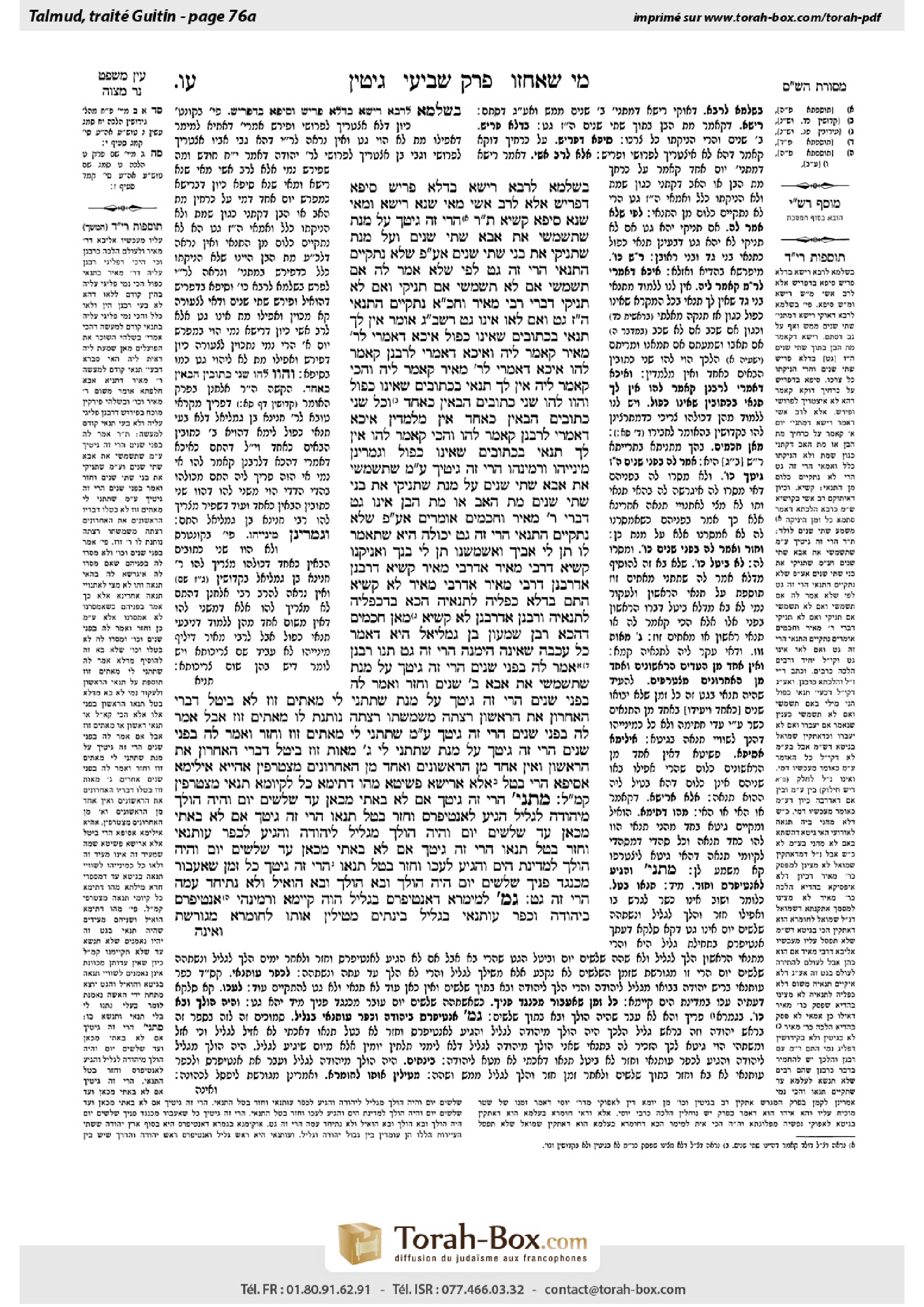
Gittin 76a: Talmud study for Daf Yomi
Study the Talmud for Daf Yomi with scanned pages, Hebrew text, English translations from Sefaria and AI-generated French translations.
Passage selection and English or AI-generated French translation are available where the scan has annotations. Daf Study is independent of Torah-Box and Sefaria.
Browse Gittin · גיטין · All tractatesGittin 76a text and translations
This page of Gittin includes the Aramaic text, an English translation and an AI-generated French translation, alongside the scan above.
גיטין ע״ו א · Aramaic and Hebrew text
בִּשְׁלָמָא לְרָבָא – רֵישָׁא בִּדְלָא פָּרֵישׁ, סֵיפָא דְּפָרֵישׁ.
אֶלָּא לְרַב אָשֵׁי – מַאי שְׁנָא רֵישָׁא, וּמַאי שְׁנָא סֵיפָא? קַשְׁיָא.
תָּנוּ רַבָּנַן: ״הֲרֵי זֶה גִּיטִּיךְ עַל מְנָת שֶׁתְּשַׁמְּשִׁי אֶת אַבָּא שְׁתֵּי שָׁנִים״, וְ״עַל מְנָת שֶׁתָּנִיקִי אֶת בְּנִי שְׁתֵּי שָׁנִים״ – אַף עַל פִּי שֶׁלֹּא נִתְקַיֵּים הַתְּנַאי, הֲרֵי זֶה גֵּט; לְפִי שֶׁלֹּא אָמַר לָהּ: ״אִם תְּשַׁמְּשִׁי – אִם לֹא תְּשַׁמְּשִׁי״; ״אִם תָּנִיקִי – וְאִם לֹא תָּנִיקִי״; דִּבְרֵי רַבִּי מֵאִיר.
וַחֲכָמִים אוֹמְרִים: נִתְקַיֵּים הַתְּנַאי – הֲרֵי זֶה גֵּט, וְאִם לָאו – אֵינוֹ גֵּט. רַבָּן שִׁמְעוֹן בֶּן גַּמְלִיאֵל אוֹמֵר: אֵין לְךָ תְּנַאי בַּכְּתוּבִים, שֶׁאֵינוֹ כָּפוּל.
אִיכָּא דְּאָמְרִי: לְרַבִּי מֵאִיר קָאָמַר לֵיהּ; וְאִיכָּא דְּאָמְרִי: לְרַבָּנַן קָאָמַר לְהוּ. אִיכָּא דְּאָמְרִי לְרַבִּי מֵאִיר קָאָמַר לֵיהּ – וְהָכִי קָאָמַר לֵיהּ: אֵין לְךָ תְּנַאי בַּכְּתוּבִים שֶׁאֵינוֹ כָּפוּל, וְהָווּ לְהוּ שְׁנֵי כְתוּבִים הַבָּאִין כְּאֶחָד, וְכֹל שְׁנֵי כְתוּבִים הַבָּאִין כְּאֶחָד – אֵין מְלַמְּדִין.
אִיכָּא דְּאָמְרִי לְרַבָּנַן קָאָמַר לְהוּ – וְהָכִי קָאָמַר לְהוּ: אִין לָךְ תְּנַאי בַּכְּתוּבִים שֶׁאֵינוֹ כָּפוּל, וְגָמְרִינַן מִינַּיְיהוּ.
וּרְמִינְהוּ: ״הֲרֵי זֶה גִּיטִּיךְ עַל מְנָת שֶׁתְּשַׁמְּשִׁי אֶת אַבָּא שְׁתֵּי שָׁנִים״; ״עַל מְנָת שֶׁתָּנִיקִי אֶת בְּנִי שְׁתֵּי שָׁנִים״ – מֵת הָאָב אוֹ מֵת הַבֵּן, אֵינוֹ גֵּט; דִּבְרֵי רַבִּי מֵאִיר.
וַחֲכָמִים אוֹמְרִים: אַף עַל פִּי שֶׁלֹּא נִתְקַיֵּים הַתְּנַאי, הֲרֵי זֶה גֵּט – יְכוֹלָה הִיא שֶׁתֹּאמַר לוֹ: ״תֵּן לִי אָבִיךָ, וַאֲשַׁמְּשֶׁנּוּ״; ״תֵּן לִי בִּנְךָ, וַאֲנִיקֶנּוּ״.
קַשְׁיָא דְּרַבִּי מֵאִיר אַדְּרַבִּי מֵאִיר, קַשְׁיָא דְּרַבָּנַן אַדְּרַבָּנַן!
דְּרַבִּי מֵאִיר אַדְּרַבִּי מֵאִיר לָא קַשְׁיָא – הָתָם בִּדְלָא כַּפְלֵיהּ לִתְנָאֵיהּ, הָכָא בִּדְכַפְלֵיהּ לִתְנָאֵיהּ.
וְרַבָּנַן אַדְּרַבָּנַן לָא קַשְׁיָא, מַאן חֲכָמִים דְּהָכָא – רַבָּן שִׁמְעוֹן בֶּן גַּמְלִיאֵל הִיא, דְּאָמַר: כׇּל עַכָּבָה שֶׁאֵינָהּ הֵימֶנָּה, הֲרֵי זֶה גֵּט.
תָּנוּ רַבָּנַן, אָמַר לָהּ בִּפְנֵי שְׁנַיִם: ״הֲרֵי זֶה גִּיטִּיךְ עַל מְנָת שֶׁתְּשַׁמְּשִׁי אֶת אַבָּא שְׁתֵּי שָׁנִים״, וְחָזַר וְאָמַר לָהּ בִּפְנֵי שְׁנַיִם: ״הֲרֵי זֶה גִּיטִּךְ עַל מְנָת שֶׁתִּתְּנִי לִי מָאתַיִם זוּז״ – לֹא בִּיטֵּל דִּבְרֵי הָאַחֲרוֹן אֶת הָרִאשׁוֹן; רָצְתָה – מְשַׁמַּשְׁתּוֹ, רָצְתָה – נוֹתֶנֶת לוֹ מָאתַיִם זוּז.
אֲבָל אָמַר לָהּ בִּפְנֵי שְׁנַיִם: ״הֲרֵי זֶה גִּיטִּיךְ עַל מְנָת שֶׁתִּתְּנִי לִי מָאתַיִם זוּז״, וְחָזַר וְאָמַר לָהּ בִּפְנֵי שְׁנַיִם: ״הֲרֵי זֶה גִּיטִּךְ עַל מְנָת שֶׁתִּתְּנִי לִי שְׁלֹשׁ מֵאוֹת זוּז״ – בִּיטֵּל דִּבְרֵי הָאַחֲרוֹן אֶת הָרִאשׁוֹן; וְאֵין אֶחָד מִן הָרִאשׁוֹנִים וְאֶחָד מִן הָאַחֲרוֹנִים מִצְטָרְפִין.
אַהֵיָיא? אִילֵּימָא אַסֵּיפָא – הֲרֵי בָּטֵל! אֶלָּא אַרֵישָׁא –
פְּשִׁיטָא! מַהוּ דְּתֵימָא, כֹּל לְקַיּוֹמֵי תְּנַאי – מִצְטָרְפִין; קָא מַשְׁמַע לַן.
מַתְנִי׳ ״הֲרֵי זֶה גִּיטִּךְ אִם לֹא בָּאתִי מִכָּאן עַד שְׁלֹשִׁים יוֹם״, וְהָיָה הוֹלֵךְ מִיהוּדָה לַגָּלִיל; הִגִּיעַ לְאַנְטִיפְרַס וְחָזַר – בָּטֵל תְּנָאוֹ.
״הֲרֵי זֶה גִּיטִּיךְ אִם לֹא בָּאתִי מִכָּאן עַד שְׁלֹשִׁים יוֹם״, וְהָיָה הוֹלֵךְ מִגָּלִיל לִיהוּדָה, וְהִגִּיעַ לִכְפַר עוֹתְנַאי וְחָזַר – בָּטֵל תְּנָאוֹ.
״הֲרֵי זֶה גִּיטִּיךְ אִם לֹא בָּאתִי מִכָּאן עַד שְׁלֹשִׁים יוֹם״, וְהָיָה הוֹלֵךְ לִמְדִינַת הַיָּם, וְהִגִּיעַ לְעַכּוֹ וְחָזַר – בָּטֵל תְּנָאוֹ.
״הֲרֵי זֶה גִּיטִּיךְ כׇּל זְמַן שֶׁאֶעֱבוֹר מִכְּנֶגֶד פָּנַיִךְ שְׁלֹשִׁים יוֹם״; הָיָה הוֹלֵךְ וּבָא, הוֹלֵךְ וּבָא, הוֹאִיל וְלֹא נִתְיַחֵד עִמָּהּ – הֲרֵי זֶה גֵּט.
גְּמָ׳ לְמֵימְרָא דְּאַנְטִיפְרַס בְּגָלִיל הֲוָה קָיְימָא?! וּרְמִינְהִי: אַנְטִיפְרַס – בִּיהוּדָה; וּכְפַר עוֹתְנַאי – בַּגָּלִיל; בֵּינְתַיִם – מְטִילִין אוֹתוֹ לְחוּמְרָא, מְגוֹרֶשֶׁת
Gittin 76a · English translation
Granted, according to the opinion of Rava, the first clause in the mishna is speaking about when the husband did not explicitly mention a period of time, and the latter clause is referring to when he did explicitly mention a period of two years.
But according to the opinion of Rav Ashi, who holds that when the husband does not mention a period of time the wife can fulfill her obligation by performing the action for even a single day, it is necessary to explain that the first clause in the mishna is referring to when she did fulfill the condition for even one day. And therefore, what is different in the first clause and what is different in the latter clause? The Gemara states: According to Rav Ashi’s opinion this is difficult.
§ The Sages taught (Tosefta 7:6): If a husband said to his wife: This is your bill of divorce on the condition that you will serve my father for two years, or he said: This is your bill of divorce on the condition that you will nurse my son for two years, even if the condition was not fulfilled it is a valid bill of divorce because he did not say to her: If you will serve my father then this will be a valid bill of divorce, and if you will not serve him it will not be a valid bill of divorce, or: If you will nurse my son then this will be a valid bill of divorce, and if you will not nurse him it will not be a valid bill of divorce. And if he did not state his condition as a compound condition, stipulating both positive and negative outcomes, the condition is void and the bill of divorce is valid. This is the statement of Rabbi Meir.
And the Rabbis say: The condition is valid even if it the husband does not stipulate both positive and negative outcomes. Consequently, if the condition was fulfilled this is a valid bill of divorce, and if it was not fulfilled this is not a valid bill of divorce. Rabban Shimon ben Gamliel says: You do not have a condition in the Bible that is not compounded.
To which side of the dispute is Rabban Shimon ben Gamliel’s statement referring? There are those who say: He is speaking to Rabbi Meir. And there are those who say: He is speaking to the Rabbis. The Gemara explains: There are those who say that this means he is speaking to Rabbi Meir and this is what he is saying to him: You do not have a condition in the Bible that is not compounded, and therefore the compound conditions mentioned in the Torah have the status of two verses that come as one, i.e., to teach the same matter. And any two verses that come as one do not teach about other cases. Consequently, one cannot derive from them that every condition must be compounded.
There are those who say: He is saying this to the Rabbis, and this is what he is saying to them: There is no condition in the Bible that is not compounded, and we learn from the conditions written in the Bible that a condition is not valid unless it is compounded.
And the Gemara raises a contradiction based on what was taught in a baraita (Tosefta 7:6): If a husband said to his wife: This is your bill of divorce on the condition that you will serve my father for two years, or he said to her: This is your bill of divorce on the condition that you will nurse my son for two years, and the father died or the son died, then it is not a valid bill of divorce, as its condition was not fulfilled. This is the statement of Rabbi Meir.
And the Rabbis say: Even though the condition was not fulfilled it is a valid bill of divorce, as she could have said to him: Give me your father and I will serve him, or: Give me your son and I will nurse him.
It is difficult to reconcile one statement of Rabbi Meir with the other statement made by Rabbi Meir, for the second baraita indicates that the husband’s condition does not need to be compounded. And it is difficult to reconcile one statement of the Rabbis with the other statement of the Rabbis, for in the second baraita they say that if the condition was fulfilled it is a valid bill of divorce, and if it was not fulfilled it is not a valid bill of divorce.
The Gemara answers: It is not difficult to reconcile one statement of Rabbi Meir with the other statement of Rabbi Meir, as there, in the case where the bill of divorce is valid, it is referring to when he did not compound his condition. Here, where the bill of divorce is valid, it is referring to when he did compound his condition, but the tanna of the baraita did not mention that fact explicitly.
And it is not difficult to reconcile one statement of the Rabbis with the other statement of the Rabbis, because whose is the opinion mentioned here anonymously as the Rabbis? It is the opinion of Rabban Shimon ben Gamliel, who says: If there is any hindrance to fulfilling the condition that is not from her, it is a valid bill of divorce.
§ The Gemara continues discussing a conditional bill of divorce. The Sages taught (Tosefta 6:6): If a husband said to his wife in the presence of two people: This is your bill of divorce on the condition that you will serve my father for two years, and afterward he returned and said to her in the presence of two other people: This is your bill of divorce on the condition that you will give me two hundred dinars, the latter statement does not nullify the first statement. Rather, he is giving her the choice, and if she fulfills either one of the conditions, the bill of divorce is valid. If she wishes, she serves his father and is divorced, or if she wishes, she gives him two hundred dinars and is divorced.
But if he said to her in the presence of two people: This is your bill of divorce on the condition that you will give me two hundred dinars, and afterward he returned and said to her in the presence of two other people: This is your bill of divorce on the condition that you will give me three hundred dinars, then the latter statement nullifies the first statement, and she is not divorced unless she gives him three hundred dinars. And one of the first pair of witnesses and one of the last pair of witnesses cannot combine their testimonies concerning the condition.
The Gemara asks: To which clause of the baraita is the statement that the witnesses cannot combine their testimonies referring? If we say that it is referring to the latter clause, where the husband demanded an additional one hundred dinars, then it already said that the first condition is nullified. It is unnecessary to mention that the two pairs of witnesses cannot combine their testimonies, since the condition witnessed by the first witnesses no longer exists. Rather, it is referring to the first clause.
But isn’t it obvious that these two pairs of witnesses cannot combine their testimonies, since each of them are testifying about a different condition? The Gemara answers: Lest you say that all of those who testify to the existence of conditions can combine their testimonies to testify that a bill of divorce was given with a condition, it teaches us that this is not the case.
MISHNA: If a resident of the region of Judea intending to embark on a journey to the Galilee said to his wife: This is your bill of divorce if I do not come back from now until the conclusion of thirty days, and when he was going from Judea to the Galilee he reached Antipatris and he returned immediately, his condition is void and his wife is not divorced, even if he subsequently returns to the Galilee for longer than thirty days. The reason for this is because he reached the Galilee and returned to Judea within the time he had allotted.
Similarly, if a resident of the region of the Galilee intending to embark on a journey to Judea said to his wife: This is your bill of divorce if I do not come back from now until the conclusion of thirty days, and he was going from the Galilee to Judea, and he reached Kefar Otnai and returned immediately, his condition is void and his wife is not divorced, even if he subsequently returns to Judea for longer than thirty days.
Similarly, if a resident of Eretz Yisrael intending to embark on a journey to a country overseas said to his wife: This is your bill of divorce if I do not come back from now until the conclusion of thirty days, and he was going to a country overseas, and he reached Akko and returned immediately, his condition is void and his wife is not divorced, even if he subsequently travels to a country overseas for longer than thirty days.
If a husband said to his wife: This is your bill of divorce if at any time I will depart from your presence for thirty consecutive days, then even if he was continually going and coming, going and coming, since he was not secluded with her during these thirty days, this is a valid bill of divorce.
GEMARA: The Gemara asks: Is this to say that Antipatris was in the Galilee? It appears from the mishna that Antipatris was on the border of the Galilee, since the condition of the resident of Judea became void by his reaching Antipatris and returning. And the Gemara raises a contradiction based on what is taught in a baraita (Tosefta 7:9): Antipatris is in Judea, and Kefar Otnai is in the Galilee. And with regard to the area between them, a stringent ruling is placed on it, and it is treated as though it is located in both Judea and the Galilee. If the husband who made such a condition reached this area and returned home, it is uncertain whether the condition attached to the bill of divorce was fulfilled. Therefore, there is uncertainty whether she is divorced
Gittin 76a · Traduction française (IA)
Bien que cela soit selon l'opinion de Rava, la première clause de la mitsna parle du cas où le mari n'a pas explicitement mentionné une période de temps, et la seconde clause fait référence au cas où il a explicitement mentionné une période de deux ans.
Mais selon l'opinion de Rav Ashi, qui considère que lorsque le mari ne mentionne pas une période de temps, la femme peut accomplir son obligation en accomplissant l'action même pendant une seule journée, il est nécessaire d'expliquer que la première clause de la mitsna fait référence au cas où elle a accompli la condition même pendant une seule journée. Et donc, ce qui diffère dans la première clause et ce qui diffère dans la seconde clause ? La Guemara dit : Selon l'opinion de Rav Ashi, cela est difficile.
§ Les Sages ont enseigné (Tosefta 7:6) : Si un mari dit à sa femme : C'est votre bill de divorce à la condition que vous servirez mon père pendant deux ans, ou s'il dit : C'est votre bill de divorce à la condition que vous allaiterez mon fils pendant deux ans, même si la condition n'a pas été accomplie, c'est un bill de divorce valide, car il n'a pas dit à elle : Si vous servirez mon père alors ce sera un bill de divorce valide, et si vous ne le servirez pas, ce ne sera pas un bill de divorce valide, ou : Si vous allaiterez mon fils alors ce sera un bill de divorce valide, et si vous ne l'allaiterez pas, ce ne sera pas un bill de divorce valide. Et si il n'a pas formulé sa condition comme une condition composée, stipulant à la fois des résultats positifs et négatifs, la condition est nulle et le bill de divorce est valide. C'est l'opinion de Rabbi Meir.
Et les Rabbins disent : La condition est valide même si le mari n'a pas stipulé à la fois des résultats positifs et négatifs. Ainsi, si la condition a été accomplie, c'est un billet de divorce valide, et si elle n'a pas été accomplie, ce n'est pas un billet de divorce valide. Rabban Shimon ben Gamliel dit : Il n'y a pas de condition dans la Bible qui ne soit pas composée.
À quel côté de la dispute l'opinion de Rabban Shimon ben Gamliel fait-elle référence ? Certains disent : Il parle à Rabbi Meir. D'autres disent : Il parle aux Rabbins. La Guemara explique : Certains disent que cela signifie qu'il parle à Rabbi Meir et que c'est ce qu'il lui dit : Il n'y a pas de condition dans la Bible qui ne soit pas composée, et donc les conditions composées mentionnées dans la Torah ont le statut de deux versets qui s'expriment ensemble, c'est-à-dire pour enseigner la même chose. Et tout couplet de versets qui s'expriment ensemble ne parle pas d'autres cas. Ainsi, on ne peut pas en déduire que toute condition doit être composée.
Certains disent : Il dit cela aux Rabbins, et c'est ce qu'il leur dit : Il n'y a pas de condition dans la Bible qui ne soit pas composée, et nous apprenons des conditions écrites dans la Bible que toute condition n'est valide que si elle est composée.
Et la Guemara soulève une contradiction basée sur ce qui a été enseigné dans une baraïta (Tosefta 7:6) : Si un mari dit à sa femme : C'est votre bill de divorce à la condition que vous servirez mon père pendant deux ans, ou s'il dit à elle : C'est votre bill de divorce à la condition que vous allaiterez mon fils pendant deux ans, et que le père meurt ou que le fils meurt, alors ce n'est pas un bill de divorce valide, car la condition n'a pas été accomplie. C'est l'opinion de Rabbi Meir.
Et les Rabbins disent : Même si la condition n'a pas été accomplie, c'est un bill de divorce valide, car elle aurait pu lui dire : Donnez-moi votre père et je le servirai, ou : Donnez-moi votre fils et je l'allaiterai.
Il est difficile de concilier l'une des déclarations de Rabbi Meir avec l'autre déclaration faite par Rabbi Meir, car la deuxième baraïta indique que la condition du mari n'a pas besoin d'être composée. Et il est difficile de concilier l'une des déclarations des Rabbins avec l'autre déclaration des Rabbins, car dans la deuxième baraïta ils disent que si la condition a été accomplie, c'est un bill de divorce valide, et si elle n'a pas été accomplie, ce n'est pas un bill de divorce valide.
La Guemara répond : Il n'est pas difficile de concilier l'une des déclarations de Rabbi Meir avec l'autre déclaration de Rabbi Meir, car là, dans le cas où le bill de divorce est valide, il s'agit du cas où il n'a pas composé sa condition. Ici, dans le cas où le bill de divorce est valide, il s'agit du cas où il a composé sa condition, mais le tanna de la baraïta n'a pas mentionné explicitement ce fait.
Et il n'est pas difficile de concilier l'une des déclarations des Rabbins avec l'autre déclaration des Rabbins, car qui est l'opinion mentionnée ici anonymement comme celle des Rabbins ? C'est l'opinion de Rabban Shimon ben Gamliel, qui dit : Si un obstacle à l'accomplissement de la condition ne provient pas d'elle, c'est un bill de divorce valide.
§ La Guemara continue de discuter d'un bill de divorce conditionnel. Les Sages ont enseigné (Tosefta 6:6) : Si un mari dit à sa femme en présence de deux personnes : C'est votre bill de divorce à la condition que vous servirez mon père pendant deux ans, et ensuite il revient et dit à elle en présence de deux autres personnes : C'est votre bill de divorce à la condition que vous me donnerez deux cents dinars, la seconde déclaration n'annule pas la première. Plutôt, il lui offre le choix, et si elle accomplit l'une des conditions, le bill de divorce est valide. Si elle le souhaite, elle sert son père et est divorcée, ou si elle le souhaite, elle lui donne deux cents dinars et est divorcée.
Mais s'il a dit à elle devant deux personnes : C'est votre certificat de divorce à la condition que vous me donniez deux cents drachmes, et ensuite il est revenu et a dit à elle devant deux autres personnes : C'est votre certificat de divorce à la condition que vous me donniez trois cents drachmes, alors l'énoncé ultérieur annule l'énoncé initial, et elle n'est pas divorcée à moins qu'elle ne lui donne trois cents drachmes. Et l'un des deux témoins du premier groupe et l'un des deux témoins du dernier groupe ne peuvent pas combiner leurs témoignages concernant la condition.
La Guemara demande : À quelle clause de la baraïta fait référence l'énoncé selon lequel les témoins ne peuvent pas combiner leurs témoignages ? Si nous disons qu'il s'agit de la clause ultérieure, où le mari exigeait une somme supplémentaire de cent drachmes, alors il a déjà été dit que la première condition est annulée. Il n'est donc pas nécessaire de mentionner que les deux paires de témoins ne peuvent pas combiner leurs témoignages, puisque la condition témoinnée par les premiers témoins n'existe plus. Plutôt, il s'agit de la première clause.
Mais n'est-ce pas évident que ces deux paires de témoins ne peuvent pas combiner leurs témoignages, puisque chacun d'eux témoigne d'une condition différente ? La Guemara répond : Pour éviter que vous ne disiez que tous ceux qui témoignent de l'existence de conditions peuvent combiner leurs témoignages pour témoigner qu'un certificat de divorce a été donné avec une condition, elle nous apprend que cela n'est pas le cas.
MICHNA : Si un habitant de la région de Juda, souhaitant entreprendre un voyage vers la Galilée, dit à sa femme : C'est votre certificat de divorce si je ne reviens pas d'ici à la fin de trente jours, et lorsqu'il était en route de Juda vers la Galilée, il arrive à Antipatris et revient immédiatement, sa condition est nulle et sa femme n'est pas divorcée, même s'il revient ensuite à la Galilée pendant plus de trente jours. La raison en est qu'il a atteint la Galilée et est revenu à Juda dans le délai qu'il avait alloué.
De même, si un habitant de la région de la Galilée, souhaitant entreprendre un voyage vers Juda, dit à sa femme : C'est votre certificat de divorce si je ne reviens pas d'ici à la fin de trente jours, et lorsqu'il était en route de la Galilée vers Juda, il arrive à Kefar Otnai et revient immédiatement, sa condition est nulle et sa femme n'est pas divorcée, même s'il revient ensuite à Juda pendant plus de trente jours.
De même, si un habitant d'Éretz Yisrael, souhaitant entreprendre un voyage vers un pays étranger, dit à sa femme : C'est votre certificat de divorce si je ne reviens pas d'ici à la fin de trente jours, et lorsqu'il était en route vers un pays étranger, il arrive à Akko et revient immédiatement, sa condition est nulle et sa femme n'est pas divorcée, même s'il voyage ensuite vers un pays étranger pendant plus de trente jours.
Si un mari a dit à sa femme : C'est votre certificat de divorce si, à tout moment, je quitte votre présence pendant trente jours consécutifs, alors même s'il est allé et venu continuellement, allé et venu, puisqu'il n'était pas seul avec elle pendant ces trente jours, ce certificat de divorce est valide.
GUEMARA : La Guemara demande : Est-ce que cela signifie que Antipatris était en Galilée ? Il semble que cela découle de la Michna que Antipatris était sur la frontière de la Galilée, puisque la condition du résident de Juda est devenue nulle par son arrivée à Antipatris et son retour. Et la Guemara soulève une contradiction basée sur ce qui est enseigné dans une baraïta (Tosefta 7:9) : Antipatris est en Juda, et Kefar Otnai est en Galilée. Et concernant la zone entre eux, une règle stricte est appliquée, et elle est traitée comme si elle était située à la fois en Juda et en Galilée. Si le mari qui a fait une telle condition atteint cette zone et revient chez lui, il est incertain si la condition attachée au certificat de divorce a été accomplie. Par conséquent, il y a incertitude sur le fait qu'elle soit divorcée.
Traduction française générée par IA à partir de l’édition anglaise de Sefaria. Vérifie toujours un passage avec le texte source.
Text from Sefaria: William Davidson Edition - Vocalized Aramaic (CC BY NC); William Davidson Edition - English (CC BY NC).