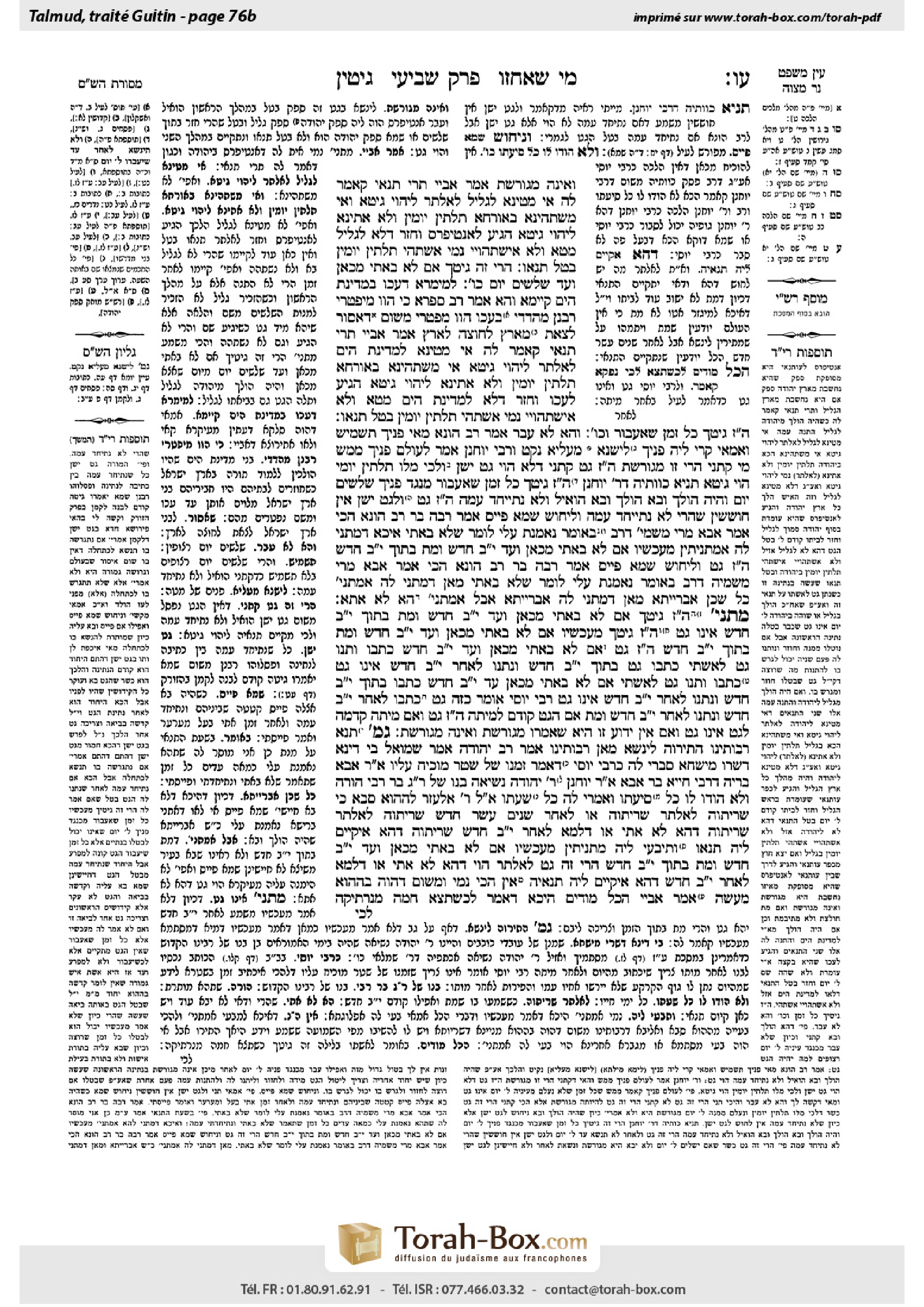
Gittin 76b: Talmud study for Daf Yomi
Study the Talmud for Daf Yomi with scanned pages, Hebrew text, English translations from Sefaria and AI-generated French translations.
Passage selection and English or AI-generated French translation are available where the scan has annotations. Daf Study is independent of Torah-Box and Sefaria.
Browse Gittin · גיטין · All tractatesGittin 76b text and translations
This page of Gittin includes the Aramaic text, an English translation and an AI-generated French translation, alongside the scan above.
גיטין ע״ו ב · Aramaic and Hebrew text
וְאֵינָהּ מְגוֹרֶשֶׁת!
אָמַר אַבָּיֵי, תְּרֵי תְּנָאֵי קָאָמַר לַהּ: אִי מָטֵינָא לְגָלִיל – לְאַלְתַּר לֶיהֱוֵי גִּיטָּא, וְאִי מִשְׁתַּהֵינָא בְּאוֹרְחָא תְּלָתִין יוֹמִין וְלָא אָתֵינָא – לֶיהֱוֵי גִּיטָּא. הִגִּיעַ לְאַנְטִיפְרַס וְחָזַר – דְּלָא לְגָלִיל מְטָא, וְלָא אִישְׁתַּהוֹיֵי נָמֵי אִשְׁתַּהִי תְּלָתִין יוֹמִין – בָּטֵל תְּנָאוֹ.
״הֲרֵי זֶה גִּיטִּיךְ אִם לֹא בָּאתִי מִכָּאן וְעַד שְׁלֹשִׁים יוֹם״ כּוּ׳: לְמֵימְרָא דְּעַכּוֹ בִּמְדִינַת הַיָּם קָיְימָא?! וְהָא אָמַר רַב סָפְרָא: כִּי הֲווֹ מִיפַּטְרִי רַבָּנַן מֵהֲדָדֵי – בְּעַכּוֹ הֲווֹ מִפַּטְרִי, מִשּׁוּם דְּאָסוּר לָצֵאת מֵאָרֶץ לְחוּצָה לָאָרֶץ!
אָמַר אַבָּיֵי, תְּרֵי תְּנָאֵי קָאָמַר לַהּ: אִי מָטֵינָא לִמְדִינַת הַיָּם – לְאַלְתַּר לֶיהֱוֵי גִּיטָּא, אִי מִשְׁתַּהֵינָא בְּאוֹרְחָא תְּלָתִין יוֹמִין וְלָא אָתֵינָא – לֶיהֱוֵי גִּיטָּא. הִגִּיעַ לְעַכּוֹ וְחָזַר – דְּלָא לִמְדִינַת הַיָּם מְטָא, וְלָא אִישְׁתַּהוֹיֵי נָמֵי אִשְׁתַּהִי תְּלָתִין יוֹמִין – בָּטֵל תְּנָאוֹ.
״הֲרֵי זֶה גִּיטִּיךְ כׇּל זְמַן שֶׁאֶעֱבוֹר״ וְכוּ׳: וְהָא לָא עֲבַר! אָמַר רַב הוּנָא: מַאי ״פָּנַיִךְ״ – תַּשְׁמִישׁ; וְאַמַּאי קָרֵי לֵיהּ ״פָּנַיִךְ״ – לִישָּׁנָא מְעַלְּיָא נָקֵט.
וְרַבִּי יוֹחָנָן אָמַר: לְעוֹלָם ״פָּנַיִךְ״ מַמָּשׁ. מִי קָתָנֵי ״הֲרֵי זוֹ מְגוֹרֶשֶׁת״? ״הֲרֵי זֶה גֵּט״ קָתָנֵי – דְּלָא הָוֵי גֵּט יָשָׁן, וּלְכִי מָלוּ תְּלָתִין יוֹמֵי הָוֵי גִּיטָּא.
תַּנְיָא כְּווֹתֵיהּ דְּרַבִּי יוֹחָנָן: ״הֲרֵי זֶה גִּיטִּיךְ כׇּל זְמַן שֶׁאֶעֱבוֹר מִנֶּגֶד פָּנַיִךְ שְׁלֹשִׁים יוֹם״, וְהָיָה הוֹלֵךְ וּבָא, הוֹלֵךְ וּבָא; הוֹאִיל וְלֹא נִתְיַיחֵד עִמָּהּ – הֲרֵי זֶה גֵּט; וּלְגֵט יָשָׁן אֵין חוֹשְׁשִׁין, שֶׁהֲרֵי לֹא נִתְיַיחֵד עִמָּהּ.
וְלֵיחוּשׁ שֶׁמָּא פִּיֵּיס! אָמַר רַבָּה בַּר רַב הוּנָא: הָכִי אָמַר אַבָּא מָרִי מִשְּׁמֵיהּ דְּרַב, בְּאוֹמֵר: נֶאֱמֶנֶת עָלַי לוֹמַר שֶׁלֹּא בָּאתִי.
אִיכָּא דְּמַתְנֵי לַהּ אַמַּתְנִיתִין: ״מֵעַכְשָׁיו אִם לֹא בָּאתִי מִכָּאן וְעַד שְׁנֵים עָשָׂר חֹדֶשׁ״, וּמֵת בְּתוֹךְ שְׁנֵים עָשָׂר חֹדֶשׁ – הֲרֵי זֶה גֵּט. וְלֵיחוּשׁ שֶׁמָּא פִּיֵּיס! אָמַר רַבָּה בַּר רַב הוּנָא: הָכִי אָמַר אַבָּא מָרִי מִשְּׁמֵיהּ דְּרַב, בְּאוֹמֵר: נֶאֱמֶנֶת עָלַי לוֹמַר שֶׁלֹּא בָּאתִי.
מַאן דְּמַתְנֵי לַהּ אַמַּתְנִיתִין, כׇּל שֶׁכֵּן אַבָּרַיְיתָא.
מַאן דְּמַתְנֵי לַהּ אַבָּרַיְיתָא – אֲבָל אַמַּתְנִיתִין, הָא לָא אֲתָא.
מַתְנִי׳ ״הֲרֵי זֶה גִּיטִּךְ, אִם לֹא בָּאתִי מִכָּאן וְעַד שְׁנֵים עָשָׂר חֹדֶשׁ״, וּמֵת בְּתוֹךְ שְׁנֵים עָשָׂר חֹדֶשׁ – אֵינוֹ גֵּט.
״הֲרֵי זֶה גִּיטִּיךְ מֵעַכְשָׁיו, אִם לֹא בָּאתִי מִכָּאן וְעַד שְׁנֵים עָשָׂר חֹדֶשׁ״, וּמֵת בְּתוֹךְ שְׁנֵים עָשָׂר חֹדֶשׁ – הֲרֵי זֶה גֵּט.
״אִם לֹא בָּאתִי מִכָּאן וְעַד שְׁנֵים עָשָׂר חֹדֶשׁ, כִּתְבוּ וּתְנוּ גֵּט לְאִשְׁתִּי״ – כָּתְבוּ גֵּט בְּתוֹךְ שְׁנֵים עָשָׂר חֹדֶשׁ, וְנָתְנוּ לְאַחַר שְׁנֵים עָשָׂר חֹדֶשׁ – אֵינוֹ גֵּט.
״כִּתְבוּ וּתְנוּ גֵּט לְאִשְׁתִּי, אִם לֹא בָּאתִי מִכָּאן עַד שְׁנֵים עָשָׂר חֹדֶשׁ״ – כָּתְבוּ בְּתוֹךְ שְׁנֵים עָשָׂר חֹדֶשׁ, וְנָתְנוּ לְאַחַר שְׁנֵים עָשָׂר חֹדֶשׁ – אֵינוֹ גֵּט. רַבִּי יוֹסֵי אוֹמֵר: כָּזֶה – גֵּט.
כָּתְבוּ לְאַחַר שְׁנֵים עָשָׂר חֹדֶשׁ, וְנָתְנוּ לְאַחַר שְׁנֵים עָשָׂר חֹדֶשׁ, וָמֵת; אִם הַגֵּט קוֹדֵם לַמִּיתָה – הֲרֵי זֶה גֵּט; וְאִם מִיתָה קָדְמָה לַגֵּט – אֵינוֹ גֵּט; וְאִם אֵין יָדוּעַ – זוֹ הִיא שֶׁאָמְרוּ מְגוֹרֶשֶׁת וְאֵינָהּ מְגוֹרֶשֶׁת.
גְּמָ׳ תָּנָא: רַבּוֹתֵינוּ הִתִּירוּהָ לִינָּשֵׂא.
מַאן רַבּוֹתֵינוּ? אָמַר רַב יְהוּדָה אָמַר שְׁמוּאֵל: בֵּי דִינָא דִּשְׁרוֹ מִישְׁחָא; סָבְרִי לַהּ כְּרַבִּי יוֹסֵי, דְּאָמַר: זְמַנּוֹ שֶׁל שְׁטָר מוֹכִיחַ עָלָיו.
אָמַר רַבִּי אַבָּא בְּרֵיהּ דְּרַבִּי חִיָּיא בַּר אַבָּא אָמַר רַבִּי יוֹחָנָן: רַבִּי יְהוּדָה נְשִׂיאָה בְּנוֹ שֶׁל רַבָּן גַּמְלִיאֵל בַּר רַבִּי הוֹרָה, וְלֹא הוֹדוּ לוֹ כׇּל סִיעָתוֹ; וְאָמְרִי לָהּ כׇּל שְׁעָתוֹ.
אֲמַר לֵיהּ רַבִּי אֶלְעָזָר לְהָהוּא סָבָא: כִּי שְׁרִיתוּהָ – לְאַלְתַּר שְׁרִיתוּהָ, אוֹ לְאַחַר שְׁנֵים עָשָׂר חֹדֶשׁ שְׁרִיתוּהָ? לְאַלְתַּר שְׁרִיתוּהָ – דְּהָא לָא אָתֵי; אוֹ דִלְמָא, לְאַחַר שְׁנֵים עָשָׂר חֹדֶשׁ שְׁרִיתוּהָ – דְּהָא אִיקַּיַּים לֵיהּ תְּנָאוֹ?
וְתִיבְּעֵי לֵיהּ מַתְנִיתִין: ״מֵעַכְשָׁיו, אִם לֹא בָּאתִי מִכָּאן וְעַד שְׁנֵים עָשָׂר חֹדֶשׁ״, וּמֵת בְּתוֹךְ שְׁנֵים עָשָׂר חֹדֶשׁ – הֲרֵי זֶה גֵּט. לְאַלְתַּר הָוֵי, דְּהָא לָא אָתֵי; אוֹ דִלְמָא, לְאַחַר שְׁנֵים עָשָׂר חֹדֶשׁ – דְּהָא אִיקַּיַּים לֵיהּ תְּנָאֵיהּ? אִין הָכִי נָמֵי, וּמִשּׁוּם דַּהֲוָה בְּהָהוּא מַעֲשֶׂה.
אָמַר אַבָּיֵי: הַכֹּל מוֹדִים הֵיכָא דְּאָמַר: ״לִכְשֶׁתֵּצֵא חַמָּה מִנַּרְתִּיקָהּ״ –
Gittin 76b · English translation
or whether she is not divorced.
Abaye said: It may be that Antipatris is in Judea and Kefar Otnai is in the Galilee. The mishna can be explained as follows: The husband was saying a statement including two conditions to her: If I arrive in the Galilee then this will be a bill of divorce immediately, or if I will tarry on the way for thirty days and I do not come back home, this will be a valid bill of divorce. If he reached Antipatris and returned within thirty days, as he did not arrive in the Galilee and he also did not tarry for thirty days, then his condition is void and his wife is not divorced.
The continuation of the mishna taught: This is your bill of divorce if I do not come back from now until the conclusion of thirty days. The Gemara asks: Is this to say that Akko is in a country overseas, and is not considered part of Eretz Yisrael? But didn’t Rav Safra say: When the Sages would take leave from one another before departing Eretz Yisrael, they would take their leave in Akko, because it is prohibited to leave from Eretz Yisrael to go outside of Eretz Yisrael? This indicates that Akko is within Eretz Yisrael.
Abaye said: The husband was saying a statement including two conditions to her: If I arrive in a country overseas, then this will be a valid bill of divorce immediately, or if I tarry thirty days on the way and I do not come back home, this will be a valid bill of divorce. If he reached Akko and returned, as he did not reach a country overseas and he also did not tarry for thirty days, his condition is void and his wife is not divorced.
§ The continuation of the mishna states: If a husband said to his wife: This is your bill of divorce if at any time I will depart from your presence for thirty consecutive days, then even if he was continually going and coming, going and coming, since he was not secluded with her during these thirty days this is a valid bill of divorce. The Gemara challenges: But did he not pass from her presence during this time, as he was going and coming the entire time? Rav Huna said: What is the meaning of the term your presence in this context? It means sexual intercourse. His actual condition was that if he will not engage in sexual intercourse with her for thirty days then the bill of divorce will be valid. And why does he call sexual intercourse your presence? He employed a euphemistic expression when he made his condition.
And Rabbi Yoḥanan disagreed and said: Actually, the husband means literally: Your presence, i.e., that he would not be in his wife’s presence for thirty consecutive days. Is the mishna teaching that she is divorced immediately? No, it is teaching only that this is a valid bill of divorce. This means that although the condition was not fulfilled during these thirty days, since he was not secluded with her this is not considered to be an outdated bill of divorce, which the Sages said may not be used for divorce. And when, at some point in the future, the thirty days during which he does pass from her presence are fulfilled, this will be a valid bill of divorce.
The Gemara comments that it is taught in a baraita (Tosefta 7:10) in accordance with the opinion of Rabbi Yoḥanan: If one says to his wife: This is your bill of divorce if at any time I will depart from your presence for thirty consecutive days, and he was going and coming, going and coming for the entire thirty days, since he was not secluded with her during that time, this is a valid bill of divorce. And one is not concerned that it is now considered an outdated bill of divorce, because he was not secluded with her.
The Gemara asks: But let there be a concern that perhaps he appeased his wife during this time that he was going and coming, and he was secluded with her. Rabba bar Rav Huna said: So said my father, my teacher, Rav Huna, in the name of Rav: The baraita is referring to a situation where the husband says: She is deemed credible by me to say that I did not come. Since the husband states explicitly that he believes her about this, if she said that he was not secluded with her then the bill of divorce remains valid.
There are those who teach this statement of Rav Huna in the name of Rav with regard to the mishna mentioned later on, which says that if the husband said to his wife: This is your bill of divorce from now if I do not come back from now until the conclusion of twelve months, and he died within twelve months, this is a valid bill of divorce. The Gemara asks: But let there be a concern that perhaps he appeased his wife during this time and was secluded with her. Rabba bar Rav Huna said: So said my father, my teacher, Rav Huna, in the name of Rav: The mishna is referring to a situation where the husband says: She is deemed credible by me to say that I did not come, and he did not appease her.
The Gemara comments: Concerning the one who taught that statement of Rav Huna in the name of Rav with regard to the mishna, all the more so would he teach this statement with regard to the baraita. Since he was constantly going and coming, the bill of divorce would be valid only if the husband stated that he trusts his wife to say that she was not secluded with him.
Concerning the one who taught this statement with regard to the baraita, it is possible that he taught this only with regard to the baraita, but with regard to the mishna, this is not the case, as he did not come back home within twelve months, but rather died. Therefore, even if he did not specify that he trusts his wife to say whether or not they were secluded, there is no concern that perhaps he was secluded with her without anyone knowing about it.
MISHNA: If a husband says to his wife: This is your bill of divorce if I do not come back from now until the conclusion of twelve months, and he died within twelve months, it is not a valid bill of divorce. This is because the bill of divorce cannot take effect after the husband’s death. As a result, she is bound by a levirate bond if her husband has no children.
By contrast, if he said to her: This is your bill of divorce from now if I do not come back from now until the conclusion of twelve months, and he died within twelve months, this is a valid bill of divorce. This is because the bill of divorce takes effect retroactively. Since he did not return within the year the condition was fulfilled.
If a husband said to others: If I do not come back from now until the conclusion of twelve months, write and give a bill of divorce to my wife, and they wrote a bill of divorce during the twelve months and gave it to her after twelve months had elapsed, it is not a valid bill of divorce because he instructed them to write the bill of divorce only after twelve months had elapsed.
Similarly, if he said to others: Write and give a bill of divorce to my wife if I do not come back from now until the conclusion of twelve months, and they wrote it during the twelve months but gave it to her after the twelve months, it is not a valid bill of divorce because he instructed them to write the bill of divorce only after twelve months had elapsed, when it was clear that he did not come back. Rabbi Yosei disagrees and says: In a case like this, it is a valid bill of divorce, as he did not tell them when to write the bill of divorce. Rather, he stipulated only the time of giving.
If they wrote the bill of divorce after twelve months had elapsed, and gave it after twelve months had elapsed, but in the interim the husband died, if the giving of the bill of divorce occurred before the husband’s death this is a valid bill of divorce. But if the husband’s death occurred before the giving of the bill of divorce it is not a valid bill of divorce. And if it is not known which occurred first, this is a case where the Sages said there is uncertainty whether she is divorced or whether she is not divorced.
GEMARA: The mishna states that if a husband said to his wife: This is your bill of divorce if I do not come back from now until the conclusion of twelve months, and the husband died within that time, it is not a valid bill of divorce. With regard to this it is taught in a baraita: Our Rabbis disagreed and permitted her to marry without requiring ḥalitza because they hold that it is a valid bill of divorce.
The Gemara clarifies: Who are our Rabbis mentioned in this baraita? Rav Yehuda said that Shmuel said: They are the court that permitted consuming oil manufactured by gentiles. Why do they hold that this is a valid bill of divorce? They hold in accordance with the opinion of Rabbi Yosei, who says: The date written in a document proves when it takes effect. Whenever a document is dated it is assumed that the intent is for it to take effect from that date even if it does not state explicitly: From now.
Rabbi Abba, son of Rabbi Ḥiyya bar Abba, says that Rabbi Yoḥanan says: Rabbi Yehuda Nesia, son of Rabban Gamliel the son of Rabbi Yehuda HaNasi, taught this matter, and all of his colleagues [siato] did not concede to his opinion. And some say that all of his life [she’ato] they did not concede to his opinion.
Rabbi Elazar said to a certain elderly man who was a member of Rabbi Yehuda Nesia’s court: When you permitted this woman to remarry, did you permit her to remarry immediately after her husband died or did you permit her only after twelve months? Did you permit her to remarry immediately after the husband died, because he will certainly not come back? Or perhaps you permitted her to remarry only after twelve months, because only then was the husband’s condition fulfilled?
The Gemara asks: And let his dilemma be raised also with regard to the mishna, in the case where the husband said to his wife: This is your bill of divorce from now if I do not come back from now until the conclusion of twelve months, and he died within the twelve months, this is a valid bill of divorce. Is the bill of divorce valid immediately once the husband dies, because he will certainly not come back? Or perhaps the bill of divorce is valid only after twelve months have elapsed, because only then was his condition fulfilled? The Gemara answers: Yes, indeed so; this question can be asked with regard to the case in the mishna. And Rabbi Elazar asked that particular elder because he was present at that incident, and he could answer based on what actually occurred.
§ Abaye said: Everyone concedes that in a case where the husband said to his wife that the bill of divorce will take effect once the sun emerges from its sheath [minnartikah],
Gittin 76b · Traduction française (IA)
ou s'il ne l'a pas divorcée.
Abaye a dit : Peut-être que Antipatris est en Judée et Kefar Otnai est en Galilée. La Michna peut être expliquée ainsi : Le mari disait à sa femme une déclaration comprenant deux conditions : Si je arrive en Galilée, ce sera un acte de divorce immédiat, ou si je reste trente jours sur le chemin et que je ne reviens pas chez moi, ce sera un acte de divorce valide. Si il est arrivé à Antipatris et est revenu dans trente jours, puisqu'il n'a pas atteint la Galilée et qu'il n'a pas resté trente jours, sa condition est nulle et sa femme n'est pas divorcée.
La suite de la Michna enseigne : C'est votre acte de divorce si je ne reviens pas de maintenant jusqu'à la fin de trente jours. La Guemara pose la question : Cela signifie-t-il que Akko est dans un pays étranger et n'est pas considéré comme faisant partie de la Terre d'Israël ? Mais n'avait pas Rav Safra dit : Lorsque les Sages partaient l'un de l'autre avant de quitter la Terre d'Israël, ils prenaient leur adieu à Akko, car il est interdit de quitter la Terre d'Israël pour aller hors de la Terre d'Israël ? Cela indique que Akko est à l'intérieur de la Terre d'Israël.
Abaye a dit : Le mari disait à sa femme une déclaration comprenant deux conditions : Si je arrive dans un pays étranger, ce sera un acte de divorce immédiat, ou si je reste trente jours sur le chemin et que je ne reviens pas chez moi, ce sera un acte de divorce valide. Si il est arrivé à Akko et est revenu, puisqu'il n'a pas atteint un pays étranger et qu'il n'a pas resté trente jours, sa condition est nulle et sa femme n'est pas divorcée.
§ La suite de la Michna dit : Si un mari disait à sa femme : C'est votre acte de divorce si à tout moment je partirai de votre présence pendant trente jours consécutifs, alors même s'il est allé et venu continuellement, puisqu'il n'a pas été seul avec elle pendant ces trente jours, c'est un acte de divorce valide. La Guemara conteste : Mais n'avait-il pas quitté sa présence pendant cette période, puisqu'il est allé et venu tout le temps ? Rav Huna a dit : Qu'entend-on par la présence dans ce contexte ? Cela signifie l'acte sexuel. Son condition était que s'il ne s'engageait pas en acte sexuel avec elle pendant trente jours, l'acte de divorce serait valide. Et pourquoi appelle-t-il l'acte sexuel la présence ? Il a utilisé une expression euphemistique lorsqu'il a formulé sa condition.
Et Rabbi Yoḥanan a contesté et a dit : En réalité, le mari entend littéralement : La présence, c'est-à-dire qu'il ne serait pas en présence de sa femme pendant trente jours consécutifs. La Michna enseigne-t-elle que la femme est divorcée immédiatement ? Non, elle enseigne seulement que c'est un acte de divorce valide. Cela signifie que bien que la condition n'ait pas été remplie pendant ces trente jours, puisqu'il n'était pas seul avec elle, cela n'est pas considéré comme un acte de divorce périmé, qui a été dit par les Sages ne pouvant être utilisé pour le divorce. Et lorsque, à un moment donné dans le futur, les trente jours pendant lesquels il a quitté sa présence seront remplis, cela sera un acte de divorce valide.
La Guemara commente que cela est enseigné dans une baraïta (Tosefta 7:10) selon l'opinion de Rabbi Yoḥanan : Si l'on dit à sa femme : C'est votre acte de divorce si à tout moment je partirai de votre présence pendant trente jours consécutifs, et s'il est allé et venu, allé et venu pendant les trente jours entiers, puisqu'il n'était pas seul avec elle pendant cette période, c'est un acte de divorce valide. Et l'on n'a pas à crainre qu'il soit maintenant considéré comme un acte de divorce périmé, car il n'était pas seul avec elle.
La Guemara pose la question : Mais peut-être qu'il a rassuré sa femme pendant cette période qu'il était allé et venu, et qu'il était seul avec elle. Rabba bar Rav Huna a dit : C'est ce que dit mon père, mon maître, Rav Huna, en nom de Rav : La baraïta fait référence à une situation où le mari dit : Elle est considérée comme crédible par moi pour dire qu'il n'est pas venu. Puisque le mari déclare explicitement qu'il croit en elle à ce sujet, si elle dit qu'il n'était pas seul avec elle, l'acte de divorce reste valide.
Certains enseignent cette déclaration de Rav Huna en nom de Rav concernant la Michna mentionnée plus tard, qui dit que si le mari dit à sa femme : C'est votre acte de divorce à partir de maintenant si je ne reviens pas de maintenant jusqu'à la fin d'un an, et s'il meurt dans un an, c'est un acte de divorce valide. La Guemara pose la question : Mais peut-être qu'il a rassuré sa femme pendant cette période et qu'il était seul avec elle. Rabba bar Rav Huna a dit : C'est ce que dit mon père, mon maître, Rav Huna, en nom de Rav : La Michna fait référence à une situation où le mari dit : Elle est considérée comme crédible par moi pour dire qu'il n'est pas venu, et il n'a pas rassuré elle.
La Guemara commente : Concernant celui qui a enseigné cette déclaration de Rav Huna en nom de Rav concernant la Michna, encore plus encore serait-il enseigné cela concernant la baraïta. Puisque il était constamment allé et venu, l'acte de divorce serait valide seulement si le mari déclarait qu'il faisait confiance à sa femme pour dire qu'elle n'était pas seule avec lui.
Concernant celui qui a enseigné cette déclaration concernant la baraïta, il est possible qu'il l'ait enseigné seulement concernant la baraïta, mais concernant la Michna, cela n'est pas le cas, puisqu'il n'est pas revenu chez lui dans un an, mais plutôt est mort. Par conséquent, même s'il n'a pas spécifié qu'il faisait confiance à sa femme pour dire si ou non ils étaient seuls, il n'y a pas à craindre qu'il ait été seul avec elle sans que personne ne sache.
MICHNA : Si un mari dit à sa femme : C'est votre acte de divorce si je ne reviens pas de maintenant jusqu'à la fin d'un an, et s'il meurt dans un an, ce n'est pas un acte de divorce valide. Cela est dû au fait que l'acte de divorce ne peut pas prendre effet après la mort du mari. En conséquence, elle est liée par un lien levirique si son mari n'a pas d'enfants.
Par contraste, si il dit à elle : C'est ton divorce à partir de maintenant, si je ne reviens pas de maintenant jusqu'à la fin de douze mois, et s'il meurt dans les douze mois, c'est un divorce valide. C'est parce que le divorce prend effet rétroactivement. Puisque il n'est pas revenu dans l'année, la condition a été accomplie.
Si un mari dit à d'autres : Si je ne reviens pas de maintenant jusqu'à la fin de douze mois, écrivez et donnez un divorce à ma femme, et s'ils ont écrit un divorce pendant les douze mois et l'ont donné à elle après que les douze mois eurent écoulé, ce n'est pas un divorce valide, car il a ordonné qu'ils écrivent le divorce seulement après que les douze mois eurent écoulé.
De même, si il dit à d'autres : Écrivez et donnez un divorce à ma femme si je ne reviens pas de maintenant jusqu'à la fin de douze mois, et s'ils l'ont écrit pendant les douze mois mais l'ont donné à elle après les douze mois, ce n'est pas un divorce valide, car il a ordonné qu'ils écrivent le divorce seulement après que les douze mois eurent écoulé, lorsqu'il était clair qu'il ne reviendrait pas. Rabbi Yosei désaccorde et dit : Dans un cas comme celui-ci, c'est un divorce valide, car il n'a pas dit à eux quand écrire le divorce. Plutôt, il a stipulé seulement le moment de la remise.
Si le divorce a été écrit après que douze mois eurent écoulé, et donné après que douze mois eurent écoulé, mais pendant l'intervalle le mari est mort, si la remise du divorce s'est produite avant la mort du mari, c'est un divorce valide. Mais si la mort du mari s'est produite avant la remise du divorce, ce n'est pas un divorce valide. Et si on ne sait pas quel événement s'est produit en premier, c'est un cas où les Sages ont dit qu'il y a incertitude quant à si elle est divorcée ou non.
GUEMARA : La Michna dit que si un mari dit à sa femme : C'est ton divorce si je ne reviens pas de maintenant jusqu'à la fin de douze mois, et le mari meurt pendant cette période, ce n'est pas un divorce valide. A ce sujet, il est enseigné dans une baraïta : Nos Rabbins étaient en désaccord et ont permis qu'elle épouse sans exiger la halitza, car ils pensaient que c'était un divorce valide.
La Guemara clarifie : Qui sont les Rabbins mentionnés dans cette baraïta ? Rav Yehuda dit que Shmuel dit : Ce sont les tribunaux qui ont permis de consommer l'huile fabriquée par les non-Juifs. Pourquoi pensent-ils que c'est un divorce valide ? Ils pensent selon l'opinion de Rabbi Yosei, qui dit : La date inscrite dans un document prouve quand il prend effet. Quand un document est daté, on suppose que l'intention est qu'il prenne effet à partir de cette date, même s'il ne dit pas explicitement : à partir de maintenant.
Rabbi Abba, fils de Rabbi Ḥiyya bar Abba, dit que Rabbi Yoḥanan dit : Rabbi Yehuda Nesia, fils de Rabban Gamliel, fils de Rabbi Yehuda HaNasi, a enseigné cette question, et tous ses collègues [siato] n'ont pas concédé à son opinion. Et certains disent que toute sa vie [she’ato] ils n'ont pas concédé à son opinion.
Rabbi Elazar a dit à un certain homme âgé qui était membre du tribunal de Rabbi Yehuda Nesia : Quand vous avez permis à cette femme de remettre mariage, avez-vous permis qu'elle remarie immédiatement après la mort de son mari ou avez-vous permis qu'elle le fasse seulement après douze mois ? Avez-vous permis qu'elle remarie immédiatement après la mort du mari, car il ne reviendra certainement pas ? Ou peut-être avez-vous permis qu'elle remarie seulement après douze mois, car c'est seulement à ce moment que la condition du mari était accomplie ?
La Guemara pose la question : Et que ce dilemme soit aussi posé concernant la mitsva, dans le cas où le mari dit à sa femme : C'est ton divorce à partir de maintenant, si je ne reviens pas de maintenant jusqu'à la fin de douze mois, et il meurt pendant les douze mois, c'est un divorce valide. Est-ce que le divorce est valide immédiatement une fois que le mari meurt, car il ne reviendra certainement pas ? Ou peut-être le divorce est valide seulement après douze mois, car c'est seulement à ce moment que la condition du mari était accomplie ? La Guemara répond : Oui, effectivement, c'est ainsi ; cette question peut être posée concernant le cas de la mitsva. Et Rabbi Elazar a posé cette question à ce vieillard particulier car il était présent à cet incident, et il pouvait répondre en se basant sur ce qui s'était réellement produit.
§ Abaye dit : Tout le monde reconnaît que dans un cas où le mari dit à sa femme que le divorce prend effet une fois que le soleil sort de son orbite [minnartikah],
Traduction française générée par IA à partir de l’édition anglaise de Sefaria. Vérifie toujours un passage avec le texte source.
Text from Sefaria: William Davidson Edition - Vocalized Aramaic (CC BY NC); William Davidson Edition - English (CC BY NC).