Gittin 77a: Talmud study for Daf Yomi
Study the Talmud for Daf Yomi with scanned pages, Hebrew text, English translations from Sefaria and AI-generated French translations.
Passage selection and English or AI-generated French translation are available where the scan has annotations. Daf Study is independent of Torah-Box and Sefaria.
Browse Gittin · גיטין · All tractatesGittin 77a text and translations
This page of Gittin includes the Aramaic text, an English translation and an AI-generated French translation, alongside the scan above.
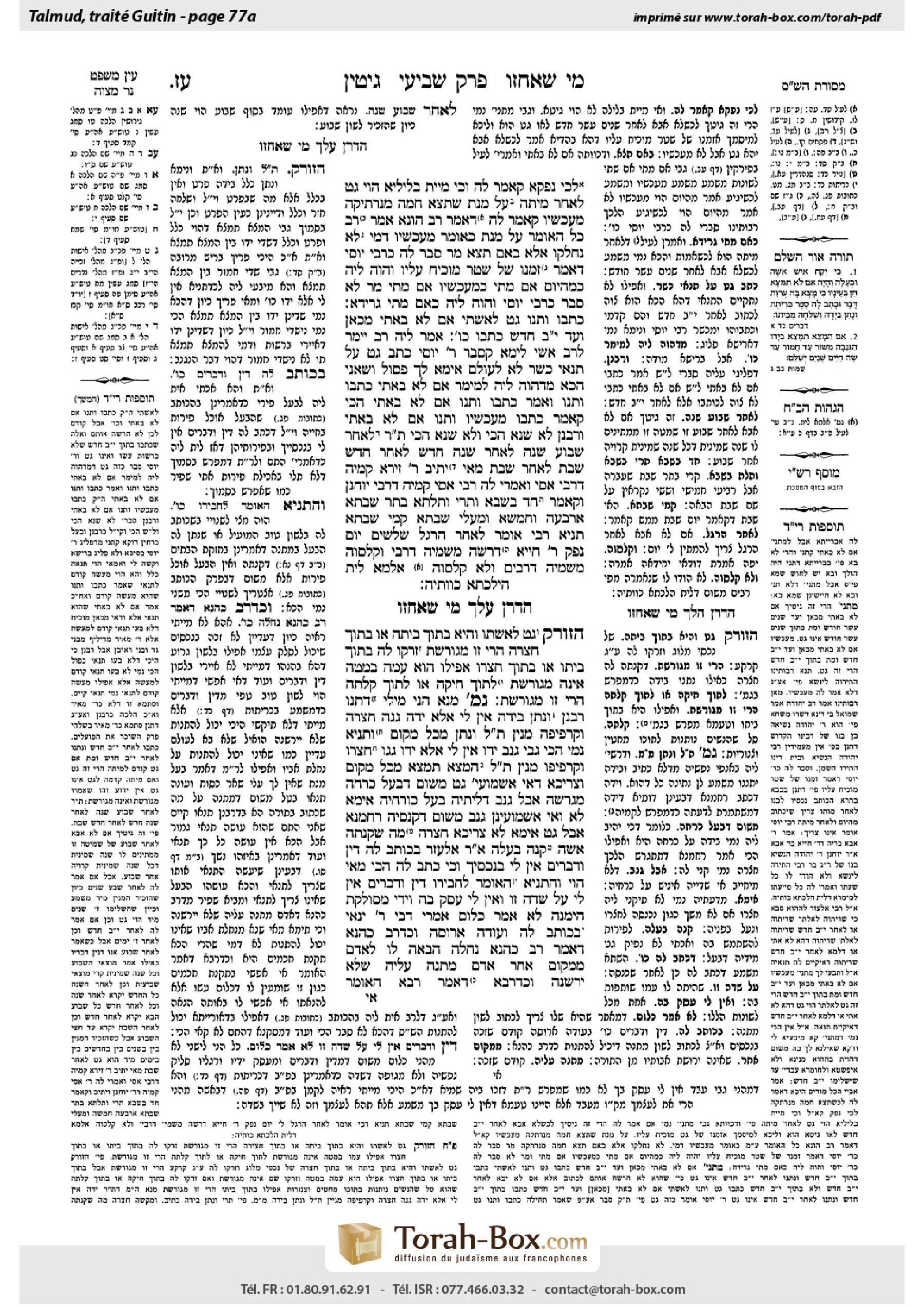
גיטין ע״ז א · Aramaic and Hebrew text
לְכִי נָפְקָא קָאָמַר לָהּ, וְכִי מָיֵית בְּלֵילְיָא – הָוֵי גֵּט לְאַחַר מִיתָה.
״עַל מְנָת שֶׁתֵּצֵא חַמָּה מִנַּרְתִּיקָהּ״ – מֵעַכְשָׁיו קָאָמַר לַהּ, דְּאָמַר רַב הוּנָא אָמַר רַב: כׇּל הָאוֹמֵר ״עַל מְנָת״ כְּאוֹמֵר ״מֵעַכְשָׁיו״ דָּמֵי.
לֹא נֶחְלְקוּ אֶלָּא בְּ״אִם תֵּצֵא״ – מָר סָבַר לַהּ כְּרַבִּי יוֹסֵי, דְּאָמַר: זְמַנּוֹ שֶׁל שְׁטָר מוֹכִיחַ עָלָיו, וְהָוֵה לֵיהּ כְּ״מֵהַיּוֹם אִם מַתִּי״, כְּ״מֵעַכְשָׁיו אִם מַתִּי״; מָר לָא סָבַר כְּרַבִּי יוֹסֵי, וְהָוֵה לֵיהּ כְּ״אִם מַתִּי״ גְּרֵידָא.
״כִּתְבוּ וּתְנוּ גֵּט לְאִשְׁתִּי, אִם לֹא בָּאתִי מִכָּאן וְעַד שְׁנֵים עָשָׂר חֹדֶשׁ״ – כָּתְבוּ כּוּ׳.
אֲמַר לֵיהּ רַב יֵימַר לְרַב אָשֵׁי: לֵימָא קָסָבַר רַבִּי יוֹסֵי כָּתַב גֵּט עַל תְּנַאי – כָּשֵׁר? לָא; לְעוֹלָם אֵימָא לָךְ פָּסוּל, וְשָׁאנֵי הָכָא – מִדַּהֲוָה לֵיהּ לְמֵימַר: ״אִם לֹא בָּאתִי כִּתְבוּ וּתְנוּ״; וְאָמַר: ״כִּתְבוּ וּתְנוּ אִם לֹא בָּאתִי״; הָכִי קָאָמַר: כִּתְבוּ מֵעַכְשָׁיו, וּתְנוּ אִם לֹא בָּאתִי. וְרַבָּנַן – לָא שְׁנָא הָכִי וְלָא שְׁנָא הָכִי.
תָּנוּ רַבָּנַן: ״לְאַחַר שָׁבוּעַ״ – שָׁנָה; ״לְאַחַר שָׁנָה״ – חֹדֶשׁ; ״לְאַחַר חֹדֶשׁ״ – שַׁבָּת.
״לְאַחַר שַׁבָּת״, מַאי? יָתֵיב רַבִּי זֵירָא קַמֵּיהּ דְּרַבִּי אַסִּי, וְאָמְרִי לַהּ רַבִּי אַסִּי קַמֵּיהּ דְּרַבִּי יוֹחָנָן, וְקָאָמַר: חַד בְּשַׁבָּא, וּתְרֵי, וּתְלָתָא – בָּתַר שַׁבְּתָא. אַרְבְּעָה, וְחַמְשָׁא וּמַעֲלֵי שַׁבְּתָא – קַמֵּי שַׁבְּתָא.
תַּנְיָא, רַבִּי אוֹמֵר: ״לְאַחַר הָרֶגֶל״ – שְׁלֹשִׁים יוֹם. נְפַק רַבִּי חִיָּיא דַּרְשַׁהּ מִשְּׁמֵיהּ דְּרַבִּי – וְקַלְּסוּהּ; מִשְּׁמֵיהּ דְּרַבִּים – וְלָא קַלְּסוּהּ; אַלְמָא לֵית הִילְכְתָא כְּווֹתֵיהּ.
הֲדַרַן עֲלָךְ מִי שֶׁאֲחָזוֹ
הַזּוֹרֵק גֵּט לְאִשְׁתּוֹ, וְהִיא בְּתוֹךְ בֵּיתָהּ אוֹ בְּתוֹךְ חֲצֵרָהּ – הֲרֵי זוֹ מְגוֹרֶשֶׁת. זְרָקוֹ לָהּ בְּתוֹךְ בֵּיתוֹ אוֹ בְּתוֹךְ חֲצֵרוֹ, אֲפִילּוּ הוּא עִמָּהּ בַּמִּטָּה – אֵינָהּ מְגוֹרֶשֶׁת. לְתוֹךְ חֵיקָהּ אוֹ לְתוֹךְ קַלְתָּהּ – הֲרֵי זוֹ מְגוֹרֶשֶׁת.
גְּמָ׳ מְנָא הָנֵי מִילֵּי? דְּתָנוּ רַבָּנַן: ״וְנָתַן בְּיָדָהּ״ – אֵין לִי אֶלָּא יָדָהּ; גַּגָּהּ, חֲצֵרָהּ וְקַרְפֵּיפָהּ – מִנַּיִן? תַּלְמוּד לוֹמַר: ״וְנָתַן״ – מִכׇּל מָקוֹם.
וְתַנְיָא נָמֵי הָכִי גַּבֵּי גַנָּב: ״יָדוֹ״ – אֵין לִי אֶלָּא יָדוֹ; גַּגּוֹ, חֲצֵרוֹ וְקַרְפֵּיפוֹ – מִנַּיִן? תַּלְמוּד לוֹמַר: ״הִמָּצֵא תִמָּצֵא״ – מִכׇּל מָקוֹם.
וּצְרִיכָא; דְּאִי אַשְׁמוֹעִינַן גֵּט – מִשּׁוּם דִּבְעַל כֻּרְחַהּ מִגָּרְשָׁה; אֲבָל גַּנָּב – דְּלֵיתֵיהּ בְּעַל כּוּרְחֵיהּ, אֵימָא לָא;
וְאִי אַשְׁמוֹעִינַן גַּנָּב – מִשּׁוּם דְּקַנְסֵיהּ רַחֲמָנָא; אֲבָל גֵּט – אֵימָא לָא, צְרִיכָא.
חֲצֵרָהּ?! מָה שֶׁקָּנְתָה אִשָּׁה קָנָה בַּעְלָהּ!
אָמַר רַבִּי אֶלְעָזָר, בְּכוֹתֵב לָהּ: ״דִּין וּדְבָרִים אֵין לִי בִּנְכָסַיִךְ״.
וְכִי כְּתַב לַהּ הָכִי – מַאי הָוֵי? וְהָתַנְיָא, הָאוֹמֵר לַחֲבֵירוֹ: ״דִּין וּדְבָרִים אֵין לִי עַל שָׂדֶה זוֹ״; וְ״אֵין לִי עֵסֶק בָּהּ״; וְ״יָדִי מְסוּלֶּקֶת הֵימֶנָּה״ – לֹא אָמַר כְּלוּם!
אָמְרִי דְּבֵי רַבִּי יַנַּאי: בְּכוֹתֵב לָהּ – וְעוֹדָהּ אֲרוּסָה, וְכִדְרַב כָּהֲנָא – דְּאָמַר רַב כָּהֲנָא: נַחֲלָה הַבָּאָה לוֹ לְאָדָם מִמָּקוֹם אַחֵר, אָדָם מַתְנֶה עָלֶיהָ שֶׁלֹּא יִרָשֶׁנָּה;
וְכִדְרָבָא – דְּאָמַר רָבָא, הָאוֹמֵר:
Gittin 77a · English translation
he is saying to her that it will be valid once the sun comes out in the morning. And if the husband dies during the night, before sunrise, then this will be a bill of divorce after his death and is therefore invalid.
But if he said to her: On the condition that the sun will emerge from its sheath, then he is saying to his wife that the bill of divorce will take effect retroactively from now once the sun emerges. As Rav Huna says that Rav says: Anyone who states a condition employing the language: On the condition, is like one who states: The agreement will take effect retroactively from now.
The tanna’im disagreed only in the case of one who said to his wife: This will be your bill of divorce if the sun emerges from its sheath, and the husband died during the night. One Sage, referred to as: Our Rabbis, holds in accordance with the opinion of Rabbi Yosei, who says that the date written in a document proves when it takes effect, and it is as if the husband said: From today if I die, or as if he said: From now if I die. And one Sage, the unattributed tanna of the mishna, does not hold in accordance with the opinion of Rabbi Yosei, and it is as if the husband said only: If I die, in which case the bill of divorce is not valid because it cannot take effect after the husband’s death.
§ The mishna states that if a husband says to others: Write and give a bill of divorce to my wife if I do not come back from now until the conclusion of twelve months, and they wrote it within the twelve months but gave it to her after twelve months, it is not a valid bill of divorce. Rabbi Yosei disagrees and says: It is a valid bill of divorce.
Rav Yeimar said to Rav Ashi: Shall we say that Rabbi Yosei holds that in general, if he wrote a bill of divorce on condition then it is valid, even if the condition was not fulfilled? Rav Ashi replied: No, actually I could say to you that according to Rabbi Yosei it is invalid if the condition is not fulfilled, and here it is different. Since he could have said: If I do not come back within twelve months, write and give the bill of divorce to my wife, which would emphasize that they may write the document only if he does not come; but instead he said: Write and give a bill of divorce if I do not come back, this is what the husband is saying: Write the bill of divorce from now, and give it to my wife if I do not come back within twelve months. And what do the Rabbis hold? They hold that it is no different whether the husband formulates his instructions like this and it is no different if the husband formulates his instructions like that. The court cannot differentiate based on the minor differences in the formulation.
§ Since the mishna discussed conditions dependent on time, the Gemara cites a baraita on a similar topic. The Sages taught: If the husband said to his wife: This is your bill of divorce if I do not come back after a seven-year Sabbatical cycle, the word after means that the bill of divorce is not valid until a full year after the conclusion of the seven-year cycle. If he said: This is your bill of divorce if I do not come back after one year, it is not valid until one month after the end of that year. If he said: This is your bill of divorce if I do not come back after one month, it is not valid until one week after the end of the month.
The Gemara clarifies other similar cases not mentioned in the baraita. If the husband said: This is your bill of divorce if I do not come back after a week, then what is the halakha? The Gemara answers: Rabbi Zeira sat before Rabbi Asi, and some say that it was Rabbi Asi who sat before Rabbi Yoḥanan, and he said the following: Sunday and Monday and Tuesday are called after Shabbat. Wednesday and Thursday and Friday are all called prior to Shabbat.
It is taught in a baraita that Rabbi Yehuda HaNasi says: If a man says: This is your bill of divorce if I do not come back after the pilgrimage Festival, then the document is valid only thirty days after the festival. Rabbi Ḥiyya went out and taught this halakha in public in the name of Rabbi Yehuda HaNasi, and they praised it. He then taught it in the name of the majority, as an unattributed opinion, and they did not praise it. Apparently, the halakha is not in accordance with this ruling. Consequently, the Sages did not praise Rabbi Ḥiyya when he taught it as if it were a majority ruling, as that would cause it to be accepted as halakha.
MISHNA: In a case of one who throws a bill of divorce to his wife, and she is in her house or in her courtyard at the time, then she is divorced as though he placed the bill of divorce in her hand. If he threw it to her in his house or in his courtyard, even if the bill of divorce is with her in the bed, she is not divorced. If he threw the bill of divorce into her lap, or into her basket [kaltah], she is divorced, even if she was in her husband’s house at the time.
GEMARA: From where are these matters derived? What is the basis for the halakha that when the husband throws the bill of divorce into his wife’s house or courtyard, the divorce takes effect? The Gemara answers: It is as the Sages taught: The verse states with regard to a bill of divorce: “And gives it in her hand” (Deuteronomy 24:1), from which I have derived that she is divorced only if he actually places it in her hand. But from where do I derive that she is divorced even if he places it on her roof, in her courtyard, or in her enclosure? The verse states: “And gives it,” indicating that she is divorced in any case, regardless of the manner in which he gives her the bill of divorce.
And that is also taught in a baraita with regard to a thief. It is written: “If the theft be found in his hand” (Exodus 22:3), from which I have derived that one is liable for theft only when the stolen item was found in his hand. But from where do I derive that one is liable for theft even if it was found on his roof, in his courtyard, or in his enclosure, i.e., if the item reached his domain and he secured it with the intent to steal it? The verse states: “If the theft be found,” indicating that he is liable in any case, whether it was found in his hand or in his domain.
The Gemara comments: And it is necessary to teach this halakha in both cases. As if the Torah had taught us only with regard to a bill of divorce, one could have said: Because a husband divorces his wife against her will, the divorce is effective regardless of how the husband places the document in her possession. But a thief, who is not accountable for theft that he performs against his will, say no, he is liable only when he actually steals the item with his hand, and not when it enters his domain by other means.
And if the Torah had taught us only with regard to a thief, one could have said: Because the Merciful One penalized the thief, obligating him to pay double the value of the item, it is clear that the Torah is strict with a thief. Similarly, the Torah also deemed him responsible for an item that was not actually in his hand. But with regard to a bill of divorce, say no, the divorce is not effective unless the husband places the document in her hand. Therefore, it is necessary to teach this halakha in both cases.
§ It was taught in the mishna that if the husband threw the bill of divorce into his wife’s courtyard, she is divorced. The Gemara asks: How can she own a courtyard of her own? There is a principle: That which a woman acquired is acquired by her husband, which indicates that the husband has the rights to all profits generated by his wife’s property. Therefore, for all intents and purposes, the courtyard belongs to him for the duration of their marriage.
Rabbi Elazar says: The mishna is referring to a case where the husband writes to his wife: I have no legal dealings or involvement in your property, thereby relinquishing any ownership rights to her property.
The Gemara asks: And when he writes this to her, what of it? But isn’t it taught in a baraita: One who says to another with whom he owns a field in a partnership: I have no rights and claims to this field, or: I have no involvement with it, or: My hand is removed from it; it is as though he said nothing, since these expressions are not considered to be a withdrawal of his rights to the field.
The Gemara answers: They say in the school of Rabbi Yannai: The case is one where he writes to her and she is still only betrothed; he has yet to obtain ownership of her property, being that his rights to his wife’s property are only actuated at the time of the marriage. And this is in accordance with the statement of Rav Kahana, as Rav Kahana says: With regard to an inheritance that comes to a person from another place, i.e., it is not an inheritance from his father, a person can stipulate about it from the outset that he should not inherit it, and this condition is effective in annulling his rights to the inheritance. This teaches that as long as the property has not yet entered his possession, he can withdraw his rights to it.
And this is in accordance with the statement of Rava, as Rava says: One who says:
Gittin 77a · Traduction française (IA)
il lui dit que cela sera valide une fois que le soleil sortira au matin. Et si l'époux meurt pendant la nuit, avant l'aube, alors cela sera un acte de divorce après sa mort et est donc invalide.
Mais s'il lui dit : sous la condition que le soleil sortira de son fourreau, alors il lui dit à sa femme que l'acte de divorce prendra effet rétroactivement dès maintenant une fois que le soleil sortira. Comme Rav Huna dit que Rav dit : celui qui formule une condition en utilisant la formule : sous la condition, est comme celui qui dit : l'accord prendra effet rétroactivement dès maintenant.
Les tannaïm ont seulement divergé dans le cas où l'homme disait à sa femme : cela sera ton acte de divorce si le soleil sort de son fourreau, et l'époux meurt pendant la nuit. Un sage, désigné comme : nos maîtres, suit l'opinion de Rabbi Yosei, qui dit que la date inscrite dans un document prouve quand il prend effet, et c'est comme si l'homme disait : à partir d'aujourd'hui si je meurs, ou comme s'il disait : à partir de maintenant si je meurs. Et un autre sage, le tanna non attribué de la mitsva, ne suit pas l'opinion de Rabbi Yosei, et c'est comme si l'homme disait seulement : si je meurs, dans ce cas l'acte de divorce n'est pas valide car il ne peut prendre effet après la mort de l'époux.
§ La mitsva stipule que si un époux dit à d'autres : écrivez et donnez un acte de divorce à ma femme si je ne reviens pas à partir de maintenant jusqu'à la fin de douze mois, et s'ils l'ont écrit pendant les douze mois mais l'ont donné à elle après douze mois, ce n'est pas un acte de divorce valide. Rabbi Yosei est d'avis contraire et dit : c'est un acte de divorce valide.
Rav Yeimar a dit à Rav Ashi : devons-nous dire que Rabbi Yosei considère que, en général, si l'homme a écrit un acte de divorce sous condition, il est valide même si la condition n'a pas été remplie ? Rav Ashi a répondu : Non, en réalité je pourrais te dire que selon Rabbi Yosei, c'est invalide si la condition n'est pas remplie, et ici c'est différent. Puisque l'homme aurait pu dire : si je ne reviens pas dans douze mois, écrivez et donnez l'acte de divorce à ma femme, ce qui soulignerait qu'ils peuvent écrire le document seulement s'il ne revient pas ; mais au lieu de cela, il a dit : écrivez et donnez un acte de divorce si je ne reviens pas, ce que l'homme dit : écrivez l'acte de divorce dès maintenant, et donnez-le à ma femme si je ne reviens pas dans douze mois. Et qu'en est-il selon les Rabbins ? Ils considèrent que cela n'est pas différent que l'homme formule ses instructions ainsi et que cela n'est pas différent si l'homme formule ses instructions ainsi. Le tribunal ne peut pas distinguer en fonction des différences mineures dans la formulation.
§ Puisque la mitsna a discuté des conditions dépendant du temps, la Guemara cite une baraïta sur un sujet similaire. Les Sages ont enseigné : si l'époux dit à sa femme : c'est ton acte de divorce si je ne reviens pas après un cycle de sept ans de sabbat, le mot « après » signifie que l'acte de divorce n'est pas valide jusqu'à une année complète après la fin du cycle de sept ans. Si il dit : c'est ton acte de divorce si je ne reviens pas après un an, il n'est pas valide jusqu'à un mois après la fin de cet an. Si il dit : c'est ton acte de divorce si je ne reviens pas après un mois, il n'est pas valide jusqu'à une semaine après la fin du mois.
La Guemara clarifie d'autres cas similaires non mentionnés dans la baraïta. Si l'époux dit : c'est ton acte de divorce si je ne reviens pas après une semaine, alors quelle est la halakha ? La Guemara répond : Rabbi Zeira s'est assis devant Rabbi Asi, et certains disent que c'était Rabbi Asi qui s'est assis devant Rabbi Yoḥanan, et il a dit ceci : dimanche, lundi et mardi sont appelés « après le shabbat ». Mercredi, jeudi et vendredi sont tous appelés « avant le shabbat ».
Il est enseigné dans une baraïta que Rabbi Yehuda HaNasi dit : si un homme dit : c'est ton acte de divorce si je ne reviens pas après la fête de pèlerinage, alors le document est valide seulement trente jours après la fête. Rabbi Ḥiyya est sorti et a enseigné cette halakha en public au nom de Rabbi Yehuda HaNasi, et ils l'ont loué. Il a ensuite enseigné cette halakha au nom de la majorité, comme une opinion non attribuée, et ils ne l'ont pas loué. Apparemment, la halakha n'est pas en conformité avec cette décision. Par conséquent, les Sages n'ont pas loué Rabbi Ḥiyya lorsqu'il l'enseignait comme si c'était une décision majoritaire, car cela aurait causé que cela soit accepté comme halakha.
MICHNA : Dans le cas d'un homme qui jette un acte de divorce à sa femme, et elle est dans sa maison ou dans son jardin à ce moment-là, alors elle est divorcée comme s'il avait mis l'acte de divorce dans sa main. Si il l'a jeté à elle dans sa maison ou dans son jardin, même si l'acte de divorce est avec elle dans le lit, elle n'est pas divorcée. Si il a jeté l'acte de divorce sur ses genoux, ou dans son panier [kaltah], elle est divorcée, même si elle était dans la maison de son mari à ce moment-là.
GUEMARA : D'où sont dérivés ces points ? Quelle est la base de la halakha selon laquelle lorsque l'époux jette l'acte de divorce dans la maison ou le jardin de sa femme, le divorce prend effet ? La Guemara répond : c'est comme les Sages ont enseigné : le verset dit concernant un acte de divorce : « Et il le donne en sa main » (Lévitique 24:1), d'où j'ai dérivé que elle est divorcée seulement si il l'a vraiment mise dans sa main. Mais d'où dérive-t-on que elle est divorcée même si il l'a mis sur son toit, dans son jardin ou dans son enclos ? Le verset dit : « Et il le donne », indiquant que elle est divorcée dans tous les cas, indépendamment du mode dont il lui donne l'acte de divorce.
Et cela est également enseigné dans une baraïta concernant un voleur. Il est écrit : « Si le vol est trouvé en sa main » (Exode 22:3), d'où je déduis que l'on est tenu responsable du vol uniquement lorsque l'objet volé a été trouvé en sa main. Mais d'où déduis-je que l'on est tenu responsable du vol même s'il a été trouvé sur son toit, dans son jardin ou dans son enclos, c'est-à-dire si l'objet a atteint son domaine et qu'il l'a sécurisé avec l'intention de le voler ? La versette dit : « Si le vol est trouvé », indiquant qu'il est tenu responsable dans tous les cas, que ce soit s'il a été trouvé en sa main ou dans son domaine.
Le Guemara commente : Il est nécessaire d'enseigner cette halakha dans les deux cas. Car si la Torah nous avait appris uniquement concernant un acte de divorce, on aurait pu dire : Puisque le mari divorce sa femme contre son gré, le divorce est efficace indépendamment de la manière dont le mari place le document en possession de sa femme. Mais un voleur, qui n'est pas responsable des vols qu'il commet contre son gré, dit non, il est tenu responsable uniquement lorsqu'il vole réellement l'objet avec sa main, et non lorsqu'il entre dans son domaine par d'autres moyens.
Et si la Torah nous avait appris uniquement concernant un voleur, on aurait pu dire : Puisque l'Éternel punit le voleur, l'obligeant à payer double la valeur de l'objet, il est clair que la Torah est sévère envers le voleur. De même, la Torah considère également responsable un objet qui n'était pas réellement en sa main. Mais concernant un acte de divorce, dit non, le divorce n'est pas efficace à moins que le mari place le document en sa main. Par conséquent, il est nécessaire d'enseigner cette halakha dans les deux cas.
§ Il est enseigné dans la Michna que si le mari jette le document de divorce dans le jardin de sa femme, elle est divorcée. La Guemara pose la question : Comment peut-elle posséder un jardin à elle seule ? Il y a un principe : Ce que la femme acquiert est acquis par son mari, ce qui indique que le mari a les droits sur tous les profits générés par la propriété de sa femme. Par conséquent, pour tous les effets, le jardin lui appartient durant leur mariage.
Rabbi Elazar dit : La Michna fait référence à un cas où le mari écrit à sa femme : Je n'ai aucun droit ou implication dans votre propriété, ce qui met fin à ses droits sur votre propriété.
Le Guemara pose la question : Et lorsqu'il écrit cela à elle, qu'y a-t-il de particulier ? Mais n'est-il pas enseigné dans une baraïta : Celui qui dit à un autre avec lequel il possède un champ en partage : Je n'ai aucun droit ou revendication sur ce champ, ou : Je n'ai aucune implication dans cela, ou : Ma main est retirée de cela ; cela équivaut à dire rien, puisque ces expressions ne sont pas considérées comme un retrait de ses droits sur le champ.
Le Guemara répond : Ils disent dans la maison de Rabbi Yannai : Le cas est celui où il écrit à elle et elle est encore seulement fiancée ; il n'a pas encore acquis la propriété de sa femme, puisque ses droits sur sa propriété ne sont actifs qu'au moment du mariage. Et cela est selon la déclaration de Rav Kahana, car Rav Kahana dit : Concernant une héritage qui vient à une personne d'un autre lieu, c'est-à-dire qui n'est pas une héritage de son père, une personne peut stipuler dès le début qu'il ne devrait pas hériter de cela, et cette condition annule ses droits sur l'héritage. Cela enseigne que tant que la propriété n'a pas encore entré en son possession, il peut retirer ses droits sur elle.
Et cela est selon la déclaration de Rava, car Rava dit : Celui qui dit :
Traduction française générée par IA à partir de l’édition anglaise de Sefaria. Vérifie toujours un passage avec le texte source.
Text from Sefaria: William Davidson Edition - Vocalized Aramaic (CC BY NC); William Davidson Edition - English (CC BY NC).