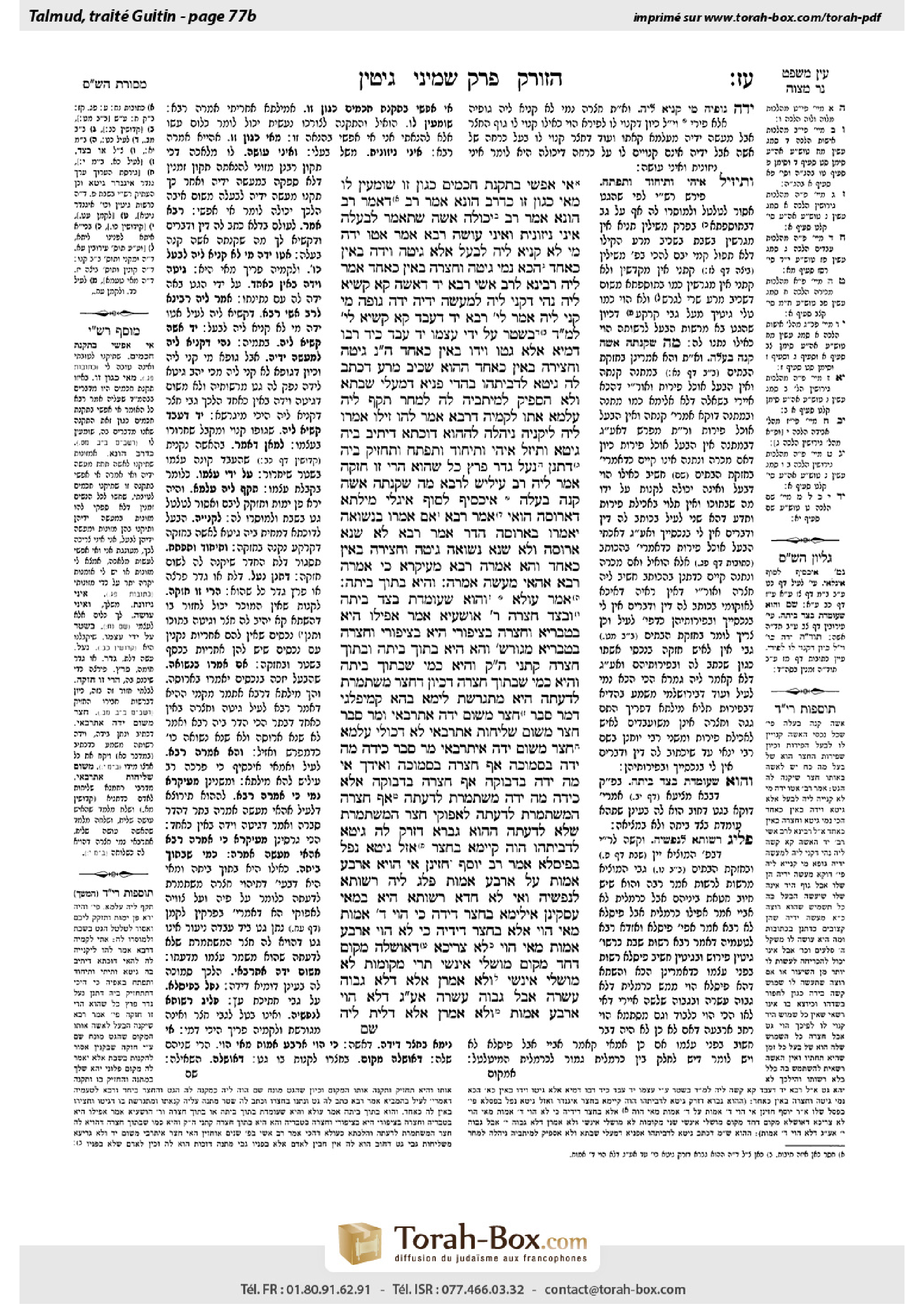
Gittin 77b: Talmud study for Daf Yomi
Study the Talmud for Daf Yomi with scanned pages, Hebrew text, English translations from Sefaria and AI-generated French translations.
Passage selection and English or AI-generated French translation are available where the scan has annotations. Daf Study is independent of Torah-Box and Sefaria.
Browse Gittin · גיטין · All tractatesGittin 77b text and translations
This page of Gittin includes the Aramaic text, an English translation and an AI-generated French translation, alongside the scan above.
גיטין ע״ז ב · Aramaic and Hebrew text
אִי אֶפְשִׁי בְּתַקָּנַת חֲכָמִים כְּגוֹן זוֹ – שׁוֹמְעִין לוֹ.
מַאי ״כְּגוֹן זוֹ״? כִּדְרַב הוּנָא אָמַר רַב – דְּאָמַר רַב הוּנָא אָמַר רַב: יְכוֹלָה אִשָּׁה שֶׁתֹּאמַר לְבַעְלָהּ: ״אֵינִי נִיזּוֹנֶית וְאֵינִי עוֹשָׂה״.
רָבָא אָמַר: אַטּוּ יָדָהּ מִי לָא קַנְיָא לֵיהּ לְבַעַל?! אֶלָּא גִּיטָּהּ וְיָדָהּ בָּאִין כְּאֶחָד; הָכָא נָמֵי – גִּיטָּהּ וַחֲצֵרָהּ בָּאִין כְּאֶחָד.
אֲמַר לֵיהּ רָבִינָא לְרַב אָשֵׁי: רָבָא – יָד דְּאִשָּׁה קָא קַשְׁיָא לֵיהּ?! נְהִי דְּקָנֵי לַהּ לְמַעֲשֵׂה יָדֶיהָ, יָדָהּ גּוּפַהּ מִי קַנְיָ[א] לֵיהּ?!
אֲמַר לֵיהּ: רָבָא – יַד הָעֶבֶד קָא קַשְׁיָא לֵיהּ; לְמַאן דְּאָמַר: בִּשְׁטָר – עַל יְדֵי עַצְמוֹ, יַד עֶבֶד כְּיַד רַבּוֹ דָּמְיָא! אֶלָּא גִּטּוֹ וְיָדוֹ בָּאִין כְּאֶחָד; הָכִי נָמֵי – גִּיטָּהּ וַחֲצֵירָהּ בָּאִין כְּאֶחָד.
הַהוּא שְׁכִיב מְרַע דִּכְתַב לַהּ גִּיטָּא לִדְבֵיתְהוּ בַּהֲדֵי פַּנְיָא דְּמַעֲלֵי שַׁבְּתָא, וְלֹא הִסְפִּיק לְמִיתְּבֵיהּ לַהּ. לִמְחַר, תְּקַף לֵיהּ עָלְמָא. אֲתוֹ לְקַמֵּיהּ דְּרָבָא, אֲמַר לְהוּ: זִילוּ אֱמַרוּ לֵיהּ, לַיקְנְיֵיהּ נִיהֲלַהּ לְהָהוּא דּוּכְתָּא דְּיָתֵיב בֵּיהּ גִּיטָּא, וְתֵיזִיל אִיהִי וְתֵיחוֹד וְתִפְתַּח וְתַחְזֵיק בֵּיהּ.
דִּתְנַן: נָעַל, גָּדַר, פָּרַץ כׇּל שֶׁהוּא – הֲרֵי זוֹ חֲזָקָה.
אֲמַר לֵיהּ רַב עִילִישׁ לְרָבָא: מָה שֶׁקָּנְתָה אִשָּׁה קָנָה בַּעְלָהּ! אִיכְּסִיף.
לְסוֹף אִיגַּלַּי מִילְּתָא דַּאֲרוּסָה הֲוַאי. אָמַר רָבָא: אִם אָמְרוּ בִּנְשׂוּאָה, יֹאמְרוּ בַּאֲרוּסָה?! הֲדַר אָמַר רָבָא: לָא שְׁנָא אֲרוּסָה וְלָא שְׁנָא נְשׂוּאָה – גִּיטָּהּ וַחֲצֵירָהּ בָּאִין כְּאֶחָד.
וְהָא אַמְרַהּ רָבָא מֵעִיקָּרָא! כִּי אַמְרַהּ רָבָא – אַהַאי מַעֲשֶׂה אַמְרַהּ.
וְהִיא בְּתוֹךְ בֵּיתָהּ. אָמַר עוּלָּא: וְהוּא שֶׁעוֹמֶדֶת בְּצַד בֵּיתָהּ וּבְצַד חֲצֵרָהּ. רַבִּי אוֹשַׁעְיָא אָמַר: אֲפִילּוּ הִיא בִּטְבֶרְיָא וַחֲצֵרָהּ בְּצִיפּוֹרִי; הִיא בְּצִיפּוֹרִי וַחֲצֵרָהּ בִּטְבֶרְיָא – מְגוֹרֶשֶׁת.
וְהָא ״הִיא בְּתוֹךְ בֵּיתָהּ וּבְתוֹךְ חֲצֵרָהּ״ קָתָנֵי! הָכִי קָאָמַר: ״וְהִיא כְּמִי שֶׁבְּתוֹךְ בֵּיתָהּ״; ״וְהִיא כְּמִי שֶׁבְּתוֹךְ חֲצֵרָהּ״ – דְּכֵיוָן דְּחָצֵר מִשְׁתַּמֶּרֶת לְדַעְתָּהּ הִיא, מִתְגָּרֶשֶׁת.
לֵימָא בְּהָא קָמִיפַּלְגִי – דְּמָר סָבַר: חָצֵר מִשּׁוּם יָדָהּ אִתְרַבַּאי; וּמָר סָבַר: חָצֵר מִשּׁוּם שְׁלִיחוּת אִתְרַבַּאי?
לָא; דְּכוּלֵּי עָלְמָא – חָצֵר מִשּׁוּם יָדָהּ אִיתְרְבַּאי; מָר סָבַר: כְּיָדָהּ – מָה יָדָהּ בִּסְמוּכָה, אַף חֲצֵרָהּ בִּסְמוּכָה.
וְאִידַּךְ – אִי, מָה יָדָהּ בִּדְבוּקָה, אַף חֲצֵרָהּ בִּדְבוּקָה?! אֶלָּא כְּיָדָהּ – מָה יָדָהּ מִשְׁתַּמֶּרֶת לְדַעְתָּהּ, אַף חֲצֵרָהּ הַמִּשְׁתַּמֶּרֶת לְדַעְתָּהּ; לְאַפּוֹקֵי חֲצֵרָהּ הַמִּשְׁתַּמֶּרֶת שֶׁלֹּא לְדַעְתָּהּ.
הָהוּא גַּבְרָא דִּזְרַק לַהּ גִּיטָּא לִדְבֵיתְהוּ. הֲוָה קָיְימָא בְּחָצֵר. אֲזַל גִּיטָּא, נְפַל בְּפִיסְלָא. אָמַר רַב יוֹסֵף: חָזֵינַן, אִי הָוְיָא אַרְבַּע אַמּוֹת עַל אַרְבַּע אַמּוֹת – פְּלַג לֵיהּ רְשׁוּתָא לְנַפְשֵׁיהּ; וְאִי לָא – חֲדָא רְשׁוּתָא הִיא.
בְּמַאי עָסְקִינַן? אִילֵימָא בְּחָצֵר דִּידַהּ, כִּי הָוֵי אַרְבַּע אַמּוֹת מַאי הָוֵי? אֶלָּא בְּחָצֵר דִּידֵיהּ, כִּי לָא הָוֵי אַרְבַּע אַמּוֹת מַאי הָוֵי?
לָא צְרִיכָא, דְּאוֹשְׁלַהּ מָקוֹם; דְּחַד מָקוֹם מוֹשְׁלִי אִינָשֵׁי, תְּרֵי מְקוֹמוֹת לָא מוֹשְׁלִי אִינָשֵׁי.
וְלָא אֲמַרַן אֶלָּא דְּלֹא גָּבוֹהַּ עֲשָׂרָה, אֲבָל גָּבוֹהַּ עֲשָׂרָה – אַף עַל גַּב דְּלָא הָוֵי אַרְבַּע אַמּוֹת.
וְלָא אֲמַרַן אֶלָּא דְּלֵית לֵיהּ
Gittin 77b · English translation
I do not want to avail myself of the ordinance of the Sages that was instituted on my behalf, such as in this scenario, we listen to him.
The Gemara asks: What is referred to by the words: Such as in this scenario? What case did Rava refer to that he indicated that in similar situations the halakha is the same? The Gemara explains that Rava was referring to that which Rav Huna says that Rav says. As Rav Huna says that Rav says: A woman can say to her husband: I do not wish to be sustained by you, and I will not do work for you. Although the Sages instituted on her behalf that she would be sustained in exchange for her work, she has the choice of waiving that right if she prefers to retain her earnings. Rava adds that in any similar case where the Sages instituted an ordinance for one’s benefit, he can say that he does not wish to accept this rabbinic ordinance if it does not assist him.
Rava said that one can resolve the question about the wife’s ability to acquire a bill of divorce in a courtyard in a more direct way: Is that to say that her hand is not acquired by her husband? Yet despite the fact that he owns her hand, she is divorced once she receives a bill of divorce in her hand. Rather, one must say that her bill of divorce and her hand, i.e., her complete ownership over her hand, enter her possession simultaneously. Since the bill of divorce releases her from her obligations to her husband, at that moment she acquires full rights to her hand. Here too, in the case of her courtyard, one can say that her bill of divorce and her courtyard enter her possession simultaneously, as her husband’s rights to her property are terminated at the time of divorce.
Ravina said to Rav Ashi: Was it difficult for Rava to understand the halakha that one can effect divorce by placing a bill of divorce in the hand of a woman? Why is this difficult? Though the rights to her earnings belong to the husband, does her hand itself belong to him? Therefore, since a woman owns her hand, she is divorced once she receives the bill of divorce in her hand; and it is not necessary to apply the principle that the bill of divorce and her hand enter her possession simultaneously. Therefore, there is no proof that the bill of divorce and her courtyard enter her possession simultaneously.
Rav Ashi said to him: It was difficult for Rava to understand the halakha that one can effect emancipation by placing a bill of manumission in the hand of a slave, as follows: According to the one who says that a slave can be emancipated with a bill of manumission by receiving the bill himself, one can ask: How is this effective? Isn’t the hand of a slave like the hand of his master, as the master owns the slave’s body? Therefore, when the master gives the bill of manumission to his slave, it is as though he gave it to himself, and the bill is never considered as having reached the slave’s domain. How can the slave be emancipated in this manner? Rather, one must say that his bill of manumission and his hand enter his possession simultaneously. So too, with regard to a woman’s courtyard, one can explain that her bill of divorce and her courtyard enter her possession simultaneously.
§ The Gemara relates that there was a certain person on his deathbed who wrote a bill of divorce for his wife toward the evening of the coming of the Shabbat, but he did not manage to give it to her. The next day his condition intensified and he was unable to give her the bill of divorce. People came before Rava to ask what they should do. He said to them: Go tell him to transfer to her ownership of that place where the bill of divorce is resting, and she should go and close the door and open it and assert ownership over it, thereby acquiring the place together with the bill of divorce that is in it.
As we learned in a mishna (Bava Batra 42a): If one locked, fenced in, or breached any amount, this is a valid act of taking possession through which land is acquired.
Rav Ilish said to Rava: How will it help for her to acquire the place, since that which a woman acquired is acquired by her husband? Rava was embarrassed that he issued an incorrect ruling.
Ultimately, it was revealed that she was a betrothed woman. Rava said: I ruled correctly, as even if they said with regard to a married woman that everything she acquires belongs to her husband, would they say the same with regard to a betrothed woman? A betrothed woman’s hand is not considered to be like the hand of her husband. Rava then said: There is no difference if she is a betrothed woman, and there is no difference if she is a married woman, as her bill of divorce and her courtyard enter her possession simultaneously.
The Gemara asks: But didn’t Rava already say this halakha, that her bill of divorce and her courtyard enter her possession simultaneously, at the outset? The Gemara answers: When Rava said this halakha, he said it in connection with this very incident.
§ It was taught in the mishna that if a husband throws his wife a bill of divorce and she is in her house, then she is divorced. Ulla says: This is only if she is standing next to her house and next to her courtyard, as only then will her house and courtyard acquire it for her. Rabbi Oshaya says: Even if she is in Tiberius and her courtyard is in Tzippori, or if she is in Tzippori and her courtyard is in Tiberius, she is divorced.
The Gemara challenges this: But isn’t it taught in the mishna that she is in her house and in her courtyard? The Gemara answers: This is what the mishna is saying: And she is considered to be like one who is in her house; and she is considered to be like one who is in her courtyard. This means that since it is a courtyard that is secured with her knowledge, it is as though she is there, and she is divorced.
The Gemara suggests: Let us say that they disagree about this issue: One Sage, Ulla, holds that a courtyard is included in the areas where she can obtain ownership of a bill of divorce as an extension of her hand. Consequently, it has the same halakhot as her hand, so that just as her hand is close to her, so too, her courtyard must be close to her in order for her to acquire the bill of divorce through it. And one Sage, Rabbi Oshaya, holds that a courtyard is included in the areas where she can obtain ownership of a bill of divorce as an extension of agency, and therefore, like an agent, her courtyard can acquire the bill of divorce for her when she is far away.
The Gemara rejects this: No, everyone agrees that a courtyard is included in the areas where she can obtain ownership of a bill of divorce as an extension of her hand. They disagree about how it is compared to her hand. One Sage, Ulla, holds that it is entirely like her hand. Just as her actual hand is next to her, so too, her courtyard, which is an extension of her hand, acquires the bill of divorce when it is next to her.
And the other Sage, Rabbi Oshaya, holds that if you derive matters in this way, you should say that just as her actual hand is attached to her, so too, her courtyard can acquire a bill of divorce only when it is attached to her, which cannot be. Rather, the comparison is as follows: Her courtyard is like her actual hand, and just as her hand is secured with her knowledge, so too, only her courtyard that is consciously secured by her can acquire a bill of divorce for her. This serves to exclude her courtyard that is not consciously secured by her, i.e., that she has no control over, which cannot acquire a bill of divorce for her, since it is not similar to her hand.
§ The Gemara relates that there was a certain man who threw a bill of divorce to his wife while she was standing in a courtyard. The bill of divorce went and fell onto a board of wood. Rav Yosef said: We see the precise circumstance: If the board encompassed an area of four cubits by four cubits, it thereby is considered to be a separate domain of its own and is not included in the courtyard within which she was standing, and she is consequently not divorced. And if the board was not that large, it is part of the courtyard and it is all one domain, and she is therefore divorced.
The Gemara clarifies: With what are we dealing here? If we say that the incident occurred in her courtyard, if the board had an area of four cubits, what of it? Since the board belongs to her as well, it should still be an effective divorce. Rather, say that the incident occurred in his courtyard; but then, even if the board did not have an area of four cubits, what of it? Since none of it belongs to her, why would it be an effective divorce?
The Gemara answers: No, it is necessary in a case where he lent her the place, i.e., the courtyard, as a means to acquire the bill of divorce. And since people lend one place, but people do not lend two places, if the board is considered to be a separate domain then it was not included in the courtyard that was lent to her, and it would therefore not be an effective divorce.
The Gemara notes: And we said that this is the halakha only in a case where the place onto which the bill of divorce fell was not ten handbreadths higher than the courtyard. But if the place onto which the bill of divorce fell was ten handbreadths higher, even though the board did not have an area of four cubits, it is still considered to be a separate domain.
And we said that this is the halakha only in a case where the place onto which the bill of divorce fell does not have
Gittin 77b · Traduction française (IA)
Je ne veux pas m'appuyer sur l'ordonnance des Sages instituée en mon nom, telle que dans ce cas-ci, nous écoutons celui-ci.
La Guemara demande : Quel cas est-il question ici ? Quel cas Rava a-t-il désigné pour indiquer que dans des situations similaires la halakha est la même ? La Guemara explique que Rava faisait référence à ce que Rav Huna rapporte que Rav dit. Comme Rav Huna rapporte que Rav dit : Une femme peut dire à son mari : Je ne veux pas être sustentée par toi, et je ne ferai pas de travail pour toi. Bien que les Sages aient institué en son nom qu'elle serait sustentée en échange de son travail, elle a le choix de renoncer à ce droit si elle préfère conserver ses revenus. Rava ajoute que dans tout cas similaire où les Sages ont institué une ordonnance en faveur d'une personne, il peut dire qu'il ne souhaite pas accepter cette ordonnance rabbinique s'il ne l'aide pas.
Rava dit qu'on peut résoudre la question concernant la capacité de la femme à acquérir un acte de divorce dans un jardin d'une manière plus directe : Est-ce que cela signifie que sa main n'est pas acquise par son mari ? Cependant, malgré le fait qu'il possède sa main, elle est divorcée une fois qu'elle reçoit un acte de divorce dans sa main. Plutôt, il faut dire que son acte de divorce et sa main, c'est-à-dire sa propriété totale sur sa main, entrent en son possession simultanément. Puisque l'acte de divorce la libère de ses obligations envers son mari, à ce moment-là elle acquiert pleinement ses droits sur sa main. De même, dans le cas de son jardin, on peut dire que son acte de divorce et son jardin entrent en son possession simultanément, car les droits du mari sur ses biens sont terminés au moment du divorce.
Ravina dit à Rav Ashi : Était-ce difficile pour Rava de comprendre la halakha selon laquelle on peut divorcer en plaçant un acte de divorce dans la main d'une femme ? Pourquoi est-ce difficile ? Bien que les droits sur ses revenus appartiennent au mari, sa main elle-même appartient-elle à lui ? Ainsi, puisque la femme possède sa main, elle est divorcée une fois qu'elle reçoit l'acte de divorce dans sa main ; il n'est pas nécessaire d'appliquer le principe selon lequel l'acte de divorce et sa main entrent en son possession simultanément. Par conséquent, il n'y a pas de preuve que l'acte de divorce et son jardin entrent en son possession simultanément.
Rav Ashi dit à lui : Était-ce difficile pour Rava de comprendre la halakha selon laquelle on peut libérer un esclave en plaçant un acte de manumission dans la main d'un esclave, comme suit : Selon celui qui dit qu'un esclave peut être libéré avec un acte de manumission en recevant lui-même l'acte, on peut demander : Comment cela fonctionne-t-il ? N'est-ce pas la main d'un esclave comme la main de son maître, puisque le maître possède le corps de l'esclave ? Ainsi, lorsque le maître donne l'acte de manumission à son esclave, cela revient à lui donner à lui-même, et l'acte n'est jamais considéré comme ayant atteint le domaine de l'esclave. Comment l'esclave peut-il être libéré ainsi ? Plutôt, il faut dire que son acte de manumission et sa main entrent en son possession simultanément. De même, concernant le jardin de la femme, on peut expliquer que son acte de divorce et son jardin entrent en son possession simultanément.
§ La Guemara relate que lorsqu'un certain homme était sur son lit de mort, il a écrit un acte de divorce pour sa femme vers le soir de la venue du Shabbat, mais il n'a pas réussi à le lui donner. Le lendemain, son état s'est aggravé et il n'a pas pu lui donner l'acte de divorce. Des gens sont venus devant Rava pour demander ce qu'ils devaient faire. Il a dit à eux : Allez lui dire de transférer à sa possession le lieu où l'acte de divorce est resté, et elle devrait aller fermer la porte et l'ouvrir et revendiquer la propriété, ce qui lui permettrait d'acquérir le lieu ainsi que l'acte de divorce qui y est.
Comme nous avons appris dans une michna (Bava Batra 42a) : Si l'on a verrouillé, clôturé ou percé une quantité, c'est une action valide d'acquérir la propriété par laquelle la terre est acquise.
Rav Ilish dit à Rava : Comment cela aidera-t-elle à acquérir le lieu, puisque ce que la femme acquiert est acquis par son mari ? Rava s'est senti honteux d'avoir donné un avis erroné.
Finalement, il a été révélé qu'elle était une femme fiancée. Rava a dit : J'ai jugé correctement, car même si l'on dit concernant une femme mariée que tout ce qu'elle acquiert appartient à son mari, serait-on dit la même chose concernant une femme fiancée ? La main d'une femme fiancée n'est pas considérée comme celle de son mari. Rava a ensuite dit : Il n'y a pas de différence si elle est une femme fiancée, et il n'y a pas de différence si elle est une femme mariée, car son acte de divorce et son jardin entrent en son possession simultanément.
La Guemara demande : Mais n'avait-il pas déjà dit cette halakha, que son acte de divorce et son jardin entrent en son possession simultanément, au début ? La Guemara répond : Lorsque Rava a dit cette halakha, il l'a dit en lien avec cet incident précis.
§ Il a été enseigné dans la michna que si un mari lance à sa femme un acte de divorce et qu'elle est chez elle, alors elle est divorcée. Ulla dit : Cela est vrai uniquement si elle est debout à côté de sa maison et à côté de son jardin, car seulement alors son maison et son jardin acquièrent cela pour elle. Rabbi Oshaya dit : Même si elle est à Tibériade et son jardin est à Tzippori, ou si elle est à Tzippori et son jardin est à Tibériade, elle est divorcée.
La Guemara remet en question cela : Mais n'est-ce pas enseigné dans la michna que elle est chez elle et dans son jardin ? La Guemara répond : C'est ce que la michna dit : Et elle est considérée comme celle qui est dans sa maison ; et elle est considérée comme celle qui est dans son jardin. Cela signifie que puisque c'est un jardin sécurisé avec son accord, c'est comme si elle y était, et elle est divorcée.
La Guemara suggère : Disons que les Sages s'opposent sur ce point : Un Sage, Ulla, affirme qu'un jardin est inclus dans les lieux où elle peut acquérir un divorce comme prolongement de sa main. Ainsi, il a les mêmes halakhot que sa main, de sorte que justement que sa main est proche d'elle, de même son jardin doit être proche d'elle afin qu'elle puisse acquérir le divorce par lui. Et un autre Sage, Rabbi Oshaya, affirme qu'un jardin est inclus dans les lieux où elle peut acquérir un divorce comme prolongement d'une délégation, et par conséquent, comme un agent, son jardin peut acquérir le divorce pour elle lorsqu'elle est éloignée.
La Guemara rejette cela : Non, tout le monde convient qu'un jardin est inclus dans les lieux où elle peut acquérir un divorce comme prolongement de sa main. Ils s'opposent sur la manière dont il est comparé à sa main. Un Sage, Ulla, affirme qu'il est entièrement comme sa main. Justement que sa main réelle est à côté d'elle, de même son jardin, qui est un prolongement de sa main, acquiert le divorce lorsqu'il est à côté d'elle.
Et l'autre Sage, Rabbi Oshaya, affirme que si on en déduit ainsi, on devrait dire que justement que sa main réelle est attachée à elle, de même son jardin peut acquérir un divorce seulement lorsqu'il est attaché à elle, ce qui n'est pas possible. Plutôt, la comparaison est la suivante : Son jardin est comme sa main réelle, et justement que sa main est sécurisée par son savoir, de même, seul son jardin qui est conscientement sécurisé par elle peut acquérir un divorce pour elle. Cela sert à exclure son jardin qui n'est pas conscientement sécurisé par elle, c'est-à-dire qu'elle n'a pas de contrôle sur lui, qui ne peut pas acquérir un divorce pour elle, car il n'est pas semblable à sa main.
§ La Guemara relate que lors d’un certain épisode, un homme lança un divorce à sa femme alors qu’elle était debout dans un jardin. Le divorce tomba sur une planche de bois. Rav Yosef dit : Nous voyons la situation précise : Si la planche couvrait une surface de quatre cubits par quatre cubits, elle est alors considérée comme un domaine distinct et n’est pas incluse dans le jardin où elle était debout, et elle n’est donc pas divorcée. Et si la planche n’avait pas cette taille, elle faisait partie du jardin et tout était un seul domaine, et elle était donc divorcée.
La Guemara précise : De quoi sommes-nous en train de parler ici ? Si nous disons que l’incident s’est produit dans son jardin, si la planche avait une surface de quatre cubits, qu’y a-t-il ? Puisque la planche appartient à elle aussi, elle devrait encore être un divorce efficace. Plutôt, disons que l’incident s’est produit dans son jardin ; mais alors, même si la planche n’avait pas cette taille, qu’y a-t-il ? Puisque rien de cela n’appartient à elle, pourquoi serait-ce un divorce efficace ?
La Guemara répond : Non, il est nécessaire qu’il s’agisse d’un cas où il lui a prêté la place, c’est-à-dire le jardin, comme moyen d’acquérir le divorce. Et puisque les gens prêtent une seule place, mais pas deux, si la planche est considérée comme un domaine distinct, elle n’était pas incluse dans le jardin que lui a prêté, et elle ne serait donc pas un divorce efficace.
La Guemara note : Et nous avons dit que c'est la halakha uniquement dans le cas où la place où le divorce est tombé n'était pas dix coudées plus haute que le jardin. Mais si la place où le divorce est tombé était dix coudées plus haute, même si la planche n'avait pas une surface de quatre cubits, elle est encore considérée comme un domaine distinct.
Et nous avons dit que c'est la halakha uniquement dans le cas où la place où le divorce est tombé ne possède pas
Traduction française générée par IA à partir de l’édition anglaise de Sefaria. Vérifie toujours un passage avec le texte source.
Text from Sefaria: William Davidson Edition - Vocalized Aramaic (CC BY NC); William Davidson Edition - English (CC BY NC).