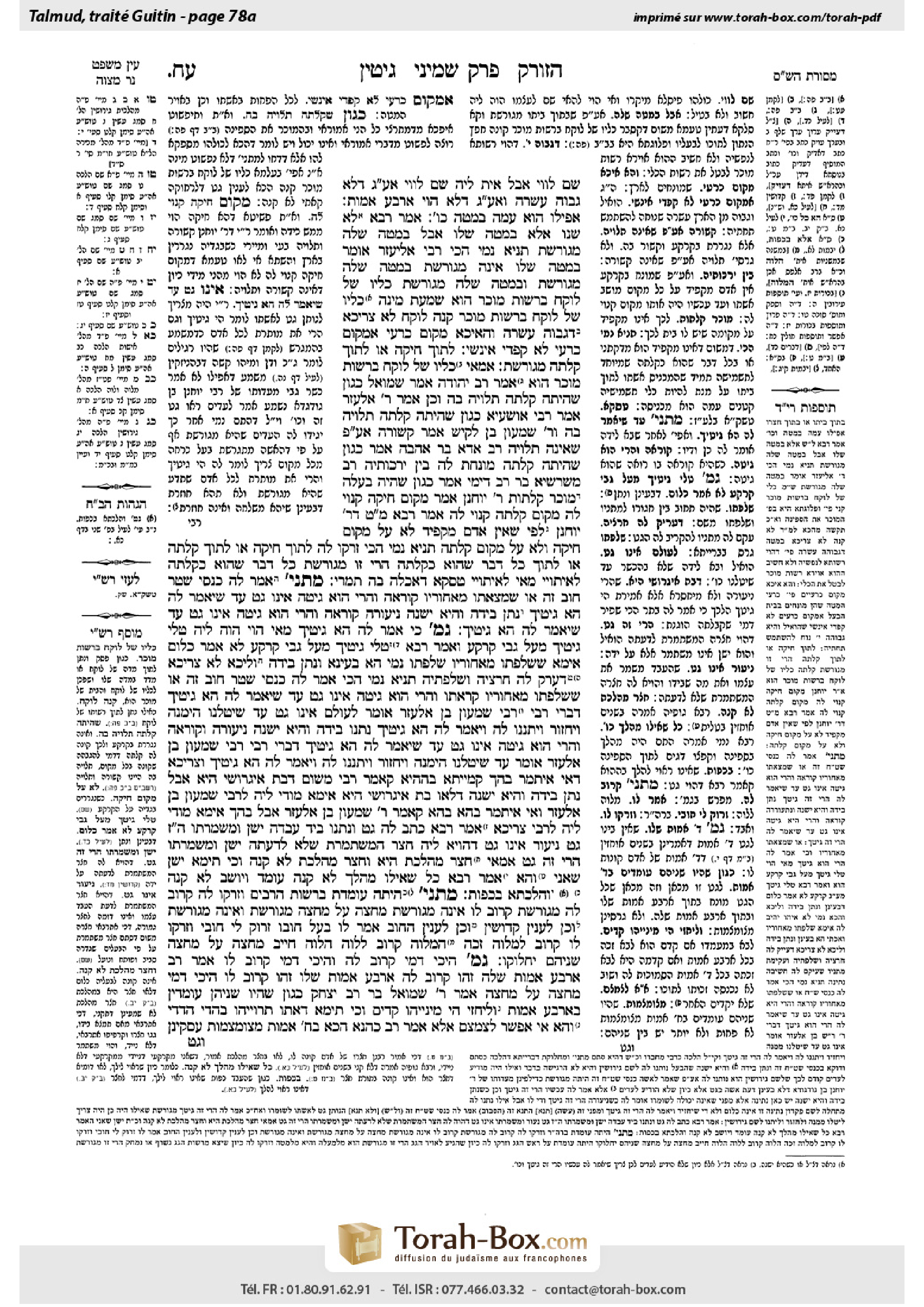
Gittin 78a: Talmud study for Daf Yomi
Study the Talmud for Daf Yomi with scanned pages, Hebrew text, English translations from Sefaria and AI-generated French translations.
Passage selection and English or AI-generated French translation are available where the scan has annotations. Daf Study is independent of Torah-Box and Sefaria.
Browse Gittin · גיטין · All tractatesGittin 78a text and translations
This page of Gittin includes the Aramaic text, an English translation and an AI-generated French translation, alongside the scan above.
גיטין ע״ח א · Aramaic and Hebrew text
שֵׁם לְוַוי, אֲבָל אִית לֵיהּ שֵׁם לְוַוי – אַף עַל גַּב דְּלֹא גָּבוֹהַּ עֲשָׂרָה, וְאַף עַל גַּב דְּלָא הָוֵי אַרְבַּע אַמּוֹת.
אֲפִילּוּ הוּא עִמָּהּ בַּמִּטָּה כּוּ׳: אָמַר רָבָא: לֹא שָׁנוּ אֶלָּא בְּמִטָּה שֶׁלּוֹ, אֲבָל בְּמִטָּה שֶׁלָּהּ – מְגוֹרֶשֶׁת.
תַּנְיָא נָמֵי הָכִי, רַבִּי אֱלִיעֶזֶר אוֹמֵר: בְּמִטָּה שֶׁלּוֹ – אֵינָהּ מְגוֹרֶשֶׁת, בְּמִטָּה שֶׁלָּהּ – מְגוֹרֶשֶׁת.
וּבְמִטָּה שֶׁלָּהּ – מְגוֹרֶשֶׁת? כִּלְיוֹ שֶׁל לוֹקֵחַ בִּרְשׁוּת מוֹכֵר הוּא; שָׁמְעַתְּ מִינַּהּ: כִּלְיוֹ שֶׁל לוֹקֵחַ בִּרְשׁוּת מוֹכֵר – קָנָה לוֹקֵחַ?
לָא צְרִיכָא, דְּגָבוֹהַּ עֲשָׂרָה. וְהָאִיכָּא מְקוֹם כַּרְעֵי! אַמְּקוֹם כַּרְעֵי לָא קָפְדִי אִינָשֵׁי.
לְתוֹךְ חֵיקָהּ אוֹ לְתוֹךְ קַלְתָּהּ – מְגוֹרֶשֶׁת: אַמַּאי? כִּלְיוֹ שֶׁל לוֹקֵחַ בִּרְשׁוּת מוֹכֵר הוּא!
אָמַר רַב יְהוּדָה אָמַר שְׁמוּאֵל: כְּגוֹן שֶׁהָיְתָה קַלְתָּהּ תְּלוּיָה בָּהּ. וְכֵן אָמַר רַבִּי אֶלְעָזָר אָמַר רַבִּי אוֹשַׁעְיָא: כְּגוֹן שֶׁהָיְתָה קַלְתָּהּ תְּלוּיָה בָּהּ. וְרַבִּי שִׁמְעוֹן בֶּן לָקִישׁ אָמַר: קְשׁוּרָה, אַף עַל פִּי שֶׁאֵינָהּ תְּלוּיָה.
רַב אַדָּא בַּר אַהֲבָה אָמַר: כְּגוֹן שֶׁהָיְתָה קַלְתָּהּ מוּנַּחַת לָהּ בֵּין יַרְכוֹתֶיהָ. רַב מְשַׁרְשְׁיָא בַּר רַב דִּימִי אָמַר: כְּגוֹן שֶׁהָיָה בַּעְלָהּ מוֹכֵר קְלָתוֹת.
רַבִּי יוֹחָנָן אָמַר: מְקוֹם חֵיקָהּ קָנוּי לָהּ, מְקוֹם קַלְתָּהּ קָנוּי לָהּ. אָמַר רָבָא: מַאי טַעְמָא דְּרַבִּי יוֹחָנָן? לְפִי שֶׁאֵין אָדָם מַקְפִּיד לֹא עַל מְקוֹם חֵיקָהּ וְלֹא עַל מְקוֹם קַלְתָּהּ.
תַּנְיָא נָמֵי הָכִי: זְרָקוֹ לָהּ לְתוֹךְ חֵיקָהּ אוֹ לְתוֹךְ קַלְתָּהּ, אוֹ לְתוֹךְ כׇּל דָּבָר שֶׁהוּא כְּקַלְתָּהּ – הֲרֵי זוֹ מְגוֹרֶשֶׁת.
״כׇּל דָּבָר שֶׁהוּא כְּקַלְתָּהּ״ – לְאֵיתוֹיֵי מַאי? לְאֵיתוֹיֵי טַסְקָא דְּאָכְלָה בַּהּ תַּמְרֵי.
מַתְנִי׳ אָמַר לָהּ: ״כִּנְסִי שְׁטַר חוֹב זֶה״, אוֹ שֶׁמְּצָאַתּוּ מֵאֲחוֹרָיו, קוֹרְאָה וַהֲרֵי הוּא גִּיטָּהּ – אֵינוֹ גֵּט, עַד שֶׁיֹּאמַר לַהּ: ״הֵא גִּיטִּיךְ״.
נָתַן בְּיָדָהּ וְהִיא יְשֵׁנָה; נֵיעוֹרָה, קוֹרְאָה, וַהֲרֵי הוּא גִּיטָּהּ – אֵינוֹ גֵּט, עַד שֶׁיֹּאמַר לָהּ ״הֵא גִּיטִּיךְ״.
גְּמָ׳ כִּי אָמַר לַהּ: ״הֵא גִּיטִּיךְ״ מַאי הָוֵי? הָוֵה לֵיהּ ״טְלִי גִּיטִּיךְ מֵעַל גַּבֵּי קַרְקַע״,
וְאָמַר רָבָא: ״טְלִי גִּיטִּיךְ מֵעַל גַּבֵּי קַרְקַע״ – לֹא אָמַר כְּלוּם! אֵימָא: שֶׁשְּׁלָפַתּוּ מֵאֲחוֹרָיו.
שְׁלָפַתּוּ נָמֵי, הָא בָּעֵינָא ״וְנָתַן בְּיָדָהּ״, וְלֵיכָּא! לָא צְרִיכָא, דַּעֲרַק לַהּ חַרְצֵיהּ, וּשְׁלַפְתֵּיהּ.
תַּנְיָא נָמֵי הָכִי: אָמַר לָהּ ״כִּנְסִי שְׁטַר חוֹב זֶה״, אוֹ שֶׁשְּׁלָפַתּוּ מֵאֲחוֹרָיו, קְרָאַתּוּ וַהֲרֵי הוּא גִּיטָּהּ – אֵינוֹ גֵּט, עַד שֶׁיֹּאמַר לָהּ ״הֵא גִּיטִּיךְ״, דִּבְרֵי רַבִּי. רַבִּי שִׁמְעוֹן בֶּן אֶלְעָזָר אוֹמֵר: לְעוֹלָם אֵינוֹ גֵּט, עַד שֶׁיִּטְּלֶנּוּ הֵימֶנָּה, וְיַחֲזוֹר וְיִתְּנֶנּוּ לָהּ, וְיֹאמַר לָהּ ״הֵא גִּיטִּיךְ״.
נְתָנוֹ בְּיָדָהּ וְהִיא יְשֵׁנָה, נֵיעוֹרָה וְקוֹרְאָה וַהֲרֵי הוּא גִּיטָּהּ – אֵינוֹ גֵּט, עַד שֶׁיֹּאמַר לָהּ: ״הֵא גִּיטִּיךְ״, דִּבְרֵי רַבִּי. רַבִּי שִׁמְעוֹן בֶּן אֶלְעָזָר אוֹמֵר: עַד שֶׁיִּטְּלֶנּוּ הֵימֶנָּה, וְיַחֲזוֹר וְיִתְּנֶנּוּ לָהּ, וְיֹאמַר לָהּ ״הֵא גִּיטִּיךְ״.
וּצְרִיכָא; דְּאִי אִיתְּמַר בְּהָךְ קַמַּיְיתָא, בְּהַהִיא קָאָמַר רַבִּי – מִשּׁוּם דְּבַת אִיגָּרוֹשֵׁי הִיא; אֲבָל נָתַן בְּיָדָהּ וְהִיא יְשֵׁנָה, דְּלָאו בַּת אִיגָּרוֹשֵׁי הִיא – אֵימָא מוֹדֵי לֵיהּ לְרַבִּי שִׁמְעוֹן בֶּן אֶלְעָזָר;
וְאִי אִיתְּמַר בְּהָא, בְּהָא קָאָמַר רַבִּי שִׁמְעוֹן בֶּן אֶלְעָזָר; אֲבָל בְּהָךְ – אֵימָא מוֹדֵי לֵיהּ לְרַבִּי; צְרִיכָא.
אָמַר רָבָא: כָּתַב לָהּ גֵּט, וּנְתָנוֹ בְּיַד עַבְדָּהּ יָשֵׁן, וּמְשַׁמַּרְתּוֹ – הֲרֵי זֶה גֵּט. נֵיעוֹר – אֵינוֹ גֵּט, דְּהָוְיָא לַיהּ חָצֵר הַמִּשְׁתַּמֶּרֶת שֶׁלֹּא לְדַעְתָּהּ.
יָשֵׁן וּמְשַׁמַּרְתּוֹ – הֲרֵי זֶה גֵּט. אַמַּאי? חָצֵר מְהַלֶּכֶת הִיא, וְחָצֵר מְהַלֶּכֶת לֹא קָנָה!
וְכִי תֵּימָא יָשֵׁן שָׁאנֵי, וְהָא אָמַר רָבָא: כׇּל שֶׁאִילּוּ מְהַלֵּךְ לֹא קָנָה, עוֹמֵד וְיוֹשֵׁב – לֹא קָנָה! וְהִלְכְתָא: בְּכָפוּת.
מַתְנִי׳ הָיְתָה עוֹמֶדֶת בִּרְשׁוּת הָרַבִּים וּזְרָקוֹ לָהּ; קָרוֹב לָהּ – מְגוֹרֶשֶׁת. קָרוֹב לוֹ – אֵינָהּ מְגוֹרֶשֶׁת. מֶחֱצָה עַל מֶחֱצָה – מְגוֹרֶשֶׁת וְאֵינָהּ מְגוֹרֶשֶׁת. וְכֵן לְעִנְיַן קִדּוּשִׁין.
וְכֵן לְעִנְיַן הַחוֹב, אָמַר לוֹ בַּעַל חוֹבוֹ: ״זְרוֹק לִי חוֹבִי״, וּזְרָקוֹ לוֹ; קָרוֹב לַמַּלְוֶה – זָכָה הַמַּלְוֶה. קָרוֹב לַלֹּוֶה – הַלֹּוֶה חַיָּיב. מֶחֱצָה עַל מֶחֱצָה – שְׁנֵיהֶם יַחְלוֹקוּ.
גְּמָ׳ הֵיכִי דָמֵי קָרוֹב לָהּ, וְהֵיכִי דָּמֵי קָרוֹב לוֹ? אָמַר רַב: אַרְבַּע אַמּוֹת שֶׁלָּהּ – זֶהוּ קָרוֹב לָהּ, אַרְבַּע אַמּוֹת שֶׁלּוֹ – זֶהוּ קָרוֹב לוֹ.
הֵיכִי דָּמֵי מֶחֱצָה עַל מֶחֱצָה? אָמַר רַבִּי שְׁמוּאֵל בַּר רַב יִצְחָק: כְּגוֹן שֶׁהָיוּ שְׁנֵיהֶן עוֹמְדִין בְּאַרְבַּע אַמּוֹת.
וְלִיחְזֵי הֵי מִינַּיְיהוּ קְדֵים! וְכִי תֵּימָא דַּאֲתוֹ תַּרְוַיְיהוּ בַּהֲדֵי הֲדָדֵי, וְהָא אִי אֶפְשָׁר לְצַמְצֵם!
אֶלָּא אָמַר רַב כָּהֲנָא: הָכָא בִּשְׁמוֹנֶה אַמּוֹת מְצוּמְצָמוֹת עָסְקִינַן,
Gittin 78a · English translation
a modifier, meaning that this board is not referred to by a unique name. But if it has a modifier, even though it is not ten handbreadths higher than the courtyard, and even though the board did not have an area of four cubits, it is still considered to be a separate domain, and it would therefore not be an effective divorce.
§ It was taught in the mishna that if he throws a bill of divorce to his wife while she is in his house, she is not divorced, even if the bill of divorce is with her in the bed, i.e., he throws it onto the bed in which she is sitting or lying. Rava says: They taught this only in a case where he throws the bill of divorce to her and it is with her in his bed. But if he throws the bill of divorce to her and it is with her in her bed, then she is divorced.
This is also taught in a baraita: Rabbi Eliezer says: If he throws the bill of divorce to her when she is in his bed, she is not divorced; if he throws it to her when she is in her bed, she is divorced.
The Gemara asks: And if he throws the bill of divorce to her in her bed, is she divorced? But the bed is like vessels of a buyer that are in the domain of the seller, since the bed that belongs to her is in the house of the husband. Can you conclude from here that even if the vessels of a buyer are in the domain of the seller, the buyer acquires anything that is deposited into his vessels? This issue is disputed elsewhere. Some hold that when a vessel of the buyer is in the domain of the seller, the vessel cannot serve to acquire an item on behalf of the buyer.
The Gemara answers: No, it is necessary to state this halakha in a case where the bed is ten handbreadths high, as then the bed is considered to be its own domain. The Gemara challenges this: But there is the place on which the legs of the bed are standing; the legs are standing in the husband’s domain. The Gemara answers: People are not particular about the place of the legs of the bed since it is so small. Therefore, since the bed is considered to be its own domain, it is not considered to be within the domain of the husband.
§ It was taught in the mishna that if the husband threw the bill of divorce into her lap, or into her basket, then she is divorced, even if she is in her husband’s house at that time. The Gemara asks: Why is she divorced? Is this not like a case of the vessels of a buyer that are in the domain of the seller, with regard to which there is a dispute concerning whether the vessels can serve to acquire an item on the buyer’s behalf?
Rav Yehuda says that Shmuel says: The mishna is referring to a case where her basket was hanging from her body, and therefore it is not considered to be within the domain of the husband. And so Rabbi Elazar says that Rabbi Oshaya says: The mishna is referring to a case where her basket was hanging from her body. And Rabbi Shimon ben Lakish says: If it was tied to her then that is enough, even though it is not hanging from her body.
Rav Adda bar Ahava says: The mishna is referring to a case where her basket was placed between her thighs and is therefore in the place where she is sitting, and since her husband is not particular about the place in which she is sitting, it is considered her domain. Rav Mesharshiyya bar Rav Dimi says: The mishna is referring to a case where her husband was a basket seller, and therefore is not particular about the place where the basket is since his whole courtyard is full of baskets, and it is therefore considered to be her domain.
Rabbi Yoḥanan says: There is no need for these explanations, since the place of her lap belongs to her, and the place of her basket belongs to her. Rava said: What is the reasoning of Rabbi Yoḥanan’s statement? Because a person is not particular, not about the place of his wife’s lap, nor about the place of her basket, it is as though he transferred ownership of the place to her for her use.
This is also taught in a baraita: If he threw the bill of divorce to her into her lap, or into her basket, or into anything that is like her basket, then she is divorced.
The Gemara analyzes the wording of the baraita: What is included by the expansive term: Anything that is like her basket? It serves to include the basket [taska] from which she eats dates, as he is not particular about its place as well.
MISHNA: If he said to his wife: Take this promissory note, and it was a bill of divorce, or she found it behind him and he did not tell her what it was but she reads what is written in it and discovers that it is her bill of divorce, it is not a valid bill of divorce until he says to her: This is your bill of divorce.
If he gave it to her in her hand and she was sleeping, and he then woke her, and when she reads what is written in it, she finds that it is her bill of divorce, it is not a valid bill of divorce until he says to her: This is your bill of divorce.
GEMARA: Apropos the mishna’s statement that if she found the bill of divorce behind him, it is not a valid bill of divorce until he says: This is your bill of divorce, the Gemara asks: And when he says to her: This is your bill of divorce, what of it? Why is it considered to be a valid bill of divorce if it was not given to her in the proper manner, being that it is as though he told her: Take your bill of divorce from where it is placed on the ground?
And Rava says that if one says to his wife: Take your bill of divorce from where it is placed on the ground, it is as though he didn’t say anything and it is not a valid bill of divorce, since a woman is divorced only when the bill of divorce is given to her by her husband. The Gemara answers: Say that the bill of divorce was not placed on the ground behind him, but rather she pulled it out from behind him. In other words, the bill of divorce was tucked into his belt and she pulled it out. Consequently, she received the bill of divorce from him.
The Gemara challenges this: If she pulled it out, it is also not a valid bill of divorce, since it is required that the directive: “And gives it in her hand” (Deuteronomy 24:1), be fulfilled, and in this case it is not fulfilled, since he did not give it to her; rather, she took it. The Gemara answers: No, it is necessary in a case where he bent [da’arak] his waist over toward her and she pulled it out, and by extending his waist to her, it is as though he gave the bill of divorce to her.
This is also taught in a baraita (Tosefta 8:1): If he said to his wife: Take this promissory note, or if she pulled it out from behind him, read it, and saw that it is her bill of divorce; it is not a valid bill of divorce until he says to her: This is your bill of divorce. This is the statement of Rabbi Yehuda HaNasi. Rabbi Shimon ben Elazar says: Actually, it is not a valid bill of divorce until he takes it from her and gives it to her again, and says to her: This is your bill of divorce.
The baraita continues: If he gave it to her in her hand, and she was sleeping, and he then woke her, and when she reads what is written in it, she finds that it is her bill of divorce; it is not a valid bill of divorce until he says to her: This is your bill of divorce. This is the statement of Rabbi Yehuda HaNasi. Rabbi Shimon ben Elazar says: It is not a valid bill of divorce until he takes it from her and gives it to her again, and says to her: This is your bill of divorce.
The Gemara notes: And it is necessary to mention this dispute in both cases. As if this dispute would have been stated only with regard to the cases in the first clause, one could assume that Rabbi Yehuda HaNasi is saying his opinion specifically with regard to the cases in this clause, because she is subject to being divorced, since she is awake and able to receive a bill of divorce, even though he did not tell her that this is a bill of divorce. But if he gave it to her in her hand and she was sleeping, she is not subject to being divorced since while she is sleeping she is a person who lacks the halakhic competence required to receive a bill of divorce. Therefore, one could say that Rabbi Yehuda HaNasi concedes to Rabbi Shimon ben Elazar that giving the bill of divorce while she was sleeping is totally not valid. It was therefore necessary to mention that Rabbi Yehuda HaNasi disagrees in this case, as well.
And if this dispute would have been stated only with regard to this case, where she was sleeping, one could assume that specifically with regard to this case Rabbi Shimon ben Elazar is saying that he must give her the bill of divorce a second time. But in the other case, in which she was awake, one could say that he concedes to Rabbi Yehuda HaNasi. Therefore, it is necessary to mention this dispute in both cases.
Rava says: If he wrote a bill of divorce for her, and he placed it in the hand of her slave when he is sleeping and she is guarding him, it is a valid bill of divorce. Within the context of the halakhot of divorce, a slave has the same status as land, in the sense that both belong to their owner. Therefore, when the husband places the bill of divorce in the slave’s hand, it is as though he placed it into her courtyard. If her slave was awake, it is not a valid bill of divorce because he is like a courtyard that is not consciously secured by her. Since he guards himself, he therefore does not acquire it on her behalf.
Rava continues: If he is sleeping and she is guarding him, it is a valid bill of divorce. The Gemara asks: But why; isn’t it true that the slave is like a mobile courtyard, and a mobile courtyard does not acquire items on behalf of its owner?
And if you would say that a case in which he is sleeping is different because he is currently not moving, but didn’t Rava say: In any case in which if he would be moving he would not acquire items, then even if he is standing or sitting, he also does not acquire items? The Gemara concludes: And this halakha that Rava said, indicating that it is a valid bill of divorce, applies only where the slave is bound and sleeping, since in that case placing the bill of divorce in his hand is like placing it in her hand.
MISHNA: If the woman was standing in the public domain and her husband took the bill of divorce and threw it to her, if it fell closer to her, she is divorced, and if it fell closer to him, she is not divorced. If it is equally balanced, there is uncertainty as to whether she is divorced or whether she is not divorced. And the same halakhot apply with regard to betrothal.
And the same halakhot apply with regard to a debt. If his creditor said to him: Throw the payment for my debt to me, and he threw it to him and the money fell closer to the creditor, the creditor acquired the payment. The debtor is absolved of his obligation to pay even if the money did not reach the creditor’s hand, e.g., it was stolen or lost after it was thrown and before the creditor was able to take it. If it fell closer to the debtor and the money was lost, the debtor is still obligated to pay. If it was equally balanced and was lost, the two of them divide it, i.e., the debtor owes half of the amount.
GEMARA: The Gemara clarifies that which was taught in the mishna: What is considered closer to her, and what is considered closer to him? Rav says: If it fell within four cubits of her, this is what was meant by the mishna’s statement: Closer to her; if it fell within four cubits of him, this is what was meant by: Closer to him.
The Gemara asks: What is considered midway? Rabbi Shmuel bar Rav Yitzḥak says: Such as when the two of them were standing within the same four cubits.
The Gemara asks: And let us see which of them preceded the other into these four cubits, and the four cubits would then be considered as belonging to that person. And if you would say that both of them came simultaneously, but isn’t there a principle that it is impossible to be so precise? It is not possible that both events occurred at exactly the same time, and it is certain that one of them arrived there before the other.
Rather, Rav Kahana said: Here we are dealing with a case of precisely eight cubits, where his four cubits are adjacent to her four cubits,
Gittin 78a · Traduction française (IA)
un modificateur, ce qui signifie que ce plateau n'est pas désigné par un nom unique. Mais si ce plateau a un modificateur, même s'il n'est pas dix coudées plus haut que la cour, et même s'il n'avait pas une surface de quatre coudées, il est considéré comme un domaine distinct et ne serait donc pas un divorce efficace.
§ Il a été enseigné dans la mitsna que si l'on jette un acte de divorce à sa femme pendant qu'elle est dans sa maison, elle n'est pas divorcée, même si l'acte de divorce est avec elle dans le lit, c'est-à-dire qu'on le jette sur le lit où elle est assise ou allongée. Rava dit : Ils ont enseigné cela uniquement dans le cas où l'on jette l'acte de divorce à elle et qu'il est avec elle dans son lit. Mais si l'on jette l'acte de divorce à elle et qu'il est avec elle dans son lit, alors elle est divorcée.
Cela est également enseigné dans une baraïta : Rabbi Eliezer dit : Si l'on jette l'acte de divorce à elle pendant qu'elle est dans son lit, elle n'est pas divorcée ; si l'on jette l'acte de divorce à elle pendant qu'elle est dans son lit, elle est divorcée.
La Guemara pose la question : Et si l'on jette l'acte de divorce à elle dans son lit, est-ce qu'elle est divorcée ? Mais le lit est comme les objets d'un acheteur qui sont dans le domaine du vendeur, puisque le lit qui appartient à elle est dans la maison du mari. Peut-on en conclure ici que même si les objets d'un acheteur sont dans le domaine du vendeur, l'acheteur acquiert tout ce qui est déposé dans ses objets ? Cette question est débattue ailleurs. Certains pensent que lorsque les objets d'un acheteur sont dans le domaine du vendeur, ces objets ne peuvent pas servir à acquérir un objet à l'égard de l'acheteur.
La Guemara répond : Non, il est nécessaire d'énoncer cette halakha dans un cas où le lit est dix coudées haut, car alors le lit est considéré comme un domaine propre. La Guemara conteste cela : Mais il y a la place où les pieds du lit sont posés ; les pieds sont posés dans le domaine du mari. La Guemara répond : Les gens ne sont pas particuliers sur la place des pieds du lit, car elle est très petite. Par conséquent, puisque le lit est considéré comme un domaine propre, il n'est pas considéré comme étant dans le domaine du mari.
§ Il a été enseigné dans la Michna que si le mari jette l'acte de divorce dans son coude ou dans son panier, alors elle est divorcée, même si elle est dans la maison de son mari à ce moment-là. La Guemara pose la question : Pourquoi est-elle divorcée ? Ce n'est-ce pas comme un cas des objets d'un acheteur qui sont dans le domaine du vendeur, concernant lequel il y a un débat sur le fait que les objets puissent servir à acquérir un objet à l'égard de l'acheteur ?
Rav Yehuda dit que Shmuel dit : La mitsva fait référence à un cas où son panier était suspendu à son corps, et par conséquent il n'est pas considéré comme étant dans le domaine du mari. Et ainsi Rabbi Elazar dit que Rabbi Oshaya dit : La mitsva fait référence à un cas où son panier était suspendu à son corps. Et Rabbi Shimon ben Lakish dit : Si c'était attaché à elle, cela suffit, même s'il n'est pas suspendu à son corps.
Rav Adda bar Ahava dit : La mitsva fait référence à un cas où son panier était placé entre ses jambes et est donc dans la place où elle est assise, et puisque son mari n'est pas particulier sur la place où elle est assise, il est considéré comme son domaine. Rav Mesharshiyya bar Rav Dimi dit : La mitsva fait référence à un cas où son mari était un vendeur de paniers, et par conséquent n'est pas particulier sur la place où le panier est, puisque son cour est plein de paniers, et il est donc considéré comme son domaine.
Rabbi Yoḥanan dit : Il n'y a pas besoin d'expliquer cela, puisque la place de son coude appartient à elle, et la place de son panier appartient à elle. Rava dit : Quel est le raisonnement de l'affirmation de Rabbi Yoḥanan ? Parce qu'une personne n'est pas particulier, ni sur la place de son épouse, ni sur la place de son panier, c'est comme s'il avait transféré la propriété de la place à elle pour son usage.
Cela est également enseigné dans une baraïta : Si l'on jette l'acte de divorce à elle dans ses bras, ou dans son panier, ou dans n'importe quoi qui est comme son panier, alors elle est divorcée.
La Guemara analyse la formulation de la baraïta : Quel est l'objet de l'expression expansive : n'importe quoi qui est comme son panier ? Il sert à inclure le panier [taska] d'où elle mange des dattes, puisqu'il n'est pas exigeant quant à sa place non plus.
MICHNA : Si il a dit à sa femme : Prends ce billet de créance, et si c'était un acte de divorce, ou si elle l'a trouvé derrière lui et qu'il ne lui a pas dit ce que c'était mais qu'elle a lu ce qui est écrit dedans et découvert que c'était son acte de divorce, ce n'est pas un acte de divorce valide jusqu'à ce qu'il dise à elle : C'est ton acte de divorce.
Si lui l'a donné dans sa main et qu'elle était endormie, et qu'il l'a ensuite réveillée, et quand elle a lu ce qui était écrit dedans, elle a découvert que c'était son acte de divorce, ce n'est pas un acte de divorce valide jusqu'à ce qu'il dise à elle : C'est ton acte de divorce.
GUEMARA : A propos de l'affirmation de la Michna que si elle a trouvé l'acte de divorce derrière lui, ce n'est pas un acte de divorce valide jusqu'à ce qu'il dise à elle : C'est ton acte de divorce, la Guemara pose la question : Et quand il dit à elle : C'est ton acte de divorce, qu'est-ce que cela change ? Pourquoi est-ce considéré comme un acte de divorce valide si il n'a pas été donné à elle de la manière appropriée, étant donné qu'il est comme s'il lui disait : Prends ton acte de divorce là où il est posé sur le sol ?
Et Ravâ dit que si l'on dit à sa femme : Prends ton acte de divorce de là où il est posé par terre, c'est comme s'il n'avait rien dit et que ce n'est pas un acte de divorce valide, car une femme est divorcée seulement lorsque l'acte de divorce lui est donné par son mari. La Guemara répond : Dis que l'acte de divorce n'était pas posé par terre derrière lui, mais qu'elle l'avait tiré de derrière lui. En d'autres termes, l'acte de divorce était glissé dans sa ceinture et elle l'avait tiré. Ainsi, elle a reçu l'acte de divorce de lui.
La Guemara conteste cela : Si elle l'a tiré, c'est aussi un acte de divorce invalide, car il faut que la directive : « Et il le donne en sa main » (Lévitique 24:1), soit accomplie, et dans ce cas-ci, elle n'est pas accomplie, car il ne lui a pas donné l'acte de divorce ; plutôt, elle l'a pris. La Guemara répond : Non, il est nécessaire dans le cas où il a penché son ventre vers elle et qu'elle l'a tiré, et en étendant son ventre vers elle, cela équivaut à ce qu'il lui donne l'acte de divorce.
Cela est également enseigné dans une baraïta (Tosefta 8:1) : Si il dit à sa femme : Prends cette note de promesse, ou si elle l'a tirée de derrière lui, lis-la et a vu qu'il s'agit de son acte de divorce ; ce n'est pas un acte de divorce valide jusqu'à ce qu'il dise à elle : C'est ton acte de divorce. C'est la déclaration de Rabbi Yéhouda Hanassi. Rabbi Shimon ben Elazar dit : En réalité, ce n'est pas un acte de divorce valide jusqu'à ce qu'il le lui prenne et le lui redonne, et qu'il dise à elle : C'est ton acte de divorce.
La baraïta continue : Si on lui donne l'acte de divorce en sa main, et qu'elle dorme, et qu'on la réveille ensuite, et qu'après qu'elle lise ce qui est écrit dedans, elle découvre qu'il s'agit de son acte de divorce ; ce n'est pas un acte de divorce valide jusqu'à ce qu'on dise à elle : C'est ton acte de divorce. C'est la déclaration de Rabbi Yéhouda Hanassi. Rabbi Shimon ben Elazar dit : Ce n'est pas un acte de divorce valide jusqu'à ce qu'on le lui prenne et qu'on le lui redonne, et qu'on dise à elle : C'est ton acte de divorce.
La Guemara note : Il est nécessaire de mentionner ce débat dans les deux cas. Comme si ce débat avait été énoncé uniquement concernant les cas du premier verset, on pourrait penser que Rabbi Yéhouda Hanassi exprime son opinion spécifiquement concernant les cas de ce verset, car elle est soumise au divorce, car elle est éveillée et capable de recevoir un acte de divorce, même s'il ne lui a pas dit que c'est un acte de divorce. Mais si on lui donne l'acte de divorce en sa main et qu'elle dorme, elle n'est pas soumise au divorce, car pendant qu'elle dort, elle est une personne qui manque de la compétence halakhique requise pour recevoir un acte de divorce. On pourrait donc dire que Rabbi Yéhouda Hanassi concède à Rabbi Shimon ben Elazar que donner l'acte de divorce pendant qu'elle dormait est totalement invalide. Il fallait donc mentionner que Rabbi Yéhouda Hanassi s'y oppose également dans ce cas.
Et si ce débat avait été énoncé uniquement concernant ce cas, où elle dormait, on pourrait penser que spécifiquement concernant ce cas Rabbi Shimon ben Elazar dit qu'il faut lui donner l'acte de divorce une deuxième fois. Mais dans l'autre cas, où elle était éveillée, on pourrait dire qu'il concède à Rabbi Yéhouda Hanassi. Il fallait donc mentionner ce débat dans les deux cas.
Ravâ dit : Si on a écrit un acte de divorce pour elle, et qu'on l'a placé dans la main de son serviteur quand il dort et qu'elle le surveille, c'est un acte de divorce valide. Dans le contexte des halakhot du divorce, un serviteur a le même statut qu'une terre, au sens où les deux appartiennent à leur propriétaire. Ainsi, lorsque le mari place l'acte de divorce dans la main du serviteur, cela équivaut à le placer dans son cour d'habitation. Si le serviteur était éveillé, ce n'est pas un acte de divorce valide, car il est comme un cour qui n'est pas délibérément sécurisé par elle. Puisqu'il surveille lui-même, il ne l'acquiert donc pas à sa place.
Ravâ continue : Si il dort et qu'elle le surveille, c'est un acte de divorce valide. La Guemara demande : Mais pourquoi ? N'est-ce pas vrai que le serviteur est comme un cour mobile, et un cour mobile ne peut pas acquérir des objets à la place de son propriétaire ?
Et si vous dites que le cas où il dort est différent parce qu'il ne bouge pas actuellement, mais n'a-t-il pas dit Ravâ : Dans tout cas où si il bougeait il ne pourrait pas acquérir des objets, même s'il est debout ou assis, il ne peut pas non plus acquérir des objets ? La Guemara conclut : Et cette halakha que Ravâ a dite, indiquant qu'il s'agit d'un acte de divorce valide, s'applique uniquement dans le cas où le serviteur est lié et dort, car dans ce cas, placer l'acte de divorce dans sa main équivaut à le placer dans sa main.
MICHNA : Si la femme était debout dans le domaine public et son mari a pris l'acte de divorce et l'a lancé vers elle, si celui-ci est tombé plus près d'elle, elle est divorcée, et si celui-ci est tombé plus près de lui, elle n'est pas divorcée. Si celui-ci est équilibré, il y a incertitude quant à savoir si elle est divorcée ou non. Et les mêmes halakhot s'appliquent concernant le betrothal.
Et les mêmes halakhot s'appliquent concernant une dette. Si son créancier lui a dit : Jette le paiement de ma dette à moi, et s'il l'a jeté à lui et que l'argent est tombé plus près du créancier, le créancier acquiert le paiement. Le débiteur est exempté de son obligation de payer même si l'argent n'a pas atteint la main du créancier, par exemple s'il a été volé ou perdu après qu'il ait été jeté et avant que le créancier ne puisse le prendre. Si l'argent est tombé plus près du débiteur et qu'il a été perdu, le débiteur reste obligé de payer. Si l'argent était équilibré et a été perdu, les deux divisent, c'est-à-dire que le débiteur doit la moitié de la somme.
GUEMARA : La Guemara clarifie ce qui a été enseigné dans la michna : Qu'est-ce qui est considéré comme plus proche d'elle et qu'est-ce qui est considéré comme plus proche de lui ? Rav dit : Si l'argent est tombé à moins de quatre coudées d'elle, c'est ce que la michna entendait par : plus proche d'elle ; si l'argent est tombé à moins de quatre coudées de lui, c'est ce que la michna entendait par : plus proche de lui.
La Guemara pose la question : Qu'est-ce qui est considéré comme étant au milieu ? Rabbi Shmuel bar Rav Yitzḥak dit : Comme lorsque les deux d'entre eux étaient debout dans les mêmes quatre cubits.
La Guemara pose la question : Et voyons qui des deux a pénétré en premier dans ces quatre cubits, et alors ces quatre cubits seraient considérés comme appartenant à cette personne. Et si l'on disait que les deux sont entrés en même temps, mais n'y a-t-il pas un principe selon lequel cela n'est pas possible ? Il est impossible que deux événements aient eu lieu exactement en même temps, et il est certain que l'un d'eux a été précédé par l'autre.
Plutôt, Rav Kahana dit : Ici nous sommes en présence d'un cas de huit cubits précisément, où ses quatre cubits sont adjacents à ceux de l'autre.
Traduction française générée par IA à partir de l’édition anglaise de Sefaria. Vérifie toujours un passage avec le texte source.
Text from Sefaria: William Davidson Edition - Vocalized Aramaic (CC BY NC); William Davidson Edition - English (CC BY NC).