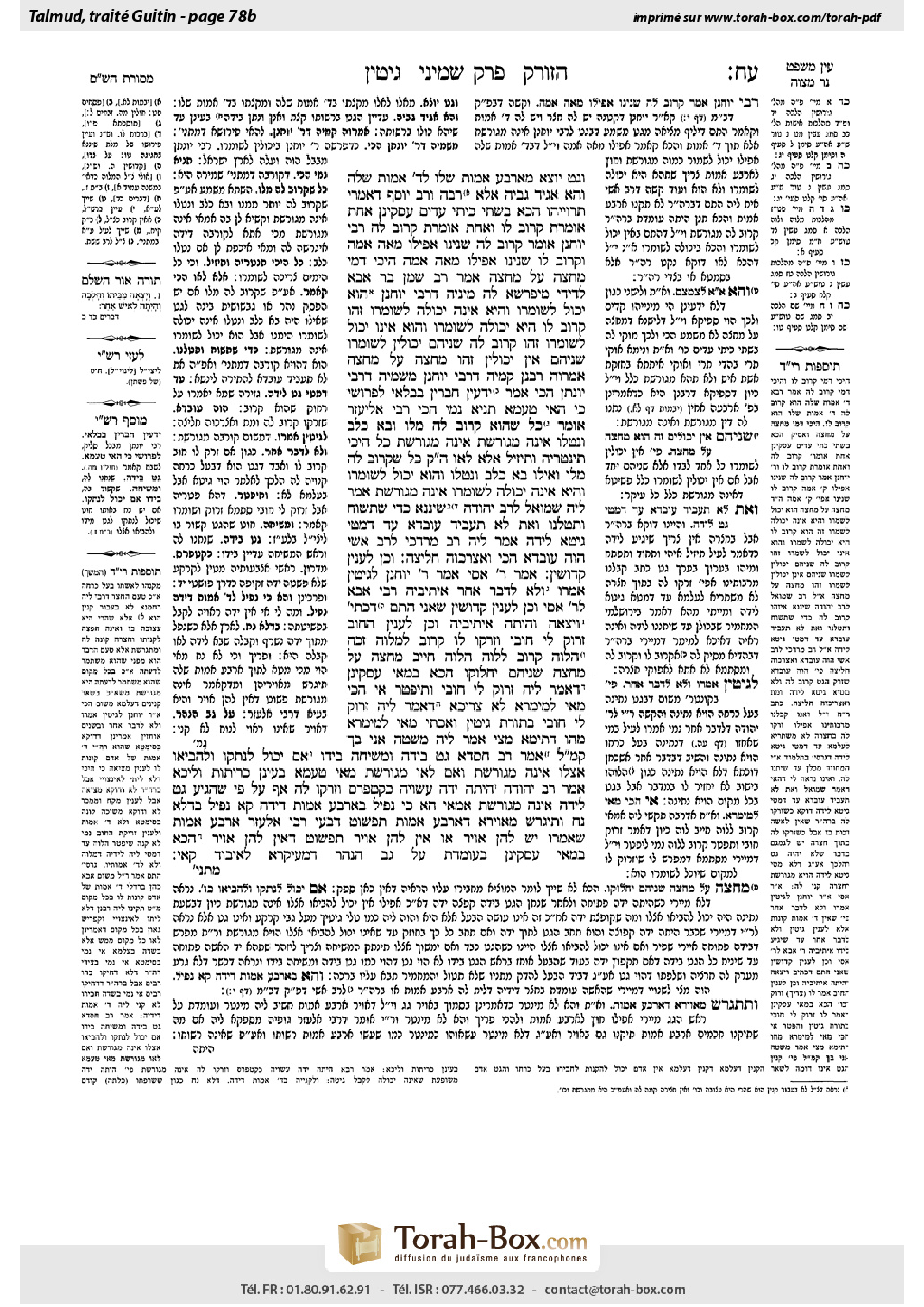
Gittin 78b: Talmud study for Daf Yomi
Study the Talmud for Daf Yomi with scanned pages, Hebrew text, English translations from Sefaria and AI-generated French translations.
Passage selection and English or AI-generated French translation are available where the scan has annotations. Daf Study is independent of Torah-Box and Sefaria.
Browse Gittin · גיטין · All tractatesGittin 78b text and translations
This page of Gittin includes the Aramaic text, an English translation and an AI-generated French translation, alongside the scan above.
גיטין ע״ח ב · Aramaic and Hebrew text
וְגֵט יוֹצֵא מֵאַרְבַּע אַמּוֹת שֶׁלּוֹ לְאַרְבַּע אַמּוֹת שֶׁלָּהּ.
וְהָא אֲגִיד גַּבֵּיהּ! אֶלָּא רַבָּה וְרַב יוֹסֵף דְּאָמְרִי תַּרְוַיְיהוּ: הָכָא בִּשְׁתֵּי כִּיתֵּי עֵדִים עָסְקִינַן – אַחַת אוֹמֶרֶת קָרוֹב לוֹ, וְאַחַת אוֹמֶרֶת קָרוֹב לָהּ.
רַבִּי יוֹחָנָן אוֹמֵר: ״קָרוֹב לָהּ״ שָׁנִינוּ – אֲפִילּוּ מֵאָה אַמָּה; וְ״קָרוֹב לוֹ״ שָׁנִינוּ – אֲפִילּוּ מֵאָה אַמָּה.
הֵיכִי דָּמֵי מֶחֱצָה עַל מֶחֱצָה? אָמַר רַב שֶׁמֶן בַּר אַבָּא, לְדִידִי מִיפָּרְשָׁא לַהּ מִינֵּיהּ דְּרַבִּי יוֹחָנָן: הוּא יָכוֹל לְשׁוֹמְרוֹ וְהִיא אֵינָהּ יְכוֹלָה לְשׁוֹמְרוֹ – זֶהוּ קָרוֹב לוֹ; הִיא יְכוֹלָה לְשׁוֹמְרוֹ וְהוּא אֵינוֹ יָכוֹל לְשׁוֹמְרוֹ – זֶהוּ קָרוֹב לָהּ; שְׁנֵיהֶם יְכוֹלִין לְשׁוֹמְרוֹ, שְׁנֵיהֶם אֵין יְכוֹלִין – זֶהוּ מֶחֱצָה עַל מֶחֱצָה.
אַמְרוּהָ רַבָּנַן קַמֵּיהּ דְּרַבִּי יוֹחָנָן מִשְּׁמֵיהּ דְּרַבִּי יוֹנָתָן הָכִי, אָמַר: יָדְעִין חַבְרִין בַּבְלָאֵי לְפָרוֹשֵׁי כִּי הַאי טַעְמָא!
תַּנְיָא נָמֵי הָכִי, רַבִּי אֱלִיעֶזֶר אוֹמֵר: כֹּל שֶׁהוּא קָרוֹב לָהּ מִלּוֹ, וּבָא כֶּלֶב וּנְטָלוֹ – אֵינָהּ מְגוֹרֶשֶׁת. אֵינָהּ מְגוֹרֶשֶׁת?! כֹּל הָיכִי תִּינְטְרֵיהּ וְתֵיזִיל?
אֶלָּא לָאו הָכִי קָאָמַר: כֹּל שֶׁקָּרוֹב לָהּ מִלּוֹ; וְאִילּוּ בָּא כֶּלֶב וּנְטָלוֹ – וְהוּא יָכוֹל לְשׁוֹמְרוֹ וְהִיא אֵינָהּ יְכוֹלָה לְשׁוֹמְרוֹ, אֵינָהּ מְגוֹרֶשֶׁת.
אֲמַר לֵיהּ שְׁמוּאֵל לְרַב יְהוּדָה: שִׁינָּנָא, כְּדֵי שֶׁתָּשׁוּחַ וְתִטְּלֶנּוּ. וְאַתְּ לָא תַּעֲבֵיד עוֹבָדָא, עַד דְּמָטֵי גִּיטָּא לִידַהּ.
אֲמַר לֵיהּ רַב מָרְדֳּכַי לְרַב אָשֵׁי: הֲוָה עוֹבָדָא הָכִי, וְאַצְרְכוּהָ חֲלִיצָה.
וְכֵן לְעִנְיַן קִדּוּשִׁין. אָמַר רַבִּי אַסִּי אָמַר רַבִּי יוֹחָנָן: לְגִיטִּין אָמְרוּ, וְלֹא לְדָבָר אַחֵר.
אֵיתִיבֵיהּ רַבִּי אַבָּא לְרַבִּי אַסִּי: וְכֵן לְעִנְיַן קִדּוּשִׁין! שָׁאנֵי הָתָם דִּכְתִיב ״וְיָצְאָה״–״וְהָיְתָה״.
אֵיתִיבֵיהּ: וְכֵן לְעִנְיַן הַחוֹב, ״זְרוֹק לִי חוֹבִי״ וּזְרָקוֹ לוֹ, קָרוֹב לַמַּלְוֶה – זָכָה הַלֹּוֶה, קָרוֹב לַלֹּוֶה – הַלֹּוֶה חַיָּיב, מֶחֱצָה עַל מֶחֱצָה – שְׁנֵיהֶם יַחְלוֹקוּ!
הָכָא בְּמַאי עָסְקִינַן – דַּאֲמַר לֵיהּ: ״זְרוֹק לִי חוֹבִי וְתִיפָּטֵר״. אִי הָכִי מַאי לְמֵימְרָא? לָא צְרִיכָא, דַּאֲמַר לֵיהּ: ״זְרוֹק לִי חוֹבִי בְּתוֹרַת גִּיטִּין״.
וְאַכַּתִּי, מַאי לְמֵימְרָא? מַהוּ דְּתֵימָא, מָצֵי אָמַר לֵיהּ מְשַׁטֶּה אֲנִי בָּךְ; קָא מַשְׁמַע לַן.
אָמַר רַב חִסְדָּא: גֵּט בְּיָדָהּ וּמְשִׁיחָה בְּיָדוֹ; אִם יָכוֹל לְנַתְּקוֹ וְלַהֲבִיאוֹ אֶצְלוֹ – אֵינָהּ מְגוֹרֶשֶׁת, וְאִם לָאו – מְגוֹרֶשֶׁת.
מַאי טַעְמָא? בָּעֵינַן כְּרִיתוּת, וְלֵיכָּא.
אָמַר רַב יְהוּדָה: הָיְתָה יָדָהּ עֲשׂוּיָה כְּקָטַפְרֵס, וּזְרָקוֹ לָהּ; אַף עַל פִּי שֶׁהִגִּיעַ גֵּט לְיָדָהּ – אֵינָהּ מְגוֹרֶשֶׁת.
אַמַּאי? הָא כִּי נָפֵיל – בְּאַרְבַּע אַמּוֹת דִּידַהּ קָא נָפֵיל! בִּדְלָא נָח.
וְתִיגָּרַשׁ מֵאַוֵּירָא דְּאַרְבַּע אַמּוֹת! תִּפְשׁוֹט דְּבָעֵי רַבִּי אֶלְעָזָר – אַרְבַּע אַמּוֹת שֶׁאָמְרוּ, יֵשׁ לָהֶן אֲוִיר אוֹ אֵין לָהֶן אֲוִיר? תִּפְשׁוֹט דְּאֵין לָהֶן אֲוִיר!
הָכָא בְּמַאי עָסְקִינַן – בְּעוֹמֶדֶת עַל גַּב הַנָּהָר, דְּמֵעִיקָּרָא לְאִיבּוּד קָאֵי.
Gittin 78b · English translation
and the bill of divorce extends from his four cubits into her four cubits, meaning that part of the bill of divorce is in his four cubits, and part is in hers. Therefore, in this case there is uncertainty whether she is divorced or whether she is not divorced.
The Gemara asks: But isn’t the bill of divorce still attached to him, since part of it is within his four cubits, and therefore it cannot be considered as if he gave her the bill of divorce completely? Rather, one should explain as Rabba and Rav Yosef both say: Here we are dealing with two groups of witnesses; one says that the bill of divorce fell closer to him, and one says that the bill of divorce fell closer to her. Therefore, the expression in the mishna, equally balanced, is referring not to distance but to opinions.
As opposed to Rav, who explained that in the mishna, the word closer meant within four cubits, Rabbi Yoḥanan says: We learned that closer to her means that the bill of divorce was actually closer to her, even if it was one hundred cubits away from her. And we learned that closer to him means that it was actually closer to him, even if it was one hundred cubits away from him.
The Gemara asks: According to the explanation offered by Rabbi Yoḥanan, what are the circumstances of when it was equally balanced? Rav Shemen bar Abba said: This was explained to me personally by Rabbi Yoḥanan himself: If it is so positioned that he can guard it and she cannot guard it, this is considered closer to him. If it is so positioned that she can guard it and he cannot guard it, this is considered closer to her. If it is so positioned that the two of them can guard it, or the two of them cannot guard it, this is considered equally balanced.
The Rabbis said this explanation before Rabbi Yoḥanan in the name of Rabbi Yonatan, and Rabbi Yoḥanan said in amazement: Do our Babylonian friends know how to explain in accordance with this explanation? Rabbi Yoḥanan was astonished that they also understood the issue as he did.
This is also taught in a baraita (Tosefta 8:1): Rabbi Eliezer says: With regard to any bill of divorce that is closer to her than it is to him, and a dog came and took it before the bill of divorce reached her hand, she is not divorced. The Gemara asks: Why is it that she is not divorced? Once it was closer to her, before the dog took it, the divorce should have taken effect. Must she continue guarding her bill of divorce indefinitely, even after the bill of divorce took effect?
The Gemara answers: Rather, is it not that this is what Rabbi Eliezer is saying: With regard to any bill of divorce that is closer to her than it is to him, and if a dog were to come and attempt to take it, he would be able to guard it and she would not be able to guard it, in that case she is not divorced, as the bill of divorce is considered in his domain.
Shmuel said to Rav Yehuda: One with large teeth [shinnana], i.e., a nickname for Rabbi Yehuda, when they said: Closer to her, it meant so that she could bend down and take it. And you should not perform an action to permit a divorcing woman to remarry until the bill of divorce actually reaches her hand.
Rav Mordekhai said to Rav Ashi: There was an incident like this, in which the bill of divorce was closer to the woman than to the man and it was then lost; and, after her husband died, they required the woman to engage in the ritual through which the yavam frees the yevama of her levirate bonds [ḥalitza] in order to permit her to marry, due to uncertainty. They did not rely on the bill of divorce that was given to the woman, since it never actually reached her hand.
§ The mishna stated the halakha about a bill of divorce that was closer to him or her, and the mishna added: And the same halakhot apply with regard to betrothal. Rabbi Asi says that Rabbi Yoḥanan says: They said these halakhot only with regard to bills of divorce, but not with regard to another matter.
Rabbi Abba raised an objection to the statement of Rabbi Asi from what was explicitly taught in the mishna: And the same halakhot apply with regard to betrothal. He responded: It is different there with regard to betrothal, as it is written: “And she departs out of his house, and goes and becomes another man’s wife” (Deuteronomy 24:2). The Torah thereby compares betrothal, through the use of the word “becomes,” to divorce, through the use of the words “and she departs,” so one can learn the halakhot of betrothal from the halakhot of divorce. One cannot learn halakhot concerning other matters from divorce.
Another objection to his statement was raised based on what is taught in a baraita: And the same halakhot apply with regard to a debt. If a creditor said to a debtor: Throw the payment for my debt to me, and he threw it to him and the money fell closer to the creditor, the debtor merits, i.e., his debt is repaid. If it fell closer to the debtor and the money was lost, the debtor is still obligated to pay. If it was equally balanced and was lost, the two of them divide it, i.e., the debtor owes half of the amount. Accordingly, the halakhot of debts are compared to the halakhot of divorce.
The Gemara answers: Here we are dealing with a case where the creditor said to the debtor: Throw the payment for my debt to me, and you will be absolved of your obligation to pay through this. The Gemara challenges this: If so, what is the purpose of stating this? Since he made an explicit stipulation, it is obvious that the outcome will be in accordance with his stipulation. The Gemara answers: No, it is necessary in a case where the creditor said to the debtor: Throw the payment for my debt to me according to the procedure in effect with bills of divorce, meaning that the halakha that applies to divorce should apply here too.
The Gemara asks: And still, what is the purpose of stating this, since the creditor stipulated explicitly: According to the procedure in effect with bills of divorce? The Gemara answers: Lest you say that the creditor can say to the debtor: I am teasing you, and what I stipulated has no validity. Therefore the mishna teaches us that if he stipulated that it should be treated as a bill of divorce, then his stipulation takes effect.
§ Rav Ḥisda says: If the bill of divorce was in her hand and a string tied to the bill of divorce was in his hand, as he gave her the bill of divorce in this way, if the husband can still pull the bill of divorce out of her hand and bring it to him, she is not divorced; and if he is not able to do so, she is divorced.
What is the reason that she is not divorced, despite the fact that he gave her a bill of divorce? The reason is that we require severance, and it is lacking, since the husband still has a hold on the bill of divorce.
Rav Yehuda says: If her hand was positioned like a slope and he threw it to her, despite the fact that the bill of divorce reached her hand, she is not divorced, since it cannot remain in her hand and will fall out.
The Gemara asks: Why? But when the bill of divorce falls from her hand, it falls within her four cubits. The Gemara answers: Rav Yehuda is discussing a case where the bill of divorce did not rest within her four cubits. Rather, it fell further away.
The Gemara asks: But why not let her be divorced because the bill of divorce was in the airspace of her four cubits? And if you do not say this, then resolve the dilemma that Rabbi Elazar raised with regard to the four cubits that the Sages stated in the halakhot of acquisition: Do they have airspace with the same legal status or do they not have airspace? Resolve that dilemma from here, i.e., that they do not have airspace.
The Gemara rejects this: One cannot resolve the dilemma from here since it is possible to say that here we are dealing with a woman who is standing at the riverbank, as the bill of divorce stands to be destroyed from the outset, since if it does not remain in her hand it will fall into the river. In such a case, everyone agrees that the airspace of the four cubits does not acquire the item.
Gittin 78b · Traduction française (IA)
et le contrat de divorce s'étend de ses quatre coudées vers les siennes, c'est-à-dire que partie du contrat de divorce est dans ses quatre coudées, et partie dans les siennes. Ainsi, dans ce cas, il y a incertitude quant au fait qu'elle soit divorcée ou non.
La Guemara pose la question : Mais n'est-ce pas que le contrat de divorce est encore attaché à lui, puisque partie du contrat est dans ses quatre coudées, et donc il ne peut pas être considéré comme s'il avait donné le contrat de divorce entièrement ? Plutôt, on devrait expliquer selon Rabba et Rav Yosef : ici nous sommes en présence de deux groupes de témoins ; l'un dit que le contrat de divorce est tombé plus près de lui, et l'autre que plus près d'elle. Ainsi, l'expression dans la Michna, équilibrée, ne fait pas référence à la distance mais aux opinions.
Contrairement à Rav, qui expliquait que dans la Michna, le mot « plus près » signifiait à l'intérieur des quatre coudées, Rabbi Yoḥanan dit : Nous avons appris que « plus près d'elle » signifie que le contrat de divorce était effectivement plus près d'elle, même s'il était à cent coudées d'elle. Et nous avons appris que « plus près de lui » signifie que le contrat de divorce était effectivement plus près de lui, même s'il était à cent coudées de lui.
La Guemara pose la question : Selon l'explication offerte par Rabbi Yoḥanan, dans quels cas il y a équilibre ? Rav Shemen bar Abba dit : Cela m'a été expliqué personnellement par Rabbi Yoḥanan lui-même : si la position est telle qu'il peut le garder et elle ne peut pas le garder, cela est considéré comme plus près de lui. Si la position est telle qu'elle peut le garder et il ne peut pas le garder, cela est considéré comme plus près d'elle. Si la position est telle que les deux peuvent le garder, ou que les deux ne peuvent pas le garder, cela est considéré comme équilibré.
Les Rabbins ont dit cette explication devant Rabbi Yoḥanan au nom de Rabbi Yonatan, et Rabbi Yoḥanan a dit avec étonnement : Nos amis de Babylone savent-ils expliquer selon cette explication ? Rabbi Yoḥanan était étonné qu'ils aient aussi compris la question comme lui.
Cela est également enseigné dans une baraïta (Tosefta 8:1) : Rabbi Eliezer dit : Concernant tout contrat de divorce qui est plus près d'elle que d'eux, et un chien est venu et l'a emporté avant que le contrat de divorce ne parvienne à sa main, elle n'est pas divorcée. La Guemara pose la question : Pourquoi est-ce qu'elle n'est pas divorcée ? Une fois qu'il était plus près d'elle, avant que le chien ne l'emporte, le divorce devrait avoir eu effet. Doit-elle continuer à garder son contrat de divorce indéfiniment, même après que le divorce ait eu effet ?
La Guemara répond : Plutôt, n'est-ce pas que c'est ce que Rabbi Eliezer dit : Concernant tout contrat de divorce qui est plus proche d'elle que de lui, et si un chien venait tenter de l'emporter, il pourrait le garder et elle ne pourrait pas le garder, dans ce cas elle n'est pas divorcée, car le contrat de divorce est considéré dans son domaine.
Shmuel a dit à Rav Yehuda : Celui qui a des dents grandes [shinnana], c'est-à-dire un surnom pour Rav Yehuda, quand ils dirent : Plus proche d'elle, cela signifiait qu'elle pouvait se baisser et le prendre. Et vous ne devriez pas effectuer une action permettant à une femme divorcée de remettre épouse jusqu'à ce que le contrat de divorce parvienne effectivement à sa main.
Rav Mordekhai a dit à Rav Ashi : Il y avait un cas semblable, où le contrat de divorce était plus proche de la femme que du mari et il fut ensuite perdu ; et, après que son mari soit mort, ils exigeaient de la femme de participer à la cérémonie par laquelle le yavam libère la yevama de ses liens levirats [ḥalitza] afin de lui permettre de se marier, en raison d'une incertitude. Ils n'ont pas fait confiance au contrat de divorce donné à la femme, puisqu'il n'avait jamais atteint sa main.
§ La Michna a énoncé la halakha concernant un contrat de divorce qui était plus proche de lui ou d'elle, et la Michna a ajouté : Et les mêmes halakha s'appliquent concernant le mariage. Rabbi Asi dit que Rabbi Yoḥanan dit : Ils ont dit ces halakha uniquement concernant les contrats de divorce, mais pas concernant une autre matière.
Rabbi Abba a soulevé une objection contre l'affirmation de Rabbi Asi à partir de ce qui a été explicitement enseigné dans la Michna : Et les mêmes halakhot s'appliquent concernant le mariage. Il a répondu : C'est différent là concernant le mariage, car il est écrit : « Et elle sort de sa maison, et va et devient l'épouse d'un autre homme » (Deutéronome 24:2). La Torah compare le mariage, par l'usage du mot « devient », au divorce, par l'usage des mots « et elle sort », donc on peut apprendre les halakhot du mariage à partir des halakhot du divorce. On ne peut pas apprendre des halakhot concernant d'autres matières à partir du divorce.
Une autre objection contre son affirmation a été soulevée à partir de ce qui est enseigné dans une baraïta : Et les mêmes halakhot s'appliquent concernant une dette. Si un créancier a dit à un débiteur : Jette le paiement de ma dette à moi, et il l'a jeté à lui et l'argent est tombé plus près du créancier, le débiteur mérite, c'est-à-dire sa dette est remboursée. Si l'argent est tombé plus près du débiteur et a été perdu, le débiteur reste obligé de payer. Si l'équilibre était égal et a été perdu, les deux divisent, c'est-à-dire le débiteur doit la moitié. Ainsi, les halakhot des dettes sont comparées aux halakhot du divorce.
La Guemara répond : Ici nous sommes en présence d’un cas où le créancier a dit au débiteur : Jette le paiement de ma dette à moi, et tu seras exempté de ton obligation de payer par cela. La Guemara conteste cela : Si c’est ainsi, à quoi sert d’énoncer cela ? Puisque l’homme a fait une stipulation explicite, il est évident que le résultat sera selon sa stipulation. La Guemara répond : Non, il est nécessaire dans un cas où le créancier a dit au débiteur : Jette le paiement de ma dette à moi selon la procédure en vigueur avec les contrats de divorce, c’est-à-dire que la halakha applicable au divorce devrait s’appliquer ici aussi.
La Guemara pose la question : Et pourtant, à quoi sert de préciser cela, puisque le créancier a stipulé explicitement : selon la procédure en vigueur pour les lettres de divorce ? La Guemara répond : afin de ne pas dire que le créancier peut dire au débiteur : Je te taquine, et ce que j'ai stipulé n'a pas de valeur. Ainsi, la Misha enseigne que si le créancier stipule qu'il doit être traité comme une lettre de divorce, sa stipulation est valable.
§ Rav Hizda dit : Si la lettre de divorce était entre ses mains et une corde attachée à la lettre de divorce était entre ses mains, comme il lui donnait la lettre de divorce ainsi, si le mari peut encore tirer la lettre de divorce de ses mains et la lui apporter, elle n'est pas divorcée ; et si il ne peut pas le faire, elle est divorcée.
Pourquoi est-ce que, malgré le fait qu'il lui a donné la lettre de divorce, elle n'est pas divorcée ? La raison est que nous exigeons la séparation, et elle n'est pas accomplie, puisque le mari tient encore la lettre de divorce.
Rav Yéhuda dit : Si sa main était orientée comme une pente et qu'il l'a lancée à elle, malgré le fait que la lettre de divorce a atteint sa main, elle n'est pas divorcée, puisque celle-ci ne peut pas rester dans sa main et tombera.
La Guemara pose la question : Pourquoi ? Mais lorsque la lettre de divorce tombe de sa main, elle tombe dans ses quatre cubits. La Guemara répond : Rav Yéhuda parle d'un cas où la lettre de divorce n'était pas restée dans ses quatre cubits. Plutôt, elle est tombée plus loin.
La Guemara pose la question : Mais pourquoi ne pas laisser qu'elle soit divorcée, puisque la lettre de divorce était dans l'espace aérien de ses quatre cubits ? Et si vous ne dites pas cela, alors résolvez le dilemme que Rabbi Eléazar a soulevé concernant les quatre cubits que les Sages ont établis dans les halakhot d'acquisition : ont-ils un espace aérien avec le même statut juridique ou non ? Résolvez ce dilemme d'ici, c'est-à-dire que l'espace aérien n'a pas de statut juridique.
La Guemara rejette cela : On ne peut pas résoudre ce dilemme à partir de là, car il est possible de dire que nous sommes en présence d'une femme debout à la rive du fleuve, car la lettre de divorce est vouée à être détruite dès le début, puisque si elle ne reste pas dans sa main, elle tombera dans le fleuve. Dans ce cas, tout le monde convient que l'espace aérien des quatre cubits ne peut pas acquérir l'objet.
Traduction française générée par IA à partir de l’édition anglaise de Sefaria. Vérifie toujours un passage avec le texte source.
Text from Sefaria: William Davidson Edition - Vocalized Aramaic (CC BY NC); William Davidson Edition - English (CC BY NC).