Gittin 79a: Talmud study for Daf Yomi
Study the Talmud for Daf Yomi with scanned pages, Hebrew text, English translations from Sefaria and AI-generated French translations.
Passage selection and English or AI-generated French translation are available where the scan has annotations. Daf Study is independent of Torah-Box and Sefaria.
Browse Gittin · גיטין · All tractatesGittin 79a text and translations
This page of Gittin includes the Aramaic text, an English translation and an AI-generated French translation, alongside the scan above.
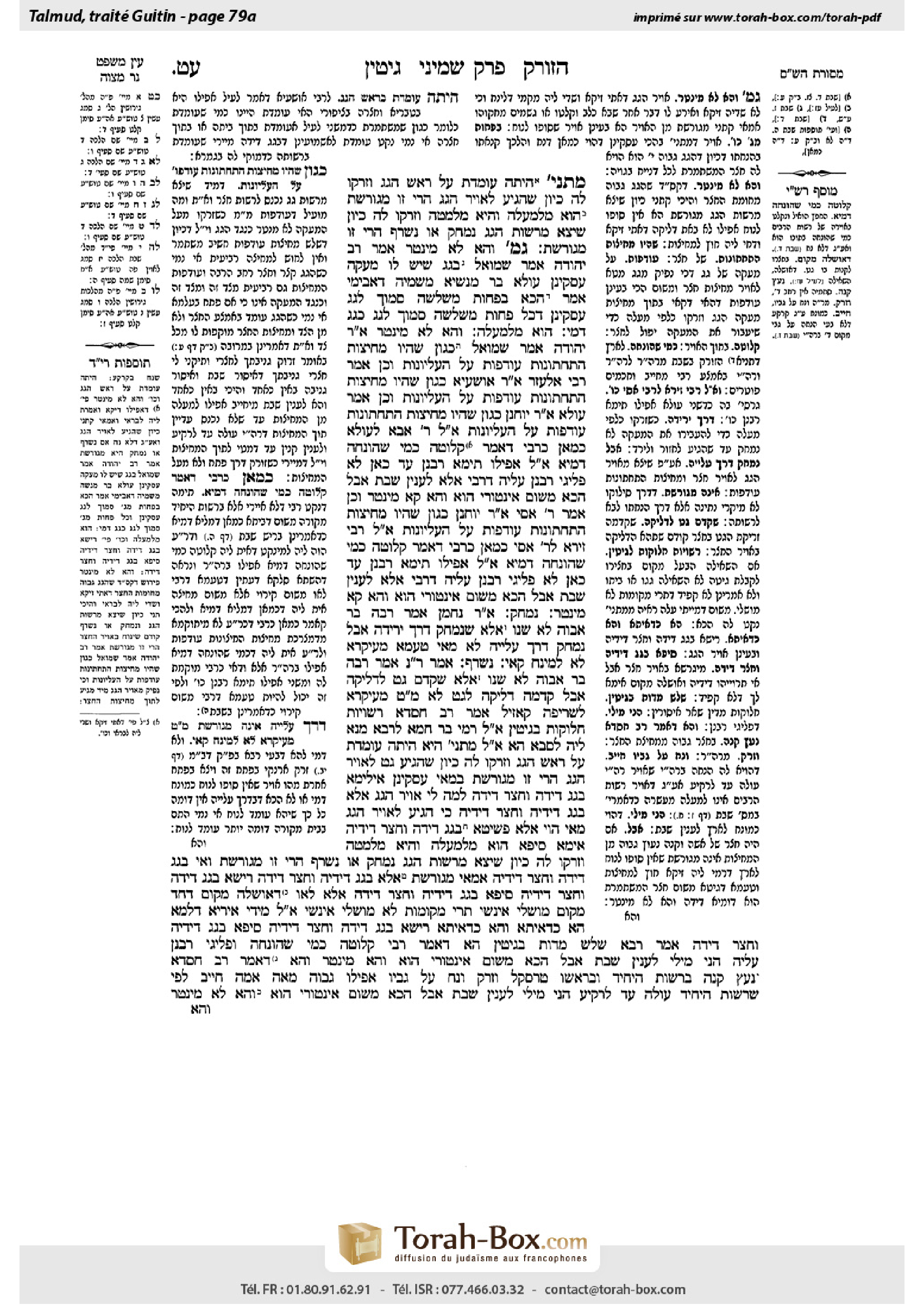
גיטין ע״ט א · Aramaic and Hebrew text
מַתְנִי׳ הָיְתָה עוֹמֶדֶת עַל רֹאשׁ הַגָּג וּזְרָקוֹ לָהּ, כֵּיוָן שֶׁהִגִּיעַ לַאֲוִיר הַגָּג – הֲרֵי זוֹ מְגוֹרֶשֶׁת. הוּא מִלְּמַעְלָה וְהִיא מִלְּמַטָּה, וּזְרָקוֹ לָהּ, כֵּיוָן שֶׁיָּצָא מֵרְשׁוּת הַגָּג, נִמְחַק אוֹ נִשְׂרַף – הֲרֵי זוֹ מְגוֹרֶשֶׁת.
גְּמָ׳ וְהָא לָא מִינְּטַר! אָמַר רַב יְהוּדָה אָמַר שְׁמוּאֵל: בְּגַג שֶׁיֵּשׁ לוֹ מַעֲקֶה עָסְקִינַן.
עוּלָּא בַּר מְנַשְּׁיָא מִשְּׁמֵיהּ דַּאֲבִימִי אָמַר: הָכָא בְּפָחוֹת מִשְּׁלֹשָׁה סָמוּךְ לַגַּג עָסְקִינַן, דְּכֹל פָּחוֹת מִשְּׁלֹשָׁה סָמוּךְ לַגַּג – כְּגַג דָּמֵי.
הוּא מִלְּמַעְלָה: וְהָא לָא מִינְּטַר! אָמַר רַב יְהוּדָה אָמַר שְׁמוּאֵל: כְּגוֹן שֶׁהָיוּ מְחִיצוֹת הַתַּחְתּוֹנוֹת עוֹדְפוֹת עַל הָעֶלְיוֹנוֹת.
וְכֵן אָמַר רַבִּי אֶלְעָזָר אָמַר רַבִּי אוֹשַׁעְיָא: כְּגוֹן שֶׁהָיוּ מְחִיצוֹת הַתַּחְתּוֹנוֹת עוֹדְפוֹת עַל הָעֶלְיוֹנוֹת. וְכֵן אָמַר עוּלָּא אָמַר רַבִּי יוֹחָנָן: כְּגוֹן שֶׁהָיוּ מְחִיצוֹת הַתַּחְתּוֹנוֹת עוֹדְפוֹת עַל הָעֶלְיוֹנוֹת.
אֲמַר לֵיהּ רַבִּי אַבָּא לְעוּלָּא: כְּמַאן, כְּרַבִּי – דְּאָמַר: קְלוּטָה, כְּמִי שֶׁהוּנְּחָה דָּמְיָא?
אֲמַר לֵיהּ: אֲפִילּוּ תֵּימָא רַבָּנַן – עַד כָּאן לָא פְּלִיגִי רַבָּנַן עֲלֵיהּ דְּרַבִּי, אֶלָּא לְעִנְיַן שַׁבָּת; אֲבָל הָכָא – מִשּׁוּם אִינְּטוֹרֵי הוּא, וְהָא קָא מִינְּטַר.
וְכֵן אָמַר רַבִּי אַסִּי אָמַר רַבִּי יוֹחָנָן: כְּגוֹן שֶׁהָיוּ מְחִיצוֹת הַתַּחְתּוֹנוֹת עוֹדְפוֹת עַל הָעֶלְיוֹנוֹת. אֲמַר לֵיהּ רַבִּי זֵירָא לְרַבִּי אַסִּי: כְּמַאן, כְּרַבִּי – דְּאָמַר: קְלוּטָה כְּמִי שֶׁהוּנְּחָה דָּמְיָא?
אֲמַר לֵיהּ: אֲפִילּוּ תֵּימָא רַבָּנַן – עַד כָּאן לָא פְּלִיגִי רַבָּנַן עֲלֵיהּ דְּרַבִּי, אֶלָּא לְעִנְיַן שַׁבָּת; אֲבָל הָכָא – מִשּׁוּם אִינְּטוֹרֵי הוּא, וְהָא קָא מִינְּטַר.
נִמְחַק: אָמַר רַב נַחְמָן אָמַר רַבָּה בַּר אֲבוּהּ: לֹא שָׁנוּ אֶלָּא שֶׁנִּמְחַק דֶּרֶךְ יְרִידָה, אֲבָל נִמְחַק דֶּרֶךְ עֲלִיָּיה – לָא. מַאי טַעְמָא? מֵעִיקָּרָא לָא לְמֵינַח קָאֵי.
נִשְׂרַף: אָמַר רַב נַחְמָן אָמַר רַבָּה בַּר אֲבוּהּ: לֹא שָׁנוּ אֶלָּא שֶׁקָּדַם גֵּט לִדְלֵיקָה, אֲבָל קָדְמָה דְּלֵיקָה לְגֵט – לָא. מַאי טַעְמָא? מֵעִיקָּרָא לִשְׂרֵיפָה קָאָזֵיל.
אָמַר רַב חִסְדָּא: רְשׁוּיוֹת חֲלוּקוֹת בְּגִיטִּין.
אֲמַר לֵיהּ רָמֵי בַּר חָמָא לְרָבָא: מְנָא לֵיהּ לְסָבָא הָא? אֲמַר לֵיהּ, מַתְנִיתִין הִיא: הָיְתָה עוֹמֶדֶת עַל רֹאשׁ הַגָּג וּזְרָקוֹ לָהּ, כֵּיוָן שֶׁהִגִּיעַ גֵּט לַאֲוִיר הַגָּג – הֲרֵי זוֹ מְגוֹרֶשֶׁת.
בְּמַאי עָסְקִינַן? אִילֵימָא בְּגַג דִּידַהּ וְחָצֵר דִּידַהּ, לְמָה לִי אֲוִיר הַגָּג?
אֶלָּא בְּגַג דִּידֵיהּ וְחָצֵר דִּידֵיהּ, כִּי הִגִּיעַ לַאֲוִיר הַגָּג מַאי הָוֵי?
אֶלָּא פְּשִׁיטָא – בְּגַג דִּידַהּ וְחָצֵר דִּידֵיהּ. אֵימָא סֵיפָא: הוּא מִלְּמַעְלָה וְהִיא מִלְּמַטָּה וּזְרָקוֹ לָהּ; כֵּיוָן שֶׁיָּצָא מֵרְשׁוּת הַגָּג, נִמְחַק אוֹ נִשְׂרַף – הֲרֵי זוֹ מְגוֹרֶשֶׁת. וְאִי בְּגַג דִּידַהּ וְחָצֵר דִּידֵיהּ, אַמַּאי מְגוֹרֶשֶׁת? אֶלָּא בְּגַג דִּידֵיהּ וְחָצֵר דִּידַהּ;
רֵישָׁא בְּגַג דִּידַהּ וְחָצֵר דִּידֵיהּ, סֵיפָא בְּגַג דִּידֵיהּ וְחָצֵר דִּידַהּ?!
אֶלָּא לָאו דְּאוֹשְׁלַהּ מָקוֹם – דְּחַד מָקוֹם מוֹשְׁלִי אִינָשֵׁי, תְּרֵי מְקוֹמוֹת לָא מוֹשְׁלִי אִינָשֵׁי?
אֲמַר לֵיהּ: מִידֵי אִירְיָא?! דִּלְמָא הָא כִּדְאִיתַהּ וְהָא כִּדְאִיתַהּ – רֵישָׁא בְּגַג דִּידַהּ וְחָצֵר דִּידֵיהּ, סֵיפָא בְּגַג דִּידֵיהּ וְחָצֵר דִּידַהּ.
אָמַר רָבָא: שָׁלֹשׁ מִדּוֹת בְּגִיטִּין; הָא דְּאָמַר רַבִּי: קְלוּטָה כְּמִי שֶׁהוּנְּחָה, וּפְלִיגִי רַבָּנַן עָלֶיהָ – הָנֵי מִילֵּי לְעִנְיַן שַׁבָּת, אֲבָל הָכָא מִשּׁוּם אִינְּטוֹרֵי הוּא, וְהָא מִינְּטַר;
וְהָא דְּאָמַר רַב חִסְדָּא: נָעַץ קָנֶה בִּרְשׁוּת הַיָּחִיד וּבְרֹאשׁוֹ טְרַסְקָל, וְזָרַק וְנָח עַל גַּבָּיו – אֲפִילּוּ גָּבוֹהַּ מֵאָה אַמָּה, חַיָּיב, לְפִי שֶׁרְשׁוּת הַיָּחִיד עוֹלָה עַד לָרָקִיעַ – הָנֵי מִילֵּי לְעִנְיַן שַׁבָּת, אֲבָל הָכָא מִשּׁוּם אִינְּטוֹרֵי הוּא, וְהָא לָא מִינְּטַר;
Gittin 79a · English translation
MISHNA: If a woman was standing on top of the roof and her husband was standing below, and he threw a bill of divorce to her, once the bill of divorce reaches the airspace of the roof, she is divorced. If he was above on the roof and she was below, and he threw it to her, once it leaves the area of the roof, even if the wording was erased or the document was burned before it fell to the ground, she is divorced.
GEMARA: The Gemara asks: But isn’t the airspace of the roof unsecured? Since the bill of divorce can be blown away from the roof by the wind, it should be considered an unsecured courtyard, which does not acquire items. If so, why is she divorced once the bill of divorce reaches the airspace of the roof? Rav Yehuda said that Shmuel said: We are dealing with a roof that has a parapet. Therefore, it is like a secured courtyard, since the bill of divorce cannot be blown away.
Ulla bar Menashya said in the name of Avimi that there is another answer: Here we are dealing with a case in which the bill of divorce is within three handbreadths of the roof, as anything within three handbreadths of the roof is considered to be like the roof itself, based on the principle that views two solid surfaces as connected if the gap between them is less than three handbreadths wide.
§ It was taught in the mishna: If he was above and she was below, and he threw the bill of divorce to her, once it leaves the area of the roof, she is divorced. The Gemara asks: But isn’t the airspace of the courtyard not secured, since the bill of divorce can be blown out of the courtyard by the wind? Rav Yehuda says that Shmuel says: We are discussing a case where the lower partitions in the courtyard extend beyond the upper partitions on the roof, so that the bill of divorce will certainly fall in the courtyard.
And so Rabbi Elazar says that Rabbi Oshaya says: We are discussing a case where the lower partitions extend beyond the upper partitions. And so Ulla says that Rabbi Yoḥanan says: We are discussing a case where the lower partitions extend beyond the upper partitions.
Rabbi Abba said to Ulla: In accordance with whose opinion is this halakha that once the bill of divorce enters the woman’s domain, it is considered as though it was given to her, even though it was destroyed before it landed on the ground? Is it in accordance with the opinion of Rabbi Yehuda HaNasi, who said that with regard to the prohibition of transferring an item from one domain to another on Shabbat, an object in airspace is considered at rest? This means that any item in the airspace of a domain is considered to be placed within that domain.
Ulla said to him: You can even say that the mishna is in accordance with the opinion of the Rabbis, who disagree with Rabbi Yehuda HaNasi, since the Rabbis disagree with Rabbi Yehuda HaNasi only with regard to Shabbat. They maintain that with regard to the halakhot of Shabbat, the item must actually come to rest in the domain to which it was transferred; while it is in the air, it is not considered as though it has landed on the ground. But here, in the case of divorce, it is because the bill of divorce is secured that she is divorced, and in this case it is secured while within the airspace of the partitions.
And so Rabbi Asi says that Rabbi Yoḥanan says: We are discussing a case where the lower partitions in the courtyard extend beyond the upper partitions on the roof. Rabbi Zeira said to Rabbi Asi: In accordance with whose opinion is this halakha? Is it in accordance with the opinion of Rabbi Yehuda HaNasi, who says that an object in airspace is considered at rest?
Rabbi Asi said to him: You can even say that the mishna is in accordance with the opinion of the Rabbis, since the Rabbis disagree with Rabbi Yehuda HaNasi only with regard to Shabbat. But here, it is because the bill of divorce is secured that she is divorced, and in this case it is secured while within the airspace of the partitions.
§ It was taught in the mishna that once the bill of divorce leaves the domain of the roof, even if the writing was erased before it reached her hand, she is divorced with it. Rav Naḥman says that Rabba bar Avuh says: They taught this halakha only when the writing was erased when it had already left the confines of the roof and was on its descent, entering her domain. But if the writing was erased while it was on its ascent, i.e., as it arched upward before falling down, then no, she is not divorced. What is the reason for this? Because initially, before it began its descent, the bill of divorce is not destined to land in her domain, since it could be blown elsewhere. Consequently, it cannot be considered as though it is already resting in her courtyard at that time.
It was taught in the mishna that once the bill of divorce leaves the domain of the roof, even if the document was burned before it reached her hand, she is divorced with it. Here, as well, Rav Naḥman says that Rabba bar Avuh says: They taught this halakha only when the throwing of the bill of divorce preceded the fire. But if the fire preceded the throwing of the bill of divorce, then the woman is not divorced. What is the reason for this? Because initially, when the bill of divorce was thrown, it was heading toward being burned, and therefore it is considered that he never gave her a bill of divorce.
§ Rav Ḥisda says: Domains are divided with regard to bills of divorce. If there are several areas within the same domain, e.g., a house and a courtyard, or a courtyard and a roof, they are not all considered a single domain with regard to bills of divorce. Rather, each one is considered to be a separate domain.
Rami bar Ḥama said to Rava: From where does the Elder, i.e., Rav Ḥisda, derive this halakha? Rava said to him: It is derived from the mishna that taught: If the woman was standing on the top of the roof and her husband threw a bill of divorce to her from below, once the bill of divorce reaches the airspace of the roof, she is divorced.
Rava explains: With what are we dealing? If we say that we are dealing with a case of her roof and her courtyard, why do I require the bill of divorce to reach the airspace of the roof in order for her to be divorced? Even if the bill of divorce remained in the courtyard, she would be divorced, since it is her courtyard.
Rather, we must be dealing with a case of his roof and his courtyard. But when the bill of divorce reaches the airspace of the roof, what of it? Why is she then divorced, if the bill of divorce has not left his domain?
Rather, it is obvious that we are dealing with a case of her roof and his courtyard. Rava questions this conclusion: Say the latter clause of the mishna, which taught: If he was above on the roof and she was below, and he threw it to her, once it leaves the area of the roof, even if the wording was erased or the document was burned before it fell to the ground, she is divorced. And if we are dealing with a case of her roof and his courtyard, why is she divorced? Rather, it is necessary to say that we are dealing with a case of his roof and her courtyard.
Rava asks: Is it possible that the first clause in the mishna is dealing with a case of her roof and his courtyard, and the latter clause in the mishna is dealing with a case of his roof and her courtyard? How could the same mishna discuss two halakhot where each one is dealing with a different reality, without mentioning this distinction?
Rava explains Rav Ḥisda’s inference: Rather, is it not so that the mishna is dealing with a case where both the roof and the courtyard belong to him, but he lent her a place in his domain wherein she could acquire her bill of divorce, and she is standing in that place? In the first clause he lent her the roof, and in the second clause he lent her the courtyard, Consequently, only once it reaches that domain is she divorced. The reason why she does not acquire the bill of divorce until it reaches the specific domain that he lent her is that people lend only one place; people do not lend two places. Rav Ḥisda understood that one can infer from the mishna that the courtyard and roof remain as separate domains, and concludes that, with regard to bills of divorce, different areas in one domain are considered to be multiple domains.
Rami bar Ḥama said to Rava: Are the cases comparable? Perhaps this case is as it is and that case is as it is, i.e., the first clause in the mishna is dealing with a case of her roof and his courtyard, and the latter clause is dealing with a case of his roof and her courtyard. In some instances, one mishna deals with two different cases. Therefore, the mishna is not an adequate proof for Rav Ḥisda’s statement.
Rava says: There are three unique qualities with regard to bills of divorce, as compared to the halakhot of Shabbat. The first is that which Rabbi Yehuda HaNasi says: An object in airspace is considered at rest; and the Rabbis disagree with him. This matter about which they disagree applies only with regard to Shabbat. But here, in the case of divorce, it is because the bill of divorce is secured that she is divorced; and once the bill of divorce is within the airspace of the partitions, it is secured and the Rabbis agree that she is divorced.
And the second matter is that which Rav Ḥisda says concerning the halakhot of Shabbat: In the case of one who embedded a reed in the ground of a private domain, and on its top was a basket [teraskal], and he threw an object from the public domain and it rested on top of it, even if the reed was a hundred cubits high, he is liable because the private domain extends upward until the sky. Therefore, the object landed in a private domain. This matter applies only with regard to Shabbat, as with regard to Shabbat domains are defined based on their partitions and the way in which they are used, which differs from the way domains are defined in other halakhic areas. But here, in the case of divorce, it is because the bill of divorce is secured that she is divorced, and when it is on the reed it is not secured.
Gittin 79a · Traduction française (IA)
MICHNA: Si une femme était debout sur le toit et son mari était debout en dessous, et il lança un acte de divorce vers elle, dès que l'acte de divorce atteint l'espace aérien du toit, elle est divorcée. Si lui était au-dessus sur le toit et elle était en dessous, et il lança l'acte de divorce vers elle, dès qu'il quitte la zone du toit, même si le texte était effacé ou le document brûlé avant qu'il ne tombe au sol, elle est divorcée.
GUEMARA: La Guemara pose la question : Mais n'est-ce pas l'espace aérien du toit qui n'est pas sécurisé ? Puisque l'acte de divorce peut être emporté par le vent, il devrait être considéré comme un cour de jardin non sécurisé, qui ne peut pas acquérir des objets. Si tel est le cas, pourquoi est-elle divorcée dès que l'acte de divorce atteint l'espace aérien du toit ? Rav Yehuda a dit que Shmuel a dit : Nous parlons d'un toit qui a un parapet. Ainsi, il est comme un cour de jardin sécurisé, puisque l'acte de divorce ne peut pas être emporté.
Ulla bar Menashya a dit en nom d'Avimi que répondre autrement : Ici nous parlons d'un cas où l'acte de divorce est à trois tefachim du toit, car tout ce qui est à trois tefachim du toit est considéré comme faisant partie du toit lui-même, selon le principe qui considère deux surfaces solides comme connectées si la distance entre elles est inférieure à trois tefachim.
§ Il a été enseigné dans la mishna : Si lui était au-dessus et elle en dessous, et il lança l'acte de divorce vers elle, dès qu'il quitte la zone du toit, elle est divorcée. La Guemara pose la question : Mais n'est-ce pas l'espace aérien du cour de jardin qui n'est pas sécurisé, puisque l'acte de divorce peut être emporté par le vent ? Rav Yehuda dit que Shmuel dit : Nous parlons d'un cas où les parois inférieures du cour de jardin dépassent les parois supérieures du toit, de sorte que l'acte de divorce tombera certainement dans le cour de jardin.
Et ainsi Rabbi Elazar dit que Rabbi Oshaya dit : Nous parlons d'un cas où les parois inférieures dépassent les parois supérieures. Et ainsi Ulla dit que Rabbi Yoḥanan dit : Nous parlons d'un cas où les parois inférieures dépassent les parois supérieures.
Rabbi Abba a dit à Ulla : Selon l'opinion de qui est cette halakha qui stipule que dès que l'acte de divorce entre dans le domaine de la femme, il est considéré comme s'il avait été donné à elle, même s'il a été détruit avant d'avoir touché le sol ? Est-ce selon l'opinion de Rabbi Yehuda HaNasi, qui disait que concernant l'interdiction de transférer un objet d'un domaine à un autre le sabbat, un objet dans l'espace aérien est considéré comme immobile ? Cela signifie que tout objet dans l'espace aérien d'un domaine est considéré comme placé dans ce domaine.
Ulla a dit à lui : Vous pouvez même dire que la mishna est selon l'opinion des Rabbins, qui s'opposent à celle de Rabbi Yehuda HaNasi, puisque les Rabbins s'opposent à Rabbi Yehuda HaNasi uniquement concernant le sabbat. Ils maintiennent que concernant les halakhot du sabbat, l'objet doit effectivement arriver dans le domaine auquel il est transféré ; pendant qu'il est dans l'air, il n'est pas considéré comme s'il avait déjà touché le sol. Mais ici, concernant le divorce, c'est parce que l'acte de divorce est sécurisé qu'elle est divorcée, et dans ce cas, il est sécurisé pendant qu'il est dans l'espace aérien des parois.
Et ainsi Rabbi Asi dit que Rabbi Yoḥanan dit : Nous discutons d'un cas où les parois inférieures du cour de jardin dépassent les parois supérieures du toit. Rabbi Zeira dit à Rabbi Asi : Selon l'opinion de qui est cette halakha ? Est-ce selon l'opinion de Rabbi Yehuda HaNasi, qui dit qu'un objet dans l'espace aérien est considéré comme immobile ?
Rabbi Asi dit à lui : Vous pouvez même dire que la mishna est selon l'opinion des Rabbins, puisque les Rabbins s'opposent à Rabbi Yehuda HaNasi uniquement concernant le sabbat. Mais ici, c'est parce que l'acte de divorce est sécurisé qu'elle est divorcée, et dans ce cas, il est sécurisé pendant qu'il est dans l'espace aérien des parois.
§ Il a été enseigné dans la mishna que dès que l'acte de divorce quitte le domaine du toit, même si le texte avait été effacé avant qu'il n'atteigne sa main, elle est divorcée avec. Rav Naḥman dit que Rabba bar Avuh dit : Ils ont enseigné cette halakha uniquement lorsque le texte avait été effacé alors qu'il était déjà sorti des limites du toit et était en descente, entrant dans son domaine. Mais si le texte avait été effacé pendant qu'il montait, c'est-à-dire pendant qu'il suivait une trajectoire ascendante avant de tomber, alors non, elle n'est pas divorcée. Quelle est la raison de cela ? Parce que d'abord, avant qu'il ne commence sa descente, l'acte de divorce n'était pas destiné à tomber dans son domaine, puisqu'il pouvait être emporté ailleurs. Ainsi, il ne peut pas être considéré comme s'il était déjà au sol dans son cour de jardin à ce moment-là.
Il a été enseigné dans la mishna que dès que l'acte de divorce quitte le domaine du toit, même si le document avait été brûlé avant qu'il n'atteigne sa main, elle est divorcée avec. Ici aussi, Rav Naḥman dit que Rabba bar Avuh dit : Ils ont enseigné cette halakha uniquement lorsque le lancer de l'acte de divorce a précédé le feu. Mais si le feu a précédé le lancer de l'acte de divorce, alors la femme n'est pas divorcée. Quelle est la raison de cela ? Parce que d'abord, lorsqu'on a lancé l'acte de divorce, il était destiné à être brûlé, et donc on considère qu'il n'a jamais été donné à elle.
§ Rav Ḥisda dit : Les domaines sont divisés concernant les actes de divorce. Si plusieurs zones sont dans le même domaine, par exemple une maison et un cour de jardin, ou un cour de jardin et un toit, elles ne sont pas toutes considérées comme un seul domaine concernant les actes de divorce. Plutôt, chacune est considérée comme un domaine séparé.
Rami bar Ḥama a dit à Rava : D'où l'Eldre, c'est-à-dire Rav Ḥisda, tire-t-il cette halakha ? Rava a dit à lui : C'est tiré de la michna qui enseignait : Si la femme était debout sur le toit et son mari lança un acte de divorce vers elle depuis en dessous, dès que l'acte de divorce atteint l'espace aérien du toit, elle est divorcée.
Rava explique : De quoi sommes-nous en train de parler ? Si nous disons que nous parlons d'un cas de toit et de cour intérieure appartenant à elle, pourquoi exige-t-on que le contrat de divorce atteigne l'espace aérien du toit afin qu'elle soit divorcée ? Même si le contrat de divorce restait dans la cour, elle serait divorcée, puisque c'est sa cour.
Au contraire, nous devons parler d'un cas de toit et de cour intérieure appartenant à lui. Mais lorsque le contrat de divorce atteint l'espace aérien du toit, qu'y a-t-il ? Pourquoi est-elle alors divorcée, si le contrat de divorce n'a pas quitté son domaine ?
Au contraire, il est évident que nous parlons d'un cas de toit et de cour intérieure appartenant à elle. Rava questionne cette conclusion : Dites la dernière clause de la mitsna, qui enseigne : S'il était au toit et elle était en bas, et il l'a lancé à elle, une fois qu'il a quitté le domaine du toit, même si le texte était effacé ou le document brûlé avant qu'il ne tombe au sol, elle est divorcée. Et si nous parlons d'un cas de toit et de cour intérieure appartenant à elle, pourquoi est-elle divorcée ? Au contraire, il faut dire que nous parlons d'un cas de toit et de cour intérieure appartenant à lui.
Rava demande : Est-il possible que la première clause de la mitsna traite d’un cas de toit et de cour intérieure appartenant à elle, et que la dernière clause traite d’un cas de toit et de cour intérieure appartenant à lui ? Comment la même mitsna peut-elle aborder deux halakhot qui traitent de réalités différentes, sans mentionner cette distinction ?
Rava explique l’inférence de Rav Ḥisda : Au contraire, n’est-ce pas ainsi que la mitsna traite d’un cas où à la fois le toit et la cour intérieure appartiennent à lui, mais il a prêté à elle un lieu dans son domaine où elle pouvait acquérir le contrat de divorce, et elle est debout dans ce lieu ? Dans la première clause, il a prêté à elle le toit, et dans la seconde clause, il a prêté à elle la cour intérieure. Ainsi, seule une fois qu’elle atteint ce domaine est-elle divorcée. La raison pour laquelle elle ne peut acquérir le contrat de divorce qu’une fois qu’elle atteint le domaine spécifique qu’il a prêté est que les gens prêtent un seul lieu ; les gens ne prêtent pas deux lieux. Rav Ḥisda a compris que l’on pouvait inférer de la mitsna que la cour intérieure et le toit restent comme des domaines distincts, et conclut que, concernant les contrats de divorce, les différentes zones d’un même domaine sont considérées comme des domaines multiples.
Rami bar Ḥama dit à Rava : Les cas sont-ils comparables ? Peut-être que ce cas est ainsi et que celui-ci est ainsi, c’est-à-dire que la première clause de la mitsna traite d’un cas de toit et de cour intérieure appartenant à elle, et la dernière clause traite d’un cas de toit et de cour intérieure appartenant à lui. Dans certains cas, une mitsna traite de deux cas différents. Ainsi, la mitsna n’est pas une preuve suffisante pour l’affirmation de Rav Ḥisda.
Rava dit : Il y a trois qualités uniques concernant les bills de divorce, par rapport aux halakhot de la Shabbat. La première est celle que dit Rabbi Yehuda HaNasi : Un objet dans l'espace aérien est considéré comme immobile ; et les Rabbins s'y opposent. Cette question sur laquelle ils s'opposent s'applique uniquement à la Shabbat. Mais ici, dans le cas du divorce, c'est parce que le bill de divorce est sécurisé qu'elle est divorcée ; et une fois que le bill de divorce est dans l'espace aérien des cloisons, il est sécurisé et les Rabbins s'accordent sur le fait qu'elle est divorcée.
Et la deuxième question est celle que Rav Ḥisda évoque concernant les halakhot de la Shabbat : Dans le cas d'une personne qui a planté un roseau dans le domaine privé, et sur sa tête était un panier [teraskal], et il a lancé un objet du domaine public et il s'est posé sur le dessus, même si le roseau était cent coudées de haut, il est responsable car le domaine privé s'étend jusqu'au ciel. Ainsi, l'objet s'est posé dans un domaine privé. Cette question s'applique uniquement à la Shabbat, car les domaines de la Shabbat sont définis en fonction de leurs cloisons et de la manière dont ils sont utilisés, ce qui diffère de la manière dont les domaines sont définis dans d'autres domaines halakhiques. Mais ici, dans le cas du divorce, c'est parce que le bill de divorce est sécurisé qu'elle est divorcée, et lorsque celui-ci est sur le roseau, il n'est pas sécurisé.
Traduction française générée par IA à partir de l’édition anglaise de Sefaria. Vérifie toujours un passage avec le texte source.
Text from Sefaria: William Davidson Edition - Vocalized Aramaic (CC BY NC); William Davidson Edition - English (CC BY NC).