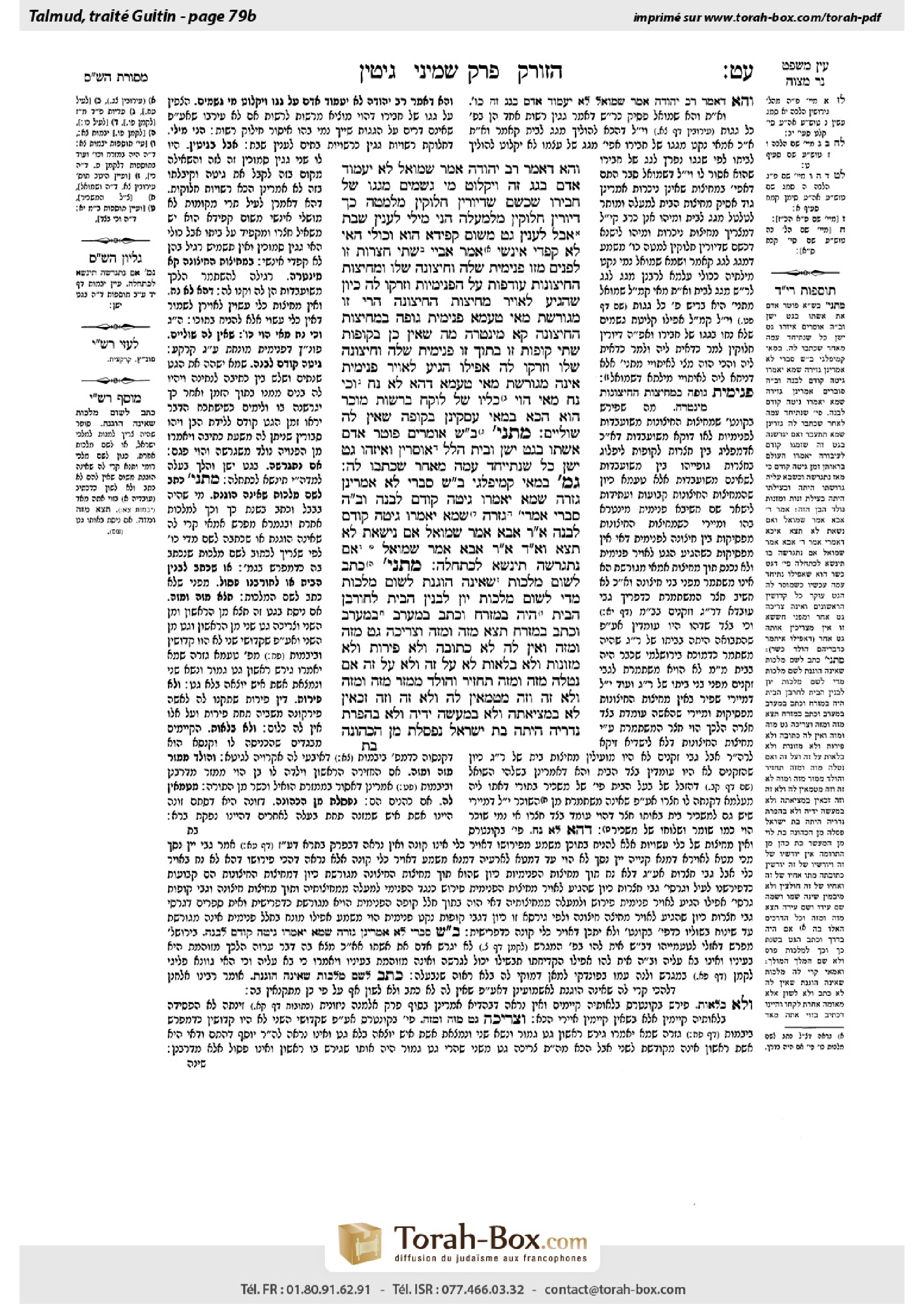
Gittin 79b: Talmud study for Daf Yomi
Study the Talmud for Daf Yomi with scanned pages, Hebrew text, English translations from Sefaria and AI-generated French translations.
Passage selection and English or AI-generated French translation are available where the scan has annotations. Daf Study is independent of Torah-Box and Sefaria.
Browse Gittin · גיטין · All tractatesGittin 79b text and translations
This page of Gittin includes the Aramaic text, an English translation and an AI-generated French translation, alongside the scan above.
גיטין ע״ט ב · Aramaic and Hebrew text
וְהָא דְּאָמַר רַב יְהוּדָה אָמַר שְׁמוּאֵל: לֹא יַעֲמוֹד אָדָם בְּגַג זֶה וְיִקְלוֹט מֵי גְשָׁמִים מִגַּגּוֹ שֶׁל חֲבֵירוֹ, שֶׁכְּשֵׁם שֶׁדִּיּוּרִין חֲלוּקִין מִלְּמַטָּה, כָּךְ דִּיּוּרִין חֲלוּקִין מִלְּמַעְלָה –
הָנֵי מִילֵּי לְעִנְיַן שַׁבָּת, אֲבָל לְעִנְיַן גֵּט – מִשּׁוּם קְפִידָא הוּא, וְכוּלֵּי הַאי לָא קָפְדִי אִינָשֵׁי.
אָמַר אַבָּיֵי: שְׁתֵּי חֲצֵרוֹת זוֹ לִפְנִים מִזּוֹ, פְּנִימִית שֶׁלָּהּ וְחִיצוֹנָה שֶׁלּוֹ, וּמְחִיצוֹת הַחִיצוֹנוֹת עוֹדְפוֹת עַל הַפְּנִימִיּוֹת; וּזְרָקוֹ לָהּ; כֵּיוָן שֶׁהִגִּיעַ לַאֲוִיר מְחִיצוֹת הַחִיצוֹנָה – הֲרֵי זוֹ מְגוֹרֶשֶׁת.
מַאי טַעְמָא? פְּנִימִית גּוּפַהּ – בִּמְחִיצוֹת הַחִיצוֹנָה קָא מִינַּטְרָה.
מַה שֶּׁאֵין כֵּן בְּקוּפּוֹת – שְׁתֵּי קוּפּוֹת זוֹ בְּתוֹךְ זוֹ, פְּנִימִית שֶׁלָּהּ וְחִיצוֹנָה שֶׁלּוֹ; וּזְרָקוֹ לָהּ; אֲפִילּוּ הִגִּיעַ לַאֲוִיר פְּנִימִית – אֵינָהּ מְגוֹרֶשֶׁת.
מַאי טַעְמָא? דְּהָא לָא נָח.
וְכִי נָח מַאי הָוֵי? כִּלְיוֹ שֶׁל לוֹקֵחַ בִּרְשׁוּת מוֹכֵר הוּא!
הָכָא בְּמַאי עָסְקִינַן – בְּקוּפָּה שֶׁאֵין לָהּ שׁוּלַיִים.
מַתְנִי׳ בֵּית שַׁמַּאי אוֹמְרִים: פּוֹטֵר אָדָם אִשְׁתּוֹ בְּגֵט יָשָׁן. וּבֵית הִלֵּל אוֹסְרִין. וְאֵיזֶהוּ גֵּט יָשָׁן – כֹּל שֶׁנִּתְיַיחֵד עִמָּהּ מֵאַחַר שֶׁכְּתָבוֹ לָהּ.
גְּמָ׳ בְּמַאי קָמִיפַּלְגִי? בֵּית שַׁמַּאי סָבְרִי: לָא אָמְרִינַן גְּזֵרָה שֶׁמָּא יֹאמְרוּ גִּיטָּהּ קוֹדֵם לִבְנָהּ;
וּבֵית הִלֵּל סָבְרִי: אָמְרִינַן גְּזֵרָה שֶׁמָּא יֹאמְרוּ גִּיטָּהּ קוֹדֵם לִבְנָהּ.
אָמַר רַבִּי אַבָּא אָמַר שְׁמוּאֵל: אִם נִישֵּׂאת, לֹא תֵּצֵא.
וְאִיכָּא דְּאָמְרִי, אָמַר רַבִּי אַבָּא אָמַר שְׁמוּאֵל: אִם נִתְגָּרְשָׁה, תִּינָּשֵׂא לְכַתְּחִלָּה.
מַתְנִי׳ כָּתַב לְשׁוּם מַלְכוּת שֶׁאֵינָהּ הוֹגֶנֶת; לְשׁוּם מַלְכוּת מָדַי; לְשׁוּם מַלְכוּת יָוָן; לְבִנְיַן הַבַּיִת; לְחוּרְבַּן הַבַּיִת;
הָיָה בַּמִּזְרָח וְכָתַב בַּמַּעֲרָב; בַּמַּעֲרָב וְכָתַב בַּמִּזְרָח – תֵּצֵא מִזֶּה וּמִזֶּה, וּצְרִיכָה גֵּט מִזֶּה וּמִזֶּה.
וְאֵין לָהּ לֹא כְּתוּבָּה וְלֹא פֵּירוֹת וְלֹא מְזוֹנוֹת וְלֹא בְּלָאוֹת – לֹא עַל זֶה, וְלֹא עַל זֶה.
אִם נָטְלָה מִזֶּה וּמִזֶּה – תַּחְזִיר. וְהַוָּלָד מַמְזֵר מִזֶּה וּמִזֶּה. וְלֹא זֶה וָזֶה מְטַמְּאִין לָהּ, וְלֹא זֶה וָזֶה זַכָּאִין – לֹא בִּמְצִיאָתָהּ וְלֹא בְּמַעֲשֵׂה יָדֶיהָ וְלֹא בַּהֲפָרַת נְדָרֶיהָ.
הָיְתָה בַּת יִשְׂרָאֵל – נִפְסֶלֶת מִן הַכְּהוּנָּה.
Gittin 79b · English translation
And the third matter relates to that which Rav Yehuda says that Shmuel says: On Shabbat a person should not stand on this roof and collect rainwater from the roof of another if there is no joining of courtyards. As just as the residences are separated below, so too, the residences are separated above. Each residence has a separate domain, and it is forbidden by rabbinic law to transfer an item from a private domain to another private domain if they are not joined. Similarly, despite the fact that the roofs are not totally separated from one another and nobody lives there, each roof is considered to be its own domain.
Rava explains: This matter applies only with regard to Shabbat. But with regard to a bill of divorce, if it fell onto another roof that is adjacent to the roof that he lent her for the purpose of acquiring the bill of divorce, she is divorced. The reason that a woman is usually not divorced when a bill of divorce falls into a different place, even though that place also belongs to her husband, is due to the fact that a husband is particular and does not want to lend her more than one place; but people are not particular to that extent, i.e., in this case the husband would not be particular about allowing her to temporarily use an adjacent rooftop that also belongs to him.
§ Abaye says: If there are two courtyards that are configured such that this courtyard is within that courtyard, and the inner courtyard is hers and the outer courtyard is his, and the partitions of the outer courtyard extend higher than the partitions of the inner courtyard, and he threw a bill of divorce to her into her courtyard, once it reaches the airspace of the partitions of the outer courtyard, i.e., it reaches the area above the inner courtyard at a height lower than the height of the partitions of the outer courtyard, she is divorced.
What is the reason for this? The inner courtyard itself is secured by the partitions of the outer courtyard. Therefore, the outer partitions service the inner courtyard as well. If the bill of divorce is secured by being encompassed by the outer partitions, it can be viewed as belonging to the inner courtyard once it reaches its airspace.
The Gemara comments: This is not so with regard to baskets. In a case where there were two baskets, this one within that one, resting in a domain that does not belong to either of them, and the inner basket is hers and the outer basket is his, and he threw a bill if divorce to her into her basket, even if the bill of divorce reached the airspace of the inner basket but was burned or taken before it landed therein, she is not divorced.
What is the reason for this? It is because the bill of divorce did not yet rest within the basket, and in this case, the walls of the outer basket do not service the inner basket.
The Gemara asks: And when it rests within the basket, what of it? They are like the vessels of a buyer in the domain of the seller, since her basket is within his basket, which is his domain. She cannot acquire the bill of divorce, despite the fact that it is in her basket, since it is within his domain.
The Gemara answers: With what are we dealing here? With a basket that has no bottom, and consequently the inner basket is resting on the ground and not inside the outer basket. Therefore, once the bill of divorce lands inside the inner basket, she is indeed divorced.
MISHNA: Beit Shammai say: A man may send, i.e., divorce, his wife with an outdated bill of divorce, and Beit Hillel prohibit him from doing so. And what is an outdated bill of divorce? Any case where he was secluded with her after he wrote it for her and before he gave it to her.
GEMARA: The Gemara explains: With regard to what do they disagree? Beit Shammai hold that we do not say that the bill of divorce is not valid due to a rabbinic decree, lest they say that receipt of her bill of divorce precedes conception of her son. If he gives her the bill of divorce long after it was written, she may give birth to children from him in the interim. There is a concern that people will say that she was actually divorced on the date written on the bill of divorce before the children were born, and the children were conceived through licentious sexual intercourse.
And Beit Hillel hold that we do say that this bill of divorce is not valid due to a rabbinic decree, lest they say that receipt of her bill of divorce precedes conception of her son. Consequently, if a woman was secluded with her husband following the writing of the bill of divorce, the bill of divorce is not valid.
Rabbi Abba says that Shmuel says: Even according to Beit Hillel, if the woman was married on the basis of an outdated bill of divorce given to her by her previous husband, who did not ask advice from the rabbis, she need not leave her second husband. In such a case, this decree is not severe enough to invalidate the bill of divorce.
And there are those who say that Rabbi Abba says that Shmuel says: If she was divorced with an outdated bill of divorce, this woman can marry even ab initio on the basis of this bill of divorce. There is no requirement for her to wait for her first husband to write her a new bill of divorce.
MISHNA: If he wrote the date on the bill of divorce using a calendrical system that counts years in the name of a kingdom that is not legitimate, or he wrote the date in the name of the kingdom of Media, or in the name of the Greek Empire, after it ceased to exist, or he wrote the date counting to the building of the Temple, or counting to the destruction of the Temple, in all these case, the bill of divorce is not valid. In the time of the mishna, the local government was particular that documents be dated with the official government date. Therefore, the Sages instituted that this must be done in bills of divorce as well. If one deviates from this practice, the rabbinic dictates of bills of divorce have been violated, and the bill of divorce is invalid.
If he was in the east and he wrote the location in the bill of divorce as in the west, or if he was in the west and he wrote the location in the bill of divorce as in the east, the bill of divorce is not valid. If he divorced her with this bill of divorce and she remarried, she must leave both this first husband and that second husband, and she needs a bill of divorce from this husband and that husband.
And she does not receive payment of her marriage contract, and not the profits from her properties that her husband consumed, and she does not have a claim to receive sustenance, and she does not have a claim to worn clothes that belonged to her, but which her husband used. She cannot demand these items, not of this husband and not of that husband.
If she took any of these items from this husband or from that husband, she must return what was taken. And the child that was born from this husband or from that husband that was conceived after she married the second husband is a son born from an adulterous relationship [mamzer]. And neither this husband nor that husband, if they are priests, is permitted to become ritually impure by her when she dies, which a husband may ordinarily do for his wife. And neither this husband nor that husband have the rights to objects she finds, or to her earnings, or to the annulment of her vows.
If she was an Israelite woman, then through these two marriages she becomes disqualified from marrying into the priesthood, due to the prohibition against a priest marrying a zona.
Gittin 79b · Traduction française (IA)
Et la troisième affaire concerne ce que Rav Yéhuda dit que Shmuel dit : Le sabbat, une personne ne doit pas se tenir sur ce toit pour recueillir l'eau de pluie provenant du toit d'une autre maison, si les courtyards ne sont pas joints. Comme les habitations sont séparées en bas, ainsi les habitations sont séparées en haut. Chaque maison a sa propre domaine, et il est interdit par la loi rabbinique de transférer un objet d'un domaine privé à un autre domaine privé s'ils ne sont pas joints. De même, malgré le fait que les toits ne sont pas totalement séparés les uns des autres et que personne n'y habite, chaque toit est considéré comme ayant sa propre domaine.
Rava explique : Cette affaire s'applique uniquement au sabbat. Mais concernant un acte de divorce, si celui-ci tombe sur un autre toit qui est adjacent au toit qu'il lui a prêté à l'effet d'acquérir l'acte de divorce, elle est divorcée. La raison pour laquelle une femme n'est généralement pas divorcée lorsque l'acte de divorce tombe dans un lieu différent, même si ce lieu appartient également à son mari, est que le mari est exigeant et ne veut pas lui prêter plus d'un lieu ; mais les gens ne sont pas exigeants à ce point, c'est-à-dire, dans ce cas, le mari ne serait pas exigeant à l'idée de lui permettre de temporairement utiliser un toit adjacent qui lui appartient également.
§ Abaye dit : Si deux courtyards sont configurés de telle sorte que ce courtyard est à l'intérieur de celui-ci, et que le courtyard intérieur est le sien et le courtyard extérieur est celui de l'autre, et que les cloisons du courtyard extérieur s'élèvent plus haut que les cloisons du courtyard intérieur, et qu'il a lancé un acte de divorce vers elle dans son courtyard, une fois que celui-ci atteint l'espace aérien des cloisons du courtyard extérieur, c'est-à-dire qu'il atteint la zone au-dessus du courtyard intérieur à une hauteur inférieure à la hauteur des cloisons du courtyard extérieur, elle est divorcée.
Quelle est la raison de cela ? Le courtil intérieur lui-même est sécurisé par les cloisons du courtil extérieur. Par conséquent, les cloisons extérieures servent également le courtil intérieur. Si l'acte de divorce est sécurisé en étant entouré par les cloisons extérieures, il peut être considéré comme appartenant au courtil intérieur une fois qu'il atteint son espace aérien.
La Guemara commente : Ce n'est pas le cas concernant les paniers. Dans un cas où il y avait deux paniers, celui-ci à l'intérieur de celui-ci, reposant dans un domaine qui n'appartient à aucun d'eux, et le panier intérieur est le sien et le panier extérieur est le sien, et qu'il a lancé un acte de divorce vers elle dans son panier, même si l'acte de divorce a atteint l'espace aérien du panier intérieur mais a été brûlé ou emporté avant d'y tomber, elle n'est pas divorcée.
Quelle est la raison de cela ? C'est parce que l'acte de divorce n'a pas encore reposé dans le panier, et dans ce cas, les parois du panier extérieur ne servent pas le panier intérieur.
La Guemara pose la question : Et lorsqu'il est dans le panier, qu'en est-il ? Ils sont comme les objets d'un acheteur dans le domaine du vendeur, puisque son panier est à l'intérieur de son panier, qui est son domaine. Elle ne peut pas acquérir l'acte de divorce, malgré le fait qu'il est dans son panier, puisqu'il est à l'intérieur de son domaine.
La Guemara répond : Avec quels paniers sommes-nous en train de parler ? Avec un panier qui n'a pas de fond, et par conséquent, le panier intérieur est posé sur le sol et non à l'intérieur du panier extérieur. Par conséquent, une fois que l'acte de divorce tombe à l'intérieur du panier intérieur, elle est effectivement divorcée.
MICHNA : Beit Shammai disent : Un homme peut envoyer, c'est-à-dire divorcer, sa femme avec un acte de divorce périmé, et Beit Hillel interdisent cela. Et qu'est-ce qu'un acte de divorce périmé ? Tout cas où il a été séparé d'elle après qu'il l'ait écrit pour elle et avant de lui l'offrir.
GUEMARA : La Guemara explique : À propos de quoi disputent-ils ? Beit Shammai considère que nous ne disons pas que l'acte de divorce n'est pas valide en raison d'un décret rabbinique, de peur qu'on dise que la réception de son acte de divorce précède la conception de son fils. S'il lui donne l'acte de divorce bien après qu'il l'ait écrit, elle peut donner naissance à des enfants de lui pendant l'intervalle. Il y a une crainte que les gens disent qu'elle était effectivement divorcée à la date inscrite sur l'acte de divorce avant que les enfants ne soient nés, et les enfants ont été conçus par un rapport sexuel licencieux.
Et Beit Hillel considère que nous disons que cet acte de divorce n'est pas valide en raison d'un décret rabbinique, de peur qu'on dise que la réception de son acte de divorce précède la conception de son fils. Par conséquent, si une femme a été séparée avec son mari après la rédaction de l'acte de divorce, l'acte de divorce n'est pas valide.
Rabbi Abba dit que Shmuel dit : Même selon Beit Hillel, si la femme a été mariée sur la base d'un acte de divorce périmé donné à elle par son mari précédent, qui n'a pas consulté les rabbins, elle n'a pas besoin de quitter son deuxième mari. Dans ce cas, ce décret n'est pas suffisamment sévère pour invalider l'acte de divorce.
Et il y a ceux qui disent que Rabbi Abba dit que Shmuel dit : Si elle a été divorcée avec un acte de divorce périmé, cette femme peut épouser même dès le début sur la base de cet acte de divorce. Il n'y a pas de nécessité pour elle d'attendre que son premier mari lui écrive un nouveau acte de divorce.
MICHNA : Si l'on a écrit la date sur le contrat de divorce en utilisant un système calendrierique qui compte les années au nom d'un royaume non légitime, ou s'il a écrit la date au nom du royaume de la Médie, ou au nom de l'Empire grec après qu'il eut cessé d'exister, ou s'il a écrit la date en comptant depuis la construction du Temple, ou en comptant depuis la destruction du Temple, dans tous ces cas, le contrat de divorce n'est pas valide. À l'époque de la Michna, la puissance locale exigeait que les documents soient datés avec la date officielle du gouvernement. Ainsi, les Sages ont institué que cela devait être fait également pour les contrats de divorce. Si l'on s'écarte de cette pratique, les ordonnances rabbiniques concernant les contrats de divorce ont été violées, et le contrat de divorce est invalide.
Si l'on était à l'est et qu'on a écrit la localisation sur le contrat de divorce comme si l'on était à l'ouest, ou si l'on était à l'ouest et qu'on a écrit la localisation sur le contrat de divorce comme si l'on était à l'est, le contrat de divorce n'est pas valide. Si l'on a divorcé avec ce contrat de divorce et qu'elle s'est remariée, elle doit quitter à la fois ce premier mari et ce second mari, et elle a besoin d'un contrat de divorce de ce mari et de ce second mari.
Et elle ne reçoit pas le paiement de son contrat de mariage, ni les profits de ses biens que son mari a consommés, et elle n'a pas le droit de demander de la subsistance, et elle n'a pas le droit de revendiquer des vêtements usagés qui appartenaient à elle, mais qu'elle a utilisés. Elle ne peut exiger ces objets, ni de ce mari ni de ce second mari.
Si elle a pris l'un de ces objets de ce mari ou de ce second mari, elle doit rendre ce qui a été pris. Et l'enfant né de ce mari ou de ce second mari, conçu après qu'elle ait épousé le second mari, est un fils né d'une relation adultère [mamzer]. Et ni ce mari ni ce second mari, s'ils sont des prêtres, ne sont autorisés à devenir impurs par elle lorsqu'elle meurt, ce que le mari peut normalement faire pour sa femme. Et ni ce mari ni ce second mari n'ont le droit aux objets qu'elle trouve, ou à ses revenus, ou à l'annulation de ses vœux.
Si elle était une femme israélite, alors par ces deux mariages elle devient inéligible à épouser un prêtre, en raison de l'interdiction d'un prêtre de se marier avec une zona.
Traduction française générée par IA à partir de l’édition anglaise de Sefaria. Vérifie toujours un passage avec le texte source.
Text from Sefaria: William Davidson Edition - Vocalized Aramaic (CC BY NC); William Davidson Edition - English (CC BY NC).