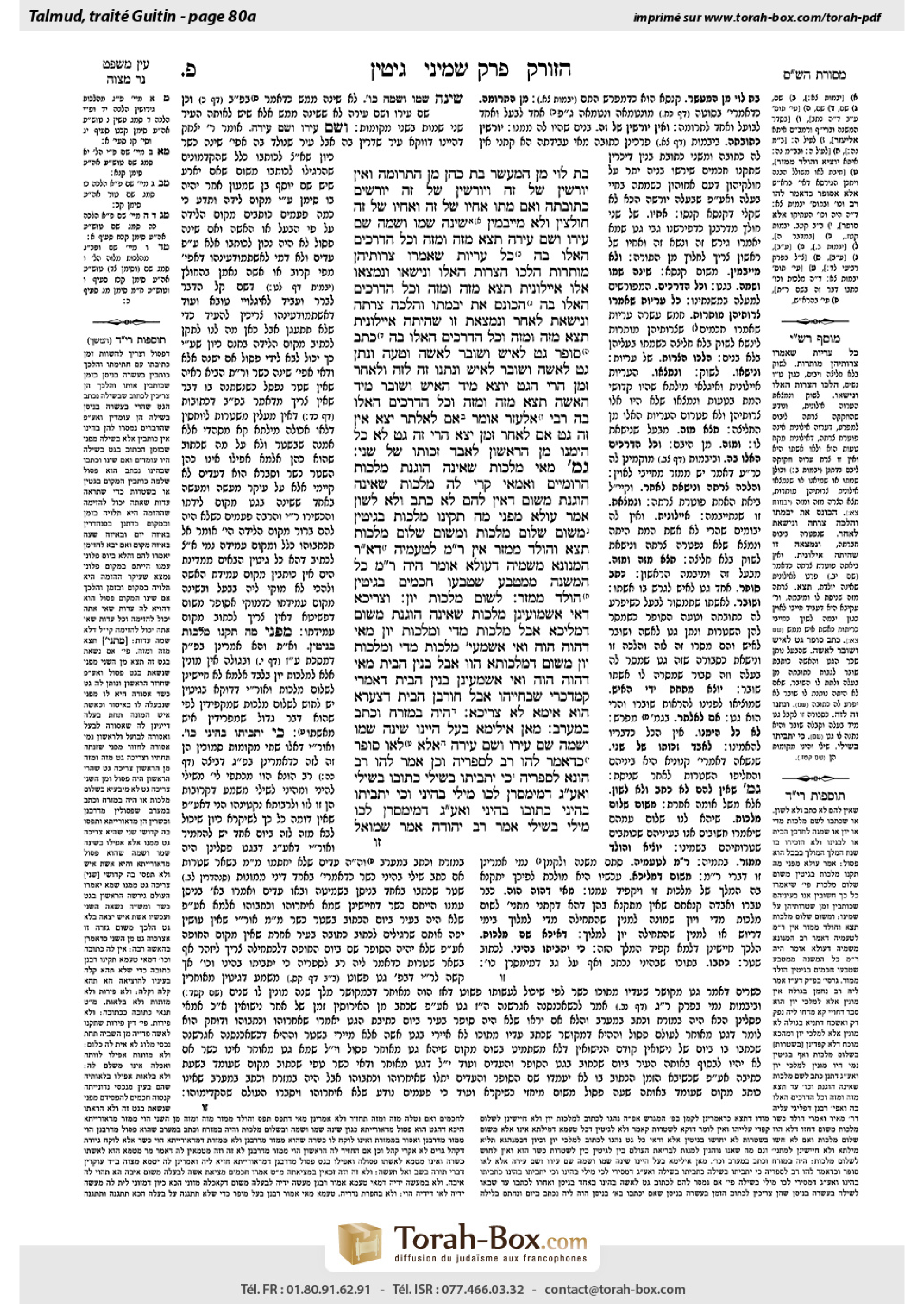
Gittin 80a: Talmud study for Daf Yomi
Study the Talmud for Daf Yomi with scanned pages, Hebrew text, English translations from Sefaria and AI-generated French translations.
Passage selection and English or AI-generated French translation are available where the scan has annotations. Daf Study is independent of Torah-Box and Sefaria.
Browse Gittin · גיטין · All tractatesGittin 80a text and translations
This page of Gittin includes the Aramaic text, an English translation and an AI-generated French translation, alongside the scan above.
גיטין פ׳ א · Aramaic and Hebrew text
בַּת לֵוִי – מִן הַמַּעֲשֵׂר. בַּת כֹּהֵן – מִן הַתְּרוּמָה.
וְאֵין יוֹרְשִׁין שֶׁל זֶה וְיוֹרְשִׁין שֶׁל זֶה יוֹרְשִׁים כְּתוּבָּתָהּ. וְאִם מֵתוּ – אָחִיו שֶׁל זֶה וְאָחִיו שֶׁל זֶה חוֹלְצִין, וְלֹא מְיַיבְּמִין.
שִׁינָּה שְׁמוֹ, וּשְׁמָהּ, שֵׁם עִירוֹ, וְשֵׁם עִירָהּ – תֵּצֵא מִזֶּה וּמִזֶּה, וְכׇל הַדְּרָכִים הָאֵלּוּ בָּהּ.
כׇּל עֲרָיוֹת שֶׁאָמְרוּ ״צָרוֹתֵיהֶן מוּתָּרוֹת״ –
הָלְכוּ הַצָּרוֹת הָאֵלּוּ וְנִישְּׂאוּ, וְנִמְצְאוּ אֵלּוּ אַיְילוֹנִיֹּת – תֵּצֵא מִזֶּה וּמִזֶּה, וְכׇל הַדְּרָכִים הָאֵלּוּ בָּהּ.
הַכּוֹנֵס אֶת יְבִמְתּוֹ, וְהָלְכָה צָרָתָהּ וְנִישֵּׂאת לְאַחֵר, וְנִמְצֵאת זוֹ – שֶׁהָיְתָה אַיְילוֹנִית; תֵּצֵא מִזֶּה וּמִזֶּה, וְכׇל הַדְּרָכִים הָאֵלּוּ בָּהּ.
כָּתַב סוֹפֵר גֵּט לָאִישׁ, וְשׁוֹבָר לָאִשָּׁה; וְטָעָה וְנָתַן גֵּט לָאִשָּׁה, וְשׁוֹבָר לָאִישׁ, וְנָתְנוּ זֶה לָזֶה;
וּלְאַחַר זְמַן הֲרֵי הַגֵּט יוֹצֵא מִיַּד הָאִישׁ וְשׁוֹבָר מִיַּד הָאִשָּׁה – תֵּצֵא מִזֶּה וּמִזֶּה, וְכׇל הַדְּרָכִים הָאֵלּוּ בָּהּ.
רַבִּי אֶלְעָזָר אוֹמֵר: אִם לְאַלְתַּר יָצָא, אֵין זֶה גֵּט; אִם לְאַחַר זְמַן יָצָא, הֲרֵי זֶה גֵּט – לֹא כָּל הֵימֶנּוּ מִן הָרִאשׁוֹן לְאַבֵּד זְכוּתוֹ שֶׁל שֵׁנִי.
גְּמָ׳ מַאי ״מַלְכוּת שֶׁאֵינָהּ הוֹגֶנֶת״? רוֹמִי. וְאַמַּאי קָרֵי לַהּ מַלְכוּת שֶׁאֵינָהּ הוֹגֶנֶת? מִשּׁוּם דְּאֵין לָהֶם לֹא כְּתָב, וְלֹא לָשׁוֹן.
אָמַר עוּלָּא: מִפְּנֵי מָה תִּיקְּנוּ מַלְכוּת בְּגִיטִּין – מִשּׁוּם שְׁלוֹם מַלְכוּת.
וּמִשּׁוּם שְׁלוֹם מַלְכוּת – תֵּצֵא וְהַוָּלָד מַמְזֵר?!
אִין, רַבִּי מֵאִיר לְטַעְמֵיהּ – דְּאָמַר רַב הַמְנוּנָא מִשְּׁמֵיהּ דְּעוּלָּא, אוֹמֵר הָיָה רַבִּי מֵאִיר: כָּל הַמְשַׁנֶּה מִמַּטְבֵּעַ שֶׁטָּבְעוּ חֲכָמִים בְּגִיטִּין – הַוָּלָד מַמְזֵר.
לְשׁוּם מַלְכוּת יָוָן. וּצְרִיכָא; דְּאִי אַשְׁמוֹעִינַן מַלְכוּת שֶׁאֵינָהּ הוֹגֶנֶת – מִשּׁוּם דִּמְלִיכָא; אֲבָל מַלְכוּת מָדַי וּמַלְכוּת יָוָן – מַאי דַהֲוָה הֲוָה;
וְאִי אַשְׁמְעִינַן מַלְכוּת מָדַי וּמַלְכוּת יָוָן – מִשּׁוּם דְּמַלְכְוָתָא הָווּ; אֲבָל בִּנְיַן הַבַּיִת – מַאי דַהֲוָה הֲוָה;
וְאִי אַשְׁמְעִינַן בִּנְיַן הַבַּיִת – דְּאָמְרִי: קָמַדְכְּרִי שְׁבָחַיְיהוּ; אֲבָל חוּרְבַּן הַבַּיִת, דְּצַעֲרָא הוּא – אֵימָא לָא; צְרִיכָא.
הָיָה בַּמִּזְרָח וְכָתַב בַּמַּעֲרָב: מַאן? אִילֵּימָא בַּעַל, הַיְינוּ ״שִׁינָּה שְׁמוֹ וּשְׁמָהּ, שֵׁם עִירוֹ וְשֵׁם עִירָהּ״!
אֶלָּא לָאו סוֹפֵר – כְּדַאֲמַר לְהוּ רַב לְסָפְרֵיהּ, וְכֵן אֲמַר לְהוּ רַב הוּנָא לְסָפְרֵיהּ: כִּי יָתְבִיתוּ בְּשִׁילֵי, כְּתוּבוּ בְּשִׁילֵי; וְאַף עַל גַּב דְּמִימַּסְרָן לְכוּ מִילֵּי בְּהִינֵי. וְכִי יָתְבִיתוּ בְּהִינֵי, כְּתוּבוּ בְּהִינֵי; וְאַף עַל גַּב דְּמִימַּסְרָן לְכוּ מִילֵּי בְּשִׁילֵי.
אָמַר רַב יְהוּדָה אָמַר שְׁמוּאֵל:
Gittin 80a · English translation
If she was the daughter of a Levite, through these two marriages she becomes prohibited from partaking of the tithe that is given to Levites. If she was the daughter of a priest, she becomes prohibited from partaking of teruma, even after she returns to the house of her father the priest.
And the heirs of this husband and the heirs of that husband do not inherit the rights to collect payment of her marriage contract if she dies. And if the husbands die, the brother of this first husband and the brother of that second husband perform ḥalitza, since she was betrothed to the second one as well, and they do not consummate the levirate marriage.
The mishna proceeds to teach an additional halakha concerning a bill of divorce written not in accordance with its halakhot: If he changed his name, i.e., he wrote a different name in the bill of divorce, or he changed her name, or if he changed the name of his city or the name of her city, and she remarried on the basis of this bill of divorce, then she must leave both this first husband and that second husband. And all of those above-mentioned ways of penalizing a woman who remarried based on the bills of divorce detailed in the earlier clause of the mishna apply to her in this case as well.
The mishna teaches another halakha associated with the previous halakhot: With regard to all of those cases in which they said that a man who died without children and left behind a widow who is, to the man’s brother, one of those with whom relations are forbidden, e.g., she is his wife’s sister, not only is there no levirate bond for her, but the rival wives of the brother who died are also permitted to marry without either levirate marriage or ḥalitza.
The mishna discusses another case: These rival wives went and married another man without ḥalitza, and these widows with whom relationships were forbidden were found to be sexually underdeveloped women incapable of bearing children [ailonit]. Therefore, it became clear, retroactively, that the marriage to the dead brother was never valid, and accordingly, the rival wives were never exempt from the obligation of levirate marriage due to their being the rival wives of a forbidden relationship. Consequently, the rival wives were forbidden to marry anyone else without ḥalitza, and the rival wives must leave both this man whom they remarried, and that yavam, i.e., they cannot enter into levirate marriage with him. And all of those above-mentioned ways of penalizing a woman who remarried based on the bills of divorce detailed in the earlier clause of the mishna apply to her in this case as well.
Similarly, with regard to one who marries his yevama, and her rival wife went and got married to another man, and it was found that this yevama was a sexually underdeveloped woman, the rival wife must leave this man whom she remarried and that yavam, i.e., she cannot enter into levirate marriage with him. Because the yevama was a sexually underdeveloped woman, the obligation of levirate marriage never applied to her, and her levirate marriage did not exempt her rival wife. And all of those aforementioned ways of penalizing a woman who remarried based on the bills of divorce detailed in the earlier clause of the mishna apply to her in this case as well.
The mishna now discusses another case: A scribe wrote a bill of divorce for a man, so that the man could divorce his wife with it; and he wrote a receipt for the woman, for her to give to her husband upon receiving payment of her marriage contract, verifying that she received the payment. And the scribe erred and gave the bill of divorce to the woman and the receipt to the man, and not knowing what was written in the documents that were in their possession, they gave what they received from the scribe to each other. The woman gave her husband a bill of divorce and the husband gave his wife a receipt, and consequently, there was no divorce at all.
And after some time, the bill of divorce is in the possession of the man, and the receipt is in the possession of the woman, and they discover that the divorce never actually transpired. If the woman had remarried another man, she must leave this, the first husband, and that, the second husband. And all of those above-mentioned ways of penalizing a woman who remarried based on the bills of divorce detailed in the earlier clause of the mishna apply to her in this case as well.
Rabbi Elazar says: If the bill of divorce is immediately [le’altar] in the husband’s possession, this is not a valid bill of divorce, since he clearly never gave it to her. But if it is in his possession after some time, then this is a valid bill of divorce, since it is not in the power of the first husband to eliminate the right of the second husband. The assumption is that the husband did in fact give her the bill of divorce in the correct manner, but at some point, he took it back from her.
GEMARA: It was stated in the mishna that if one wrote the date on a bill of divorce according to a kingdom that is not legitimate, it is invalid. The Gemara asks: What is the meaning of the description: A kingdom that is not legitimate? The Gemara answers: This is referring to the Roman Empire, and he wrote the bill of divorce in a different country, such as Babylonia, where the Romans were not in power. And why is it called: A kingdom that is not legitimate? Because they have neither their own script, nor their own language, but rather, they took them from other nations.
Ulla said: For what reason did the Sages institute that the date should be written according to the years of the local kingdom, in bills of divorce? Due to the need to maintain peaceful relations with the kingdom, as the government is particular that important documents issued in its domain be written with the date of that government.
The Gemara asks: But due to an ordinance instituted by the Sages solely for the sake of maintaining peaceful relations with the kingdom, would they be so stringent that the woman would be forced to leave her husband, and they would declare the status of the offspring is a mamzer?
The Gemara answers: Yes. Rabbi Meir conforms to his line of reasoning. As Rav Hamnuna says in the name of Ulla: Rabbi Meir would say that anyone deviating from the formula coined by the Sages for bills of divorce, even if it is only a minor deviation, the bill of divorce is invalid, and if the woman remarried on the basis of this bill of divorce, then the offspring from that marriage is a mamzer.
It was stated in the mishna: If he wrote the date on a bill of divorce in the name of the Greek Empire, then the bill of divorce is invalid. The Gemara comments: And it is necessary to state this halakha and the other halakhot as well. As, if the mishna had taught us this halakha only with regard to a kingdom that is not legitimate, one could say that the bill of divorce is invalid because this kingdom is currently ruling, and the local government where he is writing the bill of divorce therefore objects to his writing the date of an another kingdom. But with regard to the kingdom of Media, and the Greek Empire, it is not necessary to invalidate the bill of divorce, since what was, was, and since these kingdoms are no longer in power, the local government is not particular if they are mentioned in a document.
And if the mishna had taught us this halakha with regard to the kingdom of Media and the Greek Empire, one could understand the concern, because they were kingdoms, and the current government objects to another kingdom being mentioned in a document. But if he wrote the date counting to the building of the Temple, then one could say what was, was, and the local government is not particular if this is mentioned in a document. Consequently, it was necessary for the mishna to teach us this halakha as well.
And if the mishna had taught us this halakha with regard to the building of the Temple, then one could say that the reason why this is problematic is because the governments will say: The Jews mention their own praise, instead of honoring the ruling government. But with regard to the destruction of the Temple, which is a cause of anguish for us, say that no, the government is not particular about this. Therefore it is necessary to mention all of these halakhot.
§ It was stated in the mishna, that if he was in the east and he wrote the location in the bill of divorce as in the west, then the bill of divorce is invalid. The Gemara asks: Who is the mishna discussing? If we say that the place of the husband was changed, then this is the same as what is stated later on in the mishna: He changed his name, or her name; the name of his city or the name of her city.
Rather, is it not referring to a scribe who changed the place in which the bill of divorce was written, and did not record the correct location where he was when he wrote the bill of divorce? As Rav said to his scribes, and similarly, Rav Huna said to his scribes: When you are situated in the place called Shili, write the location of the document as: In Shili, even though the matters were presented to you, i.e., the transaction recorded in the document took place, in the place called Hini. And when you are situated in the place called Hini, write: In Hini, even though the matters were presented to you in Shili. One must be careful to write the precise location where the document was written and not somewhere else, as that is considered an illegitimate deviation.
Rav Yehuda says that Shmuel says:
Gittin 80a · Traduction française (IA)
Si elle était la fille d'un Lévite, par ces deux mariages elle devient interdite de consommer la tithe donnée aux Lévitiques. Si elle était la fille d'un prêtre, elle devient interdite de consommer la terouma, même après qu'elle soit revenue chez son père, le prêtre.
Et les héritiers de ce mari et les héritiers de ce second mari n'héritent pas des droits de réclamer le paiement du contrat de mariage si elle meurt. Et si les maris meurent, le frère de ce premier mari et le frère de ce second mari accomplissent la ḥalitza, puisqu'elle était fiancée au second également, et ils ne consomment pas le mariage levirique.
La mitsna poursuit pour enseigner une autre halakha concernant un divorce écrit contrairement à ses halakhot : Si il a changé son nom, c'est-à-dire s'il a écrit un autre nom dans le divorce, ou s'il a changé le nom de sa femme, ou s'il a changé le nom de sa ville ou celui de la ville de sa femme, et qu'elle s'est remariée sur la base de ce divorce, alors elle doit quitter à la fois ce premier mari et ce second mari. Et toutes les méthodes mentionnées ci-dessus de pénaliser une femme qui s'est remariée sur la base des divorces décrits dans la clause précédente de la mitsna s'appliquent également à elle dans ce cas.
La mitsna enseigne une autre halakha liée aux halakhot précédentes : Concernant tous ces cas où on dit qu'un homme est mort sans enfants et a laissé derrière lui une veuve qui, pour le frère de cet homme, est l'une de celles avec lesquelles les relations sont interdites, par exemple, elle est la sœur de sa femme, non seulement il n'y a pas de lien levirique pour elle, mais les épouses rivales du frère décédé sont également permises à se marier sans mariage levirique ni ḥalitza.
La mitsna discute d'un autre cas : Ces épouses rivales sont allées se marier à un autre homme sans ḥalitza, et ces veuves avec lesquelles les relations étaient interdites ont été trouvées être des femmes sexuellement sous-développées incapables d'avoir des enfants [ailonit]. Ainsi, il est devenu clair, de manière rétrospective, que le mariage avec le frère décédé n'était jamais valide, et par conséquent, les épouses rivales n'étaient jamais exemptées de l'obligation du mariage levirique en raison d'être les épouses rivales d'une relation interdite. En conséquence, les épouses rivales étaient interdites de se marier avec quelqu'un d'autre sans ḥalitza, et les épouses rivales doivent quitter à la fois cet homme qu'elles ont remarié et ce yavam, c'est-à-dire qu'elles ne peuvent pas entrer en mariage levirique avec lui. Et toutes les méthodes mentionnées ci-dessus de pénaliser une femme qui s'est remariée sur la base des divorces décrits dans la clause précédente de la mitsna s'appliquent également à elle dans ce cas.
De même, concernant celui qui épouse sa yevama, et son épouse rivale est allée se marier à un autre homme, et il a été trouvé que cette yevama était une femme sexuellement sous-développée, l'épouse rivale doit quitter cet homme qu'elle a remarié et ce yavam, c'est-à-dire qu'elle ne peut pas entrer en mariage levirique avec lui. Puisque la yevamah était une femme sexuellement sous-développée, l'obligation du mariage levirique n'était jamais applicable à elle, et son mariage levirique n'a pas exempté son épouse rivale. Et toutes les méthodes mentionnées ci-dessus de pénaliser une femme qui s'est remariée sur la base des divorces décrits dans la clause précédente de la mitsna s'appliquent également à elle dans ce cas.
La mitsna discute maintenant d'un autre cas : Un scribe a écrit un divorce pour un homme, afin que l'homme puisse divorcer de sa femme avec ; et il a écrit une récépisse pour la femme, pour qu'elle la donne à son mari lorsqu'elle recevra le paiement du contrat de mariage, confirmant qu'elle avait reçu le paiement. Et le scribe s'est trompé et a donné le divorce à la femme et la récépisse à l'homme, sans savoir ce qui était écrit dans les documents qui étaient en leur possession, ils ont donné ce qu'ils avaient reçu du scribe à l'autre. La femme a donné son mari un divorce et l'homme a donné sa femme une récépisse, et par conséquent, il n'y a eu aucun divorce.
Et après un certain temps, le divorce est en possession de l'homme et la récépisse est en possession de la femme, et ils découvrent que le divorce n'a jamais eu lieu. Si la femme s'était remariée avec un autre homme, elle doit quitter ce premier mari et ce second mari. Et toutes les méthodes mentionnées ci-dessus de pénaliser une femme qui s'est remariée sur la base des divorces décrits dans la clause précédente de la mitsna s'appliquent également à elle dans ce cas.
Rabbi Elazar dit : Si le divorce est immédiatement [le’altar] en possession du mari, ce n'est pas un divorce valide, puisqu'il est clair qu'il n'a jamais été donné à elle. Mais si c'est en possession de lui après un certain temps, alors c'est un divorce valide, puisqu'il n'est pas dans le pouvoir du premier mari d'effacer le droit du second mari. On suppose que le mari a effectivement donné le divorce à elle de la manière correcte, mais à un moment donné, il l'a récupéré.
GUEMARA : Il a été dit dans la mitsna que si l'on a écrit la date sur un divorce selon un royaume non légitime, il est invalide. La Guemara pose la question : De quoi la description : un royaume non légitime signifie-t-elle ? La Guemara répond : Cela fait référence à l'Empire romain, et il a écrit le divorce dans un autre pays, tel que Babylone, où les Romains n'étaient pas en pouvoir. Et pourquoi est-il appelé : un royaume non légitime ? Parce qu'ils n'ont ni leur propre script ni leur propre langue, mais plutôt, ils les ont pris d'autres nations.
Ulla dit : Pour quelle raison les Sages ont-ils institué que la date devait être écrite selon les années du royaume local dans les divorces ? En raison du besoin de maintenir des relations pacifiques avec le royaume, car le gouvernement est particulier que les documents importants émis dans son territoire soient écrits avec la date de ce gouvernement.
La Guemara pose la question : Mais en raison d’un ordonnance instituée par les Sages uniquement pour préserver les relations pacifiques avec la royauté, seraient-ils si exigeants que la femme serait contrainte de quitter son mari, et ils déclarent que le statut des enfants est celui d’un mamzer ?
La Guemara répond : Oui. Rabbi Meïr suit sa ligne de raisonnement. Comme Rav Hamnuna dit en nom de Ulla : Rabbi Meïr dirait que quiconque s’écarte de la formule établie par les Sages pour les documents de divorce, même s’il s’agit d’un écart mineur, le document de divorce est invalide, et si la femme se remarie sur la base de ce document de divorce, alors les enfants de ce mariage sont des mamzerim.
Il a été dit dans la mishna : Si l’on a écrit la date d’un document de divorce en nom de l’Empire grec, alors le document de divorce est invalide. La Guemara commente : Et il est nécessaire d’énoncer cette halakha ainsi que les autres halakhot. Car, si la mishna nous avait appris cette halakha uniquement concernant un royaume non légitime, on pourrait dire que le document de divorce est invalide parce que ce royaume règne actuellement, et que le gouvernement local où il a écrit le document de divorce s’oppose à l’indication d’un autre royaume. Mais concernant l’Empire médian et l’Empire grec, il n’est pas nécessaire d’invalidé le document de divorce, car ce qui était, est, et puisque ces royaumes ne règnent plus, le gouvernement local n’a pas d’objection à ce qu’ils soient mentionnés dans un document.
Et si la Michna nous avait appris cette halakha concernant l’Empire médian et l’Empire grec, on pourrait comprendre la préoccupation, car ce sont des royaumes, et le gouvernement actuel s’oppose à ce qu’un autre royaume soit mentionné dans un document. Mais si l’on a écrit la date en comptant depuis la construction du Temple, on pourrait dire que ce qui était, est, et le gouvernement local n’a pas d’objection à ce qu’il soit mentionné dans un document. Ainsi, il était nécessaire que la Michna nous apprenne cette halakha également.
Et si la Michna nous avait appris cette halakha concernant la construction du Temple, on pourrait dire que la raison pour laquelle cela est problématique est que les gouvernements diraient : Les Juifs mentionnent leur propre gloire, au lieu d’honorer le gouvernement actuel. Mais concernant la destruction du Temple, qui est une cause de chagrin pour nous, disons que non, le gouvernement n’a pas d’objection à cela. Ainsi, il était nécessaire d’énoncer toutes ces halakhot.
§ Il a été dit dans la Michna que si l’on était à l’est et qu’on a écrit la localisation dans le document de divorce comme si l’on était à l’ouest, alors le document de divorce est invalide. La Guemara pose la question : De qui la Michna parle-t-elle ? Si l’on dit que la place du mari a changé, alors c’est la même chose que ce qui est dit plus tard dans la Michna : Il a changé son nom, ou son épouse ; le nom de sa ville ou le nom de la ville de son épouse.
Plutôt, n’est-ce pas plutôt parler d’un scribe qui a changé la localisation où le document de divorce a été écrit, et n’a pas inscrit la localisation correcte où il était lorsqu’il a écrit le document de divorce ? Comme Rav a dit à ses scribes, et de même, Rav Huna a dit à ses scribes : Quand vous êtes situés dans la place appelée Shili, écrivez la localisation du document comme : À Shili, même si les affaires ont été présentées à vous, c’est-à-dire la transaction enregistrée dans le document a eu lieu, dans la place appelée Hini. Et quand vous êtes situés dans la place appelée Hini, écrivez : À Hini, même si les affaires ont été présentées à vous à Shili. Il faut être vigilant pour écrire la localisation exacte où le document a été écrit et pas ailleurs, car cela est considéré comme un écart illégitime.
Rav Yéhuda dit que Shmuel dit :
Traduction française générée par IA à partir de l’édition anglaise de Sefaria. Vérifie toujours un passage avec le texte source.
Text from Sefaria: William Davidson Edition - Vocalized Aramaic (CC BY NC); William Davidson Edition - English (CC BY NC).