Gittin 80b: Talmud study for Daf Yomi
Study the Talmud for Daf Yomi with scanned pages, Hebrew text, English translations from Sefaria and AI-generated French translations.
Passage selection and English or AI-generated French translation are available where the scan has annotations. Daf Study is independent of Torah-Box and Sefaria.
Browse Gittin · גיטין · All tractatesGittin 80b text and translations
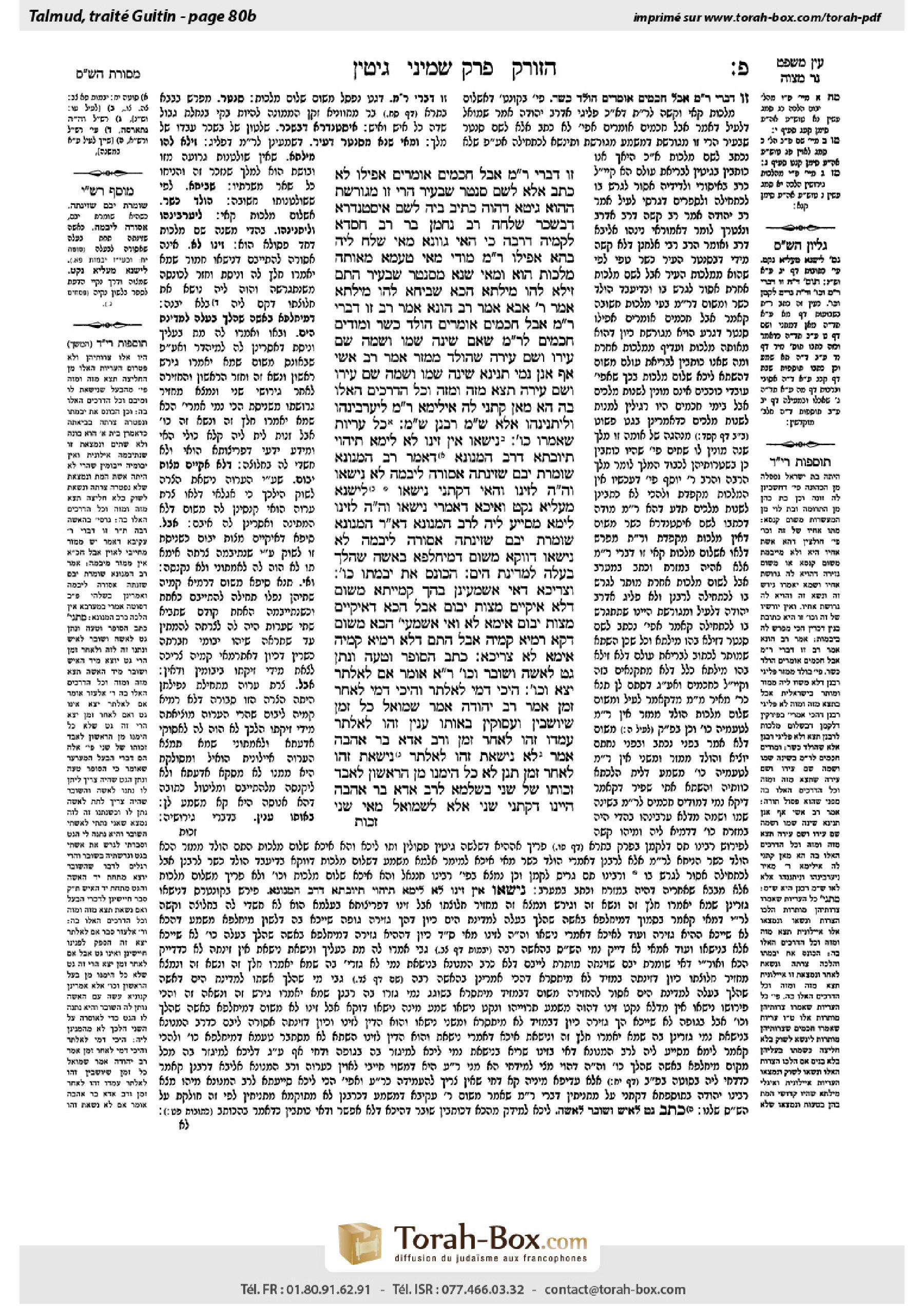
This page of Gittin includes the Aramaic text, an English translation and an AI-generated French translation, alongside the scan above.
גיטין פ׳ ב · Aramaic and Hebrew text
זוֹ דִּבְרֵי רַבִּי מֵאִיר, אֲבָל חֲכָמִים אוֹמְרִים: אֲפִילּוּ לֹא כָּתַב אֶלָּא לְשֵׁם סַנְטָר שֶׁבָּעִיר – הֲרֵי זוֹ מְגוֹרֶשֶׁת.
הָהוּא גִּיטָּא דַּהֲוָה כְּתִיב בֵּיהּ לְשֵׁם אִיסְטַנְדְּרָא דְּבַשְׁכָּר, שַׁלְחֵהּ רַב נַחְמָן בַּר רַב חִסְדָּא לְקַמֵּיהּ דְּרַבָּה: כִּי הַאי גַוְונָא, מַאי?
שְׁלַח לֵיהּ: בְּהָא אֲפִילּוּ רַבִּי מֵאִיר מוֹדֵי, מַאי טַעְמָא? מֵאוֹתָהּ מַלְכוּת הוּא.
וּמַאי שְׁנָא מִסַּנְטָר שֶׁבָּעִיר? הָתָם זִילָא לְהוּ מִילְּתָא, הָכָא שְׁבִיחָא לְהוּ מִילְּתָא.
אָמַר רַבִּי אַבָּא אָמַר רַב הוּנָא אָמַר רַב: זוֹ דִּבְרֵי רַבִּי מֵאִיר, אֲבָל חֲכָמִים אוֹמְרִים: הַוָּלָד כָּשֵׁר. וּמוֹדִים חֲכָמִים לְרַבִּי מֵאִיר, שֶׁאִם שִׁינָּה שְׁמוֹ וּשְׁמָהּ, שֵׁם עִירוֹ וְשֵׁם עִירָהּ – שֶׁהַוָּלָד מַמְזֵר.
אָמַר רַב אָשֵׁי, אַף אֲנַן נָמֵי תְּנֵינָא: שִׁינָּה שְׁמוֹ וּשְׁמָהּ, שֵׁם עִירוֹ וְשֵׁם עִירָהּ – תֵּצֵא מִזֶּה וּמִזֶּה, וְכׇל הַדְּרָכִים הָאֵלּוּ בָּהּ.
הָא מַאן קָתָנֵי לַהּ? אִילֵּימָא רַבִּי מֵאִיר – לִיעָרְבִינְהוּ וְלִיתְנִינְהוּ! אֶלָּא שְׁמַע מִינַּהּ רַבָּנַן; שְׁמַע מִינַּהּ.
כׇּל עֲרָיוֹת שֶׁאָמְרוּ כּוּ׳. נִישְּׂאוּ – אֵין, זִינּוּ – לָא;
לֵימָא תֶּיהְוֵי תְּיוּבְתָּא דְּרַב הַמְנוּנָא – דְּאָמַר רַב הַמְנוּנָא: שׁוֹמֶרֶת יָבָם שֶׁזִּינְּתָה, אֲסוּרָה לִיבָמָהּ!
לָא; נִישְּׂאוּ – וְהוּא הַדִּין לְזִינּוּ. וְהַאי דְּקָתָנֵי נִישְּׂאוּ – לִישָּׁנָא מְעַלְּיָא נָקֵט.
וְאִיכָּא דְּאָמְרִי: נִישְּׂאוּ – וְהוּא הַדִּין לְזִינּוּ;
לֵימָא מְסַיַּיע לֵיהּ לְרַב הַמְנוּנָא – דְּאָמַר רַב הַמְנוּנָא: שׁוֹמֶרֶת יָבָם שֶׁזִּינְּתָה – אֲסוּרָה לִיבָמָהּ?
לָא; נִישְּׂאוּ דַּוְוקָא, מִשּׁוּם דְּמִיחַלְּפָא בְּאִשָּׁה שֶׁהָלַךְ בַּעְלָהּ לִמְדִינַת הַיָּם.
הַכּוֹנֵס אֶת יְבִמְתּוֹ כּוּ׳. וּצְרִיכָא; דְּאִי אַשְׁמְעִינַן בְּהָךְ קַמַּיְיתָא – מִשּׁוּם דְּלָא אִיקַּיַּים מִצְוַת יִבּוּם;
אֲבָל הָכָא – דְּאִיקַּיַּים מִצְוַת יִבּוּם, אֵימָא לָא;
וְאִי אַשְׁמְעִינַן הָכָא – מִשּׁוּם דְּקָא רַמְיָא קַמֵּיהּ; אֲבָל הָתָם – דְּלָא רַמְיָא קַמֵּיהּ, אֵימָא לָא; צְרִיכָא.
כָּתַב הַסּוֹפֵר וְטָעָה, וְנָתַן גֵּט לָאִשָּׁה וְשׁוֹבָר וְכוּ׳; רַבִּי אֱלִיעֶזֶר אוֹמֵר אִם לְאַלְתַּר יָצָא וְכוּ׳.
הֵיכִי דָּמֵי לְאַלְתַּר, וְהֵיכִי דָּמֵי לְאַחַר זְמַן? אָמַר רַב יְהוּדָה אָמַר שְׁמוּאֵל: כׇּל זְמַן שֶׁיּוֹשְׁבִין וַעֲסוּקִין בְּאוֹתוֹ עִנְיָן – זֶהוּ לְאַלְתַּר; עָמְדוּ – זֶהוּ לְאַחַר זְמַן.
וְרַב אַדָּא בַּר אַהֲבָה אָמַר: לֹא נִישֵּׂאת – זֶהוּ לְאַלְתַּר; נִישֵּׂאת – זֶהוּ לְאַחַר זְמַן.
תְּנַן: לֹא כׇּל הֵימֶנּוּ מִן הָרִאשׁוֹן לְאַבֵּד זְכוּתוֹ שֶׁל שֵׁנִי. בִּשְׁלָמָא לְרַב אַדָּא בַּר אַהֲבָה – הַיְינוּ דְּקָתָנֵי ״שֵׁנִי״, אֶלָּא לִשְׁמוּאֵל – מַאי ״שֵׁנִי״?
Gittin 80b · English translation
This is the statement of Rabbi Meir, who is particular about maintaining peaceful relations with the kingdom, with regard to bills of divorce. But the Rabbis say: Even if he wrote a date on the bill of divorce only in the name of the guardsman [santar] in the city, she is divorced, since it is irrelevant which calendrical system was used for the date.
It is related that there was a certain bill of divorce in which the date was written in the name of the governor [istandera] of the city of Bascar, i.e., the date was marked according to the years of his government. Rav Naḥman bar Rav Ḥisda sent this dilemma before Rabba: What is the halakha in a case like this?
He sent him in response: With regard to this, even Rabbi Meir concedes that the bill of divorce is valid. What is the reason? The governor is an official from that kingdom, so the ruler of the kingdom does not mind.
The Gemara asks: And in what way is this case different from the guardsman in the city? The Gemara answers: There, it is demeaning for them that the date is written in the name of an unimportant official. Here, with regard to the governor, it is complimentary for them that the date is written in the name of a senior official.
Rabbi Abba says that Rav Huna says that Rav says: This mishna is in accordance with the statement of Rabbi Meir, who is stringent with regard to this bill of divorce and holds that the child is a mamzer. But the Rabbis say: The lineage of the offspring is unflawed. And the Rabbis concede to Rabbi Meir, that if he changed his name or her name, the name of his city or the name of her city, the offspring is a mamzer.
Rav Ashi says: We, too, learn in the mishna: If he changed his name or her name, the name of his city or the name of her city, and she remarried on the basis of this bill of divorce, then she must leave this husband and that husband, and all of those ways of penalizing a woman who remarried based on the bills of divorce detailed in the earlier clause of the mishna apply to her.
It is necessary to clarify who teaches this halakha? If we say that it is Rabbi Meir, let him combine the case of one who writes a different kingdom, and the case of one who changes the names, and teach them both as one halakha. Rather, conclude from it that this halakha is the opinion of the Rabbis. The Gemara concludes: Conclude from it that until this point the mishna was quoting the statement of Rabbi Meir, but subsequently it is the statement of the Rabbis that is quoted, that in a case of such a fundamental change, even in their opinion such a bill of divorce is invalid.
§ It was taught in the mishna that in all of those cases in which they said that a man who died and left behind a widow who is to the yavam one of those with whom relations are forbidden, and the rival wives were thought to be permitted to remarry, if it later became clear that the forbidden relation was an ailonit and therefore they were in fact forbidden from remarrying, then they must leave the man whom they remarried, and they cannot enter into levirate marriage with the yavam, and many other penalties apply to them as well. The Gemara comments: It is possible to deduce from the language used by the mishna that only if they married other men, then yes, these halakhot apply to them. But if the rival wives engaged in licentious sexual intercourse, then no, these halakhot do not apply to them.
The Gemara suggests: Let us say that this is a conclusive refutation of the opinion of Rav Hamnuna, as Rav Hamnuna says: A widow awaiting her brother-in-law to perform levirate marriage who engaged in licentious sexual intercourse is likened to a married woman who committed adultery, and she is prohibited from entering into levirate marriage with her yavam.
The Gemara rejects this: No, this is not a refutation, since it is possible to explain that the mishna gave the example that they married, and the same is true in a case where they engaged in licentious sexual intercourse. And this that the mishna teaches: If they married, is because it employed a euphemistic expression, to refrain from discussing a case of licentiousness.
And there are those who say that the exchange went as follows: From the mishna’s statement about the rival wives that remarried, one can understand that the halakha is so if they married, and the same is true in a case where they engaged in licentious sexual intercourse.
The Gemara suggests: Let us say that it supports the opinion of Rav Hamnuna, as Rav Hamnuna says: A widow awaiting her brother-in-law to perform levirate marriage who engaged in licentious sexual intercourse is prohibited from entering into levirate marriage with her yavam.
The Gemara rejects this: No, it is specifically when they married that they are forbidden, because she is confused with a woman whose husband traveled to a country overseas and she went and remarried. In that case she is certainly prohibited from marrying both the first and the second husband. Similarly, they instituted the same decree for a yevama who married someone else. By contrast, in the case of a yevama who engaged in licentious sexual intercourse, which is completely different, they did not institute this decree.
§ It was taught in the mishna that one who marries his yevama, and her rival wife went and married another man, and ultimately the yevama was found to be an ailonit, then the rival wife must leave her husband, and she cannot enter into levirate marriage with the yavam, and many other penalties apply to her as well. The Gemara comments: And it is necessary to teach this halakha as well, although it seemingly deals with the same issue as the previous halakha. As, if the mishna had taught us this halakha only with regard to the first case of a rival wife of a woman who is forbidden to the yavam, then one could say that the halakha is so, because the mitzva of levirate marriage was not fulfilled at all, since the rival wife married someone else, and the yavam did not perform levirate marriage.
But here, in this latter case, where the mitzva of levirate marriage was fulfilled in some way when he married the yevama, although ultimately it became clear that it was not a legitimate levirate marriage, say that the rival wives are not penalized, since she is not guilty by not having waited.
And if the mishna had taught us this halakha here, with regard to a yavam who married a yevama who was ultimately found to be an ailonit, then one could say that specifically here there is reason to penalize her, because this rival wife who remarried was also placed before the yavam, as he could have entered into levirate marriage with any of his brother’s wives. Therefore, she could have waited to see if the levirate marriage was effective before remarrying. But there, in the first case of a yevama who is forbidden to the yavam, that she is not placed before him, as all of them are entirely exempt from levirate marriage, say that the rival wives are not penalized. Therefore, it is necessary to state both halakhot.
§ It was taught in the mishna that if the scribe wrote a bill of divorce, and erred and gave the bill of divorce to the woman and the receipt to the man, and consequently the husband gave his wife a receipt and she gave him a bill of divorce, Rabbi Eliezer says: If the bill of divorce is immediately in the husband’s possession, it is not a valid bill of divorce. But if it is in his possession after some time, the assumption is that she was divorced in a correct manner and the bill of divorce was returned to him later.
The Gemara asks: What are the circumstances in which the bill of divorce is immediately in the husband’s hand and what are the circumstances in which it is in his possession after some time? Rav Yehuda says that Shmuel says: All the while that they are sitting and are engaged in the issue of the divorce, this is considered immediately. If they already arose and concluded the proceedings, this is considered after some time.
And Rav Adda bar Ahava says: If she was not married to someone else, this is considered immediately, since they can rectify the situation by requiring him to give the bill of divorce properly. If she was married, this is considered after some time.
The Gemara asks: We learned in the mishna with regard to Rabbi Elazar’s statement: It is not in the power of the first husband to eliminate the right of the second husband. Granted, according to the opinion of Rav Adda bar Ahava, this explanation is consistent with that which is taught: The second husband, since the mishna is discussing a case in which she remarried and has a second husband. But according to the opinion of Shmuel, what is the reference to a second husband? Shmuel’s opinion is that as soon as they arise and conclude the proceedings, it is considered to be after some time, and in this case there is no second husband. According to Shmuel’s opinion, how does Rabbi Elazar’s statement apply?
Gittin 80b · Traduction française (IA)
C'est la déclaration du Rabbi Meïr, qui est strict sur la préservation des relations pacifiques avec le royaume, concernant les certificats de divorce. Mais les Sages disent : Même s'il a écrit une date sur le certificat de divorce uniquement au nom du gardien [santar] de la ville, elle est divorcée, car il n'est pas important quel système calendrier a été utilisé pour la date.
Il est rapporté qu'il existait un certificat de divorce dans lequel la date était écrite au nom du gouverneur [istandera] de la ville de Bascar, c'est-à-dire que la date était indiquée selon les années de son règne. Rav Naḥman bar Rav Ḥisda envoya ce dilemme devant Rabba : Quelle est la halakha dans un cas tel que celui-ci ?
Il lui répondit : En ce qui concerne cela, même le Rabbi Meïr reconnaît que le certificat de divorce est valide. Pourquoi ? Parce que le gouverneur est un fonctionnaire de ce royaume, donc le roi du royaume n'a pas d'objection.
La Guemara demande : Et dans quelle mesure ce cas diffère-t-il du gardien de la ville ? La Guemara répond : Là, il est dégradant pour eux que la date soit écrite au nom d'un fonctionnaire mineur. Ici, concernant le gouverneur, il est flatteur pour eux que la date soit écrite au nom d'un fonctionnaire important.
Le Rabbi Abba dit que Rav Huna dit que Rav dit : Cette mitsna est selon la déclaration du Rabbi Meïr, qui est strict concernant ce certificat de divorce et considère que l'enfant est un mamzer. Mais les Sages disent : La lignée de l'enfant est intacte. Et les Sages reconnaissent au Rabbi Meïr que si l'on a changé le nom de l'un ou de l'autre, le nom de la ville de l'un ou de l'autre, l'enfant est un mamzer.
Rav Ashi dit : Nous aussi, nous apprenons dans la mitsna : Si l'on a changé le nom de l'un ou de l'autre, le nom de la ville de l'un ou de l'autre, et qu'elle s'est remariée sur la base de ce certificat de divorce, alors elle doit quitter ce mari et ce mari, et toutes les sanctions visant une femme qui s'est remariée sur la base des certificats de divorce mentionnés dans la clause précédente de la mitsna s'appliquent à elle.
Il est nécessaire de clarifier qui enseigne cette halakha ? Si nous disons que c'est le Rabbi Meïr, qu'il combine le cas d'une personne qui écrit un autre royaume et le cas d'une personne qui change les noms, et enseigne tous les deux comme une seule halakha. Plutôt, concluez-en que cette halakha est l'opinion des Sages. La Guemara conclut : Concluez-en que jusqu'à ce point la mitsna citait la déclaration du Rabbi Meïr, mais ensuite c'est la déclaration des Sages qui est citée, que dans un cas de changement fondamental, même selon leur opinion, ce certificat de divorce est invalide.
§ Il a été enseigné dans la mitsna que dans tous les cas où ils ont dit qu'un homme est mort et a laissé derrière lui une veuve qui est l'une de celles avec lesquelles les relations sont interdites au yavam, et les épouses rivales étaient considérées comme permises à remettre, si cela est devenu clair plus tard que la relation interdite était une ailonit et donc elles étaient en fait interdites de remettre, alors elles doivent quitter l'homme avec lequel elles se sont remariées, et elles ne peuvent pas entrer en mariage levirat avec le yavam, et de nombreuses sanctions s'appliquent à elles également. La Guemara commente : Il est possible de déduire de la manière dont la mitsna exprime qu'il n'est applicable que si elles se sont mariées, alors oui, ces halakhot s'appliquent à elles. Mais si les épouses rivales ont eu des relations sexuelles licencieuses, alors non, ces halakhot ne s'appliquent pas à elles.
La Guemara suggère : Disons que cela est une réfutation définitive de l'opinion de Rav Hamnuna, car Rav Hamnuna dit : Une veuve attendant que son frère de lit se marie levirat avec elle qui a eu des relations sexuelles licencieuses est comparée à une femme mariée qui a commis l'adultère, et elle est interdite d'entrer en mariage levirat avec son yavam.
La Guemara refuse cela : Non, cela n'est pas une réfutation, car il est possible d'expliquer que la mitsna a donné l'exemple qu'elles se sont mariées, et c'est la même chose dans le cas où elles ont eu des relations sexuelles licencieuses. Et ce que la mitsna enseigne : Si elles se sont mariées, c'est parce qu'elle a utilisé une expression euphemistique, afin d'éviter de parler d'un cas de relations sexuelles licencieuses.
Et il y a ceux qui disent que l'échange s'est déroulé comme suit : À partir de la déclaration de la mitsna concernant les épouses rivales qui se sont remariées, on peut comprendre que la halakha est ainsi si elles se sont mariées, et c'est la même chose dans le cas où elles ont eu des relations sexuelles licencieuses.
La Guemara suggère : Disons que cela soutient l'opinion de Rav Hamnuna, car Rav Hamnuna dit : Une veuve attendant que son frère de lit se marie levirat avec elle, qui a eu des relations sexuelles licencieuses, est interdite d'entrer en mariage levirat avec son yavam.
La Guemara refuse cela : Non, c'est spécifiquement lorsqu'elles se sont mariées qu'elles sont interdites, car elle est confuse avec une femme dont l'époux est parti dans un pays étranger et elle est allée se remarié. Dans ce cas, elle est certainement interdite de se marier à la fois avec le premier et le second mari. De même, ils ont institué le même décret pour une yevama qui s'est mariée avec quelqu'un d'autre. En revanche, dans le cas d'une yevama qui a eu des relations sexuelles licencieuses, qui est complètement différent, ils n'ont pas institué ce décret.
§ Il a été enseigné dans la mitsna que celui qui épouse sa yevama, et sa rivale épouse un autre homme, et finalement la yevama est trouvée être une ailonit, alors la rivale doit quitter son mari, et elle ne peut pas entrer en mariage levirat avec le yavam, et de nombreuses sanctions s'appliquent à elle également. La Guemara commente : Il est nécessaire d'enseigner cette halakha également, même si elle semble traiter du même sujet que la précédente halakha. En effet, si la mitsna avait enseigné cette halakha uniquement concernant le premier cas d'une rivale d'une femme interdite au yavam, on pourrait dire que la halakha est ainsi, car la mitsva du mariage levirat n'a pas été accomplie du tout, puisque la rivale a épousé quelqu'un d'autre, et le yavam n'a pas accompli le mariage levirat.
Mais ici, dans ce second cas, où la mitsva du mariage levirat a été accomplie de quelque manière que ce soit lorsqu'il a épousé la yevama, bien que finalement il ait été clair qu'il ne s'agissait pas d'un mariage levirat légitime, on dit que les rivales ne sont pas sanctionnées, car elle n'est pas coupable de ne pas avoir attendu.
Et si la mitsna avait enseigné cette halakha ici, concernant un yavam qui a épousé une yevama qui a finalement été trouvée être une ailonit, alors on pourrait dire que spécifiquement ici il y a une raison de sanctionner elle, car cette rivale qui a remarié a également été placée devant le yavam, car il aurait pu entrer en mariage levirat avec l'une de ses épouses. Donc, elle aurait pu attendre pour voir si le mariage levirat était efficace avant de remettre en mariage. Mais là, dans le premier cas d'une yevama interdite au yavam, elle n'est pas placée devant lui, car toutes sont entièrement exemptes du mariage levirat, on dit que les rivales ne sont pas sanctionnées. Donc, il est nécessaire d'expliquer les deux halakhot.
§ Il a été enseigné dans la Michna que si l'écrivain a écrit un acte de divorce, et s'est trompé et a donné l'acte de divorce à la femme et la récépisse au mari, et en conséquence le mari a donné à sa femme la récépisse et elle lui a donné l'acte de divorce, Rabbi Eliezer dit : Si l'acte de divorce est immédiatement en possession du mari, il n'est pas un acte de divorce valide. Mais si l'acte de divorce est en possession du mari après un certain temps, on suppose qu'elle a été divorcée de manière correcte et que l'acte de divorce a été rendu à lui plus tard.
La Guemara pose la question : Quelles sont les circonstances où l'acte de divorce est immédiatement en possession du mari et quels sont ceux où il est en possession du mari après un certain temps ? Rav Yehuda dit que Shmuel dit : Tant qu'ils sont assis et engagés dans l'affaire du divorce, cela est considéré comme immédiat. Si ils ont déjà levé les yeux et conclu les procédures, cela est considéré comme après un certain temps.
Et Rav Adda bar Ahava dit : Si elle n'était pas mariée à quelqu'un d'autre, cela est considéré comme immédiat, car ils peuvent corriger la situation en exigeant qu'il lui donne l'acte de divorce correctement. Si elle était mariée, cela est considéré comme après un certain temps.
La Guemara pose la question : Nous avons appris dans la Michna concernant l'affirmation de Rabbi Elazar : Il n'est pas en pouvoir du premier mari d'effacer le droit du second mari. Cela est évident selon l'opinion de Rav Adda bar Ahava, cette explication est cohérente avec ce qui est enseigné : Le second mari, puisque la Michna discute d'un cas où elle a remarié et a un second mari. Mais selon l'opinion de Shmuel, à quoi fait référence le second mari ? L'opinion de Shmuel est que dès qu'ils se lèvent et concluent les procédures, cela est considéré comme après un certain temps, et dans ce cas il n'y a pas de second mari. Selon l'opinion de Shmuel, comment l'affirmation de Rabbi Elazar s'applique-t-elle ?
Traduction française générée par IA à partir de l’édition anglaise de Sefaria. Vérifie toujours un passage avec le texte source.
Text from Sefaria: William Davidson Edition - Vocalized Aramaic (CC BY NC); William Davidson Edition - English (CC BY NC).