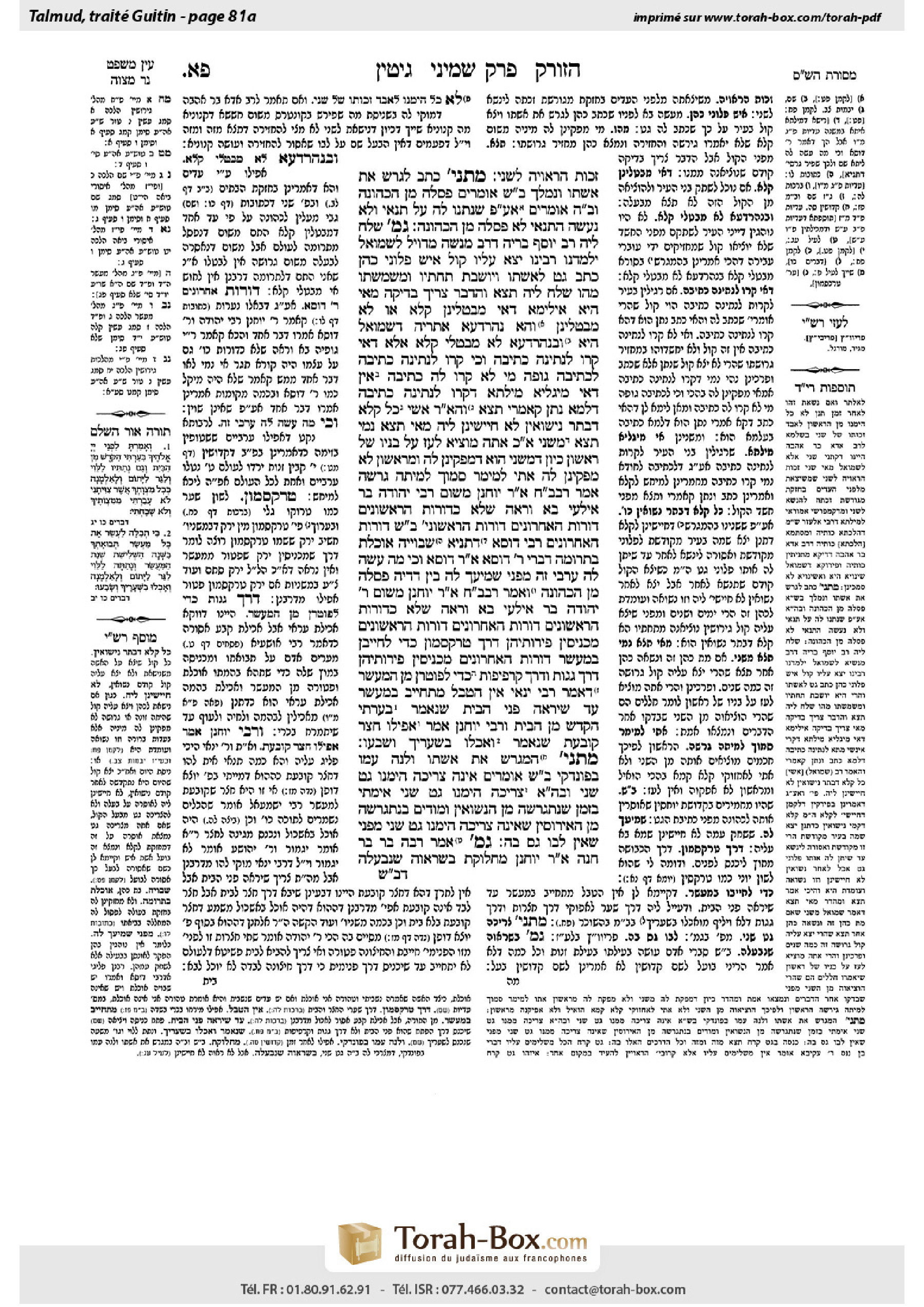
Gittin 81a: Talmud study for Daf Yomi
Study the Talmud for Daf Yomi with scanned pages, Hebrew text, English translations from Sefaria and AI-generated French translations.
Passage selection and English or AI-generated French translation are available where the scan has annotations. Daf Study is independent of Torah-Box and Sefaria.
Browse Gittin · גיטין · All tractatesGittin 81a text and translations
This page of Gittin includes the Aramaic text, an English translation and an AI-generated French translation, alongside the scan above.
גיטין פ״א א · Aramaic and Hebrew text
זְכוּת הָרְאוּיָה לַשֵּׁנִי.
מַתְנִי׳ כָּתַב לְגָרֵשׁ אֶת אִשְׁתּוֹ, וְנִמְלַךְ; בֵּית שַׁמַּאי אוֹמְרִים: פְּסָלָהּ מִן הַכְּהוּנָּה. וּבֵית הִלֵּל אוֹמְרִים: אַף עַל פִּי שֶׁנְּתָנוֹ לָהּ עַל תְּנַאי, וְלֹא נַעֲשָׂה הַתְּנַאי – לֹא פְּסָלָהּ מִן הַכְּהוּנָּה.
גְּמָ׳ שְׁלַח לֵיהּ רַב יוֹסֵף בְּרֵיהּ דְּרַב מְנַשֶּׁה מִדְּוִיל, לִשְׁמוּאֵל: יְלַמְּדֵנוּ רַבֵּינוּ, יָצָא עָלָיו קוֹל – ״אִישׁ פְּלוֹנִי כֹּהֵן כָּתַב גֵּט לְאִשְׁתּוֹ, וְיוֹשֶׁבֶת תַּחְתָּיו וּמְשַׁמַּשְׁתּוֹ״, מַהוּ?
שְׁלַח לֵיהּ: תֵּצֵא, וְהַדָּבָר צָרִיךְ בְּדִיקָה. מַאי הִיא? אִילֵימָא דְּאִי מְבַטְּלִינַן קָלָא אוֹ לָא מְבַטְּלִינַן; וְהָא נְהַרְדְּעָא אַתְרֵיהּ דִּשְׁמוּאֵל הִיא, וּבִנְהַרְדְּעָא לָא מְבַטְּלִי קָלָא! אֶלָּא דְּאִי קָרוּ לִנְתִינָה ״כְּתִיבָה״.
וְכִי קָרוּ לִנְתִינָה ״כְּתִיבָה״ – לִכְתִיבָה גּוּפַהּ מִי לָא קָרוּ לַהּ ״כְּתִיבָה״?!
אִין; דְּאִי מִיגַּלְּיָא מִילְּתָא דְּקָרוּ לִנְתִינָה כְּתִיבָה, דִּלְמָא ״נָתַן״ קָאָמְרִי.
תֵּצֵא?! וְהָאָמַר רַב אָשֵׁי: כֹּל קָלָא דְּבָתַר נִישּׂוּאִין – לָא חָיְישִׁינַן לֵיהּ!
מַאי ״תֵּצֵא״ נָמֵי – תֵּצֵא מִשֵּׁנִי.
אִם כֵּן, אַתָּה מוֹצִיא לַעַז עַל בָּנָיו שֶׁל רִאשׁוֹן! כֵּיוָן דְּמִשֵּׁנִי הוּא דְּמַפְּקִינַן לַהּ וּמֵרִאשׁוֹן לָא מַפְּקִינַן לַהּ, אָתֵי לְמֵימַר: סָמוּךְ לְמִיתָה גֵּרְשָׁהּ.
אָמַר רַבָּה בַּר בַּר חָנָה אָמַר רַבִּי יוֹחָנָן, מִשּׁוּם רַבִּי יְהוּדָה בַּר אִילְעַי: בֹּא וּרְאֵה שֶׁלֹּא כְּדוֹרוֹת הָרִאשׁוֹנִים דּוֹרוֹת הָאַחֲרוֹנִים.
דּוֹרוֹת הָרִאשׁוֹנִים – בֵּית שַׁמַּאי. דּוֹרוֹת הָאַחֲרוֹנִים – רַבִּי דּוֹסָא. דְּתַנְיָא: שְׁבוּיָיה – אוֹכֶלֶת בִּתְרוּמָה, דִּבְרֵי רַבִּי דּוֹסָא.
אָמַר רַבִּי דּוֹסָא: וְכִי מָה עָשָׂה לָהּ עַרְבִי זֶה? מִפְּנֵי שֶׁמִּיעֵךְ לָהּ בֵּין דַּדֶּיהָ, פְּסָלָהּ מִן הַכְּהוּנָּה?!
וְאָמַר רַבָּה בַּר בַּר חָנָה אָמַר רַבִּי יוֹחָנָן, מִשּׁוּם רַבִּי יְהוּדָה בַּר אִילְעַי: בֹּא וּרְאֵה שֶׁלֹּא כְּדוֹרוֹת הָרִאשׁוֹנִים דּוֹרוֹת הָאַחֲרוֹנִים. דּוֹרוֹת הָרִאשׁוֹנִים, מַכְנִיסִין פֵּירוֹתֵיהֶן דֶּרֶךְ טְרַקְסְמוֹן, כְּדֵי לְחַיְּיבָן בְּמַעֲשֵׂר. דּוֹרוֹת הָאַחֲרוֹנִים, מַכְנִיסִין פֵּירוֹתֵיהֶן דֶּרֶךְ גַּגּוֹת וְדֶרֶךְ קַרְפֵּיפוֹת, כְּדֵי לְפוֹטְרָן מִן הַמַּעֲשֵׂר.
דְּאָמַר רַבִּי יַנַּאי: אֵין הַטֶּבֶל מִתְחַיֵּיב בְּמַעֲשֵׂר, עַד שֶׁיִּרְאֶה פְּנֵי הַבַּיִת – שֶׁנֶּאֱמַר: ״בִּעַרְתִּי הַקֹּדֶשׁ מִן הַבַּיִת״.
וְרַבִּי יוֹחָנָן אָמַר: אֲפִילּוּ חָצֵר קוֹבַעַת, שֶׁנֶּאֱמַר: ״וְאָכְלוּ בִשְׁעָרֶיךָ וְשָׂבֵעוּ״.
מַתְנִי׳ הַמְגָרֵשׁ אֶת אִשְׁתּוֹ וְלָנָה עִמּוֹ בְּפוּנְדְּקִי, בֵּית שַׁמַּאי אוֹמְרִים: אֵינָהּ צְרִיכָה הֵימֶנּוּ גֵּט שֵׁנִי; וּבֵית הִלֵּל אוֹמְרִים: צְרִיכָה הֵימֶנּוּ גֵּט שֵׁנִי.
אֵימָתַי – בִּזְמַן שֶׁנִּתְגָּרְשָׁה מִן הַנִּשּׂוּאִין; וּמוֹדִים בְּנִתְגָּרְשָׁה מִן הָאֵירוּסִין – שֶׁאֵינָהּ צְרִיכָה הֵימֶנּוּ גֵּט שֵׁנִי, מִפְּנֵי שֶׁאֵין לִבּוֹ גַּס בָּהּ.
גְּמָ׳ אָמַר רַבָּה בַּר בַּר חָנָה אָמַר רַבִּי יוֹחָנָן: מַחְלוֹקֶת בְּשֶׁרָאוּהָ שֶׁנִּבְעֲלָה,
Gittin 81a · English translation
The Gemara answers: It is not referring to the right of a second man that she already married, but rather to the right that is due to a suitor who wishes to become her second husband, meaning that the first husband cannot eliminate the right of a second man who wishes to marry her.
MISHNA: If one wrote a bill of divorce to divorce his wife, and reconsidered and did not give it to her, Beit Shammai say: Although merely writing the bill of divorce does not dissolve the marriage, by doing so he disqualified her from marrying into the priesthood. And Beit Hillel say: Even if he gave the bill of divorce to her conditionally and the condition was not fulfilled, and therefore the bill of divorce did not take effect, he did not disqualify her from marrying into the priesthood. A woman is disqualified from marrying into the priesthood only if the divorce takes effect.
GEMARA: Rav Yosef, son of Rav Menashe from Devil, sent a query to Shmuel: Our teacher, instruct us. In the case of a priest about whom the following rumor circulated: So-and-so the priest wrote a bill of divorce to his wife, but she is still residing under his roof and attending to him; what is the halakha? Need one lend credence to this rumor?
Shmuel sent the following response to him: She must leave her husband; but the matter requires investigation before he is forced to divorce her. The Gemara asks: What is the investigation that is required? If we say that the investigation is whether we can abolish the rumor that circulated, or we cannot abolish it; that cannot be the question: But isn’t Neharde’a the place where Shmuel is the halakhic authority and the rulings there are in accordance with his opinion, and in Neharde’a they do not abolish a rumor? Rather, the required investigation is to determine whether people in that place refer to giving a bill of divorce as writing. If that is the case, the rumor would be that he gave her a bill of divorce.
The Gemara asks: And if they refer to giving as writing, it proves nothing, as don’t they refer to writing itself as writing? Therefore, the fact that they refer to giving as writing does not mean that he gave the woman the bill of divorce. The same term would be employed even if he only wrote the bill of divorce.
The Gemara answers: Yes, as if it is discovered that they refer to giving as writing, then there is reason to suspect that perhaps they are saying in the rumor that he gave her the bill of divorce, and there is concern that she is actually divorced.
Apropos Shmuel’s statement that she must leave his home, the Gemara asks: She must leave? But doesn’t Rav Ashi say: We are not concerned for any rumor that circulates after marriage. According to Rav Ashi, if a rumor circulates that a woman was betrothed to a man, there is concern about the rumor, and she is not allowed to marry someone else until she receives a bill of divorce from her rumored betrothed. But if such a rumor circulates after she has married someone else, there is no concern about such a rumor, and she is not obligated to leave her husband. Here too, in the case of this woman who is suspected of being divorced, she is currently living with her husband. Therefore, perhaps we should not be concerned about such a rumor.
The Gemara answers: What is the meaning of Shmuel’s directive: She must leave? This also means that she must leave the second husband. If her first husband dies, and she marries another priest, she must leave him due to the rumor that circulated that her first husband gave her a bill of divorce.
The Gemara challenges: If so, you cast aspersions on the children of the first husband. If the reason that she must leave the second husband is because she is assumed to be a divorcée, this means that she remained with her first husband while she was already divorced, and the children they had after the rumor circulated would be disqualified from the priesthood. The Gemara answers: Since we remove her only from the second husband, and we do not remove her from the first husband, they will come to explain the incident by saying as follows: The first husband divorced her proximate to his death, and the children from him are of unflawed lineage. Since he divorced her, she may not marry another priest. Because the assumption here is that the divorce took place proximate to the first husband’s death, there is no concern of aspersions being cast on the children from the first husband.
§ Rabba bar bar Ḥana says that Rabbi Yoḥanan says in the name of Rabbi Yehuda bar Elai: Come and see that the later generations are unlike the earlier generations, as the earlier generations were more conscientious about maintaining an unflawed lineage.
The Gemara explains: The earlier generations is referring to Beit Shammai. Beit Shammai were so careful about the sanctity of the priesthood that they said, as stated in the mishna, that the writing of a bill of divorce alone renders a priest’s wife forbidden to him. The later generations is referring to Rabbi Dosa, as it is taught in a mishna (Eduyyot 3:6): A priest’s wife who was taken captive may partake of teruma, and there is no concern that perhaps she was raped while in captivity and thereby became forbidden to her husband and disqualified from partaking of teruma. This is the statement of Rabbi Dosa.
In explanation of this statement, Rabbi Dosa says: And what did this Arab do to her when he took her captive? Because he fondled her breasts he disqualified her from the priesthood? As long as it is not determined that her captors actually raped her, she is not prohibited from partaking of teruma. It is apparent from here that the later generations are more lenient than the early generations with regard to the sanctity of the priesthood.
And Rabba bar bar Ḥana says that Rabbi Yoḥanan says in the name of Rabbi Yehuda bar Elai: Come and see that the later generations are unlike the earlier generations. The earlier generations would bring in their produce from the field by way of the main entranceway [teraksemon], in order to obligate the produce in tithes. By contrast, the later generations would bring in their produce by way of roofs and by way of enclosures, in order to exempt the produce from tithes.
The Gemara explains: As Rabbi Yannai says: Untithed produce does not become obligated in tithes until it sees the entrance of the house, through which people enter and exit, as it is stated in the declaration of the tithes: “I have put away the hallowed things out of my house” (Deuteronomy 26:13). As long as untithed produce is not taken into the house through the primary entrance of the house, it is permitted to eat it casually without tithing it. Consequently, they would take the produce in through another entrance in order to exempt it from tithes.
And Rabbi Yoḥanan says with regard to this issue: Even entry into the courtyard establishes an obligation to tithe, as it is stated: “That they may eat within your gates, and be satisfied” (Deuteronomy 26:12). This indicates that once the produce is brought into the courtyard, it is obligated in tithes.
MISHNA: With regard to one who divorces his wife, and afterward she spent the night with him at an inn [befundaki], Beit Shammai say: She does not require a second bill of divorce from him, and Beit Hillel say: She requires a second bill of divorce from him, since they may have engaged in sexual intercourse at the inn and thereby betrothed her once again.
When did they say this halakha? When she was divorced following the state of marriage. Beit Hillel concede that when she was divorced following the state of betrothal, she does not require a second bill of divorce from him, due to the fact that he is not accustomed to her. Therefore, there is no concern that they engaged in sexual intercourse, even though they spent the night together at the inn.
GEMARA: Rabba bar bar Ḥana says that Rabbi Yoḥanan says: The dispute between Beit Shammai and Beit Hillel is specifically in a case where they saw that she engaged in sexual intercourse,
Gittin 81a · Traduction française (IA)
La Guemara répond : Ce n'est pas le droit d'un deuxième homme qu'elle a déjà épousé, mais plutôt le droit d'un prétendant qui désire devenir son deuxième mari, c'est-à-dire que le premier mari ne peut pas annuler le droit d'un deuxième homme qui désire l'épouser.
MICHNA : Si l'on a écrit un acte de divorce pour divorcer de sa femme, puis s'est rétracté et n'a pas donné l'acte à sa femme, Beit Shammai disent : Bien que l'écriture seule de l'acte de divorce ne dissolve pas le mariage, en le faisant il l'a rendue inéligible à épouser un prêtre. Et Beit Hillel disent : Même s'il a donné l'acte de divorce à sa femme conditionnellement et que la condition n'a pas été remplie, et donc l'acte de divorce n'a pas pris effet, il ne l'a pas rendue inéligible à épouser un prêtre. Une femme est rendue inéligible à épouser un prêtre uniquement si l'acte de divorce prend effet.
GUEMARA : Rav Yosef, fils de Rav Menashe de Devil, a envoyé une question à Shmuel : Notre maître, instruisez-nous. Dans le cas d'un prêtre dont on a circulé la rumeur suivante : tel prêtre a écrit un acte de divorce à sa femme, mais elle demeure sous son toit et s'occupe de lui ; quelle est la halakha ? Faut-il accorder crédit à cette rumeur ?
Shmuel a envoyé la réponse suivante à lui : Elle doit quitter son mari ; mais la question nécessite une enquête avant qu'il ne soit contraint de la divorcer. La Guemara demande : Quelle est l'enquête requise ? Si nous disons que l'enquête est de savoir si l'on peut annuler la rumeur circulée ou non ; cela ne peut être la question : Mais n'est-ce pas Neharde’a, la ville où Shmuel est l'autorité halakhique et les décisions y sont conformes à son opinion, et où on n'annule pas une rumeur ? Plutôt, l'enquête requise est de déterminer si les gens de cette ville désignent donner un acte de divorce comme écrire. Si c'est le cas, la rumeur serait qu'il a donné l'acte de divorce à sa femme.
La Guemara demande : Et si l'on désigne donner comme écrire, cela prouve rien, car n'ont-ils pas désigné écrire lui-même comme écrire ? Donc, le fait qu'ils désignent donner comme écrire ne signifie pas qu'il a donné l'acte de divorce à la femme. Le même terme serait employé même s'il n'avait que rédigé l'acte de divorce.
La Guemara répond : Oui, car si l'on découvre qu'ils désignent donner comme écrire, alors il y a lieu de soupçonner qu'ils disent dans la rumeur qu'il a donné l'acte de divorce à sa femme, et il y a crainte qu'elle soit effectivement divorcée.
En ce qui concerne l'affirmation de Shmuel que la femme doit quitter son domicile, la Guemara demande : Elle doit quitter ? Mais n'est-ce pas que Rav Ashi dit : Nous ne nous soucions pas des rumeurs circulant après le mariage. Selon Rav Ashi, si une rumeur circule qu'une femme a été promise à un homme, il y a crainte à l'égard de la rumeur, et elle ne peut pas épouser quelqu'un d'autre jusqu'à ce qu'elle reçoive un acte de divorce de son prétendant supposé. Mais si une telle rumeur circule après qu'elle ait épousé quelqu'un d'autre, il n'y a pas de crainte à l'égard de cette rumeur, et elle n'est pas tenue de quitter son mari. Ici aussi, dans le cas de cette femme soupçonnée d'être divorcée, elle demeure actuellement avec son mari. Donc, peut-être ne devons-nous pas nous soucier de cette rumeur.
La Guemara répond : Quelle est la signification de l'ordre de Shmuel : Elle doit quitter ? Cela signifie aussi qu'elle doit quitter le deuxième mari. Si son premier mari meurt et qu'elle épouse un autre prêtre, elle doit quitter celui-ci en raison de la rumeur circulant qu'elle a reçu un acte de divorce de son premier mari.
La Guemara conteste : Si c'est ainsi, vous attaquez les enfants du premier mari. Si la raison pour laquelle elle doit quitter le deuxième mari est qu'elle est supposée être divorcée, cela signifie qu'elle a resté avec son premier mari alors qu'elle était déjà divorcée, et les enfants qu'ils ont eu après que la rumeur circulât seraient disqualifiés du sacerdoce. La Guemara répond : Puisque nous la retirons uniquement du deuxième mari et non du premier, ils viendront expliquer l'incident comme suit : Le premier mari l'a divorcée près de sa mort, et les enfants de lui sont de lignage pur. Puisque le divorce a eu lieu près de la mort du premier mari, il n'y a pas de crainte d'attaque sur les enfants du premier mari.
§ Rabba bar bar Ḥana dit que Rabbi Yoḥanan dit au nom de Rabbi Yehuda bar Elai : Approchez-vous et voyez que les générations ultérieures sont différentes des générations antérieures, car les générations antérieures étaient plus vigilantes à maintenir une lignée pure.
La Guemara explique : Les générations antérieures fait référence à Beit Shammai. Beit Shammai étaient si vigilants à la sanctité du sacerdoce qu'ils disaient, comme mentionné dans la mishna, que l'écriture seule d'un acte de divorce rend une femme mariée à un prêtre interdite à lui. Les générations ultérieures font référence à Rabbi Dosa, comme il est enseigné dans une mishna (Eduyyot 3:6) : Une femme mariée à un prêtre qui a été capturée peut participer à la terouma, et il n'y a pas de crainte qu'elle ait été violée pendant sa captivité et donc interdite à son mari et disqualifiée de participer à la terouma. C'est l'affirmation de Rabbi Dosa.
En explication de cette affirmation, Rabbi Dosa dit : Et qu'a fait cet Arabe à elle lorsqu'il l'a capturée ? Parce qu'il a caressé ses seins, il l'a disqualifiée du sacerdoce ? Tant que cela n'est pas déterminé que ses ravisseurs l'ont violée, elle n'est pas interdite à participer à la terouma. Il est évident d'ici que les générations ultérieures sont plus clémentes que les générations antérieures en ce qui concerne la sanctité du sacerdoce.
Et Rabba bar bar Ḥana dit que Rabbi Yoḥanan, dans le nom de Rabbi Yehuda bar Elai, dit : Viens voir que les générations ultérieures sont différentes des générations antérieures. Les générations antérieures apportaient leurs récoltes du champ par la porte principale [teraksemon], afin d'obliger les récoltes à la dîme. En revanche, les générations ultérieures apportaient leurs récoltes par les toits et par les enclos, afin d'exempter les récoltes de la dîme.
La Guemara explique : Comme Rabbi Yannai dit : Les récoltes non dîmées ne deviennent pas obligées à la dîme jusqu'à ce qu'elles voient l'entrée de la maison, par laquelle les gens entrent et sortent, comme il est dit dans la déclaration des dîmes : « J'ai mis de côté les choses saintes de ma maison » (Deutéronome 26:13). Aussi longtemps que les récoltes non dîmées ne sont pas introduites dans la maison par la porte principale, elles sont permises à être mangées sans dîme. Par conséquent, ils introduisaient les récoltes par une autre entrée afin d'exempter les récoltes de la dîme.
Et Rabbi Yoḥanan dit concernant cette question : Même l'entrée dans le courtil établit une obligation à la dîme, comme il est dit : « Qu'ils mangent dans vos villes et soient rassasiés » (Deutéronome 26:12). Cela indique que dès que la récolte est introduite dans le courtil, elle est obligée à la dîme.
MICHNA : Concernant celui qui divorce sa femme, et ensuite elle passe la nuit avec lui dans un auberge [befundaki], Beit Shammai disent : Elle ne nécessite pas un second acte de divorce de sa part, et Beit Hillel disent : Elle nécessite un second acte de divorce de sa part, car ils peuvent avoir eu des relations sexuelles dans l'auberge et avoir ainsi betroché à nouveau sa femme.
Quand ont-ils dit cette halakha ? Quand elle a été divorcée après l'état de mariage. Beit Hillel reconnaissent que quand elle a été divorcée après l'état de betrothal, elle ne nécessite pas un second acte de divorce de sa part, en raison du fait qu'il n'est pas habitué à elle. Par conséquent, il n'y a pas de crainte qu'ils aient eu des relations sexuelles, même s'ils ont passé la nuit ensemble dans l'auberge.
GUEMARA : Rabba bar bar Ḥana dit que Rabbi Yoḥanan dit : Le débat entre Beit Shammai et Beit Hillel est spécifiquement dans un cas où ils ont vu qu'elle avait eu des relations sexuelles,
Traduction française générée par IA à partir de l’édition anglaise de Sefaria. Vérifie toujours un passage avec le texte source.
Text from Sefaria: William Davidson Edition - Vocalized Aramaic (CC BY NC); William Davidson Edition - English (CC BY NC).