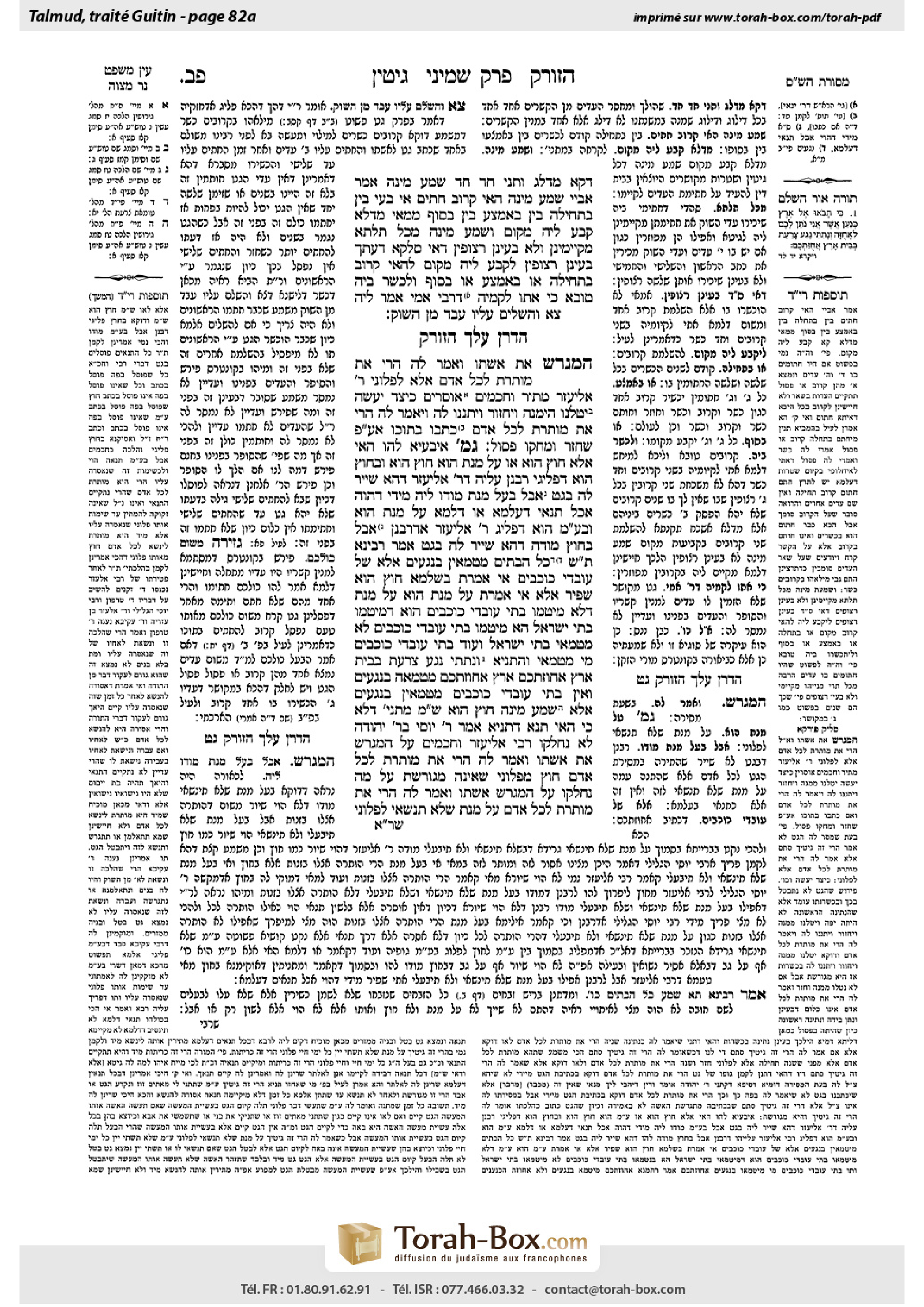
Gittin 82a: Talmud study for Daf Yomi
Study the Talmud for Daf Yomi with scanned pages, Hebrew text, English translations from Sefaria and AI-generated French translations.
Passage selection and English or AI-generated French translation are available where the scan has annotations. Daf Study is independent of Torah-Box and Sefaria.
Browse Gittin · גיטין · All tractatesGittin 82a text and translations
This page of Gittin includes the Aramaic text, an English translation and an AI-generated French translation, alongside the scan above.
גיטין פ״ב א · Aramaic and Hebrew text
דְּקָא מְדַלֵּג וְתָנֵי חַד חַד; שְׁמַע מִינַּהּ.
אָמַר אַבָּיֵי: שְׁמַע מִינַּהּ, הַאי קָרוֹב חָתֵים אִי בָּעֵי – בֵּין בַּתְּחִילָּה, בֵּין בָּאֶמְצַע, בֵּין בַּסּוֹף.
מִמַּאי – מִדְּלָא קְבַע לֵיהּ מָקוֹם. וּשְׁמַע מִינַּהּ: מִכֹּל תְּלָתָא מְקַיְּימִינַן, וְלָא בָּעֵינַן רְצוּפִין.
דְּאִי סָלְקָא דַעְתָּךְ בָּעֵינַן רְצוּפִין, לִקְבַּע לֵיהּ מָקוֹם לְהַאי קָרוֹב – בַּתְּחִילָּה אוֹ בָּאֶמְצַע אוֹ בַּסּוֹף; וְלַכְשַׁר בֵּיהּ טוּבָא.
כִּי אָתוּ לְקַמֵּיהּ דְּרַבִּי אַמֵּי, אֲמַר לֵיהּ: צֵא וְהַשְׁלֵים עָלָיו עֶבֶד מִן הַשּׁוּק.
הֲדַרַן עֲלָךְ הַזּוֹרֵק
הַמְגָרֵשׁ אֶת אִשְׁתּוֹ, וְאָמַר לָהּ: ״הֲרֵי אַתְּ מוּתֶּרֶת לְכׇל אָדָם, אֶלָּא לִפְלוֹנִי״. רַבִּי אֱלִיעֶזֶר מַתִּיר, וַחֲכָמִים אוֹסְרִים. כֵּיצַד יַעֲשֶׂה? יִטְּלֶנּוּ הֵימֶנָּה וְיַחֲזוֹר וְיִתְּנֶנּוּ לָהּ, וְיֹאמַר לָהּ: ״הֲרֵי אַתְּ מוּתֶּרֶת לְכׇל אָדָם״. כְּתָבוֹ בְּתוֹכוֹ, אַף עַל פִּי שֶׁחָזַר וּמְחָקוֹ – פָּסוּל.
גְּמָ׳ אִיבַּעְיָא לְהוּ: הַאי ״אֶלָּא״ – ״חוּץ״ הוּא, אוֹ ״עַל מְנָת״ הוּא?
״חוּץ״ הוּא – וּבְ״חוּץ״ הוּא דִּפְלִיגִי רַבָּנַן עֲלֵיהּ דְּרַבִּי אֱלִיעֶזֶר, דְּהָא שַׁיַּיר לַהּ בְּגֵט; אֲבָל בְּ״עַל מְנָת״ – מוֹדוּ לֵיהּ, מִידֵּי דְּהָוֵה אַכֹּל תְּנָאֵי דְּעָלְמָא;
אוֹ דִלְמָא ״עַל מְנָת״ הוּא – וּבְ״עַל מְנָת״ הוּא דִּפְלִיג רַבִּי אֱלִיעֶזֶר אַדְּרַבָּנַן; אֲבָל בְּ״חוּץ״ מוֹדֶה – דְּהָא שַׁיַּיר לַהּ בְּגֵט.
אָמַר רָבִינָא, תָּא שְׁמַע: כׇּל הַבָּתִּים מִטַּמְּאִין בִּנְגָעִים, אֶלָּא שֶׁל גּוֹיִם. אִי אָמְרַתְּ בִּשְׁלָמָא ״חוּץ״ הוּא – שַׁפִּיר; אֶלָּא אִי אָמְרַתְּ ״עַל מְנָת״ הוּא – עַל מְנָת דְּלָא מִיטַּמּוּ בָּתֵּי גוֹיִם הוּא דְּמִיטַּמּוּ בָּתֵּי יִשְׂרָאֵל, הָא מִיטַּמּוּ בָּתֵּי גוֹיִם – לָא מִטַּמְּאִי בָּתֵּי יִשְׂרָאֵל?!
וְעוֹד, בָּתֵּי גוֹיִם מִי מִטַּמְּאִי?! וְהָתַנְיָא: ״וְנָתַתִּי נֶגַע צָרַעַת בְּבֵית אֶרֶץ אֲחוּזַּתְכֶם״ – אֶרֶץ אֲחוּזַּתְכֶם מִטַּמְּאָה בִּנְגָעִים, וְאֵין בָּתֵּי גוֹיִם מִטַּמְּאִין בִּנְגָעִים! אֶלָּא שְׁמַע מִינַּהּ ״חוּץ״ הוּא; שְׁמַע מִינַּהּ.
מַתְנִיתִין דְּלָא כִּי הַאי תַּנָּא – דְּתַנְיָא, אָמַר רַבִּי יוֹסֵי בְּרַבִּי יְהוּדָה: לֹא נֶחְלְקוּ רַבִּי אֱלִיעֶזֶר וַחֲכָמִים עַל הַמְגָרֵשׁ אֶת אִשְׁתּוֹ, וְאָמַר לָהּ: ״הֲרֵי אַתְּ מוּתֶּרֶת לְכׇל אָדָם, חוּץ מִפְּלוֹנִי״ – שֶׁאֵינָהּ מְגוֹרֶשֶׁת. עַל מָה נֶחְלְקוּ? עַל הַמְגָרֵשׁ אִשְׁתּוֹ, וְאָמַר לָהּ: ״הֲרֵי אַתְּ מוּתֶּרֶת לְכׇל אָדָם, עַל מְנָת שֶׁלֹּא תִּנָּשְׂאִי לִפְלוֹנִי״ –
Gittin 82a · English translation
as it teaches by skipping one by one. The examples given relate to one witness missing, e.g., seven ties and six witnesses, and so on. They do not include a case in which two witnesses are missing, e.g., seven ties and five witnesses. This indicates that the dispute between Rabbi Akiva and Ben Azzai is only with regard to the signature of one witness. The Gemara affirms: Conclude from it that this is so.
Abaye said: Learn from it that this relative, who is allowed to sign a folded and tied bill of divorce, can sign if he wants to sign, either at the beginning, as the first signature, in the middle, or at the end.
From where does Abaye infer this? From the fact that it did not designate a place for him to sign. And learn from it, as well, that from any three of the witnesses who signed on a folded and tied bill of divorce, we can ratify the bill of divorce, i.e., it can be ratified based on their signatures. And we do not need to confirm the signatures specifically of three consecutive witnesses.
As if it enters your mind that we need consecutive witnesses, then they should designate a place for this relative to sign, in the beginning, or in the middle, or at the end, and they should then validate the use of many disqualified witnesses. It could have been instituted that every third witness may be disqualified. Since in any group of three witnesses, two of them would be valid, more than one disqualified witness could be allowed. Since it is possible to ratify a bill of divorce by confirming signatures that are not consecutive, and therefore there is concern that the court will rely on two disqualified witnesses, the Sages consequently allowed the use of only one disqualified witness.
With regard to the halakha concerning the dispute in the mishna, it is related that when they came before Rabbi Ami with a question pertaining to a bare bill of divorce that needed more witnesses, he said to the person overseeing: Go out and complete it even with a slave from the general public, in accordance with the opinion of ben Nannas.
MISHNA: With regard to one who divorces his wife and said to her while handing her the bill of divorce: You are hereby permitted to marry any man except [ella] for so-and-so, Rabbi Eliezer permits her to remarry based on this divorce. And the Rabbis prohibit her from remarrying, as their bond is not entirely severed by this divorce, and she is therefore still considered his wife. What should he do so the divorce may take effect? He should take it from her and hand it to her again, and he should say to her: You are hereby permitted to marry any man. If he wrote his qualification inside the bill of divorce, even if he then erased it, the bill is invalid since it was not written in a valid manner.
GEMARA: A dilemma was raised before the Sages: What is the meaning of this word ella in the husband’s statement? Does it mean except, i.e., the husband intended to divorce his wife in a manner that would render her permitted to marry only a limited group of men? Or does it mean: On the condition, i.e., the husband intended to grant her full divorce on the condition that she would not marry so-and-so?
The Gemara elaborates on how this dilemma affects the understanding of the dispute between Rabbi Eliezer and the Rabbis: Does ella mean except, and therefore it is specifically with regard to the exception of a certain man from the intended divorce that the Rabbis disagree with Rabbi Eliezer and hold that the divorce is invalid? This would be because in a case where the husband noted an exception, it is as if he left out part of her bill of divorce; since she is not permitted to remarry anyone she wishes it does not entirely sever the bond between them. But with regard to divorce on the condition that she will not marry a certain man the Rabbis agree with Rabbi Eliezer that it is valid, just as is the case with regard to any typical condition which the husband attaches to the divorce of his wife.
Or perhaps this is the meaning of ella: On the condition? Accordingly, it is specifically with regard to divorce on the condition that the wife will not marry a certain man that Rabbi Eliezer disagrees with the Rabbis and allows her to remarry based on this divorce; but with regard to the exception of a certain man from the woman’s right to remarry he concedes that the divorce is invalid as the husband left out part of her bill of divorce.
Ravina said: Come and hear a solution to this dilemma from the following mishna (Nega’im 12:1): All houses become ritually impure through leprous sores of the house except [ella] for those belonging to gentiles. Granted, if you say that the meaning of the word ella is except, this mishna is well understood. But if you say that its meaning is on the condition, the resulting interpretation of this mishna is that the houses of Jews become impure only on the condition that the houses of gentiles do not become impure; consequently, if the houses of gentiles become impure, the houses of Jews do not become impure. Does this interpretation make any sense?
Moreover, an objection against this interpretation may be raised as follows: Do the houses of gentiles become ritually impure at all? But isn’t it taught in a baraita that from the verse: “And I put the plague of leprosy in a house of the land of your possession” (Leviticus 14:34), it is derived that only the land of your possession, i.e., the houses of Jews, becomes impure through leprous sores of the house, but the houses of gentiles do not become impure through leprosy? Rather, conclude from the mishna that the meaning of ella is except. The Gemara concludes: Conclude from it that ella means except.
According to this conclusion, our mishna is not in accordance with the opinion of this tanna, as it is taught in a baraita that Rabbi Yosei, son of Rabbi Yehuda, said: Rabbi Eliezer and the Rabbis did not disagree with regard to one who divorces his wife and said to her while handing her the bill of divorce: You are hereby permitted to marry any man except for so-and-so; rather, they were in agreement that in that case she is not divorced. With regard to what case did they disagree? It was with regard to one who divorces his wife and said to her: You are hereby permitted to marry any man on the condition that you will not marry so-and-so,
Gittin 82a · Traduction française (IA)
car il enseigne en omettant un par un. Les exemples donnés concernent un témoin manquant, par exemple sept liens et six témoins, et ainsi de suite. Ils ne comprennent pas le cas où deux témoins sont manquants, par exemple sept liens et cinq témoins. Cela montre que le débat entre Rabbi Akiva et Ben Azzai concerne uniquement la signature d'un seul témoin. La Guemara affirme : Concluez-en que c'est ainsi.
Abaye dit : Apprenez-en que ce parent, qui est autorisé à signer un contrat de divorce plié et lié, peut signer s'il le souhaite, soit au début, en tant que première signature, au milieu ou à la fin.
D'où Abaye tire-t-il cette conclusion ? De ce que l'on n'a pas désigné de place pour qu'il signe. Et apprenez-en également que, parmi n'importe quels trois témoins ayant signé un contrat de divorce plié et lié, on peut valider ce contrat de divorce, c'est-à-dire qu'il peut être validé grâce à leurs signatures. On n'a noté pas la nécessité de confirmer spécifiquement les signatures de trois témoins consécutifs.
Comme si cela vous venait à l'esprit que l'on a besoin de témoins consécutifs, alors ils devraient désigner une place pour que ce parent signe, au début, ou au milieu, ou à la fin, et ensuite valider l'utilisation de nombreux témoins non qualifiés. Il aurait pu être institué que tout troisième témoin puisse être non qualifié. En effet, dans tout groupe de trois témoins, deux d'entre eux seraient valides, permettant ainsi plus d'un témoin non qualifié. Comme il est possible de valider un contrat de divorce grâce à des signatures non consécutives, et donc qu'il y ait une crainte que le tribunal puisse se fier à deux témoins non qualifiés, les Sages ont donc permis l'utilisation d'un seul témoin non qualifié.
En ce qui concerne la halakha concernant le débat mentionné dans la Michna, il est rapporté que lorsqu'ils se sont présentés devant Rabbi Ami avec une question concernant un contrat de divorce simple nécessitant plus de témoins, il a dit à la personne en charge : Sortez et achevez-le même avec un esclave du public, conformément à l'opinion de Ben Nannas.
MICHNA : En ce qui concerne celui qui divorce de son épouse et dit à elle en lui remettant le contrat de divorce : Tu es désormais autorisée à épouser n'importe quel homme sauf [ella] pour tel et tel, Rabbi Eliezer permet qu'elle se remarie sur la base de ce divorce. Et les Rabbins l'interdisent, car leur lien n'est pas entièrement rompu par ce divorce, et elle est donc encore considérée comme sa femme. Que devrait-il faire pour que le divorce prenne effet ? Il devrait le lui prendre et le lui remettre à nouveau, et il devrait lui dire : Tu es désormais autorisée à épouser n'importe quel homme. Si il a écrit sa qualification à l'intérieur du contrat de divorce, même s'il l'a ensuite effacé, le contrat est invalide, car il n'a pas été rédigé de manière valide.
GUÉMARA : Un dilemme a été soulevé devant les Sages : Quelle est la signification de ce mot [ella] dans l'affirmation du mari ? Signifie-t-il « sauf », c'est-à-dire que le mari avait l'intention de divorcer de sa femme de manière à ce qu'elle soit autorisée à épouser uniquement un groupe limité d'hommes ? Ou signifie-t-il « sur condition », c'est-à-dire que le mari avait l'intention de lui accorder un divorce complet sous la condition qu'elle ne se marie pas avec tel et tel ?
La Guemara développe comment ce dilemme affecte la compréhension du débat entre Rabbi Eliezer et les Rabbins : Signifie-t-il « sauf », et donc c'est spécifiquement concernant l'exception d'un certain homme de la divorse que les Rabbins s'opposent à Rabbi Eliezer et considèrent que le divorce est invalide ? Cela serait le cas car, dans un cas où le mari a noté une exception, cela ressemble à ce qu'il a omis partie du contrat de divorce ; puisque elle n'est pas autorisée à se remarier avec n'importe qui, cela ne rompt pas entièrement leur lien. Mais concernant le divorce sur condition qu'elle ne se marie pas avec un certain homme, les Rabbins sont d'accord avec Rabbi Eliezer que cela est valide, tout comme c'est le cas pour toute condition normale que le mari attache à la divorse de sa femme.
Ou peut-être que cette est la signification de [ella] : Sur condition ? Ainsi, c'est spécifiquement concernant le divorce sur condition qu'elle ne se marie pas avec un certain homme que Rabbi Eliezer s'oppose aux Rabbins et permet qu'elle se remarie sur la base de ce divorce ; mais concernant l'exception d'un certain homme de son droit de se remarier, il reconnaît que le divorce est invalide, car le mari a omis partie de son contrat de divorce.
Ravina dit : Venez écouter une solution à ce dilemme à partir de la mitsna suivante (Nega’im 12:1) : Tous les maisons deviennent impurs par les plaies de la maison sauf [ella] pour celles appartenant aux non-Juifs. Cela est bien compris si vous dites que la signification du mot [ella] est « sauf ». Mais si vous dites que sa signification est « sur condition », l'interprétation de cette mitsna serait que les maisons des Juifs deviennent impurs uniquement sur la condition que les maisons des non-Juifs ne deviennent pas impurs ; par conséquent, si les maisons des non-Juifs deviennent impurs, les maisons des Juifs ne deviennent pas impurs. Cette interprétation a-t-elle un sens ?
De plus, une objection contre cette interprétation peut être soulevée comme suit : Les maisons des non-Juifs deviennent-elles impures ? Mais n'est-il pas enseigné dans une baraïta que, à partir de la parole : « Et je mis la plaie de la lepra dans une maison du pays de votre possession » (Lévitique 14:34), on déduit que seul le pays de votre possession, c'est-à-dire les maisons des Juifs, devient impur par les plaies de la maison, mais les maisons des non-Juifs ne deviennent pas impures par la lepra ? Plutôt, concluez de la mitsna que la signification de [ella] est « sauf ». La Guemara conclut : Concluez-en que [ella] signifie « sauf ».
Selon cette conclusion, notre mitsna ne correspond pas à l'opinion de ce tanna, car il est enseigné dans une baraïta que Rabbi Yosei, fils de Rabbi Yehuda, a dit : Rabbi Eliezer et les Rabbins n'ont pas divergé concernant celui qui divorce de son épouse et lui dit en lui remettant le document de divorce : Vous êtes désormais autorisée à épouser n'importe quel homme sauf tel et tel ; plutôt, ils étaient d'accord sur le fait qu'elle n'était pas divorcée. À propos de quel cas ont-ils divergé ? C'était concernant celui qui divorce de son épouse et lui dit : Vous êtes désormais autorisée à épouser n'importe quel homme à la condition que vous ne marierez pas tel et tel,
Traduction française générée par IA à partir de l’édition anglaise de Sefaria. Vérifie toujours un passage avec le texte source.
Text from Sefaria: William Davidson Edition - Vocalized Aramaic (CC BY NC); William Davidson Edition - English (CC BY NC).