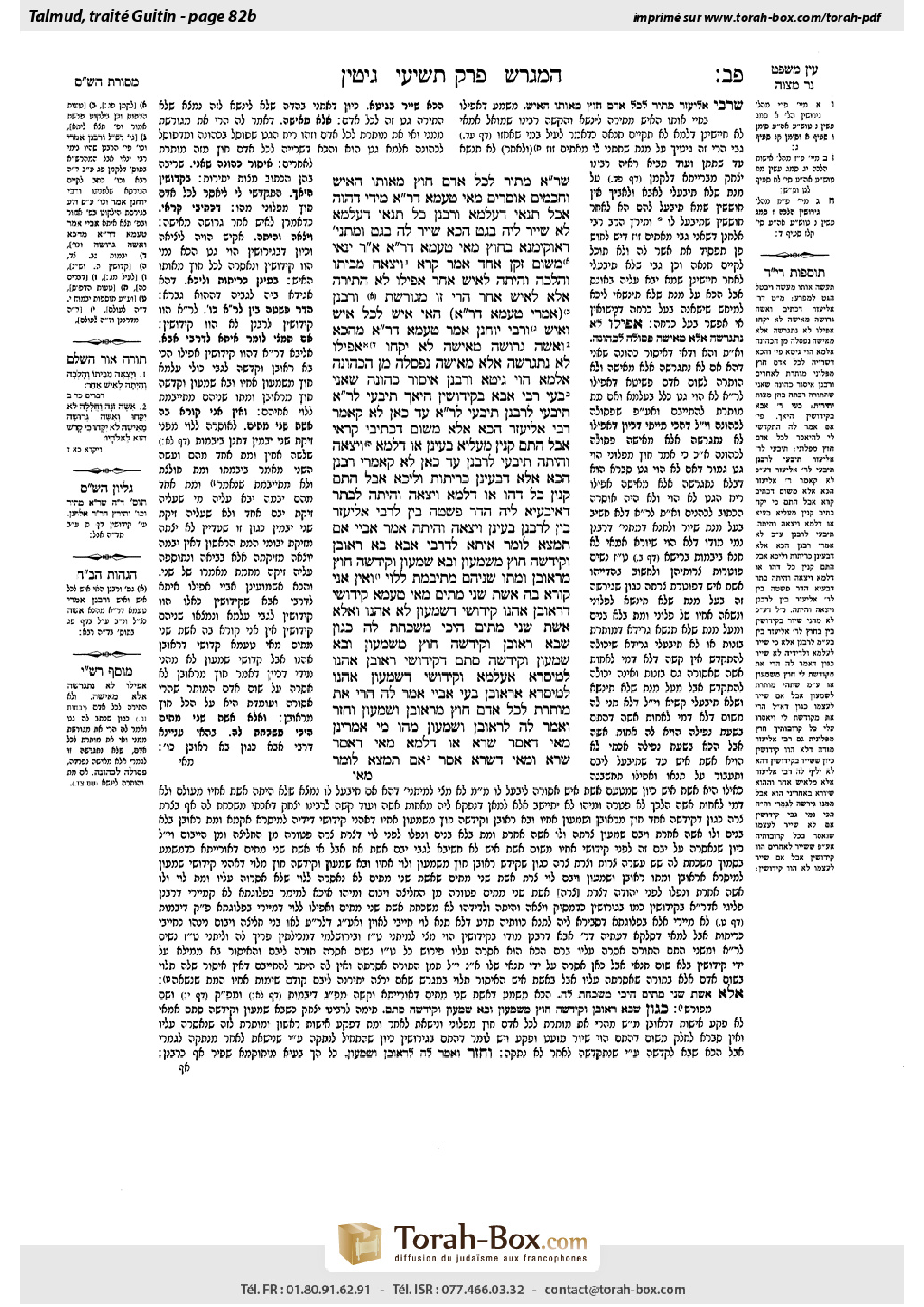
Gittin 82b: Talmud study for Daf Yomi
Study the Talmud for Daf Yomi with scanned pages, Hebrew text, English translations from Sefaria and AI-generated French translations.
Passage selection and English or AI-generated French translation are available where the scan has annotations. Daf Study is independent of Torah-Box and Sefaria.
Browse Gittin · גיטין · All tractatesGittin 82b text and translations
This page of Gittin includes the Aramaic text, an English translation and an AI-generated French translation, alongside the scan above.
גיטין פ״ב ב · Aramaic and Hebrew text
שֶׁרַבִּי אֱלִיעֶזֶר מַתִּיר לְכׇל אָדָם חוּץ מֵאוֹתוֹ הָאִישׁ, וַחֲכָמִים אוֹסְרִים.
מַאי טַעְמָא דְּרַבִּי אֱלִיעֶזֶר? מִידֵּי דְּהָוֵה אַכֹּל תְּנָאֵי דְּעָלְמָא. וְרַבָּנַן – כֹּל תְּנָאֵי דְּעָלְמָא לָא שַׁיַּיר לֵיהּ בְּגֵט, הָכָא שַׁיַּיר לַהּ בְּגֵט.
וּמַתְנִיתִין – דְּאוֹקֵימְנָא בְּ״חוּץ״, מַאי טַעְמָא דְּרַבִּי אֱלִיעֶזֶר?
אָמַר רַבִּי יַנַּאי מִשּׁוּם זָקֵן אֶחָד, אָמַר קְרָא: ״וְיָצְאָה מִבֵּיתוֹ וְהָלְכָה וְהָיְתָה לְאִישׁ אַחֵר״ – אֲפִילּוּ לֹא הִתִּירָהּ אֶלָּא לְאִישׁ אַחֵר, הֲרֵי זוֹ מְגוֹרֶשֶׁת. וְרַבָּנַן אָמְרִי, טַעְמָא דְּרַבִּי אֱלִיעֶזֶר: הַאי ״אִישׁ״ – לְכׇל אִישׁ וָאִישׁ.
וְרַבִּי יוֹחָנָן אָמַר, טַעְמָא דְּרַבִּי אֱלִיעֶזֶר מֵהָכָא: ״וְאִשָּׁה גְּרוּשָׁה מֵאִישָׁהּ לֹא יִקָּחוּ״ – אֲפִילּוּ לֹא נִתְגָּרְשָׁה אֶלָּא מֵאִישָׁהּ, נִפְסְלָה מִן הַכְּהוּנָּה – אַלְמָא הָוֵי גִּיטָּא.
וְרַבָּנַן – אִיסּוּר כְּהוּנָּה שָׁאנֵי.
בָּעֵי רַבִּי אַבָּא: בְּקִידּוּשִׁין הֵיאַךְ? תִּיבְּעֵי לְרַבִּי אֱלִיעֶזֶר, תִּיבְּעֵי לְרַבָּנַן.
תִּיבְּעֵי לְרַבִּי אֱלִיעֶזֶר – עַד כָּאן לָא קָאָמַר רַבִּי אֱלִיעֶזֶר הָכָא, אֶלָּא מִשּׁוּם דִּכְתִיבִי קְרָאֵי; אֲבָל הָתָם – קִנְיָן מְעַלְּיָא בָּעֵינַן. אוֹ דִלְמָא, ״וְיָצְאָה״–״וְהָיְתָה״.
תִּיבְּעֵי לְרַבָּנַן – עַד כָּאן לָא קָאָמְרִי רַבָּנַן הָכָא, אֶלָּא דְּבָעֵינַן כְּרִיתוּת – וְלֵיכָּא; אֲבָל הָתָם – קִנְיָן כֹּל דְּהוּ. אוֹ דִּלְמָא, ״וְיָצְאָה״–״וְהָיְתָה״.
לְבָתַר דְּאִיבַּעְיָא לֵיהּ, הֲדַר פַּשְׁטַהּ – בֵּין לְרַבִּי אֱלִיעֶזֶר בֵּין לְרַבָּנַן, בָּעֵינַן ״וְיָצְאָה״–״וְהָיְתָה״.
אָמַר אַבָּיֵי: אִם תִּמְצָא לוֹמַר אִיתָא לִדְרַבִּי אַבָּא;
בָּא רְאוּבֵן וְקִידְּשָׁהּ חוּץ מִשִּׁמְעוֹן, וּבָא שִׁמְעוֹן וְקִידְּשָׁהּ חוּץ מֵרְאוּבֵן, וּמֵתוּ שְׁנֵיהֶם – מִתְיַבֶּמֶת לְלֵוִי, וְאֵין אֲנִי קוֹרֵא בָּהּ ״אֵשֶׁת שְׁנֵי מֵתִים״.
מַאי טַעְמָא? קִידּוּשֵׁי דִרְאוּבֵן אַהֲנוֹ, קִידּוּשֵׁי דְשִׁמְעוֹן לָא אַהֲנוֹ.
וְאֶלָּא אֵשֶׁת שְׁנֵי מֵתִים – הֵיכִי מַשְׁכַּחַתְּ לַהּ? כְּגוֹן שֶׁבָּא רְאוּבֵן וְקִידְּשָׁהּ חוּץ מִשִּׁמְעוֹן, וּבָא שִׁמְעוֹן וְקִידְּשָׁהּ סְתָם – דְּקִידּוּשֵׁי רְאוּבֵן אַהֲנוֹ לְמֵיסְרַהּ אַעָלְמָא, וְקִידּוּשֵׁי דְּשִׁמְעוֹן אַהֲנוֹ לְמֵיסְרַהּ אַרְאוּבֵן.
בָּעֵי אַבָּיֵי, אָמַר לָהּ: ״הֲרֵי אַתְּ מוּתֶּרֶת לְכׇל אָדָם, חוּץ מֵרְאוּבֵן וְשִׁמְעוֹן״, וְחָזַר וְאָמַר לָהּ: ״לִרְאוּבֵן וְשִׁמְעוֹן״, מַהוּ?
מִי אָמְרִינַן: מַאי דַּאֲסַר שְׁרָא; אוֹ דִלְמָא – מַאי דַּאֲסַר שְׁרָא, וּמַאי דִּשְׁרָא אֲסַר? אִם תִּמְצָא לוֹמַר
Gittin 82b · English translation
as in this case Rabbi Eliezer permits her to marry any man except for that man about whom the condition was made, and the Rabbis prohibit her from remarrying, as in their opinion this divorce is not valid.
The Gemara asks: What is the reasoning behind Rabbi Eliezer’s opinion as cited in the baraita? The Gemara answers: The ruling here is just as it is with regard to any typical condition. The husband has the right to attach conditions to the divorce. And how would the Rabbis respond to this reasoning? They would reason that by attaching any typical condition the husband did not leave out part of the bill of divorce, as it does not diminish the essential act of severance. By contrast, here he left out part of the bill of divorce, as she is not permitted to marry any man she wishes. Therefore, the divorce is invalid.
The Gemara asks: And according to the mishna, which we established as referring to a case of exception, what is the reason for Rabbi Eliezer’s opinion that the divorce takes effect, despite its lack of complete severance?
Rabbi Yannai said in the name of one elder that the verse states with regard to divorce: “And she departs out of his house, and goes and becomes another man’s wife” (Deuteronomy 24:2), indicating that even if he divorced her in a manner that only permitted her to marry one other man, she is divorced, i.e., this partial severance takes effect. And the Rabbis would say in response to Rabbi Eliezer’s explanation that this phrase: Another man, which appears in the verse refers not to a specific man but to any man, i.e., it must be permitted for her to marry any man for the divorce to take effect.
And Rabbi Yoḥanan said that the reason for Rabbi Eliezer’s opinion is from the verse here, where it is stated with regard to priests: “Neither may they take a woman divorced from her husband” (Leviticus 21:7). This verse indicates that even if she was divorced only from her husband, and was not permitted to marry others, she is disqualified from marrying into the priesthood as a divorcée, i.e., she may not marry a priest even after her husband’s death. Apparently, all the more so, divorce that excludes certain men from the wife’s right to remarry is considered a valid bill of divorce. This is certainly the case when the divorce permits her to marry all men with the exception of one.
And the Rabbis would respond that the prohibition against marrying into the priesthood is different, as even a divorce that is otherwise invalid disqualifies a woman from marrying a priest.
§ Rabbi Abba raises a dilemma: If this kind of exception is made in a case of betrothal, i.e., the man says to the woman that she is hereby forbidden to all men except for so-and-so, how is this betrothal treated? The Gemara elaborates: Let the dilemma be raised according to the opinion of Rabbi Eliezer and let the dilemma be raised according to the opinion of the Rabbis.
Let the dilemma be raised according to Rabbi Eliezer: Is Rabbi Eliezer saying only here that the divorce is valid because verses are written that support this proposition, as delineated by Rabbi Yannai and Rabbi Yoḥanan; but there, in the case of betrothal, a proper acquisition is necessary, which is not the case when a certain man is excluded from the prohibition to engage in sexual intercourse with her? Or should it perhaps be derived from the juxtaposition between the clause: “And she departs out of his house,” and the clause: “And becomes another man’s wife” (Deuteronomy 24:2), which serves as a basis for the comparison of the halakhot of divorce and betrothal, teaching that just as divorce takes effect in this manner, so does betrothal?
Let the dilemma be raised according to the Rabbis: Are the Rabbis saying here that the divorce is invalid only because the severance of the bond between the husband and wife is necessary for the divorce to take effect, and there is no such severance as long as the woman may not marry any man she wishes; but there, in the case of betrothal, any form of acquisition is sufficient for it to take effect? Or should it perhaps be derived from the juxtaposition between the clause beginning: “And she departs,” and the clause beginning: “And becomes,” that what renders a divorce invalid renders a betrothal invalid as well?
After Rabbi Abba raised the dilemma he then resolved it in the following manner: Both according to the opinion of Rabbi Eliezer and according to the opinion of the Rabbis it is necessary to compare the halakha in the case of betrothal to the ruling with regard to divorce, based on the juxtaposition between “And she departs” and: “And becomes.” Therefore, the dispute remains in this case as well.
Abaye said: If you say that Rabbi Abba’s solution is so, i.e., if you say that Rabbi Eliezer holds that making an exception in a betrothal is valid, the issue of levirate marriage in such cases must be addressed.
If Reuven came to a woman and betrothed her saying that she is forbidden to all men except for his brother Shimon, and Shimon then came and betrothed her saying that she is forbidden to all men except for Reuven, and they both died without children, in this case she performs levirate marriage with their brother Levi, and I do not call her the wife of two dead men. It is stated in tractate Yevamot (31b) that if a woman has a levirate bond with a man due to her two late husbands who were his brothers, she may not perform levirate marriage with him, as it is derived from the verse: “The wife of the dead man shall not be married outside of the family” (Deuteronomy 25:5), that the wife of only one dead man performs levirate marriage, not the wife of two. Abaye stated that in the case under discussion the woman may perform levirate marriage with Levi.
What is the reason that she is not considered to be the wife of two dead men? It is that although her betrothal to Reuven was effective, i.e., it took effect, her betrothal to Shimon was not effective, as it did not render her forbidden to any man to whom she was not already forbidden due to her betrothal to Reuven. Therefore, she is considered only Reuven’s wife.
Rather, under what circumstances is the case of a wife of two dead men found in this context? It is found in a case where Reuven came and betrothed her, saying that she is hereby forbidden to all men except for Shimon, and Shimon then came and betrothed her without specifying any qualifications. Since Reuven’s betrothal was effective in rendering her forbidden to everyone except for Shimon, and Shimon’s betrothal was effective in rendering her forbidden to Reuven, the betrothal of both brothers took effect. And if both of them die she may not perform levirate marriage with Levi, as she is the wife of two dead men.
Abaye raises a dilemma: If a man said to his wife while handing her a bill of divorce: You are hereby permitted to marry any man except for Reuven and Shimon, and he then said to her: You are permitted to marry Reuven and Shimon, what is the halakha?
Do we say that what he forbade initially he then permitted, enabling her to marry anyone, including Reuven and Shimon, in which case the severance is complete? Or perhaps what he forbade initially he then permitted, permitting her to marry Reuven and Shimon, and what he permitted initially he then forbade, i.e., he permitted her only to Reuven and Shimon, excluding all other men? If you say
Gittin 82b · Traduction française (IA)
comme dans ce cas, le maître Eliezer permet qu'elle épouse n'importe quel homme sauf celui concerné par la condition, et les Sages interdisent qu'elle remarie, car selon leur avis ce divorce n'est pas valide.
La Guemara pose la question : Quel est le raisonnement du maître Eliezer selon le baraïta cité ? La Guemara répond : La décision ici est semblable à celle d'une condition typique. Le mari a le droit d'attacher des conditions au divorce. Et comment les Sages répondraient-ils à ce raisonnement ? Ils diraient que par l'attache de toute condition typique, le mari n'a pas omis une partie du contrat de divorce, car cela ne diminue pas l'acte essentiel de séparation. À l'inverse, ici il a omis une partie du contrat de divorce, car elle n'est pas autorisée à épouser n'importe quel homme. Par conséquent, le divorce est invalide.
La Guemara pose la question : Et selon la mitsva, que nous avons établi comme faisant référence à un cas d'exception, quelle est la raison du raisonnement du maître Eliezer selon lequel le divorce est valide, malgré son manque de séparation complète ?
Rabbi Yannai a dit en nom d'un vieillard que la Parashah dit concernant le divorce : « Et elle sort de sa maison, et va et devient femme d'un autre homme » (Deutéronome 24:2), indiquant que même s'il l'a divorcée de manière à lui permettre de se marier uniquement avec un autre homme, elle est divorcée, c'est-à-dire cette séparation partielle est efficace. Et les Sages répondraient à l'explication du maître Eliezer en disant que cette expression : « un autre homme », qui apparaît dans la Parashah, ne fait référence pas à un homme spécifique mais à n'importe quel homme, c'est-à-dire qu'il faut qu'elle puisse se marier avec n'importe quel homme pour que le divorce soit valide.
Et Rabbi Yoḥanan a dit que la raison du raisonnement du maître Eliezer vient de la Parashah ici, où il est dit concernant les prêtres : « Ni ne prendront-ils une femme divorcée de son mari » (Lévitique 21:7). Cette Parashah indique que même si elle a été divorcée uniquement de son mari et n'était pas autorisée à se marier avec d'autres, elle est exclue de l'union avec les prêtres, c'est-à-dire elle ne peut pas se marier avec un prêtre même après la mort de son mari. Apparemment, tout autant que cela, un divorce qui exclut certains hommes du droit de la femme à remarer est considéré comme un contrat de divorce valide. C'est certainement le cas lorsque le divorce permet à la femme de se marier avec tous les hommes sauf un.
Et les Sages répondraient que la prohibition de se marier avec les prêtres est différente, car même un divorce autrement invalide exclut une femme de se marier avec un prêtre.
§ Rabbi Abba soulève un dilemme : Si cette sorte d'exception est faite dans un cas de mariage, c'est-à-dire que le mari dit à la femme qu'elle est interdite à tous les hommes sauf celui-ci, comment est-ce traité ? La Guemara précise : Que le dilemme soit soulevé selon l'opinion de Rabbi Eliezer et que le dilemme soit soulevé selon l'opinion des Sages.
Que le dilemme soit soulevé selon l'opinion de Rabbi Eliezer : Rabbi Eliezer dit-il seulement ici que le divorce est valide parce que des versets soutiennent cette proposition, comme délimité par Rabbi Yannai et Rabbi Yoḥanan ; mais là, dans le cas de mariage, une acquisition appropriée est nécessaire, ce qui n'est pas le cas lorsque un certain homme est exclu de la prohibition d'engager un rapport sexuel avec elle ? Ou devrait-il peut-être être dérivé de la juxtaposition entre la clause : « Et elle sort de sa maison », et la clause : « Et devient femme d'un autre homme » (Lévitique 24:2), qui sert de base à la comparaison des halakhot du divorce et du mariage, enseignant que tout comme le divorce est efficace ainsi, le mariage l'est aussi ?
Que le dilemme soit soulevé selon l'opinion des Sages : Les Sages disent-ils ici que le divorce est invalide uniquement parce que la séparation du lien entre le mari et la femme est nécessaire pour que le divorce soit efficace, et qu'il n'y a pas de telle séparation tant que la femme ne peut pas se marier avec n'importe quel homme ; mais là, dans le cas de mariage, toute forme d'acquisition est suffisante pour qu'il soit efficace ? Ou devrait-il peut-être être dérivé de la juxtaposition entre la clause commençant par : « Et elle sort », et la clause commençant par : « Et devient », que ce qui rend un divorce invalide rend aussi un mariage invalide ?
Après que Rabbi Abba ait soulevé le dilemme, il l'a résolu de la manière suivante : Selon l'opinion du maître Eliezer et selon l'opinion des Sages, il est nécessaire de comparer la halakha dans le cas de la betrothal à la décision concernant le divorce, en se basant sur la juxtaposition entre « Et elle sort » et : « Et devient ». Par conséquent, le débat reste dans ce cas également.
Abaye dit : Si vous dites que la solution de Rabbi Abba est ainsi, c'est-à-dire si vous dites que le maître Eliezer considère que faire une exception dans un mariage de betrothal est valide, la question du levirate dans de tels cas doit être abordée.
Si Reuven est venu à une femme et l'a marié à distance en disant qu'elle est interdite à tous les hommes sauf son frère Shimon, et Shimon est ensuite venu et l'a marié à distance en disant qu'elle est interdite à tous les hommes sauf Reuven, et ils sont tous deux morts sans enfants, dans ce cas elle effectue le levirate avec leur frère Levi, et je ne l'appelle pas la femme de deux hommes morts. Il est dit dans le tractat Yevamot (31b) que si une femme a un lien de levirate avec un homme en raison de ses deux maris décédés qui étaient ses frères, elle ne peut pas effectuer le levirate avec lui, car cela est dérivé de la Parashah : « La femme du mort ne sera pas mariée en dehors de la famille » (Deutéronome 25:5), que la femme d'un seul mort effectue le levirate, pas celle de deux. Abaye a dit que dans le cas discuté, la femme peut effectuer le levirate avec Levi.
Quelle est la raison pour laquelle elle n'est pas considérée comme la femme de deux hommes décédés ? C'est que bien que son fiancement avec Réouven ait été efficace, c'est-à-dire qu'il a pris effet, son fiancement avec Simôn n'a pas été efficace, car il ne l'a pas rendue interdite à tout homme à qui elle n'était pas déjà interdite en raison de son fiancement avec Réouven. Ainsi, elle est considérée comme la femme uniquement de Réouven.
Au contraire, dans quel cas trouvons-nous le cas d'une femme de deux hommes décédés dans ce contexte ? On le trouve dans un cas où Réouven est venu la fiancer, disant qu'elle est désormais interdite à tous les hommes sauf Simôn, et Simôn est ensuite venu la fiancer sans préciser de conditions. Puisque le fiancement de Réouven a été efficace pour l'interdire à tous sauf Simôn, et que le fiancement de Simôn a été efficace pour l'interdire à Réouven, le fiancement des deux frères a pris effet. Et si les deux meurent, elle ne peut pas épouser Lévi par levirate, car elle est la femme de deux hommes décédés.
Abaye soulève un dilemme : Si un homme a dit à sa femme, en lui remettant un acte de divorce : Tu es désormais autorisée à épouser n'importe quel homme sauf Réouven et Simôn, et il a ensuite dit à elle : Tu es autorisée à épouser Réouven et Simôn, quelle est la halakha ?
Disons-nous que ce qu'il a interdit d'abord, il l'a autorisé ensuite, permettant ainsi à elle d'épouser n'importe qui, y compris Réouven et Simôn, dans ce cas le divorce est complet ? Ou peut-être que ce qu'il a interdit d'abord, il l'a autorisé ensuite, autorisant ainsi à elle d'épouser Réouven et Simôn, et ce qu'il a autorisé d'abord, il l'a interdit, c'est-à-dire qu'il l'autorise uniquement à Réouven et Simôn, excluant tous les autres hommes ? Si vous dites
Traduction française générée par IA à partir de l’édition anglaise de Sefaria. Vérifie toujours un passage avec le texte source.
Text from Sefaria: William Davidson Edition - Vocalized Aramaic (CC BY NC); William Davidson Edition - English (CC BY NC).