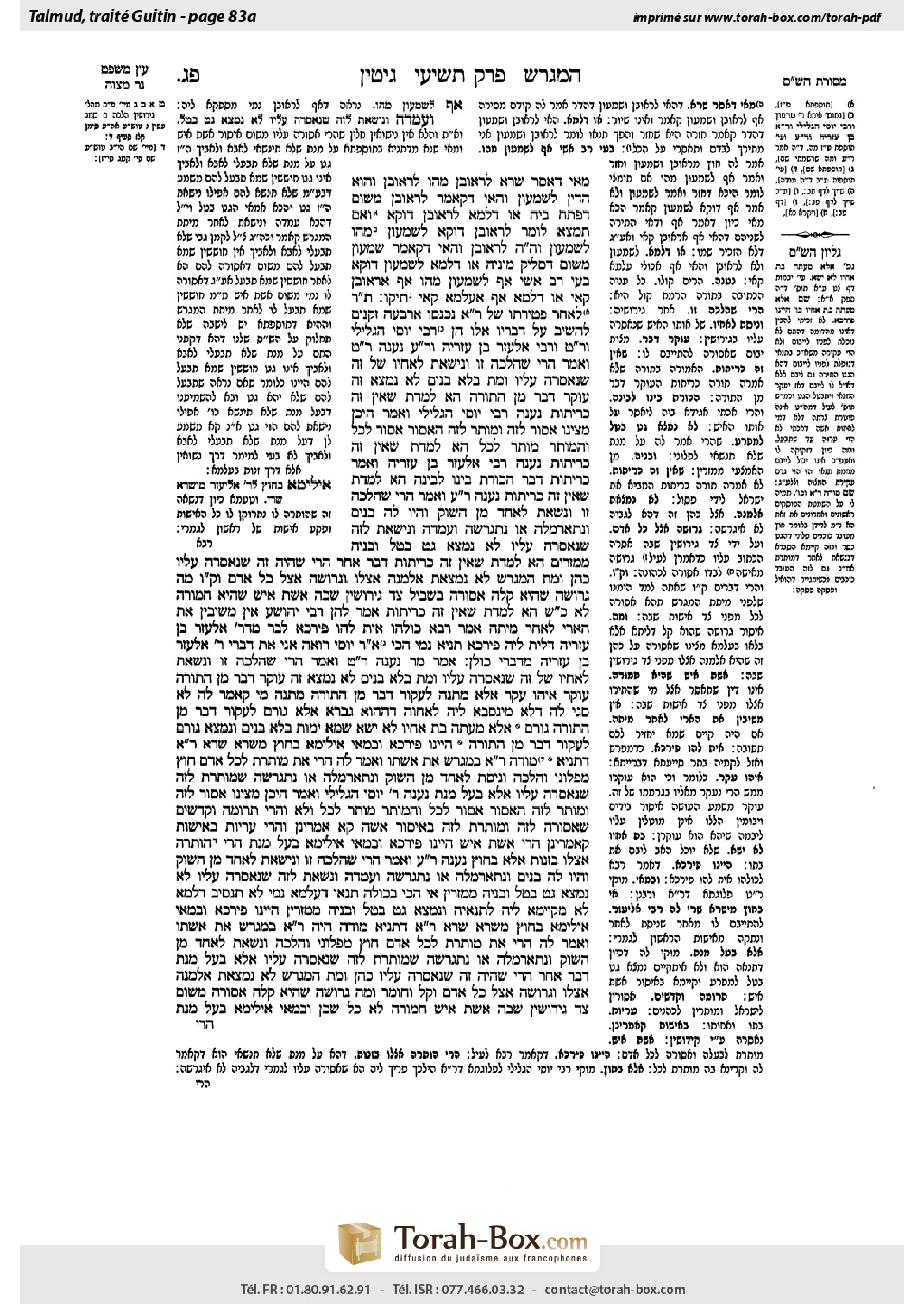
Gittin 83a: Talmud study for Daf Yomi
Study the Talmud for Daf Yomi with scanned pages, Hebrew text, English translations from Sefaria and AI-generated French translations.
Passage selection and English or AI-generated French translation are available where the scan has annotations. Daf Study is independent of Torah-Box and Sefaria.
Browse Gittin · גיטין · All tractatesGittin 83a text and translations
This page of Gittin includes the Aramaic text, an English translation and an AI-generated French translation, alongside the scan above.
גיטין פ״ג א · Aramaic and Hebrew text
מַאי דַּאֲסַר שְׁרָא; ״לִרְאוּבֵן״, מַהוּ? לִרְאוּבֵן – וְהוּא הַדִּין לְשִׁמְעוֹן, וְהַאי דְּקָאָמַר לִרְאוּבֵן – מִשּׁוּם דִּפְתַח בֵּיהּ; אוֹ דִלְמָא – לִרְאוּבֵן דַּוְקָא?
וְאִם תִּמְצָא לוֹמַר ״לִרְאוּבֵן״ דַּוְקָא; ״לְשִׁמְעוֹן״, מַהוּ? לְשִׁמְעוֹן – וְהוּא הַדִּין לִרְאוּבֵן, וְהַאי דְּקָאָמַר ״שִׁמְעוֹן״ – מִשּׁוּם דִּסְלֵיק מִינֵּיהּ; אוֹ דִלְמָא – לְשִׁמְעוֹן דַּוְקָא?
בָּעֵי רַב אָשֵׁי: ״אַף לְשִׁמְעוֹן״, מַהוּ? ״אַף״ – אַרְאוּבֵן קָאֵי; אוֹ דִלְמָא, ״אַף״ – אַעָלְמָא קָאֵי? תֵּיקוּ.
תָּנוּ רַבָּנַן: לְאַחַר פְּטִירָתוֹ שֶׁל רַבִּי אֱלִיעֶזֶר, נִכְנְסוּ אַרְבָּעָה זְקֵנִים לְהָשִׁיב עַל דְּבָרָיו, אֵלּוּ הֵן: רַבִּי יוֹסֵי הַגְּלִילִי, וְרַבִּי טַרְפוֹן, וְרַבִּי אֶלְעָזָר בֶּן עֲזַרְיָה, וְרַבִּי עֲקִיבָא.
נַעֲנָה רַבִּי טַרְפוֹן וְאָמַר: הֲרֵי שֶׁהָלְכָה זוֹ, וְנִישֵּׂאת לְאָחִיו שֶׁל זֶה שֶׁנֶּאֶסְרָה עָלָיו, וּמֵת בְּלֹא בָּנִים – לֹא נִמְצָא זֶה עוֹקֵר דָּבָר מִן הַתּוֹרָה? הָא לָמַדְתָּ, שֶׁאֵין זֶה כְּרִיתוּת.
נַעֲנָה רַבִּי יוֹסֵי הַגְּלִילִי וְאָמַר: הֵיכָן מָצִינוּ אָסוּר לָזֶה וּמוּתָּר לָזֶה? הָאָסוּר – אָסוּר לַכֹּל, וְהַמּוּתָּר – מוּתָּר לַכֹּל! הָא לָמַדְתָּ, שֶׁאֵין זֶה כְּרִיתוּת.
נַעֲנָה רַבִּי אֶלְעָזָר בֶּן עֲזַרְיָה וְאָמַר: ״כְּרִיתוּת״ – דָּבָר הַכּוֹרֵת בֵּינוֹ לְבֵינָהּ. הָא לָמַדְתָּ, שֶׁאֵין זֶה כְּרִיתוּת.
נַעֲנָה רַבִּי עֲקִיבָא וְאָמַר: הֲרֵי שֶׁהָלְכָה זוֹ וְנִשֵּׂאת לְאֶחָד מִן הַשּׁוּק וְהָיוּ לָהּ בָּנִים, וְנִתְאַרְמְלָה אוֹ נִתְגָּרְשָׁה, וְעָבְרָה וְנִישֵּׂאת לָזֶה שֶׁנֶּאֶסְרָה עָלָיו – לֹא נִמְצָא גֵּט בָּטֵל, וּבָנֶיהָ מַמְזֵרִים? הָא לָמַדְתָּ, שֶׁאֵין זֶה כְּרִיתוּת.
דָּבָר אַחֵר: הֲרֵי שֶׁהָיָה זֶה שֶׁנֶּאֶסְרָה עָלָיו כֹּהֵן, וּמֵת הַמְגָרֵשׁ – לֹא נִמְצֵאת אַלְמָנָה אֶצְלוֹ, וּגְרוּשָׁה אֵצֶל כׇּל אָדָם?
וְקַל וָחוֹמֶר: מָה גְּרוּשָׁה – שֶׁהִיא קַלָּה, אֲסוּרָה בִּשְׁבִיל צַד גֵּירוּשִׁין שֶׁבָּהּ; אֵשֶׁת אִישׁ – שֶׁהִיא חֲמוּרָה. לֹא כׇּל שֶׁכֵּן?! הָא לָמַדְתָּ, שֶׁאֵין זֶה כְּרִיתוּת.
אָמַר לָהֶן רַבִּי יְהוֹשֻׁעַ: אֵין מְשִׁיבִין אֶת הָאֲרִי לְאַחַר מִיתָה.
אָמַר רָבָא: כּוּלְּהוּ אִית לְהוּ פִּירְכָא, לְבַר מִדְּרַבִּי אֶלְעָזָר בֶּן עֲזַרְיָה – דְּלֵית לֵיהּ פִּירְכָא. תַּנְיָא נָמֵי הָכִי, אָמַר רַבִּי יוֹסֵי: רוֹאֶה אֲנִי אֶת דִּבְרֵי רַבִּי אֶלְעָזָר בֶּן עֲזַרְיָה מִדִּבְרֵי כּוּלָּן.
אָמַר מָר, נַעֲנָה רַבִּי טַרְפוֹן וְאָמַר: הֲרֵי שֶׁהָלְכָה זוֹ וְנִשֵּׂאת לְאָחִיו שֶׁל זֶה שֶׁנֶּאֶסְרָה עָלָיו, וּמֵת בְּלֹא בָּנִים – לֹא נִמְצָא זֶה עוֹקֵר דָּבָר מִן הַתּוֹרָה? עוֹקֵר?! אִיהוּ עָקַר?! אֶלָּא ״מַתְנֶה לַעֲקוֹר דָּבָר מִן הַתּוֹרָה״.
מַתְנֶה?! מִי קָאָמַר לַהּ: לָא סַגִּי לַהּ דְּלָא מִינַּסְבָא לֵיהּ לַאֲחוּהּ דְּהָהוּא גַּבְרָא?! אֶלָּא ״גּוֹרֵם לַעֲקוֹר דָּבָר מִן הַתּוֹרָה״.
גּוֹרֵם?! אֶלָּא מֵעַתָּה, בַּת אָחִיו לֹא יִשָּׂא – שֶׁמָּא יָמוּת בְּלֹא בָּנִים, וְנִמְצָא גּוֹרֵם לַעֲקוֹר דָּבָר מִן הַתּוֹרָה! הַיְינוּ פִּירְכָא.
וּבְמַאי? אִילֵימָא בְּ״חוּץ״, מִשְׁרָא שָׁרֵי רַבִּי אֱלִיעֶזֶר!
דְּתַנְיָא: מוֹדֶה רַבִּי אֱלִיעֶזֶר בִּמְגָרֵשׁ אֶת אִשְׁתּוֹ, וְאָמַר לָהּ: ״הֲרֵי אַתְּ מוּתֶּרֶת לְכׇל אָדָם, חוּץ מִפְּלוֹנִי״, וְהָלְכָה וְנִיסֵּת לְאֶחָד מִן הַשּׁוּק, וְנִתְאַרְמְלָה אוֹ נִתְגָּרְשָׁה, שֶׁמּוּתֶּרֶת לָזֶה שֶׁנֶּאֶסְרָה עָלָיו!
אֶלָּא בְּ״עַל מְנָת״.
נַעֲנָה רַבִּי יוֹסֵי הַגְּלִילִי וְאָמַר: הֵיכָן מָצִינוּ אָסוּר לָזֶה וּמוּתָּר לָזֶה? הָאָסוּר – אָסוּר לַכֹּל, וְהַמּוּתָּר – מוּתָּר לַכֹּל. וְלָא?! וַהֲרֵי תְּרוּמָה וְקָדָשִׁים, שֶׁאֲסוּרָה לָזֶה, וּמוּתֶּרֶת לָזֶה! בְּאִיסּוּר אִשָּׁה קָא אָמְרִינַן.
וַהֲרֵי עֲרָיוֹת! בְּאִישׁוּת קָאָמְרִינַן.
הֲרֵי אֵשֶׁת אִישׁ! הַיְינוּ פִּירְכָא.
וּבְמַאי? אִילֵּימָא בְּ״עַל מְנָת״ – הֲרֵי הוּתְּרָה אֶצְלוֹ בִּזְנוּת! אֶלָּא בְּ״חוּץ״.
נַעֲנָה רַבִּי עֲקִיבָא וְאָמַר: הֲרֵי שֶׁהָלְכָה זוֹ וְנִישֵּׂאת לְאֶחָד מִן הַשּׁוּק וְהָיוּ לָהּ בָּנִים, וְנִתְאַרְמְלָה אוֹ נִתְגָּרְשָׁה, וְעָמְדָה וְנִשֵּׂאת לָזֶה שֶׁנֶּאֶסְרָה עָלָיו, לֹא נִמְצָא גֵּט בָּטֵל וּבָנֶיהָ מַמְזֵרִין?
אִי הָכִי – בְּכוּלְּהוּ תְּנָאֵי דְּעָלְמָא נָמֵי לָא תִּנְּסִיב, דִּלְמָא לָא מְקַיְּימָא לֵיהּ לִתְנָאֵיהּ וְנִמְצָא גֵּט בָּטֵל וּבָנֶיהָ מַמְזֵרִין! הַיְינוּ פִּירְכָא.
וּבְמַאי? אִילֵימָא בְּ״חוּץ״, מִשְׁרָא שָׁרֵי רַבִּי אֱלִיעֶזֶר!
דְּתַנְיָא: מוֹדֶה הָיָה רַבִּי אֱלִיעֶזֶר בִּמְגָרֵשׁ אֶת אִשְׁתּוֹ, וְאָמַר לָהּ: ״הֲרֵי אַתְּ מוּתֶּרֶת לְכׇל אָדָם, חוּץ מִפְּלוֹנִי״, וְהָלְכָה וְנִשֵּׂאת לְאֶחָד מִן הַשּׁוּק וְנִתְאַרְמְלָה אוֹ נִתְגָּרְשָׁה, שֶׁמּוּתֶּרֶת לָזֶה שֶׁנֶּאֶסְרָה עָלָיו! אֶלָּא בְּ״עַל מְנָת״.
דָּבָר אַחֵר: הֲרֵי שֶׁהָיָה זֶה שֶׁנֶּאֶסְרָה עָלָיו כֹּהֵן, וּמֵת הַמְגָרֵשׁ, לֹא נִמְצֵאת אַלְמָנָה אֶצְלוֹ, וּגְרוּשָׁה אֵצֶל כׇּל אָדָם? וְקַל וָחוֹמֶר: וּמָה גְּרוּשָׁה שֶׁהִיא קַלָּה – אֲסוּרָה מִשּׁוּם צַד גֵּירוּשִׁין שֶׁבָּהּ, אֵשֶׁת אִישׁ חֲמוּרָה – לֹא כׇּל שֶׁכֵּן?!
וּבְמַאי? אִילֵּימָא בְּ״עַל מְנָת״,
Gittin 83a · English translation
that what he initially forbade he then permitted, enabling her to marry anyone she wishes, what is the halakha if he said the second time that she is permitted to marry Reuven? Did he mean that she is permitted to marry Reuven and the same is true with regard to Shimon, i.e., she is permitted to marry him as well? Is the fact that he mentioned only that she is permitted to marry Reuven because he opened his prior qualification by mentioning him before he mentioned Shimon, but he intended to permit her to marry Shimon as well? Or did he, perhaps, specifically intend to permit her to marry Reuven?
And if you say that he intended to permit her to marry specifically Reuven and not Shimon, what is the halakha if he said that she is permitted to marry Shimon? Did he mean that she is permitted to marry Shimon and the same is true with regard to Reuven, and the fact that he mentioned only Shimon is because he ended his initial previous statement by mentioning him? Or perhaps he was specifically referring only to Shimon?
Rav Ashi raises another dilemma with regard to the same case: If he said to her the second time: You are also permitted to marry Shimon, what is the halakha? Is the word also referring to Reuven, i.e., she is permitted to marry Shimon in addition to Reuven, or perhaps it is also referring to everyone, i.e., she is permitted to marry Shimon in addition to all men, but not Reuven? The dilemma shall stand unresolved.
§ The Sages taught (Tosefta 9:1): After the death of Rabbi Eliezer, four Sages entered the discussion to refute his statement. They were: Rabbi Yosei HaGelili, Rabbi Tarfon, Rabbi Elazar ben Azarya, and Rabbi Akiva.
Rabbi Tarfon responded to Rabbi Eliezer’s opinion, saying: If after the husband stipulated that the wife not marry a certain man she went and married the brother of the one to whom she was prohibited from marrying, and this husband died without children, she cannot perform levirate marriage with her husband’s brother, because he is forbidden to her due to the stipulation of her first husband. Is the first husband not found to be uprooting a matter of Torah law through his stipulation? You have therefore derived that this is not an act of severance. The divorce is not valid, as the Torah would not sanction a manner of divorce that can cause a mitzva to be nullified.
Rabbi Yosei also responded to Rabbi Eliezer’s opinion, saying: Where do we find an example of something that is forbidden to this person and permitted to that other person? What is forbidden is forbidden to everyone, and what is permitted is permitted to everyone. This contradicts Rabbi Eliezer’s opinion that a divorcée can be prohibited from marrying a certain man and permitted to marry all other men. You have therefore derived that this is not an act of severance.
Rabbi Elazar ben Azarya responded, saying: What is the meaning of the expression: “Scroll of severance,” which is used in the Torah for a bill of divorce? It means something that severs the bond between him and her entirely. This woman, by contrast, is still bound to her husband after their divorce, as his stipulation prevents her from marrying a certain man. You have therefore derived that this is not an act of severance.
Rabbi Akiva responded, saying: If after the husband stipulated that the wife not marry a certain man she went and married a man from the general public, and she had children with him, and she was subsequently widowed or divorced from the second husband, and she then arose and married the one to whom she was forbidden by her first husband’s condition, isn’t the bill of divorce thereby found to be nullified? And would this not render her children from her second marriage as born from an adulterous relationship [mamzerim], as she is retroactively considered her first husband’s wife? You have therefore derived that this is not an act of severance, as the Torah would not enable a divorce that could lead to such a situation.
Rabbi Akiva continued to offer an alternative refutation of Rabbi Eliezer’s opinion: If the one to whom she was forbidden was a priest, and her ex-husband who divorced her died, is she not thereby found to be a widow with regard to him, as she was considered a married woman with regard to this priest even after her divorce, and a divorcée with regard to any other man? Nevertheless, she is forbidden to him too, just as she is forbidden to any other priest.
And it is therefore an a fortiori inference that just as the prohibition for a divorcée to marry a priest (see Leviticus 21:14) is a relatively minor prohibition, yet she is forbidden to this priest due to the element of divorce that applies to her, even though with regard to him she is not a divorcée but a widow, all the more so is it not clear that the prohibition against sexual intercourse with a married woman, which is a major prohibition, should apply to every man during the lifetime of the ex-husband, due to the fact that she is considered a married woman with regard to this one man? You have therefore derived that this is not an act of severance, as this divorce does not permit her to marry any man.
Rabbi Yehoshua said to them: Even though your objections are valid, one does not refute the opinion of a lion after his death. After a Sage has passed away one cannot reject his opinion based on a difficulty with it, as he possibly would have provided an answer had it been presented to him while he was still alive.
Rava said: All of the previously mentioned responses have refutations that can be raised against them except for the response of Rabbi Elazar ben Azarya, which does not have a refutation. The Gemara notes that this is also taught in a baraita, as Rabbi Yosei said: I see the statement of Rabbi Elazar ben Azarya as preferable to the statements of all the other Sages.
The Gemara commences discussion of the baraita: The Master said that Rabbi Tarfon responded, saying: If she went and married the brother of the one to whom she was prohibited from marrying, and he died without children, is the first husband not thereby found to be uprooting a matter of Torah law? The Gemara asks: What is the meaning of the question: Is the first husband not uprooting a matter of Torah law? Is it he who is uprooting the mitzva? Rather, Rabbi Tarfon means that the husband is stipulating to uproot a matter of Torah law.
The Gemara questions this assertion as well: Is the husband stipulating to uproot a mitzva? Did he say to her that it is not sufficient if she does not marry the brother of that man, who he rendered forbidden to her? Since he did not stipulate this, he did not uproot the mitzva; it is the woman who uprooted the mitzva by marrying specifically that man’s brother. Rather, Rabbi Tarfon means that the husband is causing a matter of Torah law to be uprooted.
The Gemara asks: He is causing of matter of Torah law to be uprooted? But if that is so, one should not marry his brother’s daughter lest he die without children, and he will thereby be found to be causing a matter of Torah law to be uprooted in that his brother will not be able to perform levirate marriage with his own daughter, and the Sages laud one who marries his brother’s daughter. The Gemara responds: This is the refutation against Rabbi Tarfon’s response that Rava was referring to.
The Gemara asks: And with regard to what case did Rabbi Tarfon refute Rabbi Eliezer’s opinion? If we say that it was with regard to a case in which the husband said that his wife is permitted to marry any man except for so-and-so, the refutation is irrelevant, as Rabbi Eliezer permits the woman to marry this man after she married another man.
As it is taught in a baraita (Tosefta 9:1): With regard to a case where a man divorces his wife and said to her while handing her the bill of divorce: You are hereby permitted to marry any man except for so-and-so, and she went and married someone from the general public and was subsequently widowed or divorced from him, Rabbi Eliezer concedes that she is now permitted to marry the man whom she was initially prohibited from marrying by the qualification of her first husband.
Rather, Rabbi Tarfon’s refutation was clearly stated with regard to a case where the woman was divorced on the condition that she would not marry so-and-so. A condition still applies after the woman remarries and its violation nullifies the divorce retroactively.
The baraita states that Rabbi Yosei HaGelili responded, saying: Where do we find an example of something that is forbidden to this person and permitted to that other person? What is forbidden is forbidden to everyone and what is permitted is permitted to everyone. The Gemara asks: Is there not such an example? Aren’t teruma, the portion of the produce designated for the priest, and sacrificial meat forbidden to this group, i.e., non-priests (see Leviticus 22:10), and permitted to that group, i.e., priests? The Gemara answers: We are referring to a forbidden woman.
The Gemara asks: Aren’t those women with whom relations are prohibited due to familial ties forbidden to some men, i.e., their relatives, and permitted to others? The Gemara answers: We are referring to a woman who is forbidden due to marriage.
The Gemara asks: Isn’t a married woman forbidden to all men but permitted to her husband? The Gemara responds: This is the refutation against Rabbi Yosei HaGelili’s response that Rava was referring to.
The Gemara clarifies: And with regard to what case did Rabbi Yosei HaGelili raise this objection? If we say that it was with regard to a case in which the divorce was granted on the condition that she not marry a certain man, she is not entirely forbidden to him, as she is permitted to engage in licentiousness with him; the condition was with regard to marriage, not licentiousness. Rather, he clearly raised the objection with regard to a case where the husband told his wife that she is permitted to marry any man except for so-and-so, rendering her entirely forbidden to that man.
The baraita states that Rabbi Akiva responded, saying: If she went and married a man from the general public, and she had children with him, and she was subsequently widowed or divorced from this second husband, and she then arose and married the one to whom she was forbidden, isn’t the bill of divorce thereby nullified? And would this not render her children mamzerim?
The Gemara asks: If that is so, and there is a concern that she will eventually violate the condition, in a case of any typical condition that the husband attaches to the divorce she should not remarry either, lest she not fulfill his condition and the bill of divorce be found to be nullified and her children be rendered mamzerim. The Gemara responds: This is the refutation against Rabbi Akiva’s response that Rava was referring to.
The Gemara asks: And with regard to what case did Rabbi Akiva raise this objection? If we say that it was with regard to a case in which the husband said that his wife is permitted to marry any man except for so-and-so, the objection is irrelevant, as Rabbi Eliezer permits the woman to marry so-and-so after she marries another man.
As it is taught in a baraita: With regard to a case where a man divorces his wife and said to her: You are hereby permitted to marry any man except for so-and-so, and she went and married someone from the general public, and was subsequently widowed or divorced from him, Rabbi Eliezer concedes that she is now permitted to marry the man whom she was initially prohibited from marrying. Rather, Rabbi Akiva’s objection was clearly with regard to a case of a condition that she would not marry so-and-so.
The baraita states that Rabbi Akiva added an alternative response: If the one to whom she was forbidden was a priest, and her ex-husband who divorced her died, is she not found to be a widow with regard to him and a divorcée with regard to any other man? And it is therefore an a fortiori inference that just as the prohibition against a divorcée marrying a priest is minor, and yet she is forbidden to this priest due to the element of divorce that applies to her, all the more so is it not clear that the prohibition against relations with a married woman, which is major, should apply to every man during the lifetime of the ex-husband, due to the fact that she is considered a married woman with regard to this one man? Therefore, the divorce does not take effect.
The Gemara asks: And with regard to what case was this objection raised? If we say that it was with regard to a case of a condition,
Gittin 83a · Traduction française (IA)
que ce qu'il avait d'abord interdit il l'a ensuite permis, permettant ainsi qu'elle épouse quiconque elle le souhaite, quelle est la halakha si il a dit la deuxième fois qu'elle est permise à épouser Réouven ? Voulait-il dire qu'elle est permise à épouser Réouven et la même chose s'applique à Shimon, c'est-à-dire qu'elle est permise à épouser lui aussi ? Le fait qu'il ait mentionné seulement qu'elle est permise à épouser Réouven est-il dû au fait qu'il avait ouvert sa qualification précédente en mentionnant lui avant d'aborder Shimon, mais il voulait permettre qu'elle épouse Shimon également ? Ou bien voulait-il, peut-être, spécifiquement permettre qu'elle épouse Réouven ?
Et si vous dites qu'il voulait permettre qu'elle épouse spécifiquement Réouven et non Shimon, quelle est la halakha si il a dit qu'elle est permise à épouser Shimon ? Voulait-il dire qu'elle est permise à épouser Shimon et la même chose s'applique à Réouven, et le fait qu'il ait mentionné seulement Shimon est-il dû au fait qu'il avait terminé sa déclaration précédente en mentionnant lui ? Ou bien voulait-il spécifiquement faire référence seulement à Shimon ?
Rav Ashi soulève un autre dilemme concernant le même cas : Si il a dit à elle la deuxième fois : Tu es également permise à épouser Shimon, quelle est la halakha ? Le mot « également » fait-il référence à Réouven, c'est-à-dire qu'elle est permise à épouser Shimon en plus de Réouven, ou bien fait-il référence à tout le monde, c'est-à-dire qu'elle est permise à épouser Shimon en plus de tous les hommes, mais pas Réouven ? Ce dilemme restera sans solution.
§ Les Sages enseignèrent (Tosefta 9:1) : Après la mort de Rabbi Eliezer, quatre Sages entrèrent en discussion pour réfuter son opinion. Ils étaient : Rabbi Yosei HaGelili, Rabbi Tarfon, Rabbi Elazar ben Azarya et Rabbi Akiva.
Rabbi Tarfon répondit à l'opinion de Rabbi Eliezer, disant : Si après que le mari ait stipulé que la femme ne doive pas épouser un certain homme, elle est allée épouser le frère de celui à qui elle était interdite, et ce mari est mort sans enfants, elle ne peut pas pratiquer le levirate avec le frère de son mari, car il lui est interdit en raison de la stipulation de son premier mari. N'est-ce pas le premier mari qui détruit une loi divine par sa stipulation ? Vous avez donc déduit que cela n'est pas un acte de séparation. Le divorce n'est pas valide, car la Torah ne sanctionnerait pas un mode de divorce qui pourrait annuler une mitsva.
Rabbi Yosei répondit également à l'opinion de Rabbi Eliezer, disant : Où trouvons-nous un exemple de quelque chose qui est interdit à cette personne et permis à celle-ci ? Ce qui est interdit est interdit à tous, et ce qui est permis est permis à tous. Cela contredit l'opinion de Rabbi Eliezer selon laquelle une divorcée peut être interdite à épouser un certain homme et permise à épouser tous les autres hommes. Vous avez donc déduit que cela n'est pas un acte de séparation.
Rabbi Elazar ben Azarya répondit, disant : Quelle est la signification de l'expression : « Scroll de séparation », utilisée dans la Torah pour un divorce ? Cela signifie quelque chose qui coupe entièrement le lien entre lui et elle. Cette femme, en revanche, est encore liée à son mari après leur divorce, car sa stipulation l'empêche de se marier avec un certain homme. Vous avez donc déduit que cela n'est pas un acte de séparation.
Rabbi Akiva répondit, disant : Si après que le mari ait stipulé que la femme ne doive pas épouser un certain homme, elle est allée épouser un homme du public, et elle a eu des enfants avec lui, et elle est ensuite devenue veuve ou divorcée de son deuxième mari, et elle est ensuite sortie épouser celui à qui elle était interdite par la condition de son premier mari, n'est-ce pas le divorce trouvé nul ? Et ne rendrait-ce pas ses enfants de son deuxième mariage comme nés d'une relation adultère [mamzerim], car elle est considérée rétroactivement comme étant la femme de son premier mari ? Vous avez donc déduit que cela n'est pas un acte de séparation, car la Torah ne permettrait pas un divorce qui pourrait entraîner une telle situation.
Rabbi Akiva continua à offrir une autre réfutation de l'opinion de Rabbi Eliezer : Si celui à qui elle était interdite était un prêtre, et son ex-mari qui l'avait divorcée est mort, n'est-ce pas qu'elle est considérée comme une veuve concernant lui, car elle était considérée comme une femme mariée concernant ce prêtre même après son divorce, et une divorcée concernant tout autre homme ? Cependant, elle est interdite à lui aussi, tout comme elle est interdite à tout autre prêtre.
Il en est donc une déduction a fortiori : justement que l'interdiction pour une divorcée de se marier avec un prêtre (voir Lévitique 21:14) est une interdiction relativement mineure, et pourtant elle est interdite à ce prêtre en raison de l'élément de divorce qui s'applique à elle, même si, concernant lui, elle n'est pas une divorcée mais une veuve, tout autant que l'interdiction de relations sexuelles avec une femme mariée, qui est une interdiction majeure, devrait s'appliquer à chaque homme pendant la vie de l'ex-mari, en raison du fait qu'elle est considérée comme une femme mariée concernant ce seul homme ? Vous avez donc déduit que cela n'est pas un acte de séparation, car ce divorce ne permet pas qu'elle épouse n'importe quel homme.
Rabbi Yéhoshua dit à eux : Même si vos objections sont valables, on ne réfute pas l'opinion d'un lion après sa mort. Après que le Sage est mort, on ne peut pas rejeter son opinion en raison d'une difficulté avec elle, car il aurait pu fournir une réponse s'il avait été interrogé à son époque.
Rava dit : Toutes les réponses mentionnées précédemment ont des réfutations qui peuvent être soulevées contre elles, sauf la réponse de Rabbi Elazar ben Azarya, qui n'a pas de réfutation. La Guemara note que cela est également enseigné dans une baraïta, car Rabbi Yosei dit : Je considère la déclaration de Rabbi Elazar ben Azarya comme préférable à celles de tous les autres Sages.
La Guemara commence la discussion sur la baraïta : Le Maître dit que Rabbi Tarfon répondit en disant : Si elle est allée se marier avec le frère de l'homme auquel elle était interdite de se marier, et s'il est mort sans enfants, n'est-ce pas que le premier mari n'entraîne pas la violation d'une loi divine ? La Guemara demande : Quelle est la signification de cette question : n'est-ce pas que le premier mari n'entraîne pas la violation d'une loi divine ? Est-ce lui qui est en train de violer la mitsva ? Plutôt, Rabbi Tarfon veut dire que le mari stipule la violation d'une loi divine.
La Guemara questionne également cette affirmation : Est-ce que le mari stipule la violation d'une mitsva ? A-t-il dit à elle qu'il n'est pas suffisant qu'elle ne se marie pas avec le frère de cet homme, qu'il lui a rendu interdit ? Puisqu'il n'a pas stipulé cela, il n'a pas violé la mitsva ; c'est la femme qui a violé la mitsva en se mariant spécifiquement avec le frère de cet homme. Plutôt, Rabbi Tarfon veut dire que le mari cause la violation d'une loi divine.
La Guemara demande : Il cause la violation d'une loi divine ? Mais si c'est ainsi, on ne devrait pas se marier avec la fille du frère, de peur qu'il meure sans enfants, et qu'il soit ainsi trouvé en train de causer la violation d'une loi divine, car son frère ne pourra pas accomplir le levirate avec sa propre fille, et les Sages louent celui qui se marie avec la fille du frère. La Guemara répond : C'est la réfutation contre la réponse de Rabbi Tarfon que Rava faisait référence.
La Guemara demande : Et concernant quel cas Rabbi Tarfon a-t-il réfuté l'opinion de Rabbi Eliezer ? Si nous disons qu'il s'agissait d'un cas où le mari a dit à sa femme qu'elle est autorisée à se marier avec n'importe quel homme sauf celui-ci, la réfutation est inutile, car Rabbi Eliezer permet à la femme de se marier avec cet homme après qu'elle ait épousé un autre homme.
Comme il est enseigné dans une baraïta (Tosefta 9:1) : Concernant un cas où un homme divorce de sa femme et lui dit en lui remettant le document de divorce : Tu es désormais autorisée à te marier avec n'importe quel homme sauf celui-ci, et elle est allée se marier avec un homme du grand public et a ensuite été veuve ou divorcée de lui, Rabbi Eliezer reconnaît qu'elle est désormais autorisée à se marier avec l'homme auquel elle était initialement interdite par la qualification de son premier mari.
Plutôt, la réfutation de Rabbi Tarfon était clairement énoncée concernant un cas où la femme a été divorcée sous la condition qu'elle ne se marie pas avec celui-ci. Une condition reste en vigueur après que la femme ait remarié, et sa violation annule le divorce de manière rétroactive.
La baraïta indique que Rabbi Yosei HaGelili répondit en disant : Où trouvons-nous un exemple d'une chose interdite à cette personne et permise à une autre personne ? Ce qui est interdit est interdit à tous et ce qui est permis est permis à tous. La Guemara demande : N'y a-t-il pas un tel exemple ? Ne sont-ce pas la terouma, la part des produits désignée pour le prêtre, et la viande sacrée interdites à ce groupe, c'est-à-dire les non-prêtres (voir Lévitique 22:10), et permises à ce groupe, c'est-à-dire les prêtres ? La Guemara répond : Nous parlons d'une femme interdite.
La Guemara demande : Ne sont-ce pas ces femmes avec lesquelles les relations sont interdites en raison de liens familiaux, interdites à certains hommes, c'est-à-dire leurs parents, et permises à d'autres ? La Guemara répond : Nous parlons d'une femme interdite en raison du mariage.
La Guemara demande : N'est-ce pas une femme mariée interdite à tous les hommes mais permise à son mari ? La Guemara répond : C'est la réfutation contre la réponse de Rabbi Yosei HaGelili que Rava faisait référence.
La Guemara clarifie : Et concernant quel cas Rabbi Yosei HaGelili a-t-il soulevé cette objection ? Si nous disons qu'il s'agissait d'un cas où le divorce a été accordé sous la condition qu'elle ne se marie pas avec un certain homme, elle n'est pas entièrement interdite à lui, car elle est autorisée à avoir des relations avec lui ; la condition était concernant le mariage, pas les relations. Plutôt, il a clairement soulevé l'objection concernant un cas où le mari a dit à sa femme qu'elle est autorisée à se marier avec n'importe quel homme sauf celui-ci, la rendant entièrement interdite à cet homme.
La baraïta affirme que Rabbi Akiva répondit en disant : Si elle est allée se marier avec un homme du grand public, et qu'elle a eu des enfants avec lui, et qu'elle a ensuite été veuve ou divorcée de ce deuxième mari, et qu'elle est ensuite allée se marier avec celui auquel elle était interdite, n'est-ce pas que le document de divorce est ainsi annulé ? Et ne rendrait-ce pas ses enfants mamzerim ?
La Guemara demande : Si c'est ainsi, et qu'il y a une crainte qu'elle viole un jour la condition, dans un cas de toute condition habituelle que le mari attache au divorce, elle ne devrait pas se remarier non plus, de peur qu'elle ne remplisse pas sa condition et que le document de divorce soit trouvé annulé et ses enfants rendus mamzerim. La Guemara répond : C'est la réfutation contre la réponse de Rabbi Akiva que Rava faisait référence.
La Guemara demande : Et concernant quel cas Rabbi Akiva a-t-il soulevé cette objection ? Si nous disons qu'il s'agissait d'un cas où le mari a dit à sa femme qu'elle est autorisée à se marier avec n'importe quel homme sauf celui-ci, l'objection est inutile, car Rabbi Eliezer permet à la femme de se marier avec celui-ci après qu'elle ait épousé un autre homme.
Comme il est enseigné dans une baraïta : Concernant un cas où un homme divorce de sa femme et lui dit : Tu es désormais autorisée à te marier avec n'importe quel homme sauf celui-ci, et elle est allée se marier avec un homme du grand public, et a ensuite été veuve ou divorcée de lui, Rabbi Eliezer reconnaît qu'elle est désormais autorisée à se marier avec l'homme auquel elle était initialement interdite. Plutôt, l'objection de Rabbi Akiva était clairement énoncée concernant un cas d'une condition qu'elle ne se marierait pas avec celui-ci.
La baraïta indique que Rabbi Akiva a ajouté une réponse alternative : Si celui à qui elle était interdite était un prêtre, et que son ex-mari, qui l'avait divorcée, est décédé, n'est-t-elle pas considérée comme veuve par rapport à lui et comme divorcée par rapport à tout autre homme ? Et donc, par conséquent, une inférence a fortiori : puisque l'interdiction d'une divorcée de se marier avec un prêtre est mineure, et pourtant elle est interdite à ce prêtre en raison de l'élément de divorce qui s'applique à elle, toute la plus grande interdiction, celle des relations avec une femme mariée, devrait s'appliquer à tout homme pendant la vie de l'ex-mari, en raison du fait qu'elle est considérée comme une femme mariée par rapport à cet homme seul. Ainsi, le divorce ne prend pas effet.
La Guemara demande : Et à quel cas cette objection a-t-elle été soulevée ? Si nous disons qu'il s'agissait d'un cas de condition,
Traduction française générée par IA à partir de l’édition anglaise de Sefaria. Vérifie toujours un passage avec le texte source.
Text from Sefaria: William Davidson Edition - Vocalized Aramaic (CC BY NC); William Davidson Edition - English (CC BY NC).