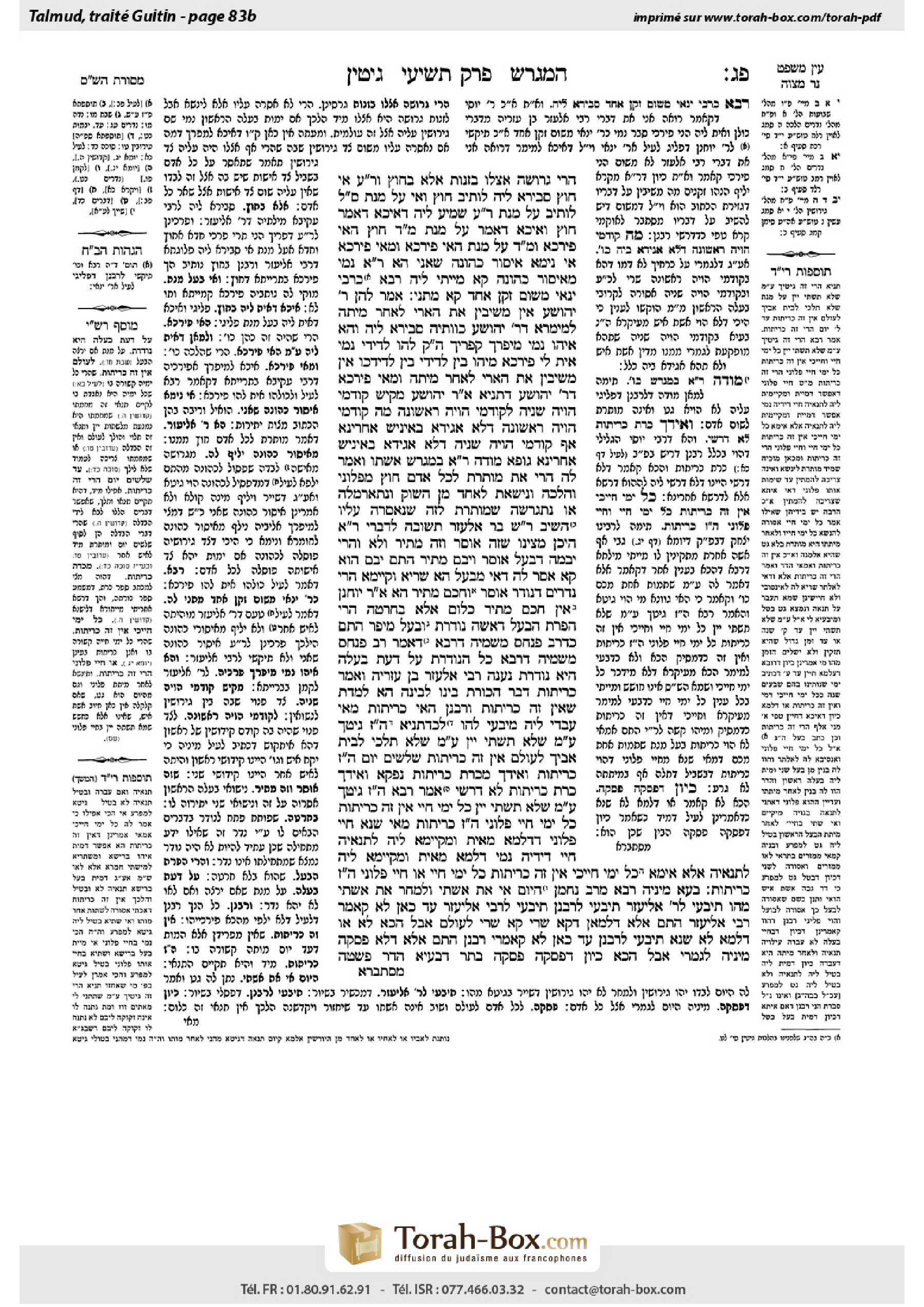
Gittin 83b: Talmud study for Daf Yomi
Study the Talmud for Daf Yomi with scanned pages, Hebrew text, English translations from Sefaria and AI-generated French translations.
Passage selection and English or AI-generated French translation are available where the scan has annotations. Daf Study is independent of Torah-Box and Sefaria.
Browse Gittin · גיטין · All tractatesGittin 83b text and translations
This page of Gittin includes the Aramaic text, an English translation and an AI-generated French translation, alongside the scan above.
גיטין פ״ג ב · Aramaic and Hebrew text
הֲרֵי גְּרוּשָׁה אֶצְלוֹ – בִּזְנוּת! אֶלָּא בְּ״חוּץ״.
וְרַבִּי עֲקִיבָא, אִי ״חוּץ״ סְבִירָא לֵיהּ – לוֹתֵיב ״חוּץ״, וְאִי ״עַל מְנָת״ סְבִירָא לֵיהּ – לוֹתֵיב ״עַל מְנָת״!
רַבִּי עֲקִיבָא שְׁמִיעַ לֵיהּ דְּאִיכָּא דְּאָמַר ״חוּץ״ וְאִיכָּא דְּאָמַר ״עַל מְנָת״; מַאן דְּאָמַר ״חוּץ״ – הַאי פִּירְכָא, וּמַאן דְּאָמַר ״עַל מְנָת״ – הַאי פִּירְכָא.
וּמַאי פִּירְכָא? אִי נֵימָא אִיסּוּר כְּהוּנָּה שָׁאנֵי, הָא רַבִּי אֱלִיעֶזֶר נָמֵי מֵאִיסּוּר כְּהוּנָּה קָא מַיְיתֵי לֵיהּ!
רָבָא – כְּרַבִּי יַנַּאי מִשּׁוּם זָקֵן אֶחָד קָא מַתְנֵי.
אָמַר לָהֶן רַבִּי יְהוֹשֻׁעַ: אֵין מְשִׁיבִין אֶת הָאֲרִי לְאַחַר מִיתָה. לְמֵימְרָא דְּרַבִּי יְהוֹשֻׁעַ כְּווֹתֵיהּ סְבִירָא לֵיהּ?! וְהָא אִיהוּ נָמֵי מִיפְרָךְ קָפָרֵיךְ!
הָכִי קָאָמַר לְהוּ: לְדִידִי נָמֵי אִית לִי פִּירְכָא; מִיהוּ בֵּין לְדִידִי, בֵּין לְדִידְכוּ – אֵין מְשִׁיבִין אֶת הָאֲרִי לְאַחַר מִיתָה.
וּמַאי פִּירְכָא דְּרַבִּי יְהוֹשֻׁעַ? דְּתַנְיָא, אָמַר רַבִּי יְהוֹשֻׁעַ: מַקִּישׁ קוֹדְמֵי הֲוָיָה שְׁנִיָּה, לְקוֹדְמֵי הֲוָיָה רִאשׁוֹנָה; מָה קוֹדְמֵי הֲוָיָה רִאשׁוֹנָה – דְּלָא אֲגִידָא בְּאִינִישׁ אַחֲרִינָא; אַף קוֹדְמֵי הֲוָיָה שְׁנִיָּה – דְּלָא אֲגִידָא בְּאִינִישׁ אַחֲרִינָא.
גּוּפָא – מוֹדֶה רַבִּי אֱלִיעֶזֶר בִּמְגָרֵשׁ אִשְׁתּוֹ וְאָמַר לָהּ: ״הֲרֵי אַתְּ מוּתֶּרֶת לְכׇל אָדָם חוּץ מִפְּלוֹנִי״, וְהָלְכָה וְנִישֵּׂאת לְאֶחָד מִן הַשּׁוּק, וְנִתְאַרְמְלָה אוֹ נִתְגָּרְשָׁה, שֶׁמּוּתֶּרֶת לָזֶה שֶׁנֶּאֶסְרָה עָלָיו.
הֵשִׁיב רַבִּי שִׁמְעוֹן בַּר אֶלְעָזָר תְּשׁוּבָה לְדִבְרֵי רַבִּי אֱלִיעֶזֶר: הֵיכָן מָצִינוּ שֶׁזֶּה אוֹסֵר וְזֶה מַתִּיר?
וְלָא?! וַהֲרֵי יְבָמָה – דְּבַעַל אוֹסֵר, וְיָבָם מַתִּיר!
הָתָם, יָבָם הוּא קָא אָסַר לַהּ, דְּאִי מִבַּעַל – הָא שַׁרְיָא וְקָיְימָא.
הֲרֵי נְדָרִים, דְּנוֹדֵר אוֹסֵר וְחָכָם מַתִּיר! הָא אָמַר רַבִּי יוֹחָנָן: אֵין חָכָם מַתִּיר כְּלוּם אֶלָּא בַּחֲרָטָה.
הֲרֵי הֲפָרַת הַבַּעַל, דְּאִשָּׁה נוֹדֶרֶת וּבַעַל מֵיפֵר! הָתָם כִּדְרַב פִּנְחָס מִשְּׁמֵיהּ דְּרָבָא – דְּאָמַר רַב פִּנְחָס מִשְּׁמֵיהּ דְּרָבָא: כׇּל הַנּוֹדֶרֶת – עַל דַּעַת בַּעְלָהּ הִיא נוֹדֶרֶת.
נַעֲנָה רַבִּי אֶלְעָזָר בֶּן עֲזַרְיָה וְאָמַר: ״כְּרִיתוּת״ – דָּבָר הַכּוֹרֵת בֵּינוֹ לְבֵינָהּ; הָא לָמַדְתָּ, שֶׁאֵין זֶה כְּרִיתוּת.
וְרַבָּנַן, הַאי ״כְּרִיתוּת״ מַאי עָבְדִי לֵיהּ? מִיבְּעֵי לְהוּ לְכִדְתַנְיָא: ״הֲרֵי זֶה גִּיטִּיךְ עַל מְנָת שֶׁלֹּא תִּשְׁתִּי יַיִן; עַל מְנָת שֶׁלֹּא תֵּלְכִי לְבֵית אָבִיךְ״; ״לְעוֹלָם״ – אֵין זֶה כְּרִיתוּת. ״שְׁלֹשִׁים יוֹם״ – הֲרֵי זֶה כְּרִיתוּת.
וְאִידָּךְ – מִ״כָּרֵת–כְּרִיתוּת״ נָפְקָא. וְאִידַּךְ – ״כָּרֵת–כְּרִיתוּת״ לָא דָּרְשִׁי.
אָמַר רָבָא: ״הֲרֵי זֶה גִּיטִּיךְ, עַל מְנָת שֶׁלֹּא תִּשְׁתִּי יַיִן״; ״כׇּל יְמֵי חַיַּי״ – אֵין זֶה כְּרִיתוּת. ״כׇּל יְמֵי חַיֵּי פְּלוֹנִי״ – הֲרֵי זֶה כְּרִיתוּת.
מַאי שְׁנָא חַיֵּי פְלוֹנִי – דְּדִלְמָא מָאֵית וּמְקַיְּימָא לֵיהּ לִתְנָאֵיהּ; חַיֵּי דִידֵיהּ נָמֵי – דִּלְמָא מָאֵית, וּמְקַיְּימָא לֵיהּ לִתְנָאֵיהּ!
אֶלָּא אֵימָא: ״כׇּל יְמֵי חַיֵּיכִי״ – אֵין זֶה כְּרִיתוּת, ״כׇּל יְמֵי חַיַּי״ אוֹ ״חַיֵּי פְלוֹנִי״ – הֲרֵי זֶה כְּרִיתוּת.
בְּעָא מִינֵּיהּ רָבָא מֵרַב נַחְמָן: ״הַיּוֹם אִי אַתְּ אִשְׁתִּי, וּלְמָחָר אַתְּ אִשְׁתִּי״, מַהוּ? תִּיבְּעֵי לְרַבִּי אֱלִיעֶזֶר, תִּיבְּעֵי לְרַבָּנַן.
תִּיבְּעֵי לְרַבִּי אֱלִיעֶזֶר – עַד כָּאן לָא קָאָמַר רַבִּי אֱלִיעֶזֶר הָתָם, אֶלָּא דִּלְמַאן דְּקָא שָׁרֵי – קָא שָׁרֵי לְעוֹלָם; אֲבָל הָכָא – לָא. אוֹ דִלְמָא לָא שְׁנָא.
תִּיבְּעֵי לְרַבָּנַן – עַד כָּאן לָא קָאָמְרִי רַבָּנַן הָתָם, אֶלָּא דְּלָא פַּסְקַהּ מִינֵּיהּ לִגְמָרֵי; אֲבָל הָכָא, כֵּיוָן דְּפַסְקַהּ – פַּסְקַהּ.
בָּתַר דְּבַעְיָא, הֲדַר פַּשְׁטַהּ:
Gittin 83b · English translation
isn’t the woman a divorcée with regard to engaging in licentious behavior with him? The husband stipulated that she not marry that man, but he did not prohibit her from engaging in licentious behavior with him. Therefore, she is considered a divorcée with regard to him as well. This removes the a fortiori inference, as with regard to all other men she is not considered married at all. Rather, the objection was clearly raised with regard to a case of exception.
The Gemara asks: If Rabbi Akiva holds that Rabbi Eliezer is referring to a case of an exception, he should raise an objection with regard to an exception, and if he holds that Rabbi Eliezer is referring to a case of a stipulation, he should raise an objection with regard to a case of a stipulation. Why does he raise one objection with regard to an exception and then another with regard to a stipulation?
The Gemara answers: Rabbi Akiva heard that there is someone who states Rabbi Eliezer’s ruling with regard to an exception, and there is someone else who states it with regard to a stipulation. He therefore raised objections with regard to both exceptions and stipulations; according to the one who says that it is with regard to an exception, this is the refutation, and according to the one who says that it is with regard to a stipulation, that is the refutation.
The Gemara asks: What is the refutation that Rava found for Rabbi Akiva’s second objection? If we say that it is that the prohibition against marrying into the priesthood is different, and therefore the halakhot of adultery and divorce cannot be inferred from it, doesn’t Rabbi Eliezer also derive his opinion from the prohibition against marrying into the priesthood? Rabbi Yoḥanan stated (82b) that Rabbi Eliezer’s ruling is derived from the verse that states with regard to priests: “Neither may they take a woman divorced from her husband” (Leviticus 21:7), indicating that even if a woman was divorced only from her husband and was not permitted to marry others, she is disqualified from marrying into the priesthood as a divorcée.
The Gemara answers: Rava taught his statement in accordance with the opinion of Rabbi Yannai, who said in the name of one elder that Rabbi Eliezer’s opinion is derived not from the prohibition against marrying into the priesthood, but from the verse: “And she departs out of his house, and goes and becomes another man’s wife” (Deuteronomy 24:2), which indicates that even if he divorced her in a manner that permitted her to marry only one other man, the divorce takes effect. Therefore, Rava refutes Rabbi Akiva’s latter objection by claiming that the prohibition against marrying into the priesthood is different from other prohibitions and cannot be compared to them.
It is stated in the baraita that Rabbi Yehoshua said to them: One does not refute the opinion of a lion after his death. The Gemara asks: Is this to say that Rabbi Yehoshua holds in accordance with the opinion of Rabbi Eliezer? But doesn’t he also raise a refutation against Rabbi Eliezer’s opinion?
The Gemara answers that this is what he was saying to them: I also have a refutation against Rabbi Eliezer’s opinion, but both my objection and yours should not be raised, as one does not refute the opinion of a lion after his death.
The Gemara asks: And what is Rabbi Yehoshua’s refutation? It is as it is taught in a baraita: Rabbi Yehoshua said that the passage: “When a man takes a wife, and marries her, and it comes to pass, if she finds no favor in his eyes, because he has found some unseemly matter in her, and he writes her a scroll of severance, and gives it in her hand, and sends her out of his house; and she departs out of his house, and goes and becomes another man’s wife” (Deuteronomy 24:1–2), juxtaposes the woman’s status before the second marriage to her status before the first marriage. It should be derived from here that just as before the first marriage she is not bound to another man, so too, before the second marriage she is not bound to another man. Therefore, a woman cannot remarry if she is still bound to her ex-husband due to a qualification that prohibits her from marrying a certain man.
§ The Gemara discusses the matter itself that was mentioned above in passing: With regard to a case where a man divorces his wife and said to her: You are hereby permitted to marry any man except for so-and-so, and she went and married someone from the general public and was subsequently widowed or divorced from him, Rabbi Eliezer concedes that she is now permitted to marry the man whom she was initially prohibited from marrying.
The baraita continues: Rabbi Shimon bar Elazar raised a refutation to Rabbi Eliezer’s statement: Where do we find a situation where this person prohibits something and that other person permits it? How can the first husband render the woman prohibited from marrying a certain man and her second husband render her permitted to do so after his death or their divorce?
The Gemara questions this refutation: Is there not such a situation? But isn’t there the case of a yevama, a woman whose husband dies childless, and he deems her forbidden to other men while she waits for his brother, her yavam, to perform levirate marriage with her, and the yavam, after performing levirate marriage with her, deems her permitted in the event of divorce or his death?
The Gemara answers: There, it is the yavam who renders her forbidden, since if not for the yavam, i.e., if her deceased husband did not have any brothers, she would have already been released from her bond to her husband and permitted to marry any man. It is only the existence of the yavam that prevents her from marrying other men. Therefore, it is he who renders her permitted.
The Gemara asks: Isn’t there the matter of vows, where the one who takes the vow prohibits something and a halakhic authority renders it permitted by dissolving the vow? The Gemara answers: Rabbi Yoḥanan says that a halakhic authority dissolves a vow only through regret of the person who took the vow. Since it is necessary for this person to express regret for taking the vow, it is not actually the halakhic authority who causes the dissolution of the vow.
The Gemara asks: Isn’t there the nullification of a wife’s vows by the husband, where the wife vows, creating a prohibition, and her husband nullifies the vow? The Gemara answers: There it can be explained in accordance with that which Rav Pineḥas reasoned in the name of Rava, as Rav Pineḥas says in the name of Rava that with regard to any woman who takes a vow, it is from the outset contingent on her husband’s consent that she takes the vow. Therefore, the husband can nullify it.
§ The Gemara resumes discussion of the previous baraita. Rabbi Elazar ben Azarya responded, saying: What is the meaning of the expression: “Scroll of severance [keritut],” that is used in the Torah for a bill of divorce? It means something that severs the bond between him and her entirely. You have therefore derived that this divorce, after which the wife is still bound to her husband due to his qualification, is not an act of severance.
The Gemara asks: And what do the other Rabbis, who did not refute Rabbi Eliezer’s opinion in this manner, do with this term “severance”? How do they interpret it? The Gemara answers: They need it for that which is taught in a baraita: If a man says to his wife: This is your bill of divorce on the condition that you will not ever drink wine, or: On the condition that you will never go to your father’s house, that is not an act of severance, as she remains restricted by him indefinitely. If he stipulates that she may not do so for thirty days, that is an act of severance. The Rabbis derive from the term severance that any indefinite condition prevents the divorce from taking effect.
The Gemara asks: And from where does the other Sage, Rabbi Elazar ben Azarya, derive this principle? The Gemara answers: It is derived from the fact that the verse does not utilize the basic form of the word severance, i.e., karet, but rather its conjugate, keritut. This indicates an additional principle that is derived from the term. The Gemara asks: And what do the other Sages derive from the seemingly superfluous use of this word? The Gemara answers: They do not interpret the distinction between karet and keritut.
§ Rava says that if a man says to his wife: This is your bill of divorce on the condition that you will not drink wine for all the days of my life, that is not an act of severance, as she remains bound to his condition for the rest of his life. If he stipulates that she may not drink wine for all the days of the life of so-and-so, that is an act of severance.
The Gemara asks: What is different about the case where he mentioned the life of so-and-so? Is it because perhaps that person will die and she will thereby fulfill the condition, allowing her to remarry? With regard to his own life it is also true that perhaps he will die and she will thereby fulfill the condition. Why is the divorce invalid in that case?
Rather, say that if the husband tells her: This is your bill of divorce on the condition that you will not drink wine for all the days of your life, that is not an act of severance, as the wife will never be released from this restriction. If he says: For all the days of my life, or: For all the days of so-and-so’s life, that is an act of severance, as the condition can potentially be fulfilled during her lifetime.
§ Rava raised a dilemma before Rav Naḥman: If a man hands his wife a bill of divorce and says to her: Today you are not my wife, and tomorrow you are my wife, what is the halakha? The Gemara elaborates: Let the dilemma be raised according to the opinion of Rabbi Eliezer and let the dilemma be raised according to the opinion of the Rabbis.
Let the dilemma be raised according to Rabbi Eliezer: Is Rabbi Eliezer saying that only there, in the case of the mishna, the divorce is valid because concerning the one whom the husband permits the wife to marry, he permits her to marry him forever, but here, the divorce is not valid as it is limited in time? Or perhaps it is no different from the case in the mishna, and in both cases Rabbi Eliezer holds that the divorce takes effect?
Let the dilemma be raised according to the Rabbis: Perhaps the Rabbis are saying only there that the divorce is invalid because the husband did not separate her from himself entirely, as she is prohibited from marrying a certain man due to his qualification. But here, the divorce takes effect, as once he separates her, even for a limited period of time, he has consequently separated her entirely.
After Rava raised the dilemma he then resolved it on his own:
Gittin 83b · Traduction française (IA)
La femme n’est-elle pas une divorcée en ce qui concerne l’acte de luxure avec lui ? Le mari a stipulé qu’elle ne doive pas épouser cet homme, mais il n’a pas interdit qu’elle ait des relations avec lui. Ainsi, elle est considérée comme une divorcée envers lui également. Cela annule l’inférence a fortiori, car envers tous les autres hommes elle n’est pas considérée comme mariée du tout. L’objection a été clairement soulevée dans un cas d’exception.
Le Guemara demande : Si Rabbi Akiva considère que Rabbi Eliezer parle d’un cas d’exception, il devrait soulever une objection concernant une exception, et si il considère qu’il s’agit d’un cas de stipulation, il devrait soulever une objection concernant un cas de stipulation. Pourquoi souleve-t-il une objection concernant une exception et une autre concernant une stipulation ?
Le Guemara répond : Rabbi Akiva a entendu qu’il y a quelqu’un qui affirme la décision de Rabbi Eliezer concernant une exception, et quelqu’un d’autre qui l’affirme concernant une stipulation. Il a donc soulevé des objections à la fois concernant les exceptions et les stipulations ; selon celui qui dit qu’il s’agit d’une exception, c’est la réfutation, et selon celui qui dit qu’il s’agit d’une stipulation, c’est la réfutation.
Le Guemara demande : Quelle est la réfutation que Rava a trouvée contre l’objection secondaire de Rabbi Akiva ? Si nous disons que l’interdiction de se marier avec la haute priesthood est différente, et donc les halakhot de l’adultère et du divorce ne peuvent pas être déduites d’elle, ne déduit pas Rabbi Eliezer aussi son opinion à partir de cette interdiction ? Rabbi Yoḥanan a déclaré (82b) que la décision de Rabbi Eliezer est tirée de la parole qui dit concernant les prêtres : « Elle ne doit pas prendre une femme divorcée de son mari » (Lévitique 21:7), indiquant que même si une femme était divorcée seulement de son mari et n’était pas autorisée à épouser d’autres, elle est exclue de se marier avec la haute priesthood en tant que divorcée.
Le Guemara répond : Rava a enseigné sa déclaration conformément à l’opinion de Rabbi Yannai, qui a dit en nom d’un ancien que la décision de Rabbi Eliezer est tirée non de l’interdiction de se marier avec la haute priesthood, mais de la parole : « Et elle sort de sa maison, et va et devient la femme d’un autre homme » (Dt 24:2), indiquant que même s’il l’a divorcée d’une manière qui lui permettait de se marier uniquement avec un autre homme, le divorce est valide. Ainsi, Rava réfute l’objection secondaire de Rabbi Akiva en affirmant que l’interdiction de se marier avec la haute priesthood est différente des autres interdictions et ne peut pas être comparée à elles.
Il est dit dans la baraïta que Rabbi Yéhoshua a dit à eux : On ne réfute pas l’opinion d’un lion après sa mort. Le Guemara demande : Est-ce pour dire que Rabbi Yéhoshua suit l’opinion de Rabbi Eliezer ? Mais ne l’élève-t-il pas aussi une réfutation contre l’opinion de Rabbi Eliezer ?
Le Guemara répond que c’est ce qu’il disait à eux : J’ai aussi une réfutation contre l’opinion de Rabbi Eliezer, mais à la fois ma objection et la vôtre ne devraient pas être soulevées, car on ne réfute pas l’opinion d’un lion après sa mort.
Le Guemara demande : Et quelle est la réfutation de Rabbi Yéhoshua ? C’est ce qui est enseigné dans une baraïta : Rabbi Yéhoshua a dit que la parole : « Quand un homme prend une femme, et l’épouse, et cela arrive, si elle ne trouve pas de grâce à ses yeux, parce qu’il a trouvé quelque chose de laid en elle, et il écrit un rouleau de séparation, et le donne en sa main, et l’envoie hors de sa maison ; et elle sort de sa maison, et va et devient la femme d’un autre homme » (Dt 24:1–2), juxtapose le statut de la femme avant le second mariage à son statut avant le premier mariage. Il devrait être déduit d’ici que tout comme avant le premier mariage elle n’est pas liée à un autre homme, ainsi aussi avant le second mariage elle n’est pas liée à un autre homme. Ainsi, une femme ne peut pas se remarier si elle est encore liée à son ex-mari en raison d’une qualification qui l’interdit de se marier avec un certain homme.
§ Le Guemara discute la question elle-même mentionnée ci-dessus en passant : En ce qui concerne un cas où un homme divorce sa femme et lui dit : Tu es désormais autorisée à épouser n’importe quel homme sauf tel et tel, et elle est allée et s’est mariée avec quelqu’un du grand public et a ensuite été veuve ou divorcée de lui, Rabbi Eliezer reconnaît qu’elle est désormais autorisée à se marier avec l’homme qu’elle était initialement interdite de marier.
La baraïta continue : Rabbi Shimon bar Elazar a soulevé une réfutation contre la déclaration de Rabbi Eliezer : Où trouvons-nous un cas où cette personne interdit quelque chose et que l’autre permet ? Comment peut le premier mari rendre la femme interdite de se marier avec un certain homme et son deuxième mari rendre elle autorisée à le faire après sa mort ou leur divorce ?
Le Guemara questionne cette réfutation : N’y a-t-il pas un tel cas ? Mais n’y a-t-il pas le cas d’une yévama, une femme dont le mari est mort sans enfants, et il la considère comme interdite aux autres hommes pendant qu’elle attend que son frère, son yavam, accomplisse le mariage levirat avec elle, et le yavam, après avoir accompli le mariage levirat avec elle, la considère comme autorisée en cas de divorce ou de sa mort ?
Le Guemara répond : Là, c’est le yavam qui la rend interdite, car si ce n’était pas pour le yavam, c’est-à-dire si son mari décédé n’avait pas de frères, elle aurait déjà été libérée de son lien avec son mari et autorisée à épouser n’importe quel homme. C’est seulement l’existence du yavam qui l’empêche de se marier avec d’autres hommes. Ainsi, c’est lui qui la rend autorisée.
La Guemara pose la question : N’est-ce pas le cas des vœux, où celui qui prend le vœu interdit quelque chose et une autorité halakhique le rend permis en annulant le vœu ? La Guemara répond : Rabbi Yoḥanan dit que l’autorité halakhique annule un vœu uniquement par le regret de la personne qui a pris le vœu. Puisque cela nécessite que cette personne exprime son regret pour avoir pris le vœu, ce n’est pas réellement l’autorité halakhique qui cause l’annulation du vœu.
La Guemara pose la question : N’est-ce pas le cas de l’annulation des vœux de la femme par son mari, où la femme prend un vœu, créant une interdiction, et son mari annule le vœu ? La Guemara répond : On peut l’expliquer selon ce que Rav Pineḥas a raisonné en nom de Rava, comme Rav Pineḥas dit en nom de Rava que concernant toute femme qui prend un vœu, c’est dès le départ conditionnel à l’accord de son mari qu’elle le prend. Ainsi, le mari peut l’annuler.
§ La Guemara reprend la discussion du baraïta précédent. Rabbi Elazar ben Azarya répondit en disant : Quelle est la signification de l’expression « rouleau de séparation [keritut] », utilisée dans la Torah pour un acte de divorce ? Cela signifie quelque chose qui coupe entièrement le lien entre lui et elle. Vous avez donc déduit que ce divorce, après lequel la femme reste liée à son mari en raison de sa qualification, n’est pas un acte de séparation.
La Guemara pose la question : Et qu’en est-il des autres Rabbins, qui n’ont pas réfuté l’opinion de Rabbi Eliezer de cette manière, à l’égard de ce terme « séparation » ? Comment interprètent-ils ce terme ? La Guemara répond : Ils en ont besoin pour ce qui est enseigné dans un baraïta : Si un homme dit à sa femme : C’est ton acte de divorce à la condition que tu ne boiras jamais de vin, ou : À la condition que tu n’iras jamais chez ton père, cela n’est pas un acte de séparation, car elle reste soumise à lui indéfiniment. Si il stipule qu’elle ne doive pas le faire pendant trente jours, cela est un acte de séparation. Les Rabbins déduisent du terme « séparation » que toute condition indéfinie empêche l’acte de divorce d’être valide.
La Guemara pose la question : Et d’où le Sage autre, Rabbi Elazar ben Azarya, déduit-il ce principe ? La Guemara répond : C’est dû au fait que le verset ne utilise pas la forme de base du mot « séparation », c’est-à-dire karet, mais plutôt sa conjugaison, keritut. Cela indique un principe supplémentaire déduit du terme. La Guemara pose la question : Et qu’en est-il des autres Sages face à l’apparente superfluité d’utiliser ce mot ? La Guemara répond : Ils ne donnent pas une interprétation de la distinction entre karet et keritut.
§ Rava dit que si un homme dit à sa femme : C’est ton acte de divorce à la condition que tu ne boiras pas de vin pour tous les jours de ma vie, cela n’est pas un acte de séparation, car elle reste liée à sa condition jusqu’à la fin de sa vie. Si il stipule qu’elle ne doive pas boire de vin pour tous les jours de la vie de quelqu’un d’autre, cela est un acte de séparation.
La Guemara pose la question : En quoi le cas où il a mentionné la vie de quelqu’un d’autre est différent ? Est-ce parce que peut-être cette personne mourra et elle pourra ainsi se remarier ? Concernant sa propre vie, c’est aussi vrai que peut-être il mourra et elle pourra ainsi se remarier. Pourquoi alors le divorce est-il invalide dans ce cas-là ?
Plutôt, disons que si l’homme dit à elle : C’est ton acte de divorce à la condition que tu ne boiras pas de vin pour tous les jours de ta vie, cela n’est pas un acte de séparation, car la femme ne sera jamais libérée de cette restriction. Si il dit : Pour tous les jours de ma vie, ou : Pour tous les jours de la vie de quelqu’un d’autre, cela est un acte de séparation, car la condition peut potentiellement être remplie pendant sa vie.
§ Rava a soulevé un dilemme devant Rav Naḥman : Si un homme donne à sa femme un acte de divorce et dit à elle : Aujourd’hui tu n’es plus mon épouse, et demain tu es mon épouse, quelle est la halakha ? La Guemara précise : Que le dilemme soit soulevé selon l’opinion de Rabbi Eliezer et que le dilemme soit soulevé selon l’opinion des Rabbins.
Que le dilemme soit soulevé selon Rabbi Eliezer : Rabbi Eliezer affirme-t-il que seul dans le cas de la Michna le divorce est valide, car concernant celui à qui l’homme permet à la femme de se marier, il permet qu’elle le mariage éternellement, mais ici, le divorce n’est pas valide car il est limité dans le temps ? Ou peut-être est-ce identique au cas de la Michna, et dans les deux cas Rabbi Eliezer considère que le divorce est valide ?
Que le dilemme soit soulevé selon les Rabbins : Peut-être les Rabbins affirment-ils que seul dans ce cas le divorce est invalide, car l’homme n’a pas séparé entièrement sa femme de lui-même, car elle est interdite de se marier avec un certain homme en raison de sa qualification. Mais ici, le divorce est valide, car une fois qu’il a séparé sa femme, même pour une période limitée, il a donc séparé entièrement sa femme.
Après que Rava ait soulevé le dilemme, il a résolu lui-même ce dilemme :
Traduction française générée par IA à partir de l’édition anglaise de Sefaria. Vérifie toujours un passage avec le texte source.
Text from Sefaria: William Davidson Edition - Vocalized Aramaic (CC BY NC); William Davidson Edition - English (CC BY NC).