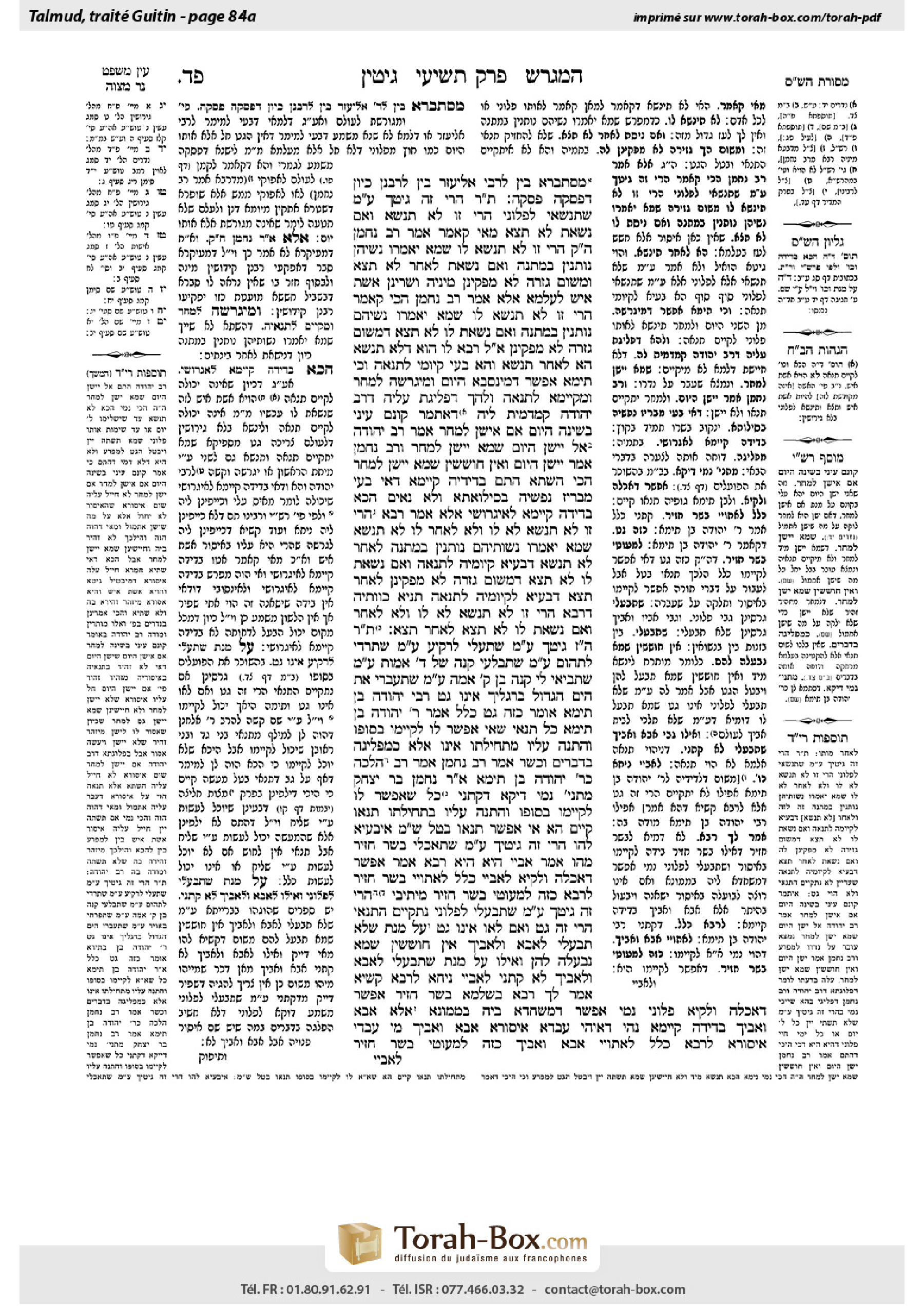
Gittin 84a: Talmud study for Daf Yomi
Study the Talmud for Daf Yomi with scanned pages, Hebrew text, English translations from Sefaria and AI-generated French translations.
Passage selection and English or AI-generated French translation are available where the scan has annotations. Daf Study is independent of Torah-Box and Sefaria.
Browse Gittin · גיטין · All tractatesGittin 84a text and translations
This page of Gittin includes the Aramaic text, an English translation and an AI-generated French translation, alongside the scan above.
גיטין פ״ד א · Aramaic and Hebrew text
מִסְתַּבְּרָא, בֵּין לְרַבִּי אֱלִיעֶזֶר בֵּין לְרַבָּנַן, כֵּיוָן דְּפַסְקַהּ – פַּסְקַהּ.
תָּנוּ רַבָּנַן: ״הֲרֵי זֶה גִּיטִּיךְ עַל מְנָת שֶׁתִּנָּשְׂאִי לִפְלוֹנִי״ – הֲרֵי זוֹ לֹא תִּנָּשֵׂא, וְאִם נִשֵּׂאת – לֹא תֵּצֵא.
מַאי קָאָמַר? אָמַר רַב נַחְמָן, הָכִי קָאָמַר: הֲרֵי זוֹ לֹא תִּנָּשֵׂא לוֹ, שֶׁמָּא יֹאמְרוּ נְשֵׁיהֶן נוֹתְנִין בְּמַתָּנָה. וְאִם נִשֵּׂאת לְאַחֵר – לֹא תֵּצֵא.
וּמִשּׁוּם גְּזֵרָה – לָא מַפְּקִינַן מִינֵּיהּ, וְשָׁרֵינַן אֵשֶׁת אִישׁ לְעָלְמָא?!
אֶלָּא אָמַר רַב נַחְמָן, הָכִי קָאָמַר: הֲרֵי זוֹ לֹא תִּנָּשֵׂא לוֹ, שֶׁמָּא יֹאמְרוּ נְשֵׁיהֶם נוֹתְנִין בְּמַתָּנָה. וְאִם נִשֵּׂאת לוֹ – לֹא תֵּצֵא, דְּמִשּׁוּם גְּזֵרָה לָא מַפְּקִינַן.
אֲמַר לֵיהּ רָבָא: לוֹ – הוּא דְּלֹא תִּנָּשֵׂא, הָא לְאַחֵר – תִּנָּשֵׂא?! וְהָא בָּעֲיָא קַיּוֹמֵיהּ לִתְנָאָה!
וְכִי תֵּימָא: אֶפְשָׁר דְּמִינַּסְבָא הַיּוֹם וּמִיגָּרְשָׁה לִמְחַר – וּמְקַיְּימָא לִתְנָאָה; וּלְהָךְ דִּפְלִיגַתְּ עֲלֵיהּ דְּרַב יְהוּדָה קָמְדַמֵּית לֵיהּ – דְּאִתְּמַר: ״קֻוֽנָּם עֵינַי בְּשֵׁינָה הַיּוֹם, אִם אִישַׁן לְמָחָר״, אָמַר רַב יְהוּדָה: אַל יִישַׁן הַיּוֹם, שֶׁמָּא יִישַׁן לְמָחָר;
וְרַב נַחְמָן אָמַר: יִישַׁן הַיּוֹם, וְאֵין חוֹשְׁשִׁין שֶׁמָּא יִישַׁן לְמָחָר;
הָכִי הַשְׁתָּא?! הָתָם בְּדִידֵיהּ קָיְימָא, דְּאִי בָּעֵי – מְבָרֵיז נַפְשֵׁיהּ בְּסִילְוָאתָא, וְלָא נָאֵים; הָכָא – בְּדִידַהּ קָיְימָא לְאִיגָּרוֹשֵׁי?!
אֶלָּא אָמַר רָבָא: הֲרֵי זוֹ לֹא תִּנָּשֵׂא לֹא לוֹ, וְלֹא לְאַחֵר. לוֹ לֹא תִּנָּשֵׂא – שֶׁמָּא יֹאמְרוּ: נְשׁוֹתֵיהֶם נוֹתְנִין בְּמַתָּנָה; לְאַחֵר לֹא תִּנָּשֵׂא – דְּבָעֲיָא קַיּוֹמֵיהּ לִתְנָאָה.
וְאִם נִשֵּׂאת לוֹ לֹא תֵּצֵא – דְּמִשּׁוּם גְּזֵרָה לָא מַפְּקִינַן; לְאַחֵר תֵּצֵא – דְּבָעֲיָא לְקַיּוֹמֵיהּ לִתְנָאָה.
תַּנְיָא כְּווֹתֵיהּ דְּרָבָא: הֲרֵי זוֹ לֹא תִּנָּשֵׂא לֹא לוֹ וְלֹא לְאַחֵר, וְאִם נִשֵּׂאת לוֹ – לֹא תֵּצֵא, לְאַחֵר – תֵּצֵא.
תָּנוּ רַבָּנַן: ״הֲרֵי זֶה גִּיטִּךְ עַל מְנָת שֶׁתַּעֲלִי לָרָקִיעַ״; ״עַל מְנָת שֶׁתֵּרְדִי לַתְּהוֹם״; ״עַל מְנָת שֶׁתִּבְלְעִי קָנֶה שֶׁל אַרְבַּע אַמּוֹת״; ״עַל מְנָת שֶׁתָּבִיאִי לִי קָנֶה בֶּן מֵאָה אַמָּה״; ״עַל מְנָת שֶׁתַּעַבְרִי אֶת הַיָּם הַגָּדוֹל בְּרַגְלַיִךְ״ – אֵינוֹ גֵּט.
רַבִּי יְהוּדָה בֶּן תֵּימָא אוֹמֵר: כָּזֶה – גֵּט. כְּלָל אָמַר רַבִּי יְהוּדָה בֶּן תֵּימָא: כׇּל תְּנַאי שֶׁאִי אֶפְשָׁר לוֹ לְקַיְּימוֹ בְּסוֹפוֹ, וְהִתְנָה עָלָיו מִתְּחִילָּתוֹ – אֵינוֹ אֶלָּא כְּמַפְלִיגָהּ בִּדְבָרִים, וְכָשֵׁר.
אָמַר רַב נַחְמָן אָמַר רַב: הֲלָכָה כְּרַבִּי יְהוּדָה בֶּן תֵּימָא. אָמַר רַב נַחְמָן בַּר יִצְחָק: מַתְנִיתִין נָמֵי דַּיְקָא, דְּקָתָנֵי: כׇּל שֶׁאֶפְשָׁר לוֹ לְקַיְּימוֹ בְּסוֹפוֹ, וְהִתְנָה עָלָיו בִּתְחִילָּתוֹ – תְּנָאוֹ קַיָּים; הָא אִי אֶפְשָׁר – תְּנָאוֹ בָּטֵל; שְׁמַע מִינַּהּ.
אִיבַּעְיָא לְהוּ: ״הֲרֵי זֶה גִּיטִּיךְ עַל מְנָת שֶׁתֹּאכְלִי בְּשַׂר חֲזִיר״, מַהוּ? אָמַר אַבָּיֵי: הִיא הִיא. רָבָא אָמַר: אֶפְשָׁר דְּאָכְלָה וְלָקְיָא.
לְאַבָּיֵי, ״כְּלָל״ – לְאֵתוֹיֵי בְּשַׂר חֲזִיר. לְרָבָא, ״כָּזֶה״ – לְמַעוֹטֵי בְּשַׂר חֲזִיר.
מֵיתִיבִי: ״הֲרֵי זֶה גִּיטִּךְ עַל מְנָת שֶׁתִּבָּעֲלִי לִפְלוֹנִי״, נִתְקַיֵּים הַתְּנַאי – הֲרֵי זֶה גֵּט, וְאִם לָאו – אֵינוֹ גֵּט. ״עַל מְנָת שֶׁלֹּא תִּבָּעֲלִי לְאַבָּא, וּלְאָבִיךְ״ – אֵין חוֹשְׁשִׁין שֶׁמָּא נִבְעֲלָה לָהֶן.
וְאִילּוּ ״עַל מְנָת שֶׁתִּבָּעֲלִי לְאַבָּא וּלְאָבִיךְ״ – לָא קָתָנֵי; לְאַבָּיֵי נִיחָא, לְרָבָא קַשְׁיָא!
אָמַר לָךְ רָבָא: בִּשְׁלָמָא בְּשַׂר חֲזִיר – אֶפְשָׁר דְּאָכְלָה וְלָקְיָא; פְּלוֹנִי נָמֵי – אֶפְשָׁר דִּמְשַׁחֲדָא לֵיהּ בְּמָמוֹנָא; אֶלָּא אַבָּא וְאָבִיךְ – בְּדִידַהּ קָיְימָא?! נְהִי דְּאִיהִי עָבְדָא אִיסּוּרָא, אַבָּא וְאָבִיךְ מִי עָבְדִי אִיסּוּרָא?!
לְרָבָא, ״כְּלָל״ – לְאֵתוֹיֵי אַבָּא וְאָבִיךְ; ״כָּזֶה״ – לְמַעוֹטֵי בְּשַׂר חֲזִיר.
Gittin 84a · English translation
It stands to reason, both according to Rabbi Eliezer and according to the Rabbis, that once he separates her, he has separated her entirely. By rendering her entirely permitted for one day he dissolves the bond between them and the divorce takes effect.
§ The Sages taught (Tosefta 6:7) that if a man says to his wife: This is your bill of divorce on the condition that you marry so-and-so, she may not marry that man, but if she marries him the marriage is valid and she need not leave her husband.
The Gemara asks: What is the baraita saying? She is forbidden from marrying whom? Rav Naḥman said that this is what the baraita is saying: She may not marry him, i.e., she may not marry the man mentioned by her husband in the condition, lest people say that these people are giving their wives to each other as a gift. But if she marries another man she need not leave him.
The Gemara asks: Do we not remove her from him, thereby allowing a married woman to marry anyone, due to a rabbinic decree, lest people say that the husband is giving her as a gift? As long as the condition that she would marry a specific man is not fulfilled, she is a married woman by Torah law.
Rather, Rav Naḥman said that this is what the baraita is saying: She may not marry him, i.e., the man who was specified in the condition, lest people say that they are giving their wives to each other as a gift. But if she marries him she need not leave him, as we do not remove a woman from her husband due to a decree.
Rava said to Rav Naḥman: It may be inferred from your statement that it is specifically to him that she may not get married, but she may marry another man ab initio. But isn’t she required to fulfill the condition by marrying the specified man before marrying someone else?
And if you would say that it is possible for her to get married today to someone else and get divorced from him tomorrow and then fulfill her condition by marrying the specified man, and you can compare it to that halakha over which you disagree with Rav Yehuda. As it was stated with regard to one who says: Sleeping is forbidden to me as if it were an offering [konam] for my eyes today if I will sleep tomorrow, Rav Yehuda says that he may not sleep today lest he sleep tomorrow, causing the vow to have been violated today, retroactively.
And Rav Naḥman says: He may sleep today, as there is currently no prohibition, and we are not concerned that perhaps he will sleep tomorrow, as he will be careful not to sleep. This dispute pertains to the general issue of a prohibition that will take effect retroactively if a condition is not fulfilled. Rav Yehuda holds that the prohibition must be observed until the condition is fulfilled, whereas Rav Naḥman maintains that it is not necessary to observe the prohibition, as he assumes that the condition will be fulfilled. Here too, perhaps Rav Naḥman allows the woman to marry another man because she can fulfill the condition after she is divorced from him.
How can these cases be compared? There, in the case of the vow, the fulfillment of the condition is in his capability, as, if he wants to prevent himself from falling asleep he can prick himself with thorns [silevata] and he will not fall asleep. Here, is it in the woman’s power to get divorced? Perhaps her husband will not agree to divorce her and the condition will not be fulfilled.
Rather, Rava said that the baraita should be interpreted in the following manner: This woman may marry neither the man who was specified in the condition nor another man. She may not marry him lest people say that these men are giving their wives to each other as a gift, and she may not marry another man because she is required to fulfill the condition.
And if she marries the specified man she need not leave him, as we do not remove a woman from her husband due to a decree. But if she gets married to another man she must leave him, as she is required to fulfill the condition before marrying another man.
It is taught in a baraita in accordance with the opinion of Rava: This woman may marry neither him nor another man, but if she marries him she need not leave him. But if she gets married to another man she must leave him.
§ The Sages taught (Tosefta 7:8) that if a man says to his wife: This is your bill of divorce on the condition that you ascend to the sky, or on the condition that you descend to the depths of the sea, or on the condition that you swallow a four-cubit reed, or on the condition that you bring me a hundred-cubit reed, or on the condition that you cross the Great Sea, i.e., the Mediterranean Sea, by foot, or on any other condition that it is impossible to fulfill, it is not a valid bill of divorce.
Rabbi Yehuda ben Teima says: A bill of divorce like this is a valid bill of divorce, as the condition is void. Rabbi Yehuda ben Teima said the following principle: With regard to any condition that cannot be fulfilled in the end, yet even so the husband stipulated it initially, he is only hyperbolizing. It is assumed that he did not really intend to attach a condition to the divorce, but rather, to cause her distress, and therefore the divorce is valid without her fulfilling the condition.
Rav Naḥman says that Rav says: The halakha is in accordance with the opinion of Rabbi Yehuda ben Teima. Rav Naḥman bar Yitzḥak says: The language of the mishna is also precisely formulated in support of this opinion, as it teaches: With regard to any condition that can be fulfilled in the end and the husband stipulated it initially, his condition stands (Bava Metzia 94a). Consequently, if his condition cannot be fulfilled it is void. The Gemara concludes: Learn from it that the halakha is in accordance with the opinion of Rabbi Yehuda ben Teima.
A dilemma was raised before the Sages: If a husband said to his wife: This is your bill of divorce on the condition that you eat pig meat, what is the halakha? Abaye said: It is the same. This is also a condition that cannot be fulfilled, as it is forbidden by Torah law. Therefore, the condition is void. Rava said: It is possible for her to eat it and be flogged for it. Consequently, the condition can be fulfilled, although it is forbidden for her to do so.
The Gemara elaborates: According to Abaye, the principle stated by Rabbi Yehuda ben Teima serves to include a condition to eat pig meat. When a tanna states a general principle, it expands the halakha beyond the specific case mentioned previously. In this case, the stating of the principle serves to apply the halakha to a condition subject to a Torah prohibition, in addition to a physical impossibility. According to Rava, when Rabbi Yehuda ben Teima stated: A bill of divorce like this is a valid bill of divorce, the limiting term of: Like this, serves to emphasize that only when there is a condition that cannot be physically fulfilled is the bill of divorce valid, and serves to exclude a condition to eat pig meat, which cannot be fulfilled due to a Torah prohibition. Therefore, if she does not fulfill this condition the divorce is invalid.
The Gemara raises an objection to Rava’s opinion from a baraita: If a man says to his wife: This is your bill of divorce on the condition that you engage in sexual intercourse with so-and-so, and the condition is fulfilled, this is a valid bill of divorce. And if the condition is not fulfilled then it is not a valid bill of divorce. If he says to her: On the condition that you do not engage in sexual intercourse with my father or your father, she is permitted to remarry, as we are not concerned that perhaps she engaged in sexual intercourse with them.
But the baraita does not teach that the condition is binding when the husband says: On the condition that you engage in sexual intercourse with my father or your father, which is forbidden by Torah law. According to Abaye it works out well, as in his opinion a condition that violates Torah law is void. According to Rava it is difficult.
The Gemara answers that Rava could have said to you: Granted, with regard to pig meat it is possible for her to eat it and be flogged. Similarly, if the condition is that she engage in sexual intercourse with so-and-so, it is also possible for her to bribe him with money to engage in sexual intercourse with her. But with regard to the case of my father or your father, is it in her power to engage in sexual intercourse with them? Though she can potentially perform a forbidden act in order to fulfill her desire to get married, would my father or your father perform a forbidden act? They certainly would not cooperate. Therefore, this is a condition that cannot be fulfilled, and it is considered hyperbole.
Based on this analysis, according to Rava, Rabbi Yehuda ben Teima stated his principle in order to include the condition of my father and your father, as this condition is also considered impossible to fulfill. And the expression: A bill of divorce like this is a valid bill of divorce, serves to exclude the condition of eating pig meat, in which case the divorce is not valid unless she fulfills the condition.
Gittin 84a · Traduction française (IA)
Il est logique, à la fois selon le point de vue de Rabbi Eliezer et selon celui des Sages, que lorsqu'il la sépare, il la sépare entièrement. En la rendant entièrement permise pour un jour, il dissout le lien entre eux et le divorce est effectif.
§ Les Sages enseignent (Tosefta 6:7) que si un homme dit à sa femme : C'est ton gittin à la condition que tu épouses tel ou tel, elle ne peut pas épouser cet homme, mais si elle épouse celui-ci, le mariage est valide et elle n'a pas besoin de quitter son mari.
La Guemara pose la question : De quoi la baraïta parle-t-elle ? Elle est interdite de se marier avec qui ? Rav Naḥman dit que c'est ce que la baraïta dit : Elle ne peut pas épouser lui, c'est-à-dire elle ne peut pas épouser l'homme mentionné par son mari dans la condition, de peur que les gens disent que ces gens donnent leurs épouses les unes aux autres en cadeau. Mais si elle épouse un autre homme, elle n'a pas besoin de quitter son mari.
La Guemara pose la question : N'éliminons-nous pas ainsi cette femme de son mari, permettant ainsi à une femme mariée de se marier avec n'importe qui, en vertu d'un décret rabbinique, de peur que le mari ne donne sa femme en cadeau ? Tant que la condition qu'elle épouse un homme spécifique n'est pas remplie, elle est une femme mariée selon la loi de la Torah.
Plutôt, Rav Naḥman dit que c'est ce que la baraïta dit : Elle ne peut pas épouser cet homme, c'est-à-dire l'homme spécifié dans la condition, de peur que les gens disent qu'ils donnent leurs épouses les unes aux autres en cadeau. Mais si elle épouse cet homme, elle n'a pas besoin de quitter son mari, car nous ne retirons pas une femme de son mari en vertu d'un décret.
Rava dit à Rav Naḥman : On peut en déduire de votre déclaration que c'est spécifiquement cet homme qu'elle ne peut pas épouser, mais elle peut épouser un autre homme dès le début. Mais n'est-ce pas qu'elle est tenue de remplir la condition en épousant l'homme spécifié avant de se marier avec quelqu'un d'autre ?
Et si vous dites que c'est possible qu'elle se marie aujourd'hui avec quelqu'un d'autre et qu'elle divorce de lui demain, puis remplisse la condition en épousant l'homme spécifié, et que vous pouvez le comparer à cette halakha sur laquelle vous avez un désaccord avec Rav Yehuda. Comme il a été dit concernant celui qui dit : Le sommeil est interdit pour moi comme s'il était un sacrifice [konam] pour mes yeux aujourd'hui si je dors demain, Rav Yehuda dit qu'il ne doit pas dormir aujourd'hui de peur qu'il dorme demain, causant la violation du serment aujourd'hui, de manière rétroactive.
Et Rav Naḥman dit : Il peut dormir aujourd'hui, car il n'y a pas de prohibition actuellement, et nous ne sommes pas préoccupés qu'il dorme demain, car il prendra soin de ne pas dormir. Ce débat concerne la question générale d'une prohibition qui prend effet rétroactivement si une condition n'est pas remplie. Rav Yehuda considère que la prohibition doit être observée jusqu'à ce que la condition soit remplie, tandis que Rav Naḥman maintient que l'observation de la prohibition n'est pas nécessaire, car il suppose que la condition sera remplie. Ici aussi, peut-être Rav Naḥman permet à la femme de se marier avec un autre homme car elle peut remplir la condition après son divorce.
Comment ces cas peuvent-ils être comparés ? Là, dans le cas du serment, la réalisation de la condition est dans sa capacité, car, s'il veut empêcher de s'endormir, il peut se piquer avec des épines [silevata] et il ne s'endormira pas. Ici, est-ce que c'est dans la puissance de la femme de divorcer ? Peut-être son mari ne consentira pas à la divorcer et la condition ne sera pas remplie.
Plutôt, Rava dit que la baraïta devrait être interprétée ainsi : Cette femme ne peut pas se marier ni avec l'homme spécifié dans la condition ni avec un autre homme. Elle ne peut pas se marier avec lui de peur que les gens pensent que ces hommes donnent leurs épouses les unes aux autres en cadeau, et elle ne peut pas se marier avec un autre homme car elle est tenue de remplir la condition.
Et si elle épouse l'homme spécifié, elle n'a pas besoin de le quitter, car nous ne retirons pas une femme de son mari en vertu d'un décret. Mais si elle se marie avec un autre homme, elle doit le quitter, car elle est tenue de remplir la condition avant de se marier avec un autre homme.
Il est enseigné dans une baraïta selon l'opinion de Rava : Cette femme ne peut pas se marier ni avec lui ni avec un autre homme, mais si elle épouse lui, elle n'a pas besoin de le quitter. Mais si elle se marie avec un autre homme, elle doit le quitter.
§ Les Sages enseignent (Tosefta 7:8) que si un homme dit à sa femme : C'est ton gittin à la condition que tu montes au ciel, ou à la condition que tu descends aux profondeurs de la mer, ou à la condition que tu avales un bâton de quatre coudées, ou à la condition que tu me rapportes un bâton de cent coudées, ou à la condition que tu traverses la mer Méditerranée à pied, ou à toute autre condition qui ne peut pas être remplie, ce n'est pas un gittin valide.
Rabbi Yehuda ben Teima dit : Un gittin comme celui-ci est un gittin valide, car la condition est nulle. Rabbi Yehuda ben Teima dit le principe suivant : Concernant toute condition qui ne peut pas être remplie à la fin, toutefois, même si le mari l'a stipulé initialement, il s'agit d'une hyperbole. On suppose qu'il n'avait pas vraiment l'intention d'attacher une condition au divorce, mais plutôt de causer à sa femme une détresse, et donc le divorce est valide sans qu'elle remplisse la condition.
Rav Naḥman dit que Rav dit : La halakha est selon l'opinion de Rabbi Yehuda ben Teima. Rav Naḥman bar Yitzḥak dit : La formulation de la mishna est aussi précisément formulée en faveur de cette opinion, car elle enseigne : Concernant toute condition qui peut être remplie à la fin et que le mari l'a stipulé initialement, sa condition est valide (Bava Metzia 94a). Par conséquent, si sa condition ne peut pas être remplie, elle est nulle. La Guemara conclut : Apprenez-en que la halakha est selon l'opinion de Rabbi Yehuda ben Teima.
Un dilemme a été soulevé devant les Sages : Si un mari dit à sa femme : C'est votre acte de divorce à la condition que vous mangiez de la viande de porc, quelle est la halakha ? Abaye a dit : C'est la même chose. C'est aussi une condition qui ne peut être remplie, car elle est interdite par la loi divine. Par conséquent, la condition est nulle. Rava a dit : Il est possible qu'elle mange cela et qu'elle soit battue pour cela. Par conséquent, la condition peut être remplie, bien qu'elle soit interdite de le faire.
Le Guemara développe : Selon Abaye, le principe énoncé par Rabbi Yéhuda ben Téima sert à inclure une condition de manger de la viande de porc. Lorsqu'un tanna énonce un principe général, il étend la halakha au-delà du cas spécifique mentionné précédemment. Dans ce cas, l'énonciation du principe sert à appliquer la halakha à une condition soumise à une interdiction divine, en plus d'une impossibilité physique. Selon Rava, lorsqu'Rabbi Yéhuda ben Téima a dit : Un acte de divorce comme celui-ci est un acte de divorce valide, le terme limitant : Comme celui-ci, sert à souligner que seul lorsqu'il y a une condition qui ne peut être physiquement remplie est l'acte de divorce valide, et sert à exclure une condition de manger de la viande de porc, qui ne peut être remplie en raison d'une interdiction divine. Par conséquent, si elle ne rempli pas cette condition, le divorce est invalide.
Le Guemara soulève une objection contre l'opinion de Rava, à partir d'une baraïta : Si un homme dit à sa femme : C'est votre acte de divorce à la condition que vous ayez des relations sexuelles avec tel ou tel, et la condition est remplie, c'est un acte de divorce valide. Et si la condition n'est pas remplie, alors ce n'est pas un acte de divorce valide. Si il dit à elle : À la condition que vous ne ayez pas des relations sexuelles avec mon père ou votre père, elle est autorisée à se remarier, car nous ne craignons pas qu'elle ait eu des relations sexuelles avec eux.
Mais la baraïta ne nous apprend pas que la condition est engageante lorsqu'il dit : À la condition que vous ayez des relations sexuelles avec mon père ou votre père, ce qui est interdit par la loi divine. Selon Abaye, cela s'arrange bien, car, selon son opinion, une condition qui viole la loi divine est nulle. Selon Rava, cela est difficile.
Le Guemara répond que Rava aurait pu dire à vous : D'accord, concernant la viande de porc, il est possible qu'elle la mange et qu'elle soit battue. De même, si la condition est qu'elle ait des relations sexuelles avec tel ou tel, il est aussi possible qu'elle le corrompe avec de l'argent pour avoir des relations sexuelles avec elle. Mais concernant le cas de mon père ou votre père, est-ce qu'elle a le pouvoir d'avoir des relations sexuelles avec eux ? Bien qu'elle puisse potentiellement commettre un acte interdit pour remplir son désir de se marier, mon père ou votre père commettraient-ils un acte interdit ? Ils ne coopéreraient certainement pas. Par conséquent, cette condition ne peut pas être remplie, et c'est de l'hyperbole.
Selon cette analyse, selon Rava, Rabbi Yéhuda ben Téima a énoncé son principe afin d'inclure la condition de mon père et de votre père, car cette condition est aussi considérée comme impossible à remplir. Et l'expression : Un acte de divorce comme celui-ci est un acte de divorce valide, sert à exclure la condition de manger de la viande de porc, dans le cas où le divorce n'est pas valide à moins qu'elle remplisse la condition.
Traduction française générée par IA à partir de l’édition anglaise de Sefaria. Vérifie toujours un passage avec le texte source.
Text from Sefaria: William Davidson Edition - Vocalized Aramaic (CC BY NC); William Davidson Edition - English (CC BY NC).