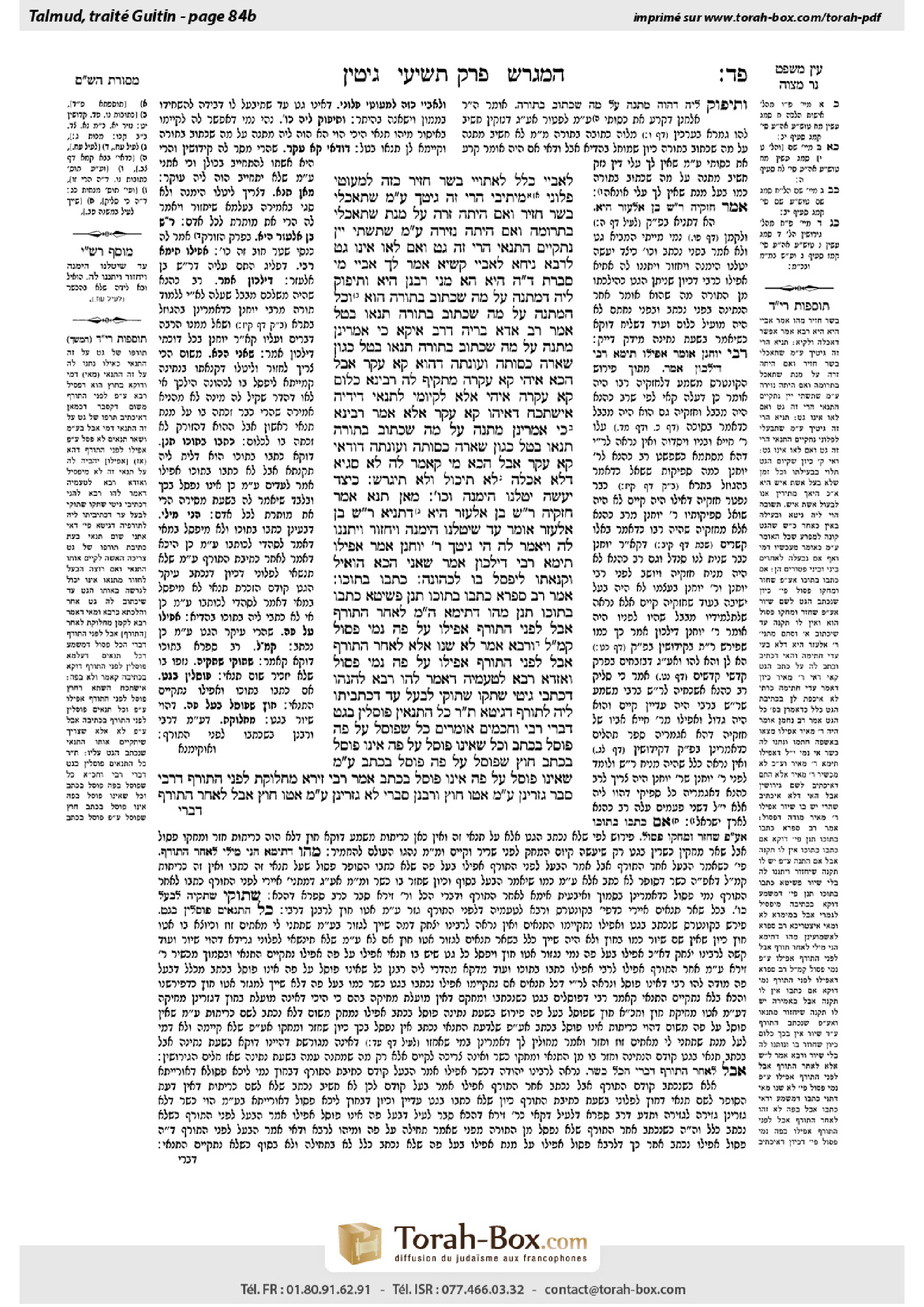
Gittin 84b: Talmud study for Daf Yomi
Study the Talmud for Daf Yomi with scanned pages, Hebrew text, English translations from Sefaria and AI-generated French translations.
Passage selection and English or AI-generated French translation are available where the scan has annotations. Daf Study is independent of Torah-Box and Sefaria.
Browse Gittin · גיטין · All tractatesGittin 84b text and translations
This page of Gittin includes the Aramaic text, an English translation and an AI-generated French translation, alongside the scan above.
גיטין פ״ד ב · Aramaic and Hebrew text
לְאַבָּיֵי, ״כְּלָל״ – לְאֵתוֹיֵי בְּשַׂר חֲזִיר; ״כָּזֶה״ – לְמַעוֹטֵי פְּלוֹנִי.
מֵיתִיבִי: ״הֲרֵי זֶה גִּיטִּיךְ עַל מְנָת שֶׁתֹּאכְלִי בְּשַׂר חֲזִיר״; וְאִם הָיְתָה זָרָה – ״עַל מְנָת שֶׁתֹּאכְלִי בִּתְרוּמָה״; וְאִם הָיְתָה נְזִירָה – ״עַל מְנָת שֶׁתִּשְׁתִּי יַיִן״; נִתְקַיֵּים הַתְּנַאי – הֲרֵי זֶה גֵּט; וְאִם לָאו – אֵינוֹ גֵּט. לְרָבָא נִיחָא, לְאַבָּיֵי קַשְׁיָא!
אָמַר לָךְ אַבָּיֵי: מִי סָבְרַתְּ דִּבְרֵי הַכֹּל הִיא?! הָא מַנִּי – רַבָּנַן הִיא.
וְתִיפּוֹק לֵיהּ דְּמַתְנֶה עַל מַה שֶּׁכָּתוּב בַּתּוֹרָה הוּא, וְכׇל הַמַּתְנֶה עַל מַה שֶּׁכָּתוּב בַּתּוֹרָה – תְּנָאוֹ בָּטֵל!
אָמַר רַב אַדָּא בְּרֵיהּ דְּרַב אִיקָא: כִּי אָמְרִינַן מַתְנֶה עַל מַה שֶּׁכָּתוּב בַּתּוֹרָה תְּנָאוֹ בָּטֵל – כְּגוֹן שְׁאֵרָהּ כְּסוּתָהּ וְעוֹנָתָהּ, דְּהוּא קָא עָקַר; אֲבָל הָכָא – אִיהִי קָא עָקְרָה.
מַתְקֵיף לַהּ רָבִינָא: כְּלוּם קָא עָקְרָה אִיהִי – אֶלָּא לְקַיּוֹמֵי לִתְנַאי דִּידֵיהּ; אִישְׁתְּכַח דְּאִיהוּ קָא עָקַר!
אֶלָּא אָמַר רָבִינָא: כִּי אָמְרִינַן מַתְנֶה עַל מַה שֶּׁכָּתוּב בַּתּוֹרָה תְּנָאוֹ בָּטֵל – כְּגוֹן שְׁאֵרָהּ כְּסוּתָהּ וְעוֹנָתָהּ, דְּוַדַּאי קָא עָקַר; אֲבָל הָכָא – מִי קָאָמַר לַהּ: לָא סַגִּיא דְּלָא אָכְלָה?! לָא תֵּיכוֹל, וְלָא תִּיגָּרַשׁ.
כֵּיצַד יַעֲשֶׂה – יִטְּלֶנּוּ הֵימֶנָּה וְכוּ׳: מַאן תַּנָּא? אָמַר חִזְקִיָּה: רַבִּי שִׁמְעוֹן בֶּן אֶלְעָזָר הִיא.
דְּתַנְיָא, רַבִּי שִׁמְעוֹן בֶּן אֶלְעָזָר אוֹמֵר: עַד שֶׁיִּטְּלֶנּוּ הֵימֶנָּה, וְיַחֲזוֹר וְיִתְּנֶנּוּ לָהּ, וְיֹאמַר לָהּ: ״הֵי גִּיטִּיךְ״.
רַבִּי יוֹחָנָן אָמַר: אֲפִילּוּ תֵּימָא רַבִּי – דִּילְכוֹן אָמַר: שָׁאנֵי הָכָא, הוֹאִיל וְקִנְאָתוֹ לִיפָּסֵל בּוֹ לַכְּהוּנָּה.
כְּתָבוֹ בְּתוֹכוֹ: אָמַר רַב סָפְרָא: ״כְּתָבוֹ בְּתוֹכוֹ״ תְּנַן.
פְּשִׁיטָא, ״כְּתָבוֹ בְּתוֹכוֹ״ תְּנַן! מַהוּ דְּתֵימָא הָנֵי מִילֵּי לְאַחַר הַתּוֹרֶף, אֲבָל לִפְנֵי הַתּוֹרֶף – אֲפִילּוּ עַל פֶּה נָמֵי פָּסוּל, קָא מַשְׁמַע לַן.
וְרָבָא אָמַר: לֹא שָׁנוּ אֶלָּא לְאַחַר הַתּוֹרֶף, אֲבָל לִפְנֵי הַתּוֹרֶף – אֲפִילּוּ עַל פֶּה נָמֵי פָּסוּל.
וְאַזְדָּא רָבָא לְטַעְמֵיהּ – דַּאֲמַר לְהוּ רָבָא לְהָנְהוּ דְּכָתְבִי גִּיטֵּי: שַׁתִּקוּ שַׁתּוֹקֵי לְבַעַל, עַד דְּכָתְבִיתוּ לֵיהּ לְתוֹרֶף דְּגִיטָּא.
תָּנוּ רַבָּנַן: כׇּל הַתְּנָאִין פּוֹסְלִין בַּגֵּט, דִּבְרֵי רַבִּי. וַחֲכָמִים אוֹמְרִים: כֹּל שֶׁפּוֹסֵל עַל פֶּה פּוֹסֵל בִּכְתָב, וְכֹל שֶׁאֵינוֹ פּוֹסֵל עַל פֶּה אֵינוֹ פּוֹסֵל בִּכְתָב – ״חוּץ״, שֶׁפּוֹסֵל עַל פֶּה, פּוֹסֵל בִּכְתָב; ״עַל מְנָת״, שֶׁאֵינוֹ פּוֹסֵל עַל פֶּה, אֵינוֹ פּוֹסֵל בִּכְתָב.
אָמַר רַבִּי זֵירָא: מַחְלוֹקֶת לִפְנֵי הַתּוֹרֶף – דְּרַבִּי סָבַר: גָּזְרִינַן ״עַל מְנָת״ אַטּוּ ״חוּץ״; וְרַבָּנַן סָבְרִי: לָא גָּזְרִינַן ״עַל מְנָת״ אַטּוּ ״חוּץ״. אֲבָל לְאַחַר הַתּוֹרֶף –
Gittin 84b · English translation
And according to Abaye this principle was stated to include the case of a condition that she should eat pig meat, and the expression: A bill of divorce like this is a valid bill of divorce, serves to exclude a condition that she should engage in sexual intercourse with so-and-so, in which case the divorce takes effect only once the condition is fulfilled, as it is possible to fulfill this condition in a permitted manner.
The Gemara raises an objection from another baraita (Tosefta 6:10): If the husband said to his wife: This is your bill of divorce on the condition that you eat pig meat; or similarly, if she was a non-priestess, i.e., the daughter of an Israelite, and he stipulated: On the condition that you partake of teruma; or if she was a nazirite and he stipulated: On the condition that you drink wine (see Numbers 6:3); in all of these cases, if the condition is fulfilled it is a valid bill of divorce, and if not, it is not a valid bill of divorce. This works out well according to Rava, who holds that a condition that she should perform a forbidden act is binding; according to Abaye it is difficult.
The Gemara answers that Abaye could have said to you: Do you hold that this ruling is agreed upon by everyone? That is not the case. Rather, in accordance with whose opinion is this baraita? It is in accordance with the opinion of the Rabbis, who disagree with Rabbi Yehuda ben Teima, maintaining that even a condition that cannot be fulfilled is a valid condition.
The Gemara challenges: Regardless of the issue of a condition that cannot be fulfilled, derive that this condition is void from the fact that the husband is stipulating counter to that which is written in the Torah, and there is a principle that with regard to anyone who stipulates counter to that which is written in the Torah, his condition is void.
Rav Adda son of Rav Ika said in response: When we say that if one stipulates counter to that which is written in the Torah his condition is void, the reference is to a case such as a man who betroths a woman on the condition that he will not be obligated to provide her with her food, her clothing, and her conjugal rights, as there he is uprooting a matter of Torah law by fulfilling the condition. But here, it is she who is uprooting a matter of Torah law by fulfilling the condition and not him.
Ravina strongly objects to this response: Isn’t she uprooting it only in order to fulfill his condition? It is therefore found that he is uprooting a matter of Torah law by attaching this condition to the divorce.
Rather, Ravina said: When we say that if one stipulates counter to that which is written in the Torah, that his condition is void, the reference is to a case such as that of a man who stipulates that he will not be obligated to provide his wife with her food, her clothing, and her conjugal rights, as by attaching this condition he is definitely uprooting a matter of Torah law. But here, is he saying to her that it is not possible for her not to eat? She may not eat and not get divorced. The condition does not counter Torah law in and of itself, as the wife has the choice of whether or not to fulfill it.
§ It is stated in the mishna: What should he do after giving her the bill of divorce and stipulating that she is not permitted to so-and-so? He should take it from her, and hand it to her again, and say to her: You are hereby permitted to marry any man. The Gemara asks: Who is the tanna who taught that? Ḥizkiyya said that it is Rabbi Shimon ben Elazar.
As it is taught in a baraita: If a husband gives his wife a bill of divorce without her knowledge, Rabbi Shimon ben Elazar says that it does not take effect until he takes it from her, and hands it to her again, and says to her: This is your bill of divorce. Rabbi Yehuda HaNasi holds that it is not necessary for him to hand it to her a second time; rather, it is sufficient for him to tell her that he is giving her a bill of divorce. The mishna is therefore in accordance with the opinion of Rabbi Shimon ben Elazar, who holds that the husband must hand it to her again.
Rabbi Yoḥanan said: You can even say that it is in accordance with the opinion of Rabbi Yehuda HaNasi. Your Sage, referring to Rav Kahana, who came from Babylonia to study in Eretz Yisrael, said that it is different here, since the wife has already acquired the bill of divorce with regard to her becoming disqualified from marrying into the priesthood due to it, and Rabbi Yehuda HaNasi holds that he need not take it back and give it to her again. Since the bill of divorce was already partially effective, it is in the wife’s possession and cannot be used by the husband to divorce her in full unless she gives it back to him and he gives it to her again. Therefore, even Rabbi Yehuda HaNasi agrees that he must give it to her a second time.
§ It is stated in the mishna that if the husband wrote his qualification inside the bill of divorce, it is invalid even if he subsequently erased it. Rav Safra said: We learned in the mishna that the bill is invalid only if he wrote the qualification inside the bill of divorce, not if he stated it orally.
The Gemara asks: It is obvious that this is the case, as we learned in the mishna explicitly that he wrote it inside. The Gemara answers: Rav Safra stated this lest you say that this matter applies only when the qualification was written after the essential part of the bill of divorce, which contains the names of the husband and wife and the date, but before the essential part was written; even if the qualification was stated orally, the bill of divorce is invalid, as it was written with the intention that the wife would not be permitted to marry any man. Rav Safra therefore teaches us that only a written qualification in the bill of divorce renders it invalid, and an oral statement does not render it invalid. Consequently, the husband can hand this bill of divorce to his wife without stating the qualification and it will be valid.
And Rava said: They taught that it is specifically writing the qualification that invalidates the bill of divorce only when the qualification is stated after the writing of the essential part. But if the qualification is stated before the essential part of the bill of divorce is written, even if it is stated orally, the bill of divorce is invalid.
And Rava followed his line of reasoning, as Rava said to those who write bills of divorce: Silence the husband until you write the essential part of the bill of divorce, lest he state a condition, thereby rendering the bill of divorce invalid.
The Sages taught: All conditions that are written in a bill of divorce invalidate it, this is the statement of Rabbi Yehuda HaNasi. And the Rabbis say: Any qualification that invalidates the divorce when stated orally by the husband while he hands the bill of divorce to his wife invalidates it when written, and any qualification that does not invalidate it when stated orally does not invalidate it when written. Therefore, issuing a qualification that she is permitted to marry any man except for so-and-so, which invalidates the divorce when stated orally, invalidates it as well when written, whereas attaching a standard condition, which does not invalidate it when stated orally, does not invalidate it when written.
Rabbi Zeira said: This dispute applies to a case where the condition was written in the bill of divorce before the essential part was written, as Rabbi Yehuda HaNasi holds that we issue a decree that a stipulation invalidates the bill of divorce due to a case of an exception, and the Rabbis hold that we do not issue a decree that a stipulation invalidates it due to a case of an exception. But if it was written after the essential part,
Gittin 84b · Traduction française (IA)
Et selon Abaye, ce principe a été formulé pour inclure le cas d'une condition selon laquelle elle devrait manger de la viande de porc, et l'expression : « Un acte de divorce tel que celui-ci est un acte de divorce valide », sert à exclure une condition selon laquelle elle devrait avoir des relations sexuelles avec tel ou tel, dans le cas où le divorce prend effet uniquement une fois que la condition est remplie, car il est possible de remplir cette condition de manière permise.
La Guemara soulève un objet à partir d'une autre baraïta (Tosefta 6:10) : Si le mari dit à sa femme : « C'est ton acte de divorce à la condition que tu manges de la viande de porc » ; ou de manière similaire, si elle était une non-prièvre, c'est-à-dire la fille d'un Israélite, et il stipule : « À la condition que tu consommes la terouma ; ou si elle était un nazir et il stipule : « À la condition que tu boives du vin (voir Nombres 6:3) » ; dans tous ces cas, si la condition est remplie, c'est un acte de divorce valide, et si non, ce n'en est pas un. Cela s'explique bien selon Rava, qui considère qu'une condition selon laquelle elle devrait accomplir un acte interdit est contraignante ; selon Abaye, cela est difficile.
La Guemara répond que Abaye aurait pu dire à vous : « Vous considérez-vous que cette décision est unanime ? » Ce n'est pas le cas. Plutôt, selon l'opinion de qui est-ce que cette baraïta ? C'est selon l'opinion des Rabbins, qui s'opposent à Rabbi Yehuda ben Teima, affirmant que même une condition qui ne peut être remplie est une condition valide.
La Guemara soulève un défi : Quel que soit le problème d'une condition qui ne peut être remplie, tirez la conclusion que cette condition est nulle à partir du fait que le mari stipule contrairement à ce qui est écrit dans la Torah, et il y a un principe selon lequel, concernant quiconque stipule contrairement à ce qui est écrit dans la Torah, sa condition est nulle.
Rav Adda fils de Rav Ika répondit ainsi : Lorsque nous disons que si l'on stipule contrairement à ce qui est écrit dans la Torah, sa condition est nulle, la référence est à un cas tel que celui d'un homme qui épouse une femme à la condition qu'il ne sera pas tenu de lui fournir sa nourriture, ses vêtements et ses droits conjugaux, car là, il enlève une question de droit divin en accomplissant la condition. Mais ici, c'est elle qui enlève une question de droit divin en accomplissant la condition et non lui.
Ravina s'oppose fermement à cette réponse : N'est-ce pas qu'elle enlève cela uniquement pour accomplir sa condition ? Il est donc trouvé que lui enlève une question de droit divin en attachant cette condition à l'acte de divorce.
Plutôt, Ravina dit : Lorsque nous disons que si l'on stipule contrairement à ce qui est écrit dans la Torah, sa condition est nulle, la référence est à un cas tel que celui d'un homme qui stipule qu'il ne sera pas tenu de fournir à sa femme sa nourriture, ses vêtements et ses droits conjugaux, car en attachant cette condition, il enlève certainement une question de droit divin. Mais ici, est-ce qu'il dit à elle qu'il n'est pas possible qu'elle ne mange pas ? Elle ne peut pas manger et ne peut pas divorcer. La condition ne contredit pas le droit divin en soi, car la femme a le choix de savoir si elle le rempli ou non.
§ Il est dit dans la mitsna : Quel doit-il faire après avoir donné à sa femme l'acte de divorce et stipulé qu'elle n'est pas autorisée à tel ou tel ? Il doit le lui prendre, le lui redonner et lui dire : Tu es désormais autorisée à épouser n'importe quel homme. La Guemara pose la question : Qui est le tanna qui a enseigné cela ? Ḥizkiyya dit que c'est Rabbi Shimon ben Elazar.
Comme il est enseigné dans une baraïta : Si un mari donne à sa femme un acte de divorce sans qu'elle ne le sache, Rabbi Shimon ben Elazar dit qu'il ne prend effet qu'une fois qu'il le lui prend, le lui redonne et lui dit : C'est ton acte de divorce. Rabbi Yehuda HaNasi considère que cela n'est pas nécessaire, il suffit qu'il lui dise qu'il lui donne un acte de divorce. La mitsna est donc selon l'opinion de Rabbi Shimon ben Elazar, qui considère que le mari doit le lui redonner.
Rabbi Yoḥanan dit : On peut même dire que c'est selon l'opinion de Rabbi Yehuda HaNasi. Votre Sage, faisant référence à Rav Kahana, qui est venu de Babylone pour étudier en Eretz Yisrael, dit que c'est différent ici, car la femme a déjà acquis l'acte de divorce concernant son inéligibilité à épouser un prêtre, et Rabbi Yehuda HaNasi considère qu'il n'est pas nécessaire qu'il le lui redonne. Puisque l'acte de divorce était déjà partiellement efficace, il est en possession de la femme et ne peut être utilisé par le mari pour divorcer complètement d'elle sans qu'elle ne le lui redonne. Par conséquent, même Rabbi Yehuda HaNasi est d'accord pour dire qu'il doit le lui redonner.
§ Il est dit dans la mitsva que si le mari a écrit sa qualification à l'intérieur de l'acte de divorce, il est invalide même s'il l'a ensuite effacé. Rav Safra dit : Nous avons appris dans la mitsva que l'acte est invalide uniquement s'il a écrit la qualification à l'intérieur de l'acte de divorce, pas s'il l'a dit oralement.
La Guemara pose la question : Cela est évident, car nous avons appris dans la mitsva explicitement qu'il l'avait écrit à l'intérieur. La Guemara répond : Rav Safra a dit cela pour que vous ne disiez pas que cela s'applique uniquement lorsque la qualification était écrite après la partie essentielle de l'acte de divorce, qui contient les noms du mari et de la femme ainsi que la date, mais avant que la partie essentielle ne soit écrite ; même si la qualification était dite oralement, l'acte de divorce est invalide, car il a été écrit avec l'intention que la femme ne soit pas autorisée à épouser n'importe quel homme. Rav Safra enseigne donc que seule une qualification écrite dans l'acte de divorce rend l'acte invalide, et une déclaration orale ne le rend pas invalide. Par conséquent, le mari peut donner cet acte de divorce à sa femme sans mentionner la qualification et il sera valide.
Et Rav a dit : Ils enseignèrent que c'est spécifiquement l'écriture de la qualification qui annule le contrat de divorce, uniquement lorsque la qualification est formulée après l'écriture de la partie essentielle. Mais si la qualification est formulée avant que la partie essentielle du contrat de divorce ne soit écrite, même si elle est formulée oralement, le contrat de divorce est nul.
Et Rav suivit sa ligne de raisonnement, car Rav dit à ceux qui rédigent des contrats de divorce : Taisez le mari jusqu'à ce que vous écriviez la partie essentielle du contrat de divorce, afin qu'il ne formule pas une qualification, ce qui annulerait le contrat de divorce.
Les Sages enseignèrent : Toutes les qualifications écrites dans un contrat de divorce l'annulent, dit Rabbi Yehuda HaNasi. Et les Rabbins disent : toute qualification qui annule le divorce lorsqu'elle est formulée oralement par le mari lorsqu'il remet le contrat de divorce à sa femme annule également le divorce lorsqu'elle est écrite, et toute qualification qui ne l'annule pas lorsqu'elle est formulée oralement ne l'annule pas non plus lorsqu'elle est écrite. Ainsi, émettre une qualification selon laquelle elle est permise de se marier avec n'importe quel homme sauf tel ou tel, qui annule le divorce lorsqu'elle est formulée oralement, annule également le divorce lorsqu'elle est écrite, tandis qu'attacher une condition standard, qui ne l'annule pas lorsqu'elle est formulée oralement, ne l'annule pas non plus lorsqu'elle est écrite.
Rabbi Zéira dit : Ce débat s'applique à un cas où la condition était écrite dans le contrat de divorce avant que la partie essentielle ne soit écrite, car Rabbi Yehuda HaNasi considère que nous émettons un décret selon lequel une stipulation annule le contrat de divorce en raison d'un cas d'exception, et les Rabbins pensent que nous ne décrétions pas qu'une stipulation annule le contrat de divorce en raison d'un cas d'exception. Mais si elle était écrite après la partie essentielle,
Traduction française générée par IA à partir de l’édition anglaise de Sefaria. Vérifie toujours un passage avec le texte source.
Text from Sefaria: William Davidson Edition - Vocalized Aramaic (CC BY NC); William Davidson Edition - English (CC BY NC).