Gittin 85a: Talmud study for Daf Yomi
Study the Talmud for Daf Yomi with scanned pages, Hebrew text, English translations from Sefaria and AI-generated French translations.
Passage selection and English or AI-generated French translation are available where the scan has annotations. Daf Study is independent of Torah-Box and Sefaria.
Browse Gittin · גיטין · All tractatesGittin 85a text and translations
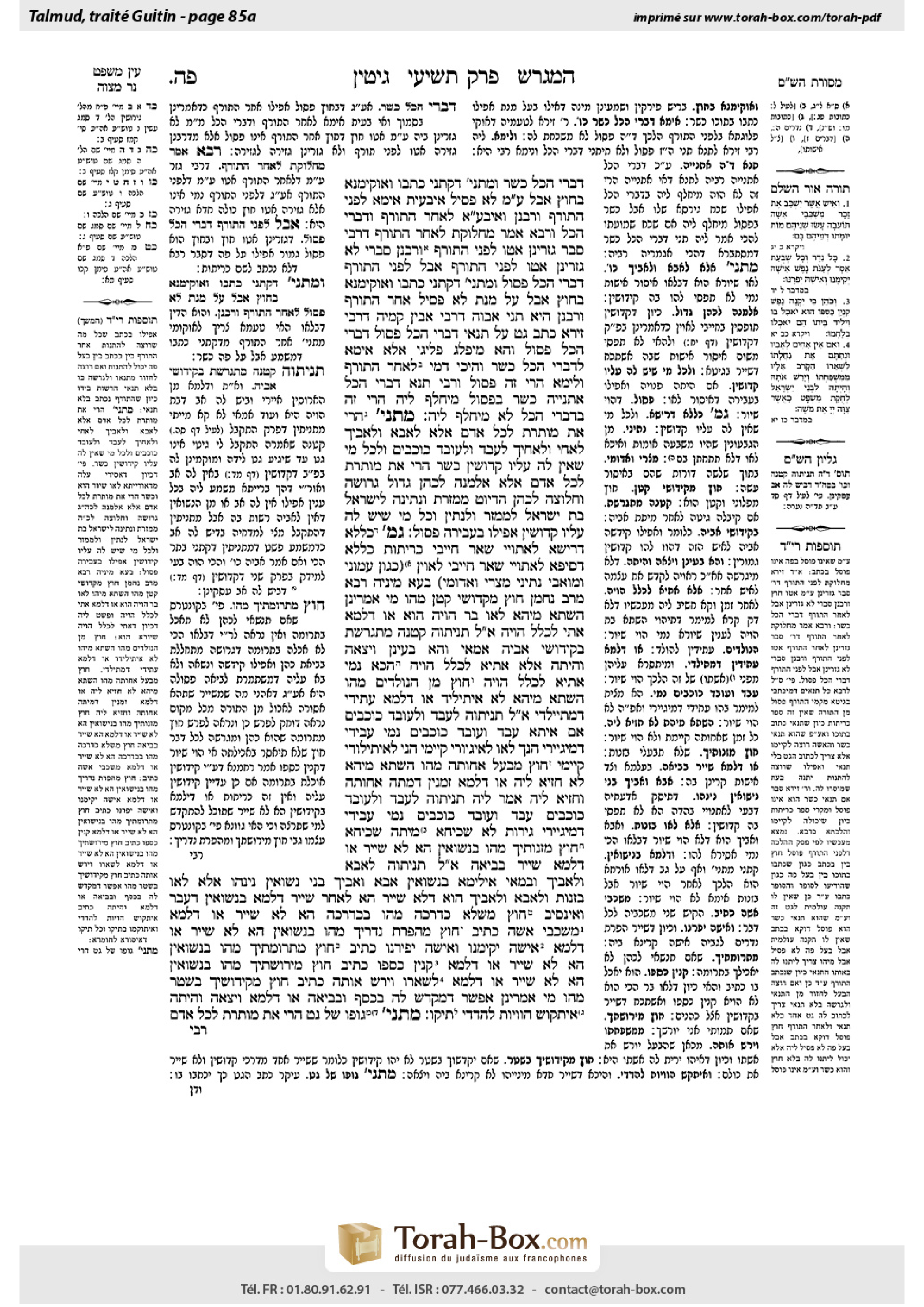
This page of Gittin includes the Aramaic text, an English translation and an AI-generated French translation, alongside the scan above.
גיטין פ״ה א · Aramaic and Hebrew text
דִּבְרֵי הַכֹּל כָּשֵׁר. וּמַתְנִיתִין, דְּקָתָנֵי ״כְּתָבוֹ״ וְאוֹקִימְנָא בְּ״חוּץ״; אֲבָל ״עַל מְנָת״ לָא פָּסֵיל – אִיבָּעֵית אֵימָא: לִפְנֵי הַתּוֹרֶף, וְרַבָּנַן; וְאִיבָּעֵית אֵימָא: לְאַחַר הַתּוֹרֶף, וְדִבְרֵי הַכֹּל.
וְרָבָא אָמַר: מַחְלוֹקֶת לְאַחַר הַתּוֹרֶף – דְּרַבִּי סָבַר: גָּזְרִינַן אַטּוּ לִפְנֵי הַתּוֹרֶף; וְרַבָּנַן סָבְרִי: לָא גָּזְרִינַן אַטּוּ לִפְנֵי הַתּוֹרֶף. אֲבָל לִפְנֵי הַתּוֹרֶף – דִּבְרֵי הַכֹּל פָּסוּל.
וּמַתְנִיתִין, דְּקָתָנֵי ״כְּתָבוֹ״ וְאוֹקִימְנָא בְּ״חוּץ״; אֲבָל ״עַל מְנָת״ לָא פָּסֵיל – אַחַר הַתּוֹרֶף, וְרַבָּנַן הִיא.
תָּנֵי אֲבוּהּ דְּרַבִּי אָבִין קַמֵּיהּ דְּרַבִּי זֵירָא: כָּתַב גֵּט עַל תְּנַאי – דִּבְרֵי הַכֹּל פָּסוּל. דִּבְרֵי הַכֹּל פָּסוּל?! וְהָא מִיפְלָג פְּלִיגִי!
אֶלָּא אֵימָא: לְדִבְרֵי הַכֹּל כָּשֵׁר, וְהֵיכִי דָּמֵי – לְאַחַר הַתּוֹרֶף.
וְלֵימָא: הֲרֵי זֶה פָּסוּל – וְרַבִּי! תַּנָּא ״דִּבְרֵי הַכֹּל״ אַתְנְיֵיהּ; ״כָּשֵׁר״ בְּ״פָסוּל״ מִיחַלַּף לֵיהּ, ״הֲרֵי זֶה״ בְּ״דִבְרֵי הַכֹּל״ לָא מִיחַלַּף לֵיהּ.
מַתְנִי׳ ״הֲרֵי אַתְּ מוּתֶּרֶת לְכׇל אָדָם – אֶלָּא לְאַבָּא״; וּ״לְאָבִיךְ״; ״לְאָחִי״; וּ״לְאָחִיךְ״; לְעֶבֶד; וּלְנׇכְרִי; וּלְכׇל מִי שֶׁאֵין לָהּ עָלָיו קִדּוּשִׁין – כָּשֵׁר.
״הֲרֵי אַתְּ מוּתֶּרֶת לְכׇל אָדָם״ – אֶלָּא אַלְמָנָה לְכֹהֵן גָּדוֹל; גְּרוּשָׁה וַחֲלוּצָה לְכֹהֵן הֶדְיוֹט; מַמְזֶרֶת וּנְתִינָה לְיִשְׂרָאֵל; בַּת יִשְׂרָאֵל לְמַמְזֵר וּלְנָתִין; וְכׇל מִי שֶׁיֵּשׁ לָהּ עָלָיו קִדּוּשִׁין, אֲפִילּוּ בַּעֲבֵירָה – פָּסוּל.
גְּמָ׳ כְּלָלָא דְּרֵישָׁא – לְאֵתוֹיֵי שְׁאָר חַיָּיבֵי כָרֵיתוֹת. כְּלָלָא דְּסֵיפָא – לְאֵתוֹיֵי שְׁאָר חַיָּיבֵי לָאוִין, כְּגוֹן עַמּוֹנִי וּמוֹאָבִי (נְתִינִי, מִצְרִי וַאֲדוֹמִי).
בְּעָא מִינֵּיהּ רָבָא מֵרַב נַחְמָן: חוּץ מִקִּדּוּשֵׁי קָטָן, מַהוּ? מִי אָמְרִינַן הַשְׁתָּא מִיהָא לָאו בַּר הֲוָיָה הוּא, אוֹ דִלְמָא אָתֵי לִכְלַל הֲוָיָה?
אֲמַר לֵיהּ, תְּנֵיתוּהָ: קְטַנָּה מִתְגָּרֶשֶׁת בְּקִידּוּשֵׁי אָבִיהָ.
אַמַּאי? וְהָא בָּעֵינַן: ״וְיָצְאָה״–״וְהָיְתָה״? אֶלָּא אָתְיָא לִכְלַל הֲוָיָה; הָכָא נָמֵי – אָתְיָא לִכְלַל הֲוָיָה.
״חוּץ מִן הַנּוֹלָדִים״, מַהוּ? הַשְׁתָּא מִיהָא לָא אִיתְיְלִיד[וּ], אוֹ דִּלְמָא עֲתִידִי דְּמִתְיַילְדִי?
אֲמַר לֵיהּ: תְּנֵיתוּהָ: ״לְעֶבֶד וּלְנׇכְרִי״, אִם אִיתָא – עֶבֶד וְנׇכְרִי נָמֵי עֲבִידִי דְּמִיגַּיְּירִי!
הָנָךְ – לָאו לְאִיגַּיּוֹרֵי קָיְימִי, הָנֵי – לְאִיתְיְלוֹדֵי קָיְימִי.
חוּץ מִבַּעַל אֲחוֹתָהּ, מַהוּ? הַשְׁתָּא מִיהָא לָא חַזְיָא לֵיהּ, אוֹ דִלְמָא זִמְנִין דְּמֵתָה אֲחוֹתָהּ וְחַזְיָא לֵיהּ?
אֲמַר לֵיהּ: תְּנֵיתוּהָ: ״לְעֶבֶד וּלְנׇכְרִי״, עֶבֶד וְנׇכְרִי נָמֵי עֲבִידִי דְּמִיגַּיְּירִי! גֵּירוּת לָא שְׁכִיחָא, מִיתָה שְׁכִיחָא.
״חוּץ מִזְּנוּתִיךְ״, מַהוּ? בְּנִשּׂוּאִין – הָא לָא שַׁיַּיר, אוֹ דִלְמָא שַׁיַּיר – בְּבִיאָה?
אֲמַר לֵיהּ, תְּנֵיתוּהָ: ״לְאַבָּא וּלְאָבִיךָ״. וּבְמַאי? אִילֵימָא בְּנִשּׂוּאִין, אַבָּא וְאָבִיךְ בְּנֵי נִשּׂוּאִין נִינְהוּ?! אֶלָּא לָאו בִּזְנוּת – וּלְאַבָּא וּלְאָבִיךְ הוּא דְּלָא שַׁיַּיר, הָא לְאַחֵר – שַׁיַּיר.
דִּלְמָא בְּנִשּׂוּאִין, דַּעֲבַר וְאִינְּסִיב.
חוּץ מִשֶּׁלֹּא כְּדַרְכָּהּ, מַהוּ? בִּכְדַרְכָּהּ הָא לָא שַׁיַּיר, אוֹ דִלְמָא ״מִשְׁכְּבֵי אִשָּׁה״ כְּתִיב?
״חוּץ מֵהֲפָרַת נְדָרַיִךְ״, מַהוּ? בְּנִשּׂוּאִין הָא לֹא שַׁיַּיר, אוֹ דִלְמָא ״אִישָׁהּ יְקִימֶנּוּ וְאִישָׁהּ יְפֵרֶנּוּ״ כְּתִיב?
״חוּץ מִתְּרוּמָתִיךְ״, מַהוּ? בְּנִשּׂוּאִין הָא לָא שַׁיַּיר, אוֹ דִלְמָא ״קִנְיַן כַּסְפּוֹ״ כְּתִיב?
״חוּץ מִיְּרוּשָּׁתִיךְ״, מַהוּ? בְּנִשּׂוּאִין הָא לָא שַׁיַּיר, אוֹ דִלְמָא ״לִשְׁאֵרוֹ״, ״וְיָרַשׁ אוֹתָהּ״, כְּתִיב?
״חוּץ מִקִּידּוּשַׁיִךְ בִּשְׁטָר״, מַהוּ? מִי אָמְרִינַן: אֶפְשָׁר דִּמְקַדֵּשׁ לַהּ בְּכֶסֶף וּבְבִיאָה; אוֹ דִלְמָא ״וְיָצְאָה״–״וְהָיְתָה״, אִיתַּקּוּשׁ הֲווֹיוֹת לַהֲדָדֵי?
תֵּיקוּ.
מַתְנִי׳ גּוּפוֹ שֶׁל גֵּט: ״הֲרֵי אַתְּ מוּתֶּרֶת לְכׇל אָדָם״.
Gittin 85a · English translation
everyone agrees that it is valid. And the mishna, which teaches that if he wrote his qualification in the bill of divorce it is invalid, and we established that it is referring only to a case of an exception, but a condition does not render the bill of divorce invalid, does not contradict this baraita. As if you wish, say that the mishna is referring to a case where the qualification is written before the essential part of the bill of divorce, and it is in accordance with the opinion of the Rabbis. And if you wish, say that it is referring to a case where the qualification is written after the essential part, and everyone, even Rabbi Yehuda HaNasi, agrees with regard to its ruling.
And Rava said: The dispute between Rabbi Yehuda HaNasi and the Rabbis is with regard to a case where the condition is written after the essential part, as Rabbi Yehuda HaNasi holds that we issue a decree rendering the bill of divorce invalid due to a case where the condition is written before the essential part, and the Rabbis hold that we do not issue a decree due to a case where it is written before the essential part. But if it is written before the essential part, everyone agrees that it is invalid.
And accordingly, the mishna, which teaches that if he wrote his qualification in the bill of divorce it is invalid, and we established that it is referring only to a case of an exception, but a condition does not render the bill of divorce invalid, does not contradict this baraita. It is referring to a case where he wrote the condition after the essential part, and it is in accordance with the opinion of the Rabbis, who hold that a condition written after the essential part does not render the bill of divorce invalid.
The father of Rabbi Avin taught a baraita before Rabbi Zeira: If one wrote a conditional bill of divorce, everyone agrees that it is invalid. Rabbi Zeira asked him: Everyone agrees that it is invalid? But don’t they disagree about this?
Rabbi Zeira therefore modified the baraita in accordance with his opinion: Rather, say that everyone agrees that it is valid. And what are the circumstances in which both sides agree that it is valid? It is referring to a case where the condition is written after the essential part of the bill of divorce.
The Gemara counters: Let Rabbi Zeira say an alternative modification of the baraita: It is invalid, omitting the words: Everyone agrees, and this baraita is in accordance with the opinion of Rabbi Yehuda HaNasi. The Gemara answers: The tanna taught him that everyone agrees, which is a conspicuous statement. Although he may conceivably confuse the word valid with invalid, he certainly does not confuse the phrase: It is, with the phrase: Everyone agrees. Therefore, Rabbi Zeira modified the baraita the way he did.
MISHNA: If a man says to his wife while handing her a bill of divorce: You are hereby permitted to marry any man, except to marry my father or to marry your father, to marry my brother or to marry your brother, to marry a slave or to marry a gentile, or to marry anyone to whom she cannot legally become betrothed, the divorce is valid. Since these men cannot betroth her anyway, his qualification is meaningless.
If he says to her: You are hereby permitted to marry any man, except for when doing so violates the following: The prohibition against a widow being married to a High Priest; the prohibition against a divorcée or a yevama who performed ḥalitza [ḥalutza] being married to a common priest; a mamzeret or a Gibeonite woman being married to an Israelite man; an Israelite woman being married to a mamzer or to a Gibeonite man; or marrying anyone to whom she can legally become betrothed, even if this betrothal would be a transgression, such as in the aforementioned cases; in all of these cases the divorce is invalid. His statement renders it a partial divorce, as the woman is still not permitted to marry any man who is eligible to betroth her.
GEMARA: The stating of the generalization in the first clause of the mishna: Anyone to whom she cannot legally become betrothed, serves to include the rest of those liable to receive karet for engaging in sexual intercourse with her, who are not listed explicitly in the mishna. The stating of the generalization in the last clause of the mishna: Anyone to whom she can legally become betrothed, serves to include the rest of those liable by a prohibition for engaging in sexual intercourse with her, such as an Ammonite and a Moabite, a Gibeonite, an Egyptian, and an Edomite (Deuteronomy 23:4, 8–9). Although they are all prohibited from engaging in sexual intercourse with her due to a prohibition or a positive mitzva, she can legally become betrothed to them.
§ Rava raised a dilemma before Rav Naḥman: If the husband says that she is permitted to marry any man except for a betrothal to so-and-so, who is a minor boy at that time, what is the halakha? Do we say that now, since he is in any event not eligible for betrothal, as a minor boy cannot betroth a woman, the husband’s qualification does not prohibit his wife to anyone, and it is a complete act of severance? Or perhaps, since he will reach eligibility for betrothal, is the husband’s qualification considered as prohibiting her to someone to whom betrothal could apply?
Rav Naḥman said to him: You learned the solution to this dilemma in a baraita: A minor girl can get divorced from her husband even if she was betrothed to him through her father’s betrothal, i.e., her father betrothed her to her husband (see Deuteronomy 22:16).
Why can she? But don’t we need there to be a broad similarity between the halakhot of divorce and betrothal, as derived from the juxtaposition between the clause: “And she departs,” and the clause: “And becomes” (Deuteronomy 24:2), which serves as the basis for the comparison of the halakhot of divorce and betrothal? Accordingly, since she will not be eligible to receive her own betrothal until she reaches majority, she should not be able to receive her bill of divorce. Rather, evidently, since she will eventually reach the age of eligibility to receive her own betrothal she is considered essentially eligible for betrothal now as well. Here also, since the minor boy, whom the husband prohibited the wife from marrying, will reach the age of eligibility for betrothal, the divorce is invalid.
Rava raised another dilemma: If the husband says that she is permitted to marry any man except for those who will be born in the future, what is the halakha? Should it be reasoned that now, since in any event they are not yet born, the qualification is void, as it pertains to people who do not exist? Or perhaps they are considered forbidden to her as they will be born in the future.
Rav Naḥman said to him: You learned the solution to your dilemma in the mishna, which states that if the husband says that she is forbidden to marry a slave or to marry a gentile the divorce is valid; if it is so that future situations are taken into account, a slave and a gentile are also likely to convert. Therefore, the husband is prohibiting her from marrying a man whom she might be able to marry in the future, which should render the divorce invalid. Evidently, only the present situation is taken into consideration.
The Gemara rejects this solution: Those people do not stand before the court ready to convert. It is only a possibility that they will convert, as there is no reason to assume that they will do so. By contrast, these people who will be born stand ready to be born. Therefore, this solution cannot be inferred from the mishna.
Rava raised another dilemma: If he permits her to marry any man except for her sister’s husband, what is the halakha? Should it be reasoned that now, since in any event she is not yet fit for him, as sexual intercourse between them is punishable by karet, the divorce is valid? Or perhaps should it be reasoned that sometimes a woman’s sister dies and she is thereby fit to marry her husband?
Rav Naḥman said to him: You learned the solution to your dilemma in the mishna, which states that if the husband says that she is forbidden to marry a slave or to marry a gentile the divorce is valid. And a slave and a gentile are also potentially fit to marry her as they are likely to convert. Evidently, only the current situation is taken into account. The Gemara rejects this; whereas conversion is uncommon, death is common.
Rava raised another dilemma: If he says to her: You are hereby permitted to any man except for your licentiousness, meaning she may get married to any man but she may not engage in sexual intercourse outside of a second marriage, as she is still rendered a married woman in that regard, what is the halakha in this case? Is the divorce valid? Should it be reasoned that with regard to marriage he did not leave anything out of the divorce, as she is permitted to marry any man, or perhaps he left out part of the divorce with regard to sexual intercourse?
Rav Naḥman said to him: You learned the solution in the mishna: If the husband says while handing her the bill of divorce: You are hereby forbidden to my father or to your father, the divorce is valid. And with regard to what action is this stated? If we say that it is with regard to marriage, are my father and your father eligible for marriage? Her betrothal to them would not take effect. Rather, is it not with regard to them engaging in licentiousness with her? And it may be inferred from the mishna that only if he renders her forbidden to my father or to your father is it not considered as if he left out part of the divorce, rendering the divorce valid; but if he renders her forbidden to engage in licentiousness with another man, it is considered as if he left out part of the divorce, and it will not take effect.
The Gemara rejects this: Perhaps the mishna is referring to marriage, where the father transgresses the prohibition and marries her anyway. Therefore, the halakha with regard to licentiousness cannot be inferred from here.
Rava raised another dilemma: If he says to her that she is permitted to any man except for engaging in intercourse in an atypical manner, i.e., anal intercourse, what is the halakha? Should it be reasoned that with regard to typical sexual intercourse he did not leave out part of the divorce, rendering the divorce valid? Or perhaps from the fact that the expression: “Cohabitations of a woman” (Leviticus 20:13), is written in the plural, it is derived that typical and atypical sexual intercourse have the same status, and accordingly this is considered a partial divorce, and it will not take effect.
The Gemara raises a similar dilemma: If he says to her that she is permitted to marry any man: Except for the halakhot of the nullification of your vows, i.e., no man who marries her can nullify her vows other than her ex-husband, who retains his power to do so, what is the halakha? Should it be reasoned that with regard to her ability to enter into marriage, he did not leave out anything from his act of severance? Or perhaps is it derived from that which is written: “Her husband may sustain it, or her husband may nullify it” (Numbers 30:14), that a husband’s power to nullify his wife’s vows is an intrinsic component of being married, and therefore this divorce is not a complete severance?
The Gemara raises another dilemma: If he says to her: You are hereby permitted to marry any man except for your partaking of teruma, i.e., if she marries a priest she will not be able to partake of teruma, what is the halakha? Should it be reasoned that with regard to her ability to enter into marriage, he did not leave out anything from his act of severance? Or perhaps is it derived from that which is written: “The purchase of his money, he may eat of it” (Leviticus 22:11), indicating that a priest’s wife partakes of teruma because she is his acquisition, and that if she is prohibited from partaking of teruma, then his acquisition of her is not complete?
The Gemara raises another dilemma: If he says to her: You are hereby permitted to marry any man except for your inheritance, i.e., her future husband will not be considered her husband with regard to the halakhot of inheritance, what is the halakha? Should it be reasoned that with regard to her ability to enter into marriage, he did not leave out anything from his act of severance? Or perhaps since it is derived that a husband inherits from his wife, who is considered his next of kin, from that which is written: “To his kinsman that is next to him of his family and he shall possess it” (Numbers 27:11), then if a husband does not become his wife’s beneficiary, is their marriage not complete?
The Gemara raises another dilemma: If he says to her: You are hereby permitted to marry any man except for your ability to enter betrothal by receiving a document, i.e., if another man betroths her by giving her a document of betrothal, the betrothal will not take effect, what is the halakha? Do we say that since one can still betroth her with money or with sexual intercourse, the act of severance is complete? Or perhaps is it derived from the juxtaposition between the clause: “And she departs” and the clause: “And becomes” (Deuteronomy 24:2), that the different ways of becoming a wife are compared to each other, so that the inability to perform one of them renders the severance incomplete?
The Gemara comments: These dilemmas shall all stand unresolved.
MISHNA: The basic, essential, element of a bill of divorce is: You are hereby permitted to marry any man.
Gittin 85a · Traduction française (IA)
Tout le monde convient qu'il est valide. Et la Michna, qui enseigne que si l'on écrit sa qualification dans le contrat de divorce, il est invalide, et nous avons établi qu'elle fait référence uniquement à un cas d'exception, mais une condition ne rend pas le contrat de divorce invalide, ne contredit pas cette baraïta. Comme si vous le vouliez, dites que la Michna fait référence à un cas où la qualification est écrite avant la partie essentielle du contrat de divorce, et cela correspond à l'opinion des Sages. Et si vous le voulez, dites qu'il s'agit d'un cas où la qualification est écrite après la partie essentielle, et tout le monde, même Rabbi Yéhuda HaNasi, convient de son jugement.
Et Rava dit : Le débat entre Rabbi Yéhuda HaNasi et les Sages concerne un cas où la condition est écrite après la partie essentielle du contrat de divorce, car Rabbi Yéhuda HaNasi considère que nous émettons un décret rendant le contrat de divorce invalide en raison d'un cas où la condition est écrite avant la partie essentielle, et les Sages pensent que nous ne rendons pas un décret en raison d'un cas où la condition est écrite avant la partie essentielle. Mais si la condition est écrite avant la partie essentielle, tout le monde convient qu'il est invalide.
Et ainsi, la Michna, qui enseigne que si l'on écrit sa qualification dans le contrat de divorce, il est invalide, et nous avons établi qu'elle fait référence uniquement à un cas d'exception, mais une condition ne rend pas le contrat de divorce invalide, ne contredit pas cette baraïta. Elle fait référence à un cas où la condition est écrite après la partie essentielle du contrat de divorce, et cela correspond à l'opinion des Sages, qui pensent qu'une condition écrite après la partie essentielle ne rend pas le contrat de divorce invalide.
Le père de Rabbi Avin enseigna une baraïta devant Rabbi Zéira : Si l'on écrit un contrat de divorce conditionnel, tout le monde convient qu'il est invalide. Rabbi Zéira lui demanda : Tout le monde convient qu'il est invalide ? Mais ne s'agit-il pas d'un débat à ce sujet ?
Rabbi Zéira modifia donc la baraïta selon son opinion : Plutôt, disons que tout le monde convient qu'il est valide. Et quels sont les cas où les deux parties conviennent qu'il est valide ? Il s'agit d'un cas où la condition est écrite après la partie essentielle du contrat de divorce.
La Guemara répond : Laissons Rabbi Zéira dire une autre modification de la baraïta : Il est invalide, en omettant les mots : Tout le monde convient, et cette baraïta correspond à l'opinion de Rabbi Yéhuda HaNasi. La Guemara répond : Le tanna lui a appris que tout le monde convient, ce qui est une déclaration évidente. Bien qu'il puisse confondre le mot valide avec invalide, il ne confond pas la phrase : Il est, avec la phrase : Tout le monde convient. Par conséquent, Rabbi Zéira modifia la baraïta comme il l'a fait.
MICHNA : Si un homme dit à sa femme, en lui remettant un contrat de divorce : Vous êtes désormais autorisée à épouser n'importe quel homme, sauf pour épouser mon père ou votre père, épouser mon frère ou votre frère, épouser un esclave ou un non-Juif, ou épouser n'importe qui à qui elle ne peut légalement se fiancer, le divorce est valide. Puisque ces hommes ne peuvent en tout cas pas la fiancer, sa qualification est inutile.
Si il dit à elle : Vous êtes désormais autorisée à épouser n'importe quel homme, sauf pour les cas où cela viole les suivants : l'interdiction d'épouser un prêtre supérieur après le décès de la femme ; l'interdiction d'épouser une divorcée ou une yévama qui a accompli la ḥalitza avec un prêtre ordinaire ; une mamzerète ou une femme Gibonite épouser un homme israélite ; une femme israélite épouser un mamzer ou une femme Gibonite ; ou épouser n'importe qui à qui elle peut légalement se fiancer, même si cette fiançailles serait une transgression, tels que dans les cas mentionnés ci-dessus ; dans tous ces cas, le divorce est invalide. Son déclaration rend le divorce partiel, car la femme n'est pas autorisée à épouser n'importe quel homme éligible à la fiançailles.
GUEMARA : L'énoncé de la généralisation dans la première partie de la Michna : N'importe qui à qui elle ne peut légalement se fiancer, sert à inclure les autres personnes soumises à la peine de karet pour avoir des relations sexuelles avec elle, qui ne sont pas explicitement mentionnés dans la Michna. L'énoncé de la généralisation dans la dernière partie de la Michna : N'importe qui à qui elle peut légalement se fiancer, sert à inclure les autres personnes soumises à une interdiction pour avoir des relations sexuelles avec elle, tels qu'un Ammonite et un Moabite, une femme Gibonite, un Égyptien et un Edomite (Deutéronome 23 : 4, 8–9). Bien qu'ils soient tous interdits d'avoir des relations sexuelles avec elle en raison d'une interdiction ou d'une mitsva positive, elle peut légalement se fiancer avec eux.
§ Rava posa un dilemme devant Rav Naḥman : Si l'homme dit qu'elle est autorisée à épouser n'importe qui sauf un fiancé désigné, qui est un jeune garçon à ce moment-là, quelle est la halakha ? Disons-nous que maintenant, puisqu'il n'est pas éligible à la fiançailles, car un jeune garçon ne peut pas fiancer une femme, la qualification de l'homme ne l'interdit à personne, et c'est un acte complet de séparation ? Ou peut-être, puisqu'il atteindra l'éligibilité à la fiançailles, la qualification de l'homme est-elle considérée comme interdisant à quelqu'un à qui la fiançailles pourrait s'appliquer ?
Rav Naḥman dit à lui : Vous avez appris la solution à ce dilemme dans une baraïta : Une jeune fille mineure peut divorcer de son mari même si elle était fiancée à lui par son père, c'est-à-dire que son père l'a fiancée à son mari (voir Deutéronome 22 : 16).
Pourquoi peut-elle ? Mais ne devons-nous pas avoir besoin qu'il y ait une similitude large entre les halakhot du divorce et de l'engagement, comme dérivée de la juxtaposition entre la clause : « Et elle part », et la clause : « Et elle devient » (Deutéronome 24:2), qui sert de base à la comparaison des halakhot du divorce et de l'engagement ? Ainsi, puisqu'elle ne sera pas éligible à recevoir son propre engagement jusqu'à l'âge de la majorité, elle ne devrait pas être capable de recevoir son acte de divorce. Cependant, puisqu'elle atteindra finalement l'âge d'éligibilité à recevoir son propre engagement, elle est considérée comme éligible à l'engagement dès maintenant. De même, puisque le jeune garçon, que le mari a interdit à la femme de marier, atteindra l'âge d'éligibilité à l'engagement, le divorce est invalide.
Rava a soulevé un autre dilemme : Si le mari dit qu'elle est autorisée à épouser n'importe quel homme sauf ceux qui seront nés à l'avenir, quelle est la halakha ? Doit-on raisonner que maintenant, puisque ces personnes n'existent pas encore, la qualification est nulle, comme elle concerne des personnes qui n'existent pas ? Ou peut-être sont-elles considérées comme interdites à elle, car elles seront nées à l'avenir.
Rav Naḥman a dit à lui : Vous avez appris la solution à votre dilemme dans la mitsna, qui stipule que si le mari dit qu'elle est interdite à épouser un esclave ou un non-Juif, le divorce est valide ; si les situations futures sont prises en compte, un esclave et un non-Juif sont également susceptibles de se convertir. Ainsi, le mari interdit à elle de marier un homme qu'elle pourrait épouser à l'avenir, ce qui devrait rendre le divorce invalide. Évidemment, seule la situation actuelle est prise en compte.
La Guemara rejette cette solution : Ces personnes ne se présentent pas devant la cour prêtes à se convertir. Il s'agit seulement d'une possibilité qu'elles se convertissent, car il n'y a pas de raison de penser qu'elles le feront. En revanche, ces personnes qui seront nées sont prêtes à naître. Ainsi, cette solution ne peut pas être déduite de la mitsna.
Rava a soulevé un autre dilemme : Si on permet à elle d'épouser n'importe quel homme sauf le mari de sa sœur, quelle est la halakha ? Doit-on raisonner que maintenant, puisque dans tous les cas elle n'est pas encore apte à lui, car l'acte sexuel entre eux est puni par la karet, le divorce est valide ? Ou peut-être doit-on raisonner que parfois la sœur de la femme meurt et elle devient alors apte à épouser son mari ?
Rav Naḥman a dit à lui : Vous avez appris la solution à votre dilemme dans la mitsna, qui stipule que si le mari dit qu'elle est interdite à épouser un esclave ou un non-Juif, le divorce est valide. Et un esclave et un non-Juif sont également susceptibles de se marier avec elle, car ils sont susceptibles de se convertir. Évidemment, seule la situation actuelle est prise en compte. La Guemara rejette cela ; alors que la conversion est rare, la mort est courante.
Rava souleva un autre dilemme : Si il dit à elle : Tu es désormais autorisée à épouser n'importe quel homme sauf pour ton adultère, c'est-à-dire qu'elle peut se marier avec n'importe quel homme mais elle ne peut pas avoir des relations sexuelles en dehors d'un second mariage, car elle est considérée comme une femme mariée à cet égard, quelle est la halakha dans ce cas ? Le divorce est-il valide ? Doit-on raisonner que concernant le mariage, il n'a pas laissé de côté quelque chose du divorce, car elle est autorisée à épouser n'importe quel homme, ou peut-être qu'il a laissé de côté une partie du divorce concernant les relations sexuelles ?
Rav Naḥman dit à lui : Vous avez appris la solution dans la mitsva : Si le mari dit en lui remettant l'acte de divorce : Tu es désormais interdite à mon père ou à ton père, le divorce est valide. Et concernant quelle action est-ce dit ? Si nous disons que c'est concernant le mariage, sont-ils éligibles à l'union ? Son engagement avec eux ne prendrait pas effet. Cependant, est-ce concernant leur engagement en adultère avec elle ? Et il peut être déduit de la mitsva que seul si il l'interdit à mon père ou à ton père, cela n'est pas considéré comme s'il a laissé de côté une partie du divorce, rendant le divorce valide ; mais si il l'interdit à avoir des relations sexuelles avec un autre homme, cela est considéré comme s'il a laissé de côté une partie du divorce, et cela ne prendra pas effet.
La Guemara rejette cela : Peut-être la mitsva fait référence au mariage, où le père transgresse la prohibition et se marie avec elle de toute façon. Ainsi, la halakha concernant l'adultère ne peut pas être déduite de là.
Rava a soulevé un autre dilemme : Si il dit à elle qu'elle est autorisée à épouser n'importe quel homme sauf pour avoir des relations sexuelles de manière atypique, c'est-à-dire l'acte sexuel anal, quelle est la halakha ? Doit-on raisonner que concernant l'acte sexuel typique, il n'a pas laissé de côté une partie du divorce, rendant le divorce valide ? Ou peut-être est-il déduit du fait que l'expression : « Cohabitations d'une femme » (Lévitique 20:13), est écrite au pluriel, que l'acte sexuel typique et atypique ont le même statut, et ainsi cela est considéré comme un divorce partiel, et cela ne prendra pas effet.
La Guemara soulève un dilemme similaire : Si il dit à elle qu'elle est autorisée à épouser n'importe quel homme : sauf pour les halakhot de l'annulation de ses vœux, c'est-à-dire qu'aucun homme qui la marie ne peut annuler ses vœux sauf son ex-mari, qui conserve son pouvoir à cet égard, quelle est la halakha ? Doit-on raisonner que concernant sa capacité à entrer en mariage, il n'a pas laissé de côté quelque chose de son acte de séparation ? Ou peut-être est-il déduit de ce qui est écrit : « Son mari peut la sustenter, ou son mari peut l'annuler » (Nombres 30:14), que le pouvoir du mari à annuler les vœux de sa femme est une composante intrinsèque d'être marié, et ainsi ce divorce n'est pas une séparation complète ?
La Guemara soulève un autre dilemme : Si il dit à elle : Tu es désormais autorisée à épouser n'importe quel homme sauf pour avoir mangé de la terouma, c'est-à-dire si elle épouse un prêtre elle ne pourra pas manger de terouma, quelle est la halakha ? Doit-on raisonner que concernant sa capacité à entrer en mariage, il n'a pas omis quelque chose de son acte de séparation ? Ou peut-être est-ce tiré de ce qui est écrit : « L'achat de son argent, il peut en manger » (Lévitique 22:11), indiquant que la femme d'un prêtre mange de la terouma parce qu'elle est son acquis, et que si elle est interdite de manger de la terouma, alors son acquis d'elle n'est pas complet ?
La Guemara soulève un autre dilemme : Si il dit à elle : Tu es désormais autorisée à épouser n'importe quel homme sauf pour ton héritage, c'est-à-dire que son futur mari ne sera pas considéré comme son mari concernant les halakhot de l'héritage, quelle est la halakha ? Doit-on raisonner que concernant sa capacité à entrer en mariage, il n'a pas omis quelque chose de son acte de séparation ? Ou peut-être est-ce tiré de ce qui est écrit : « À son parent proche qui est à côté de lui de sa famille et il possédera cela » (Nb 27:11), indiquant que le mari hérite de sa femme, qui est considérée comme son parent proche, alors si le mari ne devient pas le bénéficiaire de sa femme, leur mariage n'est-il pas complet ?
La Guemara soulève un autre dilemme : Si il dit à elle : Tu es désormais autorisée à épouser n'importe quel homme sauf pour ta capacité à entrer en mariage par l'octroi d'un document, c'est-à-dire si un autre homme l'engage par l'octroi d'un document d'engage, l'engage ne prendra pas effet, quelle est la halakha ? Disons-nous que puisqu'on peut encore l'engager avec de l'argent ou avec l'acte sexuel, l'acte de séparation est complet ? Ou peut-être est-ce tiré de la juxtaposition entre la clause : « Et elle part » et la clause : « Et elle devient » (Dt 24:2), indiquant que les différentes manières d'être mariée sont comparées les unes aux autres, de sorte que l'impossibilité de réaliser l'une d'entre elles rend la séparation incomplète ?
La Guemara commente : Ces dilemmes resteront tous sans solution.
MICHNA : L'élément fondamental et essentiel d'un acte de divorce est : Tu es désormais autorisée à épouser n'importe quel homme.
Traduction française générée par IA à partir de l’édition anglaise de Sefaria. Vérifie toujours un passage avec le texte source.
Text from Sefaria: William Davidson Edition - Vocalized Aramaic (CC BY NC); William Davidson Edition - English (CC BY NC).