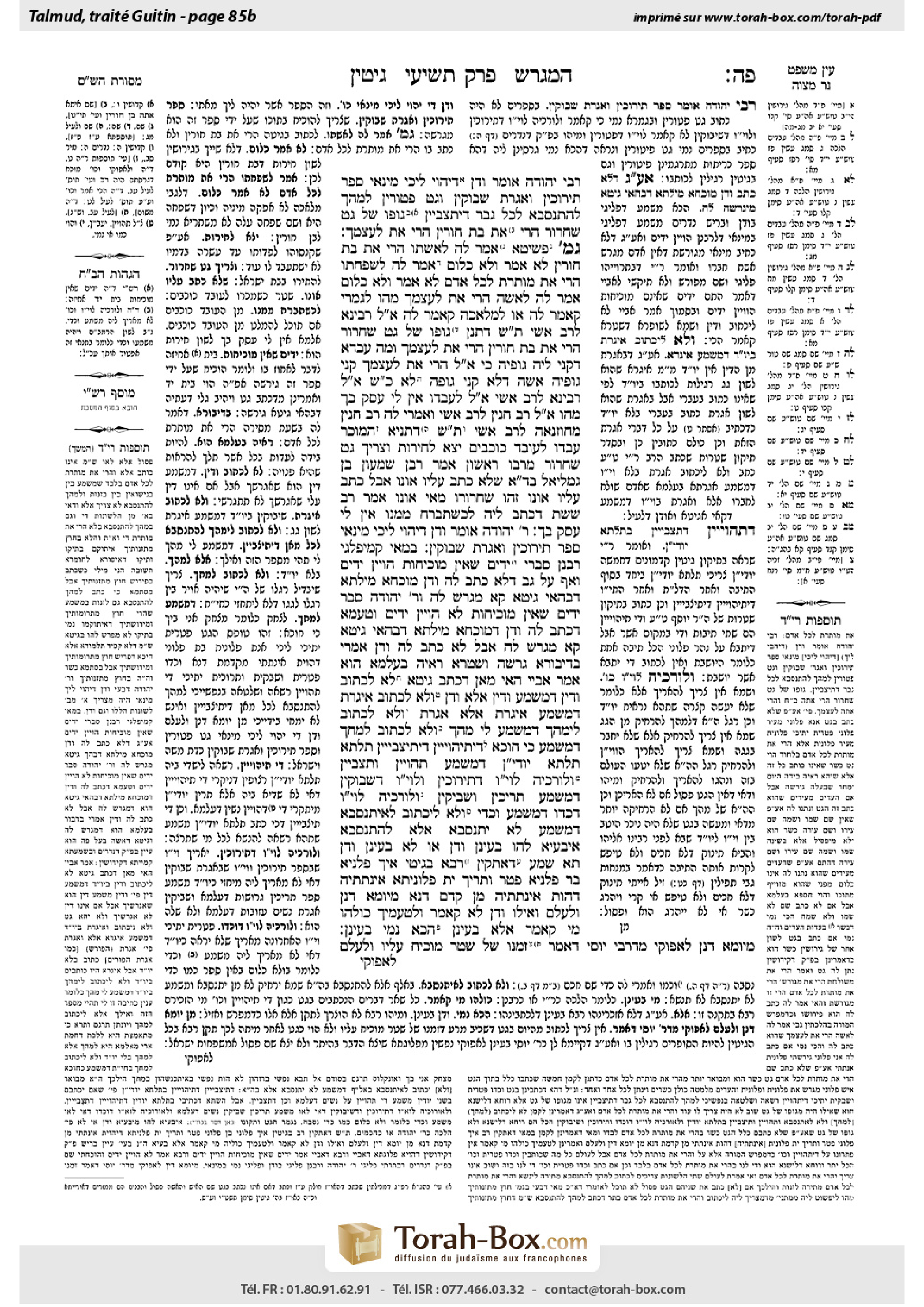
Gittin 85b: Talmud study for Daf Yomi
Study the Talmud for Daf Yomi with scanned pages, Hebrew text, English translations from Sefaria and AI-generated French translations.
Passage selection and English or AI-generated French translation are available where the scan has annotations. Daf Study is independent of Torah-Box and Sefaria.
Browse Gittin · גיטין · All tractatesGittin 85b text and translations
This page of Gittin includes the Aramaic text, an English translation and an AI-generated French translation, alongside the scan above.
גיטין פ״ה ב · Aramaic and Hebrew text
רַבִּי יְהוּדָה אוֹמֵר: ״וְדֵן, דְּיֶהֱוֵי לִיכִי מִינַּאי – סֵפֶר תֵּירוּכִין, וְאִגֶּרֶת שִׁבּוּקִין, וְגֵט פִּטּוּרִין; לִמְהָךְ לְהִתְנְסָבָא לְכֹל גְּבַר דִּיתִצְבִּיִּין״. גּוּפוֹ שֶׁל גֵּט שִׁחְרוּר: ״הֲרֵי אַתְּ (בַּת) [בֶּן] חוֹרִין״; ״הֲרֵי אַתְּ לְעַצְמָךְ״.
גְּמָ׳ פְּשִׁיטָא, אָמַר לָהּ לְאִשְׁתּוֹ: ״הֲרֵי אַתְּ בַּת חוֹרִין״ – לֹא אָמַר וְלֹא כְּלוּם; אָמַר לָהּ לְשִׁפְחָתוֹ: ״הֲרֵי אַתְּ מוּתֶּרֶת לְכׇל אָדָם״ – לֹא אָמַר וְלֹא כְּלוּם.
אָמַר לָהּ לְאִשָּׁה: ״הֲרֵי אַתְּ לְעַצְמָךְ״, מַהוּ? לִגְמָרֵי קָאָמַר לַהּ, אוֹ לִמְלָאכָה קָאָמַר לַהּ?
אֲמַר לֵיהּ רָבִינָא לְרַב אָשֵׁי: תָּא שְׁמַע, דִּתְנַן: גּוּפוֹ שֶׁל גֵּט שִׁחְרוּר: ״הֲרֵי אַתְּ (בַּת) [בֶּן] חוֹרִין״; ״הֲרֵי אַתְּ לְעַצְמָךְ״. וּמָה עַבְדָּא, דִּקְנִי לֵיהּ גּוּפֵיהּ, כִּי אֲמַר לֵיהּ: ״הֲרֵי אַתְּ לְעַצְמָךְ״ – קְנִי גּוּפֵיהּ; אִשָּׁה, דְּלָא קְנִי גּוּפַהּ – לֹא כׇּל שֶׁכֵּן?!
אֲמַר לֵיהּ רָבִינָא לְרַב אָשֵׁי: אָמַר לוֹ לְעַבְדּוֹ: ״אֵין לִי עֵסֶק בָּךְ״, מַהוּ?
אֲמַר לֵיהּ רַב חָנִין לְרַב אָשֵׁי, וְאָמְרִי לַהּ רַב חָנִין מָחוֹזְנָאָה לְרַב אָשֵׁי: תָּא שְׁמַע, דְּתַנְיָא: הַמּוֹכֵר עַבְדּוֹ לְגוֹי – יָצָא לְחֵירוּת, וְצָרִיךְ גֵּט שִׁחְרוּר מֵרַבּוֹ רִאשׁוֹן. אָמַר רַבָּן שִׁמְעוֹן בֶּן גַּמְלִיאֵל: בַּמֶּה דְּבָרִים אֲמוּרִים – שֶׁלֹּא כָּתַב עָלָיו אוֹנוֹ, אֲבָל כָּתַב עָלָיו אוֹנוֹ – זֶהוּ שִׁחְרוּרוֹ.
מַאי ״אוֹנוֹ״? אָמַר רַב שֵׁשֶׁת, דִּכְתַב לֵיהּ: ״לִכְשֶׁתִּבְרַח מִמֶּנּוּ, אֵין לִי עֵסֶק בָּךְ״.
רַבִּי יְהוּדָה אוֹמֵר: ״וְדֵן, דְּיֶהֱוֵי לִיכִי מִינַּאי – סֵפֶר תֵּירוּכִין וְאִגֶּרֶת שִׁבּוּקִין״. בְּמַאי קָמִיפַּלְגִי? רַבָּנַן סָבְרִי: יָדַיִם שֶׁאֵין מוֹכִיחוֹת הָוְיָין יָדַיִם, וְאַף עַל גַּב דְּלָא כְּתַב לָהּ ״וְדֵן״ – מוֹכְחָא מִילְּתָא דִּבְהַאי גִּיטָּא קָא מְגָרֵשׁ לַהּ.
וְרַבִּי יְהוּדָה סָבַר: יָדַיִם שֶׁאֵין מוֹכִיחוֹת לָא הָוְיָין יָדַיִם, וְטַעְמָא דִּכְתַב לַהּ ״וְדֵן״ – דְּמוֹכְחָא מִילְּתָא דִּבְהַאי גִּיטָּא קָא מְגָרֵשׁ לַהּ; אֲבָל לָא כְּתַב לָהּ ״וְדֵן״ – אָמְרִי: בְּדִיבּוּרָא גָּרְשַׁהּ, וּשְׁטָרָא רְאָיָה בְּעָלְמָא הוּא.
אָמַר אַבָּיֵי: הַאי מַאן דְּכָתֵב גִּיטָּא, לָא לִכְתּוֹב ״וְדֵין״ – דְּמַשְׁמַע וְדִין; אֶלָּא ״וְדֵן״.
וְלָא לִכְתּוֹב ״אִיגֶּרֶת״ – דְּמַשְׁמַע (אִיגֶּרֶת) [אִיגָּרָא]; אֶלָּא ״אִגֶּרֶת״. וְלָא לִכְתּוֹב ״לִימְהָךְ״ – דְּמַשְׁמַע לִי מֵהָךְ; וְלָא לִכְתּוֹב ״לִמְחָךְ״ – דְּמַשְׁמַע כִּי חוּכָא.
״דִּיתִיהְוִייִין״, ״דִּיתִיצְבִּייִין״ – תְּלָתָא תְּלָתָא יוֹדִין; דְּמַשְׁמַע תֶּהֶוְיָין וְתִצְבְּיָין. וְלוֹרְכֵיהּ לְוָיו ״דְּתֵירוּכִין״, וּלְוָיו ״דְּשִׁבּוּקִין״; דְּמַשְׁמַע תְּרִיכִין וּשְׁבִיקִין.
וְלוֹרְכֵיהּ לְוָיו ״דְּכַדּוּ״; דְּמַשְׁמַע ״וּכְדִי״. וְלָא לִיכְתּוֹב ״לְאִיתְנְסָבָא״ – דְּמַשְׁמַע לָא יִתְנַסְבָא, אֶלָּא ״לְהִתְנְסָבָא״.
אִיבַּעְיָא לְהוּ: בָּעֵינַן ״וְדֵן״, אוֹ לָא בָּעֵינַן ״וְדֵן״?
תָּא שְׁמַע, דְּאַתְקֵין רָבָא בְּגִיטֵּי: ״אֵיךְ פְּלָנְיָא בַּר פְּלָנְיָא, פְּטַר וְתָרֵיךְ יָת פְּלוֹנִיתָא אִינְתְּתֵיהּ, דַּהֲוָת אִינְתְּתֵיהּ מִן קֳדָם דְּנָא – מִיּוֹמָא דְּנַן וּלְעָלַם״. וְאִילּוּ ״וְדֵן״ לָא קָאָמַר.
וּלְטַעְמָיךְ, כּוּלְּהוּ מִי קָאָמַר? אֶלָּא בָּעֵינַן, הָכָא נָמֵי בָּעֵינַן;
״מִיּוֹמָא דְּנַן״ – לְאַפּוֹקֵי מִדְּרַבִּי יוֹסֵי, דְּאָמַר: זְמַנּוֹ שֶׁל שְׁטָר מוֹכִיחַ עָלָיו;
״וּלְעָלַם״ –
Gittin 85b · English translation
Rabbi Yehuda says that there is also another essential sentence: And this that you shall have from me is a scroll of divorce, and a letter of leave, and a bill of dismissal to go to marry any man that you wish. And the basic element of a bill of manumission for a maidservant is: You are hereby a free woman, or: You are hereby your own.
GEMARA: It is obvious that if one stated in a bill of divorce for his wife: You are hereby a free woman, he has stated nothing, as that is not a statement of divorce. Similarly, if one stated in a bill of manumission for his maidservant: You are hereby permitted to marry any man, he has stated nothing, as that is not a statement of manumission.
The Gemara asks: If he stated in a bill of divorce for his wife: You are hereby your own, what is the halakha? Is he saying to her: You are entirely your own, meaning that she has full control over her status and may marry another man? Or is he saying to her: You are your own with regard to work, meaning that she may keep the revenue from her work? If so, this is not a statement of divorce.
Ravina said to Rav Ashi: Come and hear a solution that we learned in the mishna: The basic element of a bill of manumission is: You are hereby a free woman, or: You are hereby your own. And just as with regard to a slave, whose body is acquired by the master, if the master states in a bill of manumission for the slave: You are hereby your own, the slave acquires his body, all the more so with regard to a wife, whose body is not acquired by her husband, is it not clear that by his writing in a bill of divorce: You are hereby your own, she is completely released from their marriage?
Ravina said to Rav Ashi: If he stated in a bill of manumission for his slave: I have no business with you, what is the halakha? Is this a valid statement of manumission?
Rav Ḥanin said to Rav Ashi, and some say that it was Rav Ḥanin from Meḥoza who said this to Rav Ashi: Come and hear a solution that we learned in a baraita: With regard to one who sells his slave to a gentile, the slave is emancipated but nevertheless requires a bill of manumission from his first master. Rabban Shimon ben Gamliel said: In what case is this statement said? It is when the master did not write his document for the slave when he sold him; but if he wrote his document for him, that is the slave’s bill of manumission.
The Gemara asks: What is the phrase: His document, referring to? Rav Sheshet says that he writes for him as follows: When you will escape from the gentile to whom I sold you, I have no business with you. Consequently, as soon as he escapes his gentile master in any manner, he is entirely emancipated. It may be derived from here that the statement: I have no business with you, is valid with regard to manumission.
§ It is stated in the mishna that Rabbi Yehuda says that in addition to the statement: You are hereby permitted to marry any man, there is another essential sentence in the bill of divorce: And this [veden] that you shall have from me is a scroll of divorce and a letter [ve’iggeret] of leave. The Gemara asks: With regard to what principle do Rabbi Yehuda and the Rabbis disagree? The Gemara answers: The Rabbis hold that ambiguous intimations are valid intimations. An incomplete statement is sufficient as long as the intention is clear from the context. And therefore, even if he does not write for her explicitly: And this that you shall have from me is a scroll of divorce and a letter of leave, the bill of divorce is valid as it is evident that he is divorcing her with this bill of divorce.
And Rabbi Yehuda holds that ambiguous intimations are not valid intimations, and therefore the reason that the bill of divorce is valid is that he writes for her: And this that you shall have from me is a scroll of divorce and a letter of leave, so it is evident that he is divorcing her with this bill of divorce. But if he does not write for her: And this that you shall have from me is a scroll of divorce and a letter of leave, people will say that he is divorcing her orally, and will mistakenly assume that the husband’s statement to her when he hands her the bill of divorce is what causes the divorce to take effect, and that the document is merely evidence of the divorce, rather than the divorce itself.
§ The Gemara relates several rulings concerning the precise terminology to be used in writing a bill of divorce. Abaye said: This person who writes a bill of divorce should not write the word meaning: And this, by spelling it vav, dalet, yod, nun, as that can be misread as having the vowel of a ḥirik under the letter dalet, not a tzeire. Read with a ḥirik, it indicates: And there is a law that we should get divorced. Rather, he should make sure to write the word meaning: And this, without a yod, so that it is clear that it should be read with a tzeire.
And he should not write the word meaning: A letter, by spelling it alef, yod, gimmel, reish, tav, as that can be confused with another identically spelled word that indicates a roof. Rather, he should write the word meaning: A letter, without a yod. And he should not write: To go, by spelling it lamed, yod, mem, heh, khaf, as that could be read as a conjunction which indicates: For me from this. And he should be sure not to write limḥakh, i.e., he must be careful that the letter heh not look like a ḥet, as that indicates that it is like a joke.
Abaye continues: In the clause: That you shall be permitted to go marry any man that you wish, the words ditihevyin and dititzviyin must include three instances of the letter yod in a row in each word, as with only two instances of the letter yod these words indicate: That they shall be [tehevyan], and: That they wish [titzviyan], referring to other women. And he should extend the vav of teirukhin and the vav of shevukin, as otherwise, the vav may be mistaken for a yod, and those words spelled with a yod indicate divorced [terikhin] and left [shevikin] women. In other words, it will change the meaning from describing the document as one that divorces or sends away to describing the women as divorced and sent away.
And in the clause: And now [ukhedu] I have dismissed and ousted and divorced you, he should extend the vav of khedu, as otherwise, the vav may be mistaken for a yod, and spelled with a yod it indicates: And with nothing [ukhedi]. And in the expression: To go marry [lehitnasseva] he should not write le’itnasseva with an alef and a yod, as, if he leaves space between the letters it will indicate: Will not get married [la yitnasseva]. Rather, he should write lehitnasseva, with a heh and without a yod, so there will be no room for this error.
§ A dilemma was raised before them: Do we need to write: And this that you shall have from me is a scroll of divorce, and a letter of leave, and a bill of dismissal to go to marry any man that you wish, or do we not need to write the clause beginning with the words: And this? Is the halakha in accordance with the opinion of Rabbi Yehuda or the Rabbis?
Come and hear a solution, as Rava instituted the following wording in bills of divorce: We saw how so-and-so, son of so-and-so, dismissed and divorced so-and-so, his wife, who was his wife from beforehand, from this day and forever. But he did not state the clause beginning with the words: And this.
The Gemara challenges this solution: And according to your reasoning, did Rava state all of the other necessary clauses of a bill of divorce? Rather, we need to write them even though they were not mentioned explicitly in Rava’s formulation. Here too, we need to write the clause beginning with the words: And this, even though it was not mentioned specifically by Rava.
§ The Gemara analyzes the wording instituted by Rava: The expression: From this day, is written to the exclusion of the statement of Rabbi Yosei, who said: The date written in a document proves when it takes effect, and therefore it is not necessary to write the expression: From this day. Rava added this expression to take the opposite opinion into account.
The expression: And forever,
Gittin 85b · Traduction française (IA)
Rabbi Yehuda dit que c'est aussi une autre phrase essentielle : Et ce que tu auras de moi est un rouleau de divorce, et une lettre de départ, et un billet de renvoi pour épouser n'importe quel homme que tu désires. Et l'élément fondamental d'un billet de manumission pour une servante est : Tu es désormais une femme libre, ou : Tu es désormais ta propre personne.
GUEMARA : Il est évident que si l'on a écrit dans un billet de divorce pour sa femme : Tu es désormais une femme libre, on n'a rien dit, car cela n'est pas une déclaration de divorce. De même, si l'on a écrit dans un billet de manumission pour sa servante : Tu es désormais autorisée à épouser n'importe quel homme, on n'a rien dit, car cela n'est pas une déclaration de manumission.
La Guemara pose la question : Si l'on a écrit dans un billet de divorce pour sa femme : Tu es désormais ta propre personne, quelle est la halakha ? Est-ce que l'on dit à elle : Tu es entièrement ta propre personne, c'est-à-dire qu'elle a pleine maîtrise de son statut et peut épouser un autre homme ? Ou est-ce que l'on dit à elle : Tu es ta propre personne en ce qui concerne le travail, c'est-à-dire qu'elle peut conserver les revenus de son travail ? Si c'est ainsi, cela n'est pas une déclaration de divorce.
Ravina dit à Rav Ashi : Viens écouter une solution que nous avons apprise dans la mitsna : L'élément fondamental d'un billet de manumission est : Tu es désormais une femme libre, ou : Tu es désormais ta propre personne. Et puisque c'est ainsi pour un esclave, dont le corps est acquis par le maître, si le maître écrit dans un billet de manumission pour l'esclave : Tu es désormais ta propre personne, l'esclave acquiert son corps, beaucoup plus encore pour une femme, dont le corps n'est pas acquis par son mari, n'est-ce pas clair que par son écriture dans un billet de divorce : Tu es désormais ta propre personne, elle est entièrement libérée de leur mariage ?
Ravina dit à Rav Ashi : Si l'on a écrit dans un billet de manumission pour son esclave : Je n'ai plus affaire à toi, quelle est la halakha ? Est-ce une déclaration valide de manumission ?
Rav Ḥanin dit à Rav Ashi, et on dit aussi que c'était Rav Ḥanin de Meḥoza qui a dit cela à Rav Ashi : Viens écouter une solution que nous avons apprise dans une baraïta : Concernant celui qui vend son esclave à un non-Juif, l'esclave est libéré mais il lui faut tout de même un billet de manumission de son premier maître. Rabban Shimon ben Gamliel dit : Dans quel cas cette déclaration est-elle faite ? C'est lorsque le maître n'a pas écrit son document pour l'esclave lorsqu'il l'a vendu ; mais si le maître a écrit son document pour lui, c'est le billet de manumission de l'esclave.
La Guemara pose la question : Quelle est la phrase : Son document, à quoi cela fait-il référence ? Rav Sheshet dit qu'il écrit comme suit : Lorsque tu échapperas au non-Juif à qui j'ai vendu, je n'ai plus affaire à toi. Ainsi, dès qu'il s'échappe de son maître non-Juif de toute manière, il est entièrement libéré. On peut en déduire ici que la déclaration : Je n'ai plus affaire à toi, est valide concernant la manumission.
§ Il est dit dans la mitsna que Rabbi Yehuda dit que, en plus de la déclaration : Tu es désormais autorisée à épouser n'importe quel homme, il y a une autre phrase essentielle dans le billet de divorce : Et ce que tu auras de moi est un rouleau de divorce et une lettre de départ. La Guemara pose la question : Sur quel principe Rabbi Yehuda et les Rabbins s'opposent-ils ? La Guemara répond : Les Rabbins pensent que les intonations ambiguës sont des déclarations valides. Une déclaration incomplète est suffisante tant que l'intention est claire du contexte. Et donc, même s'il n'écrit pas explicitement pour elle : Et ce que tu auras de moi est un rouleau de divorce et une lettre de départ, le billet de divorce est valide car il est évident qu'il divorce ainsi avec ce billet de divorce.
Et Rabbi Yehuda pense que les intonations ambiguës ne sont pas des déclarations valides, et donc la raison pour laquelle le billet de divorce est valide est qu'il écrit pour elle : Et ce que tu auras de moi est un rouleau de divorce et une lettre de départ, donc il est clair qu'il divorce ainsi avec ce billet de divorce. Mais si il n'écrit pas pour elle : Et ce que tu auras de moi est un rouleau de divorce et une lettre de départ, les gens diront qu'il divorce d'elle oralement, et penseront à tort que la déclaration du mari à elle lorsqu'il lui donne le billet de divorce est ce qui cause l'effet du divorce, et que le document est simplement une preuve du divorce, et non le divorce lui-même.
§ La Guemara rapporte plusieurs décisions concernant le vocabulaire précis à utiliser pour écrire un billet de divorce. Abaye dit : Cette personne qui écrit un billet de divorce ne doit pas écrire le mot signifiant : Et ce, en le rédigeant avec les lettres vav, dalet, yod, nun, car cela peut être mal compris comme ayant la voyelle ḥirik sous la lettre dalet, et non la tzeire. Lu avec ḥirik, cela indique : Et il y a une loi que nous devons divorcer. Au contraire, il doit s'assurer d'écrire le mot signifiant : Et ce, sans la lettre yod, afin qu'il soit clair qu'il doit être lu avec une tzeire.
Et il ne doit pas écrire le mot signifiant : Une lettre, en le rédigeant avec les lettres alef, yod, gimmel, reish, tav, car cela pourrait être confondu avec un autre mot orthographié de la même manière qui indique un toit. Au contraire, il doit écrire le mot signifiant : Une lettre, sans la yod. Et il ne doit pas écrire : Pour aller, en le rédigeant avec les lettres lamed, yod, mem, heh, khaf, car cela pourrait être lu comme une conjonction qui indique : Pour moi à partir de cela. Et il doit s'assurer de ne pas écrire limḥakh, c'est-à-dire il doit être prudent que la lettre heh ne ressemble pas à un ḥet, car cela indique qu'il s'agit d'une blague.
Abaye continue : Dans la clause : Que tu sois libre de t'unir à tout homme que tu désires, les mots tehevyan et titzviyan doivent comporter trois occurrences consécutives de la lettre yod dans chaque mot, comme dans le cas où il n'y a que deux occurrences de la lettre yod, ces mots indiquent : Que tu sois [tehevyan], et : Que tu désires [titzviyan], se référant à d'autres femmes. Et il doit étirer la vav de teirukhin et la vav de shevukin, autrement la vav pourrait être confondue avec une yod, et ces mots écrits avec une yod indiquent : Divorcées [terikhin] et laissées [shevikin]. En d'autres termes, cela modifierait le sens, passant de décrire le document comme celui qui divorce ou expulse à décrire les femmes comme divorcées et expulsées.
Et dans la clause : Et maintenant [ukhedu] je t'ai expulsé et expulsé et divorcé, il doit étirer la vav de khedu, autrement la vav pourrait être confondue avec une yod, et écrit avec une yod cela indique : Et sans rien [ukhedi]. Et dans l'expression : Pour t'unir [lehitnasseva], il ne doit pas écrire lehitnasseva avec un alef et une yod, car, si l'on laisse un espace entre les lettres, cela indique : Ne se mariera pas [la yitnasseva]. Plutôt, il doit écrire lehitnasseva, avec un heh et sans yod, afin qu'il n'y ait pas de place à cette erreur.
§ Un dilemme a été soulevé devant eux : Devons-nous écrire : Et ce que tu as de moi est un rouleau de divorce, et une lettre de départ, et un billet de licenciement pour t'unir à tout homme que tu désires, ou ne devons-nous pas écrire la clause commençant par les mots : Et ce ? La halakha suit-elle l'opinion de Rabbi Yehuda ou celle des Rabbins ?
Venez écouter une solution, car Rava a institué la suivante comme formule dans les actes de divorce : Nous avons vu comment tel et tel, fils de tel et tel, a expulsé et divorcé tel et tel, sa femme, qui était sa femme depuis avant, à partir de ce jour et pour toujours. Mais il n'a pas mentionné la clause commençant par les mots : Et ce.
La Guemara conteste cette solution : Et selon votre raisonnement, Rava a-t-il dit toutes les autres clauses nécessaires d'un acte de divorce ? Plutôt, nous devons les écrire même si elles n'ont pas été mentionnées explicitement dans la formulation de Rava. Ici aussi, nous devons écrire la clause commençant par les mots : Et ce, même si elle n'a pas été mentionnée spécifiquement par Rava.
§ La Guemara analyse la formule instituée par Rava : L'expression : À partir de ce jour, est écrite à l'exclusion de la déclaration de Rabbi Yosei, qui disait : La date inscrite dans un document prouve quand il entre en vigueur, et par conséquent il n'est pas nécessaire d'écrire l'expression : À partir de ce jour. Rava a ajouté cette expression pour prendre en compte l'opinion opposée.
L'expression : Et pour toujours,
Traduction française générée par IA à partir de l’édition anglaise de Sefaria. Vérifie toujours un passage avec le texte source.
Text from Sefaria: William Davidson Edition - Vocalized Aramaic (CC BY NC); William Davidson Edition - English (CC BY NC).