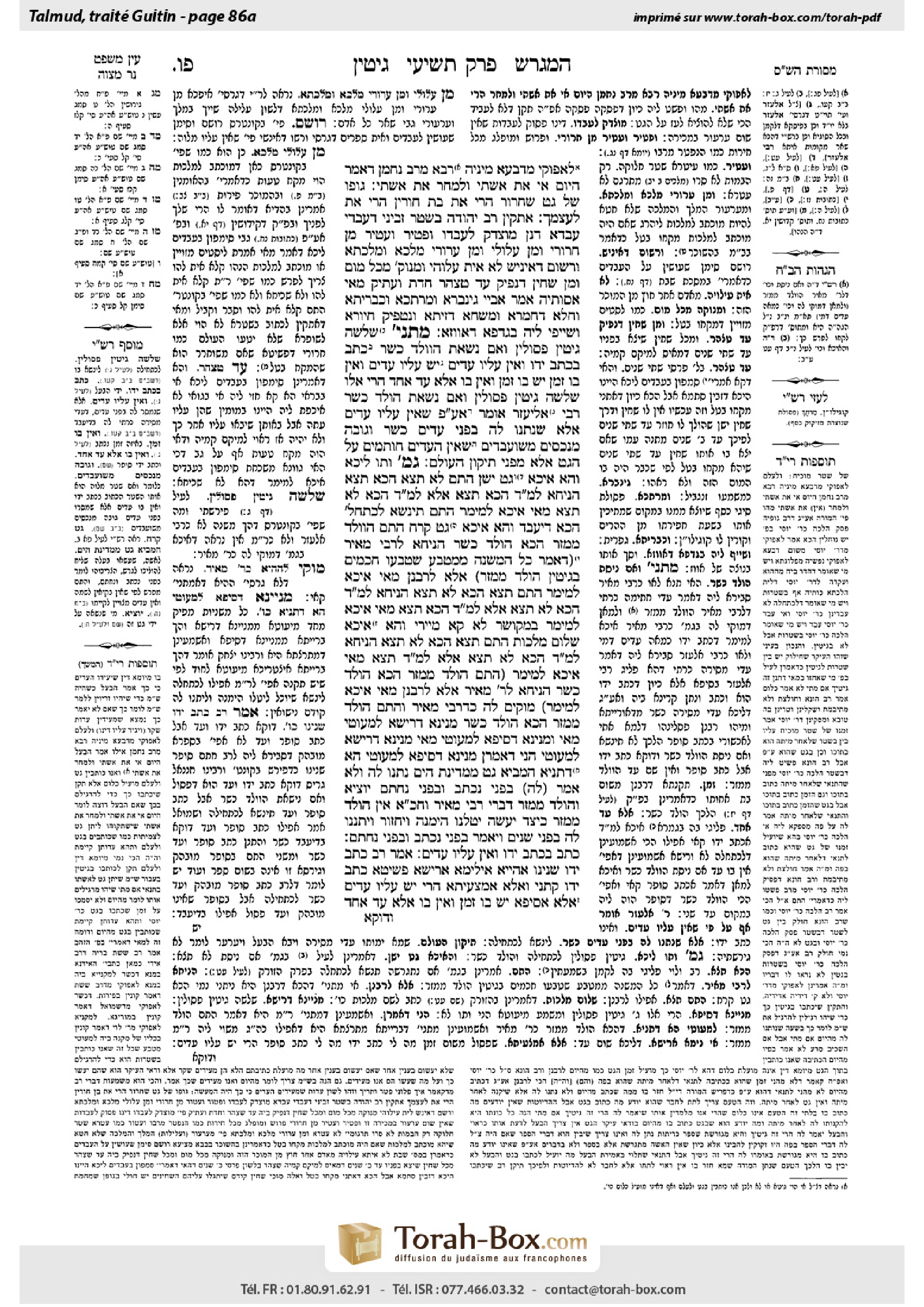
Gittin 86a: Talmud study for Daf Yomi
Study the Talmud for Daf Yomi with scanned pages, Hebrew text, English translations from Sefaria and AI-generated French translations.
Passage selection and English or AI-generated French translation are available where the scan has annotations. Daf Study is independent of Torah-Box and Sefaria.
Browse Gittin · גיטין · All tractatesGittin 86a text and translations
This page of Gittin includes the Aramaic text, an English translation and an AI-generated French translation, alongside the scan above.
גיטין פ״ו א · Aramaic and Hebrew text
לְאַפּוֹקֵי מִדִּבְעָא מִינֵּיהּ רָבָא מֵרַב נַחְמָן – דְּאָמַר: ״הַיּוֹם אִי אַתְּ אִשְׁתִּי וּלְמָחָר אַתְּ אִשְׁתִּי״.
גּוּפוֹ שֶׁל גֵּט שִׁחְרוּר: ״הֲרֵי אַתְּ (בַּת) [בֶּן] חוֹרִין״; ״הֲרֵי אַתְּ לְעַצְמָךְ״: אַתְקֵין רַב יְהוּדָה בִּשְׁטָר זְבִינֵי דְּעַבְדֵי: ״עַבְדָּא דְּנַן מוּצְדָּק לְעַבְדוּ; וּפְטִיר וַעֲטִיר מִן חֲרוּרֵי, וּמִן עֲלוּלֵי, וּמִן עָרוֹרֵי מַלְכָּא וּמַלְכְּתָא; וּרְשׁוּם דְּאִינִישׁ לָא אִית עֲלוֹהִי, וּמְנוּקֶּה מִכֹּל מוּם, וּמִן שְׁחִין דְּנָפֵיק עַד טַצְהַר חֲדַת וְעַתִּיק״.
מַאי אָסוּתֵיהּ? אָמַר אַבָּיֵי: גִּינְבְּרָא, וּמַרְתְּכָא, וְכַבְרִיתָא, וְחַלָּא דְחַמְרָא, וּמִשְׁחָא דְזֵיתָא, וְנַטְפִּיק חִיוָּרָא; וְשָׁיְיפִי לֵיהּ בְּגַדְפָּא דַאֲווֹזָא.
מַתְנִי׳ שְׁלֹשָׁה גִּיטִּין פְּסוּלִין, וְאִם נִשֵּׂאת הַוּוֹלָד כָּשֵׁר –
כָּתַב בִּכְתַב יָדוֹ, וְאֵין עָלָיו עֵדִים; יֵשׁ עָלָיו עֵדִים, וְאֵין בּוֹ זְמַן; יֵשׁ בּוֹ זְמַן, וְאֵין בּוֹ אֶלָּא עֵד אֶחָד; הֲרֵי אֵלּוּ שְׁלֹשָׁה גִּיטִּין פְּסוּלִין, וְאִם נִשֵּׂאת – הַוָּלָד כָּשֵׁר.
רַבִּי אֱלִיעֶזֶר אוֹמֵר: אַף עַל פִּי שֶׁאֵין עָלָיו עֵדִים, אֶלָּא שֶׁנְּתָנוֹ לָהּ בִּפְנֵי עֵדִים – כָּשֵׁר, וְגוֹבָה מִנְּכָסִים מְשׁוּעְבָּדִים; שֶׁאֵין הָעֵדִים חוֹתְמִים עַל הַגֵּט אֶלָּא מִפְּנֵי תִּיקּוּן הָעוֹלָם.
גְּמָ׳ וְתוּ לֵיכָּא?! וְהָא אִיכָּא גֵּט יָשָׁן! הָתָם לֹא תֵּצֵא, הָכָא תֵּצֵא.
הָנִיחָא לְמַאן דְּאָמַר: הָכָא תֵּצֵא, אֶלָּא לְמַאן דְּאָמַר: הָכָא לֹא תֵּצֵא, מַאי אִיכָּא לְמֵימַר?
הָתָם תִּינָּשֵׂא לְכַתְּחִלָּה, הָכָא דִּיעֲבַד.
וְהָא אִיכָּא גֵּט קֵרֵחַ! הָתָם הַוּוֹלָד מַמְזֵר, הָכָא הַוָּלָד כָּשֵׁר.
הָנִיחָא לְרַבִּי מֵאִיר (דְּאָמַר: כׇּל הַמְשַׁנֶּה מִמַּטְבֵּעַ שֶׁטָּבְעוּ חֲכָמִים בְּגִיטִּין, הַוָּלָד מַמְזֵר). אֶלָּא לְרַבָּנַן, מַאי אִיכָּא לְמֵימַר?
הָתָם תֵּצֵא, הָכָא לֹא תֵּצֵא.
הָנִיחָא לְמַאן דְּאָמַר הָכָא לֹא תֵּצֵא, אֶלָּא לְמַאן דְּאָמַר הָכָא תֵּצֵא, מַאי אִיכָּא לְמֵימַר? בִּמְקוּשָּׁר לָא קָא מַיְירֵי.
וְהָא אִיכָּא שְׁלוֹם מַלְכוּת! הָתָם תֵּצֵא, הָכָא לֹא תֵּצֵא.
הָנִיחָא לְמַאן דְּאָמַר הָכָא לֹא תֵּצֵא, אֶלָּא לְמַאן דְּאָמַר תֵּצֵא, מַאי אִיכָּא לְמֵימַר? (הָתָם הַוָּלָד מַמְזֵר, הָכָא הַוָּלָד כָּשֵׁר.
הָנִיחָא לְרַבִּי מֵאִיר, אֶלָּא לְרַבָּנַן מַאי אִיכָּא לְמֵימַר?) מוֹקֵים לַהּ כִּדְרַבִּי מֵאִיר; וְהָתָם הַוָּלָד מַמְזֵר, הָכָא הַוָּלָד כָּשֵׁר.
מִנְיָנָא דְרֵישָׁא לְמַעוֹטֵי מַאי, וּמִנְיָנָא דְסֵיפָא לְמַעוֹטֵי מַאי?
מִנְיָנָא דְרֵישָׁא – לְמַעוֹטֵי הָנֵי דַּאֲמַרַן.
מִנְיָנָא דְסֵיפָא – לְמַעוֹטֵי הָא דְּתַנְיָא: הַמֵּבִיא גֵּט מִמְּדִינַת הַיָּם, נְתָנוֹ לָהּ וְלֹא אָמַר לָהּ: ״בְּפָנַי נִכְתַּב וּבְפָנַי נֶחְתַּם״ – יוֹצִיא וְהַוָּלָד מַמְזֵר, דִּבְרֵי רַבִּי מֵאִיר.
וַחֲכָמִים אוֹמְרִים: אֵין הַוָּלָד מַמְזֵר. כֵּיצַד יַעֲשֶׂה? יִטְּלֶנּוּ הֵימֶנָּה, וְיַחֲזוֹר וְיִתְּנֶנּוּ לָהּ בִּפְנֵי שְׁנַיִם, וְיֹאמַר: ״בְּפָנַי נִכְתַּב וּבְפָנַי נֶחְתַּם״.
כָּתַב בִּכְתַב יָדוֹ וְאֵין עָלָיו עֵדִים. אָמַר רַב: ״כְּתַב יָדוֹ״ שָׁנִינוּ.
אַהֵיָיא? אִילֵּימָא אַרֵישָׁא – פְּשִׁיטָא! ״כְּתַב יָדוֹ״ קָתָנֵי!
וְאֶלָּא אַמְּצִיעֲתָא – הֲרֵי יֵשׁ עָלָיו עֵדִים! אֶלָּא אַסֵּיפָא: יֵשׁ בּוֹ זְמַן וְאֵין בּוֹ אֶלָּא עֵד אֶחָד –
Gittin 86a · English translation
was instituted to the exclusion of that which Rava asked Rav Naḥman, with regard to a case where the husband said to his wife while handing her the bill of divorce: Today you are not my wife and tomorrow you are my wife. Does this limitation take effect? Although the conclusion of that inquiry was that once the wife is divorced she is divorced forever, Rava instituted the addition of this expression in the text of the bill of divorce to remove any uncertainty with regard to such a case.
§ It is stated in the mishna: The basic element of a bill of manumission for a maidservant is: You are hereby a free woman, or: You are hereby your own. Rav Yehuda instituted the following formulation in a document of sale for slaves: This slave is justified, i.e., fit for slavery, and he is dismissed and removed from manumission and from accusations and from contests of the king and queen, meaning that he was not sentenced to death by the governmental court. And there is not a sign [reshum] of ownership of another person on him. And he is clean of any blemish and of boils that emerge on him for four [tatzhar] years, whether new or old.
The Gemara asks tangentially: What is the cure for boils? Abaye said: One takes ginger [ginebara], and slag from silver, and sulfur [kavrita], and wine vinegar, and olive oil, and white naphtha [natpik], and spreads it with a goose feather.
MISHNA: Three bills of divorce are invalid ab initio, but if the woman marries another man on the basis of one of these bills of divorce the lineage of the offspring from this marriage is unflawed. In other words, she is not considered to be a married woman who engaged in sexual intercourse with another man, which would impair the lineage of their child.
These three bills are: A bill of divorce that the husband wrote in his handwriting but has no signatures of witnesses on the document at all, a case where there are signatures of witnesses on the document but there is no date written on it, and a case where there is a date written on it, but it contains only one witness. These are the three invalid bills of divorce with regard to which the Sages said: And if she marries, the lineage of the offspring is unflawed.
Rabbi Eliezer says: Even though there are no signatures of witnesses on the document, but he handed it to her in the presence of two witnesses, it is a valid bill of divorce. And on the basis of this bill of divorce the woman can collect the amount written for her in her marriage contract even from liened property, as Rabbi Eliezer maintains that the witnesses sign the bill of divorce only for the betterment of the world. If no witnesses sign a bill of divorce the husband can contest its validity at any time by denying that he wrote it. Nevertheless, the witnesses’ signatures are not an essential part of a bill of divorce.
GEMARA: The Gemara asks: But are there no other invalid bills of divorce? But isn’t there an outdated bill of divorce, where the husband and wife were secluded after it was written and before it was handed to her? The Gemara answers that there is a difference between the cases: There, in the case of an outdated bill of divorce, if the woman remarries on the basis of that bill of divorce she need not leave her husband; here, she must leave him.
The Gemara asks: This works out well according to the one who says that here she must leave her husband, even though the lineage of their children is unflawed. But according to the one who says that here she need not leave, what is there to say? Why is an outdated bill of divorce not mentioned in the mishna?
The Gemara answers: There is still a difference between the cases, as there, in the case of an outdated bill of divorce, she may remarry ab initio; while here, it is only after the fact, if she remarried, that she need not leave her second husband.
The Gemara asks: But isn’t there a bare bill of divorce, i.e., one that is missing a signature, which is also invalid? The Gemara answers: There, if the woman remarries based on this bill of divorce the offspring of her second marriage is a mamzer; here, the lineage of the offspring is unflawed.
The Gemara asks: This works out well according to Rabbi Meir, who said that anyone who deviates from the formula coined by the Sages with regard to bills of divorce renders the offspring a mamzer. Therefore, a bare bill of divorce is completely invalid, and if the woman remarries the offspring is a mamzer. But according to the Rabbis, who hold that the offspring is not a mamzer, what is there to say? Why is a bare bill of divorce not listed in the mishna?
The Gemara answers that there is still a distinction between the cases: There, if the woman remarries she must leave her husband, even according to the Rabbis who hold that the offspring is not a mamzer; here, she need not leave her husband.
The Gemara asks: This works out well according to the one who says that here she need not leave her husband; but according to the one who says that here she must leave her husband, what is there to say? The Gemara answers: Apparently the mishna is not speaking about a folded and tied bill of divorce, which requires a signature on every fold, but rather, an open bill of divorce. There are only three cases in which this type of a bill of divorce is invalid in a manner that obligates the woman, if she remarries, to leave her second husband, although the lineage of their children would be unflawed.
The Gemara asks: But isn’t there a bill of divorce that is invalid due to the need to maintain peaceful relations with the kingdom, as it mentions the year of the divorce according to the age of another kingdom? Why is this not mentioned in the mishna? The Gemara answers: There, she must leave her husband; here, she need not leave her husband.
The Gemara asks: This works out well according to the one who says that here she need not leave her husband. But according to the one who says that she must leave her husband, what is there to say? The Gemara answers: There, the offspring is a mamzer; here, the lineage of the offspring is unflawed.
The Gemara asks: This works out well according to Rabbi Meir; but according to the Rabbis, who hold that in the case of a bill of divorce in which the date is written according to the age of another kingdom, the offspring is not a mamzer, what is there to say? The Gemara answers: The one who holds that in the cases in the mishna the woman must leave her husband establishes it in accordance with the opinion of Rabbi Meir, according to whom there, the offspring is a mamzer. Here, the lineage of the offspring is unflawed.
The mishna emphasizes twice that there are three bills of divorce that are invalid. The Gemara asks: What does the quantity in the first clause serve to exclude? And what does the quantity in the latter clause serve to exclude?
The Gemara answers: The quantity mentioned in the first clause serves to exclude those invalid bills of divorce that we previously mentioned, which are treated either more or less stringently than the cases in the mishna.
The quantity mentioned in the latter clause serves to exclude that which is taught in a baraita: With regard to an agent who brings a bill of divorce for a certain woman from a country overseas, and gives it to her but does not say to her: It was written in my presence and it was signed in my presence, and she remarries, her second husband must divorce her, and the offspring of their marriage is a mamzer. This is the statement of Rabbi Meir.
And the Rabbis say: The offspring of the second marriage is not a mamzer; rather, how should the agent act to rectify the situation? He should take the bill of divorce from her, and give it to her again in the presence of two witnesses and say: It was written in my presence and it was signed in my presence. Since this problem can be corrected, it is not listed in the mishna as one of the invalid bills of divorce.
§ It is stated in the mishna: A bill of divorce that the husband wrote in his handwriting, but has no signatures of witnesses on it at all, is invalid; nevertheless, if the woman remarries, the lineage of the child born from her second husband is unflawed. Rav says: We learned that this is referring to his handwriting.
The Gemara asks: With regard to which clause of the mishna is this referring? If we say that it is referring to the first clause, what Rav said is obvious, as the case of his handwriting is explicitly taught in that clause.
And if it is rather referring to the middle clause, i.e., an undated bill of divorce, why does it matter whether it was written in the husband’s handwriting? Aren’t there signatures of witnesses on it? Rather, it must be referring to the latter clause in the mishna, i.e., a bill of divorce that has a date written on it but has only the signature of one witness.
Gittin 86a · Traduction française (IA)
a été institué en excluant ce que Rava a demandé à Rav Naḥman concernant un cas où le mari disait à sa femme, en lui remettant le contrat de divorce : Aujourd'hui tu n'es plus mon épouse et demain tu es mon épouse. Cette limitation est-elle valable ? Bien que la conclusion de cette enquête ait été que, une fois la femme divorcée, elle le reste à jamais, Rava a institué l'ajout de cette expression dans le texte du contrat de divorce afin d'éliminer toute ambiguïté concernant de tels cas.
§ Il est dit dans la Michna : L'élément fondamental d'un contrat de manumission d'une servante est : Tu es désormais une femme libre, ou : Tu es désormais ta propre maîtresse. Rav Yehuda a institué la formulation suivante dans un document de vente d'esclave : Cet esclave est justifié, c'est-à-dire digne d'être esclave, et il est relâché et éloigné de la manumission, des accusations et des contentieux du roi et de la reine, c'est-à-dire qu'il n'a pas été condamné à mort par le tribunal gouvernemental. Il n'y a pas non plus de signe [reshum] d'appartenance à un autre sur lui. Il est propre de toute tache et de toute maladie qui apparaît sur lui pendant quatre [tatzhar] ans, qu'elle soit nouvelle ou ancienne.
§ La Guemara pose une question tangente : Quel est le remède contre les boutons ? Abaye dit : On prend du gingembre [ginebara], et des résidus d'argent, et du soufre [kavrita], et du vinaigre de vin, et de l'huile d'olive, et du naphta blanc [natpik], et on les applique avec une plume d'oie.
MICHNA : Trois contrats de divorce sont invalides dès leur émission, mais si la femme épouse un autre homme sur la base d'un de ces contrats de divorce, la lignée des enfants de ce mariage est intacte. En d'autres termes, elle n'est pas considérée comme une femme mariée ayant eu des relations sexuelles avec un autre homme, ce qui altérerait la lignée de leurs enfants.
Ces trois contrats sont : Un contrat de divorce que le mari a écrit de sa propre main mais qui ne comporte aucune signature de témoins sur le document, un cas où il y a des signatures de témoins sur le document mais pas d'année écrite, et un cas où il y a une année écrite, mais qui ne comporte qu'un seul témoin. Ces sont les trois contrats de divorce invalides auxquels les Sages ont dit : Et si elle se remarie, la lignée des enfants est intacte.
Rabbi Eliezer dit : Même s'il n'y a pas de signatures de témoins sur le document, mais qu'il l'a remis à elle en présence de deux témoins, c'est un contrat de divorce valide. Et sur la base de ce contrat de divorce, la femme peut récupérer la somme écrite dans son contrat de mariage même à partir de biens hypothéqués, car Rabbi Eliezer maintient que les témoins signent le contrat de divorce uniquement pour le bien du monde. Si aucun témoin ne signe un contrat de divorce, le mari peut contester sa validité à tout moment en déclarant qu'il ne l'a pas écrit. Cependant, les signatures des témoins ne sont pas un élément essentiel d'un contrat de divorce.
GUEMARA : La Guemara pose une question : Mais n'y a-t-il pas d'autres contrats de divorce invalides ? Mais n'est-ce pas un contrat de divorce périmé, où le mari et la femme ont été séparés après qu'il ait été écrit et avant qu'il ne soit remis à elle ? La Guemara répond que c'est une différence entre les cas : là, dans le cas d'un contrat de divorce périmé, si la femme se remarie sur la base de ce contrat de divorce, elle n'a pas besoin de quitter son mari ; ici, elle doit le quitter.
La Guemara pose une question : Cela s'explique bien selon celui qui dit que là elle doit quitter son mari, même si la lignée de leurs enfants est intacte. Mais selon celui qui dit que là elle n'a pas besoin de quitter, que dire ? Pourquoi un contrat de divorce périmé n'est-il pas mentionné dans la mitsna ?
La Guemara répond : Il existe encore une différence entre les cas, car là, dans le cas d'un contrat de divorce périmé, elle peut se remarier dès le début ; ici, c'est seulement après l'événement, si elle se remarie, qu'elle n'a pas besoin de quitter son second mari.
La Guemara pose la question : Mais n'y a-t-il pas un contrat de divorce vide, c'est-à-dire manquant d'une signature, qui est également invalide ? La Guemara répond : Là, si la femme se remarie sur la base de ce contrat de divorce, l'enfant de son deuxième mariage est un mamzer ; ici, la lignée de l'enfant est intacte.
La Guemara pose la question : Cela s'explique bien selon Rabbi Meir, qui a dit que quiconque s'écarte de la formule établie par les Sages concernant les contrats de divorce rend l'enfant un mamzer. Par conséquent, un contrat de divorce vide est totalement invalide, et si la femme se remarie, l'enfant est un mamzer. Mais selon les Rabbins, qui pensent que l'enfant n'est pas un mamzer, que dire ? Pourquoi un contrat de divorce vide n'est-il pas mentionné dans la mitsva ?
La Guemara répond que la distinction entre les cas persiste : là, si la femme se remarie, elle doit quitter son mari, même selon les Rabbins qui pensent que l'enfant n'est pas un mamzer ; ici, elle n'a pas besoin de quitter son mari.
La Guemara pose une question : Cela s'explique bien selon celui qui dit que là elle n'a pas besoin de quitter son mari ; mais selon celui qui dit que là elle doit quitter son mari, que dire ? La Guemara répond : Apparemment, la mitsna ne parle pas d'un contrat de divorce plié et lié, qui nécessite une signature sur chaque pli, mais plutôt d'un contrat de divorce ouvert. Il n'y a que trois cas dans lesquels ce type de contrat de divorce est invalide de manière à obliger la femme, si elle se remarie, à quitter son second mari, même si la lignée de leurs enfants est intacte.
La Guemara pose une question : Mais n'y a-t-il pas un contrat de divorce invalide en raison de la nécessité de maintenir des relations pacifiques avec le royaume, car il mentionne l'année du divorce selon l'âge d'un autre royaume ? Pourquoi ce cas n'est-il pas mentionné dans la mitsna ? La Guemara répond : Là, elle doit quitter son mari ; ici, elle n'a pas besoin de quitter son mari.
La Guemara pose la question : Cela fonctionne bien selon celui qui affirme que, dans ce cas, elle n’a pas besoin de quitter son mari. Mais selon celui qui affirme qu’elle doit quitter son mari, que dire ? La Guemara répond : Là, l’enfant est un mamzer ; ici, la lignée de l’enfant est intacte.
La Guemara pose la question : Cela fonctionne bien selon Rabbi Meïr ; mais selon les Rabbins, qui affirment que dans le cas d’un acte de divorce dont la date est écrite selon l’âge d’un autre royaume, l’enfant n’est pas un mamzer, que dire ? La Guemara répond : Celui qui affirme que dans les cas mentionnés dans la mitsva la femme doit quitter son mari établit cela selon l’opinion de Rabbi Meïr, selon lequel là, l’enfant est un mamzer. Ici, la lignée de l’enfant est intacte.
La mitsva insiste deux fois sur le fait qu’il existe trois actes de divorce invalides. La Guemara pose la question : À quoi sert la quantité mentionnée dans la première partie ? Et à quoi sert la quantité mentionnée dans la seconde partie ?
La Guemara répond : La quantité mentionnée dans la première partie sert à exclure les actes de divorce invalides que nous avions mentionnés précédemment, qui sont traités soit plus strictement, soit moins strictement que les cas mentionnés dans la mitsna.
La quantité mentionnée dans la seconde partie sert à exclure ce qui est enseigné dans une baraïta : En ce qui concerne un agent qui apporte un acte de divorce pour une femme donnée d’un pays éloigné, et le lui donne, mais ne lui dit pas : Il a été écrit en ma présence et il a été signé en ma présence, et elle se remarie, son deuxième mari doit la divorcer, et l’enfant de leur mariage est un mamzer. C’est l’affirmation de Rabbi Meïr.
Et les Rabbins disent : L’enfant de ce deuxième mariage n’est pas un mamzer ; plutôt, comment l’agent doit-il agir pour corriger la situation ? Il doit prendre l’acte de divorce de sa main et le lui redonner en présence de deux témoins et dire : Il a été écrit en ma présence et il a été signé en ma présence. Puisque ce problème peut être corrigé, il n’est pas mentionné dans la mitsna comme l’un des actes de divorce invalides.
§ Il est dit dans la Michna : Un acte de divorce que l’époux a écrit de sa propre main, mais qui n’a pas la signature de témoins, est invalide ; néanmoins, si la femme se remarie, la lignée de l’enfant né de son deuxième mari est intacte. Rav dit : Nous avons appris que cela fait référence à sa propre main.
La Guemara pose la question : À quel clause de la Michna cela fait-il référence ? Si nous disons que cela fait référence à la première clause, ce que Rav a dit est évident, car le cas de sa propre main est explicitement enseigné dans cette clause.
Et si cela fait plutôt référence à la clause centrale, c’est-à-dire un acte de divorce sans date, pourquoi la question de savoir s’il a été écrit de sa propre main est-elle pertinente ? Ne sont-ils pas signés par des témoins ? Plutôt, cela doit faire référence à la dernière clause de la Michna, c’est-à-dire un acte de divorce qui a une date écrite mais qui n’a que la signature d’un seul témoin.
Traduction française générée par IA à partir de l’édition anglaise de Sefaria. Vérifie toujours un passage avec le texte source.
Text from Sefaria: William Davidson Edition - Vocalized Aramaic (CC BY NC); William Davidson Edition - English (CC BY NC).