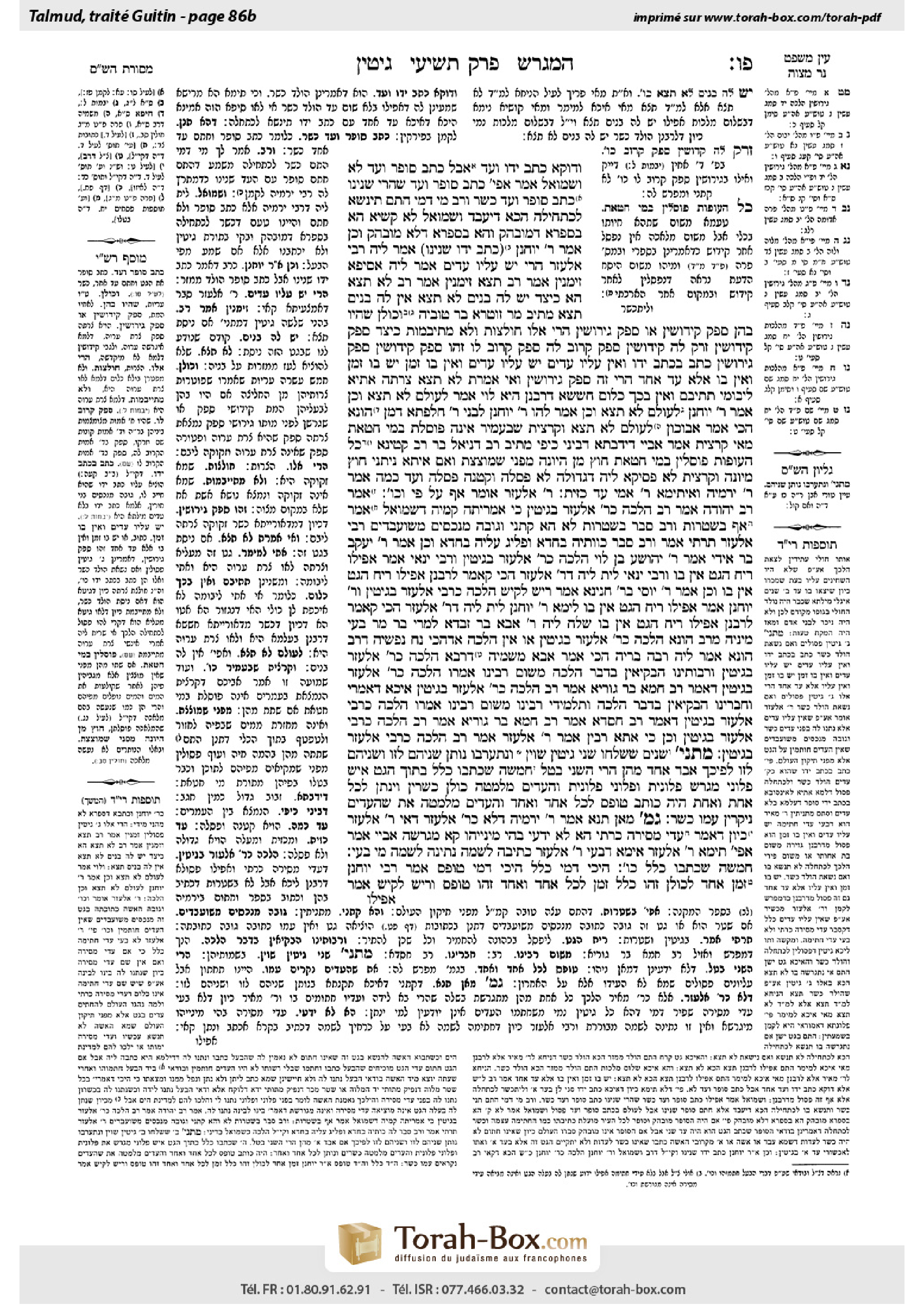
Gittin 86b: Talmud study for Daf Yomi
Study the Talmud for Daf Yomi with scanned pages, Hebrew text, English translations from Sefaria and AI-generated French translations.
Passage selection and English or AI-generated French translation are available where the scan has annotations. Daf Study is independent of Torah-Box and Sefaria.
Browse Gittin · גיטין · All tractatesGittin 86b text and translations
This page of Gittin includes the Aramaic text, an English translation and an AI-generated French translation, alongside the scan above.
גיטין פ״ו ב · Aramaic and Hebrew text
וְדַוְקָא כְּתַב יָדוֹ וְעֵד; אֲבָל כְּתַב סוֹפֵר וְעֵד – לֹא.
וּשְׁמוּאֵל אָמַר: אֲפִילּוּ כְּתַב סוֹפֵר וְעֵד, שֶׁהֲרֵי שָׁנִינוּ: כָּתַב סוֹפֵר וְעֵד – כָּשֵׁר.
וְרַב – מִי דָּמֵי?! הָתָם תִּינָּשֵׂא לְכַתְּחִילָּה, הָכָא דִּיעֲבַד.
וּשְׁמוּאֵל – לָא קַשְׁיָא; הָא בְּסָפְרָא דְּמוּבְהַק, וְהָא בְּסָפְרָא דְּלָא מוּבְהַק.
וְכֵן אָמַר רַבִּי יוֹחָנָן: ״כְּתַב יָדוֹ״ שָׁנִינוּ. אָמַר לֵיהּ רַבִּי אֶלְעָזָר: הֲרֵי יֵשׁ עָלָיו עֵדִים! אֲמַר לֵיהּ: אַסֵּיפָא.
זִימְנִין אָמַר רַב: תֵּצֵא, זִימְנִין אָמַר רַב: לֹא תֵּצֵא.
הָא כֵּיצַד? יֵשׁ לָהּ בָּנִים – לֹא תֵּצֵא, אֵין לָהּ בָּנִים – תֵּצֵא.
מֵתִיב מָר זוּטְרָא בַּר טוֹבִיָּה: וְכוּלָּן, שֶׁהָיוּ בָּהֶן סְפֵק קִידּוּשִׁין אוֹ סְפֵק גֵּירוּשִׁין – הֲרֵי אֵלּוּ חוֹלְצוֹת וְלֹא מִתְיַבְּמוֹת.
כֵּיצַד סְפֵק קִידּוּשִׁין? זָרַק לָהּ קִידּוּשִׁין – סָפֵק קָרוֹב לָהּ, סָפֵק קָרוֹב לוֹ, זֶהוּ סְפֵק קִידּוּשִׁין.
סְפֵק גֵּירוּשִׁין – כָּתַב בִּכְתַב יָדוֹ וְאֵין עָלָיו עֵדִים, יֵשׁ עָלָיו עֵדִים וְאֵין בּוֹ זְמַן, יֵשׁ בּוֹ זְמַן וְאֵין בּוֹ אֶלָּא עֵד אֶחָד – הֲרֵי זֶה סְפֵק גֵּירוּשִׁין.
וְאִי אָמְרַתְּ לֹא תֵּצֵא, צָרָתָהּ אָתְיָא לְיַבּוֹמֵי!
תִּתְיַבֵּם, וְאֵין בְּכָךְ כְּלוּם; חֲשָׁשָׁא דְרַבָּנַן הִיא.
לֵוִי אָמַר: לְעוֹלָם לֹא תֵּצֵא. וְכֵן אָמַר רַבִּי יוֹחָנָן: לְעוֹלָם לֹא תֵּצֵא.
וְכֵן אֲמַר לְהוּ רַבִּי יוֹחָנָן לִבְנֵי רַבִּי חֲלַפְתָּא דְּמִן הוּנָא, הָכִי אָמַר אֲבוּכוֹן: לְעוֹלָם לֹא תֵּצֵא; וְקַרְצִית שֶׁבֶּעָמִיר אֵינָהּ פּוֹסֶלֶת בְּמֵי חַטָּאת.
מַאי קַרְצִית? אָמַר אַבָּיֵי: דִּידְבְּתָא דְּבֵינֵי כֵיפֵי.
מֵתִיב רַב דָּנִיאֵל בַּר רַב קַטִּינָא: כׇּל הָעוֹפוֹת פּוֹסְלִין בְּמֵי חַטָּאת, חוּץ מִן הַיּוֹנָה – מִפְּנֵי שֶׁמּוֹצֶצֶת. וְאִם אִיתָא, נִיתְנֵי: חוּץ מִיּוֹנָה וְקַרְצִית!
לָא פְּסִיקָא לֵיהּ, דִּגְדוֹלָה לָא פָּסְלָה, וּקְטַנָּה פָּסְלָה. וְעַד כַּמָּה? אָמַר רַבִּי יִרְמְיָה, וְאִיתֵּימָא רַבִּי אַמֵּי: עַד כְּזַיִת.
רַבִּי אֶלְעָזָר אוֹמֵר: אַף עַל פִּי וְכוּ׳. אָמַר רַב יְהוּדָה אָמַר רַב: הֲלָכָה כְּרַבִּי אֶלְעָזָר בְּגִיטִּין. כִּי אַמְרִיתַהּ קַמֵּיהּ דִּשְׁמוּאֵל, אָמַר: אַף בִּשְׁטָרוֹת.
וְרַב סָבַר – בִּשְׁטָרוֹת לָא?! הָא קָתָנֵי: וְגוֹבָה מִנְּכָסִים מְשׁוּעְבָּדִים!
רַבִּי אֶלְעָזָר תַּרְתֵּי אָמַר; וְרַב סָבַר כְּווֹתֵיהּ בַּחֲדָא, וּפְלִיג עֲלֵיהּ בַּחֲדָא.
וְכֵן אָמַר רַבִּי יַעֲקֹב בַּר אִידֵּי אָמַר רַבִּי יְהוֹשֻׁעַ בֶּן לֵוִי: הֲלָכָה כְּרַבִּי אֶלְעָזָר בְּגִיטִּין. וְרַבִּי יַנַּאי אָמַר: אֲפִילּוּ רֵיחַ הַגֵּט אֵין בּוֹ.
וְרַבִּי יַנַּאי לֵית לֵיהּ דְּרַבִּי אֶלְעָזָר?! הָכִי קָאָמַר: לְרַבָּנַן – אֲפִילּוּ רֵיחַ הַגֵּט אֵין בּוֹ.
וְכֵן אָמַר רַבִּי יוֹסֵי בְּרַבִּי חֲנִינָא אָמַר רֵישׁ לָקִישׁ: הֲלָכָה כְּרַבִּי אֶלְעָזָר בְּגִיטִּין, וְרַבִּי יוֹחָנָן אָמַר: אֲפִילּוּ רֵיחַ הַגֵּט אֵין בּוֹ.
לֵימָא רַבִּי יוֹחָנָן לֵית לֵיהּ דְּרַבִּי אֶלְעָזָר?! הָכִי קָאָמַר: לְרַבָּנַן – אֲפִילּוּ רֵיחַ הַגֵּט אֵין בּוֹ.
שְׁלַח לֵיהּ רַבִּי אַבָּא בַּר זַבְדָּא לְמָרִי בַּר מָר, בְּעִי מִינֵּיהּ מֵרַב הוּנָא: הֲלָכָה כְּרַבִּי אֶלְעָזָר בְּגִיטִּין, אוֹ אֵין הֲלָכָה?
אַדְּהָכִי נָח נַפְשֵׁיהּ דְּרַב הוּנָא. אֲמַר לֵיהּ רַבָּה בְּרֵיהּ, הָכִי אָמַר אַבָּא מִשְּׁמֵיהּ דְּרָבָא: הֲלָכָה כְּרַבִּי אֶלְעָזָר בְּגִיטִּין. וְרַבּוֹתֵינוּ הַבְּקִיאִין בִּדְבַר הֲלָכָה, מִשּׁוּם רַבֵּינוּ אָמְרוּ: הֲלָכָה כְּרַבִּי אֶלְעָזָר בְּגִיטִּין – דְּאָמַר רַב חָמָא בַּר גּוּרְיָא אָמַר רַב: הֲלָכָה כְּרַבִּי אֶלְעָזָר בְּגִיטִּין.
אִיכָּא דְּאָמְרִי: וַחֲבֵרֵינוּ הַבְּקִיאִין בִּדְבַר הֲלָכָה, וְתַלְמִידֵי רַבֵּינוּ, מִשּׁוּם רַבֵּינוּ אָמְרוּ: הֲלָכָה כְּרַבִּי אֶלְעָזָר בְּגִיטִּין – דְּאָמַר רַב חִסְדָּא אָמַר רַב חָמָא בַּר גּוּרְיָא אָמַר רַב: הֲלָכָה כְּרַבִּי אֶלְעָזָר בְּגִיטִּין.
וְכֵן כִּי אֲתָא רָבִין, אָמַר רַבִּי אֶלְעָזָר אָמַר רַב: הֲלָכָה כְּרַבִּי אֶלְעָזָר בְּגִיטִּין.
מַתְנִי׳ שְׁנַיִם שֶׁשָּׁלְחוּ שְׁנֵי גִיטִּין שָׁוִין, וְנִתְעָרְבוּ; נוֹתֵן שְׁנֵיהֶם לָזוֹ, וּשְׁנֵיהֶם לָזוֹ. לְפִיכָךְ, אָבַד אֶחָד מֵהֶן – הֲרֵי הַשֵּׁנִי בָּטֵל.
חֲמִשָּׁה שֶׁכָּתְבוּ כְּלָל בְּתוֹךְ הַגֵּט – ״אִישׁ פְּלוֹנִי מְגָרֵשׁ פְּלוֹנִית, וּפְלוֹנִי פְּלוֹנִית״, וְהָעֵדִים מִלְּמַטָּה; כּוּלָּן כְּשֵׁרִין, וְיִנָּתֵן לְכׇל אַחַת וְאַחַת.
הָיָה כּוֹתֵב טוֹפֶס לְכׇל אֶחָד וְאֶחָד, וְהָעֵדִים מִלְּמַטָּה; אֶת שֶׁהָעֵדִים נִיקְרִין עִמּוֹ – כָּשֵׁר.
גְּמָ׳ מַאן תַּנָּא? אָמַר רַבִּי יִרְמְיָה: דְּלָא כְּרַבִּי אֶלְעָזָר. דְּאִי רַבִּי אֶלְעָזָר, כֵּיוָן דְּאָמַר עֵדֵי מְסִירָה כָּרְתִי – הָא לָא יָדְעִי בְּהֵי מִינַּיְיהוּ קָא מִגָּרְשָׁה.
אַבָּיֵי אָמַר: אֲפִילּוּ תֵּימָא רַבִּי אֶלְעָזָר – אֵימָא דְּבָעֵי רַבִּי אֶלְעָזָר כְּתִיבָה לִשְׁמָהּ, נְתִינָה לִשְׁמָהּ מִי בָּעֵי?!
חֲמִשָּׁה שֶׁכָּתְבוּ כְּלָל כּוּ׳. הֵיכִי דָּמֵי כְּלָל, הֵיכִי דָּמֵי טוֹפֶס?
אָמַר רַבִּי יוֹחָנָן: זְמַן אֶחָד לְכוּלָּן – זֶהוּ כְּלָל. זְמַן לְכׇל אֶחָד וְאֶחָד – זֶהוּ טוֹפֶס.
וְרֵישׁ לָקִישׁ אָמַר:
Gittin 86b · English translation
And Rav is saying that specifically when the bill of divorce is written in his handwriting and has the signature of one witness, the woman’s child from her second husband is of unflawed lineage. But if it is written in a scribe’s handwriting, even if it includes the signature of one witness, the child’s lineage is not unflawed, but rather he is a mamzer, as the bill of divorce is completely invalid.
And Shmuel says: Even where it is written in a scribe’s handwriting and it has the signature of a witness, the lineage of the child is unflawed, as we learned in a mishna (87b): In the case of a bill of divorce in which the scribe’s handwriting is recognizable and there is one witness signed, it is valid.
And Rav would respond: Is that case comparable? There, in that case, the mishna indicates that the woman may marry ab initio. Therefore, it must be a case where the scribe also signed as a second witness. But here, in the case of this mishna, the bill of divorce is invalid and the woman may not remarry; it is only if she remarried and had a child that his lineage is rendered unflawed after the fact. Therefore, it must be referring to a case where the husband wrote it.
And Shmuel, who holds that both cases are referring to a bill of divorce that was written by a scribe but not signed by the scribe as one of the witnesses, would respond that the contradiction is not difficult. That mishna, where the bill of divorce is rendered valid ab initio, is referring to the handwriting of an expert scribe, who can presumably be relied upon to have written the bill of divorce properly and only according to the husband’s instructions, and this mishna is referring to the handwriting of a scribe who is not expert. Since the bill of divorce was not signed by two witnesses, there is concern that the scribe did not write it properly.
And similarly, Rabbi Yoḥanan says in accordance with the opinion of Rav: We learned that the mishna is referring to his handwriting. Rabbi Elazar, assuming that Rabbi Yoḥanan was explaining the middle clause, said to him: Aren’t there signatures of witnesses in the bill of divorce? Why is the husband’s handwriting necessary? Rabbi Yoḥanan said to him: I was referring to the latter clause, in which there is only one witness.
§ With regard to the three invalid bills of divorce mentioned in the mishna, sometimes Rav said that if the woman remarries based on one of these bills of divorce she must leave her second husband, and sometimes Rav said that she need not leave.
How so? How can the contradiction between Rav’s statements be explained? If she already has children from her second husband then she need not leave him, as, if she is required to leave him there will be slander that their children are mamzerim. But if she does not have children from him, she must leave him.
Mar Zutra bar Toviya raises an objection to Rav’s opinion from a mishna (Yevamot 30b). With regard to a woman whose husband died childless [yevama] but who is prohibited from marrying her late husband’s brother [yavam] because he is a forbidden relative to her, not only is she herself exempt from levirate marriage, but she causes any rival wives of hers to be exempt as well, even if they are not forbidden relatives to the brother. The mishna lists fifteen examples of such forbidden relatives (Yevamot 2a). And if any of these fifteen women had undergone a betrothal or divorce whose status is uncertain with the deceased brother, those rival wives must perform the ritual through which the yavam frees the yevama of her levirate bonds [ḥalitza] and may not enter into levirate marriage, since they are possibly the rival wives of a forbidden relative.
How could there be a betrothal whose status is uncertain? If he threw her money or a document as betrothal in the public domain, and the item was possibly closer to her, whereby she could acquire the object and become betrothed, and possibly closer to him, preventing her from acquiring it, this is a case of a betrothal whose status is uncertain.
How can there be a divorce whose status is uncertain? It is in the cases of invalid bills of divorce mentioned in the mishna here: A bill of divorce that the husband wrote in his handwriting but has no signatures of witnesses on the document at all, a case where there are signatures of witnesses on the document but there is no date written on it, and a case where there is a date written on it but it contains only one witness. In each of the three cases, this is considered a divorce whose status is uncertain.
And if you say that despite this woman’s problematic divorce she need not leave her second husband, her rival wife from her first marriage might come to enter into levirate marriage after the first husband’s death, assuming that she was already divorced. This would violate the ruling of the mishna in tractate Yevamot that she may not do so, as the status of the divorce is uncertain and therefore it is uncertain whether she is the rival wife of a forbidden relative.
The Gemara answers: She may enter into levirate marriage, and there is no problem with that, as the difficulty with the bill of divorce is merely a concern by rabbinic law. By Torah law it is a complete bill of divorce, and the rival wife is fit for levirate marriage.
Contrary to Rav’s opinion that a woman who remarries based on one of these bills of divorce must leave her second husband unless they have children, Levi says that she is never required to leave him, whether or not they have children. And similarly, Rabbi Yoḥanan says that she is never required to leave him.
And similarly, Rabbi Yoḥanan said to the sons of Rabbi Ḥalafta of Huna: Your father said the following two statements that I heard from him: That she is never required to leave him, and that a kartzit in the sheaf does not disqualify water of purification (see Numbers 19:17–19). Even if a kartzit drinks from this water, it may still be sprinkled on a person in order to purify him from ritual impurity imparted by a corpse.
The Gemara asks: What is a kartzit? Abaye said that it is a species of fly [didveta] that is found between the sheaves.
Rav Daniel bar Rav Ketina raises an objection to this ruling from the Mishna (Para 9:3): All birds disqualify water of purification by drinking from it, because some of the water spills from the bird’s beak back into the basin after being disqualified by having been in the bird’s mouth. This is the halakha with regard to all birds except for the pigeon, because it sucks the water, which prevents it from spilling back. And if it is so that a kartzit does not disqualify water of purification, let the mishna teach that all birds disqualify except for the pigeon and the kartzit.
The Gemara answers: The matter is not clear-cut, as, while a large kartzit does not disqualify the water, a small one does disqualify it. This ruling is not mentioned in the mishna, as it is not common to all species of kartzit. The Gemara asks: And how small must a kartzit be to disqualify water of purification? Rabbi Yirmeya said, and some say that it was Rabbi Ami who said: The size is up to an olive-bulk.
§ It is stated in the mishna that Rabbi Elazar says: Even if there are no signatures of witnesses on the document, but rather he handed it to her in the presence of two witnesses, it is a valid bill of divorce. Rav Yehuda said that Rav said that the halakha is in accordance with the opinion of Rabbi Elazar with regard to bills of divorce. But when I said this halakha before Shmuel, he said that the halakha is in accordance with Rabbi Elazar with regard to monetary documents as well.
The Gemara asks: But does Rav hold that with regard to monetary documents the halakha is not in accordance with Rabbi Elazar? Doesn’t Rabbi Elazar teach in the mishna that on the basis of this bill of divorce a woman can collect the amount written in her marriage contract even from liened property? Apparently, Rabbi Elazar’s ruling has monetary ramifications as well.
The Gemara answers: Rabbi Elazar made two statements, i.e., his ruling was both with regard to divorce and with regard to monetary documents. And Rav holds in accordance with his opinion with regard to one issue, i.e., divorce, and disagrees with his opinion with regard to one issue, monetary documents.
And similarly, Rabbi Ya’akov bar Idi says that Rabbi Yehoshua ben Levi says: The halakha is in accordance with the opinion of Rabbi Elazar with regard to bills of divorce. And Rabbi Yannai says: This does not have even the trace of a bill of divorce.
The Gemara asks: But does Rabbi Yannai not hold in accordance with the opinion of Rabbi Elazar at all, as opposed to the other amora’im? The Gemara answers: Rather, this is what Rabbi Yannai is saying: According to the Rabbis, who disagree with Rabbi Elazar, this bill of divorce does not have even the trace of a bill of divorce.
And similarly, Rabbi Yosei, son of Rabbi Ḥanina, says that Reish Lakish says: The halakha is in accordance with the opinion of Rabbi Elazar with regard to bills of divorce. And Rabbi Yoḥanan says: This does not have even the trace of a bill of divorce.
The Gemara asks: Let us say that Rabbi Yoḥanan does not hold in accordance with the opinion of Rabbi Elazar at all. The Gemara answers: Rather, this is what Rabbi Yoḥanan is saying: According to the Rabbis, who disagree with Rabbi Elazar, this does not have even the trace of a bill of divorce.
Rabbi Abba bar Zavda sent the following request to Marei bar Mar: Ask Rav Huna whether the halakha is in accordance with the opinion of Rabbi Elazar with regard to bills of divorce or whether the halakha is not in accordance with his opinion.
Meanwhile, before this request reached him, Rav Huna died. Rabba, son of Rav Huna, said to Marei bar Mar: My father said in the name of Rava like this: The halakha is in accordance with the opinion of Rabbi Elazar with regard to bills of divorce. And our teachers who are well-versed in matters of halakha also said in the name of our teacher that the halakha is in accordance with the opinion of Rabbi Elazar with regard to bills of divorce, as Rav Ḥama bar Gurya, referred to as our teachers, says that our teacher Rav says: The halakha is in accordance with the opinion of Rabbi Elazar with regard to bills of divorce.
There are those who say a different version of this statement: And our colleagues who are well versed in matters of halakha and the disciples of our teacher said in the name of our teacher that the halakha is in accordance with the opinion of Rabbi Elazar with regard to bills of divorce, as Rav Ḥisda, Rabba bar Rav Huna’s colleague, said that Rav Ḥama bar Gurya, his teacher, said that Rav said: The halakha is in accordance with the opinion of Rabbi Elazar with regard to bills of divorce.
And similarly, when Ravin came from Eretz Yisrael he said that Rabbi Elazar, the amora, says that Rav says: The halakha is in accordance with the opinion of Rabbi Elazar with regard to bills of divorce.
MISHNA: With regard to a case of two men who sent their wives two identical bills of divorce with an agent, as both their names and their wives’ names are identical, and the two bills of divorce were mixed up, the agent should hand both bills of divorce to this wife and both of them to that wife, so that each wife definitely receives her bill of divorce, although it is unclear which one is hers. Therefore, if one of the bills of divorce was lost before it was given to both women, the other is void, because it is unknown which bill of divorce was meant for which woman.
With regard to five husbands who wrote a general wording in the bill of divorce, i.e., who wrote one common bill of divorce for their wives with a single formula, writing that so-and-so divorces his wife so-and-so, and so-and-so divorces so-and-so, and the witnesses signed below, in this case all of these bills of divorce that were combined into one bill are valid; and the bill must be handed to each and every wife individually, so they will all be divorced by it.
If the scribe was writing a separate formula in the bill of divorce for each and every couple, and the witnesses signed below, the formula with which the witnesses’ signatures are read is valid. In other words, the formula directly underneath which they signed is valid, and the others are not valid.
GEMARA: Who is the tanna who taught that the two bills of divorce that were mixed up should be handed to both wives? Rabbi Yirmeya said: It is not in accordance with the opinion of Rabbi Elazar, as had it been in accordance with the opinion of Rabbi Elazar, since he says that witnesses of the transmission of the bill of divorce effect the divorce, handing both bills of divorce to both wives would not enable the divorce of each woman to take effect. This is because the witnesses do not know at the time of the transmission with which one of the bills of divorce she is being divorced.
Abaye said: You can even say that it is in accordance with the opinion of Rabbi Elazar. Say that although Rabbi Elazar requires the writing of the bill of divorce to be for her sake, i.e., with the specific woman and man for whom it is designated in mind, does he require giving it to her for her sake? Although the transmission of the bill of divorce is what causes it to take effect, it need not be done with the designated woman in mind. Therefore, the divorce here is valid, as the bill of divorce was definitely given to the wife for whom it was intended.
§ It is stated in the mishna: With regard to five husbands who wrote a general wording in a bill of divorce, all of them can divorce their wives with it. But if a separate formula was written for each, only the last one is valid. The Gemara asks: What are the circumstances of the case of the general wording, and what are the circumstances of the case of the separate formula that was written for each couple?
Rabbi Yoḥanan says: If there is one date and one formula written for all of them, such as: On such-and-such a date so-and-so divorced so-and-so, and so-and-so divorced so-and-so, that is a general wording. If a separate date and formula was written for each and every one of them, that is considered a separate formula.
And Reish Lakish says:
Gittin 86b · Traduction française (IA)
Et Rav dit que spécifiquement lorsque le document de divorce est rédigé de sa propre main et possède la signature d'un témoin, l'enfant de la femme avec son deuxième mari est d'une lignée irréprochable. Mais si le document est rédigé par la main d'un scribe, même s'il inclut la signature d'un témoin, la lignée de l'enfant n'est pas irréprochable, mais il est considéré comme un mamzer, car le document de divorce est entièrement invalide.
Et Shmuel dit : Même lorsque le document est rédigé par la main d'un scribe et possède la signature d'un témoin, la lignée de l'enfant est irréprochable, car nous avons appris dans une mitsna (87b) : Dans le cas d'un document de divorce dont la main du scribe est identifiable et où un témoin a signé, il est valide.
Et Rav répondrait : Ce cas est-il comparable ? Là, dans ce cas, la mitsna indique que la femme peut épouser de droit. Par conséquent, il doit s'agir d'un cas où le scribe a également signé en tant que second témoin. Mais ici, dans le cas de cette mitsna, le document de divorce est invalide et la femme ne peut pas remettre en cause son mariage ; il est seulement si elle a remarié et a eu un enfant que sa lignée est rendue irréprochable après coup. Par conséquent, il doit s'agir d'un cas où le mari a rédigé le document.
Et Shmuel, qui considère que les deux cas se réfèrent à un document de divorce rédigé par un scribe mais non signé par le scribe en tant que témoin, répondrait que le paradoxe n'est pas difficile. Cette mitsva, où le document de divorce est rendu valide dès le début, se réfère à la main d'un scribe expert, qui peut être considéré comme fiable pour avoir rédigé le document de divorce correctement et uniquement selon les instructions du mari, tandis que cette mitsva se réfère à la main d'un scribe non expert. Puisque le document de divorce n'a pas été signé par deux témoins, il y a une crainte que le scribe n'ait pas rédigé le document correctement.
Et de même, Rabbi Yoḥanan dit selon l'opinion de Rav : Nous avons appris que la mitsva se réfère à la main du mari. Rabbi Elazar, supposant que Rabbi Yoḥanan expliquait la clause intermédiaire, lui dit : Ne sont-ils pas présents des signatures de témoins dans le document de divorce ? Pourquoi la main du mari est-elle nécessaire ? Rabbi Yoḥanan lui répondit : Je faisais référence à la dernière clause, où il n'y a qu'un seul témoin.
§ En ce qui concerne les trois documents de divorce invalides mentionnés dans la mitsva, parfois Rav dit que si la femme remarie sur la base d'un de ces documents de divorce, elle doit quitter son deuxième mari, et parfois Rav dit qu'elle n'a pas besoin de le quitter.
Comment cela ? Comment peut-on expliquer le paradoxe entre les déclarations de Rav ? Si elle a déjà des enfants avec son deuxième mari, elle n'a pas besoin de le quitter, car, si elle est obligée de le quitter, cela entraînerait des calomnies selon lesquelles leurs enfants sont des mamzers. Mais si elle n'a pas d'enfants avec lui, elle doit le quitter.
Mar Zutra bar Toviya soulève une objection contre l'opinion de Rav à partir d'une mitsna (Yevamot 30b). En ce qui concerne une femme dont le mari est décédé sans enfants [yevama] mais qui est interdite de se marier avec le frère du défunt [yavam] en raison de son parenté, non seulement elle-même est exemptée du mariage levirat, mais elle cause également l'exemption de toute épouse rivale, même si elles ne sont pas des parentes interdites du frère. La mitsna liste quinze exemples de tels parents interdits (Yevamot 2a). Et si l'une de ces quinze femmes a subi un engagement ou un divorce dont le statut est incertain avec le frère décédé, ces épouses rivales doivent effectuer la cérémonie par laquelle le yavam libère la yevama de ses liens levirats [ḥalitza] et ne peuvent pas entrer en mariage levirat, car elles pourraient être les épouses rivales d'un parent interdit.
Comment peut-il y avoir un engagement dont le statut est incertain ? Si l'on a jeté à elle de l'argent ou un document comme engagement dans le domaine public, et l'objet était possible plus proche d'elle, permettant qu'elle l'acquière et devienne engagée, et possible plus proche de lui, empêchant qu'elle l'acquière, c'est un cas d'engagement dont le statut est incertain.
Comment peut-il y avoir un divorce dont le statut est incertain ? Il s'agit des cas de documents de divorce invalides mentionnés dans la mitsna ici : Un document de divorce que le mari a rédigé de sa propre main mais qui ne comporte aucune signature de témoins, un cas où des signatures de témoins sont présentes mais où il n'y a pas d'écriture de date, et un cas où il y a une date écrite mais qui comporte seulement un témoin. Dans chaque cas des trois, cela est considéré comme un divorce dont le statut est incertain.
Et si vous dites que malgré ce divorce problématique, elle n'a pas besoin de quitter son deuxième mari, sa femme rivale de son premier mariage pourrait venir entrer en mariage levirat après la mort du premier mari, en supposant qu'elle était déjà divorcée. Cela violerait la décision de la mitsna dans le traité Yevamot selon laquelle elle ne doit pas le faire, car le statut du divorce est incertain et donc il est incertain si elle est la femme rivale d'un parent interdit.
La Guemara répond : Elle peut entrer en mariage levirat, et il n'y a pas de problème avec cela, car la difficulté avec le document de divorce est simplement une préoccupation selon la loi rabbinique. Selon la loi divine, c'est un document de divorce complet, et la femme rivale est digne de mariage levirat.
Contrairement à l'opinion de Rav selon laquelle une femme qui remarie sur l'une de ces lettres de divorce doit quitter son deuxième mari à moins qu'ils n'aient d'enfants, Levi affirme qu'elle n'est jamais obligée de le quitter, qu'elle ait ou non des enfants. Et de même, Rabbi Yoḥanan affirme qu'elle n'est jamais obligée de le quitter.
Et de même, le maître Yochanan dit aux fils de Chalafta de Huna : Votre père a dit deux choses que j'ai entendues de lui : que la femme n'est jamais tenue de le quitter, et qu'une kartzit dans le germe ne rend pas l'eau de purification inutilisable (cf. Nombres 19:17–19). Même si une kartzit boit de cette eau, on peut encore la pulvériser sur une personne afin de le purifier de l'impureté rituelle transmise par un cadavre.
Le Guemara demande : Qu'est-ce qu'une kartzit ? Abaye dit qu'il s'agit d'une espèce de moustique [didveta] trouvé entre les gerbes.
Rav Daniel bar Rav Ketina émet une objection contre cette décision en se référant à la Michna (Para 9:3) : Tous les oiseaux rendent l'eau de purification inutilisable en buvant dedans, car une partie de l'eau s'échappe du bec de l'oiseau dans le récipient après avoir été rendue inutilisable par avoir été dans la bouche de l'oiseau. C'est la halakha concernant tous les oiseaux sauf le pigeon, car il aspire l'eau, ce qui empêche l'eau de s'échapper. Et si c'est ainsi que la kartzit ne rend pas l'eau de purification inutilisable, la Michna devrait enseigner que tous les oiseaux la rendent inutilisable sauf le pigeon et la kartzit.
Le Guemara répond : La question n'est pas claire, car, bien qu'une grande kartzit ne rende pas l'eau de purification inutilisable, une petite kartzit la rend inutilisable. Cette décision n'est pas mentionnée dans la Michna, car elle ne s'applique pas à tous les genres de kartzit. Le Guemara demande : Et quelle taille doit avoir une kartzit pour rendre l'eau de purification inutilisable ? Rabbi Yirmeya dit, et certains disent que c'était Rabbi Ami qui a dit : La taille est égale à celle d'une olive.
§ Il est dit dans la Michna que Rabbi Elazar dit : Même s'il n'y a pas de signatures de témoins sur le document, mais qu'il l'a remis à elle en présence de deux témoins, c'est un divorce valide. Rav Yehuda dit que Rav a dit que la halakha suit l'opinion de Rabbi Elazar concernant les documents de divorce. Mais quand j'ai dit cette halakha à Shmuel, il a dit que la halakha suit l'opinion de Rabbi Elazar concernant les documents monétaires également.
Le Guemara demande : Mais ne tient pas Rav pas compte que la halakha ne suit pas l'opinion de Rabbi Elazar concernant les documents monétaires ? N'enseigne-t-il pas Rabbi Elazar dans la Michna que, sur la base de ce document de divorce, une femme peut récupérer la somme écrite dans son contrat de mariage même sur des biens hypothéqués ? Apparemment, la décision de Rabbi Elazar a des répercussions monétaires également.
Le Guemara répond : Rabbi Elazar a fait deux déclarations, c'est-à-dire que sa décision concerne à la fois le divorce et les documents monétaires. Et Rav suit son opinion concernant un seul point, c'est-à-dire le divorce, et s'oppose à son opinion concernant un autre point, les documents monétaires.
Et de même, Rabbi Ya'akov bar Idi dit que Rabbi Yehoshua ben Levi dit : La halakha suit l'opinion de Rabbi Elazar concernant les documents de divorce. Et Rabbi Yannai dit : Cela n'a même pas la trace d'un document de divorce.
Le Guemara demande : Mais ne tient pas Rabbi Yannai compte de l'opinion de Rabbi Elazar du tout, contrairement aux autres amoraïm ? Le Guemara répond : Plutôt, c'est ce que Rabbi Yannai dit : Selon les Rabbins, qui s'opposent à Rabbi Elazar, ce document de divorce n'a même pas la trace d'un document de divorce.
Et de même, Rabbi Yosei, fils de Rabbi Hanina, dit que Reish Lakish dit : La halakha suit l'opinion de Rabbi Elazar concernant les documents de divorce. Et Rabbi Yoḥanan dit : Cela n'a même pas la trace d'un document de divorce.
Le Guemara demande : Disons que Rabbi Yoḥanan ne suit pas l'opinion de Rabbi Elazar du tout. Le Guemara répond : Plutôt, c'est ce que Rabbi Yoḥanan dit : Selon les Rabbins, qui s'opposent à Rabbi Elazar, cela n'a même pas la trace d'un document de divorce.
Rabbi Abba bar Zavda envoya la demande suivante à Marei bar Mar : Demande à Rav Huna si la halakha suit l'opinion de Rabbi Elazar concernant les documents de divorce ou si la halakha ne suit pas son opinion.
En même temps, avant que cette demande n'atteigne lui, Rav Huna est décédé. Rabba, fils de Rav Huna, dit à Marei bar Mar : Mon père a dit en nom de Rava comme suit : La halakha suit l'opinion de Rabbi Elazar concernant les documents de divorce. Et nos maîtres, bien versés dans les questions de halakha, ont également dit en nom de notre maître que la halakha suit l'opinion de Rabbi Elazar concernant les documents de divorce, car Rav Ḥama bar Gurya, désigné comme nos maîtres, dit que notre maître Rav dit : La halakha suit l'opinion de Rabbi Elazar concernant les documents de divorce.
Certains disent une version différente de cette déclaration : Et nos collègues, bien versés dans les questions de halakha et les disciples de notre maître, ont dit en nom de notre maître que la halakha suit l'opinion de Rabbi Elazar concernant les documents de divorce, car Rav Ḥisda, collègue de Rabba bar Rav Huna, a dit que Rav Ḥama bar Gurya, son maître, a dit que Rav a dit : La halakha suit l'opinion de Rabbi Elazar concernant les documents de divorce.
Et de même, quand Ravin est venu d'Israël, il a dit que Rabbi Elazar, l'amora, dit que Rav dit : La halakha suit l'opinion de Rabbi Elazar concernant les documents de divorce.
MICHNA : Concernant un cas de deux hommes qui ont envoyé leurs épouses deux certificats de divorce identiques par un agent, puisque les noms des deux hommes et ceux de leurs épouses sont identiques, et que les deux certificats de divorce se sont mélangés, l'agent doit remettre les deux certificats de divorce à cette épouse et les deux à celle-ci, afin que chaque épouse reçoive certainement son certificat de divorce, même si on ne sait pas lequel est le sien. Ainsi, si l'un des certificats de divorce a été perdu avant qu'il ne soit remis aux deux femmes, l'autre est nul, car on ne sait pas quel certificat de divorce était destiné à quelle femme.
Concernant cinq époux qui ont rédigé une formule générale dans le certificat de divorce, c'est-à-dire qui ont rédigé un seul certificat de divorce commun pour leurs épouses avec une seule formule, indiquant que tel homme divorce sa femme telle, et tel autre divorce telle, et les témoins ont signé en dessous, dans ce cas, tous les certificats de divorce combinés en un seul sont valides ; et le certificat doit être remis à chaque épouse individuellement, afin qu'elles soient toutes divorcées par lui.
Si le scribe rédigeait une formule séparée dans le certificat de divorce pour chaque couple, et que les témoins avaient signé en dessous, la formule avec laquelle les signatures des témoins sont lues est valide. En d'autres termes, la formule directement en dessous de laquelle ils ont signé est valide, et les autres ne sont pas valides.
GUEMARA : Qui est le tanna qui a enseigné que les deux certificats de divorce mélangés devaient être remis aux deux épouses ? Rabbi Yirmeya a dit : Ce n'est pas selon l'opinion de Rabbi Elazar, car si c'était selon l'opinion de Rabbi Elazar, puisque celui-ci dit que les témoins de la transmission du certificat de divorce accomplissent le divorce, remettre les deux certificats de divorce aux deux épouses ne permettrait pas que le divorce de chaque femme prenne effet. Cela est dû au fait que les témoins ne savent pas à l'époque de la transmission avec quel certificat de divorce elle est divorcée.
Abaye a dit : On peut même dire que c'est selon l'opinion de Rabbi Elazar. Disons que bien que Rabbi Elazar exige que le certificat de divorce soit rédigé à son intention, c'est-à-dire avec la femme et l'homme spécifiques pour lesquels il est destiné, exige-t-il de le lui remettre à son intention ? Bien que la transmission du certificat de divorce soit ce qui cause l'effet, il n'est pas nécessaire de le faire à l'intention de la femme désignée. Ainsi, le divorce est valide, car le certificat de divorce a été certainement remis à l'épouse pour laquelle il était destiné.
§ Il est dit dans la mishna : Concernant cinq époux qui ont rédigé une formule générale dans le certificat de divorce, tous peuvent divorcer leurs épouses avec lui. Mais si une formule séparée avait été rédigée pour chaque couple, seul le dernier est valide. La Guemara pose la question : Quelles sont les circonstances du cas de la formule générale, et quels sont les circonstances du cas de la formule séparée rédigée pour chaque couple ?
Rabbi Yoḥanan dit : Si une date et une formule sont écrites pour tous, par exemple : Le tel jour, tel homme divorce sa femme telle, et tel autre divorce telle, c'est une formule générale. Si une date et une formule distinctes sont écrites pour chaque couple, cela est considéré comme une formule séparée.
Et Reish Lakish dit :
Traduction française générée par IA à partir de l’édition anglaise de Sefaria. Vérifie toujours un passage avec le texte source.
Text from Sefaria: William Davidson Edition - Vocalized Aramaic (CC BY NC); William Davidson Edition - English (CC BY NC).