Gittin 87a: Talmud study for Daf Yomi
Study the Talmud for Daf Yomi with scanned pages, Hebrew text, English translations from Sefaria and AI-generated French translations.
Passage selection and English or AI-generated French translation are available where the scan has annotations. Daf Study is independent of Torah-Box and Sefaria.
Browse Gittin · גיטין · All tractatesGittin 87a text and translations
This page of Gittin includes the Aramaic text, an English translation and an AI-generated French translation, alongside the scan above.
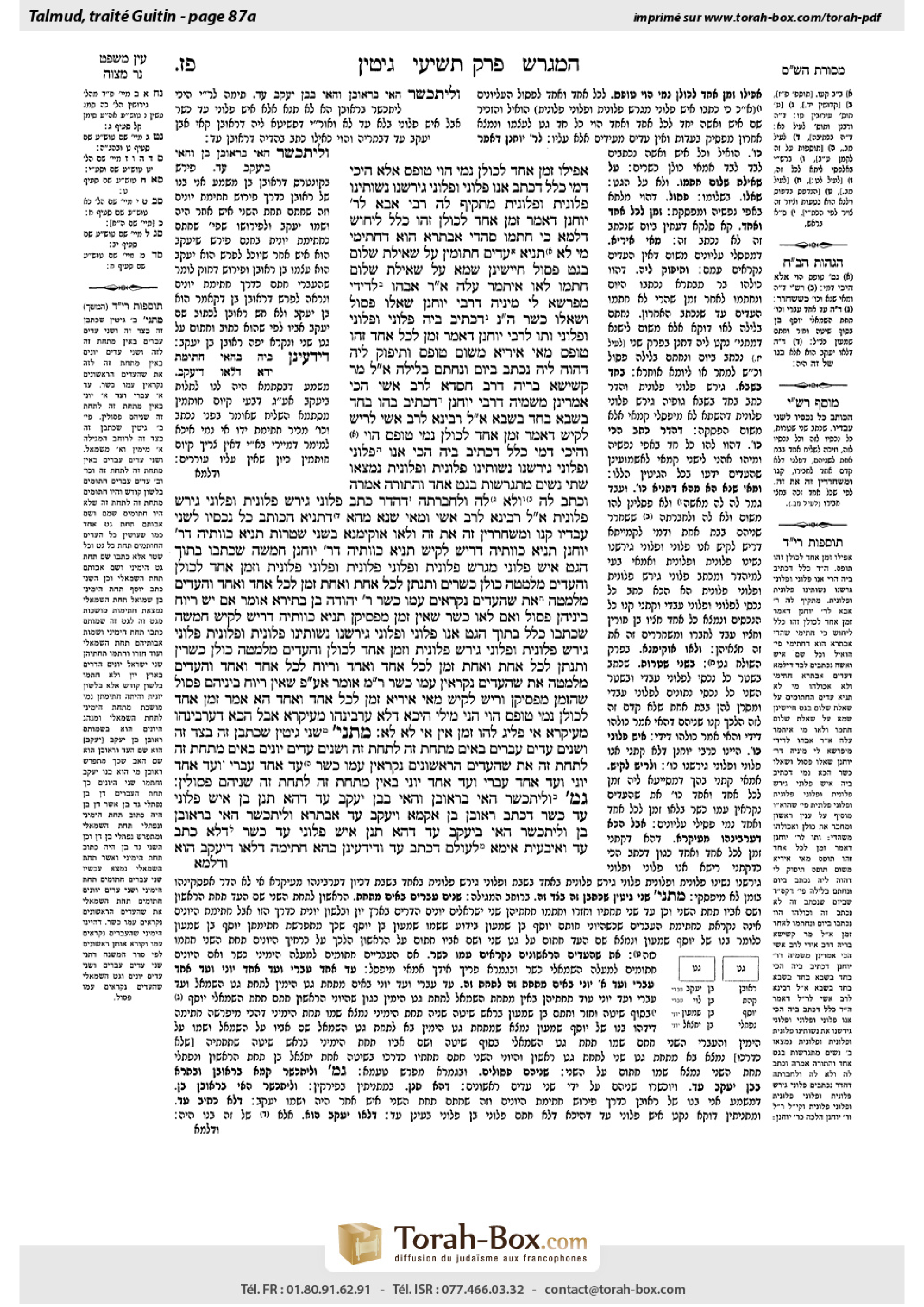
גיטין פ״ז א · Aramaic and Hebrew text
אֲפִילּוּ זְמַן אֶחָד לְכוּלָּן נָמֵי הָוֵי טוֹפֶס, אֶלָּא הֵיכִי דָּמֵי כְּלָל? דְּכָתֵב ״אָנוּ פְּלוֹנִי וּפְלוֹנִי גֵּירַשְׁנוּ נְשׁוֹתֵינוּ פְּלוֹנִית וּפְלוֹנִית״.
מַתְקֵיף לַהּ רַבִּי אַבָּא: לְרַבִּי יוֹחָנָן דְּאָמַר זְמַן אֶחָד לְכוּלָּן – זֶהוּ כְּלָל, לֵיחוּשׁ דִּלְמָא כִּי (חָתְמוּ) [חֲתִימִי] סָהֲדִי, אַבָּתְרָא הוּא דַּחֲתִימִי! מִי לָא תַּנְיָא: עֵדִים חֲתוּמִין עַל שְׁאֵילַת שָׁלוֹם בְּגֵט – פָּסוּל, חָיְישִׁינַן שֶׁמָּא עַל שְׁאֵילַת שָׁלוֹם חָתְמוּ?!
לָאו אִיתְּמַר עֲלַהּ: אָמַר רַבִּי אֲבָהוּ, לְדִידִי מִפָּרְשָׁא לִי מִינֵּיהּ דְּרַבִּי יוֹחָנָן: ״שַׁאֲלוּ״ – פָּסוּל, ״וְשַׁאֲלוּ״ – כָּשֵׁר; הָכָא נָמֵי – דִּכְתִיב בֵּיהּ: ״פְּלוֹנִי וּפְלוֹנִי וּפְלוֹנִי״.
וְתוּ, לְרַבִּי יוֹחָנָן דְּאָמַר זְמַן לְכׇל אֶחָד – זֶהוּ טוֹפֶס; מַאי אִירְיָא מִשּׁוּם טוֹפֶס? וְתִיפּוֹק לֵיהּ דְּהָוֵה לֵיהּ נִכְתַּב בַּיּוֹם וְנֶחְתַּם בַּלַּיְלָה!
אֲמַר לֵיהּ מָר קַשִּׁישָׁא בְּרֵיהּ דְּרַב חִסְדָּא לְרַב אָשֵׁי, הָכִי אָמְרִינַן מִשְּׁמֵיהּ דְּרַבִּי יוֹחָנָן: דִּכְתִיב בְּהוּ ״בְּחַד בְּשַׁבָּא, בְּחַד בְּשַׁבָּא״.
אֲמַר לֵיהּ רָבִינָא לְרַב אָשֵׁי, לְרֵישׁ לָקִישׁ דְּאָמַר: זְמַן אֶחָד לְכוּלָּן נָמֵי טוֹפֶס הָוֵי; וְהֵיכִי דָּמֵי כְּלָל – דִּכְתִיב בֵּיהּ הָכִי: ״אָנוּ פְּלוֹנִי וּפְלוֹנִי גֵּירַשְׁנוּ נְשׁוֹתֵינוּ פְּלוֹנִית וּפְלוֹנִית״; נִמְצְאוּ שְׁתֵּי נָשִׁים מִתְגָּרְשׁוֹת בְּגֵט אֶחָד, וְהַתּוֹרָה אָמְרָה: ״וְכָתַב לָהּ״ – וְלֹא לָהּ וְלַחֲבֶרְתָּהּ!
דַּהֲדַר כְּתַב: ״פְּלוֹנִי גֵּירַשׁ פְּלוֹנִית, וּפְלוֹנִי גֵּירַשׁ פְּלוֹנִית״.
אֲמַר לֵיהּ רָבִינָא לְרַב אָשֵׁי, וּמַאי שְׁנָא מֵהָא דְּתַנְיָא: הַכּוֹתֵב כׇּל נְכָסָיו לִשְׁנֵי עֲבָדָיו – קָנוּ, וּמְשַׁחְרְרִין זֶה אֶת זֶה?
וְלָאו אוֹקֵימְנָא בִּשְׁנֵי שְׁטָרוֹת?!
תַּנְיָא כְּווֹתֵיהּ דְּרַבִּי יוֹחָנָן, תַּנְיָא כְּווֹתֵיהּ דְּרֵישׁ לָקִישׁ.
תַּנְיָא כְּווֹתֵיהּ דְּרַבִּי יוֹחָנָן: חֲמִשָּׁה שֶׁכָּתְבוּ בְּתוֹךְ הַגֵּט: ״אִישׁ פְּלוֹנִי מְגָרֵשׁ פְּלוֹנִית, וּפְלוֹנִי פְּלוֹנִית, וּפְלוֹנִי פְּלוֹנִית״, וּזְמַן אֶחָד לְכוּלָּן, וְהָעֵדִים מִלְּמַטָּה – כּוּלָּן כְּשֵׁרִים, וְתִנָּתֵן לְכׇל אַחַת וְאַחַת.
זְמַן לְכׇל אֶחָד וְאֶחָד וְהָעֵדִים מִלְּמַטָּה – אֶת שֶׁהָעֵדִים נִקְרָאִים עִמּוֹ, כָּשֵׁר. רַבִּי יְהוּדָה בֶּן בְּתֵירָא אוֹמֵר: אִם יֵשׁ רֶיוַח בֵּינֵיהֶן – פָּסוּל, וְאִם לָאו – כָּשֵׁר; שֶׁאֵין זְמַן מַפְסִיקָן.
תַּנְיָא כְּווֹתֵיהּ דְּרֵישׁ לָקִישׁ: חֲמִשָּׁה שֶׁכָּתְבוּ כְּלָל בְּתוֹךְ הַגֵּט – ״אָנוּ פְּלוֹנִי וּפְלוֹנִי גֵּירַשְׁנוּ נְשׁוֹתֵינוּ פְּלוֹנִית וּפְלוֹנִית, פְּלוֹנִי גֵּירַשׁ פְּלוֹנִית וּפְלוֹנִי גֵּירַשׁ פְּלוֹנִית״; וּזְמַן אֶחָד לְכוּלָּן, וְהָעֵדִים מִלְּמַטָּה – כּוּלָּן כְּשֵׁרִין, וְתִנָּתֵן לְכׇל אַחַת וְאַחַת.
זְמַן לְכׇל אֶחָד וְאֶחָד, וְרֶיוַח לְכׇל אֶחָד וְאֶחָד, וְהָעֵדִים מִלְּמַטָּה – אֶת שֶׁהָעֵדִים נִקְרָאִין עִמּוֹ, כָּשֵׁר. רַבִּי מֵאִיר אוֹמֵר: אַף עַל פִּי שֶׁאֵין רֶיוַח בֵּינֵיהֶם – פָּסוּל, שֶׁהַזְּמַן מַפְסִיקָן.
וְרֵישׁ לָקִישׁ – מַאי אִירְיָא זְמַן לְכׇל אֶחָד וְאֶחָד? הָא אָמַר: זְמַן אֶחָד לְכוּלָּן נָמֵי טוֹפֶס הָוֵי!
הָנֵי מִילֵּי הֵיכָא דְּלָא עָרְבִינְהוּ מֵעִיקָּרָא; אֲבָל הָכָא, דְּעָרְבִינְהוּ מֵעִיקָּרָא, אִי פָּלֵיג לְהוּ זְמַן – אִין, אִי לָא – לָא.
מַתְנִי׳ שְׁנֵי גִיטִּין שֶׁכְּתָבָן זֶה בְּצַד זֶה, וּשְׁנַיִם עֵדִים עִבְרִים בָּאִים מִתַּחַת זֶה לְתַחַת זֶה, וּשְׁנַיִם עֵדִים יְוָנִים בָּאִים מִתַּחַת זֶה לְתַחַת זֶה – אֶת שֶׁהָעֵדִים הָרִאשׁוֹנִים נִקְרָאִין עִמּוֹ, כָּשֵׁר.
עֵד אֶחָד עִבְרִי וְעֵד אֶחָד יְוָנִי, וְעֵד אֶחָד עִבְרִי וְעֵד אֶחָד יְוָנִי, בָּאִין מִתַּחַת זֶה לְתַחַת זֶה – שְׁנֵיהֶם פְּסוּלִין.
גְּמָ׳ וְלִיתַּכְשַׁר הַאי בִּ״רְאוּבֵן״, וְהַאי בְּ״בֶן יַעֲקֹב עֵד״, דְּהָא תְּנַן: ״בֶּן אִישׁ פְּלוֹנִי עֵד״ – כָּשֵׁר!
דִּכְתִיב: ״רְאוּבֵן בֶּן״ אַקַּמָּא, וְ״יַעֲקֹב עֵד״ אַבָּתְרָא.
וְלִיתַּכְשַׁר הַאי בִּ״רְאוּבֵן בֶּן״, וְלִיתַּכְשַׁר הַאי בְּ״יַעֲקֹב עֵד״, דְּהָא תְּנַן: ״אִישׁ פְּלוֹנִי עֵד״ – כָּשֵׁר!
דְּלָא כְּתִיב ״עֵד״. וְאִיבָּעֵית אֵימָא: לְעוֹלָם דִּכְתִיב ״עֵד״, וּדְיָדְעִינַן בְּהָא חֲתִימָה דְּלָאו דְּיַעֲקֹב הוּא.
Gittin 87a · English translation
Even if one date was written for all of them it is still considered a separate formula if the divorce of each couple is mentioned separately. Rather, what are the circumstances of the case of a general wording? It is a case where one wrote: We, so-and-so and so-and-so, have hereby divorced our wives so-and-so and so-and-so.
Rabbi Abba objects to this: According to Rabbi Yoḥanan, who says that when there is one date written for all of them that is a general wording, we should be concerned that perhaps when the witnesses signed the bill of divorce they intended to sign for only the last couple. Isn’t it taught in a baraita (Tosefta 9:9) that if witnesses are signed on a greeting that was written in a bill of divorce, i.e., after the formulation of the bill of divorce the scribe extended greetings to someone and the witnesses signed underneath, it is invalid, as we are concerned that perhaps they signed the greeting and not the bill of divorce?
The Gemara answers: Wasn’t it stated with regard to this baraita that Rabbi Abbahu says: It was explained to me by Rabbi Yoḥanan that if the wording of the greeting is: Ask about the well-being of so-and-so, it is invalid, as perhaps the witnesses intended to witness only the greeting. But if the wording is: And ask about the well-being of so-and-so, with the conjunctive prefix vav, thereby making it appear as a continuation of the previous matter, it is valid, as the witnesses presumably signed the bill of divorce as well. Here too, it should be explained that this is a bill of divorce in which it is written: So-and-so has divorced his wife so-and-so, and so-and-so has divorced so-and-so, and so-and-so has divorced so-and-so, as the conjunctive prefix indicates continuation.
The Gemara raises another challenge: And furthermore, according to Rabbi Yoḥanan, who says that when there is a separate date written for each couple, that is considered a separate formula, why is it rendered invalid specifically due to it being considered a separate formula? Derive that it is invalid because it is like a bill of divorce that was written during the day and signed at night, which is invalid because it was signed on a different calendar date than it was written. Here too, since a different date was written for each couple, and the witnesses signed only after the last formula, they clearly signed only on that date, and with regard to the previous couples it is therefore an invalid bill of divorce.
Mar Kashisha, son of Rav Ḥisda, said to Rav Ashi: We say the following explanation of the case in the name of Rabbi Yoḥanan: It is a case where it is written in the respective formulations: On Sunday, on Sunday. In other words, the date written in each bill of divorce is the same, as they were all written on the same date.
Ravina said to Rav Ashi: According to Reish Lakish, who says that if the divorce of each couple is mentioned separately, then even if one date was written for all of them it is still considered a separate formula, and he explains that what are the circumstances of the case of a general wording; a case where the following wording is written in the bill of divorce: We, so-and-so and so-and-so, have hereby divorced our wives so-and-so and so-and-so. Accordingly, two women are found being divorced with one bill of divorce. All of these women are divorced with the same bill of divorce that contains a list of several couples. And the Torah said: “And he writes her” (Deuteronomy 24:1), and it is derived from this phrase that he cannot write it both for her and for another woman. Rather, each woman requires a separate bill of divorce.
The Gemara answers: It is valid because he then wrote after the general formulation: So-and-so has divorced so-and-so, and so-and-so has divorced so-and-so.
Ravina said to Rav Ashi: And in what way is this case different from that which is taught in a baraita: With regard to one who writes a document granting all of his property to his two slaves, they both acquire the property and must emancipate each other? Since the slaves are included in the property, by acquiring the property together they each have ownership over half of the other slave. Consequently, they must emancipate each other. Since the halakhot of emancipation of slaves are compared to the halakhot of divorce, it can be proven from here that one bill of divorce can be written for two wives.
The Gemara answers: But didn’t we establish that that baraita is referring to a case where the master wrote two documents, one for each slave, stating that he is giving him all of his property, and he gave them to them simultaneously? Certainly each slave needs his own bill of emancipation.
It is taught in a baraita in accordance with the opinion of Rabbi Yoḥanan, and similarly it is taught in a baraita in accordance with the opinion of Reish Lakish.
It is taught in a baraita in accordance with the opinion of Rabbi Yoḥanan as follows: With regard to five men who wrote in the bill of divorce: So-and-so hereby divorces so-and-so, and so-and-so divorces so-and-so, and so-and-so divorces so-and-so, and wrote one date for all of them, and the witnesses signed below, in this case all of them are valid; and this document must be handed to each and every one of the women mentioned in it.
Nevertheless, if a separate date is written for each and every one and the witnesses signed below, the bill of divorce with which the witnesses’ signatures are read is valid. Rabbi Yehuda ben Beteira says: If there is space between them it is invalid, as the witnesses’ signatures appear to be referring only to the last couple. But if there is not a space it is valid, as the date written for each couple does not separate between them. Rather, they are still considered the same bill of divorce with regard to the witnesses’ signatures.
It is taught in a baraita in accordance with the opinion of Reish Lakish: With regard to five men who wrote a general wording in the bill of divorce: We, so-and-so and so-and-so, have hereby divorced our wives so-and-so and so-and-so; so-and-so has divorced so-and-so, and so-and-so has divorced so-and-so, and they wrote one date for all of them, and the witnesses signed below, in this case all of them are valid; and it must be handed to each and every woman.
If a separate date was written for each and every one, and there is a space for each and every one, and the witnesses signed below, only the one with which the witnesses’ signatures are read is valid; the others are not. Rabbi Meir says: Even if there is no space between them, the upper ones are invalid, as the date separates them.
The Gemara asks: And according to Reish Lakish, why is the baraita referring specifically to a case in which a separate date was written for each and every one? Didn’t he say that if one date was written for all of them it is still considered a separate formula?
The Gemara answers: This matter applies where he did not merge them at the outset but instead wrote the divorce of each couple separately. But here, he merged them at the outset, writing: So-and-so and so-and-so have hereby divorced their wives so-and-so and so-and-so. Therefore, if the date separates them they are considered to be separate bills of divorce, and if not, then they are not considered separate bills of divorce.
MISHNA: With regard to two bills of divorce that a scribe wrote on the same paper one next to the other, and the signatures of two Hebrew witnesses, i.e., witnesses who signed in Hebrew from right to left, extend from underneath this bill of divorce on the right to underneath that bill of divorce on the left, and the signatures of two Greek witnesses, i.e., who signed in Greek from left to right, extend from underneath that bill of divorce on the left to underneath this bill of divorce on the right, the bill of divorce with which the names of the first two witnesses are read [nikra’in] is valid. The other bill of divorce is invalid, as it is not considered signed by these witnesses.
If one witness signed in Hebrew from right to left, and one witness signed beneath him in Greek from left to right, and underneath that signature one witness signed in Hebrew, and beneath him one witness signed in Greek, with the signatures extending from underneath this bill of divorce to underneath that bill of divorce, both bills of divorce are invalid.
GEMARA: It is stated in the first case of the mishna that the bill of divorce under which the names of the first two witnesses appear is valid and the other is not, even though the signatures extend to that bill of divorce as well. The Gemara says: But let this bill of divorce be validated by the name Reuven alone, and let that bill of divorce be validated by the continuation: Son of Ya’akov, witness, which can be considered a separate signature. Didn’t we learn in a subsequent mishna (87b) that a signature that reads: Son of so-and-so, witness, is valid?
The Gemara answers: It is a case where the words: Reuven, son of, are written on the side of the first bill of divorce, and the words: Ya’akov, witness, are written on the side of the latter bill of divorce, indicating that it is one signature.
The Gemara says: But let this bill of divorce, on the first, left-hand, side, be validated by the words: Reuven, son of, and let that bill of divorce on the other, right-hand, side be validated by the words: Ya’akov, witness. Didn’t we learn in the same mishna that a signature that reads: So-and-so, witness, without the father’s name, is valid?
The Gemara answers: It is a case where the word witness is not written. The latter side includes only a name, which is not sufficient. And if you wish, say: Actually, it is a case where the expression: Ya’akov, witness, is written underneath the second bill of divorce; but it is a case where we know that this signature is not Ya’akov’s. Evidently it is part of the signature of Reuven, son of Ya’akov, and cannot serve as a separate signature for the second bill of divorce.
Gittin 87a · Traduction française (IA)
Même si une seule date a été écrite pour tous d'entre eux, elle est considérée comme une formule distincte si la séparation de chaque couple est mentionnée séparément. En réalité, quels sont les circonstances d'un cas de formule générale ? C'est un cas où l'on écrit : Nous, tel et tel, avons ici divorcé nos épouses tel et tel.
Rabbi Abba s'oppose à cela : Selon Rabbi Yoḥanan, qui dit que lorsqu'une seule date est écrite pour tous d'entre eux, c'est une formule générale, nous devons craindre que les témoins, lorsqu'ils ont signé le document de divorce, aient pu vouloir signer uniquement pour le dernier couple. N'est-il pas enseigné dans une baraïta (Tosefta 9:9) que si les témoins signent un salut écrit dans un document de divorce, c'est-à-dire après la formulation du document de divorce, le scribe salue quelqu'un et les témoins signent en dessous, cela est invalide, car nous craignons qu'ils aient signé le salut et non le document de divorce ?
La Guemara répond : N'était-ce pas dit à propos de cette baraïta que Rabbi Abbahu dit : Il m'a été expliqué par Rabbi Yoḥanan que si la formulation du salut est : Demandez la bienveillance de tel et tel, cela est invalide, car peut-être les témoins voulaient seulement témoigner du salut. Mais si la formulation est : Et demandez la bienveillance de tel et tel, avec le conjonctif vav, ce qui fait apparaître que c'est la continuation de l'affaire précédente, cela est valide, car les témoins ont probablement signé le document de divorce. Ici aussi, il devrait être expliqué que c'est un document de divorce où il est écrit : Tel et tel a divorcé sa femme tel et tel, et tel et tel a divorcé tel et tel, et tel et tel a divorcé tel et tel, le conjonctif vav indiquant la continuation.
La Guemara soulève un autre défi : Et de plus, selon Rabbi Yoḥanan, qui dit que lorsqu'il y a une date distincte pour chaque couple, cela est considéré comme une formule distincte, pourquoi est-il rendu invalide spécifiquement en raison de cette formule distincte ? On en déduit qu'il est invalide car il s'agit d'un document de divorce écrit pendant la journée et signé la nuit, ce qui est invalide car il a été signé sur une date différente de celle de l'écriture. Ici aussi, puisque des dates différentes ont été écrites pour chaque couple, et que les témoins ont signé seulement après la dernière formule, ils ont clairement signé seulement sur cette date, et par conséquent, les couples précédents ont un document de divorce invalide.
Mar Kashisha, fils de Rav Ḥisda, a dit à Rav Ashi : Nous disons l'explication suivante du cas en nom de Rabbi Yoḥanan : C'est un cas où il est écrit dans les formulations respectives : Le dimanche, le dimanche. En d'autres termes, la date écrite dans chaque document de divorce est la même, car ils ont tous été écrits à la même date.
Ravina a dit à Rav Ashi : Selon Reish Lakish, qui dit que si la séparation de chaque couple est mentionnée séparément, même si une seule date a été écrite pour tous d'entre eux, elle est considérée comme une formule distincte, et il explique que quels sont les circonstances d'un cas de formule générale ; un cas où la formulation suivante est écrite dans le document de divorce : Nous, tel et tel, avons ici divorcé nos épouses tel et tel. Ainsi, deux femmes sont trouvées divorcées avec un seul document de divorce. Toutes ces femmes sont divorcées avec le même document de divorce qui contient une liste de plusieurs couples. Et la Torah dit : « Et il écrit à elle » (Deutéronome 24:1), et il est déduit de cette phrase qu'il ne peut pas écrire cela à elle et à une autre femme. En réalité, chaque femme exige un document de divorce distinct.
La Guemara répond : C'est valide car il a ensuite écrit après la formulation générale : tel et tel a divorcé tel et tel, et tel et tel a divorcé tel et tel.
Ravina a dit à Rav Ashi : Et dans quelle mesure ce cas diffère-t-il de celui qui est enseigné dans une baraïta : concernant celui qui écrit un document donnant tout son bien à ses deux esclaves, ils acquièrent tous les deux le bien et doivent s'émanciper mutuellement ? Puisque les esclaves sont inclus dans le bien, en acquérant le bien ensemble, ils possèdent chacun la moitié de l'autre esclave. Par conséquent, ils doivent s'émanciper mutuellement. Puisque les halakhot de l'émancipation des esclaves sont comparées aux halakhot du divorce, cela peut être prouvé d'ici que l'on puisse écrire un seul document de divorce pour deux épouses.
La Guemara répond : Mais n'avons-nous pas établi que cette baraïta fait référence à un cas où le maître a écrit deux documents, l'un pour chaque esclave, indiquant qu'il lui donne tout son bien, et il les a donnés en même temps ? Cela étant, chaque esclave a besoin de son propre document d'émancipation.
Il est enseigné dans une baraïta selon l'opinion de Rabbi Yoḥanan, et de même il est enseigné dans une baraïta selon l'opinion de Reish Lakish.
Il est enseigné dans une baraïta selon l'opinion de Rabbi Yoḥanan comme suit : Concernant cinq hommes qui ont écrit dans le document de divorce : Tel et tel divorce tel et tel, et tel et tel divorce tel et tel, et tel et tel divorce tel et tel, et ont écrit une seule date pour tous d'entre eux, et les témoins ont signé en dessous, dans ce cas, tous d'entre eux sont valides ; et ce document doit être remis à chaque femme mentionnée dedans.
Cependant, si une date distincte est écrite pour chaque couple et que les témoins ont signé en dessous, le document de divorce avec les signatures des témoins est valide. Rabbi Yehuda ben Beteira dit : Si il y a un espace entre eux, cela est invalide, car les signatures des témoins semblent se référer uniquement au dernier couple. Mais si il n'y a pas d'espace, cela est valide, car la date écrite pour chaque couple ne les sépare pas. En réalité, ils sont encore considérés comme le même document de divorce concernant les signatures des témoins.
Il est enseigné dans une baraïta selon l'opinion de Rachi Lakish : Concernant cinq hommes qui ont rédigé une formule générale dans le contrat de divorce : Nous, tel et tel, avons divorcé nos épouses tel et tel ; tel a divorcé tel, et tel a divorcé tel, et ils ont écrit une même date pour tous, et les témoins ont signé en dessous, dans ce cas tous sont valides ; et il faut remettre à chaque femme.
Si une date séparée a été écrite pour chacun d'eux, et s'il y a une place pour chacun d'eux, et que les témoins ont signé en dessous, seul celui dont les signatures des témoins sont lues est valide ; les autres ne le sont pas. Rabbi Meïr dit : Même s'il n'y a pas d'espace entre eux, les premiers sont invalides, car la date les sépare.
La Guemara pose la question : Et selon Rachi Lakish, pourquoi la baraïta fait-elle référence spécifiquement à un cas où une date séparée a été écrite pour chacun d'eux ? N'avait-il pas dit que si une seule date avait été écrite pour tous, cela restait considéré comme une formule distincte ?
La Guemara répond : Cette affaire s'applique à un cas où il n'a pas fusionné les divorces dès le départ, mais où il a rédigé le divorce de chaque couple séparément. Ici, il a fusionné les divorces dès le départ, en écrivant : Tel et tel et tel et tel ont divorcé leurs épouses tel et tel. Par conséquent, si la date les sépare, ils sont considérés comme des contrats de divorce distincts, et si non, ils ne le sont pas.
MICHNA : Concernant deux actes de divorce rédigés par un scribe sur la même feuille l'un à côté de l'autre, et les signatures de deux témoins hébreux, c'est-à-dire des témoins qui signent de droite à gauche, qui s'étendent en dessous de cet acte de divorce à droite jusqu'en dessous de l'autre acte de divorce à gauche, et les signatures de deux témoins grecs, c'est-à-dire qui signent de gauche à droite, qui s'étendent en dessous de l'autre acte de divorce à gauche jusqu'en dessous de cet acte de divorce à droite, l'acte de divorce avec lequel les noms des deux premiers témoins sont lus est valide. L'autre acte de divorce est invalide, car il n'est pas considéré comme signé par ces témoins.
Si un témoin a signé en hébreu de droite à gauche, et un autre témoin a signé en dessous de lui en grec de gauche à droite, et en dessous de cette signature un autre témoin a signé en hébreu, et en dessous de lui un autre témoin a signé en grec, avec les signatures s'étendant de dessous cet acte de divorce à celui-là, les deux actes de divorce sont invalides.
GUEMARA : Il est dit dans le premier cas de la Michna que le contrat de divorce avec lequel les noms des deux premiers témoins sont mentionnés est valide et l'autre n'est pas, même si les signatures s'étendent jusqu'à ce contrat de divorce également. La Guemara dit : Mais faites valider ce contrat de divorce par le nom de Rouben seul, et faites valider l'autre contrat de divorce par la continuation : Fils de Yaakov, témoin, ce qui peut être considéré comme une signature distincte. N'avons-nous pas appris dans une Michna ultérieure (87b) que la signature qui lit : Fils de tel et tel, témoin, est valide ?
La Guemara répond : C'est un cas où les mots : Rouben, fils de, sont écrits sur le côté du premier contrat de divorce, et les mots : Yaakov, témoin, sont écrits sur le côté du second contrat de divorce, indiquant qu'il s'agit d'une seule signature.
La Guemara dit : Mais faites valider ce contrat de divorce, sur le premier côté gauche, par les mots : Rouben, fils de, et faites valider l'autre contrat de divorce sur le côté droit par les mots : Yaakov, témoin. N'avons-nous pas appris dans la même Michna que la signature qui lit : Tel et tel, témoin, sans le nom du père, est valide ?
La Guemara répond : C'est un cas où le mot témoin n'est pas écrit. Le côté second comprend uniquement un nom, ce qui n'est pas suffisant. Et si vous le souhaitez, dites : En réalité, c'est un cas où l'expression : Yaakov, témoin, est écrite en dessous du second contrat de divorce ; mais c'est un cas où nous savons que cette signature n'est pas celle de Yaakov. Évidemment, elle fait partie de la signature de Rouben, fils de Yaakov, et ne peut pas servir de signature distincte pour le second contrat de divorce.
Traduction française générée par IA à partir de l’édition anglaise de Sefaria. Vérifie toujours un passage avec le texte source.
Text from Sefaria: William Davidson Edition - Vocalized Aramaic (CC BY NC); William Davidson Edition - English (CC BY NC).