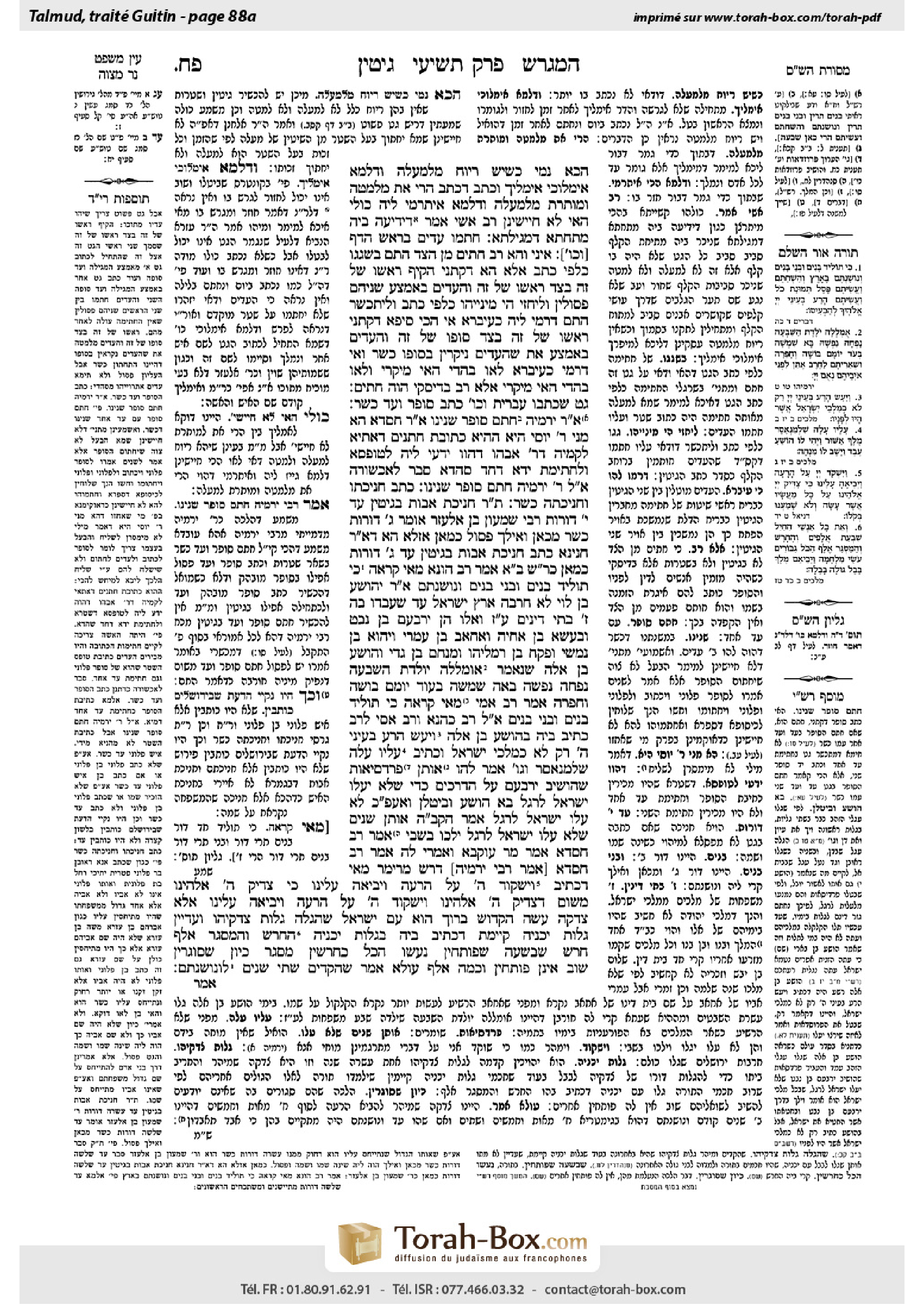
Gittin 88a: Talmud study for Daf Yomi
Study the Talmud for Daf Yomi with scanned pages, Hebrew text, English translations from Sefaria and AI-generated French translations.
Passage selection and English or AI-generated French translation are available where the scan has annotations. Daf Study is independent of Torah-Box and Sefaria.
Browse Gittin · גיטין · All tractatesGittin 88a text and translations
This page of Gittin includes the Aramaic text, an English translation and an AI-generated French translation, alongside the scan above.
גיטין פ״ח א · Aramaic and Hebrew text
הָכָא נָמֵי – כְּשֶׁיֵּשׁ רֶיוַח מִלְּמַעְלָה.
וְדִלְמָא אִימְּלוֹכֵי אִימְּלִיךְ (וּכְתַב)!
דִּכְתִיב ״הֲרֵי אַתְּ״ מִלְּמַטָּה, וּ״מוּתֶּרֶת״ מִלְּמַעְלָה. וְדִלְמָא אִיתְרְמִי לֵיהּ? כּוּלֵּי הַאי לָא חָיְישִׁינַן.
רַב אָשֵׁי אָמַר: דִּידִיעָה בֵּיהּ מְתַחְתָּא דִמְגִילְּתָא.
חָתְמוּ עֵדִים בְּרֹאשׁ הַדַּף וְכוּ׳. אִינִי?! וְהָא רַב חָתֵים מִן הַצַּד! הָתָם בְּשֶׁגַּגּוֹ כְּלַפֵּי כְתָב.
אֶלָּא הָא דְּקָתָנֵי: הִקִּיף רֹאשׁוֹ שֶׁל זֶה בְּצַד רֹאשׁוֹ שֶׁל זֶה, וְהָעֵדִים בָּאֶמְצַע – שְׁנֵיהֶם פְּסוּלִין; וְלִיחְזֵי הֵי מִינַּיְיהוּ כְּלַפֵּי כְתָב, וְלִיתַּכְשַׁר!
הָתָם, דִּרְמֵי לֵיהּ כְּעִיבְרָא.
אִי הָכִי, סֵיפָא דְּקָתָנֵי: רֹאשׁוֹ שֶׁל זֶה בְּצַד סוֹפוֹ שֶׁל זֶה, וְהָעֵדִים בָּאֶמְצַע – אֶת שֶׁהָעֵדִים נִיקְרִין בְּסוֹפוֹ, כָּשֵׁר. וְאִי דִּרְמֵי כְּעִיבְרָא – לָאו בַּהֲדֵי הַאי מִיקְּרֵי, וְלָאו בַּהֲדֵי הַאי מִיקְּרֵי!
אֶלָּא רַב בְּדִיסְקֵי הֲוָה חָתֵים.
גֵּט שֶׁכְּתָבוֹ עִבְרִית וְכוּ׳ כָּתַב סוֹפֵר וְעֵד כָּשֵׁר. אָמַר רַבִּי יִרְמְיָה: ״חָתַם סוֹפֵר״ שָׁנִינוּ.
אָמַר רַב חִסְדָּא: הָא מַנִּי – רַבִּי יוֹסֵי הִיא.
הָהִיא כְּתוּבַּת חֲתָנִים דַּאֲתַאי לְקַמֵּיהּ דְּרַבִּי אֲבָהוּ, דַּהֲווֹ יָדְעִי לֵיהּ לְטוּפְסָא, וְלַחֲתִימַת יְדָא דְּחַד סָהֲדָא. סְבַר לְאַכְשׁוֹרַהּ, אֲמַר לֵיהּ רַבִּי יִרְמְיָה: ״חָתַם סוֹפֵר״ שָׁנִינוּ.
כָּתַב חֲנִיכָתוֹ וַחֲנִיכָתָהּ – כָּשֵׁר. תָּנוּ רַבָּנַן: חֲנִיכַת אָבוֹת בְּגִיטִּין – עַד עֲשָׂרָה דּוֹרוֹת. רַבִּי שִׁמְעוֹן בֶּן אֶלְעָזָר אוֹמֵר: שְׁלֹשָׁה דּוֹרוֹת – כָּשֵׁר, מִכָּאן וְאֵילָךְ – פָּסוּל.
כְּמַאן אָזְלָא הָא דְּאָמַר רַבִּי חֲנִינָא: כָּתַב חֲנִיכַת אָבוֹת בְּגִיטִּין עַד שְׁלֹשָׁה דּוֹרוֹת? כְּמַאן – כְּרַבִּי שִׁמְעוֹן בֶּן אֶלְעָזָר.
אָמַר רַב הוּנָא: מַאי קְרָאָה? ״כִּי תוֹלִיד בָּנִים וּבְנֵי בָנִים וְנוֹשַׁנְתֶּם״.
אָמַר רַבִּי יְהוֹשֻׁעַ בֶּן לֵוִי: לֹא חָרְבָה אֶרֶץ יִשְׂרָאֵל עַד שֶׁעָבְדוּ בָּהּ שִׁבְעָה בָּתֵּי דִינִים עֲבוֹדָה זָרָה, וְאֵלּוּ הֵן: יָרׇבְעָם בֶּן נְבָט, וּבַעְשָׁא בֶּן אֲחִיָּה, וְאַחְאָב בֶּן עָמְרִי, וְיֵהוּא בֶּן נִמְשִׁי, וּפֶקַח בֶּן רְמַלְיָהוּ, וּמְנַחֵם בֶּן גָּדִי, וְהוֹשֵׁעַ בֶּן אֵלָה. שֶׁנֶּאֱמַר: ״אוּמְלְלָה יוֹלֶדֶת הַשִּׁבְעָה, נָפְחָה נַפְשָׁהּ, בָּאָה שִׁמְשָׁהּ בְּעוֹד יוֹמָם, בּוֹשָׁה וְחָפֵרָה״.
אָמַר רַב אַמֵּי: מַאי קְרָאָה? ״כִּי תוֹלִיד בָּנִים וּבְנֵי בָנִים״.
אֲמַרוּ לֵיהּ רַב כָּהֲנָא וְרַב אַסִּי לְרַב, כְּתִיב בֵּיהּ בְּהוֹשֵׁעַ בֶּן אֵלָה: ״וַיַּעַשׂ הָרַע בְּעֵינֵי ה׳, רַק לֹא כְּמַלְכֵי יִשְׂרָאֵל״, וּכְתִיב: ״עָלָיו עָלָה שַׁלְמַנְאֶסֶר וְגוֹ׳״?
אֲמַר לְהוּ: אוֹתָן פַּרְדְּסִיאוֹת שֶׁהוֹשִׁיב יָרׇבְעָם עַל הַדְּרָכִים כְּדֵי שֶׁלֹּא יַעֲלוּ יִשְׂרָאֵל לָרֶגֶל, בָּא הוֹשֵׁעַ וּבִיטְּלָן, וְאַף עַל פִּי כֵן לֹא עָלוּ יִשְׂרָאֵל לָרֶגֶל. אָמַר הַקָּדוֹשׁ בָּרוּךְ הוּא: אוֹתָן שָׁנִים שֶׁלֹּא עָלוּ יִשְׂרָאֵל לָרֶגֶל – יֵלְכוּ בַּשֶּׁבִי.
אָמַר רַב חִסְדָּא אָמַר מָר עוּקְבָא, וְאָמְרִי לַהּ אָמַר רַב חִסְדָּא אָמַר רַבִּי יִרְמְיָה, דָּרֵשׁ מָרִימָר: מַאי דִּכְתִיב: ״וַיִּשְׁקוֹד ה׳ עַל הָרָעָה וַיְבִיאֶהָ עָלֵינוּ, כִּי צַדִּיק ה׳ אֱלֹהֵינוּ״? מִשּׁוּם דְּ״צַדִּיק ה׳ אֱלֹהֵינוּ״ – ״וַיִּשְׁקוֹד ה׳ עַל הָרָעָה וַיְבִיאֶהָ עָלֵינוּ״?!
אֶלָּא צְדָקָה עָשָׂה הַקָּדוֹשׁ בָּרוּךְ הוּא עִם יִשְׂרָאֵל, שֶׁהִגְלָה גָּלוּת צִדְקִיָּהוּ – וַעֲדַיִין גָּלוּת יְכָנְיָה קַיֶּימֶת; דִּכְתִיב בֵּיהּ בְּגָלוּת יְכָנְיָה: ״הֶחָרָשׁ וְהַמַּסְגֵּר אֶלֶף״;
״חָרָשׁ״ – שֶׁבְּשָׁעָה שֶׁפּוֹתְחִין, נַעֲשׂוּ הַכֹּל כְּחֵרְשִׁין. ״מַסְגֵּר״ – כֵּיוָן שֶׁסּוֹגְרִין, שׁוּב אֵינָן פּוֹתְחִין. וְכַמָּה – אֶלֶף.
עוּלָּא אָמַר: שֶׁהִקְדִּים שְׁתֵּי שָׁנִים לִ״וְנוֹשַׁנְתֶּם״.
Gittin 88a · English translation
so too, it is a case where there is space above the latter one, so it is clearly not a separate bill of divorce that was cut.
The Gemara asks: But although it is clearly one bill of divorce, perhaps the scribe wrote the first part of the bill of divorce and then the husband changed his mind about divorcing his wife, thereby canceling the bill of divorce, and afterward he changed his mind again and the scribe then wrote the rest of the bill of divorce in the second column, after the first part was already canceled.
The Gemara answers: It is a case where he wrote: You are hereby, on the bottom of the first column, and continued: Permitted to marry any man, at the top of the second column. In this case there is obvious continuity between the columns, and he certainly did not change his mind in the meantime. The Gemara asks: But perhaps it happened that he stopped in the middle of the sentence? The Gemara answers: We are not concerned to such a degree; it is highly unlikely that he changed his mind in the middle of a sentence.
Rav Ashi said: The mishna is referring to a case where the stretch of the scroll is clear, so it is obvious that it is a complete piece of parchment and that nothing was cut out of it.
§ It is stated in the mishna: If the witnesses signed at the top of the column or on the side, the bill of divorce is invalid. The Gemara raises an objection: Is that so? Wouldn’t Rav sign on the side? The Gemara answers: There, in the case of Rav, he would sign with the roof, i.e., the top, of his signature facing the text of the document, so it was clear that he was signing the document.
The Gemara asks: But this contradicts that which is taught in the mishna: If the scribe placed the top of this bill of divorce next to the top of that bill of divorce, writing both bills of divorce in the same column in opposite directions, and the witnesses signed in the middle between them, both bills of divorce are invalid. According to the above answer, let us see with regard to which one of them the top of the witnesses’ signatures faces the text, and let it be rendered valid.
The Gemara answers: There, in the mishna, it is a case where the signatures are not parallel to the text. Rather, they are placed like a door bolt, perpendicular to the text, so they are not written in the same direction as either of the bills of divorce.
The Gemara challenges: If so, consider the latter clause of the mishna, which teaches that if the scribe placed the top of this bill of divorce next to the end of that bill of divorce, and the witnesses signed in the middle, the bill of divorce at the end of which the witnesses are read is valid. And if the mishna is referring to a case where the signatures are placed like a bolt, perpendicular to the text, they are neither read with this bill of divorce, nor are they read with that one.
Rather, a different answer must be offered: Rav would sign only letters and rulings on the side, where the location of his signature is inconsequential. By contrast, bills of divorce and monetary documents must be signed beneath the text.
§ It is stated in the mishna: With regard to a bill of divorce that was written in Hebrew and its witnesses signed in Greek, or that was written in Greek and its witnesses signed in Hebrew, or in which one witness signed in Hebrew and one witness signed in Greek, or if a bill of divorce has the writing of a scribe, and the scribe identifies his handwriting, and one witness verifies his signature, it is valid as though two witnesses testified to ratify their signatures. Rabbi Yirmeya says: We learned that the mishna means that the scribe signed the bill of divorce as a witness; his handwriting in the text is not sufficient.
Rav Ḥisda says: In accordance with whose opinion is this? It is in accordance with the opinion of Rabbi Yosei that there is no concern that the scribe signed unlawfully.
The Gemara relates: There was a certain marriage contract that was brought before Rabbi Abbahu, which people recognized and verified its formula, i.e., the scribe’s handwriting, and the signature of one witness. Rabbi Abbahu thought to deem it valid based on the scribe’s handwriting and the witness. Rabbi Yirmeya said to him: We learned that the mishna means that the scribe signed the bill of divorce; his handwriting alone is not sufficient.
§ It is stated in the mishna: With regard to the names of the husband and wife, if the scribe wrote his surname or nickname and her surname or nickname, it is valid. The Sages taught (Tosefta 8:6): A surname from one’s forefathers is valid with regard to bills of divorce until ten generations after the forefather. Rabbi Shimon ben Elazar says: It is valid for only three generations; from this point forward it is invalid.
The Gemara asks: In accordance with whose opinion is that which Rabbi Ḥanina said, that the writing of a surname from one’s forefathers is valid with regard to bills of divorce until three generations after the forefather? It is in accordance with the opinion of Rabbi Shimon ben Elazar.
Rav Huna said: What is the verse from which this opinion is derived? It is the verse: “When you will beget children, and children’s children, and you will have been long [venoshantem] in the land” (Deuteronomy 4:25). Since the word venoshantem stems from the word yashan, meaning old, it is derived that after one’s grandchildren, or three generations, a matter is considered old and forgotten.
§ The Gemara cites another derivation from this verse. Rabbi Yehoshua ben Levi says: The first destruction of Eretz Yisrael did not occur until seven dynasties and their courts committed idol worship in it, and they are these: Jeroboam, son of Nevat; and Baasa, son of Ahijah; and Ahab, son of Omri; and Jehu, son of Nimshi; and Pekah, son of Remaliah; and Menahem, son of Gadi; and Hoshea, son of Elah, as it is stated: “She who has given birth to seven languishes; her spirit droops; her sun is gone down while it was yet day, she is ashamed and confounded” (Jeremiah 15:9).
Rabbi Ammi said: What is the verse from which it is derived that it was seven dynasties? “When you will beget children, and children’s children, and you will have been long in the land, and will deal corruptly, and make a graven image, even the form of anything…you will soon utterly perish from off the land” (Deuteronomy 4:25–26). The phrase “when you will beget children and children’s children” is interpreted homiletically as indicating seven generations. This is because the term “you will beget [tolid],” written in the singular form, indicates one generation, and the word “children,” written in the plural form, indicates two generations. Since the word “children” is mentioned three times, seven generations are indicated in total.
Rav Kahana and Rav Asi said to Rav: It is written with regard to Hoshea ben Elah: “And he did that which was evil in the eyes of the Lord, yet not as the kings of Israel that were before him” (II Kings 17:2). But it is written subsequently: “Against him came up Shalmaneser, king of Assyria” (II Kings 17:3) and exiled the people of Israel. If Hoshea performed less evil than the previous kings of Israel, why was his generation the one that was punished?
Rav said to them: Hoshea came and canceled those guards [pardesei’ot] that Jeroboam placed on the roads in order to prevent the subjects of the kingdom of Israel from ascending to Jerusalem on the pilgrimage Festival, and even so the subjects of the kingdom of Israel did not ascend to Jerusalem on the pilgrimage Festival. The Holy One, Blessed be He, therefore said that for those years that the subjects of the kingdom of Israel did not ascend to Jerusalem on the pilgrimage Festival they will go into captivity.
Rav Ḥisda said that Mar Ukva said, and some say that it was Rav Ḥisda who said that Rabbi Yirmeya said, that Mareimar interpreted a verse homiletically as follows: What is the meaning of that which is written: “And so the Lord has watched over the evil, and brought it upon us; for the Lord our God is righteous [tzaddik]” (Daniel 9:14)? How can it be that because the Lord, our God, is righteous, the Lord watched over the evil and brought it upon us?
Rather, it must be interpreted as follows: The Holy One, Blessed be He, performed charity [tzedaka] with the people of Israel by exiling them in the exile of Zedekiah while the exile of Jeconiah still existed in Babylonia, as it is written with regard to the exile of Jeconiah: “And the craftsmen [ḥarash] and the smiths [masger] a thousand” (II Kings 24:16). The great scholars, referred to in this verse as craftsmen and smiths, of the generation were exiled with Jeconiah, and they were therefore able to give guidance to those who were exiled in the time of Zedekiah when they came to Babylonia.
Why are the great scholars referred to as craftsmen [ḥarash] and smiths [masger]? Ḥarash, containing the same letters as ḥeresh, meaning deaf, is an allusion to the fact that when they would introduce a statement of Torah everyone would become like deaf persons, as they would not understand. Masger, which stems from the root samekh, gimmel, reish, meaning to close, alludes to the fact that once they would close a certain matter that they did not comprehend, no one would introduce it again, as no one was capable of solving such a problem. And how many scholars were there? There were one thousand.
Ulla says that God performed charity with the people of Israel by advancing their exile by two years relative to the numerical value of the word venoshantem that appears in the verse. Although the numerical value of the word is 852, God exiled the Jewish people from the land after only 850 years, so that the punishment mentioned subsequently, i.e., utter annihilation, would not be fulfilled either.
Gittin 88a · Traduction française (IA)
De même, c'est un cas où il y a de l'espace au-dessus du second, donc il est clairement évident qu'il ne s'agit pas d'un autre contrat de divorce séparé.
La Guemara demande : Mais même si c'est clairement un seul contrat de divorce, peut-être le scribe a-t-il écrit la première partie du contrat de divorce, puis le mari a changé d'avis sur le divorce de sa femme, annulant ainsi le contrat de divorce, et ensuite il a changé d'avis à nouveau, et le scribe a alors écrit la suite du contrat de divorce dans la deuxième colonne, après la première partie avait déjà été annulée.
La Guemara répond : C'est un cas où il a écrit : Tu es ici, en bas de la première colonne, et a continué : Permets de se marier avec n'importe quel homme, en haut de la deuxième colonne. Dans ce cas, il y a une continuité évidente entre les colonnes, et il n'a certainement pas changé d'avis en cours de route. La Guemara demande : Mais peut-être qu'il a arrêté au milieu de la phrase ? La Guemara répond : Nous ne nous en soucions pas à ce point ; il est très improbable qu'il ait changé d'avis au milieu d'une phrase.
Rav Ashi a dit : La mitsva fait référence à un cas où la longueur du rouleau est claire, donc il est évident qu'il s'agit d'une feuille de parchemin complète et qu'aucune partie n'a été enlevée.
§ Il est dit dans la mitsva : Si les témoins ont signé en haut de la colonne ou sur le côté, le contrat de divorce est invalide. La Guemara soulève une objection : Est-ce ainsi ? Ne serait-ce pas que Rav signe sur le côté ? La Guemara répond : Là, dans le cas de Rav, il signait avec le haut, c'est-à-dire le toit, de sa signature tourné vers le texte du document, donc il était clair qu'il signait le document.
La Guemara demande : Mais cela contredit ce qui est enseigné dans la mitsva : Si le scribe a placé le haut de ce contrat de divorce à côté du haut de celui-ci, écrivant les deux contrats de divorce dans la même colonne dans des directions opposées, et les témoins ont signé au milieu entre eux, les deux contrats de divorce sont invalides. Selon la réponse ci-dessus, voyons avec quel des deux le haut des signatures des témoins fait face au texte, et qu'il soit rendu valide.
La Guemara répond : Là, dans la mitsva, c'est un cas où les signatures ne sont pas parallèles au texte. Plutôt, elles sont placées comme un verrou, perpendiculairement au texte, donc elles ne sont pas écrites dans la même direction que l'un ou l'autre des contrats de divorce.
La Guemara conteste : Si c'est ainsi, considérons la dernière clause de la mitsva, qui enseigne que si le scribe a placé le haut de ce contrat de divorce à côté de la fin de celui-ci, et les témoins ont signé au milieu, le contrat de divorce dont on lit les témoins à la fin est valide. Et si la mitsva fait référence à un cas où les signatures sont placées comme un verrou, perpendiculairement au texte, elles ne sont ni lues avec ce contrat de divorce, ni avec celui-ci.
Plutôt, une autre réponse doit être offerte : Rav signait uniquement les lettres et les décisions sur le côté, où la position de sa signature n'avait pas d'importance. En revanche, les contrats de divorce et les documents monétaires doivent être signés sous le texte.
§ Il est dit dans la mitsna : Concernant un contrat de divorce écrit en hébreu et dont les témoins ont signé en grec, ou un contrat de divorce écrit en grec et dont les témoins ont signé en hébreu, ou dans lequel un témoin a signé en hébreu et un autre en grec, ou si un contrat de divorce a la calligraphie d'un scribe, et le scribe identifie sa main, et un témoin vérifie sa signature, il est valide comme si deux témoins avaient témoigné pour valider leurs signatures. Rabbi Yirmeya dit : Nous avons appris que la mitsna signifie que le scribe a signé le contrat de divorce en tant que témoin ; sa main seule n'est pas suffisante.
Rav Ḥisda dit : Selon quel avis est-ce ? C'est selon l'avis de Rabbi Yosei que l'on n'a pas à craindre que le scribe ait signé de manière illégale.
La Guemara rapporte : Il y avait un certain contrat de mariage qui a été présenté devant Rabbi Abbahu, qui était reconnu et vérifié par les gens, c'est-à-dire la calligraphie du scribe et la signature d'un témoin. Rabbi Abbahu pensait le rendre valide grâce à la calligraphie du scribe et au témoin. Rabbi Yirmeya a dit à lui : Nous avons appris que la mitsna signifie que le scribe a signé le contrat de divorce ; sa main seule n'est pas suffisante.
§ Il est dit dans la Michna : Concernant les noms du mari et de la femme, si le scribe a écrit son nom de famille ou son surnom et son nom de famille ou son surnom, il est valide. Les Sages ont enseigné (Tosefta 8:6) : Un nom de famille issu de ses ancêtres est valide concernant les contrats de divorce jusqu'à dix générations après l'ancêtre. Rabbi Shimon ben Elazar dit : Il est valide seulement pour trois générations ; à partir de là, il est invalide.
La Guemara demande : Selon quel avis est-ce que Rabbi Ḥanina a dit que l'écriture d'un nom de famille issu de ses ancêtres est valide concernant les contrats de divorce jusqu'à trois générations après l'ancêtre ? C'est selon l'avis de Rabbi Shimon ben Elazar.
Rav Huna a dit : De quel verset ce avis est-il dérivé ? C'est du verset : « Quand vous aurez engendré des enfants, et des enfants d'enfants, et que vous serez longtemps [venoshantem] dans la terre » (Lévitique 4:25). Puisque le mot venoshantem provient du mot yashan, signifiant vieux, il est dérivé que après ses petits-enfants, ou trois générations, une affaire est considérée comme vieille et oubliée.
§ La Guemara cite une autre dérivation de cette versette. Rabbi Yéhoshua ben Levi dit : La première destruction de la Terre d'Israël n'est survenue pas avant sept dynasties et leurs tribunaux ayant pratiqué l'idolâtrie en elle, et ce sont ceux-ci : Jéroboam, fils de Névat ; et Baasa, fils d'Ahijah ; et Achab, fils d'Omri ; et Jéhu, fils de Nimshi ; et Pékah, fils de Rémaliah ; et Ménahem, fils de Gadi ; et Hoshea, fils d'Élah, comme il est dit : « Elle qui a donné naissance à sept languit ; son esprit s'affaiblit ; son soleil s'est couché alors qu'il était encore jour, elle est honteuse et confuse » (Jérémie 15:9).
Rabbi Ammi dit : De quelle versette tire-t-on que ce sont sept dynasties ? « Quand tu auras engendré des enfants, et des enfants d'enfants, et que tu auras été longtemps dans le pays, et que tu auras agi corrompement, et que tu auras fait un image graver, même la forme de quelque chose… tu périras bientôt entièrement du pays » (Deutéronome 4:25–26). La phrase « quand tu auras engendré des enfants et des enfants d'enfants » est interprétée homélatiquement comme indiquant sept générations. Cela est dû au fait que le terme « tu auras engendré [tolid] », écrit à la forme singulière, indique une génération, et le mot « enfants », écrit à la forme plurielle, indique deux générations. Puisque le mot « enfants » est mentionné trois fois, sept générations sont indiquées en totalité.
Rav Kahana et Rav Asi dirent à Rav : Il est écrit concernant Hoshea ben Elah : « Et il fit ce qui était mauvais aux yeux de l'Éternel, cependant pas comme les rois d'Israël qui étaient avant lui » (II Rois 17:2). Mais il est écrit ensuite : « Contre lui vint Shalmaneser, roi d'Assyrie » (II Rois 17:3) et exila le peuple d'Israël. Si Hoshea a commis moins de mal que les rois d'Israël qui étaient avant lui, pourquoi sa génération a-t-elle été punie ?
Rav dit à ceux-ci : Hoshea vint et annula ceux gardes [pardesei’ot] que Jéroboam avait mis sur les routes afin d'empêcher les sujets du royaume d'Israël de monter à Jérusalem pour la fête des Pèlerinages, et même ainsi les sujets du royaume d'Israël ne montèrent pas à Jérusalem pour la fête des Pèlerinages. L'Éternel, béni soit-Il, dit donc que pour les années où les sujets du royaume d'Israël ne montèrent pas à Jérusalem pour la fête des Pèlerinages, ils entreront en captivité.
Rav Ḥisda dit que Mar Ukva dit, et certains disent que c'était Rav Ḥisda qui dit que Rabbi Yirmeya dit, que Mareimar interpréta une versette homélatiquement ainsi : Quel est le sens de ce qui est écrit : « Et ainsi l'Éternel a veillé sur le mal, et l'a fait descendre sur nous ; car l'Éternel notre Dieu est juste [tzaddik] » (Daniel 9:14) ? Comment peut-il être que parce que l'Éternel, notre Dieu, est juste, l'Éternel a veillé sur le mal et l'a fait descendre sur nous ?
Plutôt, il faut l'interpréter ainsi : L'Éternel, béni soit-Il, fit de la charité [tzedaka] avec le peuple d'Israël en exilant celui-ci dans l'exil de Zédekiah alors que l'exil de Jéconiah existait encore en Mésopotamie, comme il est écrit concernant l'exil de Jéconiah : « Et les artisans [ḥarash] et les forgerons [masger] mille » (II Rois 24:16). Les grands savants, désignés dans cette versette comme artisans et forgerons, de la génération furent exilés avec Jéconiah, et ils purent ainsi guider ceux qui furent exilés durant l'époque de Zédekiah lorsqu'ils vinrent en Mésopotamie.
Pourquoi les grands savants sont-ils désignés comme artisans [ḥarash] et forgerons [masger] ? Ḥarash, qui contient les mêmes lettres que ḥeresh, signifiant sourd, fait référence au fait que lorsqu'ils introduisaient une déclaration de Torah, tout le monde devenait comme des sourds, car ils ne comprenaient pas. Masger, qui provient du racine samekh, gimmel, reish, signifiant fermer, fait allusion au fait que lorsqu'ils fermaient une certaine affaire qu'ils ne comprenaient pas, personne ne réintroduisait plus cette affaire, car personne n'était capable de résoudre un tel problème. Et combien de savants y avait-il ? Il y avait mille.
Ulla dit que Dieu a accompli une charité avec le peuple d'Israël en avançant leur exil de deux ans par rapport à la valeur numérique du mot venoshantem qui apparaît dans la versette. Bien que la valeur numérique de ce mot soit 852, Dieu a exilé le peuple juif du pays après seulement 850 ans, afin que la punition mentionnée ensuite, c'est-à-dire l'annihilation totale, ne soit pas accomplie non plus.
Traduction française générée par IA à partir de l’édition anglaise de Sefaria. Vérifie toujours un passage avec le texte source.
Text from Sefaria: William Davidson Edition - Vocalized Aramaic (CC BY NC); William Davidson Edition - English (CC BY NC).