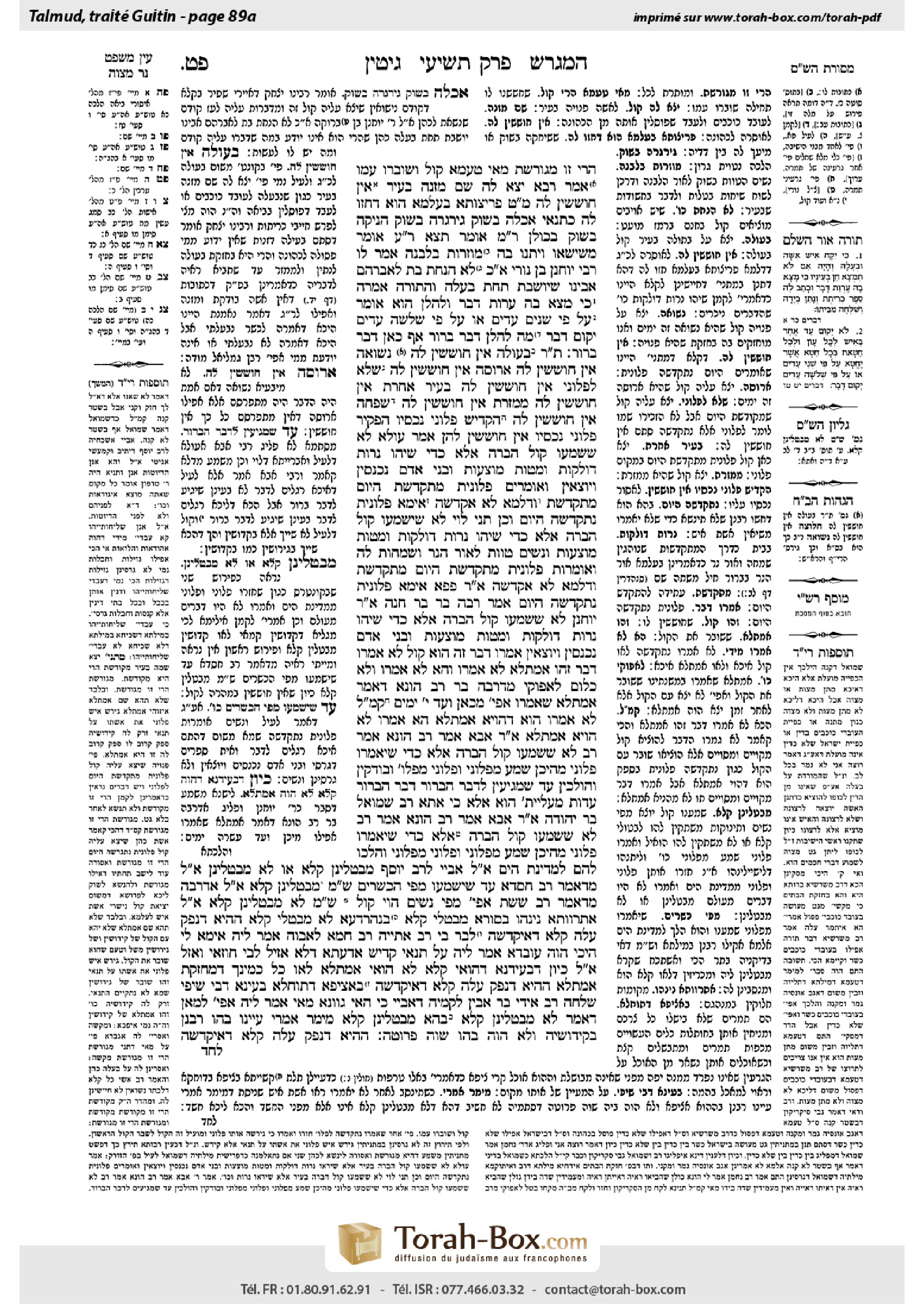
Gittin 89a: Talmud study for Daf Yomi
Study the Talmud for Daf Yomi with scanned pages, Hebrew text, English translations from Sefaria and AI-generated French translations.
Passage selection and English or AI-generated French translation are available where the scan has annotations. Daf Study is independent of Torah-Box and Sefaria.
Browse Gittin · גיטין · All tractatesGittin 89a text and translations
This page of Gittin includes the Aramaic text, an English translation and an AI-generated French translation, alongside the scan above.
גיטין פ״ט א · Aramaic and Hebrew text
הֲרֵי זוֹ מְגוֹרֶשֶׁת. מַאי טַעְמָא? קוֹל וְשׁוֹבְרוֹ עִמּוֹ.
אָמַר רָבָא: יָצָא לָהּ שֵׁם מְזַנָּה בָּעִיר – אֵין חוֹשְׁשִׁין לָהּ. מַאי טַעְמָא? פְּרִיצוּתָא בְּעָלְמָא הוּא דַּחֲזוֹ לַהּ.
כְּתַנָּאֵי: אָכְלָה בַּשּׁוּק, גִּירְגְּרָה בַּשּׁוּק, הֵנִיקָה בַּשּׁוּק – בְּכוּלָּן רַבִּי מֵאִיר אוֹמֵר: תֵּצֵא. רַבִּי עֲקִיבָא אוֹמֵר: מִשֶּׁיִּשְּׂאוּ וְיִתְּנוּ בָּהּ מוֹזְרוֹת בַּלְּבָנָה.
אָמַר לוֹ רַבִּי יוֹחָנָן בֶּן נוּרִי: אִם כֵּן, לֹא הִנַּחְתָּ בַּת לְאַבְרָהָם אָבִינוּ שֶׁיּוֹשֶׁבֶת תַּחַת בַּעֲלָהּ, וְהַתּוֹרָה אָמְרָה: ״כִּי מָצָא בָהּ עֶרְוַת דָּבָר״, וּלְהַלָּן הוּא אוֹמֵר: ״עַל פִּי שְׁנַיִם עֵדִים אוֹ עַל פִּי שְׁלֹשָׁה עֵדִים יָקוּם דָּבָר״; מָה לְהַלָּן דָּבָר בָּרוּר, אַף כָּאן דָּבָר בָּרוּר.
תָּנוּ רַבָּנַן: ״בְּעוּלָה״ – אֵין חוֹשְׁשִׁין לָהּ. ״נְשׂוּאָה״ – אֵין חוֹשְׁשִׁין לָהּ. ״אֲרוּסָה״ – אֵין חוֹשְׁשִׁין לָהּ. ״שֶׁלֹּא לִפְלוֹנִי״ – אֵין חוֹשְׁשִׁין לָהּ. ״בְּעִיר אַחֶרֶת״ – אֵין חוֹשְׁשִׁין לָהּ.
״מַמְזֶרֶת״ – אֵין חוֹשְׁשִׁין לָהּ. ״שִׁפְחָה״ – אֵין חוֹשְׁשִׁין לָהּ.
״הִקְדִּישׁ פְּלוֹנִי נְכָסָיו״; ״הִפְקִיר פְּלוֹנִי נְכָסָיו״ – אֵין חוֹשְׁשִׁין לָהֶן.
אָמַר עוּלָּא: לֹא שֶׁשָּׁמְעוּ קוֹל הֲבָרָה; אֶלָּא כְּדֵי שֶׁיְּהוּ נֵרוֹת דּוֹלְקוֹת וּמִטּוֹת מוּצָּעוֹת, וּבְנֵי אָדָם נִכְנָסִין וְיוֹצְאִין וְאוֹמְרִים: ״פְּלוֹנִית מִתְקַדֶּשֶׁת הַיּוֹם״.
״מִתְקַדֶּשֶׁת״?! וְדִלְמָא לָא אִקַּדַּשָׁה! אֵימָא: ״פְּלוֹנִית נִתְקַדְּשָׁה הַיּוֹם״.
וְכֵן תָּנֵי לֵוִי: לֹא שֶׁיִּשְׁמְעוּ קוֹל הֲבָרָה; אֶלָּא כְּדֵי שֶׁיְּהוּ נֵרוֹת דּוֹלְקוֹת וּמִטּוֹת מוּצָּעוֹת, וְנָשִׁים טוֹוֹת לְאוֹר הַנֵּר וּשְׂמֵחוֹת לָהּ, וְאוֹמְרוֹת: ״פְּלוֹנִית מִתְקַדֶּשֶׁת הַיּוֹם״. ״מִתְקַדֶּשֶׁת״?! וְדִלְמָא לָא אִקַּדַּשָׁה! אָמַר רַב פָּפָּא, אֵימָא: ״פְּלוֹנִית נִתְקַדְּשָׁה הַיּוֹם״.
אָמַר רַבָּה בַּר בַּר חָנָה אָמַר רַבִּי יוֹחָנָן: לֹא שֶׁשָּׁמְעוּ קוֹל הֲבָרָה; אֶלָּא כְּדֵי שֶׁיְּהוּ נֵרוֹת דּוֹלְקוֹת וּמִטּוֹת מוּצָּעוֹת, וּבְנֵי אָדָם נִכְנָסִין וְיוֹצְאִין. אָמְרוּ דָּבָר – זֶה הוּא קוֹל, לֹא אָמְרוּ דָּבָר – זֶהוּ אֲמַתְלָא.
לֹא אָמְרוּ?! וְהָא לֹא אָמְרוּ וְלֹא כְּלוּם! לְאַפּוֹקֵי מִדְּרַבָּה בַּר רַב הוּנָא, דְּאָמַר: אֲמַתְלָא שֶׁאָמְרוּ, אֲפִילּוּ מִכָּאן וְעַד עֲשָׂרָה יָמִים. קָא מַשְׁמַע לַן – לָא אָמְרוּ, הוּא דְּהָוְיָא אֲמַתְלָא; הָא אָמְרוּ – לָא הָוְיָא אֲמַתְלָא.
אָמַר רַבִּי אַבָּא אָמַר רַב הוּנָא אָמַר רַב: לֹא שֶׁשָּׁמְעוּ קוֹל הֲבָרָה, אֶלָּא כְּדֵי שֶׁיֹּאמְרוּ: פְּלוֹנִי מֵהֵיכָן שָׁמַע? מִפְּלוֹנִי; וּפְלוֹנִי מִפְּלוֹנִי; וּבוֹדְקִין וְהוֹלְכִין עַד שֶׁמַּגִּיעִין לְדָבָר הַבָּרוּר.
דָּבָר הַבָּרוּר – עֵדוּת מְעַלַּיְיתָא הוּא! אֶלָּא כִּי אֲתָא רַב שְׁמוּאֵל בַּר יְהוּדָה, אָמַר רַבִּי אַבָּא אָמַר רַב הוּנָא אָמַר רַב: לֹא שֶׁשָּׁמְעוּ קוֹל הֲבָרָה, אֶלָּא כְּדֵי שֶׁיֹּאמְרוּ: פְּלוֹנִי, מֵהֵיכָן שָׁמַע? מִפְּלוֹנִי; וּפְלוֹנִי מִפְּלוֹנִי; וְהָלְכוּ לָהֶם לִמְדִינַת הַיָּם.
אֲמַר לֵיהּ אַבָּיֵי לְרַב יוֹסֵף: מְבַטְּלִינַן קָלָא, אוֹ לָא מְבַטְּלִינַן? אֲמַר לֵיהּ: מִדְּאָמַר רַב חִסְדָּא: עַד שֶׁיִּשְׁמְעוּ מִפִּי הַכְּשֵׁרִים, שְׁמַע מִינַּהּ: מְבַטְּלִינַן קָלָא.
אֲמַר לֵיהּ: אַדְּרַבָּה! מִדְּאָמַר רַב שֵׁשֶׁת: אֲפִילּוּ מִפִּי נָשִׁים הָוֵי קוֹל – שְׁמַע מִינַּהּ: לָא מְבַטְּלִינַן קָלָא!
אֲמַר לֵיהּ: אַתְרָווֹתָא נִינְהוּ; בְּסוּרָא מְבַטְּלִי קָלָא, בִּנְהַרְדְּעָא לָא מְבַטְּלִי קָלָא.
הָהִיא דִּנְפַק עֲלַהּ קָלָא דְּאִיקַּדַּשָׁה לְבַר בֵּי רַב, אַתְיֵיהּ רַב חָמָא לַאֲבוּהּ, אֲמַר לֵיהּ: אֵימָא לִי – הֵיכִי הֲוָה עוֹבָדָא? אֲמַר לֵיהּ: עַל תְּנַאי קַדֵּישׁ, אַדַּעְתָּא דְּלָא אָזֵיל לְבֵי חוֹזַאי, וַאֲזַל. אֲמַר לֵיהּ: כֵּיוָן דִּבְעִידָּנָא דַּהֲוַאי קָלָא – לָא הֲוַאי אֲמַתְלָא, לָאו כֹּל כְּמִינָךְ דְּמַחְזְקַתְּ אֲמַתְלָא.
הָהִיא דִּנְפַק עֲלַהּ קָלָא, דְּאִיקַּדַּשָׁה בַּאֲצִיפָּא דְּתוּחְלָא, בְּעֵינָא דְּ״בֵי שִׁיפֵי״. שַׁלְחַהּ רַב אִידִי בַּר אָבִין לְקַמֵּיהּ דְּאַבָּיֵי: כִּי הַאי גַּוְונָא מַאי? אֲמַר לֵיהּ: אֲפִילּוּ לְמַאן דְּאָמַר לָא מְבַטְּלִינַן קָלָא, בְּהָא מְבַטְּלִינַן קָלָא; מֵימָר אָמְרִי: עַיִּינוּ בְּהוּ רַבָּנַן בְּקִידּוּשֵׁי, וְלָא הֲוָה בְּהוּ שָׁוֶה פְּרוּטָה.
הָהִיא דִּנְפַק עֲלַהּ קָלָא, דְּאִיקַּדַּשָׁה
Gittin 89a · English translation
she is considered to be divorced and may remarry. What is the reason for this? The rumor came with its receipt. The rumor that she is betrothed is canceled by the rumor that she is divorced.
§ Rava said: If a rumor circulated in the city that a woman engaged in licentious sexual intercourse, we are not concerned that the rumor is true with regard to her eligibility to marry a priest. What is the reason for this? It is assumed that people saw her engage in merely licentious behavior, in a manner that does not disqualify her from marrying a priest.
This statement is parallel to one side of a dispute among the tanna’im: If a woman ate in the marketplace, walked with her neck stretched forward in an arrogant manner in the marketplace, or nursed in the marketplace, with regard to all of these cases Rabbi Meir says that she must leave her husband, since all of these behaviors are considered licentious behavior. Rabbi Akiva says that she must leave him only once the women who spin [mozerot] by the moonlight converse about her having engaged in promiscuous sexual intercourse, as this indicates that the matter is well known and accepted as fact.
Rabbi Yoḥanan ben Nuri said to him: If so, you have not allowed any daughter of Abraham our forefather to remain with her husband, i.e., all wives will be forced to leave their husbands, as it is common for women to slander their peers. And the Torah said: “Because he has found some unseemly matter in her, and he writes her a scroll of severance” (Deuteronomy 24:1), and it says over there: “At the mouth of two witnesses, or at the mouth of three witnesses, a matter shall be established” (Deuteronomy 19:15). Just as there, the word “matter” is referring to a clear matter, as it is established through witnesses, so too here, the unseemly matter that is considered a cause for divorce is also referring to a clear matter that was not established merely through a rumor. Rava’s statement is in accordance with this opinion.
The Sages taught: If a rumor circulated that a certain unmarried woman is a non-virgin, one is not concerned about it, and she may marry a High Priest. If a rumor circulated that she is a married woman, one is not concerned about it. If a rumor circulated that she is a betrothed woman, one is not concerned about it. If a rumor circulated that she is betrothed, but not to so-and-so, i.e., the man who betrothed her is not specified, one is not concerned about it. If a rumor circulated that she was betrothed in another city, one is not concerned about it.
If a rumor circulated that she is a daughter born from an incestuous or adulterous relationship [mamzeret], one is not concerned about it. If a rumor circulated that she is a maidservant, one is not concerned about it.
Similarly, if a rumor circulated that so-and-so consecrated his property, or that so-and-so renounced ownership of his property, we are not concerned about these rumors, and his property cannot be taken away by the Temple treasury or another person.
§ Ulla says: The rumor mentioned in the mishna with regard to betrothal is not referring to a case where people only heard an echo. Rather, it is referring to a case where there is circumstantial evidence, as there are candles lit and beds made in the woman’s house, as was the custom for brides, and people entering and leaving and saying that so-and-so is becoming betrothed today.
The Gemara asks: If people merely are saying that she is becoming betrothed, what is the reason for concern? Perhaps she was not betrothed in the end. Rather, say that people are saying that so-and-so was betrothed today.
And similarly, Levi taught a baraita: The mishna is not referring to a case where people only hear an echo. Rather, it is referring to a case where candles are lit and beds are made, and women are spinning by candlelight and rejoicing for her and saying that so-and-so is becoming betrothed today. The Gemara asks: If they are merely saying that she is becoming betrothed, what is the reason for concern? Perhaps she was not betrothed in the end. Rav Pappa said: Say that they are saying that so-and-so was betrothed today.
Rabba bar bar Ḥana says that Rabbi Yoḥanan says: The mishna is not referring to a case where people only heard an echo. Rather, it is referring to a case where there are candles lit and beds made and people entering and leaving. If they made an explicit statement that the woman was betrothed, this is a rumor that renders her betrothed. If they did not make such a statement, this is the explanation mentioned in the mishna.
The Gemara asks: If they did not make such a statement, why is it considered an explanation? But they did not say anything that requires an explanation. The Gemara answers that Rabbi Yoḥanan did not mean that the people did not say anything, but rather that they did not state unequivocally that the woman is betrothed, to the exclusion of that which Rabba bar Rav Huna said: The explanation mentioned in the mishna negates the rumor even if it circulates at some point from now until ten days after the rumor begins to circulate. Rabbi Yoḥanan therefore teaches us that only if the people did not say unequivocally that she is betrothed is it considered an explanation that negates the rumor. But if they said so unequivocally, any later explanation is not considered an explanation that negates the rumor.
Rabbi Abba said that Rav Huna said that Rav said: The mishna is not referring to a case where people only heard an echo. Rather, it is referring to a case where people say: From where did so-and-so hear that this woman is betrothed? From so-and-so, and so-and-so heard it from so-and-so. And as a result, the judges investigate the rumor continuously, tracing the hearsay until they reach a clear matter, i.e., eyewitnesses.
The Gemara raises an objection: If the court reaches a clear matter it is proper testimony, not a rumor. Rather, when Rav Shmuel bar Yehuda came from Eretz Yisrael he taught that Rabbi Abba said that Rav Huna said that Rav said: The mishna is not referring to a case where people only heard an echo. Rather, it is referring to a case where people say: From where did so-and-so hear this? From so-and-so, and so-and-so heard it from so-and-so, and they went overseas, so that the court cannot investigate further.
§ Abaye said to Rav Yosef: Do we suppress a rumor that was not substantiated by the court, or do we not suppress it? He said to him: Since Rav Ḥisda says that a rumor is not treated stringently until the court hears it from valid witnesses, which indicates that rumors are generally treated leniently, learn from it that we suppress a rumor.
Abaye said to him: On the contrary, since Rav Sheshet said that even if the court hears it from women it is considered a serious rumor, indicating that rumors are treated stringently, learn from it that we do not suppress a rumor.
Rav Yosef said to him: These opinions correspond to the local custom in two different places. In Sura they suppress a rumor, whereas in Neharde’a they do not suppress a rumor.
The Gemara relates several incidents: A rumor circulated that a certain woman was betrothed to a student of Torah. Rav Ḥama summoned her father and said to him: Tell me exactly how the incident transpired. The father said to him: The student betrothed her conditionally, with the intention that he would not go to the city of Bei Ḥozai, and he subsequently went there, thereby nullifying the betrothal. Rav Ḥama said to him: Since at the time that the rumor existed this explanation did not exist, it is not in your power to create the presumption of an explanation. Therefore, the rumor must be treated stringently.
A rumor circulated that a certain woman was betrothed with a mat of dates [atzifa detoḥela] from the spring of Bei Shifei. Rav Idi bar Avin sent the case to be presented before Abaye, asking him: What is the halakha in a case like this? Should this rumor be suppressed? Abaye said to him: Even according to the one who said that we do not suppress a rumor, in this case we suppress the rumor. This is because if she marries someone else people will not slander her. Rather, they will say that the Sages investigated her betrothal, i.e., the value of the mat of dates with which she was betrothed, and concluded that it was not worth one peruta and therefore the betrothal was invalid.
A rumor circulated that a certain woman was betrothed
Gittin 89a · Traduction française (IA)
elle est considérée comme divorcée et peut remarry. Quelle est la raison de cela ? Le bruit est arrivé avec sa réception. Le bruit selon lequel elle est fiancée est annulé par le bruit selon lequel elle est divorcée.
§ Rava a dit : Si un bruit s'est répandu dans la ville selon lequel une femme s'est livrée à des relations sexuelles impudiques, nous ne craignons pas que ce bruit soit vrai en ce qui concerne son éligibilité à épouser un prêtre. Quelle est la raison de cela ? On suppose que les gens l'ont vue s'adonner à un comportement impudique, dans un sens qui ne l'exclut pas de l'épouser un prêtre.
Cette déclaration est parallèle à l'une des faces d'un débat entre les tannaïm : Si une femme a mangé dans le marché, a marché avec la tête haute dans le marché, ou a allaité dans le marché, concernant toutes ces situations, Rabbi Meir dit qu'elle doit quitter son mari, car toutes ces comportements sont considérés comme des comportements impudiques. Rabbi Akiva dit qu'elle doit quitter son mari seulement lorsque les femmes qui tissent la nuit discutent de son comportement sexuel promiscue, car cela indique que l'affaire est bien connue et acceptée comme fait.
Rabbi Yoḥanan ben Nuri a dit à lui : Si c'est ainsi, vous n'avez pas permis à aucune fille d'Abraham notre père de rester avec son mari, c'est-à-dire toutes les épouses seront contraintes de quitter leurs maris, car il est courant que les femmes diffament leurs pairs. Et la Torah dit : « Parce qu'il a trouvé quelque chose d'indécent en elle, et il écrit un rouleau de séparation » (Deutéronome 24:1), et il dit là-bas : « À la bouche de deux témoins, ou à la bouche de trois témoins, une affaire sera établie » (Deutéronome 19:15). Tout comme là-bas, le mot « affaire » désigne une affaire claire, car elle est établie par des témoins, de même ici, l'affaire indécente qui est considérée comme une cause de divorce désigne aussi une affaire claire qui n'a pas été établie uniquement par un bruit. La déclaration de Rava est en conformité avec cet avis.
Les Sages ont enseigné : Si un bruit s'est répandu selon lequel une certaine femme non mariée est une non-vierge, on n'a pas de crainte à avoir à son égard, et elle peut épouser un grand prêtre. Si un bruit s'est répandu selon lequel elle est mariée, on n'a pas de crainte à avoir à son égard. Si un bruit s'est répandu selon lequel elle est fiancée, on n'a pas de crainte à avoir à son égard. Si un bruit s'est répandu selon lequel elle est fiancée, mais pas avec tel ou tel, c'est-à-dire que l'homme qui l'a fiancée n'est pas spécifié, on n'a pas de crainte à avoir à son égard. Si un bruit s'est répandu selon lequel elle a été fiancée dans une autre ville, on n'a pas de crainte à avoir à son égard.
Si un bruit s'est répandu selon lequel elle est une fille née d'un rapport incestueux ou adultère [mamzeret], on n'a pas de crainte à avoir à son égard. Si un bruit s'est répandu selon lequel elle est une servante, on n'a pas de crainte à avoir à son égard.
De même, si un bruit circule selon lequel tel ou tel a consacré ses biens, ou que tel ou tel a renoncé à ses biens, nous ne nous en occupons pas, et ses biens ne peuvent être emportés par le trésor du Temple ou par une autre personne.
§ Ulla dit : Le bruit mentionné dans la Michna concernant le fiancement ne désigne pas un cas où les gens n'ont entendu qu'un écho. Plutôt, il désigne un cas où il y a des preuves circumstantielles, car il y a des bougies allumées et des lits préparés dans la maison de la femme, comme c'était la coutume pour les mariées, et des gens entrant et sortant en disant que tel ou tel devient fiancé aujourd'hui.
Le Guemara pose la question : Si les gens disent simplement qu'elle devient fiancée, quelle est la raison de la crainte ? Peut-être qu'elle n'a pas été fiancée à la fin. Plutôt, disons que les gens disent que tel ou tel a été fiancé aujourd'hui.
Et de même, Levi a enseigné une baraïta : La mitsna ne désigne pas un cas où les gens n'ont entendu qu'un écho. Plutôt, elle désigne un cas où des bougies sont allumées et des lits sont préparés, et des femmes tissent à la lumière des bougies et célèbrent pour elle en disant que tel ou tel devient fiancé aujourd'hui. Le Guemara pose la question : Si ils disent simplement qu'elle devient fiancée, quelle est la raison de la crainte ? Peut-être qu'elle n'a pas été fiancée à la fin. Rav Pappa a dit : Disons qu'ils disent que tel ou tel a été fiancé aujourd'hui.
Rabba bar bar Ḥana dit que Rabbi Yoḥanan dit : La mitsna ne désigne pas un cas où les gens n'ont entendu qu'un écho. Plutôt, elle désigne un cas où il y a des bougies allumées et des lits préparés et des gens entrant et sortant. Si ils ont fait une déclaration explicite selon lequel la femme était fiancée, cela est un bruit qui la rend fiancée. Si ils n'ont pas fait une telle déclaration, c'est l'explication mentionnée dans la mitsna.
Le Guemara pose la question : Si ils n'ont pas fait cette déclaration, pourquoi est-ce considéré comme une explication ? Mais ils n'ont pas dit quelque chose qui exige une explication. Le Guemara répond que Rabbi Yoḥanan n'a pas voulu dire que les gens n'ont pas dit quelque chose, mais plutôt qu'ils n'ont pas déclaré de manière évidente que la femme est fiancée, excluant ce que Rabba bar Rav Huna a dit : L'explication mentionnée dans la mitsna annule le bruit même si ce bruit circule à un moment donné jusqu'à dix jours après que le bruit commence à circuler. Rabbi Yoḥanan enseigne donc que seulement si les gens n'ont pas déclaré de manière évidente qu'elle est fiancée, cela est considéré comme une explication qui annule le bruit. Mais si ils ont déclaré de manière évidente, toute explication ultérieure n'est pas considérée comme une explication qui annule le bruit.
Rabbi Abba a dit que Rav Huna a dit que Rav a dit : La mitsna ne désigne pas un cas où les gens n'ont entendu qu'un écho. Plutôt, elle désigne un cas où les gens disent : D'où tel ou tel a-t-il entendu que cette femme est fiancée ? De tel ou tel, et tel ou tel a entendu cela de tel ou tel. Et en conséquence, les juges enquêtent sur le bruit continuellement, en traçant le bruit jusqu'à ce qu'ils trouvent une affaire claire, c'est-à-dire des témoins oculaires.
La Guemara évoque un objet d'opposition : si la cour arrive à une affaire claire, le témoignage est propre, pas un bruit. En revanche, lorsque Rav Shmuel bar Yehuda est revenu d'Eretz Yisrael, il a enseigné que Rabbi Abba a dit que Rav Huna a dit que Rav a dit : la Michna ne parle pas d'un cas où les gens n'ont entendu qu'un écho. En revanche, elle parle d'un cas où les gens disent : d'où ce tel a-t-il entendu cela ? De tel autre, et tel autre l'a entendu de tel autre, et ils sont partis en exil, de sorte que la cour ne peut pas investiguer davantage.
§ Abaye a dit à Rav Yosef : devons-nous étouffer un bruit qui n'a pas été confirmé par la cour, ou ne devons-nous pas l'étouffer ? Il lui a répondu : puisque Rav Ḥisda dit qu'un bruit n'est pas traité avec sévérité jusqu'à ce que la cour l'entende de témoins valides, ce qui indique que les bruits sont généralement traités avec indulgence, apprends-en que nous étouffons un bruit.
Abaye a dit à lui : au contraire, puisque Rav Sheshet a dit que même si la cour l'entend de femmes, cela est considéré comme un bruit grave, ce qui indique que les bruits sont traités avec sévérité, apprends-en que nous ne devons pas étouffer un bruit.
Rav Yosef a dit à lui : ces opinions correspondent à la coutume locale dans deux lieux différents. À Sura, on étouffe un bruit, tandis qu'à Neharde’a, on ne l'étouffe pas.
La Guemara rapporte plusieurs incidents : un bruit circulait selon lequel une certaine femme était promise à un étudiant de la Torah. Rav Ḥama a convoqué son père et lui a dit : dis-moi exactement comment l'incident s'est produit. Le père lui a répondu : l'étudiant l'a promise conditionnellement, avec l'intention qu'il ne viendrait pas dans la ville de Bei Ḥozai, et il est ensuite parti là-bas, annulant ainsi la promesse. Rav Ḥama a dit au père : puisque lorsqu'il y avait ce bruit cette explication n'existait pas, il ne t'est pas possible de créer l'assomption d'une explication. Par conséquent, ce bruit doit être traité avec sévérité.
Un bruit circulait selon lequel une certaine femme était promise avec un panier de figues [atzifa detoḥela] du printemps de Bei Shifei. Rav Idi bar Avin a envoyé le cas devant Abaye, en lui demandant : quelle est la halakha dans un cas comme celui-ci ? Doit-on étouffer ce bruit ? Abaye lui a répondu : même selon celui qui dit que nous ne devons pas étouffer un bruit, dans ce cas-ci nous étouffons le bruit. Cela est dû au fait que si elle épouse quelqu'un d'autre, les gens ne la diffameront pas. En revanche, ils diront que les Sages ont investigué sa promesse, c'est-à-dire la valeur du panier de figues avec lequel elle était promise, et ont conclu qu'il n'était pas valable un peruta, donc la promesse était nulle.
Un bruit circulait selon lequel une certaine femme était promise
Traduction française générée par IA à partir de l’édition anglaise de Sefaria. Vérifie toujours un passage avec le texte source.
Text from Sefaria: William Davidson Edition - Vocalized Aramaic (CC BY NC); William Davidson Edition - English (CC BY NC).