Gittin 89b: Talmud study for Daf Yomi
Study the Talmud for Daf Yomi with scanned pages, Hebrew text, English translations from Sefaria and AI-generated French translations.
Passage selection and English or AI-generated French translation are available where the scan has annotations. Daf Study is independent of Torah-Box and Sefaria.
Browse Gittin · גיטין · All tractatesGittin 89b text and translations
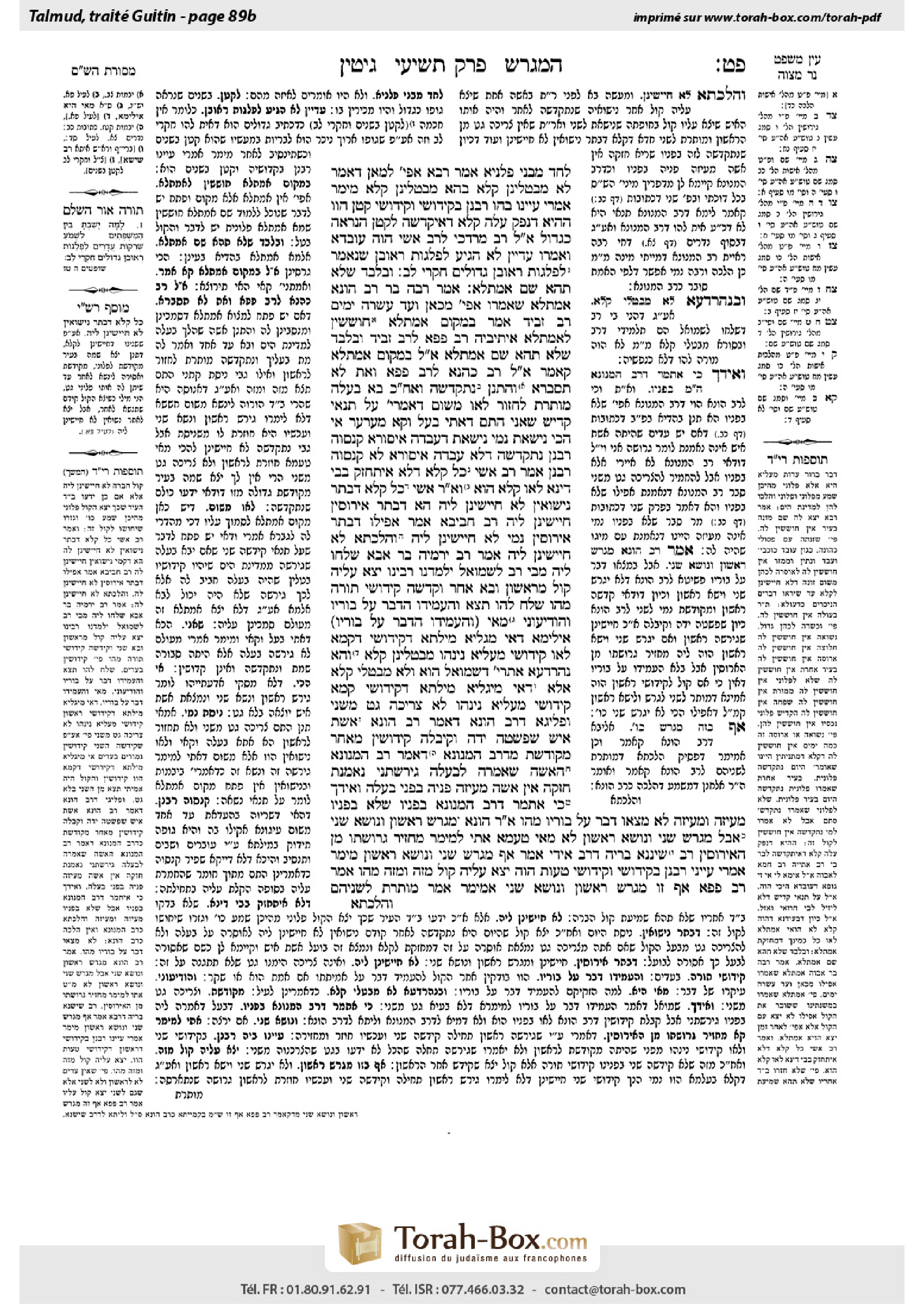
This page of Gittin includes the Aramaic text, an English translation and an AI-generated French translation, alongside the scan above.
גיטין פ״ט ב · Aramaic and Hebrew text
לְחַד מִבְּנֵי פְּלָנְיָא, אָמַר רָבָא: אֲפִילּוּ לְמַאן דְּאָמַר לָא מְבַטְּלִינַן קָלָא, בְּהָא מְבַטְּלִינַן קָלָא; מֵימָר אָמְרִי: עַיִּינוּ בְּהוּ רַבָּנַן בְּקִידּוּשֵׁי, וְקִידּוּשֵׁי קָטָן הֲווֹ.
הָהִיא דִּנְפַק עֲלַהּ קָלָא, דְּאִיקַּדַּשָׁה לְקָטָן הַנִּרְאֶה כְּגָדוֹל. אֲמַר לֵיהּ רַב מָרְדֳּכַי לְרַב אָשֵׁי: הֲוָה עוֹבָדָא, וְאָמְרוּ: עֲדַיִין לֹא הִגִּיעַ לִ״פְלַגּוֹת רְאוּבֵן״, שֶׁנֶּאֱמַר: ״לִפְלַגּוֹת רְאוּבֵן גְּדוֹלִים חִקְרֵי לֵב״.
וּבִלְבַד שֶׁלֹּא תְּהֵא שָׁם אֲמַתְלָא: אָמַר רַבָּה בַּר רַב הוּנָא: אֲמַתְלָא שֶׁאָמְרוּ, אֲפִילּוּ מִכָּאן וְעַד עֲשָׂרָה יָמִים. רַב זְבִיד אָמַר: בִּמְקוֹם אֲמַתְלָא, חוֹשְׁשִׁין לַאֲמַתְלָא.
אֵיתִיבֵיהּ רַב פָּפָּא לְרַב זְבִיד: וּבִלְבַד שֶׁלֹּא תְּהֵא שָׁם אֲמַתְלָא! אֲמַר לֵיהּ: בִּמְקוֹם אֲמַתְלָא קָאָמַר.
אֲמַר לֵיהּ רַב כָּהֲנָא לְרַב פָּפָּא: וְאַתְּ לָא תִּסְבְּרַאּ?! וְהָתְנַן: נִתְקַדְּשָׁה, וְאַחַר כָּךְ בָּא בַּעְלָהּ – מוּתֶּרֶת לַחְזוֹר. לָאו מִשּׁוּם דְּאָמְרִינַן עַל תְּנַאי קַדֵּישׁ?
שָׁאנֵי הָתָם, דְּאָתֵי בַּעַל וְקָא מְעַרְעֵר.
אִי הָכִי, נִישֵּׂאת נָמֵי! נִישֵּׂאת, דַּעֲבַדָה אִיסּוּרָא – קַנְסוּהָ רַבָּנַן; נִתְקַדְּשָׁה, דְּלָא עֲבַדָה אִיסּוּרָא – לָא קַנְסוּהָ רַבָּנַן.
אָמַר רַב אָשֵׁי: כֹּל קָלָא דְּלָא אִיתַּחְזַק בְּבֵי דִינָא – לָאו קָלָא הוּא. וְאָמַר רַב אָשֵׁי: כֹּל קָלָא דְּבָתַר נִישּׂוּאִין – לָא חָיְישִׁינַן לֵיהּ; הָא דְּבָתַר אֵירוּסִין – חָיְישִׁינַן לֵיהּ. רַב חֲבִיבָא אָמַר: אֲפִילּוּ דְּבָתַר אֵירוּסִין נָמֵי, לָא חָיְישִׁינַן לֵיהּ. וְהִלְכְתָא: לָא חָיְישִׁינַן לֵיהּ.
אָמַר רַב יִרְמְיָה בַּר אַבָּא: שְׁלַחוּ לֵיהּ מִבֵּי רַב לִשְׁמוּאֵל, יְלַמְּדֵנוּ רַבֵּינוּ: יָצָא עָלֶיהָ קוֹל מֵרִאשׁוֹן, וּבָא אַחֵר וְקִדְּשָׁהּ קִידּוּשֵׁי תוֹרָה, מַהוּ? שְׁלַח לְהוּ: תֵּצֵא, וְהַעֲמִידוּ הַדָּבָר עַל בּוּרְיוֹ, וְהוֹדִיעוּנִי.
מַאי ״וְהַעֲמִידוּ הַדָּבָר עַל בּוּרְיוֹ״? אִילֵּימָא דְּאִי מִגַּלְּיָא מִילְּתָא דְּקִידּוּשֵׁי דְקַמָּא לָאו קִידּוּשֵׁי מְעַלְּיָא נִינְהוּ – מְבַטְּלִינַן קָלָא; וְהָא נְהַרְדְּעָא אַתְרֵיהּ דִּשְׁמוּאֵל הוּא, וְלָא מְבַטְּלִי קָלָא! אֶלָּא דְּאִי מִיגַּלְּיָא מִילְּתָא דְּקִידּוּשֵׁי קַמָּא קִידּוּשֵׁי מְעַלְּיָא נִינְהוּ – לֹא צְרִיכָה גֵּט מִשֵּׁנִי.
וּפְלִיגָא דְּרַב הוּנָא – דְּאָמַר רַב הוּנָא: אֵשֶׁת אִישׁ שֶׁפָּשְׁטָה יָדָהּ, וְקִיבְּלָה קִידּוּשִׁין מֵאַחֵר, מְקוּדֶּשֶׁת –
מִדְּרַב הַמְנוּנָא; דְּאָמַר רַב הַמְנוּנָא: הָאִשָּׁה שֶׁאָמְרָה לְבַעְלָהּ: ״גֵּירַשְׁתַּנִי״ – נֶאֱמֶנֶת, חֲזָקָה אֵין אִשָּׁה מְעִיזָּה פָּנֶיהָ בִּפְנֵי בַּעְלָהּ.
וְאִידַּךְ – כִּי אִתְּמַר דְּרַב הַמְנוּנָא, בְּפָנָיו; שֶׁלֹּא בְּפָנָיו – מְעִיזָּה וּמְעִיזָּה.
לֹא מָצְאוּ דָּבָר עַל בּוּרְיוֹ, מַהוּ?
אָמַר רַב הוּנָא: מְגָרֵשׁ רִאשׁוֹן, וְנוֹשֵׂא שֵׁנִי. אֲבָל מְגָרֵשׁ שֵׁנִי וְנוֹשֵׂא רִאשׁוֹן – לָא. מַאי טַעְמָא? אָתֵי לְמֵימַר: מַחְזִיר גְּרוּשָׁתוֹ מִן הָאֵירוּסִין.
רַב שִׁינָּנָא בְּרֵיהּ דְּרַב אִידִי אָמַר: אַף מְגָרֵשׁ שֵׁנִי וְנוֹשֵׂא רִאשׁוֹן, מֵימָר אָמְרִי: עַיִּינוּ רַבָּנַן בְּקִידּוּשֵׁי, וְקִידּוּשֵׁי טָעוּת הֲוָה.
יָצָא עָלֶיהָ קוֹל מִזֶּה וּמִזֶּה, מַהוּ? אָמַר רַב פָּפָּא: אַף זוֹ – מְגָרֵשׁ רִאשׁוֹן וְנוֹשֵׂא שֵׁנִי. אַמֵּימָר אָמַר: מוּתֶּרֶת לִשְׁנֵיהֶם.
Gittin 89b · English translation
to one of the sons of so-and-so, who had both adult and minor sons. The son to whom she was betrothed was not specified. Rava said: Even according to the one who says that we do not suppress a rumor, in this case we suppress the rumor. People will not slander her. Rather, they will say that the Sages investigated the betrothal and concluded that it was the betrothal of a minor.
A rumor circulated that a certain woman was betrothed to a minor boy who looked like an adult, as his body was developed like an adult. Rav Mordekhai said to Rav Ashi: There was a precedent in which the Sages said that there is no concern that people will think that the woman is betrothed, since the boy did not yet reach the divisions of Reuben, i.e., the competence of adulthood, as it is stated: “Among the divisions of Reuben there were major resolves of heart” (Judges 5:16). Therefore, the betrothal is rendered entirely invalid, and there is no concern of slander.
§ It is stated in the mishna that a rumor is treated seriously only provided there is no explanation. Rabba bar Rav Huna said: The explanation mentioned in the mishna negates the rumor even if it circulates at some point from now, i.e., from the time the rumor circulated, until ten days afterward. Rav Zevid says: Where there is the reasonable possibility of an explanation, we are concerned about the possibility of an explanation even if it is not mentioned explicitly, and the rumor is therefore disregarded.
Rav Pappa raised an objection to the opinion of Rav Zevid from the expression in the mishna: Provided there is no explanation, which indicates that the explanation must be mentioned for it to be regarded. Rav Zevid said to him: The mishna is saying that where there is the reasonable possibility of an explanation the rumor is disregarded, even if it was not mentioned.
Rav Kahana said to Rav Pappa: And you, do you not hold Rav Zevid’s statement to be true? But didn’t we learn in a mishna that if a woman was betrothed after her husband was taken for dead, and then her husband came back, she is permitted to return to him (Yevamot 92a), which would not have been the case if she had been married and not merely betrothed? Isn’t this because we say that the second man betrothed her conditionally, stipulating that if her husband is found to be alive the betrothal is null, even though this explanation did not circulate explicitly?
The Gemara answers: It is different there because the husband comes and contests the betrothal, which shows clearly that he never divorced her and that her betrothal was mistaken. Therefore, there is no need for an additional explanation.
The Gemara asks: If so, in a case where she married the second man, it should also be permitted for her to return to her first husband. Why do the Sages render it prohibited for her to do so? The Gemara answers: In a case where she married him, since she performed a prohibited action, albeit unintentionally, by engaging in sexual intercourse with a man who is not her husband while she was married, the Sages penalized her. By contrast, in a case where she was merely betrothed, since she did not perform a prohibited action, the Sages did not penalize her.
§ Rav Ashi said: Any rumor that was not confirmed in court is not regarded as a significant rumor. And Rav Ashi said: With regard to any rumor that was spread about a woman after her marriage, we are not concerned about it. She need not leave her husband, and he need not divorce her. The Gemara infers that if the rumor circulated after her betrothal we are concerned about it, and she must be divorced from her betrothed. Rav Ḥaviva said: Even if it circulated after her betrothal, we are still not concerned about it. The Gemara concludes: And the halakha is that we are not concerned about it.
Rav Yirmeya bar Abba said that a group of students from the study hall of Rav sent the following question to Shmuel after Rav’s death: Teach us, our master: If a rumor circulated about a woman that she is betrothed to a first man, and another man came and betrothed her in a manner of betrothal that is recognized by Torah law, as there is clear testimony of it, what is the halakha? He sent them an answer: She must leave the second man, and you clarify the matter to figure out exactly what happened and inform me.
The Gemara asks: What is meant by: And you clarify the matter? If we say that he said this so that if it is discovered that the betrothal of the first man was not a proper betrothal we should suppress the rumor, thereby permitting her to marry the second man, isn’t Neharde’a Shmuel’s locale? And as mentioned above, in Neharde’a they would not suppress a rumor. Rather, he must have instructed them in this manner because if it is discovered that the betrothal of the first man was a proper betrothal, she does not need a bill of divorce from the second man.
And in ruling that she does not need a bill of divorce from the second man, Shmuel is in disagreement with Rav Huna, as Rav Huna says: In the case of a married woman who extended her hand and received money or a document of betrothal from another man, it is considered uncertain whether or not the woman is betrothed to him, and she needs a bill of divorce from him.
Rav Huna’s opinion is based on a principle stated by Rav Hamnuna, as Rav Hamnuna says that a woman who said to her husband: You divorced me, is deemed credible, due to the presumption that a wife is not so brazen to lie in this manner before her husband. Therefore, in the case brought before Shmuel, the fact that the woman received money or a document of betrothal from the second man should be considered sufficient basis for the rumor to be suppressed, since if she were already betrothed she certainly would not have accepted the betrothal from him.
The Gemara asks: And how does the other Sage, Shmuel, who disagrees with Rav Huna, relate to this principle? The Gemara answers: He holds that Rav Hamnuna’s principle was stated in reference to a case when the wife says in her husband’s presence that he divorced her, but when she is not in his presence she is certainly brazen enough to lie in this manner. Therefore, in the case brought before Shmuel, the woman may have accepted the betrothal of the other man because it was not in her husband’s presence.
The Gemara asks: What is the halakha if they did not find a clear matter, i.e., they could not establish with certainty whether she was betrothed to the first man?
Rav Huna says: The first man divorces her and the second man marries her. But for the second man to divorce her and the first man to marry her is not permitted. The Gemara explains: What is the reason that it is not permitted? It is prohibited lest people come to say that the first man is remarrying his divorcée after her betrothal to another man, as they will mistakenly assume that the first man betrothed her and then divorced her, thereby enabling her to be betrothed to the second man. Therefore, if he marries her after she is divorced from the second man, people will conclude that he is in violation of the Torah prohibition of remarrying one’s divorcée after she was married to another man.
Rav Shinnana, son of Rav Idi, says: For the second man to divorce her and the first man to marry her is also permitted. There is no concern that people will assume that the first man is remarrying his divorcée, as they will say that the Sages investigated the second man’s betrothal and found that it was a mistaken betrothal.
The Gemara asks: What is the halakha if a rumor circulated about her having been betrothed to this man and then another rumor was spread that she became betrothed to that man? Rav Pappa says: In this case too, the first man divorces her and the second man marries her, due to the previously mentioned concern that people will think that he is remarrying his divorcée after she was betrothed to another man. Ameimar says: She is permitted to both the first and the second man. One of them must divorce her while the other may marry her.
Gittin 89b · Traduction française (IA)
à l’un des fils de tel ou tel, qui avait à la fois des fils adultes et mineurs. Le fils à qui elle était fiancée n’était pas spécifié. Rava dit : Même selon celui qui dit que nous ne supprimons pas un ragot, dans ce cas-ci nous supprimons le ragot. Les gens ne la diffameront pas. Plutôt, ils diront que les Sages ont investigué le fiancement et conclu qu’il s’agissait du fiancement d’un mineur.
Un ragot circulait selon lequel une certaine femme était fiancée à un jeune garçon qui ressemblait à un adulte, car son corps était développé comme celui d’un adulte. Rav Mordekhai dit à Rav Ashi : Il y avait un précédent selon lequel les Sages disaient qu’il n’y a pas de crainte que les gens pensent que la femme est fiancée, car le garçon n’avait pas encore atteint les divisions de Rouben, c’est-à-dire la maturité, comme il est dit : « Parmi les divisions de Rouben, il y avait des résolutions importantes de cœur » (Juges 5:16). Par conséquent, le fiancement est entièrement nul, et il n’y a pas de crainte de diffamation.
§ Il est dit dans la mitsna que le ragot est traité sérieusement uniquement si aucune explication n’existe. Rabba bar Rav Huna dit : L’explication mentionnée dans la mitsna annule le ragot même s’il circule à un moment donné à partir de maintenant, c’est-à-dire depuis que le ragot a circulé, jusqu’à dix jours après. Rav Zevid dit : Lorsqu’il y a une possibilité raisonnable d’explication, nous sommes préoccupés par cette possibilité d’explication même si elle n’est pas mentionnée explicitement, et le ragot est donc ignoré.
Rav Pappa souleva une objection contre l’opinion de Rav Zevid à partir de l’expression dans la mitsna : « À condition qu’il n’y ait pas d’explication », ce qui indique que l’explication doit être mentionnée pour être prise en compte. Rav Zevid répondit à lui : La mitsna dit que lorsqu’il y a une possibilité raisonnable d’explication, le ragot est ignoré, même s’il n’a pas été mentionné.
Rav Kahana dit à Rav Pappa : Et toi, ne tiens-tu pas l’affirmation de Rav Zevid pour vraie ? Mais n’avons-nous pas appris dans une mitsna que si une femme était fiancée après que son mari avait été déclaré mort, et que son mari est revenu, elle est autorisée à revenir vers lui (Yevamot 92a), ce qui ne serait pas le cas si elle avait été mariée et non simplement fiancée ? N’est-ce pas parce que nous disons que le second homme l’a fiancée conditionnellement, stipulant que si son mari est trouvé vivant, le fiancement est nul, même si cette explication n’a pas circulé explicitement ?
La Guemara répond : C’est différent là-bas, car le mari vient contester le fiancement, ce qui montre clairement qu’il ne l’a pas divorcée et que son fiancement était erroné. Par conséquent, il n’y a pas besoin d’une explication supplémentaire.
La Guemara pose la question : Si c’est ainsi, dans un cas où elle a épousé le second homme, il devrait aussi être permis qu’elle revienne vers son premier mari. Pourquoi les Sages rendent-ils cela interdit ? La Guemara répond : Dans un cas où elle l’a épousé, puisqu’elle a commis une action interdite, même involontaire, en ayant des relations sexuelles avec un homme qui n’est pas son mari alors qu’elle était mariée, les Sages l’ont pénalisée. En revanche, dans un cas où elle était simplement fiancée, puisqu’elle n’a pas commis d’action interdite, les Sages ne l’ont pas pénalisée.
§ Rav Ashi dit : Tout ragot qui n’a pas été confirmé en cour n’est pas considéré comme un ragot important. Et Rav Ashi dit : En ce qui concerne tout ragot diffusé sur une femme après son mariage, nous ne sommes pas préoccupés par lui. Elle n’a pas besoin de quitter son mari, et il n’a pas besoin de la divorcer. La Guemara déduit que si le ragot a circulé après son fiancement, nous sommes préoccupés par lui, et elle doit être divorcée de son fiancé. Rav Ḥaviva dit : Même si le ragot a circulé après son fiancement, nous ne sommes toujours pas préoccupés par lui. La Guemara conclut : Et la halakha est que nous ne sommes pas préoccupés par lui.
Rav Yirmeya bar Abba dit qu’un groupe d’étudiants de la salle de étude de Rav a envoyé la question suivante à Shmuel après la mort de Rav : Enseigne-nous, notre maître : Si un ragot circulait sur une femme selon lequel elle est fiancée à un premier homme, et un autre homme est venu et l’a fiancée de manière reconnue par la loi divine, comme il y a un témoignage clair de cela, quelle est la halakha ? Il leur a envoyé une réponse : Elle doit quitter le second homme, et vous clarifiez la situation pour déterminer exactement ce qui s’est passé et m’informer.
La Guemara pose la question : Qu’entend-on par : Et vous clarifiez la situation ? Si nous disons qu’il a dit cela afin que si on découvre que le fiancement du premier homme n’était pas un fiancement valide, on supprime le ragot, permettant ainsi qu’elle épouse le second homme, n’est-ce pas Neharde’a, le lieu de Shmuel ? Et comme mentionné ci-dessus, à Neharde’a, ils ne supprimaient pas un ragot. Plutôt, il a dû leur dire cela ainsi, car si on découvre que le fiancement du premier homme était valide, elle n’a pas besoin d’un divorce du second homme.
Et en décidant qu’elle n’a pas besoin d’un divorce du second homme, Shmuel est en désaccord avec Rav Huna, comme Rav Huna dit : Dans le cas d’une femme mariée qui a tendu la main et a reçu de l’argent ou un document de fiancement d’un autre homme, on considère qu’il est incertain si la femme est fiancée à lui, et elle a besoin d’un divorce de lui.
L’opinion de Rav Huna s’appuie sur un principe énoncé par Rav Hamnuna, comme Rav Hamnuna dit qu’une femme qui dit à son mari : Tu m’as divorcée, est considérée comme crédible, en raison de la présomption que la femme n’est pas si audacieuse pour mentir ainsi devant son mari. Par conséquent, dans le cas soumis à Shmuel, le fait que la femme ait reçu de l’argent ou un document de fiancement du second homme devrait être considéré comme une base suffisante pour supprimer le ragot, car si elle était déjà fiancée, elle n’aurait certainement pas accepté le fiancement de lui.
La Guemara pose la question : Et comment le Sage Shmuel, qui s'oppose à Rav Huna, s'aligne sur ce principe ? La Guemara répond : Il considère que le principe de Rav Hamnuna a été énoncé dans le cas où la femme déclare devant son mari qu'il l'a divorcée, mais lorsqu'elle n'est pas en sa présence, elle est certainement suffisamment audacieuse pour mentir ainsi. Ainsi, dans le cas soumis à Shmuel, la femme pourrait avoir accepté le mariage du second homme car cela n'était pas en présence de son mari.
La Guemara pose la question : Quelle est la halakha si ils n'ont pas trouvé une affaire claire, c'est-à-dire s'ils n'ont pas pu établir avec certitude si elle était mariée au premier homme ?
Rav Huna dit : Le premier homme divorce d'elle et le second homme la marie. Mais pour que le second homme la divorce et que le premier homme la marie est interdit. La Guemara explique : Quelle est la raison de cette interdiction ? C'est interdit afin que les gens ne disent pas que le premier homme remarie sa divorcée après son mariage avec un autre homme, car ils pourraient penser à tort que le premier homme l'avait mariée puis divorcée, permettant ainsi qu'elle soit mariée au second homme. Ainsi, si il la marie après qu'elle ait été divorcée du second homme, les gens concluront qu'il viole la prohibition torahique de remariage avec une divorcée après qu'elle ait été mariée à un autre homme.
Rav Shinnana, fils de Rav Idi, dit : Que le second homme la divorce et que le premier homme la marie est également permis. Il n'y a pas de crainte que les gens pensent que le premier homme remarie sa divorcée, car ils diront que les Sages ont examiné le betrothal du second homme et l'ont trouvé être un betrothal erroné.
La Guemara pose la question : Quelle est la halakha si un bruit circule sur le fait qu'elle ait été betrothalée à cet homme et ensuite un autre bruit circule qu'elle est devenue betrothalée à un autre homme ? Rav Pappa dit : Dans ce cas également, le premier homme divorce d'elle et le second homme la marie, en raison de la crainte précédemment mentionnée que les gens pensent qu'il remarie sa divorcée après qu'elle ait été betrothalée à un autre homme. Ameimar dit : Elle est permise aux deux hommes. L'un d'eux doit la divorcer tandis que l'autre peut la marier.
Traduction française générée par IA à partir de l’édition anglaise de Sefaria. Vérifie toujours un passage avec le texte source.
Text from Sefaria: William Davidson Edition - Vocalized Aramaic (CC BY NC); William Davidson Edition - English (CC BY NC).