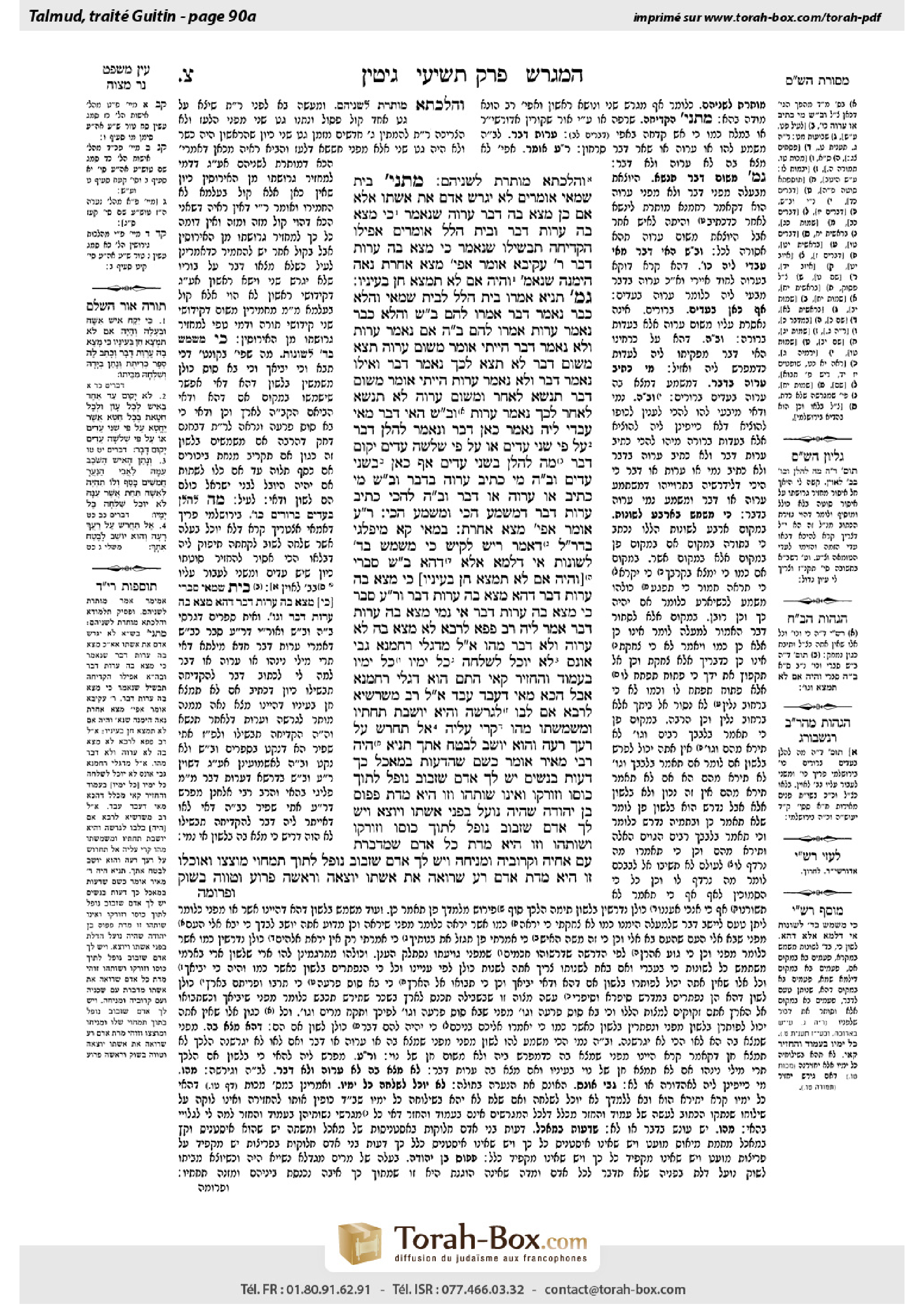
Gittin 90a: Talmud study for Daf Yomi
Study the Talmud for Daf Yomi with scanned pages, Hebrew text, English translations from Sefaria and AI-generated French translations.
Passage selection and English or AI-generated French translation are available where the scan has annotations. Daf Study is independent of Torah-Box and Sefaria.
Browse Gittin · גיטין · All tractatesGittin 90a text and translations
This page of Gittin includes the Aramaic text, an English translation and an AI-generated French translation, alongside the scan above.
גיטין צ׳ א · Aramaic and Hebrew text
וְהִלְכְתָא: מוּתֶּרֶת לִשְׁנֵיהֶם.
מַתְנִי׳ בֵּית שַׁמַּאי אוֹמְרִים: לֹא יְגָרֵשׁ אָדָם אֶת אִשְׁתּוֹ, אֶלָּא אִם כֵּן מָצָא בָּהּ דְּבַר עֶרְוָה – שֶׁנֶּאֱמַר: ״כִּי מָצָא בָהּ עֶרְוַת דָּבָר״.
וּבֵית הִלֵּל אוֹמְרִים: אֲפִילּוּ הִקְדִּיחָה תַּבְשִׁילוֹ – שֶׁנֶּאֱמַר: ״כִּי מָצָא בָהּ עֶרְוַת דָּבָר״.
רַבִּי עֲקִיבָא אוֹמֵר: אֲפִילּוּ מָצָא אַחֶרֶת נָאָה הֵימֶנָּה – שֶׁנֶּאֱמַר: ״וְהָיָה אִם לֹא תִמְצָא חֵן בְּעֵינָיו״.
גְּמָ׳ תַּנְיָא, אָמְרוּ בֵּית הִלֵּל לְבֵית שַׁמַּאי: וַהֲלֹא כְּבָר נֶאֱמַר ״דָּבָר״! אָמְרוּ לָהֶם בֵּית שַׁמַּאי: וַהֲלֹא כְּבָר נֶאֱמַר ״עֶרְוַת״!
אָמְרוּ לָהֶם בֵּית הִלֵּל: אִם נֶאֱמַר ״עֶרְוַת״ וְלֹא נֶאֱמַר ״דָּבָר״ – הָיִיתִי אוֹמֵר: מִשּׁוּם ״עֶרְוָה״ תֵּצֵא, מִשּׁוּם ״דָּבָר״ לֹא תֵּצֵא; לְכָךְ נֶאֱמַר: ״דָּבָר״. וְאִילּוּ נֶאֱמַר ״דָּבָר״ וְלֹא נֶאֱמַר ״עֶרְוַת״ – הָיִיתִי אוֹמֵר: מִשּׁוּם ״דָּבָר״ – תִּנָּשֵׂא לְאַחֵר, וּמִשּׁוּם ״עֶרְוָה״ – לֹא תִּנָּשֵׂא לְאַחֵר; לְכָךְ נֶאֱמַר: ״עֶרְוַת״.
וּבֵית שַׁמַּאי – הַאי ״דָּבָר״ מַאי עָבְדִי לֵיהּ? נֶאֱמַר כָּאן ״דָּבָר״, וְנֶאֱמַר לְהַלָּן ״דָּבָר״ – ״עַל פִּי שְׁנֵי עֵדִים אוֹ עַל פִּי שְׁלֹשָׁה עֵדִים יָקוּם דָּבָר״; מָה לְהַלָּן בִּשְׁנֵי עֵדִים, אַף כָּאן בִּשְׁנֵי עֵדִים.
וּבֵית הִלֵּל – מִי כְּתִיב ״עֶרְוָה בְּדָבָר״?! וּבֵית שַׁמַּאי – מִי כְּתִיב ״אוֹ עֶרְוָה אוֹ דָּבָר״?!
וּבֵית הִלֵּל – לְהָכִי כְּתִיב: ״עֶרְוַת דָּבָר״; דְּמַשְׁמַע הָכִי, וּמַשְׁמַע הָכִי.
רַבִּי עֲקִיבָא אוֹמֵר: אֲפִילּוּ מָצָא אַחֶרֶת: בְּמַאי קָא מִיפַּלְגִי? בִּדְרֵישׁ לָקִישׁ – דְּאָמַר רֵישׁ לָקִישׁ: ״כִּי״ מְשַׁמֵּשׁ בְּאַרְבָּעָה לְשׁוֹנוֹת – אִי, דִּלְמָא, אֶלָּא, דְּהָא.
בֵּית שַׁמַּאי סָבְרִי: ״וְהָיָה אִם לֹא תִמְצָא חֵן בְּעֵינָיו, כִּי מָצָא בָהּ עֶרְוַת דָּבָר״ – דְּהָא מָצָא בָהּ עֶרְוַת דָּבָר; וְרַבִּי עֲקִיבָא סָבַר: ״כִּי מָצָא בָהּ עֶרְוַת דָּבָר״ – אִי נָמֵי, מָצָא בָהּ עֶרְוַת דָּבָר.
אֲמַר לֵיהּ רַב פָּפָּא לְרָבָא: לֹא מָצָא בָּהּ לֹא עֶרְוָה וְלֹא דָּבָר, מַהוּ?
אֲמַר לֵיהּ, מִדְּגַלִּי רַחֲמָנָא גַּבֵּי אוֹנֶס: ״לֹא יוּכַל לְשַׁלְּחָהּ כׇּל יָמָיו״ – כׇּל יָמָיו בַּ״עֲמוֹד וְהַחְזֵיר״ קָאֵי; הָתָם הוּא דְּגַלִּי רַחֲמָנָא, אֲבָל הָכָא – מַאי דַּעֲבַד עֲבַד.
אֲמַר לֵיהּ רַב מְשַׁרְשְׁיָא לְרָבָא: אִם לִבּוֹ לְגָרְשָׁהּ, וְהִיא יוֹשֶׁבֶת תַּחְתָּיו וּמְשַׁמַּשְׁתּוֹ, מַהוּ? קָרֵי עֲלֵיהּ: ״אַל תַּחֲרֹשׁ עַל רֵעֲךָ רָעָה וְהוּא יוֹשֵׁב לָבֶטַח אִתָּךְ״.
תַּנְיָא, הָיָה רַבִּי מֵאִיר אוֹמֵר: כְּשֵׁם שֶׁהַדֵּעוֹת בְּמַאֲכָל, כָּךְ דֵּעוֹת בְּנָשִׁים. יֵשׁ לְךָ אָדָם שֶׁזְּבוּב נוֹפֵל לְתוֹךְ כּוֹסוֹ – וְזוֹרְקוֹ, וְאֵינוֹ שׁוֹתֵהוּ; וְזוֹ הִיא מִדַּת פַּפּוּס בֶּן יְהוּדָה, שֶׁהָיָה נוֹעֵל בִּפְנֵי אִשְׁתּוֹ וְיוֹצֵא.
וְיֵשׁ לְךָ אָדָם שֶׁזְּבוּב נוֹפֵל לְתוֹךְ כּוֹסוֹ – וְזוֹרְקוֹ, וְשׁוֹתֵהוּ; וְזוֹ הִיא מִדַּת כׇּל אָדָם, שֶׁמְּדַבֶּרֶת עִם אַחֶיהָ וּקְרוֹבֶיהָ – וּמַנִּיחָהּ.
וְיֵשׁ לְךָ אָדָם שֶׁזְּבוּב נוֹפֵל לְתוֹךְ תַּמְחוּי – מוֹצְצוֹ, וְאוֹכְלוֹ; זוֹ הִיא מִדַּת אָדָם רַע, שֶׁרוֹאֶה אֶת אִשְׁתּוֹ יוֹצְאָה וְרֹאשָׁהּ פָּרוּעַ, וְטוֹוָה בַּשּׁוּק,
Gittin 90a · English translation
And the halakha is that she is permitted to both of them.
MISHNA: Beit Shammai say: A man may not divorce his wife unless he finds out about her having engaged in a matter of forbidden sexual intercourse [devar erva], i.e., she committed adultery or is suspected of doing so, as it is stated: “Because he has found some unseemly matter [ervat davar] in her, and he writes her a scroll of severance” (Deuteronomy 24:1).
And Beit Hillel say: He may divorce her even due to a minor issue, e.g., because she burned or over-salted his dish, as it is stated: “Because he has found some unseemly matter in her,” meaning that he found any type of shortcoming in her.
Rabbi Akiva says: He may divorce her even if he found another woman who is better looking than her and wishes to marry her, as it is stated in that verse: “And it comes to pass, if she finds no favor in his eyes” (Deuteronomy 24:1).
GEMARA: It is taught in a baraita that Beit Hillel said to Beit Shammai: But isn’t the word “matter” already stated in the verse, indicating that any disadvantageous matter is a legitimate reason for divorce? Beit Shammai said to them: But isn’t the word “unseemly [ervat]” already stated?
Beit Hillel said to them: If the word “unseemly” had been stated and the word “matter” had not been stated, I would have said that a wife should leave her husband due to forbidden sexual intercourse, but she should not have to leave him due to any other matter. Therefore, the word “matter” is stated. And if the word “matter” had been stated and the word “unseemly” had not been stated, I would have said that if he divorced her merely due to a disadvantageous matter she may marry another man, as the Torah continues: “And she departs out of his house, and goes and becomes another man’s wife” (Deuteronomy 24:2). But if she was divorced due to her engaging in forbidden sexual intercourse, she may not marry another man, as she is prohibited from remarrying. Therefore, the word “unseemly” is stated, indicating that even a wife who is divorced due to adultery is permitted to remarry.
The Gemara asks: And what do Beit Shammai do with this word “matter”? How do they interpret it? It seems superfluous, as in their opinion the verse refers specifically to a wife who engaged in forbidden sexual intercourse. The Gemara answers: The word “matter” is stated here, with regard to divorce, and the word “matter” is stated there, with regard to testimony: “At the mouth of two witnesses, or at the mouth of three witnesses, a matter shall be established” (Deuteronomy 19:15). Just as there, it is stated that a matter is established only through two witnesses, so too here, a matter of forbidden sexual intercourse justifies divorce only if it is established through two witnesses.
And Beit Hillel would respond to this analogy in the following manner: Is it written: Because he has found something unseemly in a matter [erva bedavar], indicating that it was established through the testimony of two witnesses that she engaged in adultery? And Beit Shammai would respond to Beit Hillel’s interpretation as follows: Is it written: Because he has found either something unseemly or another matter [o erva o davar], in accordance with Beit Hillel’s understanding?
And Beit Hillel would respond that for this reason the expression “some unseemly matter [ervat davar]” is written, as it indicates that interpretation, i.e., that a husband is not obligated to divorce his wife unless there are two witnesses to her having engaged in forbidden sexual intercourse, and it also indicates this interpretation, i.e., that he may divorce her due to any deficiency, be it adultery or any other shortcoming.
§ It is stated in the mishna that Rabbi Akiva says: He may divorce her even if he found another woman who is better looking than her. With regard to what do they disagree? They disagree with regard to the application of Reish Lakish’s statement, as Reish Lakish said that the term ki actually has at least four distinct meanings: If, perhaps, rather, and because.
Beit Shammai hold that the verse “And it comes to pass, if she finds no favor in his eyes, because [ki] he has found some unseemly matter in her” means that she did not find favor in his eyes due to the fact that he has found some unseemly matter in her. And Rabbi Akiva holds that the phrase “because [ki] he has found some unseemly matter in her” means: Or if he has found some unseemly matter in her.
§ Rav Pappa said to Rava: According to Beit Hillel, if the husband found about her neither forbidden sexual intercourse nor any other matter, but divorced her anyway, what is the halakha? Is the divorce valid?
Rava said to him that the answer can be derived from what the Merciful One reveals in the Torah with regard to a rapist: “He may not send her away all his days” (Deuteronomy 22:29), indicating that even if he divorces the woman whom he raped and was subsequently commanded to marry, all his days he stands commanded to arise and remarry her as his wife. Evidently, specifically there the husband is obligated to remarry his divorcée, as the Merciful One reveals as much. But here, what he did, he did.
Rav Mesharshiyya said to Rava: If he intends to divorce her and she is living with him and serving him, what is the halakha? Rava read the following verse about such a person: “Devise not evil against your neighbor, seeing he dwells securely by you” (Proverbs 3:29).
§ It is taught in a baraita (Tosefta, Sota 5:9) that Rabbi Meir would say: Just as there are different attitudes with regard to food, so too, there are different attitudes with regard to women. With regard to food, you have a person who, when a fly falls into his cup, he throws out the wine with the fly and does not drink it. And this is comparable to the demeanor of Pappos ben Yehuda with regard to his wife, as he would lock the door before his wife and leave so that she would not see any other man.
And you have a person who, when a fly falls into his cup, he throws out the fly and drinks the wine. And this is comparable to the demeanor of any common man, whose wife speaks with her siblings and relatives, and he lets her do so.
And you have a man who, when a fly falls into his serving bowl, he sucks the fly and eats the food. This is the demeanor of a bad man, who sees his wife going out into the street with her head uncovered, and spinning in the marketplace immodestly,
Gittin 90a · Traduction française (IA)
Et la halakha est qu'elle est permise aux deux.
MICHNA: Beit Shammai disent : Un homme ne peut pas divorcer de sa femme à moins qu'il découvre qu'elle a eu un rapport sexuel interdit [devar erva], c'est-à-dire qu'elle a commis l'adultère ou qu'on la soupçonne de le faire, comme il est dit : « Parce qu'il a trouvé quelque chose d'indecent [ervat davar] en elle, et il écrit un rouleau de séparation » (Deutéronome 24:1).
Et Beit Hillel disent : Il peut divorcer d'elle même pour une petite raison, par exemple parce qu'elle a brûlé ou trop salé son plat, comme il est dit : « Parce qu'il a trouvé quelque chose d'indecent en elle », signifiant qu'il a trouvé tout type de défaut en elle.
Rabbi Akiva dit : Il peut divorcer d'elle même s'il a trouvé une autre femme qui est plus belle qu'elle et qui veut l'épouser, comme il est dit dans cette versette : « Et il arrive, si elle ne trouve pas de faveur dans ses yeux » (Deutéronome 24:1).
GUEMARA : Il est enseigné dans une baraïta que Beit Hillel a dit à Beit Shammai : Mais n'est-ce pas le mot « chose » déjà mentionné dans la versette, indiquant que toute chose défavorable est une raison valable pour le divorce ? Beit Shammai a dit à eux : Mais n'est-ce pas le mot « décent [erva] » déjà mentionné ?
Beit Hillel a dit à eux : Si le mot « décent » avait été mentionné et le mot « chose » n'avait pas été mentionné, j'aurais dit qu'une femme doit quitter son mari en raison d'un rapport sexuel interdit, mais elle ne devrait pas avoir à quitter son mari en raison de toute autre chose. Donc, le mot « chose » est mentionné. Et si le mot « chose » avait été mentionné et le mot « décent » n'avait pas été mentionné, j'aurais dit que si il divorce d'elle simplement en raison d'une chose défavorable, elle peut épouser un autre homme, comme la Torah continue : « Et elle sort de sa maison, et va et devient l'épouse d'un autre homme » (Deutéronome 24:2). Mais si elle a été divorcée en raison d'un rapport sexuel interdit, elle ne peut pas épouser un autre homme, car elle est interdite de remariage. Donc, le mot « décent » est mentionné, indiquant que même une femme divorcée en raison d'adultère est permise de remariage.
La Guemara pose la question : Et comment Beit Shammai interprètent-ils ce mot « chose » ? Il semble superflu, car selon leur opinion, la versette fait référence spécifiquement à une femme ayant eu un rapport sexuel interdit. La Guemara répond : Le mot « chose » est mentionné ici, concernant le divorce, et le mot « chose » est mentionné là, concernant le témoignage : « À la bouche de deux témoins, ou à la bouche de trois témoins, une chose sera établie » (Deutéronome 19:15). Tout comme là, il est dit qu'une chose est établie seulement par deux témoins, ainsi ici, un rapport sexuel interdit justifie le divorce seulement si elle est établi par deux témoins.
Et Beit Hillel répondrait à cette analogie de la manière suivante : Est-il écrit : « Parce qu'il a trouvé quelque chose de décent dans une chose [erva bedavar] », indiquant qu'il a été établi par le témoignage de deux témoins qu'elle a eu un rapport sexuel interdit ? Et Beit Shammai répondrait à l'interprétation de Beit Hillel comme suit : Est-il écrit : « Parce qu'il a trouvé soit quelque chose de décent soit une autre chose [o erva o davar] », selon l'interprétation de Beit Hillel ?
Et Beit Hillel répondrait que pour cette raison l'expression « quelque chose de décent [ervat davar] » est écrite, car elle indique cette interprétation, c'est-à-dire qu'un mari n'est pas tenu de divorcer de sa femme à moins qu'il y ait deux témoins de son avoir eu un rapport sexuel interdit, et elle indique aussi cette interprétation, c'est-à-dire qu'il peut divorcer d'elle en raison de tout défaut, qu'il s'agisse d'adultère ou d'un autre défaut.
§ Il est dit dans la Michna que Rabbi Akiva dit : Il peut divorcer d'elle même s'il a découvert une autre femme qui est plus belle qu'elle. Sur quel point s'opposent-ils ? Ils s'opposent sur l'application de la déclaration de Reish Lakish, car Reish Lakish a dit que le terme ki a au moins quatre sens distincts : Si, peut-être, plutôt, et parce que.
Beit Shammai considèrent que la versette « Et il arrive, si elle ne trouve pas de faveur dans ses yeux, parce [ki] il a trouvé quelque chose de décent en elle » signifie que elle n'a pas trouvé de faveur dans ses yeux en raison du fait qu'il a trouvé quelque chose de décent en elle. Et Rabbi Akiva considère que la phrase « parce [ki] il a trouvé quelque chose de décent en elle » signifie : Ou si il a trouvé quelque chose de décent en elle.
§ Rav Pappa a dit à Rava : Selon Beit Hillel, si le mari a découvert à son sujet ni un rapport sexuel interdit ni toute autre chose, mais a divorcé de toute façon, quelle est la halakha ? Le divorce est-il valide ?
Rava dit à lui que la réponse peut être déduite de ce que l'Éternel révèle dans la Torah concernant un violateur : « Il ne peut pas l'envoyer loin toute sa vie » (Deutéronome 22:29), indiquant que même s'il divorce la femme qu'il a violée et qu'il a été commandé d'épouser, toute sa vie il est tenu de se lever et de la remarié comme sa femme. Évidemment, précisément là le mari est tenu de remarié sa divorcée, car l'Éternel révèle cela. Mais ici, ce qu'il a fait, il l'a fait.
Rav Mesharshiyya dit à Rava : S'il veut divorcer d'elle et elle vit avec lui et le sert, quelle est la halakha ? Rava a lu la suivante versette à propos de telle une personne : « Conspuez pas le mal contre votre prochain, en voyant qu'il demeure en sécurité auprès de vous » (Proverbes 3:29).
§ Il est enseigné dans une baraïta (Tosefta, Sota 5:9) que Rabbi Meïr disait : Comme il existe différentes attitudes concernant la nourriture, de même il en va ainsi concernant les femmes. En ce qui concerne la nourriture, il y a un homme qui, lorsqu'un moustique tombe dans son verre, jette le vin avec le moustique et ne le boit pas. Cela est comparable au comportement de Pappos ben Yéhuda envers sa femme, car il fermait la porte avant elle et partait afin qu'elle ne voie aucun autre homme.
Et il y a un homme qui, lorsqu'un moustique tombe dans son verre, jette le moustique et boit le vin. Cela est comparable au comportement d'un homme ordinaire, dont la femme parle avec ses frères et parents, et il le permet.
Et il y a un homme qui, lorsqu'un moustique tombe dans son plat, aspire le moustique et mange la nourriture. Cela est le comportement d'un mauvais homme, qui voit sa femme sortir dans la rue avec la tête nue et tourner immodestement dans le marché.
Traduction française générée par IA à partir de l’édition anglaise de Sefaria. Vérifie toujours un passage avec le texte source.
Text from Sefaria: William Davidson Edition - Vocalized Aramaic (CC BY NC); William Davidson Edition - English (CC BY NC).