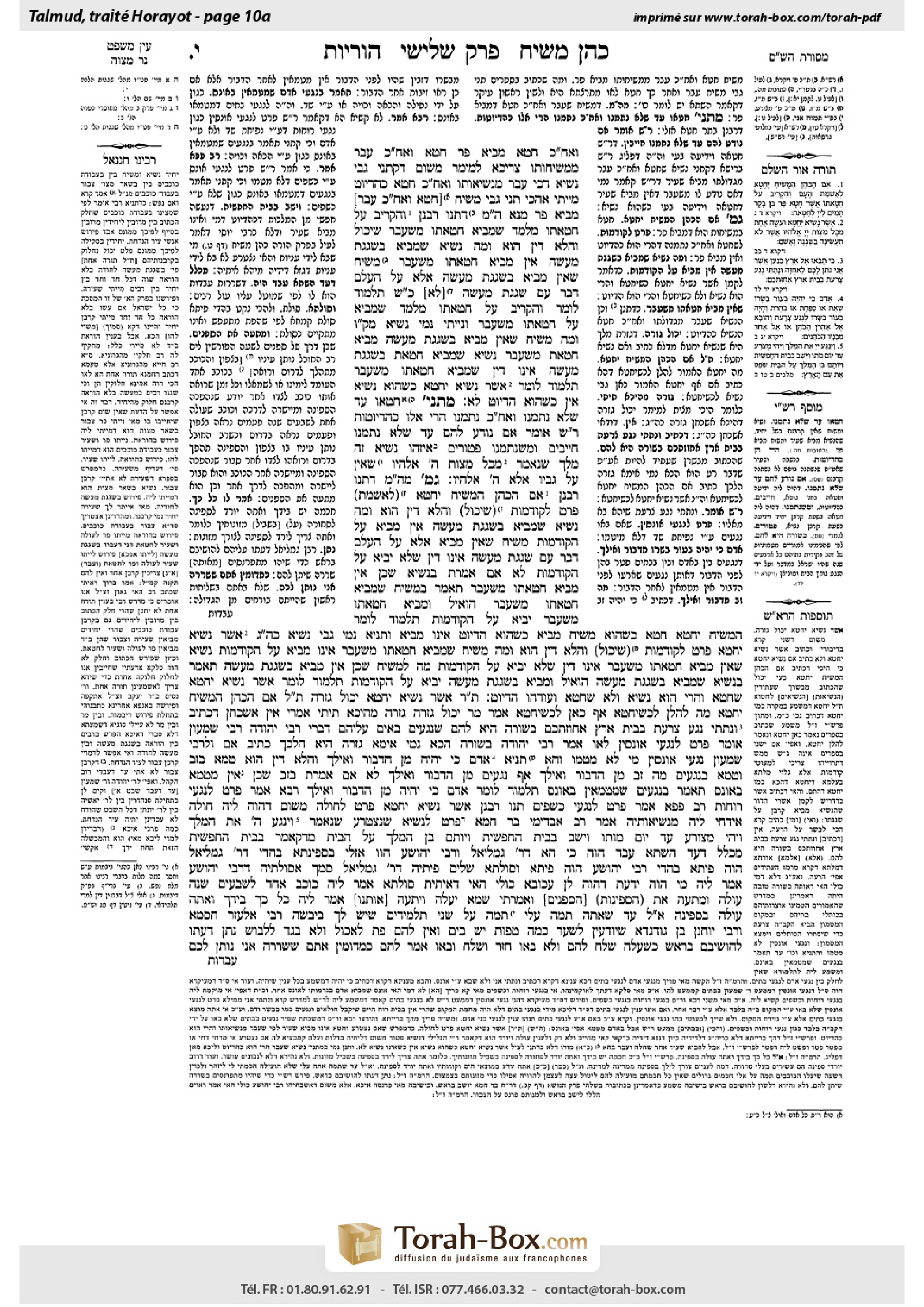
Horayot 10a: Talmud study for Daf Yomi
Study the Talmud for Daf Yomi with scanned pages, Hebrew text, English translations from Sefaria and AI-generated French translations.
Passage selection and English or AI-generated French translation are available where the scan has annotations. Daf Study is independent of Torah-Box and Sefaria.
Browse Horayot · הוריות · All tractatesHorayot 10a text and translations
This page of Horayot includes the Aramaic text, an English translation and an AI-generated French translation, alongside the scan above.
הוריות י׳ א · Aramaic and Hebrew text
וְאַחַר כָּךְ חָטָא מֵבִיא פַּר, חָטָא וְאַחַר כָּךְ עָבַר מִמְּשִׁיחוּתוֹ צְרִיכָא לְמֵימַר? מִשּׁוּם דְּקָתָנֵי גַּבֵּי נָשִׂיא, דְּכִי עָבַר מִנְּשִׂיאוּתוֹ וְאַחַר כָּךְ חָטָא – כְּהֶדְיוֹט מַיְיתֵי, אַהָכִי תָּנֵי גַּבֵּי מָשִׁיחַ [חָטָא וְאַחַר כָּךְ עָבַר] מֵבִיא פַּר.
מְנָא הָנֵי מִילֵּי? דְּתָנוּ רַבָּנַן: ״וְהִקְרִיב עַל חַטָּאתוֹ״, מְלַמֵּד שֶׁמֵּבִיא חַטָּאתוֹ מִשֶּׁעָבַר,
שֶׁיָּכוֹל, וַהֲלֹא דִּין הוּא: וּמָה נָשִׂיא שֶׁמֵּבִיא בְּשִׁגְגַת מַעֲשֶׂה – אֵין מֵבִיא חַטָּאתוֹ מִשֶּׁעָבַר, מָשִׁיחַ שֶׁאֵין מֵבִיא בְּשִׁגְגַת מַעֲשֶׂה אֶלָּא עַל הֶעְלֵם דָּבָר עִם שִׁגְגַת מַעֲשֶׂה – [לֹא] כׇּל שֶׁכֵּן! תַּלְמוּד לוֹמַר: ״וְהִקְרִיב עַל חַטָּאתוֹ״, מְלַמֵּד שֶׁמֵּבִיא עַל חַטָּאתוֹ מִשֶּׁעָבַר.
וְנַיְיתֵי נָמֵי נָשִׂיא מִקַּל וָחוֹמֶר: וּמָה מָשִׁיחַ שֶׁאֵין מֵבִיא בְּשִׁגְגַת מַעֲשֶׂה – מֵבִיא חַטָּאת מִשֶּׁעָבַר, נָשִׂיא שֶׁמֵּבִיא חַטָּאת בְּשִׁגְגַת מַעֲשֶׂה – אֵינוֹ דִּין שֶׁמֵּבִיא חַטָּאתוֹ מִשֶּׁעָבַר! תַּלְמוּד לוֹמַר: ״אֲשֶׁר נָשִׂיא יֶחֱטָא״, כְּשֶׁהוּא נָשִׂיא – אִין, כְּשֶׁהוּא הֶדְיוֹט – לָא.
מַתְנִי׳ חָטְאוּ עַד שֶׁלֹּא נִתְמַנּוּ, וְאַחַר כָּךְ נִתְמַנּוּ – הֲרֵי אֵלּוּ כְּהֶדְיוֹטוֹת. רַבִּי שִׁמְעוֹן אוֹמֵר: אִם נוֹדַע לָהֶם עַד שֶׁלֹּא נִתְמַנּוּ – חַיָּיבִים, וּמִשֶּׁנִּתְמַנּוּ – פְּטוּרִים.
אֵיזֶהוּ נָשִׂיא? זֶה מֶלֶךְ, שֶׁנֶּאֱמַר: ״מִכׇּל מִצְוֹת ה׳ אֱלֹהָיו״, שֶׁאֵין עַל גַּבָּיו אֶלָּא ה׳ אֱלֹהָיו.
גְּמָ׳ מְנָא הָנֵי מִילֵּי? דְּתָנוּ רַבָּנַן: ״אִם הַכֹּהֵן הַמָּשִׁיחַ יֶחֱטָא (לְאַשְׁמַת)״ – פְּרָט לַקּוֹדְמוֹת,
שֶׁיָּכוֹל, וַהֲלֹא דִּין הוּא: וּמָה נָשִׂיא שֶׁמֵּבִיא בְּשִׁגְגַת מַעֲשֶׂה – אֵין מֵבִיא עַל הַקּוֹדְמוֹת, מָשִׁיחַ שֶׁאֵין מֵבִיא אֶלָּא עַל הֶעְלֵם דָּבָר עִם שִׁגְגַת מַעֲשֶׂה – אֵינוֹ דִּין שֶׁלֹּא יָבִיא עַל הַקּוֹדְמוֹת!
לֹא, אִם אָמַרְתָּ בְּנָשִׂיא – שֶׁכֵּן אֵין מֵבִיא חַטָּאתוֹ מִשֶּׁעָבַר, תֹּאמַר בְּמָשִׁיחַ – שֶׁמֵּבִיא חַטָּאתוֹ מִשֶּׁעָבַר, הוֹאִיל וּמֵבִיא חַטָּאתוֹ מִשֶּׁעָבַר – יָבִיא עַל הַקּוֹדְמוֹת? תַּלְמוּד לוֹמַר: ״הַמָּשִׁיחַ יֶחֱטָא״, חָטָא כְּשֶׁהוּא מָשִׁיחַ – מֵבִיא, כְּשֶׁהוּא הֶדְיוֹט – אֵינוֹ מֵבִיא.
וְתַנְיָא נָמֵי גַּבֵּי נָשִׂיא כְּהַאי גַּוְונָא: ״אֲשֶׁר נָשִׂיא יֶחֱטָא״ – פְּרָט לַקּוֹדְמוֹת,
שֶׁיָּכוֹל וַהֲלֹא דִּין הוּא: וּמָה מָשִׁיחַ שֶׁמֵּבִיא חַטָּאתוֹ מִשֶּׁעָבַר – אֵינוֹ מֵבִיא עַל הַקּוֹדְמוֹת, נָשִׂיא שֶׁאֵין מֵבִיא חַטָּאתוֹ מִשֶּׁעָבַר – אֵינוֹ דִּין שֶׁלֹּא יָבִיא עַל הַקּוֹדְמוֹת?
מָה לְמָשִׁיחַ שֶׁכֵּן אֵין מֵבִיא בְּשִׁגְגַת מַעֲשֶׂה, תֹּאמַר בְּנָשִׂיא שֶׁמֵּבִיא בְּשִׁגְגַת מַעֲשֶׂה? הוֹאִיל וּמֵבִיא בְּשִׁגְגַת מַעֲשֶׂה – יָבִיא עַל הַקּוֹדְמוֹת? תַּלְמוּד לוֹמַר: ״אֲשֶׁר נָשִׂיא יֶחֱטָא״ – שֶׁחָטָא וַהֲרֵי הוּא נָשִׂיא, וְלֹא שֶׁחָטָא וְעוֹדֵהוּ הֶדְיוֹט.
תָּנוּ רַבָּנַן: ״אֲשֶׁר נָשִׂיא יֶחֱטָא״, יָכוֹל גְּזֵרָה? תַּלְמוּד לוֹמַר: ״אִם הַכֹּהֵן הַמָּשִׁיחַ יֶחֱטָא״, מָה לְהַלָּן לִכְשֶׁיֶּחֱטָא – אַף כָּאן לִכְשֶׁיֶּחֱטָא.
אָמַר מָר: יָכוֹל גְּזֵרָה, גְּזֵרָה מֵהֵיכָא תֵּיתֵי?
אָמְרִי אִין, אַשְׁכְּחַן, דִּכְתִיב: ״וְנָתַתִּי נֶגַע צָרַעַת בְּבֵית אֶרֶץ אֲחֻזַּתְכֶם״, בְּשׂוֹרָה הִיא לָהֶם שֶׁנְּגָעִים בָּאִים עֲלֵיהֶם, דִּבְרֵי רַבִּי יְהוּדָה. רַבִּי שִׁמְעוֹן אוֹמֵר: פְּרָט לְנִגְעֵי אוֹנָסִין. לָאו אָמַר רַבִּי יְהוּדָה בְּשׂוֹרָה? הָכָא נָמֵי אֵימָא גְּזֵרָה הִיא! הִלְכָּךְ כְּתִיב: ״אִם״.
וּלְרַבִּי שִׁמְעוֹן, נִגְעֵי אוֹנָסִין מִי לָא מְטַמּוּ? וְהָא תַּנְיָא: ״אָדָם כִּי יִהְיֶה״ – מִן הַדִּבּוּר וְאֵילָךְ. וַהֲלֹא דִּין הוּא: טָמֵא בְּזָב וְטָמֵא בִּנְגָעִים, מָה זָב – מִן הַדִּבּוּר וְאֵילָךְ, אַף נְגָעִים – מִן הַדִּבּוּר וְאֵילָךְ?
לֹא, אִם אָמַרְתָּ בְּזָב שֶׁכֵּן אֵין מְטַמֵּא בְּאוֹנֶס, תֹּאמַר בִּנְגָעִים שֶׁמְּטַמְּאִין בְּאוֹנֶס? תַּלְמוּד לוֹמַר: ״אָדָם כִּי יִהְיֶה״, מִן הַדִּבּוּר וְאֵילָךְ. רָבָא אָמַר: פְּרָט לְנִגְעֵי רוּחוֹת. רַב פָּפָּא אָמַר: פְּרָט לְנִגְעֵי כְשָׁפִים.
תָּנוּ רַבָּנַן: ״אֲשֶׁר נָשִׂיא יֶחֱטָא״ – פְּרָט לְחוֹלֶה. מִשּׁוּם דְּהָוֵה לֵיהּ חוֹלֶה, אִידְּחִי לֵיהּ מִנְּשִׂיאוּתֵיהּ? אָמַר רַב אַבְדִּימִי בַּר חָמָא: פְּרָט לְנָשִׂיא שֶׁנִּצְטָרַע, שֶׁנֶּאֱמַר: ״וַיְנַגַּע ה׳ אֶת הַמֶּלֶךְ וַיְהִי מְצֹרָע עַד יוֹם מֹתוֹ וַיֵּשֶׁב בְּבֵית הַחׇפְשִׁית וְיוֹתָם בֶּן הַמֶּלֶךְ עַל הַבַּיִת״. מִדְּקָאָמַר ״בְּבֵית הַחׇפְשִׁית״, מִכְּלָל דְּעַד הַשְׁתָּא עֶבֶד הֲוָה.
כִּי הָא דְּרַבָּן גַּמְלִיאֵל וְרַבִּי יְהוֹשֻׁעַ הֲווֹ אָזְלִי בִּסְפִינְתָּא, בַּהֲדֵי דְּרַבָּן גַּמְלִיאֵל הֲוָה פִּיתָּא, בַּהֲדֵי רַבִּי יְהוֹשֻׁעַ הֲוָה פִּיתָּא וְסוּלְתָּא. שְׁלִים פִּיתֵּיהּ דְּרַבָּן גַּמְלִיאֵל, סְמַךְ אַסּוּלְתֵּיהּ דְּרַבִּי יְהוֹשֻׁעַ. אֲמַר לֵיהּ: מִי הֲוָה יָדְעַתְּ דְּהָוֵה לַן עִכּוּבָא כּוּלֵּי הַאי דְּאַיְתֵית סוּלְתָּא? אֲמַר לֵיהּ: כּוֹכָב אֶחָד לְשִׁבְעִים שָׁנָה עוֹלֶה וּמַתְעֶה אֶת (הַסְּפִינוֹת) [הַסַּפָּנִים], וְאָמַרְתִּי: שֶׁמָּא יַעֲלֶה וְיַתְעֶה [אוֹתָנוּ].
אֲמַר לֵיהּ: כׇּל כָּךְ בְּיָדְךָ, וְאַתָּה עוֹלֶה בִּסְפִינָה? אֲמַר לֵיהּ: עַד שֶׁאַתָּה תָּמֵהַּ עָלַי, תְּמַהּ עַל שְׁנֵי תַּלְמִידִים שֶׁיֵּשׁ לְךָ בַּיַּבָּשָׁה, רַבִּי אֶלְעָזָר חַסָּמָא וְרַבִּי יוֹחָנָן בֶּן גּוּדְגְּדָא, שֶׁיּוֹדְעִין לְשַׁעֵר כַּמָּה טִפּוֹת יֵשׁ בַּיָּם, וְאֵין לָהֶם פַּת לֶאֱכוֹל וְלֹא בֶּגֶד לִלְבּוֹשׁ! נָתַן דַּעְתּוֹ לְהוֹשִׁיבָם בָּרֹאשׁ.
כְּשֶׁעָלָה, שָׁלַח לָהֶם וְלֹא בָּאוּ, חָזַר וְשָׁלַח וּבָאוּ. אָמַר לָהֶם: כִּמְדוּמִּין אַתֶּם שֶׁשְּׂרָרָה אֲנִי נוֹתֵן לָכֶם?
Horayot 10a · English translation
and thereafter sinned brings a bull. Does the case of one who sinned and thereafter moved on from his anointment need to be said? It is obvious that he is liable to bring a bull. The Gemara answers: Due to the fact that the tanna teaches the halakha with regard to a king, that when he moved on from his sovereignty and thereafter sinned he brings an offering like that of a commoner; therefore, he teaches the corresponding halakha with regard to an anointed priest: If he sinned and thereafter moved on from his priesthood, he brings a bull.
§ With regard to the statement in the mishna concerning an anointed priest who sinned after he was removed from his position, the Gemara asks: From where are these matters derived? The Gemara answers: It is as the Sages taught: It is written with regard to the High Priest: “And he shall sacrifice for his sin [ḥattato] that he sinned” (Leviticus 4:3); this teaches that he brings his sin-offering [ḥattato] even after he has moved on from his priesthood.
This derivation is necessary, as one might have thought: Could this not be derived through an a fortiori inference? And if a king, who brings a goat as his sin-offering for the unwitting performance of an action, does not bring a goat as his sin-offering from the moment that he has moved on from his sovereignty, an anointed priest, who does not bring a sin-offering for the unwitting performance of an action alone; rather, he is liable only for absence of awareness of the matter by the court together with unwitting performance of an action, is it not all the more so that he will not bring a bull for his sin-offering once he has moved on from the High Priesthood? Therefore, the verse states: “And he shall sacrifice for his sin [ḥattato] that he sinned”; this teaches that he brings his sin-offering [ḥattato] even after he has moved on from his priesthood.
The Gemara asks: And let a king who is no longer king, too, bring a goat as a sin-offering based on an a fortiori inference: And if an anointed priest, who does not bring an offering for the unwitting performance of an action, brings a sin-offering after he has moved on from the priesthood, then with regard to a king, who brings a sin-offering for the unwitting performance of an action, is it not logical that he still brings his sin-offering once he has moved on from his sovereignty? To counter this, the verse states: “When a king sins” (Leviticus 4:22), from which it is derived: If he sins when he is king, yes, he brings his sin-offering; if he sins when he is a commoner, no, he does not bring his sin-offering.
MISHNA: If a king or High Priest sinned before they were appointed, and thereafter they were appointed, the status of these people is like that of commoners; they bring the sin-offering of an individual. Rabbi Shimon says: If it became known to them, before they were appointed as king or High Priest, that they had sinned, they are liable to bring the sin-offering of an individual, but if it became known to them after they were appointed as king or High Priest they are completely exempt.
Who is the nasi? This is a king, as it is stated: “When a nasi sins, and performs any one of all the mitzvot of the Lord his God that shall not be performed, unwittingly, and he is guilty” (Leviticus 4:22), referring to one who has only the Lord his God over him and no other authority. That is only the king.
GEMARA: The mishna teaches: If a king or High Priest sinned before they were appointed, and thereafter they were appointed, the status of these people is like that of commoners. The Gemara asks: From where are these matters derived? The Gemara answers: It is as the Sages taught with regard to the verse: “If the anointed priest shall sin to bring guilt” (Leviticus 4:3); this serves to exclude the unwitting transgressions he performed prior to his installation as High Priest.
As one might have thought: Could this not be derived through an a fortiori inference? And if a king, who brings a goat as his sin-offering for the unwitting performance of an action, does not bring a sin-offering for the unwitting transgressions he performed prior to his coronation, then with regard to an anointed priest, who brings his sin-offering only for absence of awareness of the matter by the court with the unwitting performance of an action, is it not logical that he will not bring his sin-offering for the prior transgressions?
The Gemara rejects this: No, if you said this with regard to a king, that is reasonable, as he does not bring his goat for a sin-offering once he has moved on from his sovereignty, and instead brings the sin-offering of a commoner. Shall you also say this with regard to an anointed priest, who brings a bull for his sin-offering once he has moved on from his priesthood? Since he brings a bull for his sin-offering even once he has moved on from his priesthood, perhaps he shall bring a bull as a sin-offering for the unwitting transgressions he performed prior to his installation as High Priest? Therefore, the verse states: “If the anointed priest shall sin,” from which it is derived: If he sins when he is serving as an anointed priest he brings a bull as his sin-offering; if he sins when he is an ordinary priest he does not bring a bull as his sin-offering.
And it is also taught in this way in a baraita with regard to a king: “When a king sins” (Leviticus 4:22); this serves to exclude the unwitting transgressions he performed prior to his coronation as king.
As one might have thought: Could this not be derived through an a fortiori inference? If an anointed priest, who brings a bull for his sin-offering even once he has moved on from his priesthood, does not bring his sin-offering for the unwitting transgressions he performed prior to his installation, then with regard to a king, who does not bring his goat for a sin-offering once he has moved on from his sovereignty, is it not logical that he will not bring his sin-offering for the prior transgressions? Apparently, there is no need for the derivation from the verse.
The Gemara notes that this inference can be rejected. What is notable about an anointed priest? He is notable in that he does not bring a sin-offering for the unwitting performance of an action unless it was performed on the basis of an erroneous ruling. Shall you say the same with regard to a king, who brings an offering for the unwitting performance of an action alone, even without an erroneous ruling? Since he brings an offering for the unwitting performance of an action alone, shall he bring a bull as a sin-offering for the unwitting transgressions he performed prior to his coronation? Therefore, the verse states: “When a king sins,” from which it is derived: In a case where he sins and he is king, he brings a bull as his sin-offering, and not in a case where he sins and he is still a commoner.
§ Apropos a king, the Sages taught: In contrast to other cases where the verse states: If he will sin, it states concerning a king: “When [asher] a king sins.” One might have thought that this is a decree, i.e., that it is a given that the king will sin. Therefore, the verse states: “If the anointed priest shall sin” (Leviticus 4:3). Just as there the meaning is: In the event that the priest shall sin, so too here, the meaning is: In the event that the king shall sin.
The Gemara analyzes the baraita. The Master said: One might have thought that this is a decree. The Gemara asks: A decree? From where would this be derived? Why would it enter one’s mind that there would be a decree that the king must sin?
The Sages say: Yes, there is a basis for that understanding, as we find that type of interpretation elsewhere; as it is written: “When you come into the land of Canaan, which I give to you for a possession, and I shall place the mark of leprosy in a house of the land of your possession” (Leviticus 14:34). These are tidings informing them, i.e., the Jewish people, that leprous marks will come upon them when they enter Eretz Yisrael; this is the statement of Rabbi Yehuda. Rabbi Shimon says: This verse serves to teach that leprosy causes ritual impurity only when its origins are divine, to the exclusion of leprosy that results from circumstances beyond one’s control, i.e., those that have a clear physical cause. Didn’t Rabbi Yehuda say that leprosy could be tidings, i.e., that there will definitely be leprosy? Here too, with regard to the king, say that it is a decree that he will sin. Therefore, it is written: “If the anointed priest shall sin,” meaning that the sin is not a given.
The Gemara asks with regard to the baraita: And according to Rabbi Shimon, do leprous marks that result from circumstances beyond one’s control not cause ritual impurity? But isn’t it taught in a baraita: “When a person shall have in the skin of his flesh a wool-white leprous mark or a scab” (Leviticus 13:2); these halakhot apply from this statement onward, i.e., from the time that God gave this mitzva to the Jewish people, and these halakhot do not apply to leprosy that preceded the giving of the mitzva? And could this not be derived through logical inference: The Torah deemed one impure in the case of a zav, and the Torah deemed one impure in the case of leprous marks. Just as a zav is ritually impure only from the statement onward, so too, with regard to leprous marks, there is impurity only from that statement onward. There is no need for a derivation from the verse Leviticus 13:2.
The baraita continues: This inference can be rejected: No, if you said that with regard to a zav, this is reasonable, as he does not become impure if his condition was caused by circumstances beyond his control. Shall you say the same with regard to leprous marks, which impart ritual impurity when caused by circumstances beyond one’s control? Therefore, the verse states: “When a person shall have,” indicating that there is impurity only from that statement onward. In any case, it is clear that leprosy causes impurity even if it was caused by circumstances beyond his control. Rava says in explanation: The phrase “and I shall place the mark of leprosy” serves to exclude leprous marks caused by evil spirits. Rav Pappa says in explanation: That phrase serves to exclude leprous marks caused by sorcery.
§ Apropos a king, the Sages taught that when the verse states: “When a king sins” (Leviticus 4:22), this serves to exclude a king who is ill. The Gemara asks: Due to the fact that he is ill, is he removed from his sovereignty? Rav Avdimi bar Ḥama said: The reference is not to all illnesses; rather, it is to exclude a king who is afflicted with leprosy, as it is stated concerning King Azariah: “And the Lord afflicted the king, so that he was a leper until the day of his death, and dwelt in an independent house. And Jotham, son of the king, was over the household, judging the people of the land” (II Kings 15:5). Azariah was removed from his sovereignty when he was afflicted with leprosy. The Gemara comments: From the fact that the verse states: “In an independent house,” by inference it may be understood that until now he was a servant, i.e., he was in servitude to the people.
The Gemara notes: This is similar to that incident where Rabban Gamliel and Rabbi Yehoshua were traveling together on a ship. Rabban Gamliel had sufficient bread for the journey. Rabbi Yehoshua also had sufficient bread, and additionally he had flour. The journey lasted longer than expected, and Rabban Gamliel’s bread was finished. He relied on Rabbi Yehoshua’s flour for nourishment. Rabban Gamliel said to Rabbi Yehoshua: Did you know from the outset that we would have so substantial a delay? Is that the reason that you brought flour with you? Rabbi Yehoshua said to Rabban Gamliel: There is one star that rises once in seventy years and misleads sailors at sea, causing their journeys to be extended. And I said: Perhaps that star will rise during our journey and mislead us.
Rabban Gamliel said to him: So much wisdom is at your disposal, and you board a ship to earn your livelihood? Rabbi Yehoshua said to him: Before you wonder about me, wonder about two students that you have on dry land, Rabbi Elazar Ḥisma and Rabbi Yoḥanan ben Gudgeda, who are so wise that they know how to calculate how many drops of water there are in the sea, and yet they have neither bread to eat nor a garment to wear. Rabban Gamliel made up his mind to seat them at the head of the academy.
When Rabban Gamliel ascended to dry land, he sent a messenger to them to tell them to come so that he could appoint them and they did not come. He again sent a messenger to them and they came. Rabban Gamliel said to them: Do you imagine that I am granting you authority, and since you did not want to accept the honor you did not come when I sent for you?
Horayot 10a · Traduction française (IA)
Et après avoir péché, il offre un taureau. Faut-il dire le cas d'une personne qui a péché et puis s'est éloigné de son ordination ? Il est évident qu'il est tenu de présenter un taureau. La Guemara répond : En raison du fait que le tanna enseigne la halakha concernant un roi, à savoir que lorsqu'il s'est éloigné de son royaume et qu'il a ensuite péché, il présente un sacrifice comme un citoyen ordinaire ; donc, il enseigne la halakha correspondante concernant un prêtre ordonné : s'il a péché et s'est ensuite éloigné de son sacerdoce, il offre un taureau.
§ Concernant l'affirmation de la mitsna concernant un prêtre ordonné qui a péché après avoir été retiré de son poste, la Guemara pose la question : D'où ces choses sont-elles dérivées ? La Guemara répond : C'est comme les Sages ont enseigné : il est écrit concernant le grand prêtre : « Et il offrira pour son péché [ḥattato] qu'il a péché » (Lévitique 4:3) ; cela enseigne qu'il présente son sacrifice expiatoire [ḥattato] même après avoir quitté son sacerdoce.
Cette dérivation est nécessaire, car on pourrait penser : ne pourrait-on pas déduire cela par une inférence a fortiori ? Et si un roi, qui présente un bouc comme sacrifice expiatoire pour une action involontaire, ne présente pas un bouc comme sacrifice expiatoire dès qu'il a quitté son royaume, un prêtre ordonné, qui ne présente pas de sacrifice expiatoire pour une action involontaire seule ; plutôt, il est tenu seulement pour l'absence de connaissance du fait par le tribunal conjuguée à une action involontaire, n'est-il pas encore plus certain qu'il ne présentera pas un taureau comme sacrifice expiatoire une fois qu'il a quitté le sacerdoce suprême ? Par conséquent, le verset dit : « Et il offrira pour son péché [ḥattato] qu'il a péché » ; cela enseigne qu'il présente son sacrifice expiatoire [ḥattato] même après avoir quitté son sacerdoce.
La Guemara pose la question : Et un roi qui n'est plus roi, présente-t-il aussi un bouc comme sacrifice expiatoire par une inférence a fortiori : et si un prêtre ordonné, qui ne présente pas de sacrifice expiatoire pour une action involontaire, présente un sacrifice expiatoire après avoir quitté son sacerdoce, alors concernant un roi, qui présente un sacrifice expiatoire pour une action involontaire, n'est-il pas logique qu'il continue à présenter son sacrifice expiatoire une fois qu'il a quitté son royaume ? Pour contrecarrer cela, le verset dit : « Quand un roi péche » (Lévitique 4:22), d'où il est déduit : s'il péche quand il est roi, oui, il présente son sacrifice expiatoire ; s'il péche quand il est un citoyen ordinaire, non, il ne présente pas son sacrifice expiatoire.
MITSVA : Si un roi ou un grand prêtre a péché avant d'être nommé, et ensuite a été nommé, le statut de ces personnes est comme celui des citoyens ordinaires ; ils présentent le sacrifice expiatoire d'un individu. Rabbi Shimon dit : Si cela a été connu d'eux avant d'être nommés roi ou grand prêtre qu'ils avaient péché, ils sont tenus de présenter le sacrifice expiatoire d'un individu, mais si cela a été connu d'eux après leur nomination en tant que roi ou grand prêtre, ils sont entièrement exempt.
Qui est le nasi ? C'est un roi, car il est dit : « Quand un nasi péche, et accompli toute une des commandements du Seigneur son Dieu qui n'est pas accompli, involontairement, et il est coupable » (Lévitique 4:22), ce qui fait référence à celui qui a seulement le Seigneur son Dieu au-dessus de lui et pas d'autre autorité. C'est seulement le roi.
GUEMARA : La mitsva enseigne : Si un roi ou un grand prêtre a péché avant d'être nommé, et ensuite a été nommé, le statut de ces personnes est comme celui des citoyens ordinaires. La Guemara pose la question : D'où ces choses sont-elles dérivées ? La Guemara répond : C'est comme les Sages ont enseigné concernant le verset : « Si le prêtre ordonné péche pour porter la culpabilité » (Lévitique 4:3) ; cela sert à exclure les transgressions involontaires qu'il a commis avant son installation en tant que grand prêtre.
On pourrait penser : ne pourrait-on pas déduire cela par une inférence a fortiori ? Et si un roi, qui présente un bouc comme sacrifice expiatoire pour une action involontaire, ne présente pas un sacrifice expiatoire pour les transgressions involontaires qu'il a commis avant son couronnement, alors concernant un prêtre ordonné, qui présente son sacrifice expiatoire seulement pour l'absence de connaissance du fait par le tribunal conjuguée à une action involontaire, n'est-il pas logique qu'il ne présente pas son sacrifice expiatoire pour les transgressions antérieures ?
La Guemara rejette cela : Non, si vous dites cela concernant un roi, c'est raisonnable, car il ne présente pas son bouc comme sacrifice expiatoire une fois qu'il a quitté son royaume, et au contraire présente le sacrifice expiatoire du citoyen ordinaire. Direz-vous aussi cela concernant un prêtre ordonné, qui présente un taureau comme sacrifice expiatoire une fois qu'il a quitté son sacerdoce ? Puisque il présente un taureau comme sacrifice expiatoire même une fois qu'il a quitté son sacerdoce, peut-être qu'il présentera un taureau comme sacrifice expiatoire pour les transgressions involontaires qu'il a commis avant son installation en tant que grand prêtre ? Par conséquent, le verset dit : « Si le prêtre ordonné péche », d'où il est déduit : s'il péche quand il est un prêtre ordonné, il présente un taureau comme sacrifice expiatoire ; s'il péche quand il est un prêtre ordinaire, il ne présente pas un taureau comme sacrifice expiatoire.
Et cela est aussi enseigné ainsi dans une baraïta concernant un roi : « Quand un roi péche » (Lévitique 4:22) ; cela sert à exclure les transgressions involontaires qu'il a commis avant son couronnement en tant que roi.
On pourrait penser : ne pourrait-on pas déduire cela par une inférence a fortiori ? Si un prêtre ordonné, qui présente un taureau comme sacrifice expiatoire même une fois qu'il a quitté son sacerdoce, ne présente pas son sacrifice expiatoire pour les transgressions involontaires qu'il a commis avant son installation en tant que grand prêtre, alors concernant un roi, qui ne présente pas son bouc comme sacrifice expiatoire une fois qu'il a quitté son royaume, n'est-il pas logique qu'il ne présente pas son sacrifice expiatoire pour les transgressions antérieures ? Apparemment, il n'y a pas besoin de dérivation du verset.
La Guemara note que cette déduction peut être rejetée. Qu'est-ce qui rend un prêtre consacré remarquable ? Il est remarquable dans le sens où il ne présente pas un sacrifice expiatoire pour une transgression involontaire à moins qu'elle n'ait été commise sur la base d'une décision erronée. Dis-tu la même chose concernant un roi, qui présente un sacrifice pour une transgression involontaire seul, même sans une décision erronée ? Puisque le roi présente un sacrifice pour une transgression involontaire seul, devrait-il présenter un taureau comme sacrifice expiatoire pour les transgressions involontaires qu'il a commises avant sa couronne ? Ainsi, la Sainte Écriture dit : « Quand un roi péche », d'où on déduit : dans le cas où il péche et qu'il est roi, il présente un taureau comme sacrifice expiatoire, et non dans le cas où il péche et qu'il est encore un simple citoyen.
§ À propos du roi, les Sages enseignent : Contrairement à d'autres cas où la Sainte Écriture dit : « Si il péche », elle dit concernant le roi : « Quand [asher] un roi péche ». On aurait pu penser que c'était une ordonnance, c'est-à-dire qu'il était donné que le roi pécherait. Ainsi, la Sainte Écriture dit : « Si le prêtre consacré péche » (Lévitique 4:3). Tout comme là, le sens est : en cas de péché du prêtre, ainsi ici, le sens est : en cas de péché du roi.
La Guemara analyse la baraïta. Le Maître dit : On aurait pu penser que c'était une ordonnance. La Guemara demande : Une ordonnance ? D'où cela serait-il déduit ? Pourquoi aurait-on pu penser qu'il y aurait une ordonnance selon laquelle le roi doit pécher ?
Les Sages disent : Oui, il y a une base pour cette compréhension, car nous trouvons une telle interprétation ailleurs ; comme il est écrit : « Quand vous entrerez dans la terre de Canaan, que je vous donne pour possession, et je placerai le signe de la lèpre dans une maison de la terre de votre possession » (Lévitique 14:34). Ces sont des nouvelles informant le peuple juif que des marques de lèpre viendront sur eux lorsqu'ils entreront en Eretz Yisrael ; c'est la déclaration de Rabbi Yéhouda. Rabbi Shimon dit : ce verset sert à enseigner que la lèpre cause une impureté rituelle uniquement lorsqu'elle provient de Dieu, excluant la lèpre qui résulte de circonstances hors de leur contrôle, c'est-à-dire celles qui ont une cause physique claire. N'a-t-il pas dit Rabbi Yéhouda que la lèpre pouvait être des nouvelles, c'est-à-dire qu'il y aura certainement de la lèpre ? Ici aussi, concernant le roi, disons que c'est une ordonnance qu'il péchera. Ainsi, il est écrit : « Si le prêtre consacré péche », c'est-à-dire que le péché n'est pas donné.
La Guemara demande concernant la baraïta : Et selon Rabbi Shimon, les marques de lèpre résultant de circonstances hors de leur contrôle ne causent-elles pas une impureté rituelle ? Mais n'est-il pas enseigné dans une baraïta : « Quand un homme aura dans la peau de sa chair une marque blanche de lèpre ou une croûte » (Lévitique 13:2) ; ces halakhot s'appliquent à partir de cette déclaration, c'est-à-dire à partir du moment où Dieu a donné cette mitsva au peuple juif, et ces halakhot ne s'appliquent pas à la lèpre qui précède la donnation de la mitsva ? Et ne pourrait-on pas déduire cela par une déduction logique : La Torah considère comme impur le cas du zav, et la Torah considère comme impur le cas des marques de lèpre. Tout comme le zav est impur uniquement à partir de cette déclaration, ainsi aussi concernant les marques de lèpre, il y a impureté uniquement à partir de cette déclaration. Il n'y a pas besoin de déduire de la Sainte Écriture Lévitique 13:2.
La baraïta continue : Cette déduction peut être rejetée : Non, si tu dis que concernant le zav, cela est raisonnable, car il ne devient pas impur si son état a été causé par des circonstances hors de son contrôle. Dis-tu la même chose concernant les marques de lèpre, qui causent une impureté rituelle lorsqu'elles sont causées par des circonstances hors de leur contrôle ? Ainsi, la Sainte Écriture dit : « Quand un homme aura », indiquant qu'il y a impureté uniquement à partir de cette déclaration. En tout cas, il est clair que la lèpre cause une impureté même si elle a été causée par des circonstances hors de son contrôle. Rava dit en explication : La phrase « et je placerai le signe de la lèpre » sert à exclure les marques de lèpre causées par des esprits malins. Rav Pappa dit en explication : cette phrase sert à exclure les marques de lèpre causées par la sorcellerie.
§ À propos du roi, les Sages enseignent que lorsque la Sainte Écriture dit : « Quand un roi péche » (Lévitique 4:22), cela sert à exclure un roi malade. La Guemara demande : En raison de sa maladie, est-il retiré de son souveraineté ? Rav Avdimi bar Ḥama dit : La référence n'est pas à toutes les maladies ; plutôt, il s'agit d'exclure un roi atteint de lèpre, comme il est dit concernant le roi Azariah : « Et l'Éternel affligea le roi, de sorte qu'il fut un lépreux jusqu'au jour de sa mort, et demeura dans une maison indépendante. Et Jotham, fils du roi, fut à la tête de la maison, jugeant le peuple de la terre » (II Rois 15:5). Azariah fut retiré de sa souveraineté lorsqu'il fut atteint de lèpre. La Guemara commente : Du fait que la Sainte Écriture dit : « Dans une maison indépendante », on peut en déduire que jusqu'à présent il était un serviteur, c'est-à-dire qu'il était en servitude du peuple.
La Guemara note que cela ressemble à l'incident où Rabban Gamliel et Rabbi Yéhoshua voyageaient ensemble sur un bateau. Rabban Gamliel avait suffisamment de pain pour le voyage. Rabbi Yéhoshua avait aussi suffisamment de pain, et en plus il avait de la farine. Le voyage a duré plus longtemps que prévu, et le pain de Rabban Gamliel était terminé. Il s'est appuyé sur la farine de Rabbi Yéhoshua pour se nourrir. Rabban Gamliel a dit à Rabbi Yéhoshua : Savais-tu d'emblée que nous aurions un retard aussi important ? C'est la raison pour laquelle tu as apporté de la farine avec toi ? Rabbi Yéhoshua a répondu à Rabban Gamliel : Il y a une étoile qui se lève une fois en soixante-dix ans et trompe les marins en mer, prolongeant ainsi leurs voyages. Et j'ai dit : Peut-être que cette étoile se lèvera pendant notre voyage et nous trompera.
Rabban Gamliel dit à lui : Tu as à ta disposition tant de sagesse, et pourtant tu embarques sur un navire pour gagner ton pain ? Rabbi Yéhoshua dit à lui : Avant de t'interroger sur moi, interroge deux élèves que tu as sur terre, Rabbi Eléazar Ḥisma et Rabbi Yochanan ben Gudgeda, qui sont si sages qu'ils savent calculer combien de gouttes d'eau il y a dans la mer, et pourtant ils n'ont ni pain à manger ni vêtements à porter. Rabban Gamliel se décida à les placer à la tête de l'académie.
Quand Rabban Gamliel monta sur terre ferme, il envoya un messager les prévenir de venir afin qu'il puisse les nommer, mais ils ne vinrent pas. Il envoya un autre messager et ils vinrent. Rabban Gamliel leur dit : Vous croyez-vous que je vous confère une autorité, et puisque vous n'avez pas voulu accepter l'honneur, vous n'êtes pas venu quand je vous ai fait appeler ?
Traduction française générée par IA à partir de l’édition anglaise de Sefaria. Vérifie toujours un passage avec le texte source.
Text from Sefaria: William Davidson Edition - Vocalized Aramaic (CC BY NC); William Davidson Edition - English (CC BY NC).