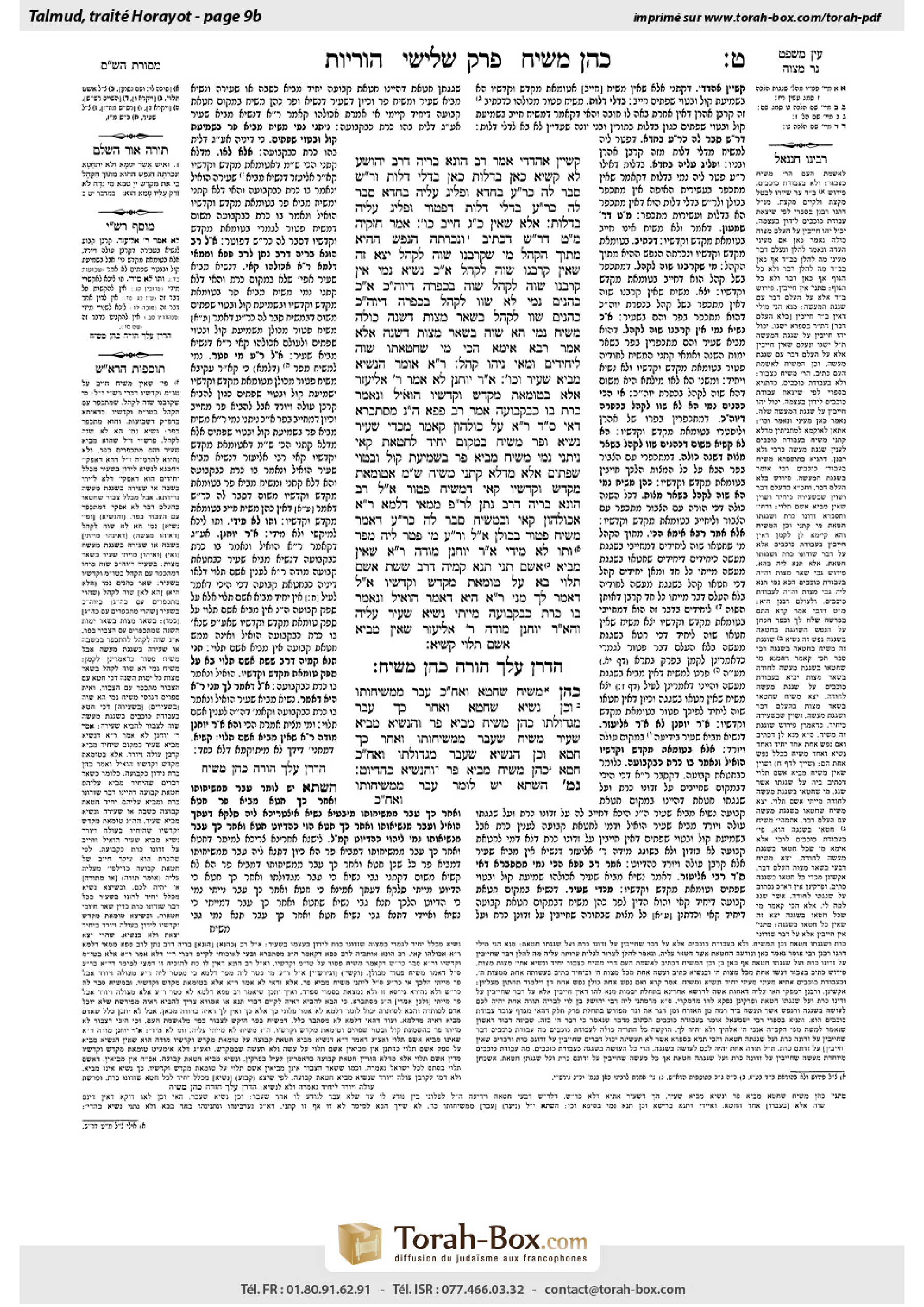
Horayot 9b: Talmud study for Daf Yomi
Study the Talmud for Daf Yomi with scanned pages, Hebrew text, English translations from Sefaria and AI-generated French translations.
Passage selection and English or AI-generated French translation are available where the scan has annotations. Daf Study is independent of Torah-Box and Sefaria.
Browse Horayot · הוריות · All tractatesHorayot 9b text and translations
This page of Horayot includes the Aramaic text, an English translation and an AI-generated French translation, alongside the scan above.
הוריות ט׳ ב · Aramaic and Hebrew text
קַשְׁיָין אַהֲדָדֵי!
אָמַר רַב הוּנָא בְּרֵיהּ דְּרַב יְהוֹשֻׁעַ: לָא קַשְׁיָא. כָּאן – בְּדַלּוּת, כָּאן – בְּדַלֵּי דַלּוּת. וְרַבִּי שִׁמְעוֹן סָבַר לַהּ כְּרַבִּי עֲקִיבָא בַּחֲדָא וּפְלִיג עֲלֵיהּ בַּחֲדָא: סָבַר לַהּ כְּרַבִּי עֲקִיבָא בְּדַלֵּי דַלּוּת דְּפָטוּר, וּפְלִיג עֲלֵיהּ בְּדַלּוּת.
אֶלָּא שֶׁאֵין כֹּהֵן גָּדוֹל חַיָּיב כּוּ׳. אָמַר חִזְקִיָּה: מַאי טַעְמָא דְּרַבִּי שִׁמְעוֹן? דִּכְתִיב: ״וְנִכְרְתָה הַנֶּפֶשׁ הַהִיא מִתּוֹךְ הַקָּהָל״, מִי שֶׁקׇּרְבָּנוֹ שָׁוֶה לַקָּהָל. יָצָא זֶה שֶׁאֵין קׇרְבָּנוֹ שָׁוֶה לַקָּהָל.
אִם כֵּן, נָשִׂיא נָמֵי – אֵין קׇרְבָּנוֹ שָׁוֶה לַקָּהָל! שָׁוֶה בְּכַפָּרָה דְּיוֹם הַכִּיפּוּרִים. אִם כֵּן, כֹּהֲנִים נָמֵי לֹא שָׁווּ לַקָּהָל בְּכַפָּרָה דְּיוֹם הַכִּיפּוּרִים! כֹּהֲנִים שָׁווּ לַקָּהָל בִּשְׁאָר מִצְוֹת דְּשָׁנָה כּוּלָּהּ.
מָשִׁיחַ נָמֵי, הָא שָׁוֶה בִּשְׁאָר מִצְוֹת דְּשָׁנָה! אֶלָּא אָמַר רָבָא, אֵימָא הָכִי: מִי שֶׁחַטָּאתוֹ שָׁוָה לִיחִידִים, וּמַאי נִיהוּ קָהָל.
רַבִּי אֱלִיעֶזֶר אוֹמֵר: הַנָּשִׂיא מֵבִיא שָׂעִיר וְכוּ׳. אָמַר רַבִּי יוֹחָנָן: לֹא אָמַר רַבִּי אֱלִיעֶזֶר אֶלָּא בְּטוּמְאַת מִקְדָּשׁ וְקָדָשָׁיו, הוֹאִיל וְנֶאֱמַר כָּרֵת בּוֹ כְּבִקְבוּעָה.
אָמַר רַב פָּפָּא: הָכִי נָמֵי מִסְתַּבְּרָא, דְּאִי סָלְקָא דַּעְתָּךְ רַבִּי אֱלִיעֶזֶר עַל כּוּלְּהוֹן קָאָמַר, מִכְּדִי שְׂעִיר נָשִׂיא וּפַר מָשִׁיחַ בִּמְקוֹם יָחִיד לְחַטָּאת קָאֵי. נִיתְנֵי נָמֵי: מָשִׁיחַ מֵבִיא פַּר בִּשְׁמִיעַת קוֹל וּבִטּוּי שְׂפָתַיִם. אֶלָּא מִדְּלָא קָתָנֵי מָשִׁיחַ, שְׁמַע מִינַּהּ אַטּוּמְאַת מִקְדָּשׁ וְקָדָשָׁיו קָאֵי, דְּמָשִׁיחַ פָּטוּר.
אֲמַר לֵיהּ רַב הוּנָא בְּרֵיהּ דְּרַב נָתָן לְרַב פָּפָּא: מִמַּאי? דִּלְמָא רַבִּי אֱלִיעֶזֶר אַכּוּלְּהוֹן קָאֵי, וּבְמָשִׁיחַ סָבַר לַהּ כְּרַבִּי עֲקִיבָא, דְּאָמַר: מָשִׁיחַ פָּטוּר בְּכוּלָּן! אֲמַר לֵיהּ: וְרַבִּי עֲקִיבָא מִי פָּטַר לֵיהּ מִפַּר? וְתוּ לָא מִידִּי.
אָמַר רַבִּי יוֹחָנָן: מוֹדֶה רַבִּי אֱלִיעֶזֶר שֶׁאֵין מֵבִיא אָשָׁם. תָּנֵי תַּנָּא קַמֵּיהּ דְּרַב שֵׁשֶׁת: אָשָׁם תָּלוּי בָּא עַל טוּמְאַת מִקְדָּשׁ וְקָדָשָׁיו. אֲמַר לֵיהּ: דַּאֲמַר לָךְ מַנִּי? רַבִּי אֱלִיעֶזֶר הִיא, דְּאָמַר: הוֹאִיל וְנֶאֱמַר בּוֹ כָּרֵת כְּבִקְבוּעָה, מַיְיתֵי נָשִׂיא שָׂעִיר עָלֶיהָ. וְהָאָמַר רַבִּי יוֹחָנָן: מוֹדֶה רַבִּי אֱלִיעֶזֶר שֶׁאֵין מֵבִיא אָשָׁם תָּלוּי! קַשְׁיָא.
הֲדַרַן עֲלָיךְ הוֹרָה כֹּהֵן מָשִׁיחַ
מַתְנִי׳ כֹּהֵן מָשִׁיחַ שֶׁחָטָא וְאַחַר כָּךְ עָבַר מִמְּשִׁיחוּתוֹ, וְכֵן נָשִׂיא שֶׁחָטָא וְאַחַר כָּךְ עָבַר מִגְּדוּלָּתוֹ – כֹּהֵן מָשִׁיחַ מֵבִיא פַּר, וְהַנָּשִׂיא מֵבִיא שָׂעִיר. מָשִׁיחַ שֶׁעָבַר מִמְּשִׁיחוּתוֹ וְאַחַר כָּךְ חָטָא, וְכֵן הַנָּשִׂיא שֶׁעָבַר מִגְּדוּלָּתוֹ וְאַחַר כָּךְ חָטָא – כֹּהֵן מָשִׁיחַ מֵבִיא פַּר, וְהַנָּשִׂיא כְּהֶדְיוֹט.
גְּמָ׳ הַשְׁתָּא יֵשׁ לוֹמַר: עָבַר מִמְּשִׁיחוּתוֹ,
Horayot 9b · English translation
If so, these two passages are difficult, as they contradict one another.
Rav Huna, son of Rav Yehoshua, said: This is not difficult, as there is a distinction between the rulings. Here, in the passage that deems the anointed priest liable in cases other than the defiling the Temple, it is in the case of an offering brought due to poverty, whereas there, in the latter clause, it is in the case of an offering brought due to extreme poverty. And Rabbi Shimon holds in accordance with the opinion of Rabbi Akiva with regard to one halakha and disagrees with him with regard to one other halakha. He holds in accordance with the opinion of Rabbi Akiva in the case of extreme poverty that the anointed priest is exempt from bringing that meal-offering. And he disagrees with Rabbi Akiva in the case of poverty, as he does not hold that the anointed priest is completely exempt from bringing a sliding-scale offering.
§ The mishna teaches that Rabbi Shimon says: But an anointed High Priest is not liable for the defiling of the Temple or its sacrificial foods. Ḥizkiyya said: What is the reason for the opinion of Rabbi Shimon? It is as it is written with regard to one who becomes ritually impure and enters the Temple: “And a man who shall be impure, and shall not be purified, that soul shall be excised [venikhreta] from the midst of the congregation, because he has defiled the Sanctuary of the Lord; the water of sprinkling has not been sprinkled on him: He is impure” (Numbers 19:20). It is derived from this verse that this halakha applies specifically to one whose offering equals the offering of the congregation, i.e., the Jewish people. This serves to exclude the High Priest, as his offering does not equal the offering of the congregation, as on Yom Kippur he brings a bull for his unwitting transgression, while he brings a goat to achieve atonement for the Jewish people.
The Gemara asks: If so, a king too, should be exempt, as his offering does not equal the offering of the congregation, as he brings a goat. The Gemara answers: Even so, the king equals the congregation in the atonement of Yom Kippur, as his atonement is achieved by means of the same offerings through which the rest of the congregation achieves atonement. The Gemara asks: If so, priests too should be exempt from bringing the offering for the defiling of the Temple, as they do not equal the congregation in the atonement of Yom Kippur, as their atonement is achieved by means of the bull of the High Priest. The Gemara answers: Priests equal the congregation with regard to atonement for the rest of the mitzvot of the entire year.
The Gemara challenges: The anointed priest, too, equals the congregation with regard to atonement for the rest of the mitzvot of the entire year. Rather, Rava said: Say this: One whose sin-offering equals that of individuals. And who are these individuals? They are the congregation. The status of a congregation that performed an unwitting transgression not on the basis of the ruling of the court is that of individuals. The High Priest’s sin-offering is different, as he brings a sin-offering only for an unwitting transgression he performed on the basis of his own ruling.
§ The mishna teaches that Rabbi Eliezer says: The king brings a goat, and not a sliding-scale offering. Rabbi Yoḥanan says: Rabbi Eliezer stated his opinion only with regard to the defiling of the Temple or its sacrificial foods, since karet is stated concerning it, as it is stated in all matters where there is liability to bring a fixed sin-offering. Just as the king brings a goat as a sin-offering for any unwitting transgression for whose intentional violation one is liable to receive karet, so too, he brings a goat for the defiling of the Temple. For other unwitting transgressions for which one is liable to bring a sliding-scale offering and for whose intentional violation one is not liable to receive karet, the king is also liable to bring a sliding-scale offering.
Rav Pappa said: So too, it is reasonable, as if it enters your mind to say that Rabbi Eliezer says that the king brings a goat for all of the transgressions enumerated in the mishna, and the king brings a goat in cases where individuals bring a sliding-scale offering, then since the goat of a king and the bull of an anointed priest stand in place of liability of an individual to bring a sin-offering, let Rabbi Eliezer also teach: An anointed priest brings a bull for hearing of a voice and for an utterance of the lips. Rather, from the fact that Rabbi Eliezer does not teach this halakha with regard to an anointed priest, learn from it that his statement that the king brings a goat stands in reference only to the defiling of the Temple or its sacrificial foods, with regard to which an anointed priest is exempt, in accordance with the opinion of Rabbi Shimon.
Rav Huna, son of Rav Natan, said to Rav Pappa: From where do you prove this? Perhaps the statement of Rabbi Eliezer stands in reference to all of them. And with regard to an anointed priest, he holds in accordance with the opinion of Rabbi Akiva, who says: An anointed priest is exempt from all of the cases where one is liable to bring a sliding-scale offering. Rav Pappa said to him: And Rabbi Akiva, does he exempt an anointed priest from bringing a bull? Rabbi Akiva exempted him only from bringing a sliding-scale offering, but he holds that the High Priest is liable to bring the offering unique to him, the bull for an unwitting transgression he performed on the basis of his own erroneous ruling. And nothing more need be discussed.
Rabbi Yoḥanan said: Rabbi Eliezer concedes that a king does not bring a guilt-offering for the defiling of the Temple or its sacrificial foods. The tanna who recited mishnayot and baraitot in the study hall recited a baraita before Rav Sheshet: In the case of a king, a provisional guilt-offering comes for the defiling of the Temple or its sacrificial foods. Rav Sheshet said to him: Who said this to you? Is it Rabbi Eliezer, who said: Since karet is stated in its regard as it is stated in all matters where there is liability to bring a fixed sin-offering, a king brings a goat for the defiling of the Temple? Since the status of his offering is like that of a fixed sin-offering, in cases of uncertainty, he is liable to bring a provisional guilt-offering. Rav Sheshet asks: But didn’t Rabbi Yoḥanan say: Rabbi Eliezer concedes that a king does not bring a provisional guilt-offering? The Gemara concludes: Indeed, based on the statement of Rabbi Yoḥanan, the baraita is difficult.
MISHNA: In the case of an anointed priest who sinned on the basis of his own erroneous halakhic ruling and thereafter moved on from his anointment, e.g., if he was disqualified due to a blemish that befell him before he brought his sin-offering, and likewise in the case of a king [nasi] who sinned and thereafter moved on from his prominence before he had brought an offering, an anointed priest brings a bull despite the fact that he is no longer the High Priest, and the king brings a goat, as he would have done during his reign. In the case of an anointed priest who moved on from his anointment and thereafter sinned, and likewise the king who moved on from his prominence and thereafter sinned, an anointed priest brings a bull, which he would have brought while he was High Priest, and the status of the king is like that of a commoner [kehedyot].
GEMARA: The Gemara questions the formulation of the mishna: Now it can be said: An anointed priest who moved on from his anointment
Horayot 9b · Traduction française (IA)
Si c'est ainsi, ces deux passages sont difficiles, car ils s'opposent l'un à l'autre.
Rav Huna, fils de Rav Yéhoshua, dit : Ce n'est pas difficile, car il y a une distinction entre les décisions. Ici, dans le passage qui considère le prêtre consacré comme responsable dans les cas autres que la souillure du Temple, il s'agit du cas d'une offrande apportée en raison de la pauvreté, tandis que là, dans la clause ultérieure, il s'agit du cas d'une offrande apportée en raison de la pauvreté extrême. Et Rabbi Shimon suit l'opinion de Rabbi Akiva concernant une halakha et s'y oppose concernant une autre halakha. Il suit l'opinion de Rabbi Akiva concernant la pauvreté extrême, où le prêtre consacré est exempt d'apporter cette offrande de mesure. Il s'y oppose à Rabbi Akiva concernant la pauvreté, car il ne considère pas que le prêtre consacré soit entièrement exempt d'apporter une offrande de mesure.
§ La mitsva enseigne que Rabbi Shimon dit : Mais le prêtre consacré n'est pas responsable de la souillure du Temple ou de ses aliments sacrés. Chizkiyya dit : Quelle est la raison de l'opinion de Rabbi Shimon ? C'est comme il est écrit concernant celui qui devient impur et entre dans le Temple : « Et celui qui sera impur et ne sera pas purifié, cette âme sera effacée [venikhreta] du milieu de la congrégation, car il a souillé le Sanctuaire du Seigneur ; l'eau de sprinkling n'a pas été sprinklé sur lui : il est impur » (Nombres 19:20). On en déduit de cette verset que cette halakha s'applique spécifiquement à celui dont l'offrande égale l'offrande de la congrégation, c'est-à-dire le peuple juif. Cela sert à exclure le prêtre consacré, car son offrande ne correspond pas à l'offrande de la congrégation, car le jour de l'Atonement, il apporte un taureau pour son péché involontaire, tandis qu'il apporte un bouc pour l'atonement du peuple juif.
Le Guemara demande : Si c'est ainsi, un roi devrait être exempt également, car son offrande ne correspond pas à l'offrande de la congrégation, car il apporte un bouc. Le Guemara répond : Même ainsi, le roi égale la congrégation en matière d'atonement du jour de l'Atonement, car son atonement est réalisé par les mêmes offrandes par lesquelles la congrégation réalise son atonement. Le Guemara demande : Si c'est ainsi, les prêtres devraient être exemptés d'apporter l'offrande pour la souillure du Temple également, car ils ne correspondent pas à la congrégation en matière d'atonement du jour de l'Atonement, car leur atonement est réalisé par le taureau du prêtre consacré. Le Guemara répond : Les prêtres égalent la congrégation concernant l'atonement des autres commandements de l'année entière.
Le Guemara conteste : Le prêtre consacré égale la congrégation concernant l'atonement des autres commandements de l'année entière. Plutôt, Rava dit : Dites cela : Celui dont l'offrande de péché égale celle des individus. Et qui sont ces individus ? Ce sont la congrégation. Le statut d'une congrégation ayant commis un péché involontaire sans se baser sur la décision du tribunal est celui des individus. L'offrande de péché du prêtre consacré est différente, car il apporte une offrande de péché uniquement pour un péché involontaire qu'il a commis sur la base de sa propre décision.
§ La mitsna enseigne que Rabbi Eliezer dit : Le roi apporte un bouc, et non une offrande de mesure. Rabbi Yoḥanan dit : Rabbi Eliezer a exprimé son opinion uniquement concernant la souillure du Temple ou de ses aliments sacrés, car la karet est mentionnée concernant cela, comme il est dit dans toutes les matières où il y a responsabilité d'apporter une offrande de péché fixe. Aussi bien que le roi apporte un bouc comme offrande de péché pour tout péché involontaire pour lequel on est puni de karet intentionnellement, ainsi aussi, il apporte un bouc pour la souillure du Temple. Pour d'autres péchés involontaires pour lesquels on est responsable d'apporter une offrande de mesure et pour lesquels on n'est pas puni de karet intentionnellement, le roi est également responsable d'apporter une offrande de mesure.
Rav Pappa dit : De même, cela est raisonnable, car si cela entre dans votre esprit de dire que Rabbi Eliezer dit que le roi apporte un bouc pour tous les péchés énumérés dans la mitsna, et que le roi apporte un bouc dans les cas où les individus apportent une offrande de mesure, alors, puisque le bouc du roi et le taureau du prêtre consacré remplacent la responsabilité d'un individu d'apporter une offrande de péché, que Rabbi Eliezer enseigne aussi : Le prêtre consacré apporte un taureau pour l'écoute d'une voix et pour une parole des lèvres. Plutôt, du fait que Rabbi Eliezer ne tient pas ce halakha concernant le prêtre consacré, apprenez-en que son affirmation que le roi apporte un bouc s'applique uniquement à la souillure du Temple ou de ses aliments sacrés, concernant lesquels le prêtre consacré est exempt, selon l'opinion de Rabbi Shimon.
Rav Huna, fils de Rav Natan, dit à Rav Pappa : D'où prouvez-vous cela ? Peut-être que l'affirmation de Rabbi Eliezer s'applique à tous. Et concernant le prêtre consacré, il suit l'opinion de Rabbi Akiva, qui dit : Le prêtre consacé est exempt de tous les cas où l'on est tenu de présenter une offrande de mesure. Rav Pappa dit à lui : Et Rabbi Akiva, exempte-t-il le prêtre consacré de présenter un taureau ? Rabbi Akiva l'exempte uniquement de présenter une offrande de mesure, mais il considère que le prêtre consacré est tenu de présenter l'offrande unique à lui, le taureau pour un péché involontaire qu'il a commis sur la base de sa propre décision erronée. Et plus rien n'a besoin d'être discuté.
Rabbi Yoḥanan a dit : Rabbi Eliezer reconnaît que le roi ne présente pas un sacrifice de culpabilité pour la souillure du Temple ou de ses aliments sacrés. Le tanna qui a récité des mishnayot et des baraitot dans la salle de study a récité une baraïta devant Rav Sheshet : Dans le cas du roi, un sacrifice de culpabilité provisoire est présenté pour la souillure du Temple ou de ses aliments sacrés. Rav Sheshet lui a dit : Qui t'a dit cela ? C'est Rabbi Eliezer, qui a dit : Puisque la peine de karet est mentionnée dans ce cas comme elle l'est dans tous les cas où il y a obligation de présenter un sacrifice expiatoire fixe, le roi présente un bouc pour la souillure du Temple ? Puisque le statut de son sacrifice est comme celui d'un sacrifice expiatoire fixe, dans les cas d'incertitude, il est tenu de présenter un sacrifice de culpabilité provisoire. Rav Sheshet a demandé : Mais n'a-t-il pas dit Rabbi Yoḥanan : Rabbi Eliezer reconnaît que le roi ne présente pas un sacrifice de culpabilité provisoire ? La Guemara conclut : En effet, selon l'affirmation de Rabbi Yoḥanan, la baraïta est difficile.
MICHNA : Dans le cas d'un prêtre anéanti qui a péché en vertu de son propre jugement halakhique erroné et s'est ensuite éloigné de son anéantissement, par exemple, s'il a été disqualifié en raison d'une tache qui lui est arrivée avant qu'il ne présente son sacrifice expiatoire, et de même dans le cas du roi [nasi] qui a péché et s'est ensuite éloigné de sa grandeur avant qu'il n'ait présenté un sacrifice, un prêtre anéanti présente un taureau, même s'il n'est plus le grand prêtre, et le roi présente un bouc, comme il l'aurait fait durant son règne. Dans le cas d'un prêtre anéanti qui s'est éloigné de son anéantissement et s'est ensuite révélé coupable, et de même le roi qui s'est éloigné de sa grandeur et s'est ensuite révélé coupable, un prêtre anéanti présente un taureau, celui qu'il aurait présenté lorsqu'il était grand prêtre, et le statut du roi est comme celui d'un citoyen [kehedyot].
GUEMARA : La Guemara interroge la formulation de la mishna : On peut dire : Un prêtre consacré qui s'est éloigné de sa consécration
Traduction française générée par IA à partir de l’édition anglaise de Sefaria. Vérifie toujours un passage avec le texte source.
Text from Sefaria: William Davidson Edition - Vocalized Aramaic (CC BY NC); William Davidson Edition - English (CC BY NC).