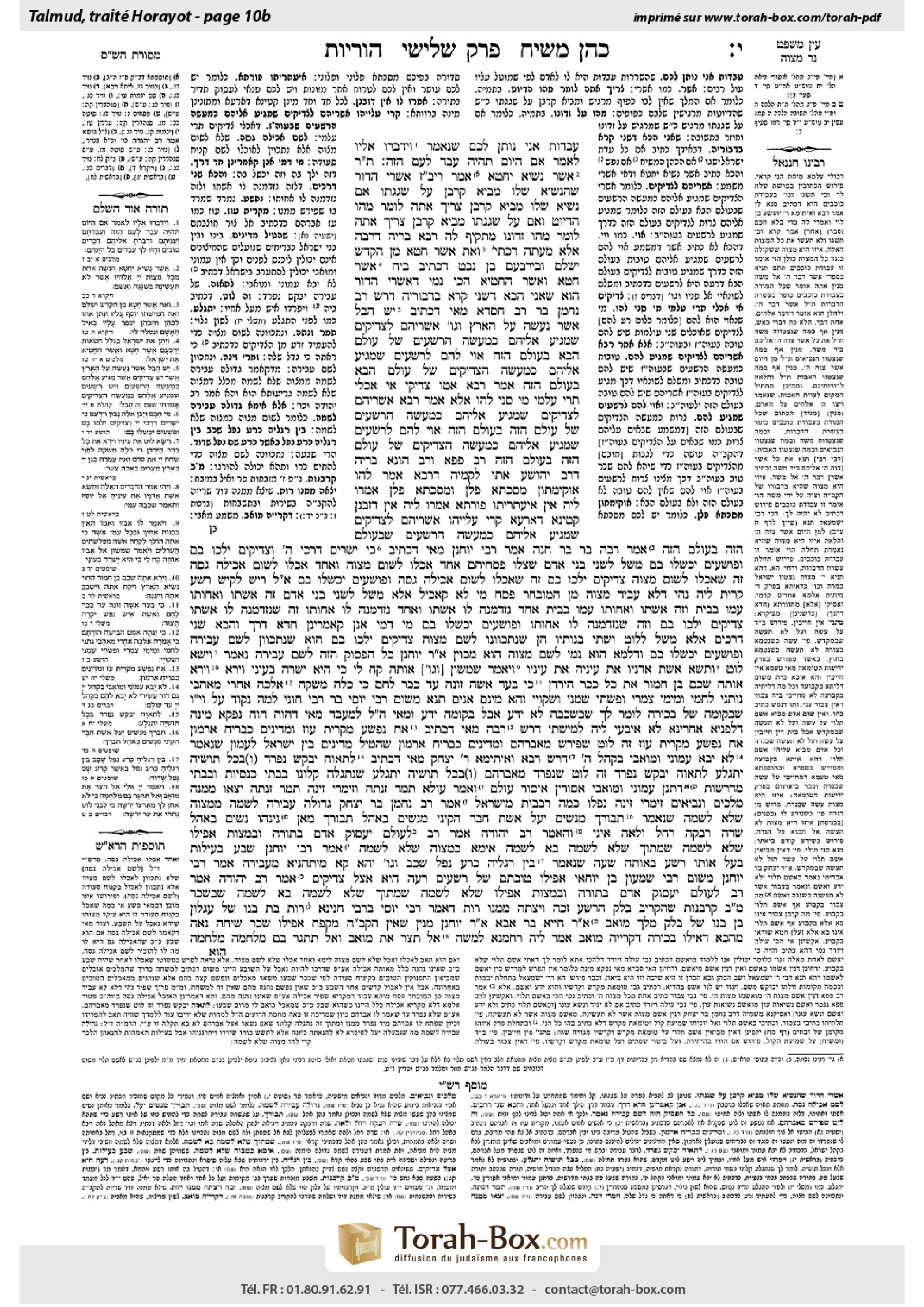
Horayot 10b: Talmud study for Daf Yomi
Study the Talmud for Daf Yomi with scanned pages, Hebrew text, English translations from Sefaria and AI-generated French translations.
Passage selection and English or AI-generated French translation are available where the scan has annotations. Daf Study is independent of Torah-Box and Sefaria.
Browse Horayot · הוריות · All tractatesHorayot 10b text and translations
This page of Horayot includes the Aramaic text, an English translation and an AI-generated French translation, alongside the scan above.
הוריות י׳ ב · Aramaic and Hebrew text
עַבְדוּת אֲנִי נוֹתֵן לָכֶם, שֶׁנֶּאֱמַר: ״וַיְדַבְּרוּ אֵלָיו לֵאמֹר אִם הַיּוֹם תִּהְיֶה עֶבֶד לָעָם הַזֶּה״.
תָּנוּ רַבָּנַן: ״אֲשֶׁר נָשִׂיא יֶחֱטָא״, אָמַר רַבִּי יוֹחָנָן בֶּן זַכַּאי: אַשְׁרֵי הַדּוֹר שֶׁהַנָּשִׂיא שֶׁלּוֹ מֵבִיא קׇרְבָּן עַל שִׁגְגָתוֹ. אִם נָשִׂיא שֶׁלּוֹ מֵבִיא קׇרְבָּן, צָרִיךְ אַתָּה לוֹמַר מַהוּ הֶדְיוֹט! וְאִם עַל שִׁגְגָתוֹ מֵבִיא קׇרְבָּן, צָרִיךְ אַתָּה לוֹמַר מַהוּ זְדוֹנוֹ!
מַתְקֵיף לַהּ רָבָא בְּרֵיהּ דְּרַבָּה: אֶלָּא מֵעַתָּה, דִּכְתִיב: ״וְאֵת אֲשֶׁר חָטָא מִן הַקֹּדֶשׁ יְשַׁלֵּם״, וּבְיָרׇבְעָם בֶּן נְבָט, דִּכְתִיב בֵּיהּ: ״אֲשֶׁר חָטָא וַאֲשֶׁר הֶחֱטִיא״, הָכִי נָמֵי דְּאַשְׁרֵי הַדּוֹר הוּא! שָׁאנֵי הָכָא, דְּשַׁנִּי קְרָא בְּדִבּוּרֵיהּ.
דָּרַשׁ רַב נַחְמָן בַּר רַב חִסְדָּא, מַאי דִּכְתִיב: ״יֶשׁ הֶבֶל אֲשֶׁר נַעֲשָׂה עַל הָאָרֶץ וְגוֹ׳״ – אַשְׁרֵיהֶם לַצַּדִּיקִים, שֶׁמַּגִּיעַ אֲלֵיהֶם כְּמַעֲשֵׂה הָרְשָׁעִים שֶׁל עוֹלָם הַבָּא בָּעוֹלָם הַזֶּה. אוֹי לָהֶם לָרְשָׁעִים, שֶׁמַּגִּיעַ אֲלֵיהֶם כְּמַעֲשֵׂה הַצַּדִּיקִים שֶׁל עוֹלָם הַבָּא בָּעוֹלָם הַזֶּה.
אָמַר רָבָא: אַטּוּ צַדִּיקֵי אִי אָכְלִי תְּרֵי עָלְמֵי מִי סְנֵי לְהוּ? אֶלָּא אָמַר רָבָא: אַשְׁרֵיהֶם לַצַּדִּיקִים שֶׁמַּגִּיעַ אֲלֵיהֶם כְּמַעֲשֵׂה הָרְשָׁעִים שֶׁל עוֹלָם הַזֶּה בָּעוֹלָם הַזֶּה, אוֹי לָהֶם לָרְשָׁעִים שֶׁמַּגִּיעַ אֲלֵיהֶם כְּמַעֲשֵׂה הַצַּדִּיקִים שֶׁל עוֹלָם הַזֶּה בָּעוֹלָם הַזֶּה.
רַב פָּפָּא וְרַב הוּנָא בְּרֵיהּ דְּרַב יְהוֹשֻׁעַ אֲתוֹ לְקַמֵּיהּ דְּרָבָא, אֲמַר לְהוּ: אוֹקֵימְתּוּן מַסֶּכְתָּא פְּלָן וּמַסֶּכְתָּא פְּלָן? אֲמַרוּ לֵיהּ: אִין. אִיעַתְּרִיתוּ פּוּרְתָּא? אֲמַרוּ לֵיהּ: אִין, דִּזְבַנַן קַטִּינָא דְּאַרְעָא. קָרֵי עֲלַיְיהוּ: אַשְׁרֵיהֶם לַצַּדִּיקִים שֶׁמַּגִּיעַ אֲלֵיהֶם כְּמַעֲשֵׂה הָרְשָׁעִים שֶׁבָּעוֹלָם הַזֶּה בָּעוֹלָם הַזֶּה.
אָמַר רַבָּה בַּר בַּר חָנָה אָמַר רַבִּי יוֹחָנָן, מַאי דִּכְתִיב: ״כִּי יְשָׁרִים דַּרְכֵי ה׳ וְצַדִּקִים יֵלְכוּ בָם וּפֹשְׁעִים יִכָּשְׁלוּ בָם״? מָשָׁל לִשְׁנֵי בְּנֵי אָדָם שֶׁצָּלוּ פִּסְחֵיהֶם, אֶחָד אֲכָלוֹ לְשׁוּם מִצְוָה, וְאֶחָד אֲכָלוֹ לְשׁוּם אֲכִילָה גַּסָּה. זֶה שֶׁאֲכָלוֹ לְשׁוּם מִצְוָה – ״צַדִּקִים יֵלְכוּ בָם״, זֶה שֶׁאֲכָלוֹ לְשׁוּם אֲכִילָה גַּסָּה – ״וּפֹשְׁעִים יִכָּשְׁלוּ בָם״.
אֲמַר לֵיהּ רֵישׁ לָקִישׁ: רָשָׁע קָרֵית לֵיהּ? נְהִי דְּלָא עָבֵיד מִצְוָה מִן הַמּוּבְחָר, פֶּסַח מִי לָא קָאָכֵיל? אֶלָּא: מָשָׁל לִשְׁנֵי בְּנֵי אָדָם, זֶה אִשְׁתּוֹ וַאֲחוֹתוֹ עִמּוֹ בַּבַּיִת, וְזֶה אִשְׁתּוֹ וַאֲחוֹתוֹ עִמּוֹ בַּבַּיִת, אֶחָד נִזְדַּמְּנָה לוֹ אִשְׁתּוֹ, וְאֶחָד נִזְדַּמְּנָה לוֹ אֲחוֹתוֹ, זֶה שֶׁנִּזְדַּמְּנָה לוֹ אִשְׁתּוֹ – ״צַדִּקִים יֵלְכוּ בָּם״, וְזֶה שֶׁנִּזְדַּמְּנָה לוֹ אֲחוֹתוֹ – ״וּפֹשְׁעִים יִכָּשְׁלוּ בָם״.
מִי דָּמֵי? אֲנַן קָאָמְרִינַן חֲדָא דֶּרֶךְ, וְהָכָא שְׁנֵי דְּרָכִים! אֶלָּא מָשָׁל לְלוֹט וּשְׁתֵּי בְנוֹתָיו, הֵן שֶׁנִּתְכַּוְּונוּ לְשֵׁם מִצְוָה – ״צַדִּקִים יֵלְכוּ בָם״, הוּא שֶׁנִּתְכַּוֵּון לְשֵׁם עֲבֵירָה – ״וּפֹשְׁעִים יִכָּשְׁלוּ בָם״.
וְדִלְמָא הוּא נָמֵי לְשֵׁם מִצְוָה (הוּא מְכַוֵּין) [אִיכַּוַּון]! אָמַר רַבִּי יוֹחָנָן, כׇּל הַפָּסוּק הַזֶּה לְשֵׁם עֲבֵירָה נֶאֱמַר.
״וַיִּשָּׂא לוֹט״ – ״וַתִּשָּׂא אֵשֶׁת אֲדֹנָיו אֶת עֵינֶיהָ״, ״אֶת עֵינָיו״ – ״וַיֹּאמֶר שִׁמְשׁוֹן [וְגוֹ׳] אוֹתָהּ קַח לִי כִּי הִיא יָשְׁרָה בְעֵינָי״, ״וַיַּרְא״ – ״וַיַּרְא אֹתָהּ שְׁכֶם בֶּן חֲמוֹר״, ״אֶת כׇּל כִּכַּר הַיַּרְדֵּן״ – ״כִּי בְעַד אִשָּׁה זוֹנָה עַד כִּכַּר לָחֶם״, ״כִּי כֻלָּהּ מַשְׁקֶה״ – ״אֵלְכָה אַחֲרֵי מְאַהֲבַי נֹתְנֵי לַחְמִי וּמֵימַי צַמְרִי וּפִשְׁתִּי שַׁמְנִי וְשִׁקּוּיָי״.
וְהָא מֵינָס אֲנִיס! תָּנָא מִשּׁוּם רַבִּי יוֹסֵי בַּר רַבִּי חוֹנִי: לָמָּה נָקוּד עַל וָיו שֶׁבְּ״קוּמָהּ״ שֶׁל בְּכִירָה? לוֹמַר לָךְ, שֶׁבְּשִׁכְבָהּ לָא יָדַע אֲבָל בְּקוּמָהּ יָדַע. וּמַאי הֲוָה לֵיהּ לְמֶעְבַּד? מַאי דַּהֲוָה הֲוָה! נָפְקָא מִינַּהּ דִּלְפַנְיָא אַחֲרִינָא לָא אִיבְּעִי לֵיהּ לְמִישְׁתֵּי.
דָּרֵשׁ רַבָּה, מַאי דִּכְתִיב: ״אָח נִפְשָׁע מִקִּרְיַת עֹז וּמִדְיָנִים כִּבְרִיחַ אַרְמוֹן״? ״אָח נִפְשָׁע מִקִּרְיַת עֹז״ – זֶה לוֹט שֶׁפֵּירַשׁ מֵאַבְרָהָם, ״וּמִדְיָנִים כִּבְרִיחַ אַרְמוֹן״ – שֶׁהֵטִיל מִדְיָנִים בֵּין יִשְׂרָאֵל לְעַמּוֹן, שֶׁנֶּאֱמַר: ״לֹא יָבֹא עַמּוֹנִי וּמוֹאָבִי בִּקְהַל ה׳״.
דָּרֵשׁ רָבָא, וְאִיתֵּימָא רַבִּי יִצְחָק, מַאי דִּכְתִיב: ״לְתַאֲוָה יְבַקֵּשׁ נִפְרָד (וּבְכָל) [בְּכָל] תּוּשִׁיָּה יִתְגַּלָּע״? ״לְתַאֲוָה יְבַקֵּשׁ נִפְרָד״ – זֶה לוֹט שֶׁנִּפְרָד מֵאַבְרָהָם. ״(וּבְכָל) [בְּכָל] תּוּשִׁיָּה יִתְגַּלָּע״ – שֶׁנִּתְגַּלָּה קְלוֹנוֹ בְּבָתֵּי כְּנֵסִיּוֹת וּבְבָתֵּי מִדְרָשׁוֹת. דִּתְנַן: עַמּוֹנִי וּמוֹאָבִי אֲסוּרִין אִסּוּר עוֹלָם.
וְאָמַר עוּלָּא: תָּמָר זִנְּתָה וְזִימְרִי זִינָּה. תָּמָר זִנְּתָה – יָצְאוּ מִמֶּנָּה מְלָכִים וּנְבִיאִים, זִימְרִי זִינָּה – נָפְלוּ כַּמָּה רְבָבוֹת מִיִּשְׂרָאֵל. אָמַר רַב נַחְמָן בַּר יִצְחָק: גְּדוֹלָה עֲבֵירָה לִשְׁמָהּ מִמִּצְוָה שֶׁלֹּא לִשְׁמָהּ, שֶׁנֶּאֱמַר: ״תְּבֹרַךְ מִנָּשִׁים יָעֵל אֵשֶׁת חֶבֶר הַקֵּינִי מִנָּשִׁים בָּאֹהֶל תְּבֹרָךְ״, מַאן נִינְהוּ ״נָשִׁים בָּאֹהֶל״? שָׂרָה, רִבְקָה, רָחֵל וְלֵאָה.
אִינִי? וְהָאָמַר רַב יְהוּדָה אָמַר רַב: לְעוֹלָם יַעֲסוֹק אָדָם בְּתוֹרָה וּבְמִצְוֹת אֲפִילּוּ שֶׁלֹּא לִשְׁמָהּ, שֶׁמִּתּוֹךְ שֶׁלֹּא לִשְׁמָהּ בָּא לִשְׁמָהּ. אֵימָא: כְּמִצְוָה שֶׁלֹּא לִשְׁמָהּ.
אָמַר רַבִּי יוֹחָנָן: שֶׁבַע בְּעִילוֹת בָּעַל אוֹתוֹ רָשָׁע בְּאוֹתָהּ שָׁעָה, שֶׁנֶּאֱמַר: ״בֵּין רַגְלֶיהָ כָּרַע נָפַל שָׁכָב וְגוֹ׳״. וְהָא קָא מִיתְהַנְיָא מֵעֲבֵירָה? אָמַר רַבִּי יוֹחָנָן מִשּׁוּם רַבִּי שִׁמְעוֹן בֶּן יוֹחַאי: אֲפִילּוּ טוֹבָתָם שֶׁל רְשָׁעִים רָעָה הִיא אֵצֶל צַדִּיקִים.
אָמַר רַב יְהוּדָה אָמַר רַב: לְעוֹלָם יַעֲסוֹק אָדָם בַּתּוֹרָה וּבַמִּצְוֹת אֲפִילּוּ שֶׁלֹּא לִשְׁמָהּ, שֶׁמִּתּוֹךְ שֶׁלֹּא לִשְׁמָהּ בָּא לִשְׁמָהּ, שֶׁבִּשְׂכַר אַרְבָּעִים וּשְׁנַיִם קׇרְבָּנוֹת שֶׁהִקְרִיב בָּלָק הָרָשָׁע, זָכָה וְיָצְתָה מִמֶּנּוּ רוּת, דְּאָמַר רַבִּי יוֹסֵי בְּרַבִּי חֲנִינָא: רוּת בַּת בְּנוֹ שֶׁל עֶגְלוֹן, בֶּן בְּנוֹ שֶׁל בָּלָק מֶלֶךְ מוֹאָב.
אָמַר רַבִּי חִיָּיא בַּר אַבָּא אָמַר רַבִּי יוֹחָנָן: מִנַּיִן שֶׁאֵין הַקָּדוֹשׁ בָּרוּךְ הוּא מְקַפֵּחַ אֲפִילּוּ שְׂכַר שִׂיחָה נָאָה? מֵהָכָא, דְּאִילּוּ בְּכִירָה דִּקְרָיתֵיהּ מוֹאָב, אֲמַר לֵיהּ רַחֲמָנָא לְמֹשֶׁה: ״אַל תָּצַר אֶת מוֹאָב וְאַל תִּתְגָּר בָם מִלְחָמָה״. מִלְחָמָה
Horayot 10b · English translation
I am granting you servitude, as it is stated: “And they spoke to him saying: If you will be a servant to this people today” (I Kings 12:7). This explains the phrase “in an independent house.”
§ The Sages taught: The verse states concerning a king: “When [asher] a king sins” (Leviticus 4:22). Rabbi Yoḥanan ben Zakkai said: Happy [ashrei] is the generation whose king feels the need to bring an offering for his unwitting transgression. If the generation’s king brings an offering, you must say all the more so what a commoner will do to atone for his sin, i.e., he will certainly bring an offering. And if the king brings an offering for his unwitting transgression, you must say all the more so what he will do to atone for his intentional transgression, i.e., he will certainly repent.
Rava, son of Rabba, objects to this: If that is so, and the term asher is interpreted in that manner, then concerning that which is written: “And he shall pay for that which [asher] he has sinned from the sacred item” (Leviticus 5:16), and with regard to Jeroboam, son of Nevat, about whom it is written: “Who [asher] sinned and caused others to sin” (I Kings 14:16), so too is the interpretation that this generation is happy? The Gemara answers: Here, in the case of a king who brings an offering, it is different, as the verse altered its formulation; in parallel verses, the term “if” is utilized, e.g., in the verse: “If the anointed priest shall sin” (Leviticus 4:3). In the other instances, asher is the standard formulation.
Apropos the homiletic interpretation of the term asher, Rav Naḥman bar Ḥisda interpreted a verse homiletically: What is the meaning of that which is written: “There is a vanity that is [asher] performed upon the earth; that there are [asher] righteous men to whom it happens according to [asher] the action of the wicked, and there are wicked men to whom it happens according to the action of the righteous” (Ecclesiastes 8:14)? Happy [ashrei] are the righteous, to whom it happens in this world according to the experiences of the wicked in the World-to-Come, i.e., they suffer in this world. Woe unto the wicked, to whom it happens in this world according to the experiences of the righteous in the World-to-Come, i.e., they enjoy this world.
Rava said: Is that to say that if the righteous enjoyed two worlds it would be awful for them? Why must the righteous suffer in this world? Rather, Rava said as follows: Happy are the righteous to whom it happens in this world according to the experiences of the wicked in this world, i.e., happy are the righteous who enjoy this world as well. Woe to the wicked, to whom it happens in this world according to the experiences of the righteous in this world, i.e., like the many righteous people who suffer in this world.
The Gemara relates: Rav Pappa and Rav Huna, son of Rav Yehoshua, came before Rava. Rava said to them: Have you mastered this tractate and that tractate? They said to him: Yes. Rava said to them: Have you become somewhat wealthy? They said to him: Yes, as each of us bought a parcel of land from which we earn our livelihoods. Rava proclaimed about them: Happy are the righteous, to whom it happens in this world according to the goodness resulting from the actions of the wicked in this world.
§ Rabba bar bar Ḥana said that Rabbi Yoḥanan said: What is the meaning of that which is written: “For the ways of the Lord are right, and the righteous will walk in them and transgressors will stumble in them” (Hosea 14:10)? It is comparable to an incident involving two people who roasted their Paschal offerings. One ate it for the sake of the mitzva, and the other one ate it with gusto, for the sake of excessive eating. With regard to that person who ate it for the sake of the mitzva, it is written: “The righteous will walk in them.” With regard to that person who ate it for the sake of excessive eating, it is written: “And transgressors will stumble in them.”
Reish Lakish said to Rabba bar bar Ḥana: Did you call the one who ate the Paschal offering for the sake of excessive eating wicked? Although he did not perform the mitzva in the ideal manner, didn’t he eat the Paschal offering? Since he fulfilled the mitzva, how can he be characterized as a transgressor? Rather, it is analogous to an incident involving two people; this one has his wife and his sister with him in a dark house and that one has his wife and his sister with him in a dark house. One of them, his wife happened to come to him and he engaged in intercourse with her, and the other one, his sister happened to come to him and he engaged in intercourse with her. With regard to that one, to whom his wife happened to come, it is written: “The righteous will walk in them.” With regard to that one, to whom his sister happened to come, it is written: “And transgressors will stumble in them.”
The Gemara asks: Are these matters comparable? In the verse, we are speaking of one path upon which both the righteous and the wicked walk, and here, in the incident mentioned by Reish Lakish, there are two paths, as the two people are not performing the same action. Rather, it is analogous to the incident involving Lot and his two daughters (see Genesis 19:30–38): With regard to the daughters, who, when engaging in intercourse with their father, intended their action for the sake of a mitzva, as they believed that the world had been destroyed and that only they remained alive, it is written: “The righteous will walk in them.” With regard to Lot, who intended his action for the sake of a transgression, it is written: “And transgressors will stumble in them.”
The Gemara challenges: Perhaps Lot too intended his action for the sake of a mitzva. Rabbi Yoḥanan says that this entire verse: “And Lot cast his eyes and beheld the entire plain of the Jordan that it was well watered everywhere” (Genesis 13:10), is stated in the context of transgression.
He explains: “And Lot cast his eyes” is an allusion to the verse: “His master’s wife cast her eyes upon Joseph and said: Lie with me” (Genesis 39:7). “His eyes” is an allusion to the verse: “And Samson said: Get her for me, as she is pleasing to my eyes” (Judges 14:3). “And beheld” is an allusion to the verse: “And Shechem, son of Hamor, the prince of the land, beheld her; and he took her and lay with her” (Genesis 34:2). “The entire plain [kikar] of the Jordan” is an allusion to the verse: “For on account of a prostitute a man is brought to a loaf [kikar] of bread” (Proverbs 6:26). “That it was well watered [mashke] everywhere” is an allusion to the verse “I will follow my lovers, givers of my bread and my water, my wool and my flax, my oil and my drink [veshikkuyai]” (Hosea 2:7).
The Gemara asks: Why is Lot accused of wrongdoing? Wasn’t he the victim of circumstances beyond his control, as he was drunk and asleep? It is taught in the name of Rabbi Yosei bar Rabbi Ḥoni: Why is it dotted over the letter vav that is in the word “bekumah” written with regard to Lot’s elder daughter in the verse: “And he knew not when she lay down, nor when she arose [bekumah]” (Genesis 19:33)? It is to say to you that when she lay down he did not know; but when she arose, he knew. Therefore, his action was not completely beyond his control. The Gemara asks: And what was he to do? What was, was. The Gemara answers: He should have derived from it that on the following night he should not drink. Since he drank again, this indicates that he did so with intent to engage in intercourse with his other daughter.
Apropos Lot, Rabba taught: What is the meaning of that which is written: “A brother betrayed a strong city, and their contentions are like the bars of a castle” (Proverbs 18:19)? “A brother betrayed a strong city”; that is Lot, who parted from Abraham. “And their contentions are like the bars of a castle” is stated because he, i.e., Lot, introduced contention between Israel and Ammon, as it is stated: “An Ammonite or a Moabite shall not enter into the congregation of the Lord” (Deuteronomy 23:4).
Rava taught, and some say it was Rabbi Yitzḥak who taught: What is the meaning of that which is written: “He that separates himself seeks his own desire, and snarls against all sound wisdom” (Proverbs 18:1)? “He that separates himself seeks his own desire”; that is Lot, who separated from Abraham to pursue his lust. “And snarls [yitgalla] against all sound wisdom”; his shame was revealed [shenitgalla] in synagogues and study halls, where the halakha concerning his offspring is taught; as we learned in a mishna (Yevamot 76a): An Ammonite and a Moabite, descendants of Lot, are forbidden with a permanent prohibition.
§ And Ulla says: Tamar engaged in licentiousness with Judah (see Genesis, chapter 38), and Zimri engaged in licentiousness with Cozbi (see Numbers 25:6–9). Tamar engaged in licentiousness, and kings and prophets emerged from her. Zimri engaged in licentiousness, and tens of thousands from the Jewish people fell. Rav Naḥman bar Yitzḥak says: A transgression performed for the sake of Heaven is greater than a mitzva performed not for its own sake, as it is stated: “Blessed above women shall be Yael, the wife of Heber the Kenite, above women in the tent shall she be blessed” (Judges 5:24). Who are these “women in the tent”? They are Sarah, Rebecca, Rachel, and Leah, and Yael is more blessed than they are. Apparently, a mitzva performed not for its own sake is a negative phenomenon.
The Gemara asks: Is that so? But doesn’t Rav Yehuda say that Rav says: A person should always engage in Torah study and the performance of mitzvot, even if he does so not for its own sake, as through the performance of mitzvot not for its own sake, one gains understanding and comes to perform them for its own sake. Apparently, even when performed not for its own sake a mitzva is still a positive phenomenon. The Gemara emends the statement: Say that the status of a transgression performed for the sake of Heaven is like that of a mitzva performed not for its own sake.
Apropos Yael, Rabbi Yoḥanan says: That wicked man Sisera performed seven acts of intercourse with Yael at that time, as it is stated: “Between her legs he crouched, he fell, he lay; between her legs he crouched, he fell; where he crouched, there he fell dead” (Judges 5:27). Each of the seven verbs is a euphemism for intercourse. The Gemara asks: But didn’t she experience pleasure from the transgression of engaging in intercourse with Sisera? Why does the verse praise her? Rabbi Yoḥanan says in the name of Rabbi Shimon ben Yoḥai: Even the good provided by the wicked is bad for the righteous, so Yael did not experience any pleasure from her intercourse with Sisera.
Rav Yehuda says that Rav says: A person should always engage in Torah study and the performance of mitzvot, even if he does so not for its own sake, as through the performance of mitzvot not for its own sake, one gains understanding and comes to perform them for its own sake. Proof for this can be adduced from the incident involving Balak, as in reward for the forty-two offerings that Balak the wicked sacrificed to God, despite the fact that he did this in order to curse the Jewish people (see Numbers, chapter 23), he merited and Ruth emerged from him, as Rabbi Yosei, son of Rabbi Ḥanina, says: Ruth was the daughter of the son of Eglon, the son of the son of Balak, king of Moab.
§ Apropos Lot and his daughters, Rabbi Ḥiyya bar Abba says that Rabbi Yoḥanan says: From where is it derived that the Holy One, Blessed be He, does not withhold even the reward for euphemistic speech? It is derived from here, as the elder daughter called her son Moab, an allusion to the fact that the child is from her own father [me’av], and the Merciful One said to Moses: “Be not at enmity with Moab, neither contend with them in battle” (Deuteronomy 2:9). From this it may be inferred: It is in battle
Horayot 10b · Traduction française (IA)
Je vous accorde la servitude, comme il est dit : « Et ils dirent à lui : Si tu seras un serviteur à ce peuple aujourd'hui » (I Rois 12:7). Cela explique la phrase « dans une maison indépendante ».
§ Les Sages enseignent : La parabole dit concernant un roi : « Quand [asher] un roi péche » (Lévitique 4:22). Rabbi Yoḥanan ben Zakkai dit : Heureux [ashrei] est le génération dont le roi a besoin de présenter un sacrifice pour son péché involontaire. Si le roi de la génération présente un sacrifice, vous devez dire que le communier le fera certainement pour expier son péché, c'est-à-dire qu'il présentera certainement un sacrifice. Et si le roi présente un sacrifice pour son péché involontaire, vous devez dire que ce qu'il fera pour expier son péché volontaire, c'est-à-dire qu'il se repentira certainement.
Rava, fils de Rabba, s'oppose à cela : Si c'est ainsi, et que le terme asher est interprété ainsi, alors concernant ce qui est écrit : « Et il paiera pour cela [asher] qu'il a péché de l'objet sacré » (Lévitique 5:16), et concernant Jéroboam, fils de Névat, à propos duquel il est écrit : « Qui [asher] a péché et a fait pécher les autres » (I Rois 14:16), est-ce que l'interprétation est aussi que cette génération est heureuse ? La Guemara répond : Ici, dans le cas d'un roi qui présente un sacrifice, c'est différent, car la parabole a changé sa formulation ; dans les paraboles parallèles, le terme « si » est utilisé, par exemple dans la parabole : « Si le prêtre anéanti péche » (Lévitique 4:3). Dans les autres cas, asher est la formulation standard.
À propos de l'interprétation homélique du terme asher, Rav Naḥman bar Ḥisda interprète une versette homéliquement : Quelle est la signification de ce qui est écrit : « Il y a une vanité qui est [asher] accomplie sur la terre ; que là sont [asher] des justes à qui il arrive selon [asher] l'action des méchants, et là sont des méchants à qui il arrive selon l'action des justes » (Ecclésiaste 8:14) ? Heureux [ashrei] sont les justes, à qui il arrive dans ce monde selon les expériences des méchants dans le Monde à Venir, c'est-à-dire qu'ils souffrent dans ce monde. Malheur aux méchants, à qui il arrive dans ce monde selon les expériences des justes dans le Monde à Venir, c'est-à-dire qu'ils jouissent de ce monde.
Rava dit : Est-ce que cela signifie que si les justes jouissaient de deux mondes cela serait affreux pour eux ? Pourquoi les justes souffrent-ils dans ce monde ? Plutôt, Rava dit comme suit : Heureux sont les justes à qui il arrive dans ce monde selon les expériences des méchants dans ce monde, c'est-à-dire heureux sont les justes qui jouissent de ce monde également. Malheur aux méchants, à qui il arrive dans ce monde selon les expériences des justes dans ce monde, c'est-à-dire comme les nombreux justes qui souffrent dans ce monde.
La Guemara rapporte : Rav Pappa et Rav Huna, fils de Rav Yehoshua, sont devant Rava. Rava dit à eux : Avez-vous maîtrisé ce traité et celui-ci ? Ils dirent à lui : Oui. Rava dit à eux : Avez-vous devenu un peu riche ? Ils dirent à lui : Oui, car chacun d'entre nous a acheté une parcelle de terre d'où nous tirons notre subsistance. Rava proclama à leur sujet : Heureux sont les justes, à qui il arrive dans ce monde selon la bonté résultant des actions des méchants dans ce monde.
§ Rabba bar bar Ḥana dit que Rabbi Yoḥanan dit : Quelle est la signification de ce qui est écrit : « Car les voies du Seigneur sont droites, et les justes marcheront en elles et les transgresseurs trébucheront en elles » (Osée 14:10) ? Cela est comparable à un incident concernant deux personnes qui ont rôti leurs offrandes pascal. L'un l'a mangé pour l'accomplissement de la mitsva, et l'autre l'a mangé avec gourmandise, pour l'excès. Concernant celui qui l'a mangé pour l'accomplissement de la mitsva, il est écrit : « Les justes marcheront en elles. » Concernant celui qui l'a mangé pour l'excès, il est écrit : « Et les transgresseurs trébucheront en elles. »
Reish Lakish dit à Rabba bar bar Ḥana : As-tu appelé celui qui a mangé l'offrande pascal pour l'excès de malhonneste ? Bien qu'il n'ait pas accompli la mitsva de manière idéale, n'a-t-il pas mangé l'offrande pascal ? Puisqu'il a accompli la mitsva, comment peut-il être caractérisé comme un transgresseur ? Plutôt, cela est comparable à un incident concernant deux personnes ; l'un a sa femme et sa sœur avec lui dans une maison sombre et l'autre a sa femme et sa sœur avec lui dans une maison sombre. L'un, sa femme est venue à lui et il a eu des relations avec elle, et l'autre, sa sœur est venue à lui et il a eu des relations avec elle. Concernant celui à qui sa femme est venue, il est écrit : « Les justes marcheront en elles. » Concernant celui à qui sa sœur est venue, il est écrit : « Et les transgresseurs trébucheront en elles. »
La Guemara pose la question : Ces choses sont-elles comparables ? Dans la parabole, nous parlons d'un chemin sur lequel les justes et les méchants marchent, et ici, dans l'incident mentionné par Reish Lakish, il y a deux chemins, car les deux personnes ne font pas la même action. Plutôt, cela est comparable à l'incident concernant Lot et ses deux filles (voir Genèse 19:30-38) : Concernant les filles, qui, en ayant des relations avec leur père, ont intenté leur action pour l'accomplissement d'une mitsva, car elles croyaient que le monde avait été détruit et qu'il ne restait que celles-ci, il est écrit : « Les justes marcheront en elles. » Concernant Lot, qui a intenté son action pour l'accomplissement d'un péché, il est écrit : « Et les transgresseurs trébucheront en elles. »
La Guemara conteste : Peut-être Lot aussi a intenté son action pour l'accomplissement d'une mitsva. Rabbi Yoḥanan dit que cette toute cette phrase : « Et Lot regarda et vit toute la plaine du Jourdain, et il vit qu'elle était bien arrosée partout » (Genèse 13:10), est mentionnée dans le contexte d'un péché.
Il explique : « Et Lot regarda » est une allusion à la parole : « Sa femme de son maître, la femme de son maître, regarda Joseph et dit : Couchons-nous ensemble » (Genèse 39:7). « Ses yeux » est une allusion à la parole : « Et Samson dit : Obtenez-la pour moi, car elle est agréable à mes yeux » (Juges 14:3). « Et il regarda » est une allusion à la parole : « Et Schéchem, fils de Hamor, le prince du pays, regarda la jeune fille ; et il la prit et coucha avec elle » (Genèse 34:2). « La plaine [kikar] du Jourdain » est une allusion à la parole : « Car à cause d’une prostituée, un homme est conduit à un pain [kikar] » (Proverbes 6:26). « Et qui était bien arrosée [mashke] partout » est une allusion à la parole : « Je suivrai mes amants, ceux qui me donnent mon pain et mon eau, mon laine et mon lin, mon huile et mon vin [veshikkuyai] » (Osée 2:7).
Le Guemara demande : Pourquoi Lot est-il blâmé ? N’était-il pas la victime de circonstances hors de son contrôle, puisqu’il était ivre et endormi ? Il est enseigné en nom de Rabbi Yosei bar Rabbi Ḥoni : Pourquoi est-ce que la lettre vav dans le mot « bekumah » est pointée, concernant la fille aînée de Lot dans la parole : « Et il ne savait pas quand elle s’étendait, ni quand elle se levait [bekumah] » (Genèse 19:33) ? C’est pour dire que lorsqu’elle s’étendait, il ne savait pas ; mais lorsqu’elle se levait, il savait. Ainsi, son action n’était pas entièrement hors de son contrôle. Le Guemara demande : Et que pouvait-il faire ? Ce qui était, était. Le Guemara répond : Il aurait dû en déduire que la nuit suivante il ne devait pas boire. Puisqu’il a bu à nouveau, cela indique qu’il le faisait avec l’intention de s’engager dans un rapport avec sa fille aînée.
A propos de Lot, Rabba enseigna : Quelle est la signification de ce qui est écrit : « Un frère a trahi une forte ville, et leurs querelles sont comme les barreaux d’un château » (Proverbes 18:19) ? « Un frère a trahi une forte ville » : c’est Lot, qui s’est séparé d’Abraham. « Et leurs querelles sont comme les barreaux d’un château » est dit parce qu’il, c’est-à-dire Lot, a introduit une querelle entre Israël et Ammon, comme il est dit : « Un Ammonite ou un Moabite ne doit pas entrer dans la congrégation du Seigneur » (Deutéronome 23:4).
Rava enseigna, et certains disent que c’était Rabbi Yitzḥak qui enseigna : Quelle est la signification de ce qui est écrit : « Celui qui se sépare cherche son propre désir, et gronde contre toute sagesse solide » (Proverbes 18:1) ? « Celui qui se sépare cherche son propre désir » : c’est Lot, qui s’est séparé d’Abraham pour poursuivre ses désirs. « Et gronde [yitgalla] contre toute sagesse solide » : sa honte a été révélée [shenitgalla] dans les synagogues et les salles de study, où la halakha concernant ses descendants est enseignée ; comme nous l’avons appris dans une mitsva (Yevamot 76a) : Un Ammonite et un Moabite, descendants de Lot, sont interdits avec une interdiction permanente.
§ Et Ulla dit : Tamar a eu des relations illicites avec Juda (voir Genèse, chapitre 38), et Zimri a eu des relations illicites avec Cozbi (voir Nombres 25:6–9). Tamar a eu des relations illicites, et des rois et des prophètes sont sortis d’elle. Zimri a eu des relations illicites, et des dizaines de milliers du peuple juif sont tombés. Rav Naḥman bar Yitzḥak dit : Une transgression accomplie pour le Ciel est supérieure à une mitsva accomplie sans son propre but, comme il est dit : « Béni soit Yael, la femme d’Heber le Kenite, au-dessus des femmes, sera-t-elle bénie » (Juges 5:24). Qui sont ces « femmes dans la tente » ? Ce sont Sarah, Rebecca, Rachel et Leah, et Yael est plus bénie qu’elles. Apparemment, une mitsva accomplie sans son propre but est un phénomène négatif.
Le Guemara demande : Est-ce ainsi ? Mais ne dit pas Rav Yehuda que Rav dit : Une personne devrait toujours étudier la Torah et accomplir des mitsvot, même s’il le fait sans son propre but, car par l’accomplissement des mitsvot sans leur propre but, on gagne une compréhension et on arrive à les accomplir pour leur propre but. Apparemment, même lorsqu’elles sont accomplies sans leur propre but, les mitsvot sont encore un phénomène positif. Le Guemara corrige l’affirmation : Dites que le statut d’une transgression accomplie pour le Ciel est comme celui d’une mitsva accomplie sans son propre but.
A propos de Yael, Rabbi Yoḥanan dit : Ce mauvais homme Sisera a eu sept relations avec Yael à ce moment-là, comme il est dit : « Il s’assit entre ses jambes, il tomba, il coucha ; entre ses jambes il s’assit, il tomba ; là où il s’assit, là il mourut » (Juges 5:27). Chacun des sept verbes est un euphémisme pour une relation. Le Guemara demande : Mais n’a-t-elle pas éprouvé du plaisir de la transgression de s’engager dans une relation avec Sisera ? Pourquoi la Parole la loue-t-elle ? Rabbi Yoḥanan dit en nom de Rabbi Shimon ben Yoḥai : Même le bien fourni par le mauvais est mauvais pour le juste, donc Yael n’a éprouvé aucun plaisir de sa relation avec Sisera.
Rav Yehuda dit que Rav dit : Une personne devrait toujours étudier la Torah et accomplir des mitsvot, même s’il le fait sans son propre but, car par l’accomplissement des mitsvot sans leur propre but, on gagne une compréhension et on arrive à les accomplir pour leur propre but. Une preuve de cela peut être tirée de l’incident concernant Balak, comme en récompense des quarante-deux offrandes que Balak le mauvais a sacrifiées à Dieu, malgré le fait qu’il le faisait pour maudire le peuple juif (voir Nombres, chapitre 23), il méritait et Ruth est sortie de lui, comme Rabbi Yosei, fils de Rabbi Ḥanina, dit : Ruth était la fille du fils d’Eglon, le fils du fils de Balak, roi de Moab.
§ A propos de Lot et de ses filles, Rabbi Ḥiyya bar Abba dit que Rabbi Yoḥanan dit : D’où est tiré que le Saint, le Très Haut, ne refuse pas même la récompense pour les paroles euphémiques ? C’est tiré d’ici, comme la fille aînée a appelé son fils Moab, une allusion au fait que l’enfant vient de son propre père [me’av], et le Miséricordieux a dit à Moïse : « Sois en paix avec Moab, ne le combats pas en guerre » (Deutéronome 2:9). De cela on peut déduire : C’est en guerre
Traduction française générée par IA à partir de l’édition anglaise de Sefaria. Vérifie toujours un passage avec le texte source.
Text from Sefaria: William Davidson Edition - Vocalized Aramaic (CC BY NC); William Davidson Edition - English (CC BY NC).