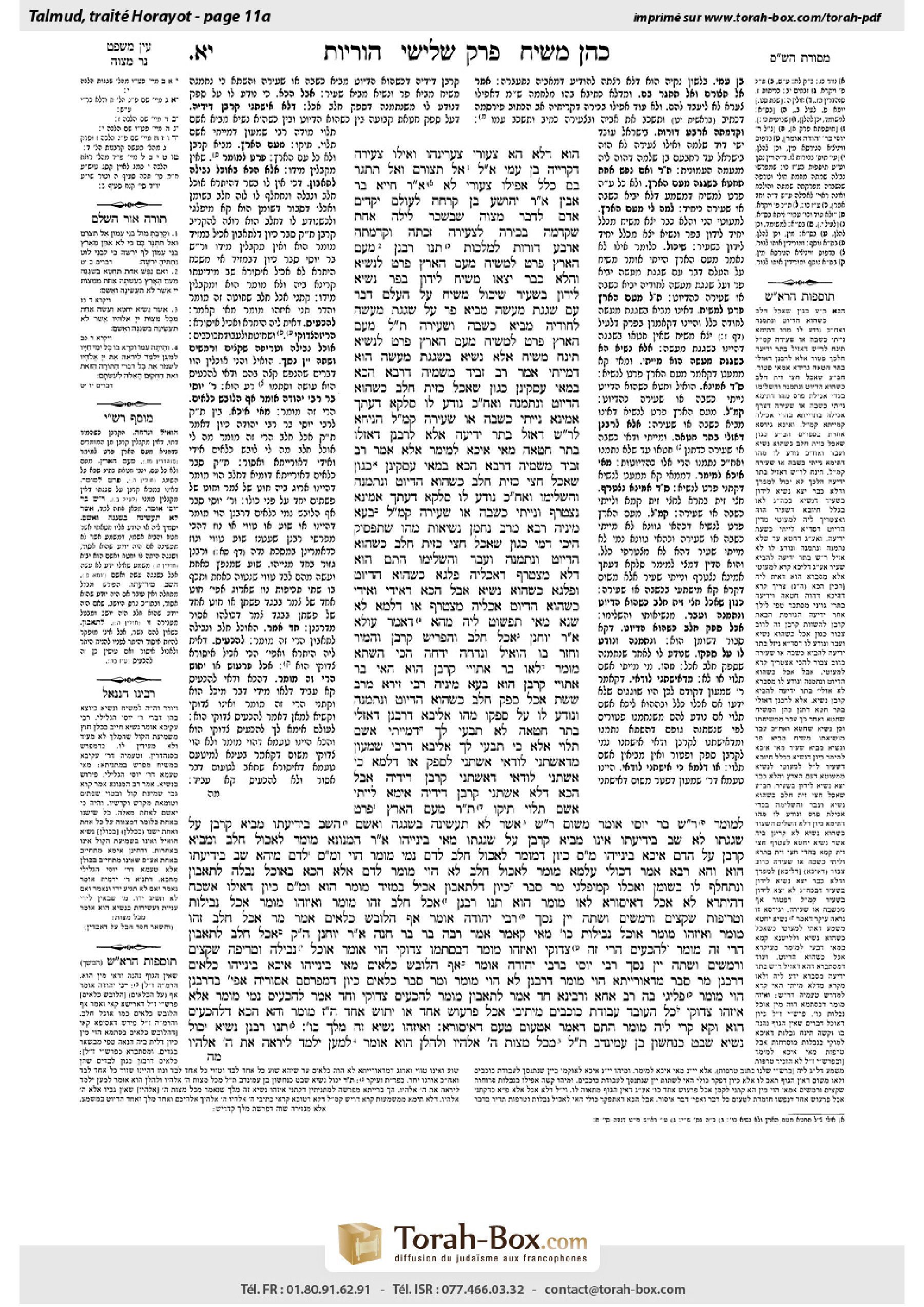
Horayot 11a: Talmud study for Daf Yomi
Study the Talmud for Daf Yomi with scanned pages, Hebrew text, English translations from Sefaria and AI-generated French translations.
Passage selection and English or AI-generated French translation are available where the scan has annotations. Daf Study is independent of Torah-Box and Sefaria.
Browse Horayot · הוריות · All tractatesHorayot 11a text and translations
This page of Horayot includes the Aramaic text, an English translation and an AI-generated French translation, alongside the scan above.
הוריות י״א א · Aramaic and Hebrew text
הוּא דְּלָא, הָא צַעוֹרֵי צַעֲרִינְהוּ. וְאִילּוּ צְעִירָה דִּקְרָיתֵיהּ ״בֶּן עַמִּי״, אֲמַר לֵיהּ: ״אַל תְּצֻרֵם וְאַל תִּתְגָּר בָּם״, כְּלָל, אֲפִילּוּ צַעוֹרֵי לָא.
אָמַר רַבִּי חִיָּיא בַּר אָבִין אָמַר רַבִּי יְהוֹשֻׁעַ בֶּן קׇרְחָה: לְעוֹלָם יַקְדִּים אָדָם לִדְבַר מִצְוָה, שֶׁבִּשְׂכַר לַיְלָה אַחַת שֶׁקָּדְמָה בְּכִירָה לַצְּעִירָה, זָכְתָה וּקְדָמַתָּה אַרְבַּע דּוֹרוֹת לַמַּלְכוּת.
תָּנוּ רַבָּנַן: ״מֵעַם הָאָרֶץ״ – פְּרָט לְמָשִׁיחַ. ״מֵעַם הָאָרֶץ״ – פְּרָט לְנָשִׂיא,
וַהֲלֹא כְּבָר יָצְאוּ מָשִׁיחַ לִידּוֹן בְּפַר, נָשִׂיא לִידּוֹן בְּשָׂעִיר! שֶׁיָּכוֹל: מָשִׁיחַ עַל הֶעְלֵם דָּבָר עִם שִׁגְגַת מַעֲשֶׂה מֵבִיא פַּר, עַל שִׁגְגַת מַעֲשֶׂה לְחוֹדֵיהּ מֵבִיא כִּשְׂבָּה וּשְׂעִירָה? תַּלְמוּד לוֹמַר: ״מֵעַם הָאָרֶץ״ – פְּרָט לְמָשִׁיחַ. ״מֵעַם הָאָרֶץ״ – פְּרָט לְנָשִׂיא.
תִּינַח מָשִׁיחַ, אֶלָּא נָשִׂיא בְּשִׁגְגַת מַעֲשֶׂה הוּא דְּמַיְיתֵי!
אָמַר רַב זְבִיד מִשְּׁמֵיהּ דְּרָבָא: הָכָא בְּמַאי עָסְקִינַן? כְּגוֹן שֶׁאָכַל כְּזַיִת חֵלֶב כְּשֶׁהוּא הֶדְיוֹט, וְנִתְמַנָּה וְאַחַר כָּךְ נוֹדַע לוֹ. סָלְקָא דַּעְתָּךְ אָמֵינָא נַיְיתֵי כִּשְׂבָּה אוֹ שְׂעִירָה, קָמַשְׁמַע לַן. הָנִיחָא לְרַבִּי שִׁמְעוֹן דְּאָזֵל בָּתַר יְדִיעָה, אֶלָּא לְרַבָּנַן (דְּאָזְלוּ) [דְּאָזְלִי] בָּתַר חֲטָאָה, מַאי אִיכָּא לְמֵימַר?
אֶלָּא אָמַר רַב זְבִיד מִשְּׁמֵיהּ דְּרָבָא: הָכָא בְּמַאי עָסְקִינַן? כְּגוֹן שֶׁאָכַל חֲצִי כְּזַיִת חֵלֶב כְּשֶׁהוּא הֶדְיוֹט, וְנִתְמַנָּה וְהִשְׁלִימוֹ, וְאַחַר כָּךְ נוֹדַע לוֹ. סָלְקָא דַּעְתָּךְ אָמֵינָא נִצְטְרֵף וְנַיְיתֵי כִּשְׂבָּה אוֹ שְׂעִירָה, קָא מַשְׁמַע לַן.
בְּעָא מִינֵּיהּ רָבָא מֵרַב נַחְמָן: נְשִׂיאוּת מַהוּ שֶׁתַּפְסִיק, הֵיכִי דָּמֵי? כְּגוֹן שֶׁאָכַל חֲצִי כְּזַיִת חֵלֶב כְּשֶׁהוּא הֶדְיוֹט, וְנִתְמַנָּה וְעָבַר, וְהִשְׁלִימוֹ – הָתָם הוּא דְּלָא מִצְטְרֵף, דְּאַכְלֵיהּ פַּלְגָא כְּשֶׁהוּא הֶדְיוֹט וּפַלְגָא כְּשֶׁהוּא נָשִׂיא, אֲבָל הָכָא דְּאִידֵּי וְאִידֵּי כְּשֶׁהוּא הֶדְיוֹט אַכְלֵיהּ מִצְטְרֵף, אוֹ דִלְמָא לָא שְׁנָא? מַאי?
תִּפְשׁוֹט לֵיהּ מֵהָא דְּאָמַר עוּלָּא אָמַר רַבִּי יוֹחָנָן: אָכַל חֵלֶב וְהִפְרִישׁ קׇרְבָּן וְנִשְׁתַּמֵּד וְחָזַר בּוֹ, הוֹאִיל וְנִדְחָה – יִדָּחֶה. הָכִי הַשְׁתָּא? מְשׁוּמָּד לָאו בַּר אֵתוֹיֵי קׇרְבָּן הוּא, הַאי בַּר אֵתוֹיֵי קׇרְבָּן הוּא.
בְּעָא מִינֵּיהּ רַבִּי זֵירָא מֵרַב שֵׁשֶׁת: אָכַל סָפֵק חֵלֶב כְּשֶׁהוּא הֶדְיוֹט, וְנִתְמַנָּה וְנוֹדַע לוֹ עַל סְפֵקוֹ, מַהוּ? אַלִּיבָּא דְּרַבָּנַן דְּאָזְלִי בָּתַר חֲטָאָה לָא תִּבְּעֵי לָךְ, דְּמַיְיתֵי אָשָׁם תָּלוּי, אֶלָּא כִּי תִּבְּעֵי לָךְ – אַלִּיבָּא דְּרַבִּי שִׁמְעוֹן.
מִדְּאִשְׁתַּנִּי לְוַדַּאי, אִשְׁתַּנִּי לְסָפֵק, אוֹ דִלְמָא כִּי אִשְׁתַּנִּי לְוַדַּאי, דְּאִשְׁתַּנִּי קׇרְבָּן דִּידֵיהּ – אֲבָל הָכָא דְּלָא אִשְׁתַּנִּי קׇרְבָּן דִּידֵיהּ, אֵימָא לַיְיתֵי אָשָׁם תָּלוּי? תֵּיקוּ.
תָּנוּ רַבָּנַן: ״מֵעַם הָאָרֶץ״ – פְּרָט לִמְשׁוּמָּד.
רַבִּי שִׁמְעוֹן בַּר יוֹסֵי אוֹמֵר מִשּׁוּם רַבִּי שִׁמְעוֹן: ״אֲשֶׁר לֹא תֵעָשֶׂינָה בִּשְׁגָגָה וְאָשֵׁם״, הַשָּׁב בִּידִיעָתוֹ – מֵבִיא קׇרְבָּן עַל שִׁגְגָתוֹ, לֹא שָׁב בִּידִיעָתוֹ – אֵינוֹ מֵבִיא קׇרְבָּן עַל שִׁגְגָתוֹ.
מַאי בֵּינַיְיהוּ? אָמַר רַבִּי הַמְנוּנָא: מְשׁוּמָּד לֶאֱכוֹל חֵלֶב וּמֵבִיא קׇרְבָּן עַל הַדָּם – אִיכָּא בֵּינַיְיהוּ. מָר סָבַר: כֵּיוָן דִּמְשׁוּמָּד לֶאֱכוֹל חֵלֶב – לְדָם נָמֵי מְשׁוּמָּד הָוֵי, וּמָר סָבַר: לְדָם מִיהָא שָׁב בִּידִיעָתוֹ הוּא.
וְהָא רָבָא אָמַר: דְּכוּלֵּי עָלְמָא מְשׁוּמָּד לֶאֱכוֹל חֵלֶב לָא הָוֵי מְשׁוּמָּד לְדָם! אֶלָּא, הָכָא בְּאוֹכֵל נְבֵלָה לְתֵאָבוֹן וְנִתְחַלֵּף לוֹ בְּשׁוּמָּן וַאֲכָלוֹ קָמִיפַּלְגִי, מָר סָבַר: כֵּיוָן דִּלְתֵאָבוֹן אָכֵיל בְּמֵזִיד – מְשׁוּמָּד הוּא, וּמָר סָבַר: כֵּיוָן דְּאִילּוּ אַשְׁכַּח דְּהֶיתֵּרָא לָא אֲכַל דְּאִיסּוּרָא – לָאו מְשׁוּמָּד הוּא.
תָּנוּ רַבָּנַן: אָכַל חֵלֶב – זֶהוּ מְשׁוּמָּד, וְאֵיזֶהוּ מְשׁוּמָּד? אָכַל נְבֵילוֹת וּטְרֵיפוֹת, שְׁקָצִים וּרְמָשִׂים, וְשָׁתָה יֵין נֶסֶךְ. רַבִּי יְהוּדָה אוֹמֵר: אַף הַלּוֹבֵשׁ כִּלְאַיִם. אָמַר מָר: אָכַל חֵלֶב זֶהוּ מְשׁוּמָּד, וְאֵיזֶהוּ מְשׁוּמָּד? אוֹכֵל נְבֵילוֹת כּוּ׳. מַאי קָאָמַר?
אָמַר רַבָּה בַּר בַּר חָנָה אָמַר רַבִּי יוֹחָנָן, הָכִי קָאָמַר: אָכַל חֵלֶב לְתֵאָבוֹן – הֲרֵי זֶה מְשׁוּמָּד, לְהַכְעִיס – הֲרֵי זֶה מִין. וְאֵיזֶהוּ מְשׁוּמָּד דְּבִסְתָמוֹ מִין? הֱוֵי אוֹמֵר: אוֹכֵל נְבֵילָה וּטְרֵיפָה, שְׁקָצִים וּרְמָשִׂים, וְשָׁתָה יֵין נֶסֶךְ. רַבִּי יוֹסֵי בְּרַבִּי יְהוּדָה אוֹמֵר: אַף הַלּוֹבֵשׁ כִּלְאַיִם.
מַאי בֵּינַיְיהוּ? אִיכָּא בֵּינַיְיהוּ כִּלְאַיִם דְּרַבָּנַן. מָר סָבַר: מִדְּאוֹרָיְיתָא הָוֵי מְשׁוּמָּד, דְּרַבָּנַן לָא הָוֵי מְשׁוּמָּד. וּמָר סָבַר: כִּלְאַיִם כֵּיוָן דִּמְפַרְסַם אִסּוּרֵיהּ, אֲפִילּוּ בִּדְרַבָּנַן הָוֵי מְשׁוּמָּד.
פְּלִיגִי בַּהּ רַב אַחָא וְרָבִינָא, חַד אָמַר: לְתֵאָבוֹן – מְשׁוּמָּד, לְהַכְעִיס – מִין. וְחַד אָמַר: לְהַכְעִיס נָמֵי מְשׁוּמָּד, אֶלָּא אֵיזֶהוּ מִין? כָּל הָעוֹבֵד עֲבוֹדָה זָרָה. מֵיתִיבִי: אָכַל פַּרְעוֹשׁ אֶחָד אוֹ יַתּוּשׁ אֶחָד – הֲרֵי זֶה מְשׁוּמָּד. וְהָא הָכָא דִּלְהַכְעִיס הוּא, וְקָא קָרֵי לֵיהּ מְשׁוּמָּד! הָתָם דְּאָמַר: אֶטְעוֹם טַעַם דְּאִיסּוּרָא.
וְאֵיזֶהוּ נָשִׂיא? זֶה מֶלֶךְ כּוּ׳. תָּנוּ רַבָּנַן: ״נָשִׂיא״ – יָכוֹל נְשִׂיא שֵׁבֶט כְּנַחְשׁוֹן בֶּן עַמִּינָדָב? תַּלְמוּד לוֹמַר: ״מִכׇּל מִצְוֹת ה׳ אֱלֹהָיו״, וּלְהַלָּן: הוּא אוֹמֵר ״לְמַעַן יִלְמַד לְיִרְאָה אֶת ה׳ אֱלֹהָיו״.
Horayot 11a · English translation
that one may not contend with them, but it is permitted to harass them. While concerning the offspring of the younger daughter, who called her son ben Ami, son of my people, avoiding any direct mention of the baby’s father, God said to Moses: “Neither harass them, nor contend with them” (Deuteronomy 2:19), at all. Even to harass them is not permitted.
Rabbi Ḥiyya bar Avin says that Rabbi Yehoshua ben Korḥa says: A person should always be first to perform a matter of a mitzva, as in reward for one night that the elder daughter preceded the younger daughter, she merited and preceded her to royalty by four generations. Ruth the Moabite, ancestor of King David, descended from her son Moab, and she preceded Naamah the Ammonite, who was married to King Solomon, by four generations.
§ The Sages taught in a baraita: The verse states: “And if one soul from among the common people sins unwittingly in performing one of the mitzvot of God that may not be done and he is guilty” (Leviticus 4:27). The phrase “from among the common people” serves to exclude the anointed priest; the phrase “from among the common people” also serves to exclude the king.
The baraita continues: But weren’t these individuals already excluded from bringing a ewe or a female goat as a sin-offering, as an anointed priest is subject to atonement with a bull, and a king is subject to atonement with a male goat? Why then is an additional exclusionary derivation necessary? The baraita answers: The derivation is necessary, as one might have thought that an anointed priest brings a bull for absence of awareness of the matter together with the unwitting performance of an action, but that he brings a ewe or a female goat, as does a non-priest, for the unwitting performance of an action alone. Therefore, the verse states: “From among the common people,” which serves to exclude the anointed priest, who is completely exempt from bringing a sin-offering for an unwitting transgression unless it was committed on the basis of his own erroneous ruling. The baraita concludes: The phrase “from among the common people” serves to exclude the king.
The Gemara challenges: Granted, in the case of an anointed priest it is clear why an additional exclusionary derivation is necessary. But in the case of a king, it is for the unwitting performance of an action that he brings a goat as his offering. Why then is the additional derivation necessary?
Rav Zevid said in the name of Rava: What are we dealing with here? We are dealing with a case where one unwittingly ate an olive-bulk of forbidden fat when he was a commoner, and he was then appointed king, and thereafter his transgression became known to him. It could enter your mind to say: Let him bring a ewe or a female goat because he performed the transgression before he became king. Therefore, the verse teaches us that he brings a male goat as he is now a king. The Gemara challenges: This works out well according to Rabbi Shimon, who follows the time of knowledge, and holds that one brings the offering on the basis of his status at the time when his transgression became known to him. But according to the Rabbis, who follow the time of the performance of the sin, what can be said?
Rather, Rav Zevid said in the name of Rava: What are we dealing with here? We are dealing with a case where one unwittingly ate half an olive-bulk of forbidden fat when he was a commoner, and he was then appointed king, and he then finished eating the olive-bulk of forbidden fat, and thereafter it became known to him that he had eaten forbidden fat. It could enter your mind to say: Let the two halves combine and let him bring a ewe or a female goat. Therefore, the verse teaches us that the status of a king is not like that of a commoner. Since a king brings a special offering, the half olive-bulk that he ate before becoming king does not combine with the half olive-bulk that he ate as a king.
Rava raised a dilemma before Rav Naḥman: With regard to kingship, what is the halakha? Does it interpose between two parts of a transgression and prevent them from combining? What are the circumstances? It is a case where one unwittingly ate half an olive-bulk of forbidden fat when he was a commoner, and he was then appointed king, and then was removed from his position, and then finished eating the olive-bulk of forbidden fat. Perhaps it is there, in the previous case, that the two actions do not combine, as he ate half when he was a commoner and half when he was king. But here, where he ate both this half and that half when he was a commoner, they combine. Or perhaps it is no different, and once he was appointed king and his status changed, the two actions do not combine. What is the halakha?
The Gemara suggests: Resolve the dilemma from that which Ulla says that Rabbi Yoḥanan says: If one ate forbidden fat and designated an offering for his unwitting sin, and he became an apostate, and then retracted his apostasy, since he was disqualified from bringing the offering as an apostate he shall remain disqualified from bringing an offering for that sin. The Gemara rejects this: How can these cases be compared? An apostate is ineligible as far as bringing an offering of any kind is concerned; this king is eligible with regard to bringing an offering, albeit of a different type.
Rabbi Zeira raised a dilemma before Rav Sheshet: If one ate meat when he was a commoner, and there was uncertainty as to whether or not it was forbidden fat, and subsequently he was appointed king and his uncertainty became known to him, what is the halakha? According to the opinion of the Rabbis, who follow the time of the actual transgression, do not raise the dilemma, as in their opinion, he is liable to bring a provisional guilt-offering. Rather, when you raise the dilemma it is according to the opinion of Rabbi Shimon, who follows the time of awareness of the transgression.
Is the halakha that from the fact that his status changed with regard to a definite transgression, as, if he was liable to bring a sin-offering and his sin became known to him after his coronation, he is completely exempt, it may be derived that his status changed with regard to an uncertain transgression as well, and he is exempt from bringing a provisional guilt-offering? Or perhaps when his status changed, it was with regard to a definite transgression only, as in that case his offering changed, since a king brings a goat as a sin-offering instead of a ewe or a female goat. But here, in the case of an uncertain transgression, as his offering does not change, say: Let him bring a provisional guilt-offering. The Gemara concludes: The dilemma shall stand unresolved.
§ The Sages taught: The verse states: “And if one soul from among the common people sins unwittingly in performing one of the mitzvot of God that may not be done and he is guilty” (Leviticus 4:27). This serves to exclude an apostate. When an apostate sins unwittingly, he is exempt from liability to bring a sin-offering even if he repents for that sin, as even his unwitting action is considered intentional.
The baraita continues: Rabbi Shimon bar Yosei says in the name of Rabbi Shimon: It is unnecessary to derive this halakha from that phrase, as it says in the same verse: “If any one of the common people sins unwittingly in performing one of the mitzvot of God that may not be done and he is guilty; or if his sin, which he has sinned, be known to him” (Leviticus 4:27–28). From the words “be known to him” it is inferred that only one who repents due to his awareness, i.e., who would not have sinned had he known that the act was forbidden, brings an offering for his unwitting transgression and achieves atonement in this way. But one who does not repent due to his awareness that he sinned, e.g., an apostate, who would sin even after becoming aware that the act is forbidden, does not bring an offering for his unwitting action.
The Gemara asks: What is the practical difference between the opinions of the Rabbis and Rabbi Shimon concerning whether the halakha is derived from the earlier or later verse? Rav Hamnuna said: The difference between them is in the case of an apostate with regard to eating forbidden fat; they disagree as to whether or not he brings an offering for unwittingly consuming blood. One Sage, the Rabbis, holds: Since he is an apostate with regard to eating forbidden fat, he is also considered an apostate with regard to consuming blood. And one Sage, Rabbi Shimon, holds: With regard to consuming blood, in any event, he is one who repents due to his awareness, as he is not considered an apostate with regard to blood.
The Gemara asks: But didn’t Rava say that everyone agrees that an apostate with regard to eating forbidden fat is not considered an apostate with regard to consuming blood? The Gemara answers: Rather, here it is with regard to a person who eats forbidden fat and an animal carcass due to appetite, e.g., only when he does not have access to kosher meat. And forbidden fat became confused for that person with permitted fat and he ate the forbidden fat. It is in that case that the Rabbis and Rabbi Shimon disagree. One Sage, the Rabbis, holds: Since he intentionally eats forbidden fat due to appetite, he is an apostate. And one Sage, Rabbi Shimon, holds: Since if he finds food that is permitted he does not eat food that is prohibited, as he merely seeks to satiate his appetite, he is not an apostate.
The Sages taught: One who ate forbidden fat is an apostate. And who is an apostate? It is one who ate animal carcasses or animals with wounds that will cause them to die within twelve months [tereifot], repugnant creatures or creeping animals, and one who drank wine used for a libation in idol worship. Rabbi Yehuda says: This applies even to one who wears garments fashioned of diverse kinds, containing wool and linen. The Gemara analyzes this baraita. The Master said: One who ate forbidden fat is an apostate. And who is an apostate? It is one who ate animal carcasses, etc. The Gemara asks: What is he saying? Why, after answering the question, does the tanna ask who is an apostate and then provide a different answer?
Rabba bar bar Ḥana said that Rabbi Yoḥanan said: This is what he is saying: If one ate forbidden fat due to appetite, he is an apostate. If he ate it to express insolence, this person is a heretic. And which is the apostate who is a presumptive heretic merely on the basis of his actions? You must say that it is one who eats an animal carcass or a tereifa, repugnant creatures or creeping animals, and one who drank wine used for a libation in idol worship. Based on the fact that he violates serious transgressions for which one has no appetite such as repugnant creatures or creeping animals, it is clear that he is a heretic who denies the Torah in its entirety. Rabbi Yosei, son of Rabbi Yehuda, says: This applies even to one who wears garments fashioned of diverse kinds, containing wool and linen.
The Gemara asks: What is the practical difference between the opinion of the Rabbis and that of Rabbi Yosei, son of Rabbi Yehuda? The Gemara answers: The difference between them is in the case of one who wears a garment of diverse kinds, containing wool and linen prohibited by rabbinic law. One Sage, the Rabbis, holds: One who violates a prohibition by Torah law is an apostate; one who violates a prohibition by rabbinic law is not an apostate. And one Sage, Rabbi Yosei, holds: With regard to diverse kinds, since his violation of the prohibition is well known, as people see that he is wearing that garment, even though he violates a prohibition by rabbinic law, he is an apostate.
Rav Aḥa and Ravina disagree with regard to this matter. One said: If one violated a prohibition due to appetite or convenience he is an apostate, while one who eats to express insolence is a heretic. And one said: One who violates a prohibition to express insolence is also an apostate. Rather, who is a heretic? It is anyone who engages in idol worship. The Gemara raises an objection to the first opinion from a baraita: If a person ate one flea or one mosquito, this person is an apostate. But here, isn’t it a case where it is a violation performed to express insolence, as one has no desire to eat these insects, and yet the tanna calls him an apostate? The Gemara answers: The reference there, in that baraita, is to the case of one who eats the flea due to appetite, as he says: I shall taste the flavor of prohibition. He seeks to eat a food that he has never eaten before.
§ The mishna teaches: Who is the nasi? This is a king, as it is stated: “When a nasi sins, and performs any one of all the mitzvot of the Lord his God that shall not be performed, unwittingly, and he is guilty” (Leviticus 4:22), referring to one who has only the Lord his God over him and no other authority. The Sages taught: The verse states: “nasi.” One might have thought that the reference is to the prince of a tribe, like Naḥshon, son of Amminadab. Therefore, the verse states: “And performed any one of all the mitzvot of the Lord his God.” Later, in the passage with regard to the king, the verse states: “That he may learn to fear the Lord his God” (Deuteronomy 17:19).
Horayot 11a · Traduction française (IA)
qu'on ne peut pas les contester, mais il est permis de les importuner. Concernant les enfants de la fille aînée, qui appela son fils ben Ami, fils de mon peuple, évitant toute mention directe du père de l'enfant, Dieu dit à Moïse : « Ni les importuner, ni les contester » (Deutéronome 2:19), en aucun cas. Même d'importuner eux est interdit.
Rabbi Ḥiyya bar Avin dit que Rabbi Yehoshua ben Korḥa dit : Une personne devrait toujours être la première à accomplir une matière de mitsva, car en récompense pour une nuit que la fille aînée avait précédé la jeune fille, elle méritait de précéder sa fille à la royauté par quatre générations. Ruth la Moabite, ancêtre du roi David, descendait de son fils Moab, et elle précéda Naamah l'Ammonite, qui était mariée au roi Salomon, par quatre générations.
§ Les Sages enseignèrent dans une baraïta : La parole dit : « Et si une âme du peuple ordinaire péche involontairement en accomplissant l'une des mitsvot de Dieu qui ne doit pas être accomplie et qu'il est coupable » (Lévitique 4:27). La phrase « du peuple ordinaire » sert à exclure le prêtre consacré ; la phrase « du peuple ordinaire » sert également à exclure le roi.
La baraïta continue : Mais ces individus n'étaient-ils pas déjà exclus de présenter une agnelle ou une chèvre femelle comme sacrifice expiatoire, puisque le prêtre consacré est soumis à l'atonement avec un taureau, et le roi avec une chèvre mâle ? Pourquoi alors une exclusion supplémentaire est-elle nécessaire ? La baraïta répond : Cette exclusion est nécessaire, car on pourrait penser que le prêtre consacré présente un taureau pour l'absence de connaissance de la chose, conjointement à l'accomplissement involontaire d'une action, mais qu'il présente une agnelle ou une chèvre femelle, comme le non-prêtre, pour l'accomplissement involontaire d'une action seule. Ainsi, la parole dit : « Du peuple ordinaire », ce qui sert à exclure le prêtre consacré, qui est entièrement exempt de présenter un sacrifice expiatoire pour un péché involontaire à moins qu'il ne l'ait commis sur la base de son propre jugement erroné. La baraïta conclut : La phrase « du peuple ordinaire » sert à exclure le roi.
Le Guemara conteste : C'est évident, dans le cas du prêtre consacré, pourquoi une exclusion supplémentaire est nécessaire. Mais dans le cas du roi, c'est pour l'accomplissement involontaire d'une action qu'il présente une chèvre comme offrande. Pourquoi alors une exclusion supplémentaire est-elle nécessaire ?
Rav Zevid dit en nom de Rava : De quoi sommes-nous en train de parler ? Nous parlons d'un cas où l'on a involontairement mangé une quantité d'huile prohibée égale à une olive, lorsqu'il était un simple citoyen, et il a ensuite été nommé roi, et ensuite son péché a été connu. Il pourrait entrer en votre esprit de dire : Laissez-le présenter une agnelle ou une chèvre femelle, car il a commis le péché avant d'être roi. Ainsi, la parole nous enseigne que désormais il présente une chèvre mâle, car il est maintenant roi. Le Guemara conteste : Cela fonctionne bien selon Rabbi Shimon, qui suit le moment de la connaissance, et qui considère que l'offrande est présentée selon son statut au moment où son péché a été connu. Mais selon les Rabbins, qui suivent le moment de la commission du péché, que peut-on dire ?
Plutôt, Rav Zevid dit en nom de Rava : De quoi sommes-nous en train de parler ? Nous parlons d'un cas où l'on a involontairement mangé la moitié d'une quantité d'huile prohibée égale à une olive lorsqu'il était un simple citoyen, et il a ensuite été nommé roi, et il a ensuite fini de manger la quantité d'huile prohibée, et ensuite il a été connu qu'il avait mangé de l'huile prohibée. Il pourrait entrer en votre esprit de dire : Que les deux moitiés s'unissent et qu'il présente une agnelle ou une chèvre femelle. Ainsi, la parole nous enseigne que le statut de roi n'est pas comme celui du citoyen ordinaire. Puisque le roi présente un sacrifice spécial, la moitié d'huile prohibée qu'il a mangé avant d'être roi ne s'unira pas à la moitié qu'il a mangé en tant que roi.
Rava posa un dilemme devant Rav Naḥman : En ce qui concerne la royauté, quelle est la halakha ? La royauté interpose-t-elle entre deux parties d'un péché et empêche-t-elle qu'elles s'unissent ? Quelles sont les circonstances ? C'est un cas où l'on a involontairement mangé la moitié d'une quantité d'huile prohibée égale à une olive lorsqu'il était un simple citoyen, et il a ensuite été nommé roi, et ensuite il a été retiré de son poste, et il a ensuite fini de manger la quantité d'huile prohibée. Peut-être est-ce là, dans le cas précédent, que les deux actions ne s'unissent pas, car il a mangé la moitié lorsqu'il était un citoyen ordinaire et la moitié lorsqu'il était roi. Mais ici, où il a mangé les deux moitiés lorsqu'il était citoyen, elles s'unissent. Ou peut-être n'est-ce pas différent, et une fois qu'il a été nommé roi et que son statut a changé, les deux actions ne s'unissent pas. Quelle est la halakha ?
Le Guemara suggère : Résolvez ce dilemme à partir de ce que Ulla rapporte que Rabbi Yoḥanan a dit : Si l'on a mangé de l'huile prohibée et a désigné une offrande pour son péché involontaire, et qu'il est devenu un apostat, puis qu'il a rétracté son apostasie, puisque l'apostat est inéligible à présenter une offrande, il restera inéligible à présenter une offrande pour ce péché. Le Guemara rejette cela : Comment peuvent ces cas être comparés ? L'apostat est inéligible à présenter toute offrande, tandis que ce roi est éligible à présenter une offrande, bien qu'un type différent.
Rabbi Zeira posa un dilemme devant Rav Sheshet : Si l'on a mangé de la viande lorsqu'il était un citoyen ordinaire, et s'il y avait une incertitude quant à ce que ce soit de la graisse prohibée, et ensuite il a été nommé roi et son incertitude a été connue, quelle est la halakha ? Selon l'opinion des Rabbins, qui suivent le moment de la commission du péché, ne soulève pas le dilemme, car selon leur opinion, il est tenu de présenter un sacrifice de culpabilité provisoire. Plutôt, lorsque vous soulévez le dilemme, c'est selon l'opinion de Rabbi Shimon, qui suit le moment de la connaissance du péché.
Est-ce que la halakha peut être déduite du fait que son statut a changé par rapport à une transgression définie, comme, par exemple, s'il était tenu de présenter un sacrifice expiatoire et que sa faute lui est devenue connue après son couronnement, il est entièrement exempt, peut-on en déduire que son statut a changé par rapport à une transgression incertaine également, et qu'il est exempt de présenter un sacrifice de culpabilité provisoire ? Ou peut-être que lorsqu'il a changé de statut, c'était uniquement par rapport à une transgression définie, comme dans ce cas son sacrifice a changé, puisque le roi présente un bouc comme sacrifice expiatoire au lieu d'une brebis ou d'une femelle bouc. Mais ici, dans le cas d'une transgression incertaine, comme son sacrifice ne change pas, disons : qu'il présente un sacrifice de culpabilité provisoire. La Guemara conclut : ce dilemme restera sans solution.
§ Les Sages enseignent : La Parole dit : « Et si une âme du peuple ordinaire péche involontairement en accomplissant l'une des Mitsvot de Dieu qui ne doit pas être accomplie et qu'il est coupable » (Lévitique 4:27). Cela sert à exclure l'apostat. Lorsqu'un apostat péche involontairement, il est exempt de responsabilité de présenter un sacrifice expiatoire même s'il se repent de cette faute, car même son action involontaire est considérée comme intentionnelle.
La baraïta continue : Rabbi Shimon bar Yosei dit au nom de Rabbi Shimon : Il n'est pas nécessaire de déduire cette halakha de cette expression, car il dit dans le même verset : « Si l'un des peuples ordinaires péche involontairement en accomplissant l'une des Mitsvot de Dieu qui ne doit pas être accomplie et qu'il est coupable ; ou si sa faute, qu'il a commise, est connue à lui » (Lévitique 4:27–28). À partir des mots « soit connue à lui », on déduit que seul celui qui se repente en raison de sa connaissance, c'est-à-dire celui qui ne serait pas tombé en faute s'il avait su que l'acte était interdit, présente un sacrifice pour sa faute involontaire et obtient ainsi la rédemption. Celui qui ne se repente pas en raison de sa connaissance qu'il a péché, par exemple l'apostat, qui pécherait même après avoir pris conscience que l'acte est interdit, ne présente pas de sacrifice pour son action involontaire.
La Guemara pose la question : Quelle est la différence pratique entre les opinions des Rabbins et celle de Rabbi Shimon concernant la question de savoir si la halakha est déduite du verset précédent ou du suivant ? Rav Hamnuna dit : La différence entre eux est dans le cas de l'apostat concernant la consommation de graisse interdite ; ils divergent sur le fait qu'il présente ou non un sacrifice pour la consommation involontaire de sang. Un Sage, les Rabbins, affirme : Puisque c'est un apostat concernant la consommation de graisse interdite, il est également considéré comme un apostat concernant la consommation de sang. Et un autre Sage, Rabbi Shimon, affirme : Concernant la consommation de sang, en tout cas, il est celui qui se repente en raison de sa connaissance, car il n'est pas considéré comme un apostat concernant le sang.
La Guemara pose la question : Mais n’a-t-il pas dit Rava que tout le monde convient que l’apostat concernant la consommation de graisse interdite n’est pas considéré comme un apostat concernant la consommation de sang ? La Guemara répond : Plutôt, ici, il s’agit d’une personne qui mange de la graisse interdite et un cadavre d’animaux en raison de l’appétit, c’est-à-dire uniquement lorsqu’il n’a pas accès à de la viande kasher. Et la graisse interdite s’est confondu pour cette personne avec la graisse permise et il a mangé la graisse interdite. C’est dans ce cas que les Rabbins et Rabbi Shimon divergent. Un Sage, les Rabbins, affirme : Puisque c’est un appétit qui le pousse à manger de la graisse interdite, il est un apostat. Et un autre Sage, Rabbi Shimon, affirme : Puisque s’il trouve de la nourriture permise il ne mange pas de nourriture interdite, car il cherche simplement à satisfaire son appétit, il n’est pas un apostat.
Les Sages enseignent : Celui qui a mangé de la graisse interdite est un apostat. Et qui est un apostat ? C’est celui qui a mangé des cadavres d’animaux ou des animaux blessés qui mourront dans les douze mois [tereifot], des créatures repoussantes ou des animaux rampants, et celui qui a bu du vin utilisé pour un libation dans l’idolâtrie. Rabbi Yehuda dit : Cela s’applique même à celui qui porte des vêtements faits de diverses sortes, contenant de la laine et du lin. La Guemara analyse cette baraïta. Le Maître dit : Celui qui a mangé de la graisse interdite est un apostat. Et qui est un apostat ? C’est celui qui a mangé des cadavres d’animaux, etc. La Guemara pose la question : Qu’est-ce qu’il dit ? Pourquoi, après avoir répondu à la question, le tanna demande qui est un apostat et puis donne une réponse différente ?
Rabba bar bar Ḥana dit que Rabbi Yoḥanan a dit : C'est ce qu'il veut dire : Si l'on a mangé de la graisse interdite en raison de l'appétit, il est un apostat. Si l'on l'a mangé pour exprimer l'insolence, cette personne est un hérétique. Et qui est l'apostat qui est un hérétique présumé uniquement sur la base de ses actions ? Vous devez dire que c'est celui qui mange un cadavre d'animaux ou un tereifa, des créatures repoussantes ou des animaux rampants, et celui qui a bu du vin utilisé pour un libation dans l'idolâtrie. En raison du fait qu'il viole des transgressions graves pour lesquelles on n'a pas d'appétit, comme les créatures repoussantes ou les animaux rampants, il est clair qu'il est un hérétique qui nie la Torah dans son ensemble. Rabbi Yosei, fils de Rabbi Yehuda, dit : Cela s'applique même à celui qui porte des vêtements faits de diverses sortes, contenant de la laine et du lin.
La Guemara pose la question : Quelle est la différence pratique entre l'opinion des Rabbins et celle de Rabbi Yosei, fils de Rabbi Yehuda ? La Guemara répond : La différence entre eux est dans le cas d'une personne qui porte un vêtement de diverses sortes, contenant de la laine et du lin interdits par la loi rabbinique. Un Sage, les Rabbins, affirme : Celui qui viole une interdiction selon la loi divine est un apostat ; celui qui viole une interdiction selon la loi rabbinique n'est pas un apostat. Et un autre Sage, Rabbi Yosei, affirme : Concernant les diverses sortes, puisque sa violation de l'interdiction est bien connue, car les gens voient qu'il porte ce vêtement, même s'il viole une interdiction selon la loi rabbinique, il est un apostat.
Rav Aḥa et Ravina sont en désaccord sur ce point. L'un dit : Celui qui transgresse une interdiction en raison de l'appétit ou de la commodité est un apostat, tandis que celui qui mange pour manifester son insolence est un hérétique. L'autre dit : Celui qui transgresse une interdiction pour manifester son insolence est aussi un apostat. Cependant, qui est un hérétique ? C'est celui qui pratique l'idolâtrie. La Guemara soulève un objet contre l'opinion première, à partir d'une baraïta : Si une personne a mangé un cafard ou un moustique, cette personne est un apostat. Mais ici, n'est-ce pas un cas où la transgression est faite pour manifester son insolence, puisque l'on n'a pas envie de manger ces insectes, et pourtant le tanna l'appelle un apostat ? La Guemara répond : La référence dans cette baraïta est au cas où l'on mange le cafard en raison de l'appétit, car il dit : Je vais goûter le goût de l'interdiction. Il cherche à manger un aliment qu'il n'a jamais mangé auparavant.
§ La michna enseigne : Qui est le nasi ? C'est un roi, comme il est dit : « Quand un nasi péche et accomplit l'une de toutes les mitsvot du Seigneur son Dieu qui ne doit pas être accomplie, sans le savoir, et il est coupable » (Lévitique 4:22), ce qui fait référence à celui qui a seulement le Seigneur son Dieu comme autorité et pas d'autre. Les Sages enseignent : La parole dit : « nasi ». On aurait pu penser qu'il s'agissait du prince d'une tribu, comme Naḥshon, fils d'Amminadab. Ainsi, la parole dit : « et accomplit l'une de toutes les mitsvot du Seigneur son Dieu ». Plus tard, dans le passage concernant le roi, la parole dit : « afin qu'il apprenne à craindre le Seigneur son Dieu » (Dt 17:19).
Traduction française générée par IA à partir de l’édition anglaise de Sefaria. Vérifie toujours un passage avec le texte source.
Text from Sefaria: William Davidson Edition - Vocalized Aramaic (CC BY NC); William Davidson Edition - English (CC BY NC).