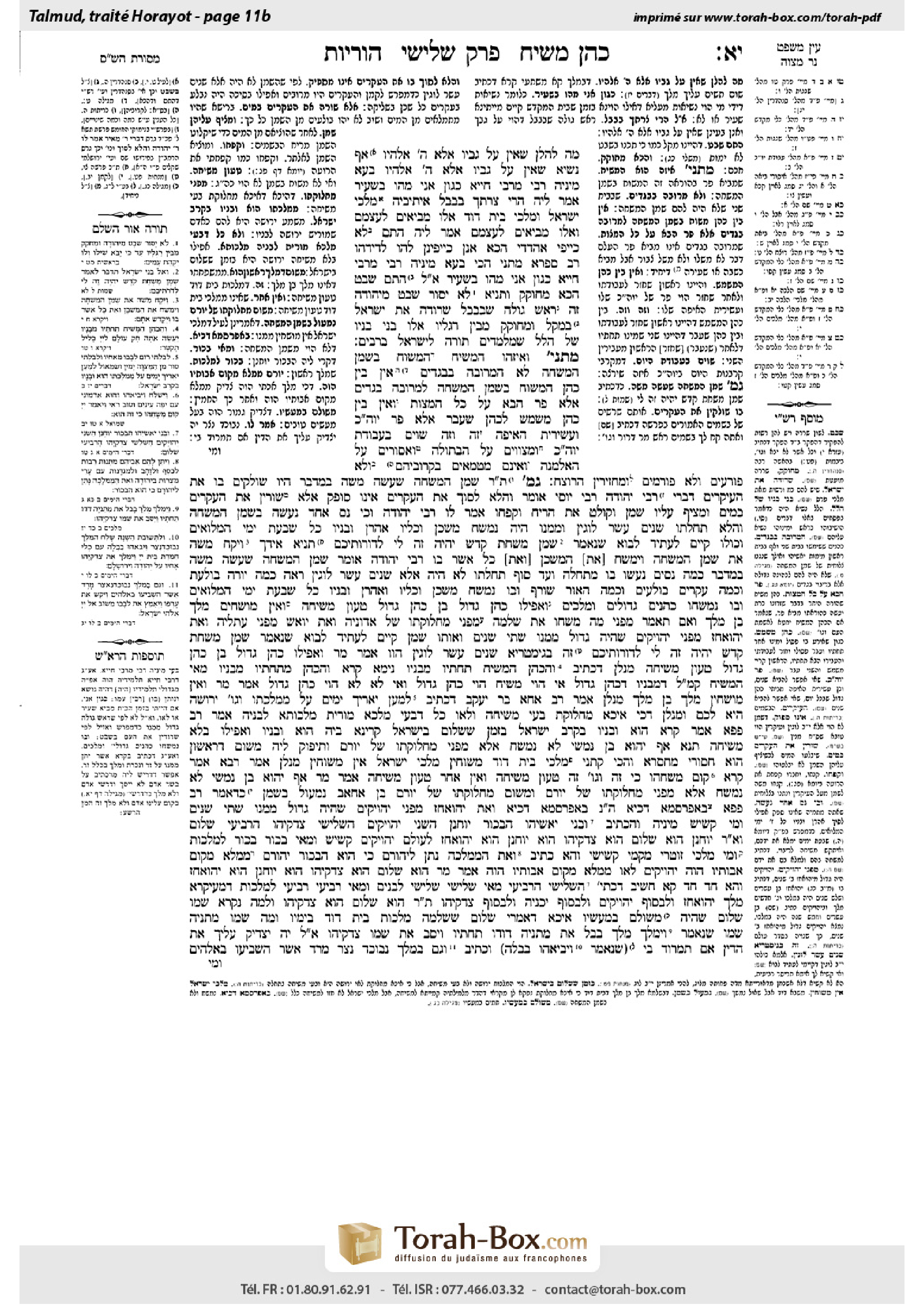
Horayot 11b: Talmud study for Daf Yomi
Study the Talmud for Daf Yomi with scanned pages, Hebrew text, English translations from Sefaria and AI-generated French translations.
Passage selection and English or AI-generated French translation are available where the scan has annotations. Daf Study is independent of Torah-Box and Sefaria.
Browse Horayot · הוריות · All tractatesHorayot 11b text and translations
This page of Horayot includes the Aramaic text, an English translation and an AI-generated French translation, alongside the scan above.
הוריות י״א ב · Aramaic and Hebrew text
מָה לְהַלָּן שֶׁאֵין עַל גַּבָּיו אֶלָּא ה׳ אֱלֹהָיו, אַף נָשִׂיא שֶׁאֵין עַל גַּבָּיו אֶלָּא ה׳ אֱלֹהָיו.
בְּעָא מִינֵּיהּ רַבִּי מֵרַבִּי חִיָּיא: כְּגוֹן אֲנִי, מַהוּ בְּשָׂעִיר? אֲמַר לֵיהּ: הֲרֵי צָרָתְךָ בְּבָבֶל. אֵיתִיבֵיהּ: מַלְכֵי יִשְׂרָאֵל וּמַלְכֵי בֵּית דָּוִד, אֵלּוּ מְבִיאִים לְעַצְמָם, וְאֵלּוּ מְבִיאִים לְעַצְמָם! אֲמַר לֵיהּ: הָתָם לָא כַּיְיפִי אַהֲדָדֵי, הָכָא אֲנַן כַּיְיפִינַן לְהוּ לְדִידְהוּ.
רַב סָפְרָא מַתְנֵי הָכִי. בְּעָא מִינֵּיהּ רַבִּי מֵרַבִּי חִיָּיא: כְּגוֹן אֲנִי מַהוּ בְּשָׂעִיר? אֲמַר לֵיהּ: הָתָם ״שֵׁבֶט״, הָכָא ״מְחוֹקֵק״, וְתַנְיָא: ״לֹא יָסוּר שֵׁבֶט מִיהוּדָה״ – זֶה רֹאשׁ גּוֹלָה שֶׁבְּבָבֶל, שֶׁרוֹדֶה אֶת יִשְׂרָאֵל בְּמַקֵּל. ״וּמְחוֹקֵק מִבֵּין רַגְלָיו״ – אֵלּוּ בְּנֵי בָנָיו שֶׁל הִלֵּל שֶׁמְלַמְּדִים תּוֹרָה לְיִשְׂרָאֵל בָּרַבִּים.
מַתְנִי׳ וְאֵיזֶהוּ הַמָּשִׁיחַ? הַמָּשׁוּחַ בְּשֶׁמֶן הַמִּשְׁחָה, לֹא הַמְרוּבֶּה בִּבְגָדִים. אֵין בֵּין כֹּהֵן הַמָּשׁוּחַ בְּשֶׁמֶן הַמִּשְׁחָה לִמְרוּבֵּה בְּגָדִים, אֶלָּא פַּר הַבָּא עַל כׇּל הַמִּצְוֹת.
וְאֵין בֵּין כֹּהֵן מְשַׁמֵּשׁ לְכֹהֵן שֶׁעָבַר אֶלָּא פַּר יוֹם הַכִּיפּוּרִים וַעֲשִׂירִית הָאֵיפָה.
זֶה וָזֶה שָׁוִים בַּעֲבוֹדַת יוֹם הַכִּיפּוּרִים, וּמְצֻוִּוים עַל הַבְּתוּלָה, וַאֲסוּרִים עַל הָאַלְמָנָה, וְאֵינָם מִטַּמְּאִים בִּקְרוֹבֵיהֶם, וְלֹא פּוֹרְעִים, וְלֹא פּוֹרְמִים, וּמַחְזִירִין הָרוֹצֵחַ.
גְּמָ׳ תָּנוּ רַבָּנַן: שֶׁמֶן הַמִּשְׁחָה שֶׁעָשָׂה מֹשֶׁה בַּמִּדְבָּר הָיוּ שׁוֹלְקִים בּוֹ אֶת הָעִיקָּרִים, דִּבְרֵי רַבִּי יְהוּדָה. רַבִּי יוֹסֵי אוֹמֵר: וַהֲלֹא לָסוּךְ אֶת הָעִקָּרִים אֵינוֹ סוֹפֵק?! אֶלָּא: שׁוֹרִין אֶת הָעִקָּרִים בְּמַיִם, וּמֵצִיף עָלָיו שֶׁמֶן, וְקוֹלֵט אֶת הָרֵיחַ וְקוֹפְחוֹ.
אָמַר לוֹ רַבִּי יְהוּדָה: וְכִי נֵס אֶחָד נַעֲשָׂה בְּשֶׁמֶן הַמִּשְׁחָה? וַהֲלֹא תְּחִלָּתוֹ שְׁנֵים עָשָׂר לוּגִּין, וּמִמֶּנּוּ הָיָה נִמְשָׁח מִשְׁכָּן וְכֵלָיו אַהֲרֹן וּבָנָיו כׇּל שִׁבְעַת יְמֵי הַמִּלּוּאִים, וְכוּלּוֹ קַיָּים לֶעָתִיד לָבוֹא, שֶׁנֶּאֱמַר: ״שֶׁמֶן מִשְׁחַת קֹדֶשׁ יִהְיֶה זֶה לִי לְדוֹרוֹתֵיכֶם״.
תַּנְיָא אִידַּךְ: ״וַיִּקַּח מֹשֶׁה אֶת שֶׁמֶן הַמִּשְׁחָה וַיִּמְשַׁח [אֶת] הַמִּשְׁכָּן [וְאֶת] כׇּל אֲשֶׁר בּוֹ״, רַבִּי יְהוּדָה אוֹמֵר: שֶׁמֶן הַמִּשְׁחָה שֶׁעָשָׂה מֹשֶׁה בַּמִּדְבָּר, כַּמָּה נִסִּים נַעֲשׂוּ בּוֹ מִתְּחִלָּה וְעַד סוֹף, תְּחִלָּתוֹ לֹא הָיָה אֶלָּא שְׁנֵים עָשָׂר לוּגִּין, רְאֵה כַּמָּה יוֹרָה בּוֹלַעַת, וְכַמָּה עִקָּרִים בּוֹלְעִים, וְכַמָּה הָאוּר שׂוֹרֵף, וּבוֹ נִמְשַׁח מִשְׁכָּן וְכֵלָיו וְאַהֲרֹן וּבָנָיו כׇּל שִׁבְעַת יְמֵי הַמִּלּוּאִים, וּבוֹ נִמְשְׁחוּ כֹּהֲנִים גְּדוֹלִים וּמְלָכִים.
וַאֲפִילּוּ כֹּהֵן גָּדוֹל בֶּן כֹּהֵן גָּדוֹל טָעוּן מְשִׁיחָה, וְאֵין מוֹשְׁחִים מֶלֶךְ בֶּן מֶלֶךְ. וְאִם תֹּאמַר: מִפְּנֵי מָה מָשְׁחוּ אֶת שְׁלֹמֹה? מִפְּנֵי מַחְלוּקְתּוֹ שֶׁל אֲדוֹנִיָּה, וְאֶת יוֹאָשׁ מִפְּנֵי עֲתַלְיָה, וְאֶת יְהוֹאָחָז מִפְּנֵי יְהוֹיָקִים, שֶׁהָיָה גָּדוֹל מִמֶּנּוּ שְׁתֵּי שָׁנִים. וְאוֹתוֹ שֶׁמֶן קַיָּים לֶעָתִיד לָבוֹא, שֶׁנֶּאֱמַר: ״שֶׁמֶן מִשְׁחַת קֹדֶשׁ יִהְיֶה זֶה לִי לְדוֹרוֹתֵיכֶם״, ״זֶה״ – בְּגִימַטְרִיָּא שְׁנֵים עָשָׂר לוּגִּין הֲווֹ.
אָמַר מָר: וַאֲפִילּוּ כֹּהֵן גָּדוֹל בֶּן כֹּהֵן גָּדוֹל טָעוּן מְשִׁיחָה. מְנָלַן? דִּכְתִיב: ״וְהַכֹּהֵן הַמָּשִׁיחַ תַּחְתָּיו מִבָּנָיו״, נֵימָא קְרָא ״וְהַכֹּהֵן מִתַּחְתָּיו מִבָּנָיו״, מַאי ״הַמָּשִׁיחַ״? קָא מַשְׁמַע לַן דְּמִבָּנָיו דְּכֹהֵן גָּדוֹל, אִי הָוֵי מָשִׁיחַ – הָוֵי כֹּהֵן גָּדוֹל, וְאִי לָא – לָא הָוֵי כֹּהֵן גָּדוֹל.
אָמַר מָר: וְאֵין מוֹשְׁחִין מֶלֶךְ בֶּן מֶלֶךְ. מְנָלַן? אָמַר רַב אַחָא בַּר יַעֲקֹב, דִּכְתִיב: ״לְמַעַן יַאֲרִיךְ יָמִים עַל מַמְלַכְתּוֹ וְגוֹ׳״, יְרוּשָּׁה הִיא לָכֶם. וּמְנָלַן דְּכִי אִיכָּא מַחְלוֹקֶת בָּעֵי מְשִׁיחָה, וְלָאו כָּל דְּבָעֵי מַלְכָּא מוֹרֵית מַלְכוּתָא לִבְנֵיהּ, אָמַר רַב פָּפָּא אָמַר קְרָא: ״הוּא וּבָנָיו בְּקֶרֶב יִשְׂרָאֵל״. בִּזְמַן שֶׁשָּׁלוֹם בְּיִשְׂרָאֵל קָרֵינָא בֵּיהּ ״הוּא וּבָנָיו״, וַאֲפִילּוּ בְּלֹא מְשִׁיחָה.
תָּנָא: אַף יֵהוּא בֶּן נִמְשִׁי לֹא נִמְשַׁח אֶלָּא מִפְּנֵי מַחְלוּקְתּוֹ שֶׁל יוֹרָם. וְתִיפּוֹק לֵיהּ מִשּׁוּם דְּרִאשׁוֹן הוּא! חַסּוֹרֵי מְחַסְּרָא וְהָכִי קָתָנֵי: מַלְכֵי בֵּית דָּוִד מְשׁוּחִין, מַלְכֵי יִשְׂרָאֵל אֵין מְשׁוּחִין. מְנָלַן? אָמַר רָבָא, אָמַר קְרָא: ״קוּם מְשָׁחֵהוּ כִּי זֶה וְגוֹ׳״ – זֶה טָעוּן מְשִׁיחָה, וְאֵין אַחֵר טָעוּן מְשִׁיחָה.
אָמַר מָר: אַף יֵהוּא בֶּן נִמְשִׁי לֹא נִמְשַׁח אֶלָּא מִפְּנֵי מַחְלוּקְתּוֹ שֶׁל יוֹרָם. וּמִשּׁוּם מַחְלוּקְתּוֹ שֶׁל יוֹרָם בֶּן אַחְאָב נִמְעוֹל בְּשֶׁמֶן? כִּדְאָמַר רַב פָּפָּא: בַּאֲפַרְסְמָא דַּכְיָא, הָכִי נָמֵי בַּאֲפַרְסְמָא דַּכְיָא.
וְאֶת יְהוֹאָחָז מִפְּנֵי יְהוֹיָקִים, שֶׁהָיָה גָּדוֹל מִמֶּנּוּ שְׁתֵּי שָׁנִים. וּמִי קַשִּׁישׁ מִינֵּיהּ? וְהָכְתִיב: ״וּבְנֵי יֹאשִׁיָּהוּ הַבְּכוֹר יוֹחָנָן הַשֵּׁנִי יְהוֹיָקִים הַשְּׁלִישִׁי צִדְקִיָּהוּ הָרְבִיעִי שַׁלּוּם״, וְאָמַר רַבִּי יוֹחָנָן: הוּא שַׁלּוּם הוּא צִדְקִיָּהוּ, הוּא יוֹחָנָן הוּא יְהוֹאָחָז. לְעוֹלָם יְהוֹיָקִים קַשִּׁישׁ, וּמַאי ״בְּכוֹר״? בְּכוֹר לַמַּלְכוּת.
וּמִי מָלְכִי זוּטְרֵי מִקַּמֵּי קַשִּׁישֵׁי? וְהָא כְּתִיב: ״וְאֶת הַמַּמְלָכָה נָתַן לִיהוֹרָם כִּי הוּא הַבְּכוֹר״! יְהוֹרָם מְמַלֵּא מְקוֹם אֲבוֹתָיו הֲוָה, יְהוֹיָקִים לָאו מְמַלֵּא מְקוֹם אֲבוֹתָיו הֲוָה.
אָמַר מָר: הוּא שַׁלּוּם הוּא צִדְקִיָּהוּ, הוּא יוֹחָנָן הוּא יְהוֹאָחָז. וְהָא חַד חַד קָא חָשֵׁיב, דִּכְתִיב: ״הַשְּׁלִישִׁי הָרְבִיעִי״! מַאי ״שְׁלִישִׁי״ – שְׁלִישִׁי לַבָּנִים, וּמַאי ״רְבִיעִי״ – רְבִיעִי לַמַּלְכוּת. דְּמֵעִיקָּרָא מְלַךְ יְהוֹאָחָז, וּלְבַסּוֹף יְהוֹיָקִים, וּלְבַסּוֹף יְכׇנְיָה, וּלְבַסּוֹף צִדְקִיָּהוּ.
תָּנוּ רַבָּנַן: הוּא שַׁלּוּם הוּא צִדְקִיָּהוּ. וְלָמָּה נִקְרָא שְׁמוֹ שַׁלּוּם? שֶׁהָיָה מְשׁוּלָּם בְּמַעֲשָׂיו. אִיכָּא דְּאָמְרִי: ״שַׁלּוּם״ – שֶׁשָּׁלְמָה מַלְכוּת בֵּית דָּוִד בְּיָמָיו, וּמָה שְׁמוֹ? מַתַּנְיָה שְׁמוֹ, שֶׁנֶּאֱמַר: ״וַיַּמְלֵךְ מֶלֶךְ בָּבֶל אֶת מַתַּנְיָה דוֹדוֹ תַּחְתָּיו וַיַּסֵּב אֶת שְׁמוֹ צִדְקִיָּהוּ״. אֲמַר לֵיהּ: יָהּ יַצְדִּיק עָלֶיךָ אֶת הַדִּין אִם תִּמְרוֹד בִּי, (שֶׁנֶּאֱמַר וַיְבִאֵהוּ בָּבֶלָה) וּכְתִיב: ״וְגַם בַּמֶּלֶךְ נְבוּכַדְנֶצַּר מָרָד אֲשֶׁר הִשְׁבִּיעוֹ בֵּאלֹהִים״.
Horayot 11b · English translation
Just as there, in the passage with regard to the king, the reference is to one over whom there is only the Lord his God, so too, with regard to a nasi, the reference is to one over whom there is only the Lord his God.
Rabbi Yehuda HaNasi raised a dilemma before Rabbi Ḥiyya: In a case where I perform an unwitting transgression, what is the halakha: Would I be liable to atone with a goat as a sin-offering because I am the Nasi, or is my atonement with a ewe or a female goat, like a commoner, because I am not the king? Rabbi Ḥiyya said to him: Your rival, the Exilarch in Babylonia, is as great as you; therefore, you are not akin to a king. Rabbi Yehuda HaNasi raised an objection to Rabbi Ḥiyya from a baraita: If kings of the kingdom of Israel and kings of the house of David perform an unwitting transgression, these bring a sin-offering for themselves as kings, and those bring a sin-offering for themselves as kings. This indicates that even if a king has a counterpart who is as powerful as he is, he brings a male goat as his sin-offering. Rabbi Ḥiyya said to Rabbi Yehuda HaNasi: There, the kings were not subject to each other’s authority. Here, in Eretz Yisrael, we are subject to their authority, as the authority of the Exilarch is greater than the authority of the Nasi.
Rav Safra taught the exchange in this manner: Rabbi Yehuda HaNasi raised a dilemma before Rabbi Ḥiyya: In a case where I perform an unwitting transgression, what is the halakha: Would I be liable to atone with a male goat as a sin-offering because I am the Nasi, or is my atonement with a ewe or a female goat, like a commoner, because I am not the king? Rabbi Ḥiyya said to him: There, the Exilarch has authority that is represented by a scepter; here, in Eretz Yisrael, we have lesser authority, which is represented by a staff. And it is taught in a baraita: “The scepter shall not depart from Judah” (Genesis 49:10); this is a reference to the Exilarch in Babylonia, who reigns over the Jewish people with a rod, as he is authorized by the gentile monarchy to impose his will. “Nor the ruler’s staff from between his feet” (Genesis 49:10); these are the descendants of Hillel, who serve in the role of the Nasi and teach Torah to the Jewish people in public, but who are not authorized by the government to impose their will.
MISHNA: And who is the anointed priest? It is the High Priest who is anointed with the anointing oil, not the High Priest consecrated by donning multiple garments, i.e., one who served after the anointing oil had been sequestered, toward the end of the First Temple period. The difference between a High Priest anointed with the anointing oil and one consecrated by donning multiple garments unique to the High Priest is only that the latter does not bring the bull that comes for the transgression of any of the mitzvot.
And the difference between a High Priest currently serving in that capacity and a former High Priest who had temporarily filled that position while the High Priest was unfit for service is only with regard to the bull brought by the High Priest on Yom Kippur and the tenth of an ephah meal-offering brought by the High Priest daily. Each of these offerings is brought only by the current High Priest, and not by a former High Priest.
Both this High Priest currently serving and that former High Priest are equal with regard to performing the rest of the Yom Kippur service, and they are both commanded with regard to marrying a virgin (see Leviticus 21:13), and it is prohibited for both to marry a widow (see Leviticus 21:14), and they may not render themselves impure with impurity imparted by a corpse even in the event that one of their relatives dies (see Leviticus 21:11), and they may not grow their hair long and they may not rend their garments as expressions of mourning (see Leviticus 21:10), and when they die they restore the unwitting murderer to his home from the city of refuge (see Numbers 35:25).
GEMARA: The Sages taught: To blend the anointing oil that Moses prepared in the wilderness, they would boil in the oil the roots of the spices in the quantities enumerated in the verse; this is the statement of Rabbi Yehuda. Rabbi Yosei says: But isn’t that amount of oil insufficient even to smear on the roots of those spices, as the oil would be absorbed into the roots? How then could the roots be boiled in the oil? Rather, they soak the roots in water. Once the roots are waterlogged, they do not absorb the oil. The fragrance of the spices gradually rises and they float oil on the water and the oil absorbs the fragrance. And at that point, one removed the oil [vekippeḥo] from the water, and that was the anointing oil.
Rabbi Yehuda said to him: And was it merely one miracle that was performed with regard to the anointing oil? But wasn’t it initially only twelve log, and from it the Tabernacle, and its vessels, Aaron, and his sons were anointed for the entire seven days of inauguration, and all of it remains in existence for the future, as it is stated: “This shall be a sacred anointing oil unto Me throughout your generations” (Exodus 30:31)? Since the entire existence of the anointing oil is predicated on miracles, it is no wonder that its preparation also involved a miracle.
It is taught in another baraita: “And Moses took the anointing oil, and anointed the Tabernacle and all that was in it and sanctified them” (Leviticus 8:10). Rabbi Yehuda says: With regard to the anointing oil that Moses prepared in the wilderness, how many miracles were performed in its regard continuously, from beginning to end? Initially it was only twelve log. Consider how much oil a pot absorbs, and how much oil is absorbed by the roots, and how much oil the fire burns, and yet the Tabernacle, and its vessels, Aaron, and his sons were anointed with it for the entire seven days of inauguration, and High Priests and kings were anointed with it throughout the generations.
Apropos the anointing oil, the baraita continues: And even a High Priest, son of a High Priest, requires anointing, but one does not anoint a king, son of a king. And if you say: For what reason did they anoint King Solomon (see I Kings, chapter 1), who was the son of a king? It was due to the challenge of Adonijah, who sought to succeed their father David as king. And they anointed Joash due to Athaliah (see II Kings, chapter 11). And they anointed Jehoahaz due to Jehoiakim, who was two years older than he was (see II Kings 23:30). In all these cases, it was necessary to underscore that these men were crowned king. And that oil remains in existence for the future, as it is stated: “This [zeh] shall be a sacred anointing oil unto Me throughout your generations” (Exodus 30:31). The numerical value of zeh is twelve log, indicating that this amount of oil remains intact despite its use.
§ The Gemara analyzes the baraita. The Master said: And even a High Priest, son of a High Priest, requires anointing. The Gemara asks: From where do we derive this halakha? It is derived from a verse, as it is written: “And the anointed priest that shall be in his stead from among his sons” (Leviticus 6:15). Let the verse say only: The priest that shall be in his stead from among his sons. What is the reason that it says: “The anointed priest”? The Torah teaches us that even from among the sons of a High Priest, if he is anointed with oil he is a High Priest, and if not, he is not a High Priest.
The Master said: But one does not anoint a king, son of a king. The Gemara asks: From where do we derive this halakha? Rav Aḥa bar Ya’akov said that it is derived from a verse, as it is written: “So that he may prolong his days in his kingdom, he and his sons, in the midst of Israel” (Deuteronomy 17:20). His children are mentioned in the verse in order to teach them: The kingdom is an inheritance for you. The Gemara asks: And from where do we derive that when there is a dispute with regard to succession, the king requires anointing, and it is not that whenever the king wishes he can bequeath the kingdom to his son without anointing him? Rav Pappa said that the verse states: “He and his sons, in the midst of Israel.” When there is peace in Israel we read concerning him: “He and his sons,” even without anointing; but when there is dispute, anointing is required.
It is taught: Even Jehu, son of Nimshi, king of Israel, was anointed only due to the challenge of Joram (see II Kings 9:1–14). The Sages challenge: And let him derive that Jehu was anointed due to the fact that he was the first of his dynasty and was not the son of a king. The Gemara answers: The baraita is incomplete and this is what it is teaching: Kings of the house of David are anointed; kings of Israel are not anointed. The Gemara asks: From where do we derive this? Rava said that the verse states: “Arise, anoint him, for this is he” (I Samuel 16:12), from which it is derived: This king, David, requires anointing, but another king does not require anointing.
The Gemara analyzes the baraita. The Master said: Even Jehu, son of Nimshi, king of Israel, was anointed only due to the challenge of Joram. The Gemara asks: And due to the challenge of Joram, son of Ahab, shall we misuse consecrated anointing oil and anoint a king of Israel, who does not require anointing? The Gemara answers that it is like that which Rav Pappa said in another context: They anointed him with pure balsam oil, not with anointing oil. So too, with regard to Jehu, they anointed him with pure balsam oil, not with anointing oil.
The baraita teaches: And they anointed Jehoahaz due to Jehoiakim, who was two years older than he was. The Gemara asks: And was Jehoiakim older than Jehoahaz? But isn’t it written: “And the sons of Josiah: The firstborn Johanan, the second Jehoiakim, the third Zedekiah, the fourth Shallum” (I Chronicles 3:15), and Rabbi Yoḥanan says: He is Shallum, he is Zedekiah; these are two names for one person. Likewise, he is Johanan, he is Jehoahaz, who is mentioned in the book of Kings. Since Jehoahaz was the eldest, why was it necessary to anoint him? The Gemara answers: Actually, Jehoiakim was older than Jehoahaz. And what is the meaning of the term “firstborn” written with regard to Jehoahaz? It means that his status was like that of a firstborn in terms of ascent to the kingship.
The Gemara asks: And do younger sons rule before elder sons? But isn’t it written: “And the kingdom he gave to Jehoram, because he was the firstborn” (II Chronicles 21:3). The Gemara answers: Jehoram was a surrogate for his ancestors as he was suited to serve as king, so since he was firstborn, he ascended to the throne. Jehoiakim was not a surrogate for his ancestors; he was not suited to serve as king. Therefore, his brother ascended to the throne before him.
The Master said: He is Shallum, he is Zedekiah; he is Johanan, he is Jehoahaz. The Gemara asks: But doesn’t the verse enumerate them individually, as it is written: “The third Zedekiah, the fourth Shallum,” indicating that they are two people? The Gemara answers: What is the meaning of third? It means the third among the sons. And what is the meaning of fourth? It means the fourth to ascend to the kingship. How so? Initially, Jehoahaz reigned, and ultimately, after him, Jehoiakim, and ultimately, after him, Jeconiah, son of Jehoiakim, and ultimately, after him, Zedekiah, who was fourth to the kingship.
The Sages taught: He is Shallum, he is Zedekiah. And why was he called Shallum? It is due to the fact that he was perfect [meshullam] is his actions. Some say: He was called Shallum because the kingdom of the house of David was concluded [sheshalema] during his days. And what was his actual name? Mattaniah was his name, as it is stated: “And the king of Babylon crowned Mattaniah his uncle in his stead, and changed his name to Zedekiah” (II Kings 24:17). Why did Nebuchadnezzar call him Zedekiah? He said to him: God will justify the judgment against you if you rebel against me; and it is written: “And he also rebelled against King Nebuchadnezzar, who had imposed upon him an oath by God” (II Chronicles 36:13).
Horayot 11b · Traduction française (IA)
Comme dans le passage concernant le roi, où il est question d'une personne dont l'autorité est uniquement celle du Seigneur son Dieu, de même, concernant un nasi, il est question d'une personne dont l'autorité est uniquement celle du Seigneur son Dieu.
Rabbi Yehuda HaNasi a posé un dilemme à Rabbi Ḥiyya : Dans un cas où je commets une transgression involontaire, quelle est la halakha : dois-je m'attenter à un sacrifice expiatoire avec un bouc, car je suis le nasi, ou mon expiation est-elle avec une brebis ou une femelle bouc, comme un citoyen ordinaire, car je ne suis pas le roi ? Rabbi Ḥiyya a répondu à Rabbi Yehuda HaNasi : Votre adversaire, l'Exilarch en Babylone, est aussi puissant que vous ; donc, vous n'êtes pas comparable à un roi. Rabbi Yehuda HaNasi a soulevé un objection contre Rabbi Ḥiyya à partir d'une baraïta : Les rois du royaume d'Israël et les rois de la maison de David, lorsqu'ils commettent une transgression involontaire, apportent un sacrifice expiatoire pour eux-mêmes comme des rois, et ceux-ci apportent un sacrifice expiatoire pour eux-mêmes comme des rois. Cela indique que même si un roi a un contrepartie aussi puissant que lui, il apporte un bouc mâle comme sacrifice expiatoire. Rabbi Ḥiyya a répondu à Rabbi Yehuda HaNasi : Là-bas, les rois n'étaient pas soumis à l'autorité les uns des autres. Ici, en Terre d'Israël, nous sommes soumis à leur autorité, car l'autorité de l'Exilarch est supérieure à celle du nasi.
Rav Safra a enseigné cette discussion ainsi : Rabbi Yehuda HaNasi a posé un dilemme à Rabbi Ḥiyya : Dans un cas où je commets une transgression involontaire, quelle est la halakha : dois-je m'attenter à un sacrifice expiatoire avec un bouc mâle, car je suis le Nasi, ou mon expiation est-elle avec une brebis ou une femelle bouc, comme un citoyen ordinaire, car je ne suis pas le roi ? Rabbi Ḥiyya a répondu à Rabbi Yehuda HaNasi : Là-bas, l'Exilarch a une autorité représentée par un sceptre ; ici, en Eretz Yisrael, nous avons une autorité moindre, représentée par un bâton. Et il est enseigné dans une baraïta : « Le sceptre ne quittera pas Juda » (Genèse 49:10) ; cela fait référence à l'Exilarch en Babylone, qui règne sur le peuple juif avec un sceptre, car il est autorisé par la monarchie païenne à imposer sa volonté. « Ni la verge du prince ne sortira des pieds de lui » (Genèse 49:10) ; ces sont les descendants de Hillel, qui servent en tant que Nasi et enseignent la Torah au peuple juif en public, mais qui ne sont pas autorisés par la gouvernance à imposer leur volonté.
MICHNA : Qui est le prêtre consacré ? C'est le grand prêtre consacré avec l'huile d'immersion, pas le grand prêtre consacré par le port de plusieurs vêtements, c'est-à-dire celui qui a servi après que l'huile d'immersion avait été séquestrée, vers la fin de la Première Maison. La différence entre un grand prêtre consacré avec l'huile d'immersion et un autre consacré par le port de plusieurs vêtements spécifiques au grand prêtre est seulement que le second ne présente pas le bouc qui vient pour la transgression de toute la mitzvah.
La différence entre un grand prêtre actuellement en service et un ancien grand prêtre qui a temporairement rempli ce poste pendant que le grand prêtre était inapte au service est uniquement concernant le bouc offert par le grand prêtre le Yom Kippur et l'offrande d'un dixième d'ephah offerte quotidiennement par le grand prêtre. Chacune de ces offrandes est offerte uniquement par le grand prêtre actuel, et non par un ancien grand prêtre.
Les deux grands prêtres, celui actuellement en service et celui ancien, sont égaux concernant l'accomplissement du reste du service du Yom Kippur, et ils sont tous deux commandés concernant le mariage d'une vierge (cf. Lévitique 21:13), et il est interdit pour les deux de se marier à une veuve (cf. Lévitique 21:14), et ils ne peuvent pas se rendre impurs par l'impureté transmise par un cadavre même si l'un de leurs parents meurt (cf. Lévitique 21:11), et ils ne peuvent pas laisser leurs cheveux pousser et ne peuvent pas déchirer leurs vêtements comme expressions de deuil (cf. Lévitique 21:10), et lorsqu'ils meurent, ils restituent l'assassin imprévoyant à son domicile depuis la ville de refuge (cf. Nombres 35:25).
GUEMARA : Les Sages ont enseigné : Pour mélanger l'huile d'immersion que Moïse avait préparé dans le désert, ils faisaient bouillir les racines des épices dans l'huile dans les quantités indiquées dans la Torah ; c'est la déclaration de Rabbi Yehuda. Rabbi Yosei dit : Mais n'est-ce pas une quantité d'huile insuffisante même pour appliquer sur les racines de ces épices, car l'huile serait absorbée par les racines ? Comment alors pouvaient-elles être bouillies dans l'huile ? Plutôt, ils immergeaient les racines dans l'eau. Une fois que les racines étaient imbibées d'eau, elles ne pouvaient plus absorber l'huile. L'odeur des épices montait progressivement et des gouttes d'huile flottaient sur l'eau et l'huile absorbait l'odeur. À ce moment-là, on retirait l'huile [vekippeḥo] de l'eau, et c'était l'huile d'immersion.
Rabbi Yehuda a dit à lui : Et n'était-ce qu'un seul miracle qui a été accompli concernant l'huile d'immersion ? Mais n'était-ce pas initialement seulement douze log, et à partir de cela, le Tabernacle, ses ustensiles, Aaron et ses fils ont été consacrés pour les sept jours d'inauguration, et tout cela subsistait pour l'avenir, comme il est dit : « Cet huile sera un huile sacrée pour moi à travers vos générations » (Exode 30:31) ? Puisque toute l'existence de l'huile d'immersion repose sur des miracles, il n'est pas surprenant que sa préparation ait également impliqué un miracle.
Il est enseigné dans une autre baraïta : « Et Moïse prit l'huile d'immersion, et il consacra le Tabernacle et tout ce qui était en lui et il les sanctifia » (Lévitique 8:10). Rabbi Yehuda dit : Concernant l'huile d'immersion que Moïse avait préparé dans le désert, combien de miracles ont été accomplis à son sujet continuellement, du début à la fin ? Initialement, il n'était que douze log. Pensez à combien d'huile un pot absorbe, et combien d'huile est absorbé par les racines, et combien d'huile le feu brûle, et pourtant le Tabernacle, ses ustensiles, Aaron et ses fils ont été consacrés avec cela pour les sept jours d'inauguration, et les grands prêtres et les rois ont été consacrés avec cela à travers les générations.
Concernant l'huile d'immersion, la baraïta continue : Même un grand prêtre, fils d'un grand prêtre, nécessite l'immersion, mais on ne bapteme pas un roi, fils d'un roi. Et si l'on dit : Pourquoi ont-ils bapteme le roi Salomon (voir I Rois, chapitre 1), qui était le fils d'un roi ? C'était à cause du défi d'Adonijah, qui voulait succéder à leur père David. Et ils ont bapteme Joash à cause d'Athaliah (voir II Rois, chapitre 11). Et ils ont bapteme Jéhohaz à cause de Jéhoakim, qui était deux ans plus âgé que lui (voir II Rois 23:30). Dans tous ces cas, il fallait souligner que ces hommes étaient couronnés rois. Et cette huile subsiste pour l'avenir, car il est dit : « Cet huile sera un huile sacrée pour moi, pour vos générations » (Exode 30:31). La valeur numérique de « zeh » est douze log, indiquant que cette quantité d'huile reste intacte malgré son utilisation.
§ La Guemara analyse la baraïta. Le Maître dit : Même un grand prêtre, fils d'un grand prêtre, nécessite l'immersion. La Guemara demande : D'où dérive cette halakha ? Elle est dérivée d'un verset, car il est écrit : « Et le prêtre consacré qui sera en son lieu parmi ses fils » (Lévitique 6:15). Que le verset dise seulement : Le prêtre qui sera en son lieu parmi ses fils. Quelle est la raison qu'il dise : « Le prêtre consacré » ? La Torah nous enseigne que même parmi les fils d'un grand prêtre, s'il est bapteme avec l'huile, il est un grand prêtre, et s'il n'est pas bapteme, il ne l'est pas.
Le Maître dit : Mais on ne couronne pas un roi, fils d'un roi. La Guemara demande : D'où dérive cette halakha ? Rav Acha bar Ya'akov dit qu'elle est dérivée d'un verset, car il est écrit : « Afin qu'il prolonge ses jours dans son royaume, lui et ses fils, au milieu d'Israël » (Deutéronome 17:20). Ses enfants sont mentionnés dans le verset afin d'enseigner : Le royaume est une héritage pour vous. La Guemara demande : Et d'où dérive-t-on que lors d'un litige concernant la succession, le roi nécessite l'huile d'immersion, et ce n'est pas que chaque fois que le roi le souhaite, il peut léguer le royaume à son fils sans l'immuniser ? Rav Pappa dit que le verset dit : « Lui et ses fils, au milieu d'Israël. » Lorsque tout va bien en Israël, on lit concernant lui : « Lui et ses fils », même sans immersion ; mais lorsqu'il y a un litige, l'immersion est requise.
Il est enseigné : Même Jéhu, fils de Nimshi, roi d'Israël, a été immergé uniquement à cause du défi de Joram (voir II Rois 9:1–14). Les Sages contestent : Et qu'il dérive que Jéhu a été immergé à cause du fait qu'il était le premier de sa dynastie et n'était pas le fils d'un roi. La Guemara répond : La baraïta est incomplète et c'est ce qu'elle enseigne : Les rois de la maison de David sont immergés ; les rois d'Israël ne sont pas immergés. La Guemara demande : D'où dérive-t-on cela ? Rava dit que le verset dit : « Lève-toi, immerge-le, car c'est lui » (I Samuel 16:12), d'où on dérive : Ce roi, David, nécessite l'immersion, mais un autre roi ne nécessite pas l'immersion.
La Guemara analyse la baraïta. Le Maître dit : Même Jéhu, fils de Nimshi, roi d'Israël, a été consacré uniquement à cause du défi de Joram. La Guemara demande : Et à cause du défi de Joram, fils d'Ahab, devons-nous abuser de l'huile consacrée et consacrer un roi d'Israël, qui ne nécessite pas la consécration ? La Guemara répond qu'il est comme ce que Rav Pappa a dit dans un autre contexte : Ils l'ont consacré avec l'huile de balsam pure, pas avec l'huile consacrée. De même, concernant Jéhu, ils l'ont consacré avec l'huile de balsam pure, pas avec l'huile consacrée.
La baraïta enseigne : Et ils ont consacré Jéhohaz à cause de Jéhoakim, qui était deux ans plus âgé que lui. La Guemara demande : Et Jéhoakim était-il plus âgé que Jéhohaz ? Mais n'est-il pas écrit : « Et les fils de Josias : Le premier Johanan, le second Jéhoakim, le troisième Zédekiah, le quatrième Shallum » (I Chroniques 3:15), et Rabbi Yoḥanan dit : C'est Shallum, c'est Zédekiah ; ces sont deux noms pour une même personne. De même, c'est Johanan, c'est Jéhohaz, qui est mentionné dans le livre des Rois. Puisque Jéhohaz était le plus âgé, pourquoi fallait-il le consacrer ? La Guemara répond : En réalité, Jéhoakim était plus âgé que Jéhohaz. Et quelle est la signification du terme « premier-né » concernant Jéhohaz ? Cela signifie que son statut était comme celui d'un premier-né en termes d'ascension au trône.
La Guemara demande : Et les fils plus jeunes règnent avant les fils plus âgés ? Mais n'est-il pas écrit : « Et le royaume qu'il donna à Jéoram, car il était le premier-né » (II Chroniques 21:3). La Guemara répond : Jéoram était un substitut pour ses ancêtres, car il était adapté à servir comme roi, donc puisqu'il était premier-né, il est monté sur le trône. Jéhoakim n'était pas un substitut pour ses ancêtres ; il n'était pas adapté à servir comme roi. Par conséquent, son frère est monté sur le trône avant lui.
Le Maître dit : C'est Shallum, c'est Zédekiah ; c'est Johanan, c'est Jéhohaz. La Guemara demande : Mais n'est-ce pas que le verset les énumère individuellement, comme il est écrit : « Le troisième Zédekiah, le quatrième Shallum », indiquant qu'ils sont deux personnes ? La Guemara répond : Quelle est la signification de « troisième » ? Cela signifie le troisième parmi les fils. Et quelle est la signification de « quatrième » ? Cela signifie le quatrième à monter sur le trône. Comment cela ? Initialement, Jéhohaz a régné, et finalement, après lui, Jéhoakim, et finalement, après lui, Jéconiah, fils de Jéhoakim, et finalement, après lui, Zédekiah, qui était le quatrième à monter sur le trône.
Les Sages enseignèrent : C'est Shallum, c'est Zédekiah. Et pourquoi l'appelait-on Shallum ? C'est à cause de la perfection [meshullam] de ses actions. Certains disent : On l'appelait Shallum parce que la royauté de la maison de David a été conclue [sheshalema] durant ses jours. Et quel était son vrai nom ? Mattaniah était son nom, comme il est dit : « Et le roi de Babylone a couronné Mattaniah son oncle à sa place, et a changé son nom en Zédekiah » (II Rois 24:17). Pourquoi Nebuchadnezzar l'appelait-il Zédekiah ? Il lui disait : Dieu justifiera le jugement contre toi si tu rebelles contre moi ; et il est écrit : « Et il a également rebelle contre le roi Nebuchadnezzar, qui avait imposé sur lui un serment par Dieu » (II Chroniques 36:13).
Traduction française générée par IA à partir de l’édition anglaise de Sefaria. Vérifie toujours un passage avec le texte source.
Text from Sefaria: William Davidson Edition - Vocalized Aramaic (CC BY NC); William Davidson Edition - English (CC BY NC).