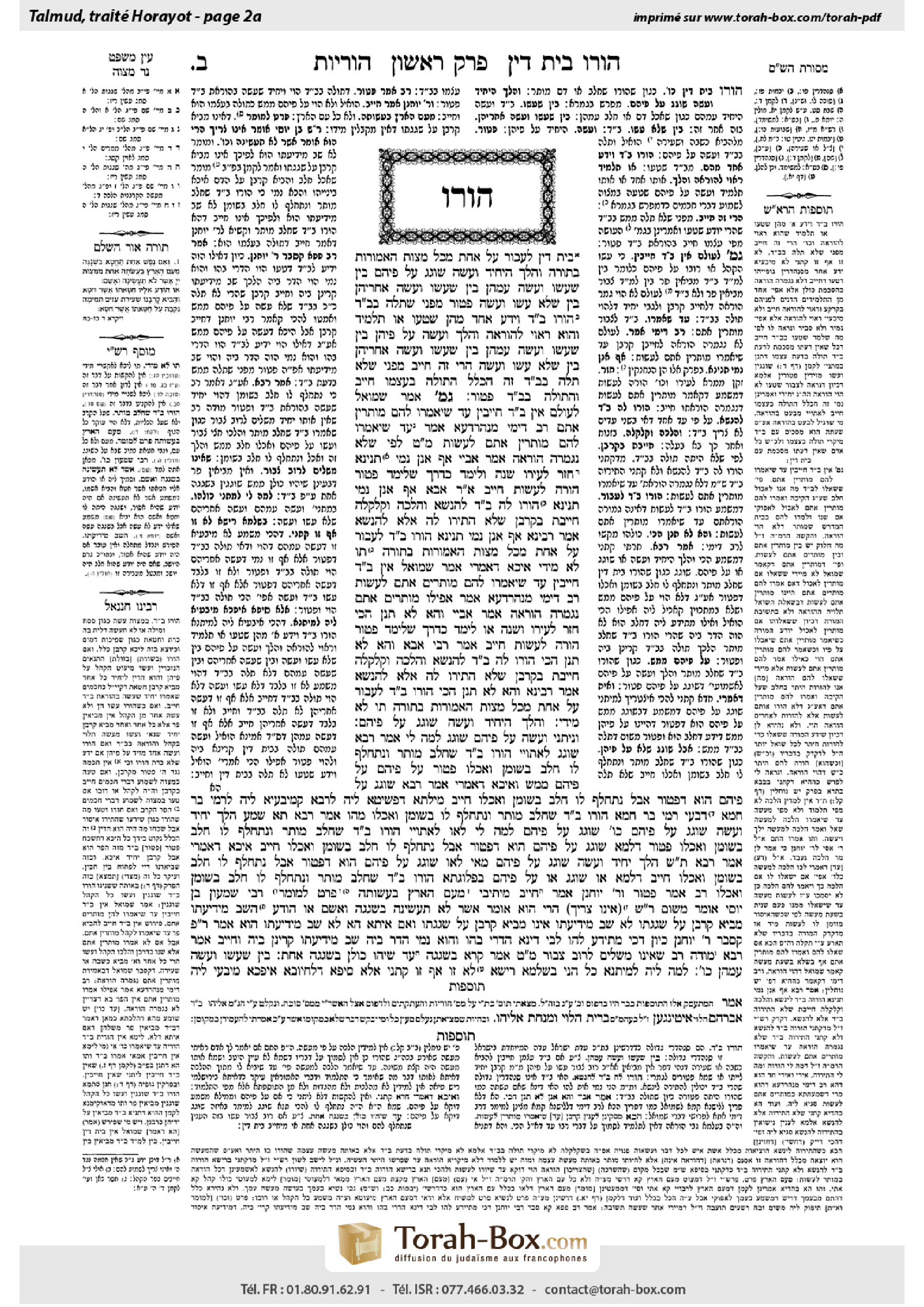
Horayot 2a: Talmud study for Daf Yomi
Study the Talmud for Daf Yomi with scanned pages, Hebrew text, English translations from Sefaria and AI-generated French translations.
Passage selection and English or AI-generated French translation are available where the scan has annotations. Daf Study is independent of Torah-Box and Sefaria.
Browse Horayot · הוריות · All tractatesHorayot 2a text and translations
This page of Horayot includes the Aramaic text, an English translation and an AI-generated French translation, alongside the scan above.
הוריות ב׳ א · Aramaic and Hebrew text
מַתְנִי׳ הוֹרוּ בֵּית דִּין לַעֲבוֹר עַל אַחַת מִכׇּל מִצְוֹת הָאֲמוּרוֹת בַּתּוֹרָה, וְהָלַךְ הַיָּחִיד וְעָשָׂה שׁוֹגֵג עַל פִּיהֶם, בֵּין שֶׁעָשׂוּ וְעָשָׂה עִמָּהֶן, בֵּין שֶׁעָשׂוּ וְעָשָׂה אַחֲרֵיהֶן, בֵּין שֶׁלֹּא עָשׂוּ וְעָשָׂה – פָּטוּר, מִפְּנֵי שֶׁתָּלָה בְּבֵית דִּין.
הוֹרוּ בֵּית דִּין, וְיָדַע אֶחָד מֵהֶן שֶׁטָּעוּ, אוֹ תַּלְמִיד וְהוּא רָאוּי לְהוֹרָאָה, וְהָלַךְ וְעָשָׂה עַל פִּיהֶן – בֵּין שֶׁעָשׂוּ וְעָשָׂה עִמָּהֶן, בֵּין שֶׁעָשׂוּ וְעָשָׂה אַחֲרֵיהֶן, בֵּין שֶׁלֹּא עָשׂוּ וְעָשָׂה – הֲרֵי זֶה חַיָּיב, מִפְּנֵי שֶׁלֹּא תָּלָה בְּבֵית דִּין. זֶה הַכְּלָל: הַתּוֹלֶה בְּעַצְמוֹ חַיָּיב, וְהַתּוֹלֶה בְּבֵית דִּין – פָּטוּר.
גְּמָ׳ אָמַר שְׁמוּאֵל: לְעוֹלָם אֵין בֵּית דִּין חַיָּיבִין עַד שֶׁיֹּאמְרוּ לָהֶם ״מוּתָּרִין אַתֶּם״. רַב דִּימִי מִנְּהַרְדְּעָא אָמַר: עַד שֶׁיֹּאמְרוּ לָהֶם ״מוּתָּרִין אַתֶּם לַעֲשׂוֹת״. מַאי טַעְמָא? לְפִי שֶׁלֹּא נִגְמְרָה הוֹרָאָה.
אָמַר אַבָּיֵי, אַף אֲנַן נָמֵי תְּנֵינָא: חָזַר לְעִירוֹ שָׁנָה וְלִימֵּד כְּדֶרֶךְ שֶׁלִּימֵּד – פָּטוּר, הוֹרָה לַעֲשׂוֹת – חַיָּיב.
אָמַר רַבִּי אַבָּא, אַף אֲנַן נָמֵי תְּנֵינָא: הוֹרוּ לָהּ בֵּית דִּין לְהִנָּשֵׂא, וְהָלְכָה וְקִלְקְלָה – חַיֶּיבֶת בְּקׇרְבָּן, שֶׁלֹּא הִתִּירוּ לָהּ אֶלָּא לְהִנָּשֵׂא.
אָמַר רָבִינָא, אַף אֲנַן נָמֵי תְּנֵינָא: ״הוֹרוּ בֵּית דִּין לַעֲבוֹר עַל אַחַת מִכׇּל מִצְוֹת הָאֲמוּרוֹת בַּתּוֹרָה״, תּוּ לָא מִידִּי.
אִיכָּא דְאָמְרִי, אָמַר שְׁמוּאֵל: אֵין בֵּית דִּין חַיָּיבִין עַד שֶׁיֹּאמְרוּ לָהֶם ״מוּתָּרִים אַתֶּם לַעֲשׂוֹת״. רַב דִּימִי מִנְּהַרְדְּעָא אָמַר: אֲפִילּוּ ״מוּתָּרִים אַתֶּם״ – נִגְמְרָה הוֹרָאָה. אָמַר אַבָּיֵי, וְהָא לָא תְּנַן הָכִי: חָזַר לְעִירוֹ, וְשָׁנָה אוֹ לִימֵּד כְּדֶרֶךְ שֶׁלִּימֵּד – פָּטוּר, הוֹרָה לַעֲשׂוֹת – חַיָּיב.
אָמַר רַבִּי אַבָּא, וְהָא לָא תְּנַן הָכִי: הוֹרוּ לָהּ בֵּית דִּין לְהִנָּשֵׂא, וְהָלְכָה וְקִלְקְלָה – חַיֶּיבֶת בְּקׇרְבָּן, שֶׁלֹּא הִתִּירוּ לָהּ אֶלָּא לְהִנָּשֵׂא.
אָמַר רָבִינָא, וְהָא לָא תְּנַן הָכִי: הוֹרוּ בֵּית דִּין לַעֲבוֹר עַל אַחַת מִכׇּל מִצְוֹת הָאֲמוּרוֹת בַּתּוֹרָה, תּוּ לָא מִידִּי.
וְהָלַךְ הַיָּחִיד וְעָשָׂה שׁוֹגֵג עַל פִּיהֶם. וְנִיתְנֵי: ״וְעָשָׂה עַל פִּיהֶם״, ״שׁוֹגֵג״ לְמָה לִי? אָמַר רָבָא: ״שׁוֹגֵג״ – לְאֵתוֹיֵי הוֹרוּ בֵּית דִּין שֶׁחֵלֶב מוּתָּר, וְנִתְחַלֵּף לוֹ חֵלֶב בְּשׁוּמָּן, וַאֲכָלוֹ – פָּטוּר. ״עַל פִּיהֶם״ – עַל פִּיהֶם מַמָּשׁ,
וְאִיכָּא דְּאָמְרִי, אָמַר רָבָא: ״שׁוֹגֵג״ – עַל פִּיהֶם הוּא דְּפָטוּר, אֲבָל נִתְחַלֵּף לוֹ חֵלֶב בְּשׁוּמָּן וַאֲכָלוֹ – חַיָּיב.
מִילְּתָא דִּפְשִׁיטָא לֵיהּ לְרָבָא קָמִיבַּעְיָא לֵיהּ לְרָמִי בַּר חָמָא, דִּבְעַי רָמֵי בַּר חָמָא: הוֹרוּ בֵּית דִּין שֶׁחֵלֶב מוּתָּר, וְנִתְחַלֵּף לוֹ בְּשׁוּמָּן וַאֲכָלוֹ, מַהוּ?
אָמַר רָבָא, תָּא שְׁמַע: הָלַךְ יָחִיד וְעָשָׂה שׁוֹגֵג עַל פִּיהֶם כּוּ׳. שׁוֹגֵג עַל פִּיהֶם לְמָה לִי? לָאו לְאֵתוֹיֵי הוֹרוּ בֵּית דִּין שֶׁחֵלֶב מוּתָּר, וְנִתְחַלֵּף לוֹ חֵלֶב בְּשׁוּמָּן וַאֲכָלוֹ – פָּטוּר. דִּלְמָא שׁוֹגֵג עַל פִּיהֶם הוּא דְּפָטוּר, אֲבָל נִתְחַלֵּף לוֹ חֵלֶב בְּשׁוּמָּן וַאֲכָלוֹ – חַיָּיב.
אִיכָּא דְּאָמְרִי, אָמַר רָבָא, תָּא שְׁמַע: הָלַךְ יָחִיד וְעָשָׂה שׁוֹגֵג עַל פִּיהֶם. מַאי לָאו, שׁוֹגֵג עַל פִּיהֶם הוּא דְּפָטוּר, אֲבָל נִתְחַלֵּף לוֹ חֵלֶב בְּשׁוּמָּן וַאֲכָלוֹ – חַיָּיב. דִּלְמָא: אוֹ שׁוֹגֵג, אוֹ עַל פִּיהֶם.
בִּפְלוּגְתָּא: הוֹרוּ בֵּית דִּין שֶׁחֵלֶב מוּתָּר, וְנִתְחַלֵּף לוֹ חֵלֶב בְּשׁוּמָּן וַאֲכָלוֹ – רַב אָמַר: פָּטוּר, וְרַבִּי יוֹחָנָן אָמַר: חַיָּיב. מֵיתִיבִי: ״מֵעַם הָאָרֶץ בַּעֲשֹׂתָהּ״, פְּרָט לִמְשׁוּמָּד.
רַבִּי שִׁמְעוֹן בֶּן יוֹסֵי אוֹמֵר מִשּׁוּם רַבִּי שִׁמְעוֹן: אֵינוֹ צָרִיךְ, הֲרֵי הוּא אוֹמֵר: ״אֲשֶׁר לֹא תֵעָשֶׂינָה בִּשְׁגָגָה וְאָשֵׁם אוֹ הוֹדַע״ – הַשָּׁב מִידִיעָתוֹ, מֵבִיא קׇרְבָּן עַל שִׁגְגָתוֹ. לֹא שָׁב מִידִיעָתוֹ – אֵינוֹ מֵבִיא קׇרְבָּן עַל שִׁגְגָתוֹ.
וְאִם אִיתָא, הָא לֹא שָׁב מִידִיעָתוֹ הוּא.
אָמַר רַב פָּפָּא, קָסָבַר רַבִּי יוֹחָנָן: כֵּיוָן דְּכִי מִתְיְדַע לְהוּ לְבֵי דִינָא, הָדְרִי בְּהוּ, וְהוּא נָמֵי הָדַר בֵּיהּ – שָׁב מִידִיעָתוֹ קָרֵינַן בֵּיהּ, וְחַיָּיב.
אָמַר רָבָא: מוֹדֶה רַב שֶׁאֵינוֹ מַשְׁלִים לְרוֹב צִבּוּר, מַאי טַעְמָא? אָמַר קְרָא: ״בִּשְׁגָגָה״ – עַד שֶׁיְּהוּ כּוּלָּן בִּשְׁגָגָה אֶחָת.
בֵּין שֶׁעָשׂוּ וְעָשָׂה עִמָּהֶן כּוּ׳. לְמָה לֵיהּ לְמִיתְנָא כׇּל הָנֵי? בִּשְׁלָמָא רֵישָׁא – לֹא זוֹ אַף זוֹ קָתָנֵי. אֶלָּא סֵיפָא דִּלְחִיּוּבָא, אִיפְּכָא מִיבְּעֵי לֵיהּ!
Horayot 2a · English translation
MISHNA: If a court erroneously issued a ruling permitting the Jewish people to violate one of all the mitzvot that are stated in the Torah, and an individual proceeded and performed that transgression unwittingly on the basis of the court’s ruling, then whether the judges performed the transgression and he performed it with them, or whether the judges performed the transgression and he performed it after them, or whether the judges did not perform the transgression and he performed it alone, in all these cases the individual is exempt from bringing an offering. This is due to the fact that he associated his action with the ruling of the court.
If the court issued a ruling and one of the judges knew that they erred, despite the fact that the majority ruled against his opinion, or if he was a student and he was qualified to issue halakhic rulings, and that judge or student proceeded and performed that transgression on the basis of its ruling, then whether the judges performed the transgression and he performed it with them, or whether the judges performed the transgression and he performed it after them, or whether the judges did not perform the transgression and he performed it alone, in all these cases, the judge or the student is liable to bring an offering. This is due to the fact that he did not associate his action with the ruling of the court. This is the principle: One who associates his action with himself is liable, and one who associates his action with the ruling of the court is exempt.
GEMARA: Shmuel says: The judges of the court are never liable to bring an offering for an erroneous ruling until they say to those seeking a ruling: It is permitted for you. Rav Dimi from Neharde’a says: The judges are not liable unless they say to those seeking a ruling: It is permitted for you to perform this action. What is the reason that Rav Dimi says that there is liability only if the judges say: To perform this action? It is due to the fact that the ruling is not completed if they say only: It is permitted, as perhaps the judges were expressing a theoretical opinion and not issuing a ruling.
Abaye said: We learn proof for Rav Dimi’s opinion in a mishna as well. The mishna teaches with regard to a rebellious elder (Sanhedrin 86b): If the Sanhedrin ruled contrary to the ruling of the elder and the elder then returned to his city, and nevertheless he taught in the manner that he was teaching previously, he is exempt from punishment. But if he instructed others to act on the basis of his ruling that stands contrary to the ruling of the Sanhedrin, he is liable to be executed.
Rabbi Abba said: We learn proof for Rav Dimi’s opinion in a mishna as well. The mishna teaches (Yevamot 87b): If the court instructed a woman to marry on the basis of inaccurate testimony, but she proceeded and disgraced herself and engaged in promiscuous intercourse, she is liable to bring an offering, as they permitted her only to marry, and her conduct lacked the approval of the court. This indicates that it is not sufficient for the court to issue a general ruling to the woman; rather, the court issues a ruling that includes instruction to perform a specific action.
Ravina said: We learn proof for Rav Dimi’s opinion in the mishna here, as well: If a court unwittingly issued a ruling permitting the Jewish people to violate one of all the mitzvot that are stated in the Torah, etc.; and nothing more need be said, as it is clear from the phrase: Issued a ruling to violate, that the ruling must include instruction to perform a specific action.
Some say there is a version of this amoraic dispute with the opposite opinions. Shmuel says: The judges of the court are not liable to bring an offering for an erroneous ruling until they say to those seeking a ruling: It is permitted for you to perform this action. Rav Dimi from Neharde’a says: Even if the judges say to those seeking a ruling: It is permitted for you, the ruling is completed and they are liable. Abaye said: But isn’t it so that we did not learn in accordance with the opinion of Rav Dimi in a mishna with regard to a rebellious elder: If the Sanhedrin ruled contrary to the ruling of the elder and the elder then returned to his city, and nevertheless he taught in the manner that he was teaching previously, he is exempt from punishment. But if he instructed others to act on the basis of his ruling that stands contrary to the ruling of the Sanhedrin, he is liable to be executed.
Rabbi Abba said: But isn’t it so that we did not learn in accordance with the opinion of Rav Dimi in a mishna: If the court instructed a woman to marry on the basis of inaccurate testimony, but she proceeded and disgraced herself and engaged in promiscuous intercourse, she is liable to bring an offering, as they permitted her only to marry, and her conduct lacked the approval of the court.
Ravina said: But isn’t it so that we did not learn in accordance with the opinion of Rav Dimi in the mishna: If a court unwittingly issued a ruling permitting the Jewish people to violate one of all the mitzvot that are stated in the Torah, etc.; and nothing more need be said.
§ The mishna teaches: And the individual proceeded and performed that transgression unwittingly on the basis of the court’s ruling. The Gemara asks: And let us teach only: And performed that transgression on the basis of the court’s ruling; why do I need to add: Unwittingly? Obviously, it was unwitting, as he thought his action was permitted. Rava said: The term unwittingly serves to include a case where the court issued a ruling that it is permitted to eat forbidden fat, and the forbidden fat became confused for him with permitted fat, and he ate it under the impression that he was eating permitted fat. In this case he is exempt. Then, when the mishna says: On the basis of the court’s ruling, it means that he ate forbidden fat actually on the basis of the court’s ruling.
And some say that Rava said a different interpretation of the mishna: It is specifically in a case where the individual proceeded and performed that transgression unwittingly on the basis of the court’s ruling that he is exempt. But if the forbidden fat became confused for him with permitted fat and he ate it under the impression that he was eating permitted fat, he is liable to bring an offering, because his unwitting transgression of eating forbidden fat was not associated solely with the ruling of the court.
The Gemara comments: The matter that is obvious to Rava, that one who confuses between forbidden fat and permitted fat is either exempt, according to the first version, or liable, according to the second version, was raised as a dilemma for Rami bar Ḥama, as Rami bar Ḥama raised a dilemma: If a court ruled that forbidden fat is permitted, and the forbidden fat became confused for him with permitted fat and he ate the forbidden fat, what is the halakha?
Rava said: Come and hear proof from the mishna: The individual proceeded and performed that transgression unwittingly on the basis of the court’s ruling, etc. Why do I need the redundancy: Unwittingly on the basis of the court’s ruling? Is the redundancy not stated to include a case where the court issued a ruling that it is permitted to eat forbidden fat, and the forbidden fat became confused for him with permitted fat, and he ate it under the impression that he was eating permitted fat, and the mishna is teaching that he is exempt? The Gemara rejects this: Perhaps the intent of the mishna is: It is in a case where one performed that transgression unwittingly on the basis of its ruling that he is exempt; but if the forbidden fat became confused for him with permitted fat, and he ate it under the impression that he was eating permitted fat, he is liable.
Some say that Rava said: Come and hear a proof from the mishna: The individual proceeded and performed that transgression unwittingly on the basis of the court’s ruling. What, is it not in a case where one performed that transgression unwittingly on the basis of its ruling that he is exempt; but if the forbidden fat became confused for him with permitted fat, and he ate the forbidden fat, he is liable? The Gemara rejects this: Perhaps the mishna is saying that he is liable if he either confused forbidden fat with permitted fat and ate the forbidden fat unwittingly, or ate the forbidden fat on the basis of the court’s ruling.
The Gemara notes: This matter was already taught in the dispute between amora’im of earlier generations: If a court ruled that forbidden fat is permitted, and the forbidden fat became confused for him with permitted fat and he ate the forbidden fat, Rav says: He is exempt, as the court ruled that it is permitted, and Rabbi Yoḥanan says: He is liable, as he did not base his conduct on its ruling. The Gemara raises an objection to the statement of Rabbi Yoḥanan from a baraita that teaches: The verse states: “And if one soul from among the common people shall sin unwittingly in performing one of the mitzvot of the Lord that are not to be done, and he is guilty” (Leviticus 4:27). This serves to exclude an apostate. When an apostate sins unwittingly, he is exempt from liability to bring a sin-offering even if he repents, as even his unwitting action is considered intentional.
Rabbi Shimon ben Yosei says in the name of Rabbi Shimon: It is unnecessary to derive this halakha from that phrase, as it says in the same verse: “Shall sin unwittingly in performing one of the mitzvot of the Lord that are not to be done, and he is guilty; or if his sin, which he has sinned, be known to him” (Leviticus 4:27–28). From the words “be known to him” it is inferred that only one who repents due to his awareness, i.e., he would not have sinned if he had known the act was prohibited, brings a sacrifice for his unwitting transgression in order to achieve atonement. But one who does not repent due to his awareness that he sinned, e.g., an apostate, who would have sinned even had he been aware that the act is prohibited, does not bring an offering for his unwitting action.
The Gemara asks: And if it is so that one who would not repent due to his awareness is exempt, isn’t this person who confused forbidden fat with permitted fat considered one who will not repent due to his awareness? Even if he discovers that he ate forbidden fat he will not regret his action, as he relies on the ruling of the court that forbidden fat is permitted. This contradicts the statement of Rabbi Yoḥanan, who says that one is liable in that case.
Rav Pappa said that Rabbi Yoḥanan holds: Since once it becomes known to the court that it erred, the judges will retract their erroneous ruling, and this individual will also repent when he discovers that he ate forbidden fat which the court erroneously permitted, we characterize him as one who repents due to his awareness, and he is liable to bring an offering.
Rava says: Even though Rav says the individual is exempt, and his sin is dependent on the court, Rav concedes that in a case where one confused forbidden fats with permitted fats, he does not complete a majority of the congregation. The court is liable to bring an offering only when the majority of the congregation performs a transgression based on its ruling. This individual who thought the fat was permitted is not included in the majority of the congregation. What is the reason? It is as the verse states: “For all the people it was performed unwittingly” (Numbers 15:26), from which it is derived: There is no liability unless they are all unwitting in one and the same manner; and the action of this individual is unwitting in a different manner than the rest of the transgressors.
§ The mishna teaches: Whether the judges performed the transgression and he performed it with them, or whether the judges performed the transgression and he performed it after them, or whether the judges did not perform the transgression and he performed it alone, in all these cases the individual is exempt. The Gemara asks: Why did the tanna in the mishna need to teach all of these cases? Granted, in the first clause of the mishna, the tanna teaches the mishna employing the style: Not only this but also that, i.e., not only is he exempt if the judges performed the transgression with him, but he is exempt even if he performed the act after the judges, and even if he alone performed the transgression. But in the latter clause of the mishna, where the tanna is teaching liability, the tanna should have taught the opposite. He should have started with the case where he is most likely to be liable, the case where the judges performed no transgression and he sinned alone.
Horayot 2a · Traduction française (IA)
MICHNA : Si un tribunal a erronément rendu un jugement permettant au peuple juif de transgresser l'une des commandements que la Torah a énoncés, et qu'un individu a ensuite commis cette transgression sans le savoir en se basant sur le jugement du tribunal, alors que les juges aient commis la transgression et qu'il l'ait commise avec eux, ou que les juges aient commis la transgression et qu'il l'ait commise après eux, ou que les juges n'aient pas commis la transgression et qu'il l'ait commise seul, dans tous ces cas, l'individu est exempt de présenter un holocauste. Cela est dû au fait qu'il a associé son action au jugement du tribunal.
Si le tribunal a rendu un jugement et qu'un des juges savait qu'ils avaient erré, malgré le fait que la majorité ait voté contre son avis, ou si c'était un étudiant et qu'il était qualifié pour rendre des jugements halakhiques, et que ce juge ou cet étudiant a ensuite commis cette transgression en se basant sur son jugement, alors que les juges aient commis la transgression et qu'il l'ait commise avec eux, ou que les juges aient commis la transgression et qu'il l'ait commise après eux, ou que les juges n'aient pas commis la transgression et qu'il l'ait commise seul, dans tous ces cas, le juge ou l'étudiant est tenu de présenter un holocauste. Cela est dû au fait qu'il n'a pas associé son action au jugement du tribunal. C'est le principe : celui qui associe son action à lui-même est tenu, et celui qui associe son action au jugement du tribunal est exempt.
GUEMARA : Shmuel dit : Les juges du tribunal ne sont jamais tenus de présenter un holocauste pour un jugement erroné jusqu'à ce qu'ils disent à ceux qui demandent un jugement : Il est permis pour vous d'accomplir cette action. Rav Dimi de Neharde’a dit : Les juges ne sont tenus qu'en cas où ils disent à ceux qui demandent un jugement : Il est permis pour vous d'accomplir cette action. Quelle est la raison pour laquelle Rav Dimi dit qu'il y a responsabilité uniquement si les juges disent : Accomplir cette action ? C'est dû au fait que le jugement n'est pas achevé s'ils disent seulement : Il est permis, car peut-être les juges exprimaient un avis théorique et non un jugement.
Abaye dit : Nous trouvons une preuve pour l'opinion de Rav Dimi dans une mésna également. La mésna enseigne concernant un vieillard rebelle (Sanhedrin 86b) : Si le Sanhédrin a rendu un jugement contraire au jugement du vieillard et que le vieillard est ensuite revenu dans sa ville, et qu'il a toutefois continué à enseigner comme il le faisait auparavant, il est exempt de punition. Mais si il a instruit d'autres personnes à agir en se basant sur son jugement qui est contraire au jugement du Sanhédrin, il est tenu d'être exécuté.
Rabbi Abba dit : Nous trouvons une preuve pour l'opinion de Rav Dimi dans une mésna également. La mésna enseigne (Yevamot 87b) : Si le tribunal a instruit une femme à se marier sur la base de témoignages inexactes, mais qu'elle a ensuite perdu sa dignité et s'est livrée à des relations sexuelles non conjugales, elle est tenue de présenter un holocauste, car ils lui ont permis uniquement de se marier, et son comportement n'avait pas l'approbation du tribunal. Cela indique que le tribunal ne suffit pas à rendre un jugement général à la femme ; il doit rendre un jugement qui inclut une instruction à accomplir une action spécifique.
Ravina dit : Nous trouvons une preuve pour l'opinion de Rav Dimi dans la mésna ici également : Si un tribunal a erronément rendu un jugement permettant au peuple juif de transgresser l'une des commandements que la Torah a énoncés, etc. ; et rien de plus n'a besoin d'être dit, car il est clair de la phrase : Rendu un jugement pour transgresser, que le jugement doit inclure une instruction à accomplir une action spécifique.
Certains disent qu'il existe une version de ce débat entre les amoraim avec des opinions opposées. Shmuel dit : Les juges du tribunal ne sont pas tenus de présenter un holocauste pour un jugement erroné jusqu'à ce qu'ils disent à ceux qui demandent un jugement : Il est permis pour vous d'accomplir cette action. Rav Dimi de Neharde’a dit : Même si les juges disent à ceux qui demandent un jugement : Il est permis pour vous, le jugement est achevé et ils sont tenus. Abaye dit : Mais n'est-ce pas le cas que nous n'avons pas appris selon l'opinion de Rav Dimi dans une mésna concernant un vieillard rebelle : Si le Sanhédrin a rendu un jugement contraire au jugement du vieillard et que le vieillard est ensuite revenu dans sa ville, et qu'il a toutefois continué à enseigner comme il le faisait auparavant, il est exempt de punition. Mais si il a instruit d'autres personnes à agir en se basant sur son jugement qui est contraire au jugement du Sanhédrin, il est tenu d'être exécuté.
Rabbi Abba dit : Mais n'est-ce pas le cas que nous n'avons pas appris selon l'opinion de Rav Dimi dans une mésna : Si le tribunal a instruit une femme à se marier sur la base de témoignages inexactes, mais qu'elle a ensuite perdu sa dignité et s'est livrée à des relations sexuelles non conjugales, elle est tenue de présenter un holocauste, car ils lui ont permis uniquement de se marier, et son comportement n'avait pas l'approbation du tribunal.
Ravina dit : Mais n'est-ce pas le cas que nous n'avons pas appris selon l'opinion de Rav Dimi dans la mésa : Si un tribunal, sans le vouloir, rend un jugement permettant au peuple juif de transgresser l'une des commandements que la Torah a énoncés, etc. ; et rien de plus n'a besoin d'être dit.
§ La mésna enseigne : Et l'individu a ensuite commis cette transgression sans le savoir en se basant sur le jugement du tribunal. La Guemara pose la question : Et permettons-nous de ne enseigner que : Et a accompli cette transgression en se basant sur le jugement du tribunal ; pourquoi ai-je besoin d'ajouter : Sans le savoir ? Évidemment, il était sans le savoir, car il croyait que son action était permise. Rava dit : Le terme « sans le savoir » sert à inclure un cas où le tribunal a rendu un jugement permettant d'ingérer de la graisse interdite, et que la graisse interdite s'est confondu pour lui avec la graisse permise, et qu'il l'a mangée en croyant qu'il mangeait de la graisse permise. Dans ce cas, il est exempt. Puis, lorsque la mésna dit : En se basant sur le jugement du tribunal, cela signifie qu'il a mangé de la graisse interdite effectivement en se basant sur le jugement du tribunal.
Et certains disent que Rava a dit une autre interprétation de la mitsna : Il s'agit spécifiquement d'un cas où l'individu a procédé à commettre cette transgression sans le savoir, sur la base du jugement du tribunal, qu'il est exempt. Mais si la graisse interdite s'est confondue pour lui avec la graisse permise et qu'il l'a mangée en croyant qu'il mangeait de la graisse permise, il est tenu de présenter un sacrifice, car sa transgression involontaire de manger de la graisse interdite n'était pas uniquement liée au jugement du tribunal.
La Guemara commente : La question évidente pour Rava, à savoir que celui qui confond la graisse interdite avec la graisse permise est soit exempt, selon la première version, soit tenu, selon la seconde version, a été soulevée comme un dilemme pour Rami bar Ḥama, comme Rami bar Ḥama a soulevé un dilemme : Si un tribunal a décidé que la graisse interdite est permise, et que la graisse interdite s'est confondue pour lui avec la graisse permise et qu'il a mangé la graisse interdite, quelle est la halakha ?
Rava dit : Viens écouter une preuve à partir de la mitsna : L'individu a procédé à commettre cette transgression sans le savoir, sur la base du jugement du tribunal, etc. Pourquoi ai-je besoin de la répétition : sans le savoir sur la base du jugement du tribunal ? N'est-ce pas pour inclure un cas où le tribunal a rendu un jugement selon lequel il est permis de manger de la graisse interdite, et que la graisse interdite s'est confondue pour lui avec la graisse permise, et qu'il l'a mangée en croyant qu'il mangeait de la graisse permise, et que la mitsna enseigne qu'il est exempt ? La Guemara rejette cela : Peut-être que l'intention de la mitsna est : Il s'agit d'un cas où l'individu a commis cette transgression sans le savoir sur la base de son jugement qu'il est exempt ; mais si la graisse interdite s'est confondue pour lui avec la graisse permise, et qu'il l'a mangée en croyant qu'il mangeait de la graisse permise, il est tenu.
Certains disent que Rava a dit : Viens écouter une preuve tirée de la mitsna : L'individu est allé et a commis cette transgression sans le savoir, sur la base du jugement du tribunal. Qu'est-ce que cela signifie ? N'est-ce pas dans un cas où l'individu a commis cette transgression sans le savoir sur la base du jugement du tribunal qu'il est exempt ; mais si la graisse interdite s'est confondue pour lui avec la graisse permise, et qu'il a mangé la graisse interdite, il est tenu ? La Guemara rejette cela : Peut-être que la mitsna dit qu'il est tenu si l'on confond la graisse interdite avec la graisse permise et qu'on mange la graisse interdite sans le savoir, ou si l'on mange la graisse interdite sur la base du jugement du tribunal.
La Guemara note : Cette question a déjà été enseignée dans le débat entre les amoraïm des générations précédentes : Si un tribunal a décidé que la graisse interdite est permise, et que la graisse interdite s'est confondue pour lui avec la graisse permise et qu'il a mangé la graisse interdite, Rav dit : Il est exempt, car le tribunal a décidé qu'il est permis, et Rabbi Yoḥanan dit : Il est tenu, car il n'a pas basé son comportement sur son jugement. La Guemara soulève une objection contre l'affirmation de Rabbi Yoḥanan à partir d'une baraïta qui enseigne : La parabole dit : « Et si une âme du peuple commun commet un péché involontaire en accomplissant l'une des mitsvot du Seigneur qui ne doit pas être faite, et il est coupable » (Lévitique 4:27). Cela sert à exclure un apostat. Lorsqu'un apostat commet un péché involontaire, il est exempt de la responsabilité de présenter un sacrifice expiatoire même s'il se repent, car même son action involontaire est considérée comme intentionnelle.
Rabbi Shimon ben Yosei dit en nom de Rabbi Shimon : Il n'est pas nécessaire d'extraire cette halakha de cette expression, car il est dit dans la même versette : « Il commet un péché involontaire en accomplissant l'une des mitsvot du Seigneur qui ne doivent pas être accomplies, et il est coupable ; ou si son péché, qu'il a commis, est connu à lui-même » (Lévitique 4:27–28). À partir des mots « est connu à lui-même », on infère que seul celui qui se repente en raison de sa connaissance, c'est-à-dire celui qui ne serait pas tombé en péché s'il avait su que l'acte était interdit, présente un sacrifice pour son péché involontaire afin d'obtenir la rédemption. Celui qui ne se repente pas en raison de sa connaissance qu'il a péché, par exemple un apostat, qui aurait péché même s'il avait su que l'acte était interdit, ne présente pas un sacrifice pour son action involontaire.
La Guemara demande : Et si c'est ainsi que celui qui ne se repente pas en raison de sa connaissance est exempt, n'est-ce pas cette personne qui confond la graisse interdite avec la graisse permise qui est considérée comme celui qui ne se repente pas en raison de sa connaissance ? Même s'il découvre qu'il a mangé de la graisse interdite, il ne regrettera pas son action, car il repose sur le jugement du tribunal que la graisse interdite est permise. Cela contredit l'affirmation de Rabbi Yoḥanan, qui dit que l'on est tenu dans ce cas.
Rav Pappa a dit que Rabbi Yoḥanan affirme : Puisque, une fois que le tribunal découvre qu'il a erré, les juges rétractent leur jugement erroné, et cette personne se repentra également lorsqu'il découvrira qu'il a mangé de la graisse interdite que le tribunal a erronément permise, nous le caractérisons comme celui qui se repente en raison de sa connaissance, et il est tenu de présenter un sacrifice.
Rava dit : Même si Rav dit que l'individu est exempt, et que son péché dépend du tribunal, Rav reconnaît que dans un cas où l'on confond les graisses interdites avec les graisses permises, il ne complète pas la majorité du peuple. Le tribunal est tenu de présenter un sacrifice uniquement lorsque la majorité du peuple commet un péché sur la base de son jugement. Cette personne qui croyait que la graisse était permise n'est pas incluse dans la majorité du peuple. Quelle est la raison ? C'est comme la parole de Dieu dit : « Pour tout le peuple, cela a été fait involontairement » (Nombres 15:26), d'où on déduit : Il n'y a pas de responsabilité à moins qu'ils soient tous involontaires de la même manière ; et l'action de cette personne est involontaire d'une manière différente des autres transgresseurs.
§ La Michna enseigne : Que les juges aient commis la transgression et qu'il l'ait commise avec eux, ou que les juges aient commis la transgression et qu'il l'ait commise après eux, ou que les juges n'aient pas commis la transgression et qu'il l'ait commise seul, dans tous ces cas, l'individu est exempt. La Guemara demande : Pourquoi le tanna dans la Michna a-t-il besoin d'enseigner tous ces cas ? En effet, dans la première partie de la Michna, le tanna enseigne la Michna en utilisant le style : Non seulement cela, mais aussi cela, c'est-à-dire non seulement il est exempt si les juges ont commis la transgression avec lui, mais il est exempt même s'il l'a commise après les juges, et même s'il a commis la transgression seul. Mais dans la seconde partie de la Michna, où le tanna enseigne la responsabilité, le tanna aurait dû enseigner l'opposé. Il aurait dû commencer par le cas où il est le plus susceptible d'être responsable, le cas où les juges n'ont pas commis la transgression et qu'il a péché seul.
Traduction française générée par IA à partir de l’édition anglaise de Sefaria. Vérifie toujours un passage avec le texte source.
Text from Sefaria: William Davidson Edition - Vocalized Aramaic (CC BY NC); William Davidson Edition - English (CC BY NC).