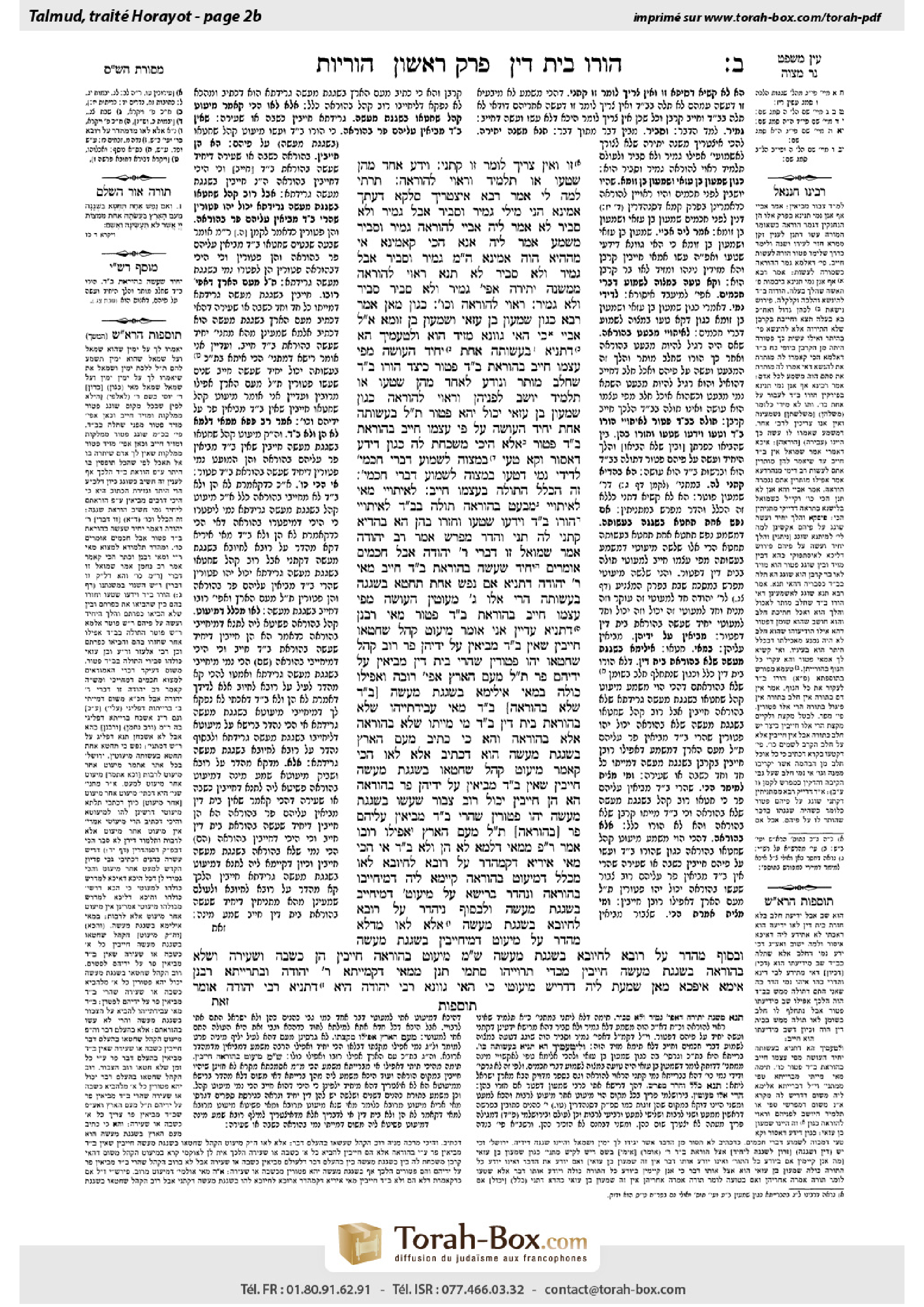
Horayot 2b: Talmud study for Daf Yomi
Study the Talmud for Daf Yomi with scanned pages, Hebrew text, English translations from Sefaria and AI-generated French translations.
Passage selection and English or AI-generated French translation are available where the scan has annotations. Daf Study is independent of Torah-Box and Sefaria.
Browse Horayot · הוריות · All tractatesHorayot 2b text and translations
This page of Horayot includes the Aramaic text, an English translation and an AI-generated French translation, alongside the scan above.
הוריות ב׳ ב · Aramaic and Hebrew text
זוֹ וְאֵין צָרִיךְ לוֹמַר זוֹ קָתָנֵי.
וְיָדַע אֶחָד מֵהֶן שֶׁטָּעוּ אוֹ תַּלְמִיד וְרָאוּי לְהוֹרָאָה. תַּרְתֵּי לְמָה לִי? אָמַר רָבָא: אִיצְטְרִיךְ, סָלְקָא דַּעְתָּךְ אָמֵינָא הָנֵי מִילֵּי גְּמִיר וּסְבִיר, אֲבָל גְּמִיר וְלָא סְבִיר – לָא.
אֲמַר לֵיהּ אַבָּיֵי: לְהוֹרָאָה גְּמִיר וּסְבִיר מַשְׁמַע! אֲמַר לֵיהּ, אֲנָא הָכִי קָאָמֵינָא: אִי מֵהַהִיא – הֲוָה אָמֵינָא הָנֵי מִילֵּי גְּמִיר וּסְבִיר, אֲבָל גְּמִיר וְלָא סְבִיר – לָא, תְּנָא רָאוּי לְהוֹרָאָה, מִמִּשְׁנָה יְתֵירָה: אֲפִילּוּ גְּמִיר וְלָא סְבִיר, סְבִיר וְלָא גְּמִיר.
רָאוּי לְהוֹרָאָה וְכוּ׳. כְּגוֹן מַאן? אָמַר רָבָא: כְּגוֹן שִׁמְעוֹן בֶּן עַזַּאי וְשִׁמְעוֹן בֶּן זוֹמָא. אֲמַר לֵיהּ אַבָּיֵי: כִּי הַאי גַוְונָא מֵזִיד הוּא!
וּלְטַעְמָיךְ, הָא דְּתַנְיָא: ״בַּעֲשֹׂתָהּ אַחַת״, יָחִיד הָעוֹשֶׂה מִפִּי עַצְמוֹ – חַיָּיב, בְּהוֹרָאַת בֵּית דִּין – פָּטוּר. כֵּיצַד? הוֹרוּ בֵּית דִּין שֶׁחֵלֶב מוּתָּר, וְנוֹדַע לְאֶחָד מֵהֶן שֶׁטָּעוּ, אוֹ תַּלְמִיד יוֹשֵׁב לִפְנֵיהֶן וְרָאוּי לְהוֹרָאָה כְּגוֹן שִׁמְעוֹן בֶּן עַזַּאי, יָכוֹל יְהֵא פָּטוּר? תַּלְמוּד לוֹמַר: ״בַּעֲשֹׂתָהּ אַחַת״, יָחִיד הָעוֹשֶׂה עַל פִּי עַצְמוֹ – חַיָּיב, בְּהוֹרָאַת בֵּית דִּין – פָּטוּר!
אֶלָּא הֵיכִי מַשְׁכַּחַתְּ לַהּ? כְּגוֹן דְּיָדַע דְּאָסוּר, וְקָא טָעֵי בְּמִצְוָה לִשְׁמוֹעַ דִּבְרֵי חֲכָמִים. לְדִידִי נָמֵי, דְּטָעוּ בְּמִצְוָה לִשְׁמוֹעַ דִּבְרֵי חֲכָמִים.
זֶה הַכְּלָל הַתּוֹלֶה בְּעַצְמוֹ – חַיָּיב. לְאֵיתוֹיֵי מַאי? לְאֵיתוֹיֵי מְבַעֵט בְּהוֹרָאָה.
תּוֹלֶה בְּבֵית דִּין – לְאֵיתוֹיֵי הוֹרוּ בֵּית דִּין וְיָדְעוּ שֶׁטָּעוּ וְחָזְרוּ בָּהֶן. הָא בְּהֶדְיָא קָתָנֵי לַהּ! תָּנֵי וַהֲדַר מְפָרֵשׁ.
אָמַר רַב יְהוּדָה אָמַר שְׁמוּאֵל: זוֹ דִּבְרֵי רַבִּי יְהוּדָה, אֲבָל חֲכָמִים אוֹמְרִים: יָחִיד שֶׁעָשָׂה בְּהוֹרָאַת בֵּית דִּין – חַיָּיב. מַאי רַבִּי יְהוּדָה? דְּתַנְיָא: ״אִם נֶפֶשׁ אַחַת תֶּחֱטָא בִשְׁגָגָה בַּעֲשֹׂתָהּ״ – הֲרֵי אֵלּוּ שְׁלֹשָׁה מִעוּטִין: הָעוֹשֶׂה מִפִּי עַצְמוֹ – חַיָּיב, בְּהוֹרָאַת בֵּית דִּין – פָּטוּר.
מַאי רַבָּנַן? דְּתַנְיָא, עֲדַיִין אֲנִי אוֹמֵר: מִיעוּט קָהָל שֶׁחָטְאוּ – חַיָּיבִין, שֶׁאֵין בֵּית דִּין מְבִיאִין עַל יְדֵיהֶן פַּר. רוֹב קָהָל שֶׁחָטְאוּ – יְהוּ פְּטוּרִין, שֶׁהֲרֵי בֵּית דִּין מְבִיאִין עַל יְדֵיהֶם פַּר. תַּלְמוּד לוֹמַר: ״מֵעַם הָאָרֶץ״ – אֲפִילּוּ רוּבָּהּ, וַאֲפִילּוּ כּוּלָּהּ.
בְּמַאי? אִילֵּימָא בְּשִׁגְגַת מַעֲשֶׂה [בֵּית דִּין שֶׁלֹּא בְּהוֹרָאָה], בֵּית דִּין מַאי עֲבִידְתַּיְיהוּ? שֶׁלֹּא בְּהוֹרָאַת בֵּית דִּין, בֵּית דִּין מִי מַיְיתוּ שֶׁלֹּא בְּהוֹרָאָה? אֶלָּא בְּהוֹרָאָה. וְהָא כִּי כְּתִיב ״מֵעַם הָאָרֶץ״ – בְּשִׁגְגַת מַעֲשֶׂה הוּא דִּכְתִיב!
אֶלָּא לָאו הָכִי קָאָמַר: מִיעוּט קָהָל שֶׁחָטְאוּ בְּשִׁגְגַת מַעֲשֶׂה חַיָּיבִין, שֶׁאֵין בֵּית דִּין מְבִיאִין עַל יְדֵיהֶן פַּר בְּהוֹרָאָה. הָא הֵן חַיָּיבִין.
יָכוֹל רוֹב צִבּוּר שֶׁעָשׂוּ בְּשִׁגְגַת מַעֲשֶׂה יְהוּ פְּטוּרִין, שֶׁהֲרֵי בֵּית דִּין מְבִיאִין עֲלֵיהֶם פַּר [בְּהוֹרָאָה]? תַּלְמוּד לוֹמַר: ״מֵעַם הָאָרֶץ״, אֲפִילּוּ רוּבּוֹ.
אָמַר רַב פָּפָּא: מִמַּאי? דִּלְמָא לֹא הֵן וְלֹא בֵּית דִּין!
אִי הָכִי, מַאי אִירְיָא דְּקָמְהַדַּר עַל רוּבָּא לְחִיּוּבָא? לָאו מִכְּלָל דְּמִיעוּט בְּהוֹרָאָה קַיְימָא לֵיהּ דְּמִיחַיְּיבוּ בְּהוֹרָאָה?! וּנְהַדַּר בְּרֵישָׁא עַל מִיעוּטָא דְּמִיחַיַּיב בְּשִׁגְגַת מַעֲשֶׂה, וּלְבַסּוֹף נִיהַדַּר עַל רוּבָּא לְחִיּוּבָא בְּשִׁגְגַת מַעֲשֶׂה!
אֶלָּא לָאו מִדְּלָא מְהַדַּר עַל מִיעוּט דְּמִיחַיְּיבִין בְּשִׁגְגַת מַעֲשֶׂה, וּבְסוֹף מְהַדַּר עַל רוּבָּא לְחִיּוּבָא בְּשִׁגְגַת מַעֲשֶׂה. שְׁמַע מִינַּהּ: מִיעוּט בְּהוֹרָאָה חַיָּיבִין – הֵן כִּשְׂבָּה וּשְׂעִירָה, וְשֶׁלֹּא בְּהוֹרָאָה – בְּשִׁגְגַת מַעֲשֶׂה חַיָּיבִין.
מִכְּדֵי תַּרְוַיְיהוּ סְתָמֵי תְּנַן, מִמַּאי דְּקַמַּיְיתָא רַבִּי יְהוּדָה וּבָתְרָיְיתָא רַבָּנַן? אֵימָא אִיפְּכָא! מַאן שָׁמְעַתְּ לֵיהּ דְּדָרֵישׁ מִיעוּטֵי כִּי הַאי גַוְונָא? רַבִּי יְהוּדָה הִיא, דְּתַנְיָא, רַבִּי יְהוּדָה אוֹמֵר:
Horayot 2b · English translation
The Gemara answers: In the latter clause, the tanna teaches the mishna employing the style: This, and it is unnecessary to say that, i.e., the cases are arranged with each case more obvious than the one that preceded it.
§ The mishna teaches: And one of the judges knew that they erred, or if he was a student and he is qualified to issue halakhic rulings. The Gemara asks: Why do I need two cases? As a student qualified to issue halakhic rulings is the equivalent of one of the judges, why did the tanna mention both? Rava said: It was necessary to state both, as it may enter your mind to say that this statement that he is liable applies specifically to one who is learned and analytical, but that one who is learned but not analytical, no, he should not be liable to bring an offering. Therefore, the tanna cites both the case of a judge and the case of a student qualified to issue halakhic rulings, to teach that even one who is learned but not analytical is liable in this case.
Abaye challenged this and said to Rava that the term: A student qualified to issue halakhic rulings, indicates that he is both learned and analytical. Rava said to Abaye: This is what I am saying: If the tanna had taught the halakha from that first halakha with regard to one of the judges, I would say that this statement applies only to one who is both learned and analytical, but if he was learned and not analytical, no, he would not be liable. Therefore, the tanna taught the additional case of a student qualified to issue halakhic rulings, and from the extraneous case in the mishna one can infer that the halakha applies even to one who is learned but not analytical or one who is analytical but not yet learned. Since he associates his action with himself, he is liable.
§ The mishna teaches: Qualified to issue halakhic rulings. The Gemara asks: Like whom? Who is an example of one qualified to issue halakhic rulings? Rava said: It is one like Shimon ben Azzai or Shimon ben Zoma, who, although they were among the most outstanding Torah scholars of their generation, were not ordained. Abaye said to Rava: In a case like this, he is an intentional sinner, as a scholar of that caliber would certainly not err. If he ruled that a prohibited action is permitted, it is assumed that he acted with intent, and he is exempt from bringing an offering.
Rava said to Abaye: But according to your reasoning, that which is taught in a baraita that cites the verse: “In performing one” (Leviticus 4:27), from which it is derived that an individual who performs a transgression on his own is liable, while one who performs a transgression based on the ruling of the court is exempt; how so? When does this apply? If the court ruled that forbidden fat is permitted, and it became known to one of the judges that they erred, or if he was a student who was sitting before them and he is qualified to issue halakhic rulings, e.g., Shimon ben Azzai, might one have thought that he would be exempt? To counter this, the verse states: “In performing one,” from which it is derived that an individual who performs a transgression on his own is liable, while one who performs a transgression on the basis of the ruling of the court is exempt.
Rava continues: Rather, the baraita is difficult; how can you find these circumstances where a judge or a prominent Torah scholar would be considered an unwitting sinner? The Gemara answers: It is in a case where the judge or the scholar knew that the action with regard to which the court issued a ruling that it is permitted is in fact prohibited, but he erred with regard to the mitzva of heeding the statements of the Sages. He believed that there is a mitzva to heed the directives of the Sages even when he is certain that they are mistaken. If so, according to my understanding too, the reference is to one like Shimon ben Azzai or Shimon ben Zoma; it is also a case where they erred with regard to the mitzva of heeding the statements of the Sages. Due to that error, they are liable to bring an offering.
§ The mishna teaches: This is the principle: One who associates his action with himself is liable. The Gemara asks: What case that was not already mentioned in the mishna does this principle serve to include? The Gemara answers: It serves to include one who disdains halakhic rulings in general, treating them with contempt and relying only on his own understanding.
The mishna teaches the second part of that principle: And one who associates his action with the ruling of the court is exempt. The Gemara explains: This principle serves to include an additional case that was not yet mentioned in the mishna, namely, where the court issued a ruling and the judges discovered that they erred and reversed their decision. If one was unaware that the court reversed their decision, and acted based on their initial ruling, he is deemed one who associates his action with the ruling of the court and is exempt. The Gemara challenges: The tanna teaches this halakha explicitly in the next mishna (3b), and consequently there is no need for an allusion in this mishna. The Gemara explains: The tanna teaches it ambiguously, and then teaches it explicitly.
§ Rav Yehuda says that Shmuel says: This halakha in the mishna, which states that an individual who performs a transgression on the basis of a ruling issued by the court is exempt from liability to bring an offering, is the statement of Rabbi Yehuda. But the Rabbis say: An individual who performs a transgression on the basis of the ruling of the court is liable. The Gemara asks: What is the opinion of Rabbi Yehuda to which Shmuel refers? It is as it is taught in a baraita: The verse states: “And if one soul from among the common people shall sin unwittingly in performing one of the mitzvot of the Lord” (Leviticus 4:27). These are three exclusionary terms: “One,” “unwittingly,” and “in performing,” and one of these exclusions serves to teach that one who performs a transgression on his own is liable, while one who performs a transgression on the basis of the ruling of the court is exempt.
The Gemara asks: What is the opinion of the Rabbis? It is as it is taught in a baraita: Still I say: Each member of a minority of the congregation that sinned based on the ruling of a court is liable to bring an offering for his unwitting transgression, as the court does not bring a bull for an unwitting communal sin on the basis of the minority’s transgression. One might have thought that each member of a majority of the congregation that sinned based on the ruling of a court would be exempt from liability to bring an offering for his unwitting transgression, as the court brings a bull for an unwitting communal sin on the basis of the majority’s transgression. To counter this, the verse states with regard to a sin-offering brought for an unwitting transgression: “From among the common people,” from which it is derived that even members of the majority of the congregation, and even members of the entire congregation, are not exempt because of the ruling of the court.
The Gemara asks: In what circumstances did the majority of the congregation sin? If we say that the reference is to a transgression with unwitting performance of an action unrelated to a ruling of the court, why does the tanna say: As the court brings a bull for an unwitting communal sin on the basis of the majority’s transgression? Given that this is a case where a court did not issue a ruling, what action did the court perform? Since it was not on the basis of the ruling of the court, does the court bring a bull for an unwitting communal sin that was performed not on the basis of its ruling? Rather, the reference in the baraita must be to a case where the majority of the congregation performed a transgression on the basis of the ruling of the court. If so, the question arises: But when it is written with regard to a sin-offering brought for an unwitting transgression: “From among the common people,” it is with regard to a transgression with unwitting performance of an action that it is written.
Rather, is it not that this is what the tanna is saying: The baraita is incomplete and must be taught in this manner: Each member of a minority of the congregation that sinned with unwitting performance of an action is liable to bring an offering for his unwitting transgression, as the court does not bring a bull for an unwitting communal sin on the basis of the minority’s transgression in a case where the court issued an erroneous ruling. But a minority of the congregation that sinned unwittingly on the basis of the ruling of the court is also liable.
The baraita continues: One might have thought that a majority of the congregation that sinned with unwitting performance of an action would be exempt, as the court brings a bull for an unwitting communal sin on the basis of the majority’s transgression in a case where the court issued an erroneous ruling. Therefore, the verse states: “From among the common people,” from which it is derived that even members of the majority of the congregation are liable. If the unwitting transgression was performed not on the basis of the ruling of the court, there is no difference between a minority and a majority of the people. This is proof that according to the Rabbis both an individual and a minority of the congregation who performed a transgression on the basis of the ruling of the court are liable.
Rav Pappa said: From where do you draw this conclusion? Perhaps in the case where a minority of the congregation performs a transgression on the basis of the ruling of the court, neither do those individuals bring an offering, because they associated their action with the court, nor does the court bring an offering, because it was only a minority of the congregation that performed a transgression on the basis of the ruling of the court.
The Gemara rejects this: If so, why does the tanna specifically seek a source with regard to the majority for liability? Why did the tanna seek to introduce the halakha that even if a majority of the congregation sinned they would be liable to bring an offering? Can one not, by inference, conclude with regard to a minority that acts on the basis of the ruling of the court, that he holds that they are liable even though they acted on the basis of the ruling of the court? According to Rav Pappa’s opinion, let the tanna first seek to cite proof about a minority that each of its members is liable to bring a sin-offering for unwitting performance of an action, and ultimately seek to cite proof about a majority to establish liability for each of its members to bring a sin-offering for unwitting performance of an action, as it has not yet been established with regard to a minority that each of its members is liable to bring a sin-offering for unwitting performance of an action.
Rather, can one not make an inference from the fact that the tanna did not first seek to cite proof about a minority that each of its members is liable to bring a sin-offering for unwitting performance of an action and then seek to cite proof about a majority to establish liability for each of its members to bring a sin-offering for unwitting performance of an action? Accordingly, one can conclude from it that it was clear to the tanna that in a case of a minority that acts on the basis of the ruling of the court, each member of the minority is liable to bring a female lamb or a female goat as a sin-offering, and for unwitting performance of an action not on the basis of the ruling of the court, each member of the minority is similarly liable.
The Gemara asks: Now, we learned both of the baraitot unattributed. From where may it be ascertained that the tanna of the first baraita is Rabbi Yehuda and the tanna of the latter baraita is the Rabbis? Say the opposite. The Gemara answers: Whom did you hear that interprets exclusionary terms in this way? It is Rabbi Yehuda, as it is taught in a baraita that Rabbi Yehuda says:
Horayot 2b · Traduction française (IA)
La Guemara répond : Dans la clause ultérieure, le tanna enseigne la mishna en utilisant le style : Cela, et il n'est pas nécessaire de dire que, c'est-à-dire que les cas sont ordonnés de manière que chaque cas soit plus évident que celui qui le précède.
§ La mishna enseigne : Et l'un des juges savait qu'ils avaient erré, ou s'il était un étudiant et s'il est qualifié pour émettre des décisions halakhiques. La Guemara pose la question : Pourquoi dois-je avoir deux cas ? Un étudiant qualifié pour émettre des décisions halakhiques est équivalent à l'un des juges, pourquoi le tanna a-t-il mentionné les deux ? Rava dit : Il était nécessaire de les mentionner tous les deux, car cela pourrait entrer en votre esprit de penser que cette déclaration selon laquelle il est responsable s'applique spécifiquement à celui qui est instruit et analytique, mais que celui qui est instruit mais pas analytique, non, il ne devrait pas être responsable de présenter un sacrifice. Ainsi, le tanna cite à la fois le cas du juge et celui de l'étudiant qualifié pour émettre des décisions halakhiques, afin d'enseigner que même celui qui est instruit mais pas analytique est responsable dans ce cas.
Abaye a contesté cela et a dit à Rava que le terme : un étudiant qualifié pour émettre des décisions halakhiques, indique qu'il est à la fois instruit et analytique. Rava a répondu à Abaye : C'est ce que je dis : Si le tanna avait enseigné la halakha à partir de cette première halakha concernant l'un des juges, je dirais que cette déclaration s'applique uniquement à celui qui est à la fois instruit et analytique, mais si c'était un homme instruit mais pas analytique, non, il ne devrait pas être responsable de présenter un sacrifice. Ainsi, le tanna a enseigné le cas supplémentaire de l'étudiant qualifié pour émettre des décisions halakhiques, et à partir du cas supplémentaire dans la mishna, on peut déduire que la halakha s'applique même à celui qui est instruit mais pas analytique ou à celui qui est analytique mais pas encore instruit. Puisqu'il associe son action à lui-même, il est responsable.
§ La Michna enseigne : Qualifié pour émettre des décisions halakhiques. La Guemara pose la question : Comme qui ? Qui est un exemple de celui qui est qualifié pour émettre des décisions halakhiques ? Rava dit : C'est celui qui est comme Siméon ben Azzai ou Siméon ben Zoma, qui, bien qu'ils fussent parmi les plus grands savants de leur génération, n'étaient pas ordonnés. Abaye dit à Rava : Dans un cas comme celui-ci, il est un pécheur intentionnel, car un savant de ce niveau ne pourrait certainement pas errer. Si il a décidé qu'une action interdite est permise, on suppose qu'il agissait avec l'intention, et il est exempt de présenter un sacrifice.
Rava a dit à Abaye : Mais selon votre raisonnement, ce qui est enseigné dans une baraïta qui cite la versette : « En accomplissant l'un » (Lévitique 4:27), d'où on déduit que celui qui commet une transgression de son propre chef est responsable, tandis que celui qui commet une transgression sur la base de la décision du tribunal est exempt ; comment cela s'applique-t-il ? Si le tribunal a décidé que la graisse interdite est permise, et si cela est devenu connu d'un des juges qu'ils avaient erré, ou s'il était un étudiant qui était assis devant eux et qui est qualifié pour émettre des décisions halakhiques, par exemple Siméon ben Azzai, pourrait-on penser qu'il serait exempt ? Pour contrecarrer cela, la versette dit : « En accomplissant l'un », d'où on déduit que celui qui commet une transgression de son propre chef est responsable, tandis que celui qui commet une transgression sur la base de la décision du tribunal est exempt.
Rava continue : Plutôt, la baraïta est difficile ; comment pouvez-vous trouver ces circonstances où un juge ou un savant de la Torah distingué serait considéré comme un pécheur involontaire ? La Guemara répond : C'est dans un cas où le juge ou le savant savait que l'action concernant laquelle le tribunal a rendu un jugement est en fait interdite, mais il a erré concernant la mitsva d'obéir aux paroles des Sages. Il croyait qu'il y a une mitsva d'obéir aux directives des Sages même lorsqu'il est certain qu'ils sont erronés. Si tel est le cas, selon mon compréhension également, la référence est à celui qui est comme Siméon ben Azzai ou Siméon ben Zoma ; c'est également un cas où ils ont erré concernant la mitsva d'obéir aux paroles des Sages. En raison de cet erreur, ils sont responsables de présenter un sacrifice.
§ La mishna enseigne : Ce principe : celui qui associe son action à lui-même est responsable. La Guemara pose la question : Quel cas qui n'a pas été mentionné dans la mishna ce principe sert-il à inclure ? La Guemara répond : Il sert à inclure celui qui méprise les décisions halakhiques en général, les traitant avec dédain et s'appuyant uniquement sur sa propre compréhension.
La mishna enseigne la deuxième partie de ce principe : Et celui qui associe son action à la décision du tribunal est exempt. La Guemara explique : Ce principe sert à inclure un cas supplémentaire qui n'a pas été mentionné dans la mishna, à savoir celui où le tribunal a rendu une décision et les juges ont découvert qu'ils avaient erré et ont annulé leur décision. Si l'un n'était pas informé que le tribunal avait annulé leur décision et agissait sur la base de leur décision initiale, il est considéré comme celui qui associe son action à la décision du tribunal et est exempt. La Guemara conteste : Le tanna enseigne explicitement cette halakha dans la mishna suivante (3b), et par conséquent, il n'y a pas besoin d'une allusion dans cette mishna. La Guemara explique : Le tanna l'enseigne de manière ambiguë, puis l'enseigne explicitement.
§ Rav Yehuda dit que Shmuel dit : Cette halakha dans la Michna, qui stipule que celui qui commet une transgression sur la base d'une décision rendue par le tribunal est exempt de la responsabilité de présenter un sacrifice, est l'opinion de Rabbi Yehuda. Mais les Rabbins disent : Celui qui commet une transgression sur la base de la décision du tribunal est responsable. La Guemara pose la question : Quelle est l'opinion de Rabbi Yehuda à laquelle Shmuel fait référence ? C'est comme il est enseigné dans une baraïta : Le verset dit : « Et si un âme parmi le peuple ordinaire commet un péché involontaire en accomplissant l'une des commandements du Seigneur » (Lévitique 4:27). Ces trois termes exclusifs sont : « un », « involontaire », et « en accomplissant », et l'un de ces exclusions sert à enseigner que celui qui commet une transgression de son propre chef est responsable, tandis que celui qui commet une transgression sur la base de la décision du tribunal est exempt.
La Guemara pose la question : Quelle est l'opinion des Sages ? Elle est comme enseignée dans une baraïta : Je dis encore : Chaque membre d'une minorité du congrès qui a péché en vertu d'un jugement du tribunal est tenu de présenter un sacrifice pour son péché involontaire, car le tribunal ne présente pas un taureau pour un péché commun involontaire en raison de la transgression de la minorité. On aurait pu penser que chaque membre d'une majorité du congrès qui a péché en vertu d'un jugement du tribunal est exempt de responsabilité de présenter un sacrifice pour son péché involontaire, car le tribunal présente un taureau pour un péché commun involontaire en raison de la transgression de la majorité. Pour contredire cela, la Parole dit concernant un sacrifice expiatoire présenté pour un péché involontaire : « De parmi le peuple », d'où on déduit que même les membres de la majorité du congrès, et même ceux de l'ensemble du congrès, ne sont pas exemptés en raison du jugement du tribunal.
La Guemara pose la question : Dans quelles circonstances le congrès majoritaire a-t-il péché ? Si nous disons que la référence est à un péché commis par une action involontaire non liée à un jugement du tribunal, pourquoi le tanna dit-il : « Le tribunal présente un taureau pour un péché commun involontaire en raison de la transgression de la majorité » ? Étant donné que c'est un cas où le tribunal n'a pas rendu un jugement, quelle action le tribunal a-t-il accomplie ? Puisque ce n'était pas en vertu du jugement du tribunal, le tribunal présente-t-il un taureau pour un péché commun involontaire accompli sans le fondement de son jugement ? Plutôt, la référence dans la baraïta doit être à un cas où la majorité du congrès a commis un péché en vertu du jugement du tribunal. Si tel est le cas, la question se pose : Mais lorsque la Parole dit concernant un sacrifice expiatoire présenté pour un péché involontaire : « De parmi le peuple », c'est concernant un péché commis par une action involontaire que cela est dit.
Plutôt, n'est-ce pas ce que le tanna dit : La baraïta est incomplète et doit être enseignée ainsi : Chaque membre d'une minorité du congrès qui a péché par une action involontaire est tenu de présenter un sacrifice pour son péché involontaire, car le tribunal ne présente pas un taureau pour un péché commun involontaire en vertu de la transgression de la minorité dans un cas où le tribunal a rendu un jugement erroné. Mais une minorité du congrès qui a péché involontairement en vertu du jugement du tribunal est également tenue.
La baraïta continue : On aurait pu penser qu'une majorité du congrès qui a péché par une action involontaire est exemptée, car le tribunal présente un taureau pour un péché commun involontaire en vertu de la transgression de la majorité dans un cas où le tribunal a rendu un jugement erroné. Ainsi, la Parole dit : « De parmi le peuple », d'où on déduit que même les membres de la majorité du congrès sont tenus. Si le péché involontaire n'a pas été accompli en vertu du jugement du tribunal, il n'y a pas de différence entre une minorité et une majorité du peuple. Cela prouve que selon les Sages, à la fois l'individu et la minorité du congrès qui ont commis un péché en vertu du jugement du tribunal sont tenus.
Rav Pappa dit : D'où tirez-vous cette conclusion ? Peut-être que dans le cas où une minorité du congrès commet un péché en vertu du jugement du tribunal, ni ces individus ne présentent un sacrifice, car ils ont associé leur action au tribunal, ni le tribunal ne présente un sacrifice, car c'est seulement une minorité du congrès qui a commis un péché en vertu du jugement du tribunal.
La Guemara rejette cela : Si tel est le cas, pourquoi le tanna cherche-t-il spécifiquement une source concernant la majorité pour la responsabilité ? Pourquoi le tanna cherche-t-il à introduire la halakha selon laquelle même si la majorité du congrès a péché, ils sont tenus de présenter un sacrifice ? Ne peut-on pas, par déduction, conclure concernant une minorité qui agit en vertu du jugement du tribunal, qu'il considère qu'ils sont tenus même s'ils ont agi en vertut du jugement du tribunal ? Selon l'opinion de Rav Pappa, que le tanna ait d'abord cherché à citer une preuve concernant une minorité où chaque membre est tenu de présenter un sacrifice expiatoire pour une action involontaire, et ensuite cherché à citer une preuve concernant une majorité pour établir la responsabilité de chaque membre à présenter un sacrifice expiatoire pour une action involontaire, comme cela n'a pas encore été établi concernant une minorité que chaque membre est tenu de présenter un sacrifice expiatoire pour une action involontaire.
Plutôt, ne peut-on pas déduire du fait que le tanna n'a pas d'abord cherché à citer une preuve concernant une minorité où chaque membre est tenu de présenter un sacrifice expiatoire pour une action involontaire, et ensuite cherché à citer une preuve concernant une majorité pour établir la responsabilité de chaque membre à présenter un sacrifice expiatoire pour une action involontaire ? Ainsi, on peut conclure de cela que le tanna savait que dans le cas d'une minorité agissant en vertu du jugement du tribunal, chaque membre de la minorité est tenu de présenter une agnelle ou une chèvre comme sacrifice expiatoire, et pour une action involontaire non en vertu du jugement du tribunal, chaque membre de la minorité est également tenu.
La Guemara pose la question : Maintenant, nous avons appris les deux baraitot sans attribuer. D'où peut-on conclure que le tanna de la première baraïta est Rabbi Yéhuda et que le tanna de la seconde baraïta est les Sages ? Dites le contraire. La Guemara répond : Qui vous a dit que celui qui interprète les termes d'exclusion fait ainsi ? C'est Rabbi Yéhuda, car il est enseigné dans une baraïta que Rabbi Yéhuda dit :
Traduction française générée par IA à partir de l’édition anglaise de Sefaria. Vérifie toujours un passage avec le texte source.
Text from Sefaria: William Davidson Edition - Vocalized Aramaic (CC BY NC); William Davidson Edition - English (CC BY NC).