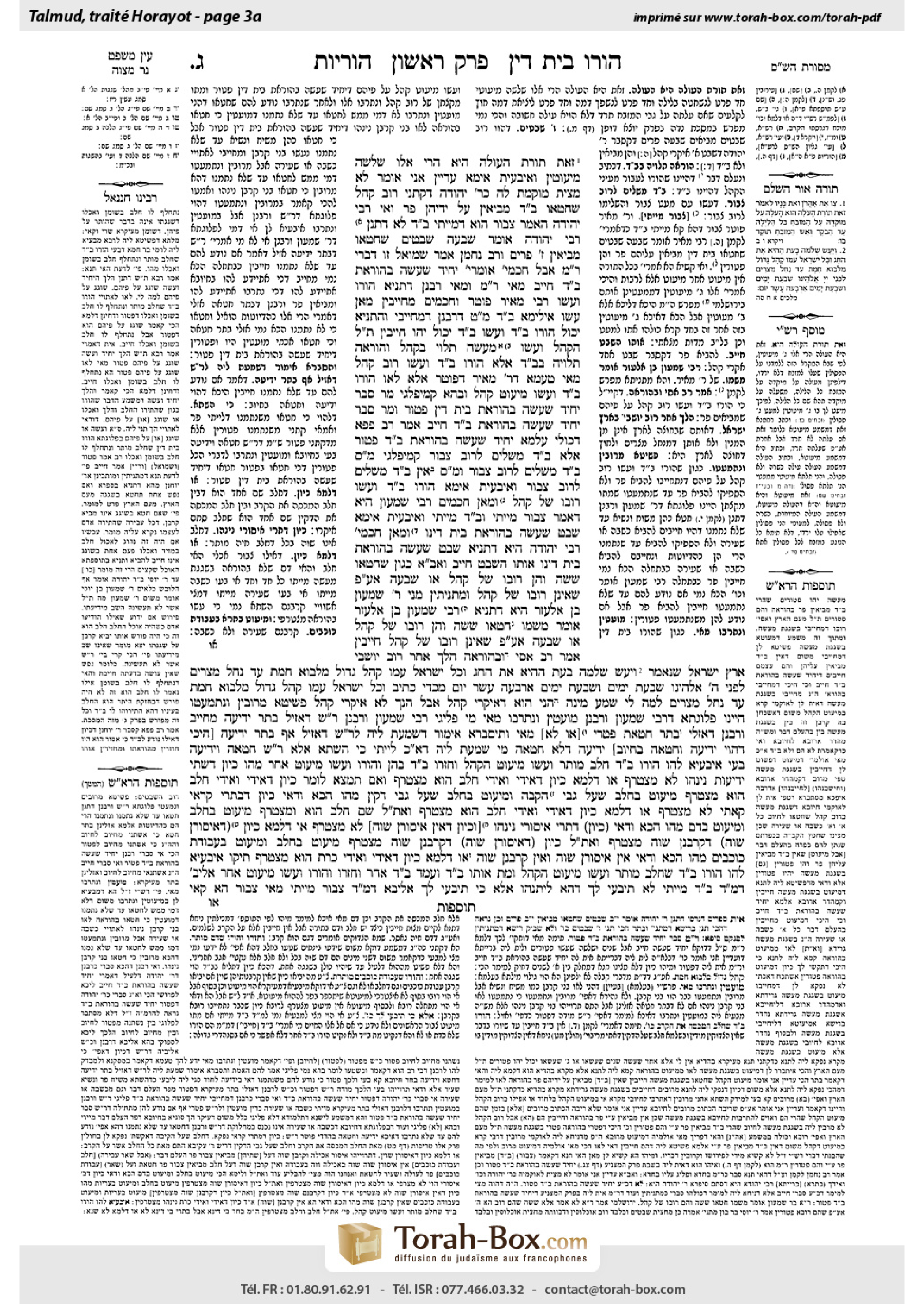
Horayot 3a: Talmud study for Daf Yomi
Study the Talmud for Daf Yomi with scanned pages, Hebrew text, English translations from Sefaria and AI-generated French translations.
Passage selection and English or AI-generated French translation are available where the scan has annotations. Daf Study is independent of Torah-Box and Sefaria.
Browse Horayot · הוריות · All tractatesHorayot 3a text and translations
This page of Horayot includes the Aramaic text, an English translation and an AI-generated French translation, alongside the scan above.
הוריות ג׳ א · Aramaic and Hebrew text
״זֹאת תּוֹרַת הָעוֹלָה הִיא״ – הֲרֵי אֵלּוּ שְׁלֹשָׁה מִיעוּטִין.
וְאִיבָּעֵית אֵימָא: עֲדַיִין אֲנִי אוֹמֵר לָא מָצֵית מוֹקְמַתְּ לַהּ כְּרַבִּי יְהוּדָה, דְּקָתָנֵי: רוֹב קָהָל שֶׁחָטְאוּ – בֵּית דִּין מְבִיאִין עַל יְדֵיהֶן פַּר, וְאִי רַבִּי יְהוּדָה הָאָמַר: צִבּוּר הוּא דְּמַיְיתֵי, בֵּית דִּין – לָא. דִּתְנַן, רַבִּי יְהוּדָה אוֹמֵר: שִׁבְעָה שְׁבָטִים שֶׁחָטְאוּ – מְבִיאִין שִׁבְעָה פָּרִים.
וְרַב נַחְמָן אָמַר שְׁמוּאֵל: זוֹ דִּבְרֵי רַבִּי מֵאִיר, אֲבָל חֲכָמִים אוֹמְרִים: יָחִיד שֶׁעָשָׂה בְּהוֹרָאַת בֵּית דִּין – חַיָּיב. מַאי רַבִּי מֵאִיר וּמַאי רַבָּנַן? דְּתַנְיָא: הוֹרוּ וְעָשׂוּ – רַבִּי מֵאִיר פּוֹטֵר, וַחֲכָמִים מְחַיְּיבִין.
מַאן עָשׂוּ? אִילֵּימָא בֵּית דִּין, מַאי טַעְמָא דְּרַבָּנַן דִּמְחַיְּיבִי? וְהָתַנְיָא: יָכוֹל הוֹרוּ בֵּית דִּין וְעָשׂוּ בֵּית דִּין, יָכוֹל יְהוּ חַיָּיבִין? תַּלְמוּד לוֹמַר: ״הַקָּהָל וְעָשׂוּ״, מַעֲשֶׂה תָּלוּי בַּקָּהָל וְהוֹרָאָה תְּלוּיָה בְּבֵית דִּין!
אֶלָּא הוֹרוּ בֵּית דִּין וְעָשׂוּ רוֹב קָהָל. מַאי טַעְמָא דְּרַבִּי מֵאִיר דְּפוֹטֵר? אֶלָּא לָאו: הוֹרוּ בֵּית דִּין וְעָשׂוּ מִיעוּט קָהָל, וּבְהָא קָמִיפַּלְגִי, מָר סָבַר: יָחִיד שֶׁעָשָׂה בְּהוֹרָאַת בֵּית דִּין – פָּטוּר, וּמַר סָבַר: יָחִיד שֶׁעָשָׂה בְּהוֹרָאַת בֵּית דִּין – חַיָּיב.
אָמַר רַב פָּפָּא: דְּכוּלֵּי עָלְמָא יָחִיד שֶׁעָשָׂה בְּהוֹרָאַת בֵּית דִּין – פָּטוּר, אֶלָּא בֵּית דִּין מַשְׁלִים לְרוֹב צִבּוּר קָמִיפַּלְגִי.
מָר סָבַר: בֵּית דִּין מַשְׁלִים לְרוֹב צִבּוּר, וּמַר סָבַר: אֵין בֵּית דִּין מַשְׁלִים לְרוֹב צִבּוּר.
וְאִיבָּעֵית אֵימָא: הוֹרוּ בֵּית דִּין וְעָשׂוּ רוּבּוֹ שֶׁל קָהָל, וּמַאן חֲכָמִים – רַבִּי שִׁמְעוֹן הִיא, דְּאָמַר: צִבּוּר מַיְיתֵי וּבֵית דִּין מַיְיתִי.
וְאִיבָּעֵית אֵימָא: שֵׁבֶט שֶׁעָשָׂה בְּהוֹרָאַת בֵּית דִּינוֹ, וּמַאן חֲכָמִים? רַבִּי יְהוּדָה הִיא, דְּתַנְיָא: שֵׁבֶט שֶׁעָשָׂה בְּהוֹרָאַת בֵּית דִּינוֹ, אוֹתוֹ הַשֵּׁבֶט חַיָּיב.
וְאִיבָּעֵית אֵימָא: כְּגוֹן שֶׁחָטְאוּ שִׁשָּׁה, וְהֵן רוּבּוֹ שֶׁל קָהָל, אוֹ שִׁבְעָה אַף עַל פִּי שֶׁאֵינָן רוּבּוֹ שֶׁל קָהָל, וּמַתְנִיתִין מַנִּי? רַבִּי שִׁמְעוֹן בֶּן אֶלְעָזָר הִיא.
דְּתַנְיָא, רַבִּי שִׁמְעוֹן בֶּן אֶלְעָזָר אוֹמֵר מִשְּׁמוֹ: חָטְאוּ שִׁשָּׁה וְהֵן רוּבּוֹ שֶׁל קָהָל, אוֹ שִׁבְעָה אַף עַל פִּי שֶׁאֵינָן רוּבּוֹ שֶׁל קָהָל – חַיָּיבִין.
אָמַר רַב אַסִּי: וּבְהוֹרָאָה, הַלֵּךְ אַחַר רוֹב יוֹשְׁבֵי אֶרֶץ יִשְׂרָאֵל, שֶׁנֶּאֱמַר: ״וַיַּעַשׂ שְׁלֹמֹה בָעֵת הַהִיא אֶת הֶחָג וְכׇל יִשְׂרָאֵל עִמּוֹ קָהָל גָּדוֹל מִלְּבוֹא חֲמָת עַד נַחַל מִצְרַיִם לִפְנֵי ה׳ אֱלֹהֵינוּ שִׁבְעַת יָמִים וְשִׁבְעַת יָמִים אַרְבָּעָה עָשָׂר יוֹם״. מִכְּדֵי כְּתִיב: ״וְכׇל יִשְׂרָאֵל עִמּוֹ״, ״קָהָל גָּדוֹל מִלְּבוֹא חֲמָת עַד נַחַל מִצְרַיִם״ לְמָה לִי? שְׁמַע מִינַּהּ: הָנֵי הוּא דְּאִיקְּרִי קָהָל, אֲבָל הָנָךְ לָא אִיקְּרִי קָהָל.
פְּשִׁיטָא: מְרוּבִּין וְנִתְמַעֲטוּ – הַיְינוּ פְּלוּגְתָּא דְּרַבִּי שִׁמְעוֹן וְרַבָּנַן.
מוּעָטִין וְנִתְרַבּוּ, מַאי? מִי פְּלִיגִי רַבִּי שִׁמְעוֹן וְרַבָּנַן? רַבִּי שִׁמְעוֹן דְּאָזֵיל בָּתַר יְדִיעָה מְחַיַּיב, וְרַבָּנַן דְּאָזְלִי בָּתַר חַטָּאת – פָּטְרִי [אוֹ לָא], מַאי?
וְתִיסְבְּרָא? אֵימוֹר דְּשָׁמְעַתְּ לֵיהּ לְרַבִּי שִׁמְעוֹן דְּאָזֵיל אַף בָּתַר יְדִיעָה [הֵיכִי דְּהָוֵי יְדִיעָה וַחֲטָאָה בְּחִיּוּב], יְדִיעָה דְּלָא חֲטָאָה מִי שָׁמְעַתְּ לֵיהּ?
דְּאִם כֵּן, לַיְיתֵי כִּי הַשְׁתָּא! אֶלָּא, רַבִּי שִׁמְעוֹן חֲטָאָה וִידִיעָה בָּעֵי.
אִיבַּעְיָא לְהוּ: הוֹרוּ בֵּית דִּין חֵלֶב מוּתָּר, וְעָשׂוּ מִיעוּט הַקָּהָל, וְחָזְרוּ בֵּית דִּין בָּהֶן, וְהוֹרוּ, וְעָשׂוּ מִיעוּט אַחֵר, מַהוּ? כֵּיוָן דִּשְׁתֵּי יְדִיעוֹת נִינְהוּ לָא מִצְטָרֵף, אוֹ דִּלְמָא: כֵּיוָן דְּאִידֵּי וְאִידֵּי חֵלֶב הוּא, מִצְטָרֵף?
וְאִם תִּמְצָא לוֹמַר: כֵּיוָן דְּאִידֵּי וְאִידֵּי חֵלֶב הוּא מִצְטָרֵף, מִיעוּט בְּחֵלֶב שֶׁעַל גַּבֵּי הַקֵּבָה, וּמִיעוּט בְּחֵלֶב שֶׁעַל גַּבֵּי דַּקִּין, מַהוּ? הָכָא וַדַּאי כֵּיוָן דְּבִתְרֵי קְרָאֵי קָאָתֵי – לָא מִצְטָרֵף, אוֹ דִּלְמָא כֵּיוָן דְּאִידֵּי וְאִידֵּי חֵלֶב הוּא – מִצְטָרֵף?
וְאִם תִּמְצֵי לוֹמַר: שֵׁם חֵלֶב הוּא וּמִצְטָרֵף, מִיעוּט בְּחֵלֶב וּמִיעוּט בְּדָם, מַהוּ? הָכָא וַדַּאי (כֵּיוָן) דִּתְרֵי אִיסּוּרֵי נִינְהוּ, [וְכֵיוָן דְּאֵין אִיסּוּרָן שָׁוֶה] – לָא מִצְטָרֵף, אוֹ דִלְמָא כֵּיוָן (דְּאִיסּוּרָן שָׁוֶה) – דְּקׇרְבָּנָן שָׁוֶה, מִצְטָרֵף?
וְאִם תִּמְצֵי לוֹמַר: כֵּיוָן (דְּאִיסּוּרָן שָׁוֶה) דְּקׇרְבָּנָן שָׁוֶה מִצְטָרֵף, מִיעוּט בְּחֵלֶב וּמִיעוּט בַּעֲבוֹדָה זָרָה, מַהוּ? הָכָא וַדַּאי אֵין אִיסּוּרָן שָׁוֶה וְאֵין קׇרְבָּנָן שָׁוֶה, אוֹ דִּלְמָא כֵּיוָן דְּאִידֵּי וְאִידֵּי כָּרֵת הוּא, מִצְטָרֵף? תֵּיקוּ.
אִיבַּעְיָא לְהוּ: הוֹרוּ בֵּית דִּין שֶׁחֵלֶב מוּתָּר, וְעָשׂוּ מִיעוּט הַקָּהָל, וּמֵת אוֹתוֹ בֵּית דִּין וְעָמַד בֵּית דִּין אַחֵר, וְחָזְרוּ וְהוֹרוּ, וְעָשׂוּ מִיעוּט אַחֵר.
אַלִּיבָּא דְּמַאן דְּאָמַר בֵּית דִּין מַיְיתֵי – לָא תִּיבְּעֵי לָךְ, דְּהָא לֵיתַנְהוּ, אֶלָּא כִּי תִּיבְּעֵי לָךְ – אַלִּיבָּא דְּמַאן דְּאָמַר צִבּוּר מַיְיתֵי, מַאי צִבּוּר? הָא קָאֵי,
Horayot 3a · English translation
“This is the law of the burnt-offering, it is that which goes up on its pyre on the altar” (Leviticus 6:2); these are three exclusionary terms: “This,” “the burnt-offering,” and “it is,” which serve to exclude three offerings concerning which the halakha is that even if they are placed on the altar they are subsequently removed: A burnt-offering slaughtered at night, a burnt-offering whose blood was spilled before it was sprinkled, and a burnt-offering whose blood was taken outside the courtyard. Apparently, it is Rabbi Yehuda who interprets multiple exclusionary terms.
And if you wish, say that proof for the attribution of the baraitot may be cited from the second baraita, which begins with the phrase: Still I say. You cannot interpret that baraita in accordance with the opinion of Rabbi Yehuda, as the baraita teaches: One might have thought that each member of a majority of the congregation that sinned based on the ruling of a court is exempt from liability to bring an offering for his unwitting transgression, as the court brings a bull for an unwitting communal sin on the basis of their transgression. And if this baraita is in accordance with the opinion of Rabbi Yehuda, didn’t he say: It is the congregation that brings the bull as an offering, and not the court? As we learned in a mishna (5a) that Rabbi Yehuda says: Seven tribes that sinned bring seven bulls. The tribes bring the offerings, not the court.
§ Up to this point, the Gemara explained the mishna in accordance with the opinion of Rabbi Yehuda and contrary to the opinion of the Rabbis, who disagree with him. And Rav Naḥman says that Shmuel says: The mishna is the statement of Rabbi Meir, but the Rabbis say: An individual who performed a transgression on the basis of the ruling of the court is liable. The Gemara asks: What is the opinion of Rabbi Meir and what is the opinion of the Rabbis to which Shmuel referred? It is as it is taught in a baraita: If the court issued a ruling and the judges performed a transgression on the basis of that ruling, Rabbi Meir deems them exempt and the Rabbis deem them liable.
The Gemara asks: Who performed the transgression? If we say that it is the members of the court who performed the transgression, what is the reasoning of the Rabbis, who deem him liable? But isn’t it taught in a baraita: One might have thought that if the court issued a ruling and the members of the court performed the transgression, one might have thought they would be liable to bring a bull for an unwitting communal sin. The verse states with regard to that bull: “And the matter is hidden from the eyes of the congregation and they performed” (Leviticus 4:13), from which it is derived that the action is dependent on the congregation and the ruling is dependent on the court.
Rather, the case in the baraita is where the court issued a ruling and the majority of the congregation performed a transgression on the basis of that ruling. If so, what is the reasoning of Rabbi Meir, who deems them exempt? Rather, is it not referring to a case where the court issued a ruling and a minority of the congregation performed a transgression on the basis of that ruling, and it is with regard to this matter that the tanna’im disagree: One Sage, Rabbi Meir, holds: An individual who performed a transgression on the basis of the ruling of the court is exempt; and one Sage, the Rabbis, holds: An individual who performed a transgression on the basis of a ruling of the court is liable. The mishna, which states that an individual who performs a transgression on the basis of a ruling of the court is exempt, is in accordance with the opinion of Rabbi Meir.
Rav Pappa said: There is no proof that the dispute between Rabbi Meir and the Rabbis relates to the mishna, as their dispute can be understood differently. Perhaps everyone agrees that an individual who performed a transgression on the basis of the ruling of the court is exempt. Rather, the tanna’im disagree with regard to whether the members of the court combine with the members of the congregation to complete a majority of the congregation. The members of the congregation who sinned constitute less than a majority. When the judges of the court who sinned are added to that minority, the total of people who sinned constitute a majority.
He explains: One Sage, the Rabbis, holds: The members of the court combine with the members of the congregation to complete a majority of the congregation. And one Sage, Rabbi Meir, holds: The members of the court do not combine with the members of the congregation to complete a majority of the congregation; therefore, those who sinned on the basis of the ruling of the court constitute less than a majority and the court is exempt from liability to bring an offering. The mishna is not only in accordance with the opinion of Rabbi Meir, as in the case of the mishna, but even the Rabbis agree.
And if you wish, say instead that the dispute between Rabbi Meir and the Rabbis is in a case where the court issued a ruling and a majority of the congregation performed a transgression on the basis of that ruling, and everyone agrees that the court is liable to bring a bull as an offering for an unwitting communal sin. Rabbi Meir deems the members of the congregation exempt from bringing an offering. And who are the Rabbis who deem them liable to bring an offering? It is Rabbi Shimon, who said: The congregation brings an offering and the court brings an offering.
And if you wish, say instead that the dispute between Rabbi Meir and the Rabbis is in the case of a tribe that performed a transgression on the basis of the ruling of its tribal court. Rabbi Meir holds that there is no liability to bring a bull as an offering for an unwitting communal sin for a ruling issued by a tribal court; therefore, he deems the court exempt from bringing an offering. And who are the Rabbis who deem the tribal court liable to bring an offering? It is Rabbi Yehuda, as it is taught in a baraita: In the case of a tribe that performed a transgression on the basis of a ruling of its tribal court, that tribe is liable.
And if you wish, say instead that the dispute between Rabbi Meir and the Rabbis is in a case where six of the twelve tribes sinned and, although they do not constitute a majority of the number of the tribes, in terms of population they constitute a majority of the congregation. Or seven tribes sinned, and even though in terms of population they are not a majority of the congregation, they constitute a majority of the tribes. And whose opinion is expressed in the baraita as the opinion of the Rabbis? It is the opinion of Rabbi Shimon ben Elazar.
This is as it is taught in a baraita: Rabbi Shimon ben Elazar says in the name of Rabbi Meir: If six tribes sinned and in terms of population they are a majority of the congregation, or if seven tribes sinned even though in terms of population they are not a majority of the congregation, they are liable. All these alternative understandings of the dispute between Rabbi Meir and the Rabbis lead to the conclusion that there is no proof for the statement of Rav Naḥman in the name of Shmuel that the mishna is in accordance with the opinion of Rabbi Meir.
§ Rav Asi says: And with regard to the definition of the majority that establishes liability for performance of a transgression on the basis of the ruling of a court, follow the majority of the residents of Eretz Yisrael, as it is stated: “And Solomon held the feast at that time, and all Israel with him, a great congregation, from the entrance of Hamath until the Brook of Egypt, before the Lord our God, seven days and seven days, fourteen days” (I Kings 8:65). The Gemara clarifies the words of this verse: Since it is written: “And all Israel with him,” why do I need to add: “A great congregation, from the entrance of Hamath until the Brook of Egypt”? Conclude from it: It is these residents of Eretz Yisrael who are characterized as a congregation; but those who reside outside Eretz Yisrael are not characterized as a congregation.
§ The Gemara continues defining the majority that establishes liability. It is obvious that the case of when those who performed a transgression on the basis of the ruling of the court were numerous, i.e., they constituted a majority, and their percentage diminished, e.g., if some sinners died and they now constitute a minority of the congregation; that is the dispute between Rabbi Shimon and the Rabbis, who disagree in a mishna (10b) with regard to an anointed High Priest or a king who performed an unwitting transgression before assuming his position. The Rabbis hold: Since they were laymen when they sinned, they are liable to bring the offering of a layman. Rabbi Shimon holds: If they became aware of their transgression while still laymen, they bring the offering of a layman. If they became aware of their transgression after they assumed their positions, they are exempt. Accordingly, in the case of a majority whose number diminished, the Rabbis hold that since it was a majority that sinned, they bring an offering. Rabbi Shimon holds that it depends on their status when they became aware they had unwittingly sinned.
If those who performed a transgression on the basis of the ruling of the court were few, i.e., they constituted a minority, and their percentage increased, e.g., if some non-sinners died and the sinners now constitute a majority of the congregation, what is the halakha? Do Rabbi Shimon and the Rabbis disagree with regard to this matter as well? That would mean that Rabbi Shimon, who follows the status at the time of awareness, deems the court liable, and the Rabbis, who follow the status at the time of the transgression, deem the court exempt. Or do they not disagree? What is the conclusion?
And can you understand that this case is contingent on the dispute between Rabbi Shimon and the Rabbis? Say that you heard that Rabbi Shimon follows the status at the time of awareness as well, i.e., in a case where both the awareness and the transgression were in a period of liability, either liability as a layman or liability as a king or as an anointed High Priest, the sinner is liable to bring an offering. But in a case where the awareness was during a period of liability, but the transgression was not, did you hear Rabbi Shimon say the court is liable?
The Gemara clarifies: As, if it is so that Rabbi Shimon holds that the period of awareness is the sole determining factor, let the High Priest and the king bring an offering according to their present status. If they became aware of the transgression after assuming their positions, let them bring the offering appropriate for a High Priest or a king. Why, then, does Rabbi Shimon say that in that case they are exempt? Rather, apparently Rabbi Shimon requires that both the transgression and the awareness take place in a period of liability. There is no resolution for the dilemma that was raised.
§ A dilemma was raised before the Sages: If the court issued a ruling that forbidden fat is permitted, and a minority of the congregation performed the transgression of eating forbidden fat on the basis of that ruling, and the court reversed their decision and then reversed their decision again and issued a ruling that forbidden fat is permitted, and a different minority of the congregation performed the transgression, what is the halakha? The Gemara elaborates: Is it that since there are two disparate experiences of awareness, the first minority does not combine with the second minority, even though the two minorities together would constitute a majority? Or perhaps, since both this transgression and that transgression are the same, eating forbidden fat, the first minority combines with the second minority, and the two minorities together constitute a majority.
And if you say in that case: Since both this transgression and that transgression are the same, eating forbidden fat, the first minority combines with the second minority, then there is another dilemma: In a case where a minority performed a transgression on the basis of the first ruling of the court and ate forbidden fat that is upon the maw, and a minority performed a transgression on the basis of the second ruling of the court and ate forbidden fat that is upon the small intestine, what is the halakha? The Gemara elaborates: Here, certainly, since these transgressions come from two different verses, the first minority does not combine with the second minority; or perhaps, since both this transgression and that transgression are the same, eating forbidden fat, the first minority combines with the second minority, and the two minorities together constitute a majority.
And if you say in that case: It is the name of forbidden fat that they both have in common, and the first minority combines with the second minority, then there is another dilemma: In a case where a minority performed a transgression on the basis of the first ruling of the court and ate forbidden fat, and a minority performed a transgression on the basis of the second ruling of the court and ate forbidden blood, what is the halakha? The Gemara elaborates: Here, certainly, they are two distinct prohibitions, and since the nature of their prohibition is not identical, the first minority does not combine with the second minority. Or perhaps, since their offerings are identical, as one is liable to bring a sin-offering for unwitting violation of either of these prohibitions, the first minority combines with the second minority.
And if you say in that case: Since their offerings are identical, the first minority combines with the second minority, then there is another dilemma: In a case where a minority performed a transgression on the basis of the first ruling of the court and ate forbidden fat, and a minority performed a transgression on the basis of the second ruling of the court and engaged in idol worship, what is the halakha? Here, certainly, neither are their prohibitions identical nor are their offerings identical, because an individual who unwittingly engages in idol worship may bring only a female goat for atonement. Therefore, the first minority does not combine with the second minority. Or perhaps, since for both this transgression and that transgression one is liable to receive excision from the World-to-Come [karet] if he performs it intentionally, the first minority combines with the second minority. The Gemara concludes: The dilemma shall stand unresolved.
§ A dilemma was raised before the Sages: If the court issued a ruling that forbidden fat is permitted, and a minority of the congregation performed the transgression of eating forbidden fat on the basis of that ruling, and the members of that court died and another court stood in their place, and again issued the same ruling that forbidden fat is permitted, and a different minority performed the transgression of eating forbidden fat on the basis of that ruling, what is the halakha?
The Gemara elaborates: According to the opinion of the one who said that only the court brings the offering, do not raise the dilemma, as those judges who issued the original ruling on the basis of which the minority performed a transgression are no longer alive. Rather, when should you raise the dilemma? Raise it according to the opinion of the one who said that the congregation brings the offering. What is the halakha? The Gemara elaborates: The congregation exists, as together the two minorities constitute a majority of the congregation who performed the transgression.
Horayot 3a · Traduction française (IA)
« C’est la loi du holocauste, c’est celui qui monte sur son bûcher sur l’autel » (Lévitique 6:2) ; ces trois termes exclusifs : « C’est », « le holocauste », et « c’est », servent à exclure trois offrandes concernant lesquelles la halakha est que même si elles sont placées sur l’autel, elles sont ensuite retirées : un holocauste sacrifié la nuit, un holocauste dont le sang avait été versé avant d’être répandu, et un holocauste dont le sang avait été pris en dehors du cour de l’enclos. Apparemment, c’est Rabbi Yéhuda qui interprète plusieurs termes exclusifs.
Et si vous le souhaitez, dites que la preuve pour l’attribution des baraitot peut être citée à partir de la deuxième baraïta, qui commence par la phrase : « Je dis encore. » On ne peut pas interpréter cette baraïta selon l’opinion de Rabbi Yéhuda, car la baraïta enseigne : On pourrait penser que chaque membre d’une majorité du peuple qui a péché en vertu de la décision d’un tribunal est exempt de responsabilité de présenter une offrande pour son péché involontaire, car le tribunal présente un taureau pour un péché involontaire commun en vertu de leur péché. Et si cette baraïta est en conformité avec l’opinion de Rabbi Yéhuda, n’a-t-il pas dit : C’est le peuple qui présente le taureau en offrande, et non le tribunal ? Comme nous l’avons appris dans une mitsna (5a) que Rabbi Yéhuda dit : Sept tribus qui ont péché présentent sept taureaux. Les tribus présentent les offrandes, pas le tribunal.
§ Jusqu’à présent, le Guemara explique la mitsna selon l’opinion de Rabbi Yéhuda et contrairement à l’opinion des Rabbins, qui s’y opposent. Et Rav Naḥman dit que Shmuel dit : La mitsna est la déclaration de Rabbi Meir, mais les Rabbins disent : Un individu qui a commis un péché en vertu de la décision du tribunal est responsable. Le Guemara demande : Quelle est l’opinion de Rabbi Meir et quelle est l’opinion des Rabbins à laquelle Shmuel faisait référence ? C’est ce qui est enseigné dans une baraïta : Si le tribunal a rendu une décision et les juges ont commis un péché en vertu de cette décision, Rabbi Meir considère qu’ils sont exemptés et les Rabbins considèrent qu’ils sont responsables.
Le Guemara demande : Qui a commis le péché ? Si nous disons que c’est les membres du tribunal qui ont commis le péché, quelle est la raison des Rabbins, qui considèrent qu’il est responsable ? Mais n’est-il pas enseigné dans une baraïta : On pourrait penser que si le tribunal a rendu une décision et les membres du tribunal ont commis le péché, on pourrait penser qu’ils sont responsables de présenter un taureau pour un péché involontaire commun. La parabole dit concernant ce taureau : « Et l’affaire est cachée aux yeux du peuple et ils ont accompli » (Lévitique 4:13), d’où il est déduit que l’action dépend du peuple et la décision dépend du tribunal.
Plutôt, le cas mentionné dans la baraïta est celui où le tribunal a rendu une décision et la majorité du peuple a commis un péché en vertu de cette décision. Si tel est le cas, quelle est la raison de Rabbi Meir, qui considère qu'ils sont exemptés ? Plutôt, n'est-ce pas plutôt un cas où le tribunal a rendu une décision et une minorité du peuple a commis un péché en vertu de cette décision, et c'est à propos de cette affaire que les tanna’im s'opposent : Un sage, Rabbi Meir, dit : Un individu qui a commis un péché en vertu de la décision du tribunal est exempt ; et un sage, les Rabbins, dit : Un individu qui a commis un péché en vertu d'une décision du tribunal est responsable. La mitsva, qui affirme qu'un individu qui commet un péché en vertu d'une décision du tribunal est exempt, est en conformité avec l'opinion de Rabbi Meir.
Rav Pappa dit : Il n'y a pas de preuve que le débat entre Rabbi Meir et les Rabbins concerne la mitsva, car leur débat peut être compris différemment. Peut-être que tout le monde est d'accord sur le fait qu'un individu qui a commis un péché en vertu de la décision du tribunal est exempt. Plutôt, les tanna’im s'opposent quant à savoir si les membres du tribunal s'unissent aux membres du peuple pour former une majorité du peuple. Les membres du peuple qui ont péché constituent moins d'une majorité. Lorsque les juges du tribunal qui ont péché sont ajoutés à cette minorité, le total des personnes qui ont péché constitue une majorité.
Il explique : Un sage, les Rabbins, disent : Les membres du tribunal s’unissent aux membres du peuple pour former une majorité du peuple. Et un sage, Rabbi Meir, dit : Les membres du tribunal ne s’unissent pas aux membres du peuple pour former une majorité du peuple ; par conséquent, ceux qui ont péché en vertu de la décision du tribunal constituent moins d’une majorité et le tribunal est exempt de responsabilité de présenter une offrande. La mitsva n’est pas seulement en conformité avec l’opinion de Rabbi Meir, comme dans le cas de la mitsva, mais même les Rabbins sont d’accord.
Et si vous le souhaitez, dites plutôt que le débat entre Rabbi Meir et les Rabbins est dans un cas où le tribunal a rendu une décision et une majorité du peuple a commis un péché en vertu de cette décision, et tout le monde est d’accord sur le fait que le tribunal est responsable de présenter un taureau en offrande pour un péché involontaire commun. Rabbi Meir considère que les membres du peuple sont exemptés de présenter une offrande. Et qui sont les Rabbins qui considèrent qu’ils sont responsables de présenter une offrande ? C’est Rabbi Shimon, qui a dit : Le peuple présente une offrande et le tribunal présente une offrande.
Et si vous le souhaitez, dites plutôt que le débat entre Rabbi Meir et les Rabbins est dans le cas d’une tribu qui a commis un péché en vertu de la décision de son tribunal tribal. Rabbi Meir dit qu’il n’y a pas de responsabilité de présenter un taureau en offrande pour un péché involontaire commun pour une décision rendue par un tribunal tribal ; par conséquent, il considère que le tribunal est exempt de présenter une offrande. Et qui sont les Rabbins qui considèrent que le tribunal tribal est responsable de présenter une offrande ? C’est Rabbi Yéhuda, comme il est enseigné dans une baraïta : Dans le cas d’une tribu qui a commis un péché en vertu d’une décision de son tribunal tribal, cette tribu est responsable.
Et si tu veux, dis plutôt que le débat entre Rabbi Meïr et les Rabbins est dans un cas où six des douze tribus ont péché et, bien qu'ils ne constituent pas la majorité du nombre des tribus, en termes de population ils constituent la majorité de la congrégation. Ou sept tribus ont péché, et même si en termes de population ils ne sont pas la majorité de la congrégation, ils constituent la majorité des tribus. Et quel est l'opinion exprimée dans la baraïta comme l'opinion des Rabbins ? C'est l'opinion de Rabbi Shim'on ben Elazar.
C'est ce qui est enseigné dans une baraïta : Rabbi Shim'on ben Elazar dit au nom de Rabbi Meïr : Si six tribus ont péché et en termes de population ils constituent la majorité de la congrégation, ou si sept tribus ont péché même si en termes de population ils ne sont pas la majorité de la congrégation, ils sont redevables. Toutes ces interprétations alternatives du débat entre Rabbi Meïr et les Rabbins conduisent à la conclusion qu'il n'y a pas de preuve pour l'affirmation de Rav Naḥman au nom de Shmuel que la mitsva est selon l'opinion de Rabbi Meïr.
§ Rav Asi dit : Et concernant la définition de la majorité qui établit la redevabilité pour la commission d'une transgression sur la base de la décision d'un tribunal, suivez la majorité des habitants de la Terre d'Israël, comme il est dit : « Et Salomon tint la fête à cette époque, et tout Israël avec lui, une grande congrégation, de l'entrée de Hamath jusqu'au torrent d'Égypte, devant l'Éternel notre Dieu, sept jours et sept jours, quatorze jours » (I Rois 8:65). La Guemara clarifie les mots de cette versette : Puisqu'il est écrit : « Et tout Israël avec lui », pourquoi ai-je besoin d'ajouter : « Une grande congrégation, de l'entrée de Hamath jusqu'au torrent d'Égypte » ? Concluez-en : Ce sont ces habitants de la Terre d'Israël qui sont caractérisés comme une congrégation ; mais ceux qui habitent en dehors de la Terre d'Israël ne sont pas caractérisés comme une congrégation.
§ La Guemara continue de définir la majorité qui établit la responsabilité. Il est évident que le cas où ceux qui ont commis une transgression sur la base de la décision du tribunal étaient nombreux, c'est-à-dire qu'ils constituaient une majorité, et leur pourcentage a diminué, par exemple si certains pécheurs sont morts et qu'ils constituent maintenant une minorité de la congrégation ; c'est le débat entre Rabbi Shim'on et les Rabbins, qui s'opposent dans une mitsva (10b) concernant un grand prêtre ou un roi qui a commis une transgression involontaire avant d'assumer sa fonction. Les Rabbins pensent : Puisqu'ils étaient des laïcs lorsqu'ils ont péché, ils sont redevables de présenter l'offrande du laïc. Rabbi Shim'on pense : Si ils ont pris conscience de leur transgression alors qu'ils étaient encore des laïcs, ils présentent l'offrande du laïc. Si ils ont pris conscience de leur transgression après avoir assumé leurs fonctions, ils sont exemptés. Ainsi, dans le cas d'une majorité dont le nombre a diminué, les Rabbins pensent que puisqu'il s'agissait d'une majorité qui a péché, ils présentent une offrande. Rabbi Shim'on pense que cela dépend de leur statut lorsqu'ils ont pris conscience d'avoir commis un péché involontaire.
Si ceux qui ont commis une transgression sur la base de la décision du tribunal étaient peu nombreux, c'est-à-dire qu'ils constituaient une minorité, et leur pourcentage a augmenté, par exemple si certains non-pécheurs sont morts et que les pécheurs constituent maintenant la majorité de la congrégation, quelle est la halakha ? Rabbi Shimon et les Rabbins s'opposent-ils également à ce sujet ? Cela signifierait que Rabbi Shimon, qui suit le statut au moment de la prise de conscience, considère que le tribunal est redevable, et les Rabbins, qui suivent le statut au moment de la transgression, considèrent que le tribunal est exempt. Ou ne s'opposent-ils pas ? Quelle est la conclusion ?
Et peux-tu comprendre que ce cas dépend du débat entre Rabbi Shimon et les Rabbins ? Dis que tu as entendu que Rabbi Shimon suit le statut au moment de la prise de conscience également, c'est-à-dire dans un cas où à la fois la prise de conscience et la transgression se sont produits pendant une période de redevabilité, soit en tant que laïc, soit en tant que roi ou en tant que grand prêtre consacré, le pécheur est redevable de présenter une offrande. Mais dans un cas où la prise de conscience s'est produite pendant une période de redevabilité, mais la transgression n'a pas eu lieu, as-tu entendu Rabbi Shimon dire que le tribunal est redevable ?
La Guemara clarifie : Comme, si c'est ainsi que Rabbi Shim'on pense que la période de prise de conscience est le seul facteur déterminant, laissez le grand prêtre et le roi présenter une offrande selon leur statut actuel. Si ils ont pris conscience de la transgression après avoir assumé leurs fonctions, laissez-les présenter l'offrande appropriée pour un grand prêtre ou un roi. Pourquoi, alors, Rabbi Shim'on dit-il que dans ce cas ils sont exemptés ? Plutôt, apparemment Rabbi Shim'on exige que à la fois la transgression et la prise de conscience aient lieu pendant une période de redevabilité. Il n'y a pas de résolution pour le dilemme qui a été soulevé.
§ Un dilemme a été soulevé devant les Sages : Si le tribunal a rendu une décision autorisant la graisse interdite, et une minorité de la congrégation a commis la transgression de manger de la graisse interdite sur la base de cette décision, et le tribunal a révoqué sa décision et l'a révoquée à nouveau, rendant une décision autorisant la graisse interdite, et une autre minorité de la congrégation a commis la transgression, quelle est la halakha ? La Guemara développe : Est-ce que, puisque les deux expériences de prise de conscience sont différentes, la première minorité ne s'ajoute pas à la deuxième minorité, même si les deux minorités ensemble constituent une majorité ? Ou peut-être, puisque cette transgression et celle-ci sont la même, manger de la graisse interdite, la première minorité s'ajoute à la deuxième minorité, et les deux minorités ensemble constituent une majorité ?
Et si vous dites dans ce cas : Puisque cette transgression et celle-ci sont identiques, manger de la graisse interdite, la minorité première s'unit à la minorité second, alors il y a un autre dilemme : Dans un cas où une minorité a commis une transgression sur la base de la première décision du tribunal et a mangé de la graisse interdite qui est sur la gueule, et une minorité a commis une transgression sur la base de la deuxième décision du tribunal et a mangé de la graisse interdite qui est sur l'intestin grêle, quelle est la halakha ? La Guemara développe : Ici, certainement, puisque ces transgressions proviennent de deux versets différents, la minorité première ne s'unira pas à la minorité second ; ou peut-être, puisque cette transgression et celle-ci sont identiques, manger de la graisse interdite, la minorité première s'unira à la minorité second, et les deux minorités ensemble formeront une majorité.
Et si vous dites dans ce cas : C'est le nom de la graisse interdite qu'ils ont en commun, et la minorité première s'unira à la minorité second, alors il y a un autre dilemme : Dans un cas où une minorité a commis une transgression sur la base de la première décision du tribunal et a mangé de la graisse interdite, et une minorité a commis une transgression sur la base de la deuxième décision du tribunal et a mangé du sang interdit, quelle est la halakha ? La Guemara développe : Ici, certainement, ce sont deux prohibitions distinctes, et puisque la nature de leurs prohibitions n'est pas identique, la minorité première ne s'unira pas à la minorité second. Ou peut-être, puisque leurs offrandes sont identiques, comme l'un est tenu de présenter un sacrifice expiatoire pour une violation involontaire de l'une ou l'autre de ces prohibitions, la minorité première s'unira à la minorité second.
Et si vous dites dans ce cas : Puisque leurs offrandes sont identiques, la minorité première s'unira à la minorité second, alors il y a un autre dilemme : Dans un cas où une minorité a commis une transgression sur la base de la première décision du tribunal et a mangé de la graisse interdite, et une minorité a commis une transgression sur la base de la deuxième décision du tribunal et a participé à l'idolâtrie, quelle est la halakha ? Ici, certainement, ni leurs prohibitions ne sont identiques ni leurs offrandes ne sont identiques, car une personne qui participe involontairement à l'idolâtrie peut présenter uniquement une petite chèvre comme expiation. Par conséquent, la minorité première ne s'unira pas à la minorité second. Ou peut-être, puisque pour cette transgression et celle-ci l'un est tenu de recevoir l'excision du monde à venir [karet] s'il les commet volontairement, la minorité première s'unira à la minorité second. La Guemara conclut : Le dilemme restera sans solution.
§ Un dilemme a été soulevé devant les Sages : Si le tribunal a rendu une décision selon laquelle la graisse interdite est permise, et une minorité de la communauté a commis la transgression de manger de la graisse interdite sur la base de cette décision, et les membres de ce tribunal sont morts et un autre tribunal est venu à leur place, et a rendu à nouveau la même décision selon laquelle la graisse interdite est permise, et une autre minorité a commis la transgression de manger de la graisse interdite sur la base de cette décision, quelle est la halakha ?
La Guemara développe : Selon l'opinion de celui qui dit que seul le tribunal présente l'offrande, ne soulevez pas le dilemme, car ces juges qui ont rendu la décision originale sur la base de laquelle la minorité a commis une transgression ne sont plus vivants. À quel moment devriez-vous soulever le dilemme ? Soulevez-le selon l'opinion de celui qui dit que la communauté présente l'offrande. Quelle est la halakha ? La Guemara développe : La communauté existe, car ensemble les deux minorités constituent la majorité de la communauté qui a commis la transgression.
Traduction française générée par IA à partir de l’édition anglaise de Sefaria. Vérifie toujours un passage avec le texte source.
Text from Sefaria: William Davidson Edition - Vocalized Aramaic (CC BY NC); William Davidson Edition - English (CC BY NC).