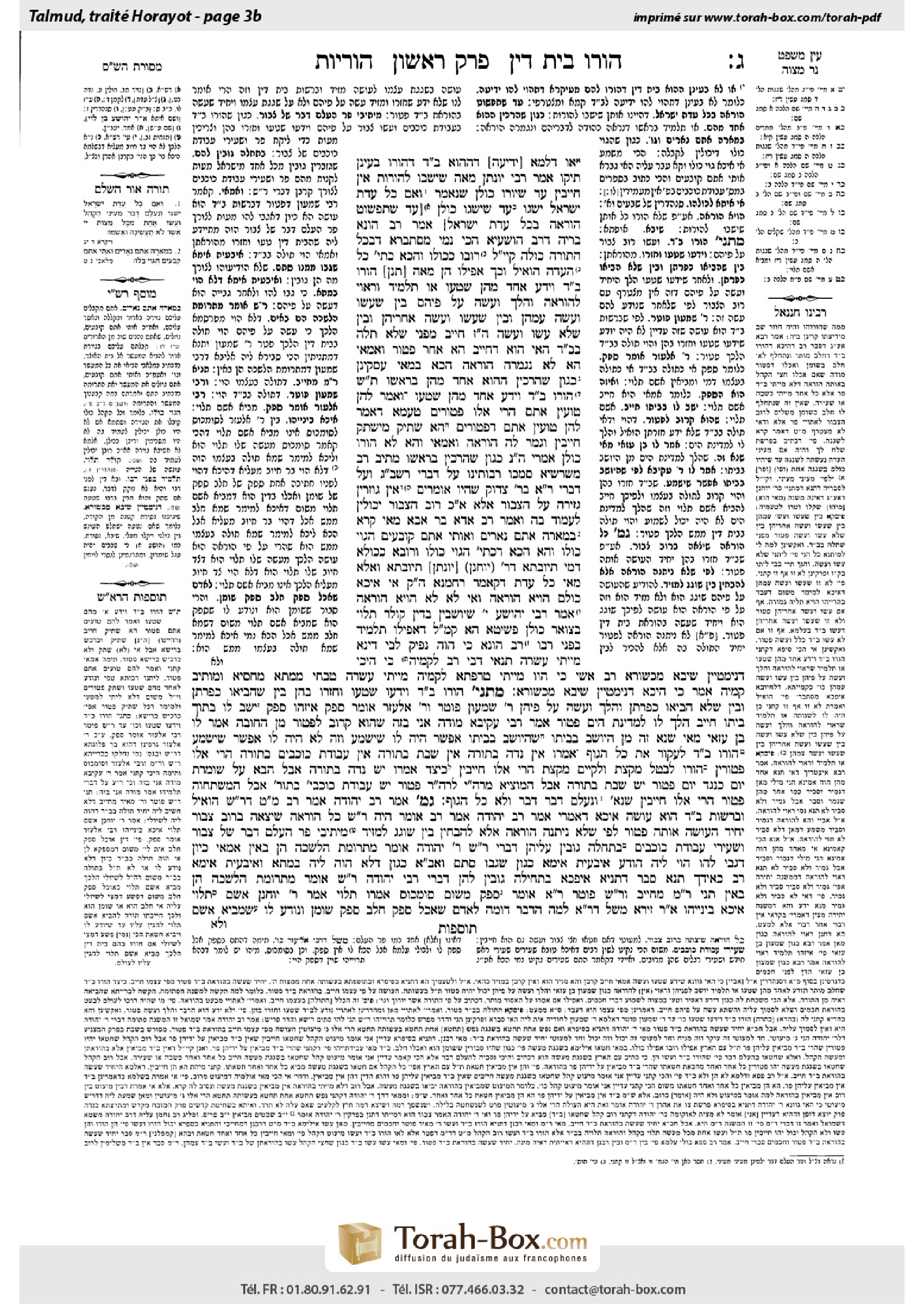
Horayot 3b: Talmud study for Daf Yomi
Study the Talmud for Daf Yomi with scanned pages, Hebrew text, English translations from Sefaria and AI-generated French translations.
Passage selection and English or AI-generated French translation are available where the scan has annotations. Daf Study is independent of Torah-Box and Sefaria.
Browse Horayot · הוריות · All tractatesHorayot 3b text and translations
This page of Horayot includes the Aramaic text, an English translation and an AI-generated French translation, alongside the scan above.
הוריות ג׳ ב · Aramaic and Hebrew text
אוֹ דִּלְמָא [יְדִיעָה] דְּהָהוּא בֵּית דִּין דְּהוֹרוּ בָּעִינַן! תֵּיקוּ.
אָמַר רַבִּי יוֹנָתָן: מֵאָה שֶׁיָּשְׁבוּ לְהוֹרוֹת – אֵין חַיָּיבִין עַד שֶׁיּוֹרוּ כּוּלָּן, שֶׁנֶּאֱמַר: ״וְאִם כׇּל עֲדַת יִשְׂרָאֵל יִשְׁגּוּ״, עַד שֶׁיִּשְׁגּוּ כּוּלָּן [עַד שֶׁתִּפְשׁוֹט הוֹרָאָה בְּכׇל עֲדַת יִשְׂרָאֵל] אָמַר רַב הוּנָא בְּרֵיהּ דְּרַב הוֹשַׁעְיָא: הָכִי נָמֵי מִסְתַּבְּרָא, דִּבְכָל הַתּוֹרָה כּוּלָּהּ קַיְימָא לַן רוּבּוֹ כְּכוּלּוֹ, וְהָכָא כְּתִיב ״כׇּל הָעֵדָה״ – הוֹאִיל וְכָךְ, אֲפִילּוּ הֵן מֵאָה.
[תְּנַן:] הוֹרוּ בֵּית דִּין, וְיָדַע אֶחָד מֵהֶן שֶׁטָּעוּ, אוֹ תַּלְמִיד וְרָאוּי לְהוֹרָאָה, וְהָלַךְ וְעָשָׂה עַל פִּיהֶם, בֵּין שֶׁעָשׂוּ וְעָשָׂה עִמָּהֶן, וּבֵין שֶׁעָשׂוּ וְעָשָׂה אַחֲרֵיהֶן, וּבֵין שֶׁלֹּא עָשׂוּ וְעָשָׂה – הֲרֵי זֶה חַיָּיב, מִפְּנֵי שֶׁלֹּא תָּלָה בְּבֵית דִּין.
הַאי הוּא דְּחַיָּיב, הָא אַחֵר פָּטוּר, וְאַמַּאי? הָא לֹא נִגְמְרָה הוֹרָאָה! הָכָא בְּמַאי עָסְקִינַן? כְּגוֹן שֶׁהִרְכִּין הַהוּא אֶחָד מֵהֶן בְּרֹאשׁוֹ.
תָּא שְׁמַע: הוֹרוּ בֵּית דִּין, וְיָדַע אֶחָד מֵהֶן שֶׁטָּעוּ וְאָמַר לָהֶן ״טוֹעִין אַתֶּם״ – הֲרֵי אֵלּוּ פְּטוּרִים. טַעְמָא דְּאָמַר לָהֶן ״טוֹעִין אַתֶּם״ – דִּפְטוּרִים, הָא שָׁתֵיק מִישְׁתָּק – חַיָּיבִין, וְגָמַר לַהּ הוֹרָאָה, וְאַמַּאי? וְהָא לֹא הוֹרוּ כּוּלָּן! אָמְרִי: הָכִי נָמֵי כְּגוֹן שֶׁהִרְכִּין בְּרֹאשׁוֹ.
מֵתִיב רַב מְשַׁרְשְׁיָא: סָמְכוּ רַבּוֹתֵינוּ עַל דִּבְרֵי רַבָּן שִׁמְעוֹן בֶּן גַּמְלִיאֵל וְעַל דִּבְרֵי רַבִּי אֶלְעָזָר בְּרַבִּי צָדוֹק, שֶׁהָיוּ אוֹמְרִים: אֵין גּוֹזְרִין גְּזֵירָה עַל הַצִּבּוּר אֶלָּא אִם כֵּן רוֹב הַצִּבּוּר יְכוֹלִין לַעֲמוֹד בָּהּ,
וְאָמַר רַב אַדָּא בַּר אַבָּא: מַאי קְרָא? ״בַּמְּאֵרָה אַתֶּם נֵאָרִים וְאֹתִי אַתֶּם קֹבְעִים הַגּוֹי כֻּלּוֹ״. וְהָא הָכָא דִּכְתִיב ״הַגּוֹי כֻּלּוֹ״, וְרוּבָּא כְּכוֹלָּא דָּמֵי, תְּיוּבְתָּא דְּרַבִּי (יוֹחָנָן) [יוֹנָתָן]. תְּיוּבְתָּא.
וְאֶלָּא, מַאי ״כׇּל עֲדַת״ דְּקָאָמַר רַחֲמָנָא? הָכִי קָאָמַר: אִי אִיכָּא כּוּלָּם – הָוְיָא הוֹרָאָה, וְאִי לָא – לָא הָוְיָא הוֹרָאָה.
אָמַר רַבִּי יְהוֹשֻׁעַ: עֲשָׂרָה שֶׁיּוֹשְׁבִין בַּדִּין – קוֹלָר תָּלוּי בְּצַוַּאר כּוּלָּן. פְּשִׁיטָא! הָא קָא מַשְׁמַע לַן דַּאֲפִילּוּ תַּלְמִיד בִּפְנֵי רַבּוֹ.
רַב הוּנָא כִּי הֲוָה נָפֵיק לְבֵי דִינָא, מַיְיתִי עֲשָׂרָה תַּנָּאֵי דְבֵי רַב לְקַמֵּיהּ, כִּי הֵיכִי דְּנִימְטְיַין שִׁיבָּא מִכְּשׁוּרָא. רַב אָשֵׁי כִּי הֲווֹ מַיְיתִי טְרֵפְתָּא לְקַמֵּיהּ, מַיְיתֵי עֲשָׂרָה טַבָּחֵי מִמָּתָא מַחְסֵיָא וּמוֹתֵיב קַמֵּיהּ, אָמַר: כִּי הֵיכָא דְּנִימְטְיַין שִׁיבָּא מִכְּשׁוּרָא.
מַתְנִי׳ הוֹרוּ בֵּית דִּין וְיָדְעוּ שֶׁטָּעוּ וְחָזְרוּ בָּהֶן, בֵּין שֶׁהֵבִיאוּ כַּפָּרָתָן וּבֵין שֶׁלֹּא הֵבִיאוּ כַּפָּרָתָן, וְהָלַךְ וְעָשָׂה עַל פִּיהֶן – רַבִּי שִׁמְעוֹן פּוֹטֵר, וְרַבִּי אֶלְעָזָר אוֹמֵר: סָפֵק. אֵיזֶהוּ סָפֵק? יָשַׁב לוֹ בְּתוֹךְ בֵּיתוֹ – חַיָּיב, הָלַךְ לוֹ לִמְדִינַת הַיָּם – פָּטוּר.
אָמַר רַבִּי עֲקִיבָא: מוֹדֶה אֲנִי בָּזֶה שֶׁהוּא קָרוֹב לִפְטוּר מִן הַחוֹבָה. אָמַר לוֹ בֶּן עַזַּאי: מַאי שְׁנָא זֶה מִן הַיּוֹשֵׁב בְּבֵיתוֹ? שֶׁהַיּוֹשֵׁב בְּבֵיתוֹ אֶפְשָׁר הָיָה לוֹ שֶׁיִּשְׁמַע, וְזֶה לֹא הָיָה לוֹ אֶפְשָׁר שֶׁיִּשְׁמַע.
הוֹרוּ בֵּית דִּין לַעֲקוֹר אֶת כָּל הַגּוּף, אָמְרוּ: אֵין נִדָּה בַּתּוֹרָה, אֵין שַׁבָּת בַּתּוֹרָה, אֵין עֲבוֹדָה זָרָה בַּתּוֹרָה – הֲרֵי אֵלּוּ פְּטוּרִין. הוֹרוּ לְבַטֵּל מִקְצָת וּלְקַיֵּים מִקְצָת – הֲרֵי אֵלּוּ חַיָּיבִין.
כֵּיצַד? אָמְרוּ: יֵשׁ נִדָּה בַּתּוֹרָה, אֲבָל הַבָּא עַל שׁוֹמֶרֶת יוֹם כְּנֶגֶד יוֹם – פָּטוּר,
יֵשׁ שַׁבָּת בַּתּוֹרָה, אֲבָל הַמּוֹצִיא מֵרְשׁוּת הַיָּחִיד לִרְשׁוּת הָרַבִּים – פָּטוּר,
יֵשׁ עֲבוֹדָה זָרָה בַּתּוֹרָה, אֲבָל הַמִּשְׁתַּחֲוֶה – פָּטוּר, הֲרֵי אֵלּוּ חַיָּיבִין, שֶׁנֶּאֱמַר: ״וְנֶעֱלַם דָּבָר״ – דָּבָר, וְלֹא כָּל הַגּוּף.
גְּמָ׳ אָמַר רַב יְהוּדָה אָמַר רַב: מַאי טַעְמָא דְּרַבִּי שִׁמְעוֹן? הוֹאִיל וּבִרְשׁוּת בֵּית דִּין הוּא עוֹשֶׂה. אִיכָּא דְּאָמְרִי: אָמַר רַב יְהוּדָה אָמַר רַב, אוֹמֵר הָיָה רַבִּי שִׁמְעוֹן: כׇּל הוֹרָאָה שֶׁיָּצְאָה בְּרוֹב צִבּוּר – יָחִיד הָעוֹשֶׂה אוֹתָהּ פָּטוּר, לְפִי שֶׁלֹּא נִיתְּנָה הוֹרָאָה אֶלָּא לְהַבְחִין בֵּין שׁוֹגֵג לְמֵזִיד.
מֵיתִיבִי: פַּר הֶעְלֵם דָּבָר שֶׁל צִבּוּר וּשְׂעִירֵי עֲבוֹדָה זָרָה – בַּתְּחִלָּה גּוֹבִין עֲלֵיהֶן, דִּבְרֵי רַבִּי שִׁמְעוֹן. רַבִּי יְהוּדָה אוֹמֵר: מִתְּרוּמַת הַלִּשְׁכָּה הֵן בָּאִין. אַמַּאי, כֵּיוָן דְּגָבֵי לְהוּ, הָוֵי לֵיהּ ״הוֹדַע״!
אִיבָּעֵית אֵימָא: כְּגוֹן שֶׁגָּבוּ סְתָם.
וְאִיבָּעֵית אֵימָא: כְּגוֹן דְּלָא הֲוָה לֵיהּ בְּמָתָא.
וְאִיבָּעֵית אֵימָא: רַב כְּאִידַּךְ תַּנָּא סָבַר, דְּתַנְיָא אִיפְּכָא: בַּתְּחִילָּה גּוֹבִין לָהֶן, דִּבְרֵי רַבִּי יְהוּדָה. רַבִּי שִׁמְעוֹן אוֹמֵר: מִתְּרוּמַת הַלִּשְׁכָּה הֵן בָּאִין.
תָּנֵי: רַבִּי מֵאִיר מְחַיֵּיב, וְרַבִּי שִׁמְעוֹן פּוֹטֵר, רַבִּי אֶלְעָזָר אוֹמֵר: סָפֵק, מִשּׁוּם סוֹמְכוֹס אָמְרוּ: תָּלוּי. אָמַר רַבִּי יוֹחָנָן: אָשָׁם תָּלוּי אִיכָּא בֵּינַיְיהוּ.
אָמַר רַבִּי זֵירָא: מָשָׁל דְּרַבִּי אֶלְעָזָר לָמָּה הַדָּבָר דּוֹמֶה? לְאָדָם שֶׁאָכַל סָפֵק חֵלֶב סָפֵק שׁוּמָּן, וְנוֹדַע לוֹ, שֶׁמֵּבִיא אָשָׁם.
Horayot 3b · English translation
Or perhaps, for liability we require the awareness of the same court that issued the ruling, and that court no longer exists. The Gemara concludes: The dilemma shall stand unresolved.
§ Rabbi Yonatan says: Even in the case of one hundred judges who convened to issue a ruling and erred, they are not liable to bring an offering unless they all issue that ruling, as it is stated with regard to liability to bring the offering: “And if the entire assembly of Israel shall act unwittingly” (Leviticus 4:13). From the term “entire” it is derived that the judges are not liable until they all act unwittingly, and the ruling must disseminate and be adopted throughout the entire assembly of Israel, i.e., the Sanhedrin. Rav Huna, son of Rav Hoshaya, said: So too it is reasonable to conclude this, as throughout the entire Torah we maintain the principle: The legal status of the majority of an entity is considered like all of that entity, and here: “The entire assembly,” is written. Since it is so, a majority does not suffice. Even if they are one hundred judges, they are liable only if the erroneous ruling was unanimous.
We learned in the mishna: If the court issued that ruling, and one of the judges knew that they erred, despite the fact that the majority ruled against his opinion, or if he was a student and was qualified to issue halakhic rulings, and that judge or student proceeded and performed that transgression on the basis of the court’s ruling, then whether the judges performed the transgression and he performed it with them, or whether the judges performed the transgression and he performed it after them, or whether the judges did not perform the transgression and he performed it alone, in all these cases the judge or the student is liable to bring an offering. This is due to the fact that he did not associate his action with the ruling of the court.
The Gemara notes that one may infer: It is this judge or student who is liable, but another who acts on the basis of the ruling of the court is exempt. But why would he be exempt? The ruling is not completed if it is not unanimous. The Gemara answers: What are we dealing with here? We are dealing with a case where the one dissenting judge among them bowed his head and indicated his agreement with the remaining judges.
The Gemara suggests: Come and hear proof from a mishna (4b): If the court issued a ruling, and one of the judges knew that they erred and he said to them: You are mistaken, they are exempt. One may infer: The reason that they are exempt is that the judge said to them: You are mistaken. But if he was silent, they are liable, and the ruling is complete. And why, according to Rabbi Yonatan, would they be liable? But isn’t it so that not all of them issued the same ruling? The Sages say in response: So too here, it is a case where the dissenting judge bowed his head.
Rav Mesharshiyya raises an objection to the statement of Rabbi Yonatan from a baraita: Our Sages relied on the statement of Rabban Shimon ben Gamliel and on the statement of Rabbi Elazar, son of Rabbi Tzadok, who would say: One does not issue a decree upon the congregation unless the majority of the congregation is able to withstand it.
And Rav Adda bar Abba said: What is the verse from which this principle is derived? It is derived from the verse: “With the curse you are cursed, yet you rob Me, the entire nation” (Malachi 3:9). The verse is referring to the oath taken by the entire people to observe the halakhot of tithes, and they violated those halakhot. But here it is written: “The entire nation,” and yet, Rabban Shimon ben Gamliel and Rabbi Elazar, son of Rabbi Tzadok, relied on this verse to derive that the legal status of the majority of an entity is like that of the entire entity, and therefore if a majority of the congregation can withstand the decree the court may issue it. The Gemara concludes: The refutation of the opinion of Rabbi Yonatan is indeed a conclusive refutation.
The Gemara asks: Rather, now that Rabbi Yonatan’s opinion has been refuted, what is derived from the phrase “the entire assembly” that the Merciful One states? This is what it is saying: If there are all the judges present and they issue that ruling based on the majority, it is a ruling, and if not, it is not a ruling.
With regard to a court session Rabbi Yehoshua says: When there are ten judges who sit in judgment, the chain [kolar] placed around the neck of the person taken to his punishment is suspended around the neck of all of them, i.e., they are all responsible for the decision. The Gemara asks: Isn’t this obvious? The Gemara answers: This teaches us that even a student before his teacher may not be silent in deference to his teacher, as he bears responsibility for an erroneous ruling.
The Gemara relates: Rav Huna, when he would go out to the court to sit in judgment, would bring ten tanna’im, i.e., people who recited mishnayot and baraitot in the study hall, to sit before him and serve as partners in judgment with him. He said: I do this so that we will each receive a splinter from the beam, i.e., each of us will bear only a small part of the responsibility. The Gemara relates on a similar note: Rav Ashi, when they would bring a slaughtered animal before him to determine whether or not it was a tereifa, would bring ten slaughterers from Mata Meḥasya and sit them before him while rendering his decision. He said: I do this so that we will each receive a splinter from the beam.
MISHNA: In a case where the judges of the court issued an erroneous ruling and they discovered that they erred and reversed their decision, whether they brought their atonement offering for their erroneous ruling or whether they did not bring their atonement offering, and an individual who was unaware of the new ruling proceeded and performed a transgression on the basis of their first ruling, Rabbi Shimon deems him exempt from bringing an offering, and Rabbi Elazar says: There is uncertainty with regard to his status and he is liable to bring a provisional guilt-offering. Which is the case of uncertainty for which one is liable to bring a provisional guilt-offering? If one sat inside his house and performed the transgression he is liable to bring a provisional guilt-offering, as he could have learned of the change in the court’s ruling. If he went to a country overseas and is relying on the initial ruling, he is exempt.
Rabbi Akiva said: I concede in that case of one who went overseas that he is closer to exemption than he is to liability. Ben Azzai said to him: In what way is this person who went overseas different from one who sits in his house? Rabbi Akiva said to him: The difference is that with regard to one who sits in his house it would have been possible for him to hear of the court’s reversal, but with regard to that person who went overseas, it would not have been possible for him to hear of the court’s reversal.
The mishna explains for which type of unwitting transgression based on the ruling of the court there is liability to bring an offering. In a case where the judges of the court issued an erroneous ruling to abolish the entire essence of a mitzva, not only a detail thereof, e.g., they said: There is no prohibition against engaging in intercourse with a menstruating woman written in the Torah, or there is no prohibition against performing prohibited labor on Shabbat written in the Torah, or there is no prohibition against engaging in idol worship written in the Torah, these judges are exempt, as this is an error based on ignorance, not an erroneous ruling. If the judges issued a ruling to nullify part of a mitzva and to sustain part of that mitzva, these judges are liable.
How so? An example of this is if the judges said: There is a prohibition against engaging in intercourse with a menstruating woman written in the Torah, but one who engages in intercourse with a woman who observes a clean day for a day she experiences a discharge is exempt. When the woman sees a discharge of blood for one or two days during the eleven days between the end of one menstrual period and the expected start of another, the blood is assumed to not be menstrual blood. If after the second day, the next day passes without any discharge of blood, she may immerse immediately and she is ritually pure. The judges ruled erroneously that it is permitted to engage in intercourse with her on the day that she is observing a clean day, even without the day having passed and her having immersed.
Another example is if they said: There is a prohibition against performing prohibited labor on Shabbat written in the Torah, but one who carries out objects from the private domain to the public domain is exempt.
Another example is if they said: There is a prohibition against engaging in idol worship written in the Torah, but one who bows to the idol but does not sacrifice an offering is exempt. In all of these cases, these judges are liable, as it is stated: “And the matter is hidden” (Leviticus 4:13), from which it is derived that there is liability only if a matter, a single detail, is hidden, but not if the entire essence of a mitzva is hidden.
GEMARA: The mishna teaches that Rabbi Shimon deems exempt one who performed a transgression on the basis of the initial ruling of the court even though the court reversed its ruling. Rav Yehuda said that Rav said: What is the reason for the statement of Rabbi Shimon? The reason is since it is with the permission of the court that he performs the transgression, he is exempt. Some say there is a different version of the statement cited by Rav Yehuda: Rav Yehuda said that Rav said: Rabbi Shimon would say: Concerning any ruling that disseminated to the majority of the congregation, even if the court later reversed that decision, an individual who performs a transgression based on the first ruling is exempt, because a ruling is given only to distinguish between unwitting and intentional acts. One who performs an action on the basis of that ruling is unwitting, as he associated his action with the court, and he is unaware that the court reversed its decision.
The Gemara raises an objection from a baraita: For a bull brought for an unwitting communal sin, and for goats brought for the unwitting violation of the prohibition of idol worship, the Temple treasury collects money from the congregation to pay for the offerings from the outset, i.e., a collection undertaken specifically for that offering; this is the statement of Rabbi Shimon. Rabbi Yehuda says: The money for purchasing these offerings comes from the funds of the collection of the Temple treasury chamber, just like the money for purchasing all other communal offerings. According to Rabbi Shimon, why is this person exempt? Since they collect money specifically for each of these communal sin-offerings, the transgression is for him one that became known, as he presumably heard about the collection, and he should be liable because he is aware of the reversal in the court’s ruling.
The Gemara answers: If you wish, say that the reference in the mishna is to a case where they collected the money without specification. Therefore, he was unaware of the reversal of the court’s ruling.
And if you wish, say instead that the reference in the mishna is to a case where the person was not in the city. Therefore, he was unaware of the collection of the funds and unaware of the reversal of the ruling of the court.
And if you wish, say instead that Rav holds in accordance with the opinion of the other tanna who cited the dispute between Rabbi Shimon and Rabbi Yehuda, as it is taught in a baraita with the attribution of the opinions reversed: The Temple treasury collects money from the congregation to pay for the offerings from the outset; this is the statement of Rabbi Yehuda. Rabbi Shimon says: The money for purchasing these offerings comes from the funds of the collection of the Temple treasury chamber. According to Rabbi Shimon’s opinion in this baraita, it is possible that the transgressor remained unaware that the court reversed its decision.
Apropos this topic, it is taught in a baraita: If an individual performed a transgression on the basis of the original ruling of the court after the court reversed its ruling, Rabbi Meir deems him liable to bring a sin-offering and Rabbi Shimon deems him exempt. Rabbi Elazar says: There is uncertainty with regard to his status. In the name of Sumakhos, the Sages said: His status is suspended and remains uncertain. Rabbi Yoḥanan said: It is with regard to a provisional guilt-offering that there is a practical difference between the opinion of Rabbi Elazar and the opinion of Sumakhos. According to Rabbi Elazar, he is liable to bring a provisional guilt-offering, whereas according to Sumakhos the question of his liability is suspended, and he does not bring a provisional guilt-offering.
Rabbi Zeira says: There is an analogy to illustrate the opinion of Rabbi Elazar. To what is this matter comparable? It is comparable to a person who ate a piece of fat with regard to which there is uncertainty whether it is forbidden fat and uncertainty whether it is permitted fat, and he thought that he was eating permitted fat. And he later became aware that there is uncertainty whether he unwittingly ate fat for which one is liable to receive karet if he ate it intentionally, as in this case he is liable to bring a provisional guilt-offering. In the case in the baraita too, when he later discovered that the court reversed its ruling, it is like one who is uncertain whether he associated his action with the court or associated his action with himself.
Horayot 3b · Traduction française (IA)
Peut-être que pour la responsabilité, nous exigeons la connaissance du même tribunal qui a rendu le verdict, et que ce tribunal n’existe plus. La Guemara conclut : Ce dilemme restera sans solution.
§ Rabbi Yonatan dit : Même dans le cas de cent juges qui se sont réunis pour rendre un verdict et ont commis une erreur, ils ne sont pas tenus de présenter un sacrifice à moins qu'ils aient tous rendu ce même verdict, comme il est dit concernant la responsabilité à présenter le sacrifice : « Et si l'ensemble de l'assemblée d'Israël agit de manière inconsciente » (Lévitique 4:13). Du terme « ensemble », on déduit que les juges ne sont pas tenus jusqu'à ce qu'ils agissent tous de manière inconsciente, et que le verdict doit être diffusé et adopté par l'ensemble de l'assemblée d'Israël, c'est-à-dire le Sanhédrin. Rav Huna, fils de Rav Hoshaya, dit : De même, il est raisonnable de conclure cela, car tout au long de la Torah, nous maintenons le principe : le statut juridique de la majorité d'un groupe est considéré comme celui de l'ensemble du groupe, et ici : « l'ensemble de l'assemblée », est écrit. Puisque c'est ainsi, une majorité ne suffit pas. Même s'ils sont cent juges, ils sont tenus seulement si le verdict erroné était unanime.
Nous avons appris dans la michna : Si le tribunal a rendu ce verdict, et qu'un des juges savait qu'ils avaient commis une erreur, malgré le fait que la majorité ait voté contre son avis, ou s'il était un étudiant et était qualifié de rendre des décisions halakhiques, et que ce juge ou cet étudiant ait procédé à cette transgression sur la base du verdict du tribunal, alors que les juges aient accompli la transgression et qu'il l'ait accomplie avec eux, ou que les juges aient accompli la transgression et qu'il l'ait accomplie après eux, ou que les juges n'aient pas accompli la transgression et qu'il l'ait accomplie seul, dans tous ces cas, le juge ou l'étudiant est tenu de présenter un sacrifice. Cela est dû au fait qu'il n'a pas associé son action au verdict du tribunal.
La Guemara note que l'on peut en déduire : c'est ce juge ou cet étudiant qui est responsable, mais un autre qui agit sur la base du verdict du tribunal est exempt. Mais pourquoi serait-il exempt ? Le verdict n'est pas complet s'il n'est pas unanime. La Guemara répond : De quoi s'agit-il ici ? Nous parlons d'un cas où le juge dissident parmi eux a baissé la tête et a indiqué son accord avec les autres juges.
La Guemara suggère : Viens écouter la preuve d'une michna (4b) : Si le tribunal a rendu un verdict, et qu'un des juges savait qu'ils avaient commis une erreur et qu'il a dit à ceux-ci : Vous avez tort, ils sont exempt. On peut en déduire : la raison pour laquelle ils sont exempt est que le juge a dit à ceux-ci : Vous avez tort. Mais si il avait gardé le silence, ils seraient responsables, et le verdict serait complet. Et pourquoi, selon Rabbi Yonatan, seraient-ils responsables ? Mais n'est-ce pas ainsi que tous n'ont pas rendu le même verdict ? Les Sages répondent : De même, ici, c'est un cas où le juge dissident a baissé la tête.
Rav Mesharshiyya émet une objection contre l'opinion de Rabbi Yonatan à partir d'une baraïta : Nos Sages ont suivi l'opinion de Rabban Shimon ben Gamliel et de Rabbi Elazar, fils de Rabbi Tzadok, qui disaient : On ne prend pas une décision sur la communauté à moins que la majorité de la communauté puisse la supporter.
Et Rav Adda bar Abba dit : De quel verset ce principe est-il dérivé ? Il est dérivé du verset : « Avec la malédiction tu es maudit, et pourtant tu me vole, l'ensemble du peuple » (Malachie 3:9). Ce verset fait référence à l'œuf pris par l'ensemble du peuple pour observer les halakhot des dîmes, et ils ont violé ces halakhot. Mais ici il est écrit : « l'ensemble du peuple », et pourtant, Rabban Shimon ben Gamliel et Rabbi Elazar, fils de Rabbi Tzadok, ont utilisé ce verset pour déduire que le statut juridique de la majorité d'un groupe est comme celui de l'ensemble du groupe, et donc si la majorité de la communauté peut supporter le décret, le tribunal peut le rendre. La Guemara conclut : La réfutation de l'opinion de Rabbi Yonatan est effectivement une réfutation concluante.
La Guemara pose la question : Plutôt, maintenant que l'opinion de Rabbi Yonatan a été réfutée, de quoi est-on déduit à partir du terme « l'ensemble de l'assemblée » que l'Éternel dit ? C'est ce que cela signifie : si tous les juges sont présents et qu'ils rendent ce verdict sur la majorité, c'est un verdict, et si non, ce n'en est pas un.
Concernant une session de tribunal, Rabbi Yéhoshua dit : Lorsqu'il y a dix juges qui siègent en jugement, la chaîne [kolar] placée autour du cou de la personne conduite à sa punition est suspendue autour du cou de tous, c'est-à-dire qu'ils sont tous responsables de la décision. La Guemara pose la question : N'est-ce pas évident ? La Guemara répond : cela nous apprend que même un étudiant devant son maître ne peut pas garder le silence par respect pour son maître, car il porte la responsabilité d'un verdict erroné.
La Guemara rapporte : Rav Huna, lorsqu'il allait au tribunal pour siéger en jugement, apportait dix tannaïm, c'est-à-dire des personnes qui récitaient des michnayot et des baraitot dans la salle de study, pour siéger devant lui et agir en tant que partenaires dans le jugement. Il disait : Je fais cela afin que nous recevions chacun un fragment de la poutre, c'est-à-dire que chacun de nous porterait seulement une petite part de la responsabilité. La Guemara rapporte également : Rav Ashi, lorsqu'on lui apportait un animal sacrifié pour déterminer s'il était téréif, apportait dix bouchers de Mata Meḥasya et les faisait siéger devant lui pendant qu'il rendait son verdict. Il disait : Je fais cela afin que nous recevions chacun un fragment de la poutre.
MICHNA : Dans un cas où les juges du tribunal ont rendu un verdict erroné et qu'ils ont découvert qu'ils avaient commis une erreur et ont annulé leur décision, qu'ils aient offert un sacrifice d'expiation pour leur verdict erroné ou non, et qu'un individu ignorant de la nouvelle décision ait agi en violation de la loi en se basant sur leur première décision, le Rabbi Shimon considère qu'il est exempt d'offrir un sacrifice, tandis que le Rabbi Elazar dit : Il y a une incertitude concernant son statut et il est tenu de présenter un sacrifice de culpabilité provisoire. Quel cas d'incertitude justifie la présentation d'un sacrifice de culpabilité provisoire ? Si l'individu s'est trouvé à l'intérieur de sa maison et a commis la transgression, il est tenu de présenter un sacrifice de culpabilité provisoire, car il aurait pu apprendre du changement dans la décision du tribunal. Si il est parti dans un pays éloigné et s'appuie sur la première décision, il est exempt.
Le Rabbi Akiva a dit : Je reconnais que dans le cas d'une personne qui est parti dans un pays éloigné, il est plus proche d'être exempt qu'il ne l'est de l'être. Ben Azzai a dit à lui : De quelle manière cette personne qui est parti dans un pays éloigné diffère-t-elle de celle qui est assise dans sa maison ? Le Rabbi Akiva a répondu à lui : La différence est que, concernant celui qui est assis dans sa maison, il aurait pu entendre de la décision du tribunal, tandis que concernant cette personne qui est parti dans un pays éloigné, il n'aurait pas pu entendre de la décision du tribunal.
La mitsva explique pour quel type de transgression involontaire, basée sur la décision du tribunal, il y a obligation de présenter un sacrifice. Dans un cas où les juges du tribunal ont rendu une décision erronée pour annuler l'essence entière d'une mitsva, pas seulement un détail de celle-ci, par exemple, ils ont dit : Il n'y a pas de prohibition contre l'acte sexuel avec une femme en période de ménstruation écrite dans la Torah, ou il n'y a pas de prohibition contre l'accomplissement de travaux interdits le sabbat écrite dans la Torah, ou il n'y a pas de prohibition contre l'adoration d'idoles écrite dans la Torah, ces juges sont exemptés, car cette erreur est basée sur l'ignorance, pas sur un verdict erroné. Si les juges ont rendu une décision pour annuler une partie d'une mitsva et pour maintenir une autre partie de celle-ci, ces juges sont tenus.
Comment cela ? Un exemple de cela est si les juges ont dit : Il y a une prohibition contre l'acte sexuel avec une femme en période de ménstruation écrite dans la Torah, mais celui qui engage en acte sexuel avec une femme qui observe un jour propre pour un jour où elle a une décharge est exempt. Lorsque la femme voit une décharge de sang pendant un ou deux jours pendant les onze jours entre la fin d'une période menstruelle et le début prévu d'une autre, le sang est considéré comme non menstruel. Si après le deuxième jour, le jour suivant passe sans décharge de sang, elle peut se purifier immédiatement et est considérée comme pure. Les juges ont rendu une décision erronée permettant l'acte sexuel avec elle le jour où elle observe un jour propre, même sans que le jour ne soit passé et qu'elle ne se soit pas purifiée.
Un autre exemple est si ils ont dit : Il y a une prohibition contre l'accomplissement de travaux interdits le sabbat écrite dans la Torah, mais celui qui transporte des objets du domaine privé vers le domaine public est exempt.
Un autre exemple est si ils ont dit : Il y a une prohibition contre l'adoration d'idoles écrite dans la Torah, mais celui qui s'incline devant l'idole mais ne sacrifie pas un holocauste est exempt. Dans tous ces cas, ces juges sont tenus, car il est dit : « Et l'affaire est cachée » (Lévitique 4:13), d'où il est déduit que l'obligation existe uniquement si une affaire, un détail, est caché, mais pas si l'essence entière d'une mitsva est cachée.
GUEMARA : La mitsna enseigne que le Rabbi Shimon considère exempt celui qui a commis une transgression sur la base de la décision initiale du tribunal, même si le tribunal a annulé sa décision. Rav Yehuda a dit que Rav a dit : Quel est le raisonnement du Rabbi Shimon ? Le raisonnement est que, puisque c'est avec l'autorisation du tribunal qu'il commet la transgression, il est exempt. Certains disent qu'il y a une autre version de la déclaration citée par Rav Yehuda : Rav Yehuda a dit que Rav a dit : Le Rabbi Shimon dirait : Concernant toute décision qui s'est répandue auprès de la majorité du peuple, même si le tribunal a ensuite annulé cette décision, un individu qui commet une transgression sur la base de la première décision est exempt, car une décision est donnée uniquement pour distinguer entre les actes involontaires et intentionnels. Celui qui agit sur la base de cette décision est involontaire, car il associe son action au tribunal, et il est ignorant que le tribunal a annulé sa décision.
La Guemara soulève une objection tirée d'une baraïta : Pour un taureau apporté en expiation d'une transgression communautaire involontaire, et pour des boucs apportés en expiation de la violation involontaire de la prohibition d'adoration d'idoles, le trésor du Temple recueille de l'argent de la communauté afin de payer les offrandes dès le début, c'est-à-dire une collecte spécifiquement destinée à cette offrande ; c'est la déclaration du Rabbi Shimon. Le Rabbi Yehuda dit : L'argent nécessaire à l'achat de ces offrandes provient des fonds de la collecte du trésor du Temple, tout comme l'argent nécessaire à l'achat de toutes les autres offrandes communautaires. Selon le Rabbi Shimon, pourquoi cette personne est-elle exemptée ? Parce que l'argent est recueilli spécifiquement pour chaque offrande de ces transgressions communautaires, la transgression est pour lui une qui est devenue connue, car il a probablement entendu parler de la collecte, et il devrait être tenu responsable car il est conscient de l'inversion de la décision du tribunal.
La Guemara répond : Si vous le souhaitez, dites que la référence dans la Michna concerne un cas où l'argent a été recueilli sans spécification. Ainsi, il était ignorant de l'inversion de la décision du tribunal.
Et si vous le souhaitez, dites plutôt que la référence dans la Michna concerne un cas où la personne n'était pas dans la ville. Ainsi, il était ignorant de la collecte de l'argent et de l'inversion de la décision du tribunal.
Et si tu veux, dis plutôt que Rav suit l'opinion du tanna qui a cité le débat entre Rabbi Shimon et Rabbi Yéhuda, comme il est enseigné dans une baraïta avec l'attribution des opinions inversées : Le trésor du Temple recueille de l'argent du peuple pour payer les offrandes dès le début ; c'est l'opinion de Rabbi Yéhuda. Rabbi Shimon dit : L'argent nécessaire pour acheter ces offrandes provient des fonds de la chambre du trésor du Temple. Selon l'opinion de Rabbi Shimon dans cette baraïta, il est possible que le transgresseur ne soit pas encore conscient que la cour a inversé sa décision.
À propos de ce sujet, il est enseigné dans une baraïta : Si un individu a commis une transgression en se basant sur la décision initiale de la cour après que la cour a inversé sa décision, Rabbi Méir considère qu'il est tenu de présenter un sacrifice expiatoire, tandis que Rabbi Shimon considère qu'il est exempt. Rabbi Eléazar dit : Il y a une incertitude concernant son statut. En nom de Sumakhos, les Sages dirent : Son statut est suspendu et reste incertain. Rabbi Yochanan dit : C'est concernant un sacrifice de culpabilité provisoire que le différend pratique entre l'opinion de Rabbi Eléazar et celle de Sumakhos est établi. Selon Rabbi Eléazar, il est tenu de présenter un sacrifice de culpabilité provisoire, tandis que selon Sumakhos, la question de sa responsabilité est suspendue, et il ne présente pas de sacrifice de culpabilité provisoire.
Rabbi Zéira dit : Il existe une analogie pour illustrer l'opinion de Rabbi Eléazar. À quoi cela ressemble-t-il ? Cela ressemble à un homme qui a mangé une portion de graisse, avec incertitude quant à ce qu'elle est interdite et incertitude quant à ce qu'elle est permise, et il pensait qu'il mangeait de la graisse permise. Et plus tard, il a découvert qu'il y avait incertitude quant à ce qu'il avait inconsciemment mangé de la graisse pour laquelle on est tenu de recevoir karet s'il l'avait mangée intentionnellement, comme dans ce cas il est tenu de présenter un sacrifice de culpabilité provisoire. Dans le cas de la baraïta également, lorsqu'il a découvert que la cour avait inversé sa décision, cela ressemble à celui qui est incertain quant à ce qu'il a associé son action à la cour ou à lui-même.
Traduction française générée par IA à partir de l’édition anglaise de Sefaria. Vérifie toujours un passage avec le texte source.
Text from Sefaria: William Davidson Edition - Vocalized Aramaic (CC BY NC); William Davidson Edition - English (CC BY NC).