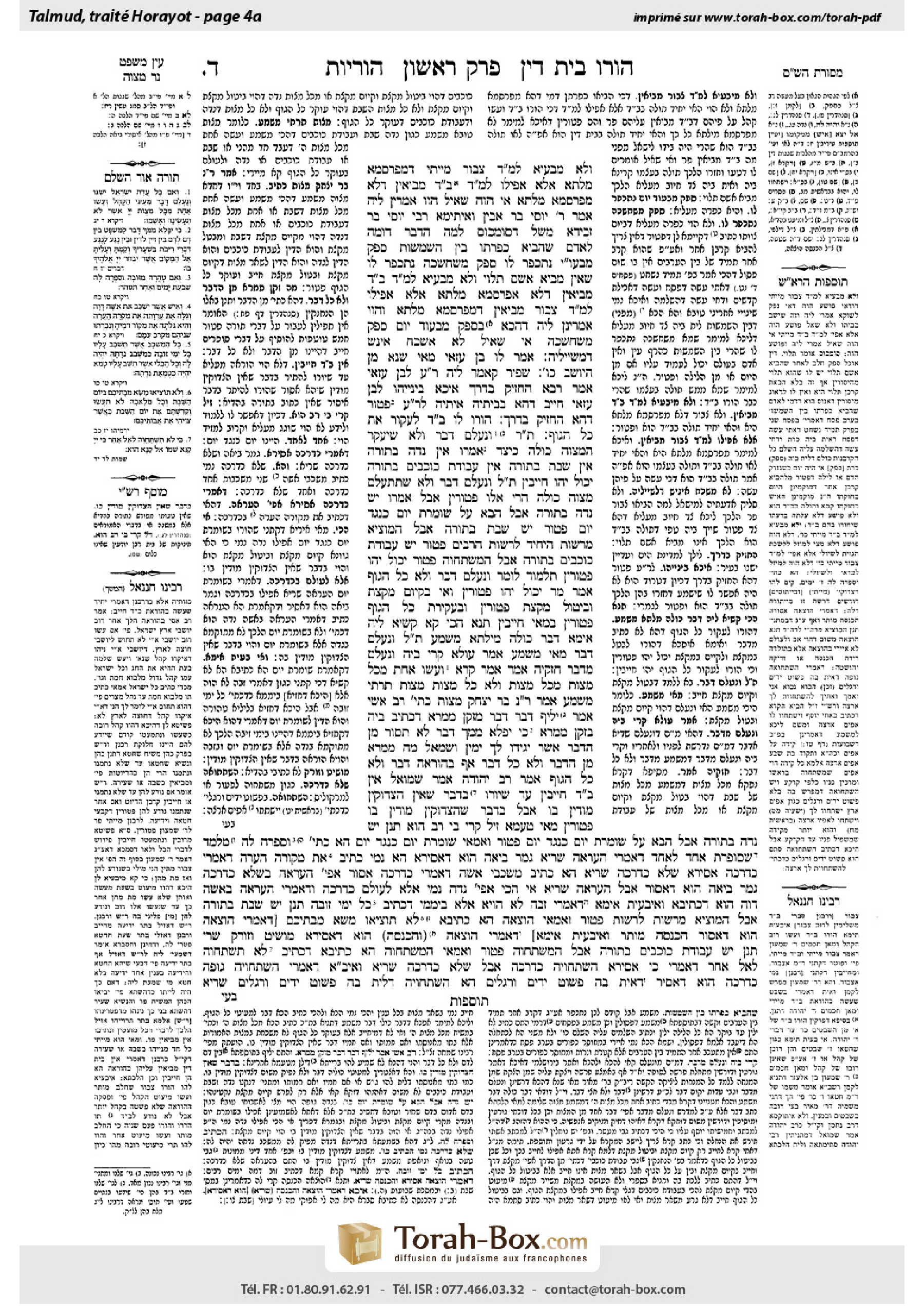
Horayot 4a: Talmud study for Daf Yomi
Study the Talmud for Daf Yomi with scanned pages, Hebrew text, English translations from Sefaria and AI-generated French translations.
Passage selection and English or AI-generated French translation are available where the scan has annotations. Daf Study is independent of Torah-Box and Sefaria.
Browse Horayot · הוריות · All tractatesHorayot 4a text and translations
This page of Horayot includes the Aramaic text, an English translation and an AI-generated French translation, alongside the scan above.
הוריות ד׳ א · Aramaic and Hebrew text
וְלָא מִבַּעְיָא לְמַאן דְּאָמַר צִבּוּר מַיְיתֵי, דִּמְפַרְסְמָא מִלְּתָא. אֶלָּא אֲפִילּוּ לְמַאן דְּאָמַר בֵּית דִּין מְבִיאִין, דְּלָא מְפַרְסְמָא מִלְּתָא – אִי הֲוָה שָׁאֵיל, הֲווֹ אָמְרִין לֵיהּ.
אָמַר רַבִּי יוֹסֵי בַּר אָבִין, וְאִיתֵּימָא רַבִּי יוֹסֵי בַּר זְבִידָא: מָשָׁל דְּסוֹמְכוֹס לְמָה הַדָּבָר דּוֹמֶה? לְאָדָם שֶׁהֵבִיא כַּפָּרָתוֹ בֵּין הַשְּׁמָשׁוֹת, סָפֵק מִבְּעוֹד יוֹם נִתְכַּפֵּר לוֹ, סָפֵק מִשֶּׁחָשֵׁכָה נִתְכַּפֵּר לוֹ, שֶׁאֵין מֵבִיא אָשָׁם תָּלוּי.
וְלָא מִבַּעְיָא לְמַאן דְּאָמַר בֵּית דִּין מְבִיאִין דְּלָא אִפַּרְסְמָא מִלְּתָא, אֶלָּא אֲפִילּוּ לְמַאן דְּאָמַר צִבּוּר מְבִיאִין, דִּמְפַרְסְמָא מִלְּתָא, וַהֲווֹ אָמְרִינַן לֵיהּ, דְּהָכָא בְּסָפֵק מִבְּעוֹד יוֹם סָפֵק מִשֶּׁחָשֵׁכָה, אִי שָׁאֵיל לָא אַשְׁכַּח אִינָשׁ דִּמְשַׁיֵּילֵּיהּ.
אָמַר לוֹ בֶּן עַזַּאי: מַאי שְׁנָא מִן הַיּוֹשֵׁב כּוּ׳. שַׁפִּיר קָאָמַר לֵיהּ רַבִּי עֲקִיבָא לְבֶן עַזַּאי?
אָמַר רָבָא: הֶחְזִיק בַּדֶּרֶךְ אִיכָּא בֵּינַיְיהוּ, לְבֶן עַזַּאי חַיָּיב – דְּהָא בְּבֵיתֵיהּ אִיתֵיהּ, לְרַבִּי עֲקִיבָא פָּטוּר – דְּהָא הֶחְזִיק בַּדֶּרֶךְ.
הוֹרוּ לוֹ בֵּית דִּין לַעֲקוֹר אֶת כָּל הַגּוּף. תָּנוּ רַבָּנַן: ״וְנֶעֱלַם דָּבָר״ – וְלֹא שֶׁיֵּעָקֵר הַמִּצְוָה כּוּלָּהּ. כֵּיצַד? אָמְרוּ: אֵין נִדָּה בַּתּוֹרָה, אֵין שַׁבָּת בַּתּוֹרָה, אֵין עֲבוֹדָה זָרָה בַּתּוֹרָה, יָכוֹל יְהוּ חַיָּיבִין? תַּלְמוּד לוֹמַר: ״וְנֶעֱלַם דָּבָר״ – וְלֹא שֶׁתִּתְעַלֵּם מִצְוָה כּוּלָּהּ. הֲרֵי אֵלּוּ פְּטוּרִין.
אֲבָל אָמְרוּ: יֵשׁ נִדָּה בַּתּוֹרָה אֲבָל הַבָּא עַל שׁוֹמֶרֶת יוֹם כְּנֶגֶד יוֹם פָּטוּר, יֵשׁ שַׁבָּת בַּתּוֹרָה אֲבָל הַמּוֹצִיא מֵרְשׁוּת הַיָּחִיד לִרְשׁוּת הָרַבִּים פָּטוּר, יֵשׁ עֲבוֹדָה זָרָה בַּתּוֹרָה אֲבָל הַמִּשְׁתַּחֲוֶה פָּטוּר – יָכוֹל יְהוּ פְּטוּרִין? תַּלְמוּד לוֹמַר: ״וְנֶעֱלַם דָּבָר״ וְלֹא כָּל הַגּוּף.
אָמַר מָר: יָכוֹל יְהוּ פְּטוּרִין. וְאִי בְּקִיּוּם מִקְצָת וּבִיטּוּל מִקְצָת פְּטוּרִין, וּבַעֲקִירַת כָּל הַגּוּף פְּטוּרִין – בְּמַאי חַיָּיבִין? תַּנָּא הָכִי קָא קַשְׁיָא לֵיהּ, אֵימָא: ״דָּבָר״ כּוּלַּהּ מִילְּתָא מַשְׁמַע! תַּלְמוּד לוֹמַר: ״וְנֶעֱלַם דָּבָר״.
מַאי מַשְׁמַע? אָמַר עוּלָּא: קְרִי בֵּיהּ ״וְנֶעֱלַם מִדָּבָר״.
חִזְקִיָּה אָמַר, אָמַר קְרָא: ״וְעָשׂוּ אַחַת מִכׇּל מִצְוֹת״, ״מִכׇּל מִצְוֹת״ – וְלֹא כׇּל מִצְוֹת. מִצְוֹת תַּרְתֵּי מַשְׁמַע! אָמַר רַב נַחְמָן בַּר יִצְחָק: ״מִצְוַת״ כְּתִיב.
רַב אָשֵׁי אָמַר: יָלֵיף ״דָּבָר״ ״דָּבָר״ מִזָּקֵן מַמְרֵא, דִּכְתִיב בֵּיהּ בְּזָקֵן מַמְרֵא: ״כִּי יִפָּלֵא מִמְּךָ דָבָר... לֹא תָסוּר מִן הַדָּבָר אֲשֶׁר יַגִּידוּ לְךָ יָמִין וּשְׂמֹאל״, מָה מַמְרֵא – ״מִן הַדָּבָר״ וְלֹא כׇּל דָּבָר, אַף בְּהוֹרָאָה – ״דָּבָר״ וְלֹא כָּל הַגּוּף.
אָמַר רַב יְהוּדָה אָמַר שְׁמוּאֵל: אֵין בֵּית דִּין חַיָּיבִין עַד שֶׁיּוֹרוּ בְּדָבָר שֶׁאֵין הַצַּדּוּקִין מוֹדִין בּוֹ. אֲבָל בְּדָבָר שֶׁהַצַּדּוּקִין מוֹדִין בּוֹ – פְּטוּרִין. מַאי טַעְמָא? זִיל קְרִי בֵּי רַב הוּא.
תְּנַן: יֵשׁ נִדָּה בַּתּוֹרָה, אֲבָל הַבָּא עַל שׁוֹמֶרֶת יוֹם כְּנֶגֶד יוֹם פָּטוּר. וְאַמַּאי? שׁוֹמֶרֶת יוֹם כְּנֶגֶד יוֹם, הָא כְּתִיב ״וְסָפְרָה לָּהּ״, מְלַמֵּד שֶׁסּוֹפֶרֶת אֶחָד לְאֶחָד!
דְּאָמְרִי: הַעֲרָאָה שַׁרְיָא, גְּמַר בִּיאָה הוּא דַּאֲסִירָא. הָא נָמֵי כְּתִיב: ״אֶת מְקוֹרָהּ הֶעֱרָה״!
דְּאָמְרִי: כְּדַרְכָּהּ – אֲסִירָא, שֶׁלֹּא כְּדַרְכָּהּ – שַׁרְיָא. הָא כְּתִיב: ״מִשְׁכְּבֵי אִשָּׁה״!
דְּאָמְרִי: כְּדַרְכָּהּ – אָסוּר אֲפִילּוּ הַעֲרָאָה, בְּשֶׁלֹּא כְּדַרְכָּהּ – גְּמַר בִּיאָה הוּא דְּאָסוּר, אֲבָל הַעֲרָאָה שַׁרְיָא. אִי הָכִי, אֲפִילּוּ נִדָּה נָמֵי!
אֶלָּא לְעוֹלָם כְּדַרְכָּהּ, וּדְאָמְרִי: הַעֲרָאָה בְּאִשָּׁה דָּוָה הוּא דִּכְתִיבָא. וְאִיבָּעֵית אֵימָא, דְּאָמְרִי: זָבָה לָא הָוְיָא אֶלָּא בִּימָמֵי, דִּכְתִיב: ״כׇּל יְמֵי זוֹבָהּ״.
תְּנַן: יֵשׁ שַׁבָּת בַּתּוֹרָה, אֲבָל הַמּוֹצִיא מֵרְשׁוּת לִרְשׁוּת פָּטוּר. וְאַמַּאי? הוֹצָאָה הָא כְּתִיבָא: ״לֹא תוֹצִיאוּ מַשָּׂא מִבָּתֵּיכֶם״!
[דְּאָמְרִי הוֹצָאָה הוּא דְּאָסוּר, הַכְנָסָה מוּתָּר. וְאִיבָּעֵית אֵימָא], דְּאָמְרִי: הוֹצָאָה וְהַכְנָסָה הוּא דַּאֲסִירָא, מוֹשִׁיט וְזוֹרֵק שְׁרֵי.
תְּנַן: יֵשׁ עֲבוֹדָה זָרָה בַּתּוֹרָה, אֲבָל הַמִּשְׁתַּחֲוֶה פָּטוּר. וְאַמַּאי? הַמִּשְׁתַּחֲוֶה הָא כְּתִיבָא, דִּכְתִיב: ״לֹא תִשְׁתַּחֲוֶה לְאֵל אַחֵר״!
דְּאָמְרִי: כִּי אֲסִירָא הִשְׁתַּחֲוָיָה כְּדַרְכָּהּ, אֲבָל שֶׁלֹּא כְּדַרְכָּהּ – שַׁרְיָא. וְאִיבָּעֵית אֵימָא, דְּאָמְרִי: הִשְׁתַּחֲוָיָה גּוּפַהּ כְּדַרְכָּהּ הוּא דַּאֲסִיר, דְּאִית בַּהּ פִּשּׁוּט יָדַיִם וְרַגְלַיִם, הָא הִשְׁתַּחֲוָיָה דְּלֵית בַּהּ פִּשּׁוּט יָדַיִם וְרַגְלַיִם – שַׁרְיָא.
Horayot 4a · English translation
And it is not necessary to state this according to the one who said that the congregation brings the offering, as in that case the matter, that the court reversed its ruling, is publicized among the congregation. But even according to the one who said that the court brings the offering, where the matter is not publicized that the court reversed its ruling, if he had asked, they would have told him that the court reversed its ruling. Therefore, it could be said that he associated his action with himself and did not associate it with the court, and he is liable to bring a provisional guilt-offering.
Rabbi Yosei bar Avin, and some say Rabbi Yosei bar Zevida, says: There is an analogy to illustrate the opinion of Sumakhos. To what is this matter comparable? It is comparable to a person who brings his atonement offering during twilight, which is a time when there is uncertainty whether it is day or night, and there is uncertainty whether the offering atoned for him while it is still day, and the atonement was effective, and there is uncertainty whether it atoned for him after nightfall, and the atonement was not effective. The halakha is that he does not bring a provisional guilt-offering. Although typically one is liable to bring a provisional guilt-offering in a case where there is uncertainty whether he performed a transgression for which he is liable to bring a sin-offering, in this case, since the uncertainty relates to twilight, which is an uncertainty that can never be resolved, it is not a typical uncertainty and one is not liable to bring a provisional guilt-offering.
And it is not necessary to state this according to the one who said that the court brings the offering, which is the case when the matter is not publicized that the court reversed its ruling; but it can be stated even according to the one who said that the congregation brings the offering, which is the case when the matter is publicized that the court reversed its ruling, and if he had asked we would have said to him that the court reversed its ruling. This is because here, in a case where there is uncertainty whether it atoned for him while it is still day and there is uncertainty whether it atoned for him after nightfall, if he asks he would not find a person whom he could ask.
§ The mishna teaches that ben Azzai said to Rabbi Akiva: In what way is this person who went overseas different from one who sits in his house? Rabbi Akiva said to him: The difference is that with regard to one who sits in his house it would have been possible for him to hear of the court’s reversal, but with regard to that person who went overseas, it would not have been possible for him to hear of the court’s reversal. The Gemara asks: Rabbi Akiva said well to ben Azzai. How did a scholar of the caliber of ben Azzai fail to understand that distinction?
Rava said: The reference is not to one who already went to a country overseas; rather, it is a case of one who set out on the way but has not yet left his city in which there is a practical difference between them. According to ben Azzai he is liable, as it is in his home city where he is located at this time and there is no difference between him and one who is sitting in his house. According to Rabbi Akiva he is exempt, as he has already set out on his way. Even though he is still in his home city, he is preoccupied with his travels and his status is like one who has already gone overseas.
§ The mishna teaches: In a case where the judges of the court issued an erroneous ruling to abolish the entire essence of the mitzva, that is not a valid ruling, and the court is exempt from bringing an offering. The Sages taught: The verse states: “And the matter is hidden from the eyes of the congregation” (Leviticus 4:13), from which it is derived that there is liability only when a single matter is hidden but not in a case where they will abolish the entire mitzva. How so? If the court said: There is no prohibition against engaging in intercourse with a menstruating woman written in the Torah, or there is no prohibition against performing prohibited labor on Shabbat written in the Torah, or there is no prohibition against engaging in idol worship written in the Torah, one might have thought that the judges would be liable. Therefore, the verse states: “And the matter is hidden,” and not that the entire mitzva will be hidden. Accordingly, if the judges issued that ruling, they are exempt from bringing an offering.
But if the judges said: There is a prohibition against engaging in intercourse with a menstruating woman written in the Torah, but one who engages in intercourse with a woman who observes a clean day for a day she experiences a discharge is exempt; or if they said: There is a prohibition against performing prohibited labor on Shabbat written in the Torah, but one who carries out objects from the private domain to the public domain is exempt; or if they said: There is a prohibition against engaging in idol worship written in the Torah, but one who bows to the idol but did not sacrifice an offering is exempt, one might have thought that the judges would be exempt. Therefore, the verse states: “And the matter is hidden,” from which it is derived that there is liability only for a matter, a single detail, but not for the entire essence. In this case, since they ruled to abolish only a detail of the mitzva, the judges are liable.
The Gemara analyzes the latter clause of the baraita. The Master said: One might have thought that the judges would be exempt. The Gemara asks: But if in a case of sustaining a portion of the mitzva and nullifying a portion of the mitzva the judges are exempt, and in a case of abolishing the entire essence of the mitzva the judges are exempt, as explained in the first clause of the baraita, in what case would they be liable? The Gemara answers: This is what is difficult for the tanna: Say that the term “matter” is referring to the entire matter, and the judges are liable even if they ruled to abolish the entire mitzva. Therefore, the verse states: “And the matter is hidden [venelam davar].”
The Gemara asks: From where is this inferred? Ulla said: Read into the verse as though the letter mem, the last letter in the word venelam, is also appended to the beginning of the word davar, resulting in the phrase: Venelam middavar, meaning: Part of the matter is hidden, from which it is derived that there is liability for nullification of part of the matter, and not for abolishing the entire matter.
Ḥizkiyya said that the verse states: “And they performed one of all the mitzvot” (Leviticus 4:13), from which it is inferred that one is liable for nullification for a portion of all the mitzvot and not for nullification of all the mitzvot. The Gemara asks: The term mitzvot is plural, which indicates at least two. If that is the source, there should be liability even if the judges issue a ruling abolishing the entire essence of one mitzva, as one mitzva is a portion of two mitzvot. Rav Naḥman bar Yitzḥak said: Although the word is vocalized in the plural, as mitzvot, the word mitzvat is written, without a second vav, as though it were in the singular.
Rav Ashi said: The tanna derives a verbal analogy, learning the meaning of the term “matter” written in the context of the erroneous ruling from the term “matter” written in the context of the rebellious elder. As it is written with regard to the rebellious elder: “If there shall be a matter [davar] too hard for you…You shall not turn aside from the matter [haddavar] that they shall declare unto you, to the right nor to the left” (Deuteronomy 17:8–11). Just as one becomes a rebellious elder only when his dispute with the Sages is with regard to a portion of the matter and not an entire matter, so too, with regard to an erroneous ruling of the court, the error of the judges must be with regard to a portion of the matter and not the entire essence of the matter.
§ Rav Yehuda says that Shmuel says: A court is not liable to bring an offering unless it issues an erroneous ruling concerning a matter with which the Sadducees do not agree. The Sadducees do not accept the Oral Torah, and they interpret the Written Torah literally. The court is liable only for a matter that is not explicitly written in the Torah or that does not clearly stem from that which is written in the Torah. But with regard to an erroneous ruling concerning a matter with which the Sadducees agree, the judges are exempt. What is the reasoning for this exemption? It is a topic that you could go learn in a children’s school. Since the matter the judges ruled upon is so obvious, their ruling simply exhibits ignorance, and is not deemed a ruling.
The Gemara cites proof against the statement of Rav Yehuda, citing Shmuel. We learned in the mishna: The judges are liable if they said: There is a prohibition against engaging in intercourse with a menstruating woman written in the Torah, but one who engages in intercourse with a woman who observes a clean day for a day she experiences a discharge is exempt. The Gemara asks: And why should they be liable in that case? The halakha of a woman who observes a day for a day that she experiences a discharge is written in the Torah with regard to a woman who experiences a discharge of blood during the eleven-day interval between menstrual periods: “And she shall count for herself” (Leviticus 15:28); this teaches that she counts one clean day for one day that she experiences a discharge. Since it is written in the Torah, even the Sadducees would agree.
The Gemara answers: The judges did not issue an erroneous ruling with regard to the halakha of a woman who observes a day for a day. Rather, the mishna is discussing a case where they said: The initial stage of intercourse [ha’ara’a] is permitted with a menstruating woman; it is the completion of the act of intercourse that is prohibited. The Gemara asks: That halakha is also written: “He has uncovered [he’era] her fount” (Leviticus 20:18), indicating that the first stage of intercourse with a menstruating woman is also prohibited.
The Gemara says: Rather, it is a case where they said: Intercourse with her in the typical manner is prohibited, but intercourse in an atypical manner, i.e., anal intercourse, is permitted. The Gemara asks: Isn’t it written: “The manners in which one lies with a woman” (Leviticus 18:22), in the plural, indicating that both intercourse in a typical manner and intercourse in an atypical manner are manners in which one lies with a woman?
The Gemara says: Rather, it is a case where they said: With regard to intercourse in a typical manner, even the initial stage of intercourse is forbidden. With regard to intercourse in an atypical manner, it is completion of the act of intercourse that is forbidden, but the initial stage of intercourse is permitted. The Gemara asks: If so, then even in a case where they issued a ruling permitting the initial stage of intercourse in an atypical manner in the case of a menstruating woman, the judges should also be liable. Why does the mishna cite the case specifically with regard to a woman who observes a day for a day?
The Gemara says: Rather, actually, the reference is to a ruling permitting the initial stage of intercourse in a typical manner, and the judges said: In the case of the prohibition of the initial stage of intercourse, it is with regard to an afflicted woman, who experienced the discharge of blood during her menstrual period, that it is written, not with regard to one who experiences the discharge during the eleven days between the end of one menstrual period and the expected start of another. And if you wish, say instead that they said: A woman assumes the status of a zava, i.e., one who experiences a discharge of blood for three consecutive days during those eleven days, only if she experienced the discharge during the day, not at night, as it is written: “All the days of her discharge” (Leviticus 15:26).
The Gemara offers proof against the statement of Rav Yehuda by citing Shmuel. We learned in the mishna: The judges are liable if they said: There is a prohibition against performing prohibited labor on Shabbat written in the Torah, but one who carries out objects from the private domain to the public domain is exempt. The Gemara asks: And why should they be liable in that case? With regard to carrying out into the public domain, isn’t it written: “Neither carry a burden out of your houses on Shabbat” (Jeremiah 17:22), and the Sadducees agree to that prohibition.
The Gemara answers: It is a case where the judges said: It is carrying an object out to the public domain that is prohibited, but carrying an object into the private domain is permitted. And if you wish, say instead that the judges said: It is carrying an object out to the public domain and carrying an object into the private domain that is prohibited. But passing or throwing an object from domain to domain is permitted.
The Gemara cites proof against the statement of Rav Yehuda, citing Shmuel. We learned in the mishna: The judges are liable if they said: There is a prohibition against engaging in idol worship written in the Torah, but one who bows to the idol but did not sacrifice an offering is exempt. The Gemara asks: And why should they be liable in that case? With regard to one who bows to an idol, isn’t it written in the Torah, as it is written: “You shall not bow to another god” (Exodus 34:14)?
The Gemara answers that the reference is to a case where the judges said: When bowing is forbidden is when it represents the typical manner of worship of that idol. But when bowing is not its typical manner of worship, it is permitted. And if you wish, say instead that the reference is to a case where the judges said: With regard to bowing itself, it is when it is performed in its typical manner that it is prohibited. What is the typical manner of bowing? It is bowing that has in its performance extension of the arms and legs, as it was practiced in the Temple. But bowing that does not have in its performance extension of the arms and legs is permitted.
Horayot 4a · Traduction française (IA)
Et ce n'est pas nécessaire de mentionner cela selon celui qui a dit que le tribunal apporte l'offrande, car dans ce cas, la question, que le tribunal a annulé sa décision, est rendue publique auprès de la congrégation. Mais même selon celui qui a dit que le tribunal apporte l'offrande, où la question n'est pas rendue publique que le tribunal a annulé sa décision, s'il avait demandé, ils lui auraient dit que le tribunal a annulé sa décision. Ainsi, on pourrait dire qu'il a associé son action à lui-même et non à la cour, et il est tenu de présenter un sacrifice de culpabilité provisoire.
Rabbi Yosei bar Avin, et certains disent Rabbi Yosei bar Zevida, dit : Il y a une comparaison pour illustrer l'opinion de Sumakhos. À quoi est-ce comparable ? C'est comparable à une personne qui apporte son sacrifice expiatoire à l'heure du crépuscule, moment où il y a incertitude quant à ce qui est jour ou nuit, et où il y a incertitude quant à ce que l'offrande a expié pour lui pendant qu'il faisait encore jour, et l'expiation a été efficace, et incertitude quant à ce que l'offrande a expié pour lui après la nuit, et l'expiation n'a pas été efficace. La halakha est qu'il ne présente pas un sacrifice de culpabilité provisoire. Bien que généralement on soit tenu de présenter un sacrifice de culpabilité provisoire dans un cas où il y a incertitude quant à s'il a commis une transgression pour laquelle il est tenu de présenter un sacrifice expiatoire, dans ce cas-ci, puisque l'incertitude concerne le crépuscule, une incertitude qui ne peut jamais être résolue, ce n'est pas une incertitude typique et on n'est pas tenu de présenter un sacrifice de culpabilité provisoire.
Et ce n'est pas nécessaire de mentionner cela selon celui qui a dit que le tribunal apporte l'offrande, qui est le cas où la question n'est pas rendue publique que le tribunal a annulé sa décision ; mais on peut le mentionner même selon celui qui a dit que la congrégation apporte l'offrande, qui est le cas où la question est rendue publique que le tribunal a annulé sa décision, et s'il avait demandé, on nous aurait dit qu'il a annulé sa décision. Cela est dû au fait que, dans un cas où il y a incertitude quant à ce que l'offrande a expié pour lui pendant qu'il faisait encore jour et incertitude quant à ce que l'offrande a expié pour lui après la nuit, s'il demande, il ne trouvera pas une personne à qui il puisse demander.
§ La mitsva enseigne que ben Azzai a dit à Rabbi Akiva : Dans quel sens ce personnage qui est parti en voyage est-il différent d'une personne qui reste chez elle ? Rabbi Akiva a répondu à lui : La différence est que, concernant la personne qui reste chez elle, il aurait été possible qu'il entende la révocation de la décision du tribunal, mais concernant cette personne qui est partie en voyage, il n'aurait pas été possible qu'il entende la révocation de la décision du tribunal. La Guemara demande : Rabbi Akiva a bien répondu à ben Azzai. Comment un savant de la trempe de ben Azzai n'a-t-il pas compris cette distinction ?
Rava a dit : La référence n'est pas à celui qui est déjà parti dans un pays éloigné ; plutôt, il s'agit d'un cas où l'on est parti en route mais n'a pas encore quitté sa ville où il y a une différence pratique entre eux. Selon ben Azzai, il est tenu, car il est dans sa ville natale où il se trouve actuellement et il n'y a pas de différence entre lui et celui qui reste chez lui. Selon Rabbi Akiva, il est exempt, car il a déjà commencé son voyage. Même s'il est encore dans sa ville natale, il est préoccupé par son voyage et son statut est comme celui qui a déjà quitté le pays.
§ La mitsva enseigne : Dans un cas où les juges du tribunal ont rendu une décision erronée pour annuler l'essence entière de la mitsva, cette décision n'est pas valable, et le tribunal est exempt de présenter un sacrifice. Les Sages ont enseigné : La Paracha dit : « Et la chose est cachée aux yeux de la congrégation » (Lévitique 4:13), d'où on déduit que la responsabilité existe seulement lorsque une seule chose est cachée, mais pas dans un cas où ils annulent toute la mitsva. Comment cela ? Si les juges ont dit : Il n'y a pas de prohibition contre l'intercourse avec une femme en état de ménstruation écrite dans la Torah, ou il n'y a pas de prohibition contre l'accomplissement de travaux interdits le sabbat écrite dans la Torah, ou il n'y a pas de prohibition contre l'adoration d'idolatres écrite dans la Torah, on pourrait penser que les juges seraient responsables. Ainsi, la Paracha dit : « Et la chose est cachée », et non que toute la mitsva sera cachée. Ainsi, si les juges ont rendu cette décision, ils sont exempt de présenter un sacrifice.
Mais si les juges ont dit : Il y a une prohibition contre l'intercourse avec une femme en état de ménstruation écrite dans la Torah, mais celui qui s'interroge avec une femme qui observe un jour propre pour un jour où elle a une décharge est exempt ; ou s'ils ont dit : Il y a une prohibition contre l'accomplissement de travaux interdits le sabbat écrite dans la Torah, mais celui qui transporte des objets du domaine privé au domaine public est exempt ; ou s'ils ont dit : Il y a une prohibition contre l'adoration d'idolatres écrite dans la Torah, mais celui qui s'incline devant l'idole mais n'a pas offert un sacrifice est exempt, on pourrait penser que les juges seraient exemptés. Ainsi, la Paracha dit : « Et la chose est cachée », d'où on déduit que la responsabilité existe seulement pour une chose, un détail, mais pas pour l'essence entière. Dans ce cas, puisqu'ils ont rendu une décision pour annuler seulement un détail de la mitsva, les juges sont responsables.
La Guemara examine la dernière partie de la baraïta. Le Maître a dit : On pourrait penser que les juges seraient exemptés. La Guemara demande : Mais si, dans un cas de maintien d'une partie de la mitsva et d'annulation d'une partie de la mitsva, les juges sont exemptés, et dans un cas d'annulation de l'essence entière de la mitsva, les juges sont exemptés, comme expliqué dans la première partie de la baraïta, dans quel cas seraient-ils responsables ? La Guemara répond : C'est ce qui est difficile pour le tanna : Disons que le terme « chose » fait référence à la chose entière, et les juges sont responsables même s'ils ont rendu une décision pour annuler toute la mitsva. Ainsi, la Paracha dit : « Et la chose est cachée [venelam davar]. »
La Guemara pose la question : D'où cela est-il déduit ? Ulla dit : Lisez la parole comme si la lettre mem, la dernière lettre du mot venelam, était aussi ajoutée au début du mot davar, ce qui donne la phrase : Venelam middavar, ce qui signifie : Une partie de la matière est cachée, d'où l'on déduit qu'il y a responsabilité pour l'annulation d'une partie de la matière, et non pour l'abolition de toute la matière.
Ḥizkiyya dit que la parole stipule : « Et ils ont accompli l'une de toutes les mitsvot » (Lévitique 4:13), d'où l'on déduit qu'on est responsable de l'annulation d'une partie de toutes les mitsvot et non de l'annulation de toute la matière des mitsvot. La Guemara pose la question : Le terme mitsvot est au pluriel, ce qui indique au moins deux. Si c'est la source, il devrait y avoir responsabilité même si les juges rendent un jugement abolissant l'essence entière d'une mitsva, car une mitsva est une partie de deux mitsvot. Rav Naḥman bar Yitzḥak dit : Bien que le mot soit vocalisé au pluriel, comme mitsvot, le mot mitsvat est écrit sans la deuxième vav, comme s'il était au singulier.
Rav Ashi dit : Le tanna tire une analogie verbale, en apprenant le sens du terme « matière » écrit dans le contexte d'un jugement erroné à partir du terme « matière » écrit dans le contexte d'un vieillard rebelle. Comme il est écrit concernant le vieillard rebelle : « Si il y aura une matière [davar] trop difficile pour vous… Vous ne devrez pas détourner de la matière [haddavar] qu'ils vous diront, à droite ni à gauche » (Dt 17:8–11). Tout comme l'on devient un vieillard rebelle uniquement lorsque son conflit avec les Sages est concernant une partie de la matière et non l'entièreté de la matière, de même, concernant un jugement erroné du tribunal, l'erreur des juges doit être concernant une partie de la matière et non l'essence entière de la matière.
§ Rav Yehuda dit que Shmuel dit : Un tribunal n'est pas tenu de présenter un sacrifice à moins qu'il ne rende un jugement erroné concernant une matière avec laquelle les Sadducéens ne s'accordent pas. Les Sadducéens ne reconnaissent pas la Torah orale, et ils interprètent la Torah écrite littéralement. Le tribunal est tenu responsable uniquement d'une matière qui n'est pas explicitement écrite dans la Torah ou qui ne découle pas clairement de ce qui est écrit dans la Torah. Mais concernant un jugement erroné concernant une matière avec laquelle les Sadducéens s'accordent, les juges sont exemptés. Quelle est la raison de cette exemption ? C'est un sujet que l'on pourrait apprendre dans une école pour enfants. Puisque la matière sur laquelle les juges ont rendu leur décision est si évidente, leur décision révèle simplement une ignorance, et n'est pas considérée comme un jugement.
La Guemara cite un argument contre la déclaration de Rav Yehuda, en citant Shmuel. Nous avons appris dans la mishna : Les juges sont responsables s'ils disent : Il y a une interdiction de faire l'acte sexuel avec une femme en période de ménstruation écrite dans la Torah, mais celui qui fait l'acte sexuel avec une femme qui observe un jour propre pour un jour où elle a une décharge est exempt. La Guemara pose la question : Et pourquoi devraient-ils être responsables dans ce cas ? La halakha d'une femme qui observe un jour propre pour un jour où elle a une décharge est écrite dans la Torah concernant une femme qui a une décharge de sang pendant les onze jours entre les menstruations : « Et elle comptera pour elle-même » (Lévitique 15:28) ; cela enseigne qu'elle compte un jour propre pour un jour où elle a une décharge. Puisque cela est écrit dans la Torah, même les Sadducéens y seraient d'accord.
La Guemara répond : Les juges n'ont pas rendu un jugement erroné concernant la halakha d'une femme qui observe un jour propre pour un jour. Plutôt, la mishna parle d'un cas où ils disent : L'initiation de l'acte sexuel [ha'ara'a] est permise avec une femme en période de ménstruation ; c'est la fin de l'acte sexuel qui est interdite. La Guemara pose la question : Cette halakha est aussi écrite : « Il a découvert [he'era] sa source » (Lévitique 20:18), indiquant que l'initiation de l'acte sexuel avec une femme en période de ménstruation est aussi interdite.
La Guemara dit : Plutôt, il s'agit d'un cas où ils disent : L'acte sexuel dans le mode habituel est interdit, mais l'acte sexuel dans un mode atypique, c'est-à-dire l'acte sexuel anal, est permis. La Guemara pose la question : N'est-il pas écrit : « Les manières dans lesquelles l'homme couchant avec une femme » (Lévitique 18:22), au pluriel, indiquant que tant l'acte sexuel dans le mode habituel que l'acte sexuel dans un mode atypique sont des manières dans lesquelles l'homme couchant avec une femme ?
La Guemara dit : Plutôt, il s'agit d'un cas où ils disent : Concernant l'acte sexuel dans le mode habituel, même l'initiation de l'acte sexuel est interdite. Concernant l'acte sexuel dans un mode atypique, c'est la fin de l'acte sexuel qui est interdite, mais l'initiation de l'acte sexuel est permise. La Guemara pose la question : Si c'est ainsi, alors même dans le cas où ils ont rendu un jugement permettant l'initiation de l'acte sexuel dans un mode atypique concernant une femme en période de ménstruation, les juges devraient aussi être responsables. Pourquoi la mishna cite spécifiquement le cas d'une femme qui observe un jour propre pour un jour ?
La Guemara dit : En réalité, la référence est à un jugement permettant l'initiation de l'acte sexuel dans le mode habituel, et les juges disent : Concernant l'interdiction de l'initiation de l'acte sexuel, c'est concernant une femme souffrant d'une maladie, qui a eu une décharge de sang pendant sa période de ménstruation, que cela est écrit, et non concernant celle qui a une décharge pendant les onze jours entre la fin d'une période de ménstruation et le début de la suivante. Et si vous le souhaitez, dites plutôt qu'ils disaient : Une femme acquiert le statut de zava, c'est-à-dire une femme qui a une décharge de sang pendant trois jours consécutifs pendant ces onze jours, uniquement si elle a eu la décharge pendant la journée, pas la nuit, comme il est écrit : « Tous les jours de sa décharge » (Lévitique 15:26).
La Guemara apporte une preuve contre l'affirmation de Rav Yehuda en citant Shmuel. Nous avons appris dans la michna : Les juges sont redevables si ils ont dit : Il y a une interdiction de travailler le sabbat, écrite dans la Torah, mais celui qui transporte des objets du domaine privé vers le domaine public est exempt. La Guemara demande : Et pourquoi devraient-ils être redevables dans ce cas ? En ce qui concerne le transport vers le domaine public, n'est-il pas écrit : « Ni ne portez un fardeau de vos maisons le sabbat » (Jérémie 17:22), et les Sadducéens acceptent cette interdiction ?
La Guemara répond : Il s'agit d'un cas où les juges ont dit : Il est interdit de transporter un objet vers le domaine public, mais le transport d'un objet vers le domaine privé est permis. Et si vous le souhaitez, dites plutôt que les juges ont dit : Il est interdit de transporter un objet vers le domaine public et de transporter un objet vers le domaine privé. Mais le passage ou le lancer d'un objet d'un domaine à l'autre est permis.
La Guemara cite une preuve contre l'affirmation de Rav Yehuda, en citant Shmuel. Nous avons appris dans la michna : Les juges sont redevables si ils ont dit : Il y a une interdiction de pratiquer l'idolâtrie, écrite dans la Torah, mais celui qui s'incline devant l'idole mais n'a pas offert un sacrifice est exempt. La Guemara demande : Et pourquoi devraient-ils être redevables dans ce cas ? En ce qui concerne celui qui s'incline devant un idole, n'est-il pas écrit dans la Torah, comme il est écrit : « Tu ne devras pas te prosterner devant un autre dieu » (Exode 34:14) ?
La Guemara répond que la référence est à un cas où les juges ont dit : Lorsqu'il est interdit de s'incliner, c'est lorsque cela représente la manière typique de culte de cette idole. Mais lorsque l'inclination n'est pas sa manière typique de culte, elle est permise. Et si vous le souhaitez, dites plutôt que la référence est à un cas où les juges ont dit : En ce qui concerne l'inclination elle-même, c'est lorsque cela est pratiqué dans sa manière typique qu'il est interdit. Quelle est la manière typique d'incliner ? C'est l'inclination qui comporte l'étirement des bras et des jambes, comme elle était pratiquée dans le Temple. Mais l'inclination qui ne comporte pas l'étirement des bras et des jambes est permise.
Traduction française générée par IA à partir de l’édition anglaise de Sefaria. Vérifie toujours un passage avec le texte source.
Text from Sefaria: William Davidson Edition - Vocalized Aramaic (CC BY NC); William Davidson Edition - English (CC BY NC).