Horayot 4b: Talmud study for Daf Yomi
Study the Talmud for Daf Yomi with scanned pages, Hebrew text, English translations from Sefaria and AI-generated French translations.
Passage selection and English or AI-generated French translation are available where the scan has annotations. Daf Study is independent of Torah-Box and Sefaria.
Browse Horayot · הוריות · All tractatesHorayot 4b text and translations
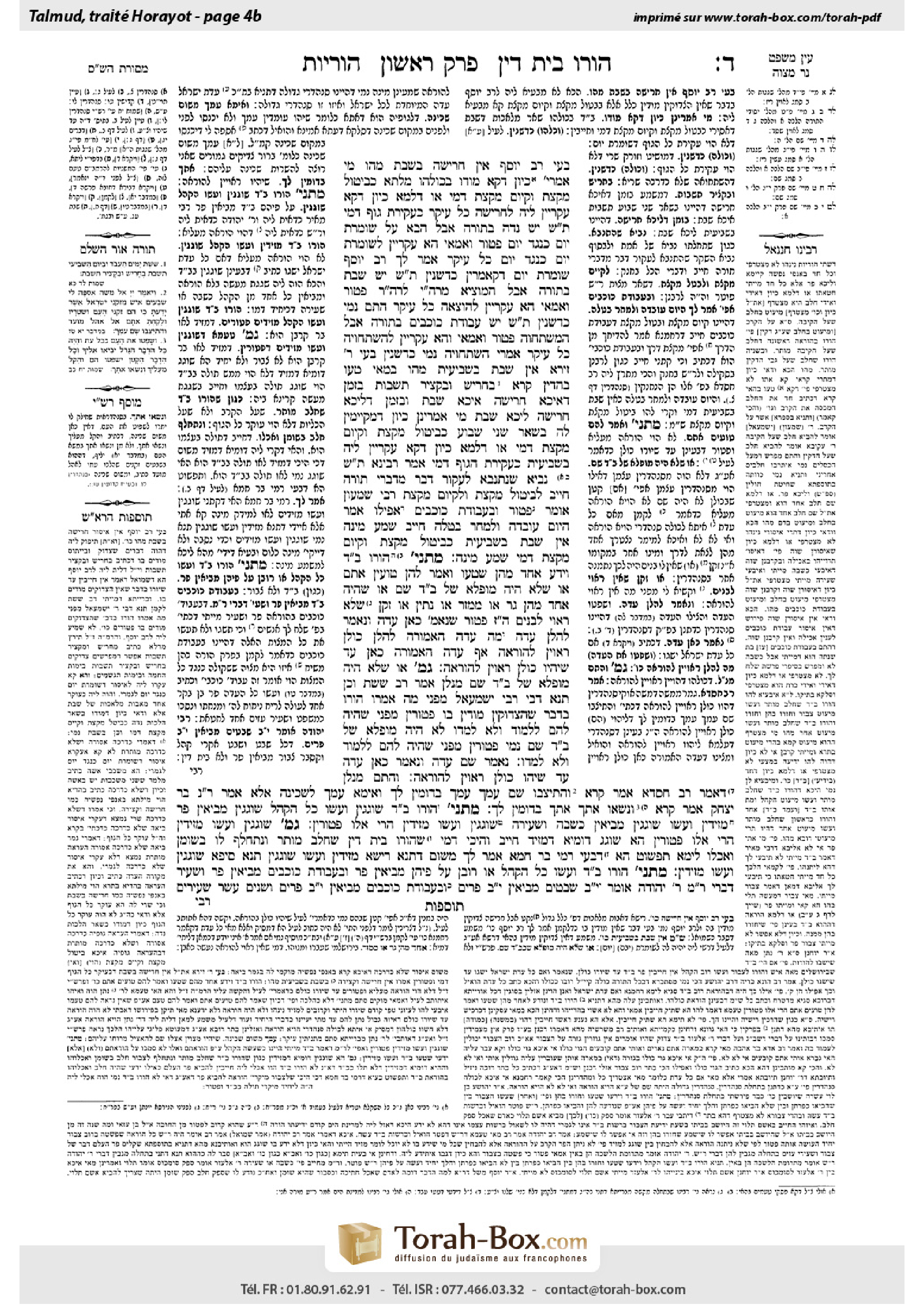
This page of Horayot includes the Aramaic text, an English translation and an AI-generated French translation, alongside the scan above.
הוריות ד׳ ב · Aramaic and Hebrew text
בָּעֵי רַב יוֹסֵף: אֵין חֲרִישָׁה בְּשַׁבָּת, מַהוּ? מִי אָמְרִינַן: כֵּיוָן דְּקָא מוֹדוּ בְּכוּלְּהוּ מִלְּתָא, כְּבִיטּוּל מִקְצָת וְקִיּוּם מִקְצָת דָּמֵי, אוֹ דִלְמָא: כֵּיוָן דְּקָא עָקְרִיִין לֵיהּ לַחֲרִישָׁהּ כׇּל עִיקָּר, כַּעֲקִירַת גּוּף דָּמֵי?
תָּא שְׁמַע: יֵשׁ נִדָּה בַּתּוֹרָה אֲבָל הַבָּא עַל שׁוֹמֶרֶת יוֹם כְּנֶגֶד יוֹם פָּטוּר. וְאַמַּאי? הָא עָקְרִיִין לְשׁוֹמֶרֶת יוֹם כְּנֶגֶד יוֹם כׇּל עִיקָּר!
אָמַר לְךָ רַב יוֹסֵף: שׁוֹמֶרֶת יוֹם דְּקָאָמְרִין כִּדְשַׁנִּין.
תָּא שְׁמַע: יֵשׁ שַׁבָּת בַּתּוֹרָה, אֲבָל הַמּוֹצִיא מֵרְשׁוּת הַיָּחִיד לִרְשׁוּת הָרַבִּים פָּטוּר. וְאַמַּאי? הָא עָקְרִיִין לְהוֹצָאָה כׇּל עִיקָּר!
הָתָם נָמֵי כִּדְשַׁנִּין.
תָּא שְׁמַע: יֵשׁ עֲבוֹדָה זָרָה בַּתּוֹרָה, אֲבָל הַמִּשְׁתַּחֲוֶה פָּטוּר. אַמַּאי? וְהָא עָקְרִיִין לְהִשְׁתַּחֲוָיָה כׇּל עִיקָּר!
אָמְרִי: הִשְׁתַּחֲוָיָה נָמֵי כִּדְשַׁנִּין.
בָּעֵי רַבִּי זֵירָא: אֵין שַׁבָּת בַּשְּׁבִיעִית, מַהוּ? בְּמַאי טָעוּ? בְּהָדֵין קְרָא: ״בֶּחָרִישׁ וּבַקָּצִיר תִּשְׁבֹּת״, בִּזְמַן דְּאִיכָּא חֲרִישָׁה – אִיכָּא שַׁבָּת, וּבִזְמַן דְּלֵיכָּא חֲרִישָׁה – לֵיכָּא שַׁבָּת.
מִי אָמְרִינַן: כֵּיוָן דִּמְקַיְּימִין לַהּ בִּשְׁאָר שְׁנֵי שָׁבוּעַ, כְּבִיטּוּל מִקְצָת וְקִיּוּם מִקְצָת דָּמֵי, אוֹ דִלְמָא: כֵּיוָן דְּקָא עָקְרִיִין לֵיהּ בִּשְׁבִיעִית, כַּעֲקִירַת הַגּוּף דָּמֵי?
אָמַר רָבִינָא, תָּא שְׁמַע: נָבִיא שֶׁנִּתְנַבֵּא לַעֲקוֹר דָּבָר מִדִּבְרֵי תוֹרָה – חַיָּיב. לְבִיטּוּל מִקְצָת וּלְקִיּוּם מִקְצָת, רַבִּי שִׁמְעוֹן אוֹמֵר: פָּטוּר. וּבַעֲבוֹדָה זָרָה, אֲפִילּוּ אָמַר: הַיּוֹם עוֹבְדָהּ, וּלְמָחָר בַּטְּלָה – חַיָּיב, שְׁמַע מִינַּהּ: אֵין שַׁבָּת בַּשְּׁבִיעִית כְּבִיטּוּל מִקְצָת וְקִיּוּם מִקְצָת דָּמֵי. שְׁמַע מִינַּהּ.
מַתְנִי׳ הוֹרוּ בֵּית דִּין, וְיָדַע אֶחָד מֵהֶן שֶׁטָּעוּ, וְאָמַר לָהֶן: ״טוֹעִין אַתֶּם״, אוֹ שֶׁלֹּא הָיָה מוּפְלָא שֶׁל בֵּית דִּין שָׁם, אוֹ שֶׁהָיָה אֶחָד מֵהֶן גֵּר אוֹ מַמְזֵר אוֹ נָתִין, אוֹ זָקֵן שֶׁלֹּא רָאוּי לְבָנִים – הֲרֵי זֶה פָּטוּר.
שֶׁנֶּאֱמַר כָּאן ״עֵדָה״, וְנֶאֱמַר לְהַלָּן ״עֵדָה״, מֶה ״עֵדָה״ הָאֲמוּרָה לְהַלָּן – כּוּלָּן רְאוּיִן לְהוֹרָאָה, אַף ״עֵדָה״ הָאֲמוּרָה כָּאן – עַד שֶׁיִּהְיוּ כּוּלָּן רְאוּיִן לְהוֹרָאָה.
גְּמָ׳ אוֹ שֶׁלֹּא הָיָה מוּפְלָא שֶׁל בֵּית דִּין שָׁם – מְנָלַן? אָמַר רַב שֵׁשֶׁת, וְכֵן תָּנָא דְּבֵי רַבִּי יִשְׁמָעֵאל: מִפְּנֵי מָה אָמְרוּ הוֹרוּ בְּדָבָר שֶׁהַצַּדּוּקִין מוֹדִין בּוֹ פְּטוּרִין? מִפְּנֵי שֶׁהָיָה לָהֶם לִלְמוֹד וְלֹא לָמְדוּ, לֹא הָיָה מוּפְלָא שֶׁל בֵּית דִּין שָׁם נָמֵי פְּטוּרִין, מִפְּנֵי שֶׁהָיָה לָהֶם לִלְמוֹד וְלֹא לָמְדוּ.
נֶאֱמַר שָׁם ״עֵדָה״ וְנֶאֱמַר כָּאן ״עֵדָה״, עַד שֶׁיְּהוּ כּוּלָּן רְאוּיִן לְהוֹרָאָה. וְהָתָם מְנָלַן? דְּאָמַר רַב חִסְדָּא אָמַר קְרָא: ״וְהִתְיַצְּבוּ שָׁם עִמָּךְ״ – ״עִמָּךְ״ בְּדוֹמִין לָךְ.
וְאֵימָא: ״עִמָּךְ״ לִשְׁכִינָה! אֶלָּא אָמַר רַב נַחְמָן בַּר יִצְחָק, אָמַר קְרָא: ״וְנָשְׂאוּ אִתָּךְ״ – ״אִתָּךְ״ בְּדוֹמִין לָךְ.
מַתְנִי׳ הוֹרוּ בֵּית דִּין שׁוֹגְגִין, וְעָשׂוּ כָּל הַקָּהָל שׁוֹגְגִין – מְבִיאִין פַּר. מְזִידִין, וְעָשׂוּ שׁוֹגְגִין – מְבִיאִין כִּשְׂבָּה וּשְׂעִירָה. שׁוֹגְגִין, וְעָשׂוּ מְזִידִין – הֲרֵי אֵלּוּ פְּטוּרִין.
גְּמָ׳ שׁוֹגְגִין וְעָשׂוּ מְזִידִין – הֲרֵי אֵלּוּ פְּטוּרִין. הָא שׁוֹגֵג דּוּמְיָא דְּמֵזִיד – חַיָּיב, וְהֵיכִי דָּמֵי? שֶׁהוֹרוּ בֵּית דִּין שֶׁחֵלֶב מוּתָּר, וְנִתְחַלֵּף לוֹ בְּשׁוּמָּן וַאֲכָלוֹ.
לֵימָא, תִּפְשׁוֹט הָא דְּבָעֵי רָמֵי בַּר חָמָא! אָמַר לָךְ, מִשּׁוּם דִּתְנָא רֵישָׁא: מְזִידִין וְעָשׂוּ שׁוֹגְגִין, תְּנָא סֵיפָא: שׁוֹגְגִין וְעָשׂוּ מְזִידִין.
מַתְנִי׳ הוֹרוּ בֵּית דִּין וְעָשׂוּ כׇּל הַקָּהָל אוֹ רוּבָּן עַל פִּיהֶן – מְבִיאִין פַּר. וּבַעֲבוֹדָה זָרָה – מְבִיאִין פַּר וְשָׂעִיר, דִּבְרֵי רַבִּי מֵאִיר. רַבִּי יְהוּדָה אוֹמֵר: שְׁנֵים עָשָׂר שְׁבָטִים – מְבִיאִין שְׁנֵים עָשָׂר פָּרִים. וּבַעֲבוֹדָה זָרָה – מְבִיאִין שְׁנֵים עָשָׂר פָּרִים וּשְׁנֵים עָשָׂר שְׂעִירִים.
Horayot 4b · English translation
§ Apropos the ruling of a court to nullify a mitzva, Rav Yosef raises a dilemma: If the court issued a ruling that there is no prohibition against plowing on Shabbat, what is the halakha? The Gemara elaborates: Do we say that since the judges agree to the application of the entire matter of prohibitions on Shabbat and their ruling is exclusively with regard to plowing, its status is tantamount to nullification of a portion of the mitzva and fulfillment of a portion of the mitzva? Or perhaps, since the judges are abolishing the principal category of labor of plowing in its entirety, it is tantamount to abolishing the essence of the mitzva of Shabbat.
The Gemara suggests: Come and hear resolution of the dilemma from the mishna, which gives as an example of a ruling for which the court is liable to bring an offering: There is a prohibition against engaging in intercourse with a menstruating woman written in the Torah, but one who engages in intercourse with a woman who observes a clean day for a day that she experiences a discharge is exempt. And why should they be liable in that case? Didn’t the judges abolish the halakha of a woman who observes a clean day for a day that she experiences a discharge, in its entirety? Apparently, nullification of one category of halakha in a mitzva is not tantamount to abolition of the essence of an entire mitzva.
The Gemara rejects this: Rav Yosef could say to you: The ruling concerning a woman who observes a clean day for a day that she experiences a discharge is as we stated, as we explained earlier. The reference is not to abolition of the entire halakha of the woman who observes a day for a day, but rather to a case where the judges ruled that the initial stage of intercourse is permitted.
The Gemara suggests: Come and hear resolution of the dilemma from the mishna, which gives as an example of a ruling for which the court is liable to bring an offering: There is a prohibition against performing prohibited labor on Shabbat written in the Torah, but one who carries out objects from the private domain to the public domain is exempt. And why should they be liable in that case? Didn’t the judges abolish the halakha of the principal category of labor of carrying out in its entirety?
The Gemara rejects this: That too is as we explained earlier, that the court rules to nullify only a portion of the labor, e.g., throwing or passing an item from domain to domain.
The Gemara suggests: Come and hear resolution of the dilemma from the mishna, which gives as an example of a ruling for which the court is liable to bring an offering: There is a prohibition against engaging in idol worship written in the Torah, but one who bows to the idol but did not sacrifice an offering is exempt. And why should the court be liable in that case? But didn’t the judges abolish the halakha of bowing in its entirety?
The Sages say: Bowing, too, is as we explained earlier, that the court rules to nullify only an aspect of bowing, not to abolish the prohibition against bowing in its entirety.
Apropos rulings to nullify a mitzva or part of a mitzva, Rabbi Zeira raises a dilemma: If a court issued a ruling that there is no prohibition against performing prohibited labor on Shabbat during the Sabbatical Year, what is the halakha? Before seeking to resolve that dilemma, the Gemara asks: With regard to what matter did they err that resulted in that ruling? They erred with regard to this verse written with regard to Shabbat: “In plowing and in harvest you shall rest” (Exodus 34:21), which the judges interpreted to mean: During a time when there is plowing, i.e., in all years of the Sabbatical cycle other than the Sabbatical Year, there is a prohibition against performing labor on Shabbat. But during a time when there is no plowing, i.e., during the Sabbatical Year, there is no prohibition against performing labor on Shabbat.
The Gemara elaborates on Rabbi Zeira’s dilemma. Do we say: Since one fulfills the mitzva of Shabbat during the rest of the years of the Sabbatical cycle, nullifying Shabbat during the Sabbatical Year is tantamount to nullification of a portion of the mitzva and fulfillment of a portion of the mitzva? Or perhaps, since the court is abolishing Shabbat during the Sabbatical Year, it is tantamount to abolishing the entire essence of the mitzva?
Ravina said: Come and hear resolution of the dilemma from a baraita: In the case of a prophet who prophesies to abolish a matter of the matters of the Torah, he is deemed a false prophet and is liable to be executed through strangulation. If he prophesies for the nullification of part and the fulfillment of part of a matter in the Torah, Rabbi Shimon says he is exempt from execution. And with regard to idol worship, even if he says: Worship it today and revoke its status tomorrow, everyone agrees that he is liable, as with regard to idol worship, even a ruling to nullify part of the mitzva involves a severe prohibition. Learn from it that in a case where a court issued a ruling that there is no prohibition against performing prohibited labor on Shabbat during the Sabbatical Year, it is tantamount to nullification of a portion of the mitzva and fulfillment of a portion of the mitzva. The Gemara affirms: Indeed, learn from it.
MISHNA: If the court issued a ruling, and one of the judges knew that they erred and he said to them: You are mistaken; or if the most distinguished [mufla] member of the court was not there for that session of the Sanhedrin, or if one of the judges was disqualified from serving as a judge, e.g., because he was a convert, or a child born from an incestuous or adulterous relationship [mamzer], or a Gibeonite, or an old man no longer able to father children, this court is exempt, because they have not rendered a full-fledged ruling.
This is derived by means of a verbal analogy, as “assembly” is stated here with regard to a court that issues an erroneous ruling: “And if the entire assembly of Israel shall act unwittingly” (Leviticus 4:13), and “assembly” is stated there with regard to the halakha of one who commits murder unwittingly: “And the assembly shall judge between the one who struck and the blood redeemer” (Numbers 35:24). Just as in the “assembly” stated there, with regard to the unwitting murderer, all the judges must be fit to issue rulings, so too, in the “assembly” stated here, with regard to the court that issued an erroneous ruling; the court will not be liable unless all the judges will be fit to issue rulings.
GEMARA: The mishna teaches: Or if the most distinguished member of the court was not there, the court is exempt. From where do we derive this halakha? Rav Sheshet said, and likewise the school of Rabbi Yishmael taught: For what reason did the Sages say: If the court issued a ruling with regard to a matter with which the Sadducees agree, the judges are exempt? It is due to the fact that it was incumbent upon them to learn that halakha that is written explicitly in the Torah, and they did not learn it. Similarly, in a case where the most distinguished member of the court was not there, the judges are also exempt, as it was incumbent upon them to learn and they did not learn.
The mishna teaches: “Assembly” is stated there and “assembly” is stated here…the court will not be liable unless all the judges will be fit to issue rulings. The Gemara asks: And there, from where do we derive that all the judges must be fit to issue rulings? The Gemara answers that this is as Rav Ḥisda says that the verse states in connection with the transfer of the Divine Spirit from Moses to the Elders: “That they may stand there with you” (Numbers 11:16). The term “with you” is explained to mean: With similarity to you, in the sense that they must be fit to issue rulings.
The Gemara challenges: And say that the term “with you,” means that they shall be like Moses in that they will all be fit for the Divine Presence to rest upon them. Rather, Rav Naḥman bar Yitzḥak says that it is derived as the verse states in the context of the advice that Yitro gave to Moses: “And they shall judge the people at all times…and ease your burden from upon you and bear it with you” (Exodus 18:22). “With you” is interpreted to mean: Similar to you.
MISHNA: If the judges of the court issued an erroneous ruling unwittingly and the entire congregation performed a transgression unwittingly on the basis of their ruling, the court brings a bull, as it is stated in the Torah with regard to an unwitting communal sin-offering. If the court issued the erroneous ruling intentionally, as they knew that their ruling was incorrect, and the congregation performed a transgression unwittingly on the basis of the ruling of the court, each member of the congregation brings a female lamb or a female goat as an individual sin-offering. If the court issued the erroneous ruling unwittingly and the congregation performed a transgression intentionally, i.e., with the knowledge that the ruling of the court was erroneous, these people are exempt from bringing an offering.
GEMARA: The mishna teaches: If the court issued the erroneous ruling unwittingly and the congregation performed a transgression intentionally, these people are exempt. The Gemara infers: But if the person performed a transgression unwittingly in a manner similar to that of an intentional transgression, the court is liable. And what are the circumstances of that performance? It is a case where the court issued a ruling that forbidden fat is permitted, and the forbidden fat became confused for a person with permitted fat and he ate the forbidden fat.
The Gemara suggests: If so, let us say: Resolve from here that which Rami bar Ḥama raises as a dilemma (2a) with regard to this case, a dilemma that remained unresolved. The Gemara rejects this: Rami bar Ḥama could say to you that the dilemma cannot be resolved based on this inference, as due to the fact that the tanna taught the first clause of the mishna: If the court issued the erroneous ruling intentionally, and the congregation performed a transgression unwittingly, he taught the latter clause employing a similar style: If the court issued the erroneous ruling unwittingly and the congregation performed a transgression intentionally.
MISHNA: If the judges of the court issued an erroneous ruling and the entire congregation or a majority thereof performed a transgression on the basis of their ruling, the judges bring a bull as an unwitting communal sin-offering. And if the erroneous ruling involved idol worship, the judges bring a bull and a goat, as it is written in the Torah (see Numbers 15:24); this is the statement of Rabbi Meir. Rabbi Yehuda says: It is not the court that brings the offering, it is the people. Twelve tribes, each of which performed a transgression, bring twelve bulls, i.e., each tribe brings one, and for idol worship they bring twelve bulls and twelve goats, as each tribe is a congregation.
Horayot 4b · Traduction française (IA)
§ En ce qui concerne la décision d’un tribunal de rendre nulle une mitsva, Rav Yosef soulève un dilemme : Si le tribunal a rendu une décision selon laquelle il n’y a pas de prohibition contre la ploughing le sabbat, quelle est la halakha ? La Guemara développe : Disons-nous que puisque les juges s’accordent sur l’application de l’ensemble de la question des prohibitions le sabbat et que leur décision concerne uniquement la ploughing, cela équivaut à la nullification d’une partie de la mitsva et à son accomplissement ? Ou bien, puisque les juges abolissent la catégorie principale du travail de la ploughing en entier, cela équivaut à l’abolition de l’essence même de la mitsva du sabbat ?
La Guemara suggère : Viens écouter la résolution du dilemme à partir de la mitsna, qui donne un exemple d’une décision pour laquelle le tribunal est tenu de présenter un holocauste : Il y a une prohibition de faire l’acte sexuel avec une femme en état de ménstruation écrite dans la Torah, mais celui qui fait l’acte sexuel avec une femme qui observe un jour propre pour un jour où elle a une décharge est exempt. Et pourquoi devrait-il être tenu responsable dans ce cas ? N’a-t-il pas abolis la halakha de la femme qui observe un jour propre pour un jour où elle a une décharge en entier ? Apparemment, la nullification d’une catégorie de halakha dans une mitsva n’équivaut pas à l’abolition de l’essence d’une mitsva entière.
La Guemara rejette cela : Rav Yosef pourrait te dire : La décision concernant la femme qui observe un jour propre pour un jour où elle a une décharge est comme nous l’avons dit, comme nous l’avons expliqué plus tôt. La référence n’est pas à l’abolition de l’ensemble de la halakha de la femme qui observe un jour propre pour un jour, mais plutôt à un cas où les juges ont décidé que la première étape de l’acte sexuel est permise.
La Guemara suggère : Viens écouter la résolution du dilemme à partir de la mitsna, qui donne un exemple d’une décision pour laquelle le tribunal est tenu de présenter un holocauste : Il y a une interdiction de faire un travail interdit le sabbat, inscrite dans la Torah, mais celui qui transporte des objets du domaine privé au domaine public est exempt. Et pourquoi devrait-il être tenu responsable dans ce cas ? N’a-t-il pas abolis la halakha de la catégorie principale du travail de transport en entier ?
La Guemara rejette cela : Cela aussi est comme nous l’avons expliqué plus tôt, que le tribunal règle à annuler seulement une partie du travail, par exemple, jeter ou passer un objet d’un domaine à un autre.
La Guemara suggère : Viens écouter la résolution du dilemme à partir de la mitsna, qui donne un exemple d’une décision pour laquelle le tribunal est tenu de présenter un holocauste : Il y a une interdiction de pratiquer l’idolâtrie, inscrite dans la Torah, mais celui qui s’incline devant l’idole mais n’a pas offert un holocauste est exempt. Et pourquoi devrait-il être tenu responsable dans ce cas ? Mais n’a-t-il pas abolis la halakha de l’inclination en entier ?
Les Sages disent : L’inclination aussi est comme nous l’avons expliqué plus tôt, que le tribunal règle à nullifier seulement une partie de l’inclination, pas à abolir la prohibition de l’inclination en entier.
En ce qui concerne les décisions de rendre nulle une mitsva ou une partie d’une mitsva, Rabbi Zeira soulève un dilemme : Si un tribunal a rendu une décision selon laquelle il n’y a pas de prohibition contre la pratique d’un travail interdit le sabbat pendant l’année sabbatique, quelle est la halakha ? Avant de chercher à résoudre ce dilemme, la Guemara pose la question : À propos de quelle matière ont-ils commis une erreur qui a conduit à cette décision ? Ils ont commis une erreur concernant cette verset relatif au sabbat : « En moissonnant et en récoltant, tu dois reposer » (Exode 34:21), que les juges ont interprété pour signifier : Pendant une période où il y a moisson, c’est-à-dire pendant tous les ans du cycle sabbatique à l’exception de l’année sabbatique, il y a une prohibition contre la pratique de travail le sabbat. Mais pendant une période où il n’y a pas de moisson, c’est-à-dire pendant l’année sabbatique, il n’y a pas de prohibition contre la pratique de travail le sabbat.
La Guemara développe le dilemme de Rabbi Zeira. Disons-nous : Puisque l’on accomplit la mitsva du sabbat pendant les autres années du cycle sabbatique, la nullification du sabbat pendant l’année sabbatique équivaut à la nullification d’une partie de la mitsva et à son accomplissement ? Ou bien, puisque le tribunal abolit le sabbat pendant l’année sabbatique, cela équivaut à l’abolition de l’essence même de la mitsva ?
Ravina dit : Viens écouter la résolution du dilemme à partir d’une baraïta : Dans le cas d’un prophète qui prophétise pour abolir une des choses de la Torah, il est considéré comme un prophète menteur et est tenu de mourir par strangulation. Si il prophétise pour la nullification d’une partie et l’accomplissement d’une autre partie d’une des choses de la Torah, Rabbi Shimon dit qu’il est exempt de la peine. Et concernant l’idolâtrie, même s’il dit : Adore-le aujourd’hui et annule son statut demain, tout le monde convient qu’il est tenu, car concernant l’idolâtrie, même une décision de nullifier une partie de la mitsva implique une prohibition grave. Apprends-en que dans le cas où un tribunal a rendu une décision selon laquelle il n’y a pas de prohibition contre la pratique d’un travail interdit le sabbat pendant l’année sabbatique, cela équivaut à la nullification d’une partie de la mitsva et à son accomplissement. La Guemara affirme : En effet, apprends-en.
MICHNA : Si le tribunal a rendu une décision, et l’un des juges savait qu’ils avaient commis une erreur et il a dit à eux : Vous êtes trompeurs ; ou si le membre le plus distingué du tribunal n’était pas présent lors de cette session du Sanhédrin, ou si l’un des juges était inéligible à être juge, par exemple, parce qu’il était un converti, ou un enfant né d’une relation incestueuse ou adultère [mamzer], ou un Gibeonite, ou un homme âgé incapable d’avoir des enfants, ce tribunal est exempt, car ils n’ont pas rendu une décision complète.
Cela est déduit par analogie verbale, car « assemblée » est mentionné ici concernant un tribunal qui rend un jugement erroné : « Et si toute l'assemblée d'Israël agit de manière inconsciente » (Lévitique 4:13), et « assemblée » est mentionné là concernant la halakha d'une personne qui commet un meurtre inconsciemment : « Et l'assemblée jugera entre celui qui a frappé et le rédempteur du sang » (Nb 35:24). Tout comme dans l'« assemblée » mentionné là, concernant le meurtrier inconscient, tous les juges doivent être dignes de rendre des jugements, de même, dans l'« assemblée » mentionné ici, concernant le tribunal qui a rendu un jugement erroné ; le tribunal ne sera pas responsable à moins que tous les juges soient dignes de rendre des jugements.
GUEMARA : La mitsva enseigne : ou si le membre le plus distingué du tribunal n'était pas présent, le tribunal est exempt. D'où dérivons-nous cette halakha ? Rav Sheshet a dit, et de même l'école de Rabbi Yishmael a enseigné : Pour quelle raison les Sages ont-ils dit : Si le tribunal a rendu un jugement concernant une affaire avec laquelle les Sadducéens sont d'accord, les juges sont exemptés ? C'est en raison du fait qu'il leur était incumbent d'apprendre cette halakha qui est explicitement écrite dans la Torah, et ils n'ont pas appris. De même, dans le cas où le membre le plus distingué du tribunal n'était pas présent, les juges sont également exemptés, car il leur était incumbent d'apprendre et ils n'ont pas appris.
La mitsva enseigne : « Assemblée » est mentionné là et « assemblée » est mentionné ici… le tribunal ne sera pas responsable à moins que tous les juges soient dignes de rendre des jugements. La Guemara pose la question : Et là, d'où dérivons-nous que tous les juges doivent être dignes de rendre des jugements ? La Guemara répond que cela est comme Rav Ḥisda a dit que la parole mentionne en lien avec le transfert de l'Esprit Divin de Moïse aux Anciens : « Qu'ils puissent être là avec vous » (Nb 11:16). Le terme « avec vous » est interprété pour signifier : Avec la similitude de vous, c'est-à-dire qu'ils doivent être dignes de rendre des jugements.
La Guemara conteste : Et dire que le terme « avec vous », signifie qu'ils doivent être comme Moïse, c'est-à-dire que tous doivent être dignes que la présence divine repose sur eux. Plutôt, Rav Naḥman bar Yitzḥak dit que cela est déduit comme la parole mentionne dans le contexte de l'avis que Yitro a donné à Moïse : « Et ils jugeront le peuple en tout temps… et allégeront votre charge sur vous et la porteront avec vous » (Ex 18:22). « Avec vous » est interprété pour signifier : Similaire à vous.
MICHNA : Si les juges du tribunal ont rendu un jugement erroné inconsciemment et que toute la congrégation a commis une transgression inconsciemment en se basant sur leur jugement, le tribunal offre un taureau, car il est dit dans la Torah concernant un sacrifice expiatoire commun inconscient. Si le tribunal a rendu le jugement erroné intentionnellement, sachant que leur jugement était incorrect, et que la congrégation a commis une transgression inconsciemment en se basant sur le jugement du tribunal, chaque membre de la congrégation offre une agnelle ou une chèvre comme sacrifice expiatoire individuel. Si le tribunal a rendu le jugement erroné inconsciemment et que la congrégation a commis une transgression intentionnellement, c'est-à-dire avec la connaissance que le jugement du tribunal était erroné, ces personnes sont exemptées de présenter un sacrifice.
GUEMARA : La mitsva enseigne : Si le tribunal a rendu un jugement erroné inconsciemment et que la congrégation a commis une transgression intentionnellement, ces personnes sont exemptées. La Guemara infère : Mais si la personne a commis une transgression inconsciemment de manière similaire à une transgression intentionnelle, le tribunal est responsable. Et quels sont les circonstances de cette situation ? C'est un cas où le tribunal a rendu un jugement permettant la graisse interdite, et la graisse interdite a été confondue avec la graisse permise pour une personne, et il a mangé la graisse interdite.
La Guemara suggère : Si c'est ainsi, disons-le ici pour résoudre ce que Rami bar Ḥama soulève comme dilemme (2a) concernant ce cas, un dilemme qui n'a pas été résolu. La Guemara rejette cela : Rami bar Ḥama pourrait dire à vous que ce dilemme ne peut être résolu sur la base de cette inférence, car en raison du fait que le tanna a enseigné la première clause de la mitsva : Si le tribunal a rendu un jugement erroné intentionnellement, et la congrégation a commis une transgression inconsciemment, il a enseigné la clause suivante en utilisant un style similaire : Si le tribunal a rendu un jugement erroné inconsciemment et la congrégation a commis une transgression intentionnellement.
MICHNA : Si les juges du tribunal ont rendu un jugement erroné et que toute la congrégation ou la majorité d'entre eux a commis une transgression en se basant sur leur jugement, les juges offrent un taureau comme sacrifice expiatoire commun inconscient. Et si le jugement erroné concernait l'idolâtrie, les juges offrent un taureau et une chèvre, car il est écrit dans la Torah (voir Lévitique 15:24) ; c'est la déclaration de Rabbi Meir. Rabbi Yehuda dit : Ce n'est pas le tribunal qui offre le sacrifice, c'est le peuple. Douze tribus, chacune ayant commis une transgression, offrent douze taureaux, c'est-à-dire que chaque tribu offre un, et pour l'idolâtrie, ils offrent douze taureaux et douze chèvres, car chaque tribu est une congrégation.
Traduction française générée par IA à partir de l’édition anglaise de Sefaria. Vérifie toujours un passage avec le texte source.
Text from Sefaria: William Davidson Edition - Vocalized Aramaic (CC BY NC); William Davidson Edition - English (CC BY NC).