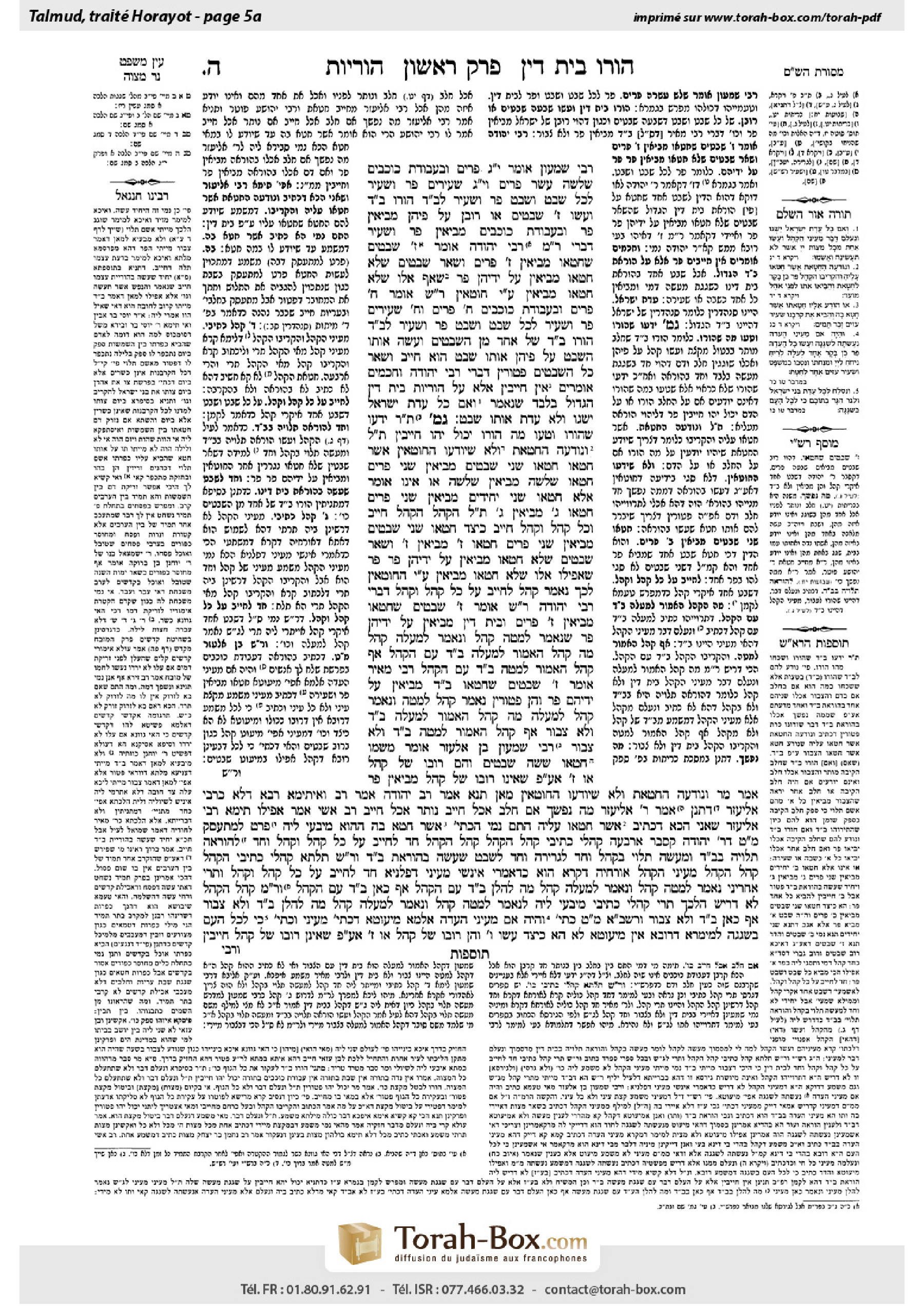
Horayot 5a: Talmud study for Daf Yomi
Study the Talmud for Daf Yomi with scanned pages, Hebrew text, English translations from Sefaria and AI-generated French translations.
Passage selection and English or AI-generated French translation are available where the scan has annotations. Daf Study is independent of Torah-Box and Sefaria.
Browse Horayot · הוריות · All tractatesHorayot 5a text and translations
This page of Horayot includes the Aramaic text, an English translation and an AI-generated French translation, alongside the scan above.
הוריות ה׳ א · Aramaic and Hebrew text
רַבִּי שִׁמְעוֹן אוֹמֵר: שְׁלֹשָׁה עָשָׂר פָּרִים, וּבַעֲבוֹדָה זָרָה – שְׁלֹשָׁה עָשָׂר פָּרִים וּשְׁלֹשָׁה עָשָׂר שְׂעִירִים, פַּר וְשָׂעִיר לְכׇל שֵׁבֶט וְשֵׁבֶט, פַּר וְשָׂעִיר לְבֵית דִּין.
הוֹרוּ בֵּית דִּין וְעָשׂוּ שִׁבְעָה שְׁבָטִים אוֹ רוּבָּן עַל פִּיהֶן – מְבִיאִין פַּר, וּבַעֲבוֹדָה זָרָה – מְבִיאִין פַּר וְשָׂעִיר, דִּבְרֵי רַבִּי מֵאִיר. רַבִּי יְהוּדָה אוֹמֵר: שִׁבְעָה שְׁבָטִים שֶׁחָטְאוּ – מְבִיאִין שִׁבְעָה פָּרִים, וּשְׁאָר שְׁבָטִים שֶׁלֹּא חָטְאוּ – מְבִיאִין עַל יְדֵיהֶן פַּר, שֶׁאַף אֵלּוּ שֶׁלֹּא חָטְאוּ מְבִיאִין עַל יְדֵי חוֹטְאִין. רַבִּי שִׁמְעוֹן אוֹמֵר: שְׁמוֹנָה פָּרִים, וּבַעֲבוֹדָה זָרָה – שְׁמוֹנָה פָּרִים וּשְׁמוֹנָה שְׂעִירִים, פַּר וְשָׂעִיר לְכׇל שֵׁבֶט וְשֵׁבֶט, פַּר וְשָׂעִיר לְבֵית דִּין.
הוֹרוּ בֵּית דִּין שֶׁל אֶחָד מִן הַשְּׁבָטִים, וְעָשָׂה אוֹתוֹ הַשֵּׁבֶט עַל פִּיהֶן – אוֹתוֹ שֵׁבֶט הוּא חַיָּיב, וּשְׁאָר כׇּל הַשְּׁבָטִים פְּטוּרִין, דִּבְרֵי רַבִּי יְהוּדָה. וַחֲכָמִים אוֹמְרִים: אֵין חַיָּיבִין אֶלָּא עַל הוֹרָיוֹת בֵּית דִּין הַגָּדוֹל בִּלְבַד, שֶׁנֶּאֱמַר: ״וְאִם כׇּל עֲדַת יִשְׂרָאֵל יִשְׁגּוּ״, וְלֹא עֲדַת אוֹתוֹ שֵׁבֶט.
גְּמָ׳ תָּנוּ רַבָּנַן: יָדְעוּ שֶׁהוֹרוּ, וְטָעוּ מָה הוֹרוּ, יָכוֹל יְהוּ חַיָּיבִין? תַּלְמוּד לוֹמַר: ״וְנוֹדְעָה הַחַטָּאת״, וְלֹא שֶׁיִּוָּדְעוּ הַחוֹטְאִין.
״אֲשֶׁר חָטְאוּ״, חָטְאוּ שְׁנֵי שְׁבָטִים – מְבִיאִין שְׁנֵי פָרִים, חָטְאוּ שְׁלֹשָׁה – מְבִיאִין שְׁלֹשָׁה, אוֹ אֵינוֹ אוֹמֵר אֶלָּא חָטְאוּ שְׁנֵי יְחִידִים – מְבִיאִין שְׁנֵי פָרִים, חָטְאוּ שְׁלֹשָׁה – מְבִיאִין שְׁלֹשָׁה? תַּלְמוּד לוֹמַר: ״הַקָּהָל״, הַקָּהָל חַיָּיב, וְכׇל קָהָל וְקָהָל חַיָּיב, כֵּיצַד? חָטְאוּ שְׁנֵי שְׁבָטִים – מְבִיאִין שְׁנֵי פָרִים, חָטְאוּ שִׁבְעָה – מְבִיאִין שִׁבְעָה, וּשְׁאָר שְׁבָטִים שֶׁלֹּא חָטְאוּ – מְבִיאִין עַל יְדֵיהֶן פַּר פַּר, שֶׁאֲפִילּוּ אֵלּוּ שֶׁלֹּא חָטְאוּ מְבִיאִין עַל יְדֵי הַחוֹטְאִין, לְכָךְ נֶאֱמַר ״קָהָל״ לְחַיֵּיב עַל כׇּל קָהָל וְקָהָל. דִּבְרֵי רַבִּי יְהוּדָה.
רַבִּי שִׁמְעוֹן אוֹמֵר: שִׁבְעָה שְׁבָטִים שֶׁחָטְאוּ – מְבִיאִין שִׁבְעָה פָּרִים, וּבֵית דִּין מְבִיאִין עַל יְדֵיהֶן פַּר, שֶׁנֶּאֱמַר לְמַטָּה ״קָהָל״ וְנֶאֱמַר לְמַעְלָה ״קָהָל״. מָה ״קָהָל״ הָאָמוּר לְמַעְלָה – בֵּית דִּין עִם הַקָּהָל, אַף ״קָהָל״ הָאָמוּר לְמַטָּה – בֵּית דִּין עִם הַקָּהָל.
רַבִּי מֵאִיר אוֹמֵר: שִׁבְעָה שְׁבָטִים שֶׁחָטְאוּ – בֵּית דִּין מְבִיאִין עַל יְדֵיהֶם פַּר, וְהֵן פְּטוּרִין, נֶאֱמַר ״קָהָל״ לְמַטָּה וְנֶאֱמַר ״קָהָל״ לְמַעְלָה, מָה ״קָהָל״ הָאָמוּר לְמַעְלָה – בֵּית דִּין וְלֹא צִבּוּר, אַף ״קָהָל״ הָאָמוּר לְמַטָּה – בֵּית דִּין וְלֹא צִבּוּר.
רַבִּי שִׁמְעוֹן בֶּן אֶלְעָזָר אוֹמֵר מִשְּׁמוֹ: חָטְאוּ שִׁשָּׁה שְׁבָטִים וְהֵם רוּבּוֹ שֶׁל קָהָל, אוֹ שִׁבְעָה אַף עַל פִּי שֶׁאֵינוֹ רוּבּוֹ שֶׁל קָהָל – מְבִיאִין פַּר.
אָמַר מָר: ״וְנוֹדְעָה הַחַטָּאת״ – וְלֹא שֶׁיִּוָּדְעוּ הַחוֹטְאִין. מַאן תַּנָּא? אָמַר רַב יְהוּדָה אָמַר רַב, וְאִיתֵּימָא רָבָא: דְּלָא כְּרַבִּי אֱלִיעֶזֶר. דִּתְנַן,
אָמַר רַבִּי אֱלִיעֶזֶר: מָה נַפְשָׁךְ? אִם חֵלֶב אָכַל – חַיָּיב, נוֹתָר אָכַל – חַיָּיב.
רַב אָשֵׁי אָמַר: אֲפִילּוּ תֵּימָא רַבִּי אֱלִיעֶזֶר, שָׁאנֵי הָכָא, דִּכְתִיב: ״אֲשֶׁר חָטְאוּ עָלֶיהָ״. הָתָם נָמֵי הָכְתִיב: ״אֲשֶׁר חָטָא בָּהּ״! הַהוּא מִיבְּעֵי לֵיהּ: פְּרָט לַמִּתְעַסֵּק.
מַאי טַעְמָא דְּרַבִּי יְהוּדָה? קָסָבַר: אַרְבָּעָה קְהָלֵי כְּתִיבִי – ״קָהָל״, ״הַקָּהָל״, ״קָהָל״, ״הַקָּהָל״.
חַד לְחַיֵּיב עַל כׇּל קָהָל וְקָהָל, וְחַד לְהוֹרָאָה תְּלוּיָה בְּבֵית דִּין וּמַעֲשֶׂה תָּלוּי בַּקָּהָל. וְחַד לִגְרִירָה. וְחַד לְשֵׁבֶט שֶׁעָשָׂה בְּהוֹרָאַת בֵּית דִּין.
וְרַבִּי שִׁמְעוֹן תְּלָתָא קְהָלֵי כְּתִיבִי: ״הַקָּהָל״, ״קָהָל״, ״הַקָּהָל״. ״מֵעֵינֵי הַקָּהָל״ אוֹרְחֵיהּ דִּקְרָא הוּא, כִּדְאָמְרִי אִינָשֵׁי: מֵעֵינֵי דִּפְלָנְיָא.
חַד לְחַיֵּיב עַל כׇּל קָהָל וְקָהָל, וּתְרֵי אַחֲרִינֵי: נֶאֱמַר לְמַטָּה ״קָהָל״ וְנֶאֱמַר לְמַעְלָה ״קָהָל״, מָה לְהַלָּן בֵּית דִּין עִם הַקָּהָל – אַף כָּאן בֵּית דִּין עִם הַקָּהָל.
וְרַבִּי מֵאִיר, ״קָהָל״ ״הַקָּהָל״ לָא דָּרֵישׁ, הִלְכָּךְ תְּרֵי קְהָלֵי כְּתִיבִי. מִיבְּעֵי לֵיהּ: לְנֶאֱמַר לְמַטָּה ״קָהָל״ וְנֶאֱמַר לְמַעְלָה ״קָהָל״, מָה לְהַלָּן בֵּית דִּין וְלֹא צִבּוּר – אַף כָּאן בֵּית דִּין וְלֹא צִבּוּר.
וְרַבִּי שִׁמְעוֹן בֶּן אֶלְעָזָר מַאי טַעְמָא? כְּתִיב: ״וְהָיָה אִם מֵעֵינֵי הָעֵדָה״ – אַלְמָא מִיעוּטָא, דִּכְתִיב: ״מֵעֵינֵי״. וּכְתִיב: ״כִּי לְכׇל הָעָם בִּשְׁגָגָה״, לְמֵימְרָא דְּרוּבָּא – אִין, מִיעוּטָא – לָא.
הָא כֵּיצַד? עָשׂוּ שִׁשָּׁה וְהֵן רוּבּוֹ שֶׁל קָהָל, אוֹ שִׁבְעָה אַף עַל פִּי שֶׁאֵינָן רוּבּוֹ שֶׁל קָהָל – חַיָּיבִין.
Horayot 5a · English translation
Rabbi Shimon says: They bring thirteen bulls; and for idol worship they bring thirteen bulls and thirteen goats, a bull and a goat for each and every tribe and a bull and a goat for the court.
The mishna continues: If the judges of the court issued a ruling, and at least seven tribes, or a majority of each of those tribes, performed a transgression on the basis of their ruling, the judges bring a bull; and for idol worship they bring a bull and a goat. This is the statement of Rabbi Meir. Rabbi Yehuda says: The seven tribes that sinned bring seven bulls, i.e., each tribe brings one bull, and each of the rest of the tribes, i.e., those that did not sin, brings one bull on the basis of the sin of the other tribes, as even those who did not sin bring an offering on the basis of the actions of the sinners. Rabbi Shimon says: When seven tribes sin eight bulls are brought as offerings, one bull for each and every tribe and one bull for the court. And for idol worship, eight bulls and eight goats are brought, one bull and one goat for each and every tribe and one bull and one goat for the court.
If the court of one of the tribes issued a ruling and the majority of that tribe performed a transgression on the basis of its ruling, that tribe is liable to bring an offering and the rest of all the tribes are exempt; this is the statement of Rabbi Yehuda. And the Rabbis say: One is liable to bring an offering for an unwitting communal sin only for rulings of the High Court alone, as it is stated: “And if the entire assembly of Israel shall act unwittingly” (Leviticus 4:13), from which it is derived that there is liability only for a ruling of the assembly, i.e., the court, of the entire people, but not for a ruling of the assembly of that particular tribe.
GEMARA: The Gemara elaborates on the dispute cited in the mishna. The Sages taught in a baraita: In a case where the judges knew that they issued an erroneous ruling, and erred in remembering which erroneous ruling they issued, one might have thought that they would be liable to bring an offering for this. The verse states: “And the sin that they sinned became known, the congregation shall sacrifice” (Leviticus 4:14), indicating that liability is only in a case where the sin became known to the court that issued the erroneous ruling, and not in a case where it became known only to the sinners. In this case, the sinners are certain that they sinned, but the court does not know the sin with regard to which it issued the ruling.
From the phrase “that they sinned” it is derived: If two tribes sinned they bring two bulls, one from each tribe; if three tribes sinned they bring three bulls, one from each tribe. Or perhaps that phrase says only that if two individuals sinned they bring two bulls, one from each individual; if three individuals sinned they bring three bulls, one from each individual. Therefore, the verse states: “The congregation,” from which it is derived: The congregation is liable, and each and every congregation is liable. How so? If two tribes sinned they bring two bulls. If seven tribes sinned they bring seven bulls. And each of the rest of the tribes that did not sin brings one bull on the basis of the sin of the other tribes, as even those tribes that did not sin bring an offering on the basis of the actions of the sinners. For that reason “congregation” is stated in the verse, to render each and every congregation liable. This is the statement of Rabbi Yehuda.
The baraita continues: Rabbi Shimon says: Seven tribes that sinned bring seven bulls, and the court brings one bull on the basis of their actions, as the term “congregation” is stated below: “The congregation shall sacrifice” (Leviticus 4:14), and the term “congregation” is stated above: “And the matter is hidden from the eyes of the congregation” (Leviticus 4:13). Just as with regard to the term “congregation” that is stated above the reference is to the court, i.e., “the eyes of the congregation,” together with “the congregation,” so too, with regard to the term “congregation” that is stated below, with regard to liability to bring an offering the reference is to the court together with the congregation.
Rabbi Meir says: In the case of seven tribes that sinned, the court brings a bull on the basis of their sin and the members of the tribe are exempt, as the term “congregation” is stated below: “The congregation shall sacrifice” (Leviticus 4:14), and the term “congregation” is stated above: “And the matter is hidden from the eyes of the congregation” (Leviticus 4:13). Just as with regard to the term “congregation” that is stated above the reference is to the court and not to the public, so too, with regard to the term “congregation” that is stated below the reference is to the court and not to the public.
The baraita concludes: Rabbi Shimon ben Elazar says in the name of Rabbi Meir: If six tribes sinned and in terms of population they constitute a majority of the congregation, or if seven tribes, which constitute a majority of the tribes, sinned, even though in terms of population they do not constitute a majority of the congregation, the court brings a bull.
The Gemara proceeds to analyze the baraita. The Master said: “And the sin that they sinned became known,” indicating that liability is only in a case where the sin became known to the court that issued the erroneous ruling and not in a case where it became known only to the sinners. Who is the tanna whose opinion is expressed here? Rav Yehuda said that Rav said, and some say it was Rava who said, that this is not in accordance with the opinion of Rabbi Eliezer, as we learned in a baraita that there is a dispute with regard to one who had two pieces before him, one of them prohibited because it is forbidden fat and one of them prohibited because it is left over from an offering after the time allotted for its consumption [notar], and he ate one, but does not know whether he ate the forbidden fat or the notar.
Rabbi Eliezer says: Whichever way you look at it, he is liable to bring a sin-offering. If it was forbidden fat that he ate he is liable, and if it was notar that he ate he is liable. Therefore, he must bring an offering. Likewise, in the case in the baraita, since the court issued an erroneous ruling and it is known that the erroneous ruling was with regard to a matter for which it is liable to bring an offering, according to Rabbi Eliezer it should make no difference that they do not know the precise nature of their error, and they should be liable to bring an offering. Nevertheless, the ruling in the baraita is that they are exempt, counter to what one would expect to be the opinion of Rabbi Eliezer.
Rav Ashi said: Even if you say that the baraita is in accordance with the opinion of Rabbi Eliezer, one can explain the ruling of the baraita. Here, in the baraita, it is different, as it is written: “And the sin that they sinned became known” (Leviticus 4:14). The verse underscores that the judges must be aware of the specific sin for which they are liable to bring an offering. The Gemara asks: There too, with regard to an individual sin-offering, isn’t it written: “Or if his sin that he sinned became known to him” (Leviticus 4:23), leading to the same conclusion? The Gemara answers: In the case of the individual sin-offering, that expression is necessary for the tanna to exclude one who acts unawares. One is liable to bring a sin-offering for an unwitting transgression only if he performs the action with intent.
The Gemara asks: What is the reasoning of Rabbi Yehuda, who holds that even one tribe that sinned is liable to bring an offering? The Gemara answers that he holds: There are four mentions of the term congregation written: Congregation, the congregation, congregation, the congregation. The term “the congregation” appears in both verses. Since the Torah could have written the term: Congregation, in both instances, Rabbi Yehuda derives two matters from each of the two terms, one from the term “congregation” itself, and another from the fact that it is written with the definitive article “the.”
One serves to render each and every congregation liable, as a tribe is also called a congregation; and one serves to establish that the ruling is dependent on the court and the action is dependent on the congregation; and one serves to teach the concept of drawing, i.e., a tribe that did not sin is drawn after a tribe that sinned and is liable to bring an offering; and one serves to teach that a tribe that performed a transgression on the basis of the ruling of its tribal court is liable to bring a bull as an unwitting communal sin-offering.
And what is the reasoning of Rabbi Shimon, who holds that seven tribes that sinned bring seven bulls and the court brings one bull? He holds that there are three mentions of the term congregation written. The first two are: The congregation, congregation, which he interprets in the manner that Rabbi Yehuda interpreted. He counts the third and last mention of the term: The congregation, as in the verse: “From the eyes of the congregation.” This is written in the typical manner of the verse, as people say: From the eyes of so-and-so, and the definitive article “the” does not serve to teach another halakha.
Of those three, one serves to render each and every congregation liable, as a tribe is also called congregation, and the other two come so that a verbal analogy can be derived: The term “congregation” is stated below, and the term “congregation” is stated above. Just as with regard to the term “congregation” that is stated there, above, the reference is to the court, i.e., “the eyes of the congregation,” together with the congregation, so too, with regard to the term “congregation” that is stated here concerning liability to bring an offering, the reference is to the court together with the congregation.
And what is the reasoning of Rabbi Meir, who holds that the court brings a bull on the basis of its sin and the members of the tribe are exempt? He does not derive a halakha from the difference between the terms “congregation” and “the congregation.” He does not consider the addition of the definite article to be significant. Therefore, he holds that there are two mentions of the term congregation written. They are necessary for him to derive: The term “congregation” is stated below, and the term “congregation” is stated above. Just as with regard to the term “congregation” that is stated there, above, the reference is to the court and not to the public, so too with regard to the term “congregation” that is stated here, below, the reference is to the court and not to the public.
And what is the reasoning of Rabbi Shimon ben Elazar, who holds that if six tribes sinned and in terms of population they constitute a majority of the congregation, or if seven tribes sinned even though in terms of population they do not constitute a majority of the congregation, the court brings a bull? It is written: “Then it shall be, if it was performed unwittingly, hidden from the eyes of the congregation” (Numbers 15:24). Apparently, the reference is even to a minority of the people, as “from the eyes” is written, indicating: Not all of them, but some of them. And it is written: “As for all the people it was performed unwittingly” (Numbers 15:26), to say that based on the principle: The halakhic status of a majority is like that of the entirety, if the majority of the congregation sinned, then yes, the court is liable to bring an offering. If the minority sinned, then no, the court is not liable.
How so? How can this apparent contradiction be resolved? The Gemara explains: If six tribes sinned and they constitute a majority of the congregation, or if seven tribes sinned, even though in terms of population they do not constitute a majority of the congregation, the court is liable to bring a bull. Although in both cases they are not a majority in every sense, the court is liable, as a reference to the minority is also indicated in the verse.
Horayot 5a · Traduction française (IA)
Rabbi Shimon dit : On apporte treize taureaux ; et pour l'idolâtrie, on apporte treize taureaux et treize boucs, un taureau et un bouc pour chaque tribu et un taureau et un bouc pour le tribunal.
La mitsva continue : Si les juges du tribunal ont rendu un jugement, et que sept tribus, ou la majorité de chacune de ces tribus, ont commis un péché en vertu de ce jugement, les juges apportent un taureau ; et pour l'idolâtrie, on apporte un taureau et un bouc. C'est la déclaration de Rabbi Meir. Rabbi Yéhuda dit : Les sept tribus qui ont péché apportent sept taureaux, c'est-à-dire un taureau par tribu, et chaque autre tribu, c'est-à-dire celles qui n'ont pas péché, apporte un taureau en vertu des péchés des autres tribus, car même ceux qui n'ont pas péché apportent un sacrifice en vertu des actions des pécheurs. Rabbi Shimon dit : Lorsque sept tribus péchent, on apporte huit taureaux comme offrandes, un taureau pour chaque tribu et un taureau pour le tribunal. Et pour l'idolâtrie, huit taureaux et huit boucs sont apportés, un taureau et un bouc pour chaque tribu et un taureau et un bouc pour le tribunal.
Si le tribunal d'une des tribus a rendu un jugement et que la majorité de cette tribu a commis un péché en vertu de ce jugement, cette tribu est tenue de présenter un sacrifice et les autres tribus sont exemptes ; c'est la déclaration de Rabbi Yéhuda. Et les Sages disent : On est tenu de présenter un sacrifice pour un péché commun non intentionnel uniquement pour les jugements du Grand Tribunal seul, car il est dit : « Et si l'ensemble de l'assemblée d'Israël agit de manière non intentionnelle » (Lévitique 4:13), d'où on déduit que la responsabilité existe uniquement pour un jugement de l'assemblée, c'est-à-dire du tribunal, de tout le peuple, mais pas pour un jugement de l'assemblée de cette tribu particulière.
GUEMARA : La Guemara développe le débat mentionné dans la mitsna. Les Sages enseignèrent dans une baraïta : Dans un cas où les juges savaient qu'ils avaient rendu un jugement erroné, et qu'ils avaient oublié quel jugement erroné ils avaient rendu, on pourrait penser qu'ils étaient tenus de présenter un sacrifice pour cela. La versette dit : « Et le péché qu'ils ont commis est devenu connu, l'assemblée sacrifiera » (Lévitique 4:14), indiquant que la responsabilité existe uniquement dans un cas où le péché est devenu connu du tribunal qui a rendu le jugement erroné, et non dans un cas où il est devenu connu uniquement aux pécheurs. Dans ce cas, les pécheurs savent certainement qu'ils ont péché, mais le tribunal ne connaît pas le péché concernant lequel il a rendu le jugement.
De la phrase « qu'ils ont péché » on déduit : Si deux tribus ont péché, on apporte deux taureaux, un de chaque tribu ; si trois tribus ont péché, on apporte trois taureaux, un de chaque tribu. Ou peut-être que cette phrase signifie seulement que si deux individus ont péché, on apporte deux taureaux, un de chaque individu ; si trois individus ont péché, on apporte trois taureaux, un de chaque individu. Ainsi, la versette dit : « L'assemblée », d'où on déduit : L'assemblée est tenue, et chaque assemblée est tenue. Comment cela ? Si deux tribus ont péché, on apporte deux taureaux. Si sept tribus ont péché, on apporte sept taureaux. Et chaque autre tribu qui n'a pas péché apporte un taureau en vertu des péchés des autres tribus, car même ces tribus qui n'ont pas péché apportent un sacrifice en vertu des actions des pécheurs. Pour cette raison, « assemblée » est mentionné dans la versette, afin de rendre chaque assemblée tenue. C'est la déclaration de Rabbi Yéhuda.
La baraïta continue : Rabbi Shimon dit : Sept tribus qui ont péché apportent sept taureaux, et le tribunal apporte un taureau en vertu de leurs actions, car le terme « assemblée » est mentionné ci-dessous : « L'assemblée sacrifiera » (Lévitique 4:14), et le terme « assemblée » est mentionné ci-dessus : « Et l'affaire est cachée des yeux de l'assemblée » (Lévitique 4:13). Tout comme, concernant le terme « assemblée » mentionné ci-dessus, la référence est au tribunal, c'est-à-dire « les yeux de l'assemblée », ainsi aussi, concernant le terme « assemblée » mentionné ci-dessous, concernant la responsabilité de présenter un sacrifice, la référence est au tribunal et non au public.
Rabbi Meir dit : Dans le cas de sept tribus qui ont péché, le tribunal apporte un taureau en vertu de leur péché et les membres de la tribu sont exemptés, car le terme « assemblée » est mentionné ci-dessous : « L'assemblée sacrifiera » (Lévitique 4:14), et le terme « assemblée » est mentionné ci-dessus : « Et l'affaire est cachée des yeux de l'assemblée » (Lévitique 4:13). Tout comme, concernant le terme « assemblée » mentionné ci-dessus, la référence est au tribunal et non au public, ainsi aussi, concernant le terme « assemblée » mentionné ci-dessous, la référence est au tribunal et non au public.
La baraïta conclut : Rabbi Shimon ben Elazar dit en nom de Rabbi Meir : Si six tribus ont péché et, en termes de population, elles constituent la majorité de l'assemblée, ou si sept tribus, qui constituent la majorité des tribus, ont péché, même si, en termes de population, elles ne constituent pas la majorité de l'assemblée, le tribunal apporte un taureau.
La Guemara poursuit son analyse de la baraïta. Le Maître dit : « Et le péché qu'ils ont commis est devenu connu », indiquant que la responsabilité existe uniquement dans un cas où le péché est devenu connu du tribunal qui a rendu le jugement erroné et non dans un cas où il est devenu connu uniquement aux pécheurs. De quel tanna est l'opinion exprimée ici ? Rav Yéhuda dit que Rav a dit, et certains disent que c'était Rava qui a dit, que cela ne correspond pas à l'opinion de Rabbi Eliezer, car nous avons appris dans une baraïta qu'il y a un débat concernant celui qui avait deux morceaux devant lui, l'un interdit parce qu'il est gras interdit et l'autre interdit parce qu'il est restant d'un sacrifice après la période allouée à sa consommation [notar], et il a mangé l'un, mais ne sait pas s'il a mangé la graisse interdite ou le notar.
Rabbi Eliezer dit : Quelle que soit la manière dont on y regarde, il est tenu de présenter un sacrifice expiatoire. Si c'est un gras interdit qu'il a mangé, il est tenu, et si c'est un notar qu'il a mangé, il est tenu. Ainsi, il doit présenter un sacrifice. De même, dans le cas du baraïta, puisque le tribunal a rendu un jugement erroné et qu'il est connu que ce jugement erroné concerne une affaire pour laquelle il est tenu de présenter un sacrifice, selon Rabbi Eliezer, cela ne devrait pas faire de différence qu'ils ne connaissent pas la nature précise de leur erreur, et ils devraient être tenu de présenter un sacrifice. Cependant, le jugement du baraïta est que ceux-ci sont exemptés, contrairement à ce que l'on pourrait attendre comme opinion de Rabbi Eliezer.
Rav Ashi dit : Même si vous dites que le baraïta suit l'opinion de Rabbi Eliezer, on peut expliquer le jugement du baraïta. Ici, dans le baraïta, c'est différent, car il est écrit : « Et le péché qu'ils ont péché est devenu connu » (Lévitique 4:14). La versette souligne que les juges doivent être conscients du péché spécifique pour lequel ils sont tenu de présenter un sacrifice. La Guemara demande : De même, concernant un sacrifice expiatoire individuel, n'est-il pas écrit : « Ou si son péché qu'il a péché est devenu connu à lui » (Lévitique 4:23), menant à la même conclusion ? La Guemara répond : Dans le cas du sacrifice expiatoire individuel, cette expression est nécessaire pour que le tanna exclue celui qui agit sans connaissance. On est tenu de présenter un sacrifice expiatoire pour un péché involontaire uniquement s'il agit avec l'intention.
La Guemara demande : Quel est le raisonnement de Rabbi Yéhuda, qui considère que même une tribu qui a péché est tenu de présenter un sacrifice ? La Guemara répond qu'il considère que le terme « congrégation » est mentionné quatre fois : congrégation, la congrégation, congrégation, la congrégation. Le terme « la congrégation » apparaît dans les deux versets. Puisque la Torah aurait pu écrire « congrégation » dans les deux cas, Rabbi Yéhuda dérive deux points de chaque des deux termes, un du terme « congrégation » lui-même, et un autre du fait qu'il est écrit avec l'article défini « la ».
L'un sert à rendre chaque congrégation tenu de présenter un sacrifice, car une tribu est aussi appelée congrégation ; et l'autre sert à établir que le jugement dépend du tribunal et l'action dépend de la congrégation ; et l'un sert à enseigner la notion de dérivation, c'est-à-dire une tribu qui n'a pas péché est dérivée après une tribu qui a péché et est tenu de présenter un sacrifice ; et l'un sert à enseigner que une tribu qui a commis un péché sur la base du jugement de son tribunal tribal est tenu de présenter un taureau comme sacrifice expiatoire involontaire collectif.
Et quel est le raisonnement de Rabbi Shimon, qui considère que sept tribus qui ont péché présentent sept taureaux et le tribunal présente un taureau ? Il considère que le terme « congrégation » est mentionné trois fois. Les deux premiers sont : La congrégation, congrégation, qu'il interprète de la manière que Rabbi Yéhuda a interprétée. Il compte le troisième et dernier mention : La congrégation, comme dans la versette : « De l'œil de la congrégation. » Celle-ci est écrite dans le mode typique de la versette, comme les gens disent : « De l'œil de tel ou tel », et l'article défini « la » ne sert pas à enseigner une autre halakha.
De ces trois, l'un sert à rendre chaque congrégation tenue de présenter un sacrifice, car une tribu est aussi appelée congrégation, et les deux autres permettent d'extraire une analogie verbale : le terme « congrégation » est mentionné en dessous, et le terme « congrégation » est mentionné en dessus. Tout comme, concernant le terme « congrégation » mentionné là-haut, l'expression fait référence au tribunal, c'est-à-dire « les yeux de la congrégation », avec la congrégation, ainsi aussi, concernant le terme « congrégation » mentionné ici concernant la responsabilité de présenter un sacrifice, l'expression fait référence au tribunal avec la congrégation.
Et quel est le raisonnement de Rabbi Méïr, qui considère que le tribunal présente un taureau sur la base de son péché et les membres de la tribu sont exemptés ? Il ne dérive pas une halakha de la différence entre les termes « congrégation » et « la congrégation ». Il ne considère pas l'ajout de l'article défini comme significatif. Ainsi, il considère que le terme « congrégation » est mentionné deux fois. Ces mentions sont nécessaires pour lui pour dériver : le terme « congrégation » est mentionné en dessous, et le terme « congrégation » est mentionné en dessus. Tout comme, concernant le terme « congrégation » mentionné là-haut, l'expression fait référence au tribunal et non au public, ainsi aussi, concernant le terme « congrégation » mentionné ici, en dessous, l'expression fait référence au tribunal et non au public.
Et quel est le raisonnement de Rabbi Shimon ben Elazar, qui affirme que si six tribus ont péché et, en termes de population, elles constituent la majorité de la congrégation, ou si sept tribus ont péché même si, en termes de population, elles ne constituent pas la majorité de la congrégation, le tribunal est tenu de présenter un taureau ? Il est écrit : « Alors il arrivera, si cela a été fait involontairement, caché aux yeux de la congrégation » (Nb 15:24). Apparemment, la référence est même à une minorité du peuple, car « des yeux » est écrit, indiquant : pas tous, mais certains. Et il est écrit : « Quant à toute la population, cela a été fait involontairement » (Nb 15:26), pour dire que sur le principe : le statut halakhique d'une majorité est comme celui de l'ensemble, si la majorité de la congrégation a péché, alors oui, le tribunal est tenu de présenter un sacrifice. Si la minorité a péché, alors non, le tribunal n'est pas tenu.
Comment cela se passe-t-il ? Comment ce paradoxe apparent peut-il être résolu ? La Guemara explique : Si six tribus ont péché et qu'elles constituent la majorité de la congrégation, ou si sept tribus ont péché, même si, en termes de population, elles ne constituent pas la majorité de la congrégation, le tribunal est tenu de présenter un taureau. Bien que dans les deux cas ils ne soient pas une majorité dans un sens complet, le tribunal est tenu, car une référence à la minorité est aussi indiquée dans la versette.
Traduction française générée par IA à partir de l’édition anglaise de Sefaria. Vérifie toujours un passage avec le texte source.
Text from Sefaria: William Davidson Edition - Vocalized Aramaic (CC BY NC); William Davidson Edition - English (CC BY NC).