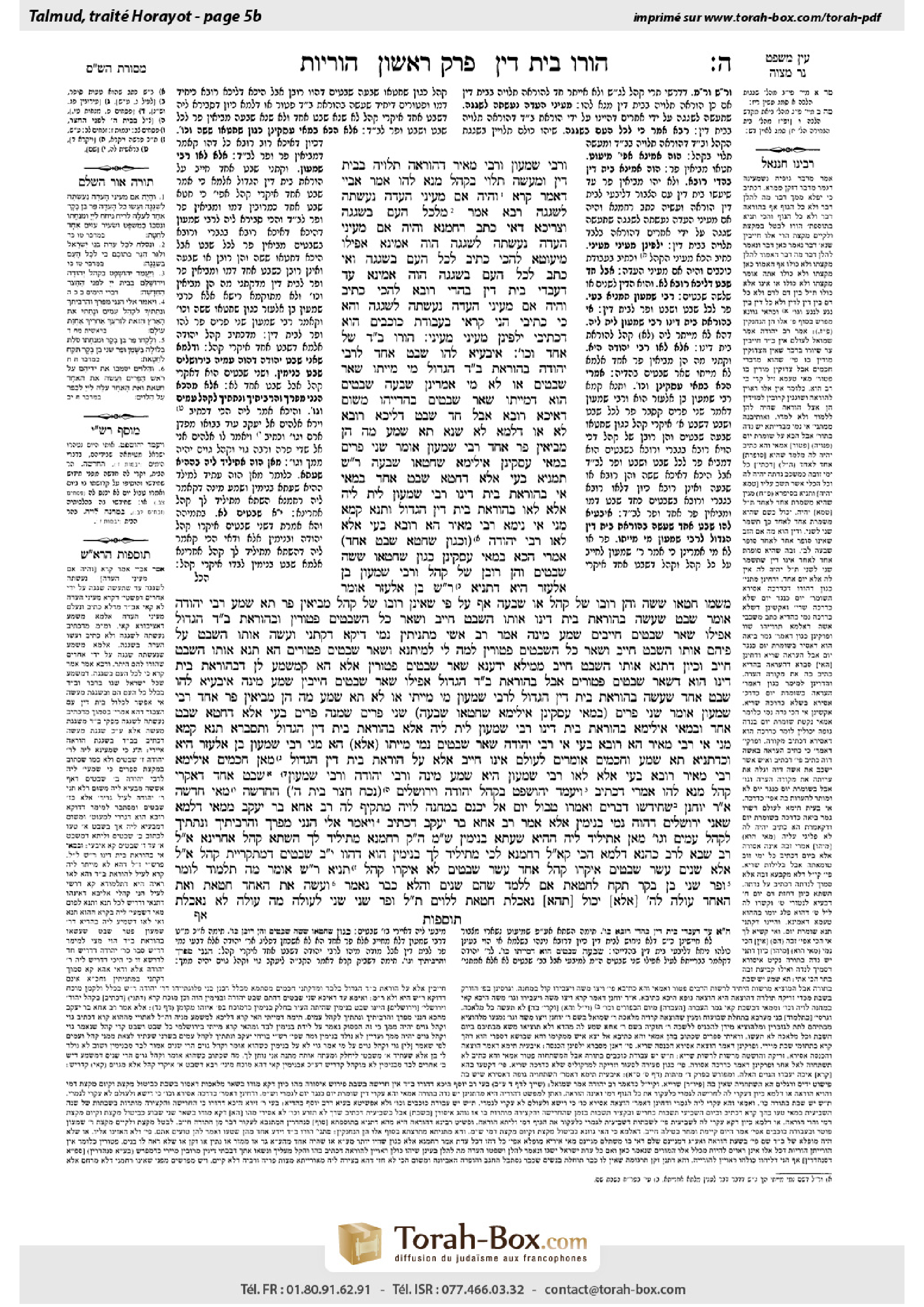
Horayot 5b: Talmud study for Daf Yomi
Study the Talmud for Daf Yomi with scanned pages, Hebrew text, English translations from Sefaria and AI-generated French translations.
Passage selection and English or AI-generated French translation are available where the scan has annotations. Daf Study is independent of Torah-Box and Sefaria.
Browse Horayot · הוריות · All tractatesHorayot 5b text and translations
This page of Horayot includes the Aramaic text, an English translation and an AI-generated French translation, alongside the scan above.
הוריות ה׳ ב · Aramaic and Hebrew text
וְרַבִּי שִׁמְעוֹן וְרַבִּי מֵאִיר, דְּהוֹרָאָה תְּלוּיָה בְּבֵית דִּין וּמַעֲשֶׂה תָּלוּי בַּקָּהָל, מְנָא לְהוּ? אָמַר אַבָּיֵי, דְּאָמַר קְרָא: ״וְהָיָה אִם מֵעֵינֵי הָעֵדָה נֶעֶשְׂתָה לִשְׁגָגָה״. רָבָא אָמַר: ״מִלְּכׇל הָעָם בִּשְׁגָגָה״.
וּצְרִיכָא, דְּאִי כְּתַב רַחֲמָנָא ״וְהָיָה אִם מֵעֵינֵי הָעֵדָה נֶעֶשְׂתָה לִשְׁגָגָה״, הֲוָה אָמֵינָא: אֲפִילּוּ מִיעוּטָא, לְהָכִי כְּתִיב ״לְכׇל הָעָם בִּשְׁגָגָה״. וְאִי כְּתַב ״לְכׇל הָעָם בִּשְׁגָגָה״, הֲוָה אָמֵינָא: עַד דְּעָבְדִי בֵּית דִּין בַּהֲדֵי רוּבָּא, לְהָכִי כְּתִיב ״וְהָיָה אִם מֵעֵינֵי הָעֵדָה נֶעֶשְׂתָה לִשְׁגָגָה״.
וְהָא כִּי כְּתִיבִי הָנֵי קְרָאֵי בַּעֲבוֹדָה זָרָה הוּא דִּכְתִיבִי. יָלְפִינַן ״מֵעֵינֵי״ ״מֵעֵינֵי״.
הוֹרוּ בֵּית דִּין שֶׁל אֶחָד וְכוּ׳. אִיבַּעְיָא לְהוּ: שֵׁבֶט אֶחָד לְרַבִּי יְהוּדָה בְּהוֹרָאַת בֵּית דִּין הַגָּדוֹל, מִי מַיְיתוּ שְׁאָר שְׁבָטִים אוֹ לָא? מִי אָמְרִינַן: שִׁבְעָה שְׁבָטִים הוּא דְּמַיְיתוּ שְׁאָר שְׁבָטִים בַּהֲדַיְיהוּ, מִשּׁוּם דְּאִיכָּא רוּבָּא, אֲבָל חַד שֵׁבֶט, דְּלֵיכָּא רוּבָּא – לָא, אוֹ דִלְמָא לָא שְׁנָא!
תָּא שְׁמַע: מָה הֵן מְבִיאִין? פַּר אֶחָד, רַבִּי שִׁמְעוֹן אוֹמֵר: שְׁנֵי פָרִים. בְּמַאי עָסְקִינַן? אִילֵימָא שֶׁחָטְאוּ שִׁבְעָה, רַבִּי שִׁמְעוֹן תְּמָנְיָא בָּעֵי! אֶלָּא דְּחָטָא שֵׁבֶט אֶחָד. בְּמַאי? אִי בְּהוֹרָאַת בֵּית דִּינוֹ, רַבִּי שִׁמְעוֹן לֵית לֵיהּ! אֶלָּא לָאו בְּהוֹרָאַת בֵּית דִּין הַגָּדוֹל.
וְתַנָּא קַמָּא מַנִּי? אִי נֵימָא רַבִּי מֵאִיר, הָא רוּבָּא בָּעֵי! אֶלָּא לָאו רַבִּי יְהוּדָה, וּכְגוֹן שֶׁחָטָא שֵׁבֶט אֶחָד.
אָמְרִי, הָכָא בְּמַאי עָסְקִינַן? כְּגוֹן שֶׁחָטְאוּ שִׁשָּׁה שְׁבָטִים וְהֵן רוּבָּן שֶׁל קָהָל, וְרַבִּי שִׁמְעוֹן בֶּן אֶלְעָזָר הִיא. דְּתַנְיָא, רַבִּי שִׁמְעוֹן בֶּן אֶלְעָזָר אוֹמֵר מִשְּׁמוֹ: חָטְאוּ שִׁשָּׁה וְהֵן רוּבּוֹ שֶׁל קָהָל, אוֹ שִׁבְעָה אַף עַל פִּי שֶׁאֵינָן רוּבּוֹ שֶׁל קָהָל – מְבִיאִין פַּר.
תָּא שְׁמַע, רַבִּי יְהוּדָה אוֹמֵר: שֵׁבֶט שֶׁעָשָׂה בְּהוֹרָאַת בֵּית דִּינוֹ – אוֹתוֹ הַשֵּׁבֶט חַיָּיב, וּשְׁאָר כׇּל הַשְּׁבָטִים פְּטוּרִין. וּבְהוֹרָאַת בֵּית דִּין הַגָּדוֹל – אֲפִילּוּ שְׁאָר שְׁבָטִים חַיָּיבִים. שְׁמַע מִינַּהּ.
אָמַר רַב אָשֵׁי: מַתְנִיתִין נָמֵי דַּיְקָא, דְּקָתָנֵי: וְעָשָׂה אוֹתוֹ הַשֵּׁבֶט עַל פִּיהֶם – אוֹתוֹ הַשֵּׁבֶט חַיָּיב וּשְׁאָר כׇּל הַשְּׁבָטִים פְּטוּרִין. לְמָה לִי לְמִיתְנָא וּשְׁאָר שְׁבָטִים פְּטוּרִים? הָא תְּנָא אוֹתוֹ הַשֵּׁבֶט חַיָּיב, וְכֵיוָן דִּתְנָא אוֹתוֹ הַשֵּׁבֶט חַיָּיב, מִמֵּילָא יָדַעְנָא שְׁאָר שְׁבָטִים פְּטוּרִין! אֶלָּא הָא קָמַשְׁמַע לָן, בְּהוֹרָאַת בֵּית דִּינוֹ הוּא דִּשְׁאָר שְׁבָטִים פְּטוּרִים, אֲבָל בְּהוֹרָאַת בֵּית דִּין הַגָּדוֹל – אֲפִילּוּ שְׁאָר שְׁבָטִים חַיָּיבִין. שְׁמַע מִינַּהּ.
אִיבַּעְיָא לְהוּ: שֵׁבֶט אֶחָד שֶׁעָשָׂה בְּהוֹרָאַת בֵּית דִּין הַגָּדוֹל, לְרַבִּי שִׁמְעוֹן מִי מַיְיתֵי אוֹ לָא?
תָּא שְׁמַע: מָה הֵן מְבִיאִין? פַּר אֶחָד, רַבִּי שִׁמְעוֹן אוֹמֵר: שְׁנֵי פָרִים. בְּמַאי עָסְקִינַן? אִילֵימָא שֶׁחָטְאוּ שִׁבְעָה – שְׁנֵי פָרִים? שְׁמֹנָה פָּרִים בָּעֵי! אֶלָּא דְּחָטָא שֵׁבֶט אֶחָד, וּבְמַאי? אִילֵימָא בְּהוֹרָאַת בֵּית דִּינוֹ, רַבִּי שִׁמְעוֹן לֵית לֵיהּ! אֶלָּא בְּהוֹרָאַת בֵּית דִּין הַגָּדוֹל.
וְתִסְבְּרָא: תַּנָּא קַמָּא מַנִּי? אִי רַבִּי מֵאִיר – הָא רוּבָּא בָּעֵי, אִי רַבִּי יְהוּדָה – שְׁאָר שְׁבָטִים נָמֵי מַיְיתוּ! אֶלָּא הָא מַנִּי – רַבִּי שִׁמְעוֹן בֶּן אֶלְעָזָר הִיא, וְכִדְתַנְיָא.
תָּא שְׁמַע, וַחֲכָמִים אוֹמְרִים: לְעוֹלָם אֵינוֹ חַיָּיב אֶלָּא עַל הוֹרָאַת בֵּית דִּין הַגָּדוֹל. מַאן חֲכָמִים? אִילֵימָא רַבִּי מֵאִיר, רוּבָּא בָּעֵי! אֶלָּא לָאו, רַבִּי שִׁמְעוֹן הִיא! שְׁמַע מִינַּהּ.
וְרַבִּי יְהוּדָה וְרַבִּי שִׁמְעוֹן, שֵׁבֶט אֶחָד דְּאִקְּרִי קָהָל מְנָא לְהוּ? אָמְרִי, דִּכְתִיב: ״וַיַּעֲמֹד יְהוֹשָׁפָט בִּקְהַל יְהוּדָה וִירוּשָׁלִַים (נָכַח חֲצַר בֵּית ה׳) [בְּבֵית ה׳ לִפְנֵי הֶחָצֵר] הַחֲדָשָׁה״. מַאי ״חֲדָשָׁה״? אָמַר רַבִּי יוֹחָנָן, שֶׁחִידְּשׁוּ דְּבָרִים וְאָמְרוּ: טְבוּל יוֹם, אַל יִכָּנֵס בְּמַחֲנֵה לְוִיָּה.
מַתְקֵיף לַהּ רַב אַחָא בַּר יַעֲקֹב: מִמַּאי? דִּלְמָא שָׁאנֵי יְרוּשָׁלַיִם, דַּהֲוָה נָמֵי בִּנְיָמִין! אֶלָּא אָמַר רַב אַחָא בַּר יַעֲקֹב, דִּכְתִיב: ״וַיֹּאמֶר אֵלַי הִנְנִי מַפְרְךָ וְהִרְבִּיתִךָ וּנְתַתִּיךָ לִקְהַל עַמִּים וְגוֹ׳״ מַאן אִתְיְלִיד לֵיהּ הָהִיא שַׁעְתָּא? בִּנְיָמִין, שְׁמַע מִינַּהּ הָכִי קָאָמַר רַחֲמָנָא: מִתְיְלִיד לָךְ הַשְׁתָּא קָהָל אַחֲרִינָא.
אֲמַר לֵיהּ רַב שַׁבָּא לְרַב כָּהֲנָא, דִּלְמָא הָכִי קָאָמַר לֵיהּ רַחֲמָנָא: לְכִי מִתְיְלִיד לָךְ בִּנְיָמִין, הוּא דְּהָווּ שְׁנֵים עָשָׂר שְׁבָטִים דְּמִתְקַרְיַית קָהָל! אֲמַר לֵיהּ: אֶלָּא שְׁנֵים עָשָׂר שְׁבָטִים אִיקְּרוּ קָהָל, אַחַד עָשָׂר שְׁבָטִים לֹא אִיקְּרוּ קָהָל?
תַּנְיָא רַבִּי שִׁמְעוֹן אוֹמֵר: מָה תַּלְמוּד לוֹמַר: ״וּפַר שֵׁנִי בֶן בָּקָר תִּקַּח לְחַטָּאת״? אִם לְלַמֵּד שֶׁהֵם שְׁנַיִם, וַהֲלֹא כְּבָר נֶאֱמַר: ״וַעֲשֵׂה אֶת הָאֶחָד חַטָּאת וְאֶת הָאֶחָד עֹלָה לַה׳״! [אֶלָּא] יָכוֹל [תְּהֵא] נֶאֱכֶלֶת חַטָּאת לַלְוִיִּם? תַּלְמוּד לוֹמַר: ״וּפַר שֵׁנִי״ – שֵׁנִי לָעוֹלָה, מָה עוֹלָה לָא נֶאֱכֶלֶת,
Horayot 5b · English translation
The Gemara asks: And Rabbi Shimon and Rabbi Meir, from where do they derive the fact that the ruling is dependent on the court and the action is dependent on the congregation? Abaye said that they derive it from a verse, as the verse states in the passive form: “Then it shall be, if it was performed unwittingly, hidden from the eyes of the congregation” (Number 15:24), indicating that the action of the congregation was generated by the ruling of the court. Rava said: It is derived from that which is stated: “For all the people it was performed unwittingly” (Numbers 15:26). The term “all the people” indicates that the unwitting action is common to all, the court through its ruling and the people through their action.
The Gemara notes: And both of the verses are necessary. As, had the Merciful One written only: “Then it shall be, if it was performed unwittingly, hidden from the eyes of the congregation” (Number 15:24), I would say: There is liability to bring an offering even if only a minority of the congregation sinned. Therefore, it is written: “For all the people it was performed unwittingly.” And had the Merciful One written only: “For all the people it was performed unwittingly,” I would say: There is no liability unless the court performs the transgression together with the majority of the congregation, as the verse appears to refer to a single unwitting action. Therefore, it is written: “Then it shall be, if it was performed unwittingly, hidden from the eyes of the congregation,” indicating that the unwitting act was performed on the basis of the ruling of the court, and the action of the court is not significant in this regard.
The Gemara challenges: But when these verses are written, they are written with regard to an erroneous ruling involving idol worship, not concerning erroneous rulings involving other transgressions. The Gemara explains: We derive it by means of a verbal analogy between “from the eyes of the congregation” written with regard to other transgressions, and “from the eyes of the congregation” written concerning idol worship.
§ The mishna teaches: If the court of one of the tribes issued a ruling, and the majority of that tribe performed a transgression on the basis of its ruling, that tribe is liable to bring an offering and the rest of all the tribes are exempt; this is the statement of Rabbi Yehuda. A dilemma was raised before the Sages: According to Rabbi Yehuda, in the case of one tribe that performed a transgression on the basis of the ruling of the High Court, are the other tribes liable to bring an offering or not? The Gemara elaborates: Do we say that it is specifically in a case where seven tribes sinned that other tribes each bring an offering together with them because there is a majority of the tribes that sinned, but in a case where only one tribe sinned, where there is no majority of the tribes that sinned, they do not? Or perhaps it is no different, and the other tribes are drawn after even one tribe.
The Gemara suggests: Come and hear resolution of this dilemma from a baraita, which teaches: What do they bring? They bring one bull; Rabbi Shimon says: Two bulls. The Gemara elaborates: What are we dealing with in this baraita? If we say the reference is to a case where seven tribes sinned, Rabbi Shimon requires eight bulls, one for each tribe that sinned and one for the court. Rather, the reference must be to a case where one tribe sinned. The Gemara clarifies: In what circumstances did the tribe sin? If the tribe sinned on the basis of the ruling of its tribal court, Rabbi Shimon does not accept the halakha that an erroneous ruling of the tribal court renders them liable to bring an offering. Rather, is it not so that they sinned on the basis of a ruling of the High Court?
The Gemara asks: And who is the first tanna, who says that they must bring one bull? If we say it is Rabbi Meir, that is difficult: Doesn’t he require that the majority perform a transgression in order for a bull to be brought? A transgression performed by one tribe does not suffice. Rather, is the first tanna not Rabbi Yehuda, and the reference is to a case where one tribe sinned and he deems it liable to bring one bull, and the remaining tribes are not liable to bring an offering.
The Gemara rejects this proof and says there is an alternative explanation of the baraita. What are we dealing with here? With a case where six tribes sinned and in terms of population they constitute a majority of the congregation, and the first tanna in the baraita is Rabbi Shimon ben Elazar, as it is taught in a baraita that Rabbi Shimon ben Elazar says in the name of Rabbi Meir: If six tribes sinned and in terms of population they constitute a majority of the congregation, or if seven tribes, which constitute a majority of the tribes, sinned, even though in terms of population they do not constitute a majority of the congregation, the court brings a bull.
The Gemara suggests: Come and hear a resolution to the dilemma from a baraita, which teaches: Rabbi Yehuda says: In the case of a tribe that performed a transgression on the basis of a ruling of its tribal court, that tribe is liable and all the rest of the tribes are exempt. But if it was on the basis of the ruling of the High Court, even the rest of the tribes are liable. The Gemara concludes: Learn from it that Rabbi Yehuda holds that the other tribes are liable in a case where one tribe performed a transgression on the basis of the ruling of the High Court.
Rav Ashi said: The language of the mishna is also precise in support of that conclusion, as the tanna teaches: If the court of one of the tribes issued an erroneous ruling and the majority of that tribe performed a transgression on the basis of its ruling, that tribe is liable to bring an offering and all the rest of the tribes are exempt. He explains: Why do I need the tanna to teach: And the rest of the tribes are exempt? Didn’t he already teach: That tribe is liable? And since he teaches: That tribe is liable, we know automatically that the rest of the tribes are exempt. Rather, this tanna is teaching us that it is specifically in a case where the tribe performed an unwitting transgression on the basis of the ruling of its tribal court that the rest of the tribes are exempt; but in a case where the tribe performed an unwitting transgression on the basis of the ruling of the High Court, even the rest of the tribes are liable. The Gemara concludes: Learn from the mishna that this is Rabbi Yehuda’s opinion.
A dilemma was raised before the Sages: In a case where one tribe performed a transgression on the basis of the ruling of the High Court, according to Rabbi Shimon are they liable to bring an offering or not?
The Gemara suggests: Come and hear a resolution to this dilemma from the baraita cited earlier: What do they bring? They bring one bull; Rabbi Shimon says: Two bulls. The Gemara elaborates: What are we dealing with in this baraita? If we say that the reference is to a case where seven tribes sinned, that is difficult. In that case, are two bulls brought? Eight bulls are required according to Rabbi Shimon. Rather, the reference is to a case where one tribe sinned. The Gemara clarifies: And in what circumstances did the tribe sin? If we say that the tribe sinned on the basis of the ruling of its tribal court, Rabbi Shimon does not accept the halakha that an erroneous ruling of the tribal court renders them liable to bring an offering. Rather, the circumstances are that they sinned on the basis of a ruling of the High Court. Apparently, even Rabbi Shimon agrees that in this case one tribe brings an offering.
The Gemara rejects this proof: And how can you understand that this is the reference? Who, then, is the first tanna who says that they must bring one bull? If it is Rabbi Meir, that is difficult. Doesn’t he require that the majority and not just one tribe perform a transgression in order for there to be liability? If it is Rabbi Yehuda, that is also difficult, as in his opinion the rest of the tribes are also liable to bring an offering. Rather, who is the first tanna of this baraita? The first tanna is Rabbi Shimon ben Elazar, and the reference is to a case where six tribes sinned and in terms of population they constitute a majority of the congregation, and this baraita is as it is taught in the baraita cited earlier. In that case, Rabbi Shimon holds that two bulls are brought, one by the congregation and one by the court. No proof may be cited from here with regard to the opinion of Rabbi Shimon in the case of one tribe that performed a transgression on the basis of a ruling of the High Court.
The Gemara suggests: Come and hear a resolution to the dilemma from the mishna, which teaches: And the Rabbis say: One tribe is never liable, other than for violating a transgression on the basis of the ruling of the High Court. The Gemara clarifies: Who are the Rabbis cited in the mishna? If we say that the Rabbis are Rabbi Meir, he requires that a majority perform a transgression in order to be liable. Rather, is it not that the Rabbis are Rabbi Shimon? The Gemara affirms: Conclude from it that Rabbi Shimon holds that one tribe that performed a transgression on the basis of the ruling of the High Court is liable to bring a bull.
§ The Gemara elaborates on a matter raised earlier. And Rabbi Yehuda and Rabbi Shimon, who hold one tribe that performs a transgression liable, from where do they derive that one tribe is characterized as a congregation? The Sages say that it is derived from a verse, as it is written: “And Jehoshaphat stood in the congregation of Judah and Jerusalem before the new courtyard in the house of the Lord” (II Chronicles 20:5). The Gemara asks: What is the meaning of “new” in this verse? Rabbi Yoḥanan says that on that occasion they introduced new matters and said: One who was ritually impure who immersed that day and is waiting for nightfall for the purification process to be completed may not enter even the Levite camp. From the fact that the verse employs the term “congregation” in reference to Judah and Jerusalem, it can be inferred that one tribe is characterized as a congregation.
Rav Aḥa bar Ya’akov objects to this: From where do you draw this conclusion? Perhaps Jerusalem is different, as Jerusalem was also in the tribal land of Benjamin. Accordingly, it was shared by two tribes. Rather, Rav Aḥa bar Ya’akov said that proof that a tribe is characterized as a congregation is derived from another verse, as it is written that Jacob recounted what God said to him when he returned from Paddan: “And said to me: Behold, I will make you fruitful and multiply you, and I will make of you a congregation of peoples” (Genesis 48:4). Who was born to him from that time on? Only Benjamin. Conclude from it that this is what the Merciful One is saying to Jacob: Another congregation shall be now born to you. Apparently, one tribe is characterized as a congregation.
Rav Shabba said to Rav Kahana: Perhaps this is what the Merciful One is saying to Jacob: It is when Benjamin is born to you that you will have twelve tribes, who are together characterized as a congregation. Rav Kahana said to him: But is that to say that twelve tribes are characterized as a congregation, and eleven tribes are not characterized as a congregation? It has already been established that even two tribes are characterized as a congregation. Rather, it is apparent from this verse that even one tribe is characterized as a congregation.
§ It is taught in a baraita that Rabbi Shimon says: What is the meaning when the verse states: “And a second young bull shall you take as a sin-offering” (Numbers 8:8), in the context of the purification of the Levites in the aftermath of the sin of the Golden Calf? If this is written to teach that they are two, i.e., that there is an additional bull sacrificed, isn’t it already stated: “And sacrifice the one as a sin-offering, and the other as a burnt-offering, unto the Lord” (Numbers 8:12)? Rather, one might have thought that the sin-offering that is sacrificed for the Levites shall be eaten like other sin-offerings. To counter this, the verse states: “And a second bull,” to underscore that it is second to the burnt-offering and similar to it: Just as a burnt-offering is not eaten,
Horayot 5b · Traduction française (IA)
La Guemara pose la question : Et Rabbi Shimon et Rabbi Meir, d'où tirent-ils que la décision dépend du tribunal et l'action dépend de la communauté ? Abaye dit qu'ils tirent cela d'un verset, car le texte est formulé à la forme passive : « Alors il arrivera, si cela a été fait de façon involontaire, caché aux yeux de la communauté » (Nombres 15:24), indiquant que l'action de la communauté a été générée par la décision du tribunal. Rava dit : Cela est tiré de ce qui est dit : « Car c'était fait de façon involontaire par toute la communauté » (Nombres 15:26). Le terme « toute la communauté » indique que l'action involontaire est commune à tous, le tribunal par sa décision et la communauté par son action.
La Guemara note : Et les deux versets sont nécessaires. Car, si le Très Haut avait seulement écrit : « Alors il arrivera, si cela a été fait de façon involontaire, caché aux yeux de la communauté » (Nombres 15:24), je dirais : Il y a obligation de présenter un sacrifice même si seulement une minorité de la communauté a péché. Par conséquent, il est écrit : « Car c'était fait de façon involontaire par toute la communauté » (Nombres 15:26). Et si le Très Haut avait seulement écrit : « Car c'était fait de façon involontaire par toute la communauté », je dirais : Il n'y a pas d'obligation à moins que le tribunal ne commette le péché avec la majorité de la communauté, car le verset semble se référer à une seule action involontaire. Par conséquent, il est écrit : « Alors il arrivera, si cela a été fait de façon involontaire, caché aux yeux de la communauté », indiquant que l'action involontaire a été accomplie sur la base de la décision du tribunal, et l'action du tribunal n'est pas significative à cet égard.
La Guemara soulève un défi : Mais lorsque ces versets sont écrits, ils sont écrits concernant une décision erronée en matière d'idolâtrie, et non concernant des décisions erronées en matière d'autres transgressions. La Guemara explique : Nous en déduisons cela par analogie verbale entre « des yeux de la communauté » concernant d'autres transgressions et « des yeux de la communauté » concernant l'idolâtrie.
§ La michna enseigne : Si le tribunal d'une des tribus a rendu une décision, et que la majorité de cette tribu a commis un péché sur la base de cette décision, cette tribu est tenue de présenter un sacrifice et les autres tribus sont exemptes ; c'est la déclaration de Rabbi Yehuda. Un dilemme a été soulevé devant les Sages : Selon Rabbi Yehuda, dans le cas où une tribu a commis un péché sur la base de la décision du Sanhédrin, les autres tribus sont-elles tenues de présenter un sacrifice ou non ? La Guemara développe : Disons-nous que c'est spécifiquement dans le cas où sept tribus ont péché que les autres tribus doivent présenter un sacrifice ensemble avec elles parce qu'il y a une majorité des tribus qui ont péché, mais dans le cas où seulement une tribu a péché, où il n'y a pas de majorité des tribus qui ont péché, elles ne le font pas ? Ou peut-être n'est-ce pas différent, et les autres tribus suivent même une seule tribu.
La Guemara suggère : Viens écouter la résolution de ce dilemme à partir d'une baraïta, qui enseigne : Qu'apportent-ils ? Ils apportent un taureau ; Rabbi Shimon dit : Deux taureaux. La Guemara développe : De quoi s'agit-il dans cette baraïta ? Si nous disons que la référence est à un cas où sept tribus ont péché, Rabbi Shimon exige huit taureaux, un pour chaque tribu qui a péché et un pour le tribunal. Plutôt, la référence doit être à un cas où une seule tribu a péché. La Guemara clarifie : Dans quelles circonstances la tribu a-t-elle péché ? Si la tribu a péché sur la base de la décision de son tribunal tribal, Rabbi Shimon ne reconnaît pas la halakha selon laquelle une décision erronée du tribunal tribal rend les personnes tenues de présenter un sacrifice. Plutôt, n'est-ce pas ainsi que les tribus ont péché sur la base d'une décision du Sanhédrin ?
La Guemara pose la question : Et qui est le premier tanna, qui dit qu'ils doivent apporter un taureau ? Si nous disons qu'il s'agit de Rabbi Meir, cela est difficile : N'exige-t-il pas que la majorité commette un péché pour qu'un taureau soit apporté ? Un péché commis par une seule tribu ne suffit pas. Plutôt, n'est-ce pas que le premier tanna n'est pas Rabbi Yehuda, et la référence est à un cas où une seule tribu a péché et il considère qu'il y a obligation d'apporter un taureau, et les autres tribus ne sont pas tenues de présenter un sacrifice.
La Guemara rejette cette preuve et dit qu'il existe une autre explication de la baraïta. De quoi s'agit-il ici ? D'un cas où six tribus ont péché et, en termes de population, elles constituent une majorité de la communauté, et le premier tanna de la baraïta est Rabbi Shimon ben Elazar, car il est enseigné dans une autre baraïta que Rabbi Shimon ben Elazar dit en nom de Rabbi Meir : Si six tribus ont péché et, en termes de population, elles constituent une majorité de la communauté, ou si sept tribus, qui constituent une majorité des tribus, ont péché, même si, en termes de population, elles ne constituent pas une majorité de la communauté, le tribunal apporte un taureau.
La Guemara suggère : Viens écouter une résolution du dilemme à partir d'une baraïta, qui enseigne : Rabbi Yehuda dit : Dans le cas d'une tribu qui a commis un péché sur la base d'une décision de son tribunal tribal, cette tribu est responsable et toutes les autres tribus sont exemptes. Mais si c'était sur la base d'une décision du Sanhédrin, même les autres tribus sont responsables. La Guemara conclut : Apprends-en que Rabbi Yehuda considère que les autres tribus sont responsables dans le cas où une seule tribu a commis un péché sur la base d'une décision du Sanhédrin.
Rav Ashi a dit : La langue de la michna est aussi précise en soutien de cette conclusion, car le tanna enseigne : Si la cour d'une des tribus a rendu un jugement erroné et que la majorité de cette tribu a commis un péché en vertu de ce jugement, cette tribu est tenue de présenter un sacrifice et les autres tribus sont exemptes. Il explique : Pourquoi ai-je besoin du tanna pour enseigner : Et les autres tribus sont exemptes ? N'avait-il pas déjà enseigné : Cette tribu est tenue ? Et puisque nous apprenons : Cette tribu est tenue, nous savons automatiquement que les autres tribus sont exemptes. Plutôt, ce tanna nous enseigne que c'est spécifiquement dans le cas où la tribu a commis un péché involontaire en vertu du jugement de sa cour tribale que les autres tribus sont exemptes ; mais dans le cas où la tribu a commis un péché involontaire en vertu du jugement de la Cour suprême, même les autres tribus sont tenues. La Guemara conclut : Apprenez de la michna que c'est l'opinion de Rabbi Yehuda.
Un dilemme a été soulevé devant les Sages : Dans le cas où une tribu a commis un péché en vertu du jugement de la Cour suprême, selon Rabbi Shimon sont-elles tenues de présenter un sacrifice ou non ?
La Guemara suggère : Venez écouter une résolution à ce dilemme à partir de la baraïta citée plus tôt : Quel sacrifice présentent-ils ? Un taureau ; Rabbi Shimon dit : Deux taureaux. La Guemara développe : De quoi s'agit-il dans cette baraïta ? Si nous disons que la référence est à un cas où sept tribus ont péché, cela est difficile. Dans ce cas, présente-t-on deux taureaux ? Huit taureaux sont requis selon Rabbi Shimon. Plutôt, la référence est à un cas où une seule tribu a péché. La Guemara clarifie : Et dans quelles circonstances la tribu a-t-elle péché ? Si nous disons qu'elle a péché en vertu du jugement de sa cour tribale, Rabbi Shimon ne reconnaît pas la halakha selon laquelle un jugement erroné de la cour tribale rend la tribu tenue de présenter un sacrifice. Plutôt, les circonstances sont que la tribu a péché en vertu d'un jugement de la Cour suprême. Apparemment, même Rabbi Shimon accepte que dans ce cas une seule tribu présente un sacrifice.
La Guemara rejette cette preuve : Et comment pouvez-vous comprendre que c'est la référence ? Qui, alors, est le premier tanna qui dit qu'ils doivent présenter un taureau ? Si c'est Rabbi Meir, cela est difficile. N'exige-t-il pas que la majorité et non pas seulement une tribu ait commis un péché pour être tenue ? Si c'est Rabbi Yehuda, cela est également difficile, car selon son opinion, les autres tribus sont également tenues de présenter un sacrifice. Plutôt, qui est le premier tanna de cette baraïta ? Le premier tanna est Rabbi Shimon ben Elazar, et la référence est à un cas où six tribus ont péché et, en termes de population, constituent une majorité du peuple, et cette baraïta est telle que mentionnée dans la baraïta citée plus tôt. Dans ce cas, Rabbi Shimon considère que deux taureaux sont présentés, un par le peuple et un par la cour. Aucune preuve ne peut être citée à partir de là concernant l'opinion de Rabbi Shimon dans le cas d'une seule tribu ayant commis un péché en vertu d'un jugement de la Cour suprême.
La Guemara suggère : Venez écouter une résolution à ce dilemme à partir de la michna, qui enseigne : Et les Rabbins disent : Une seule tribu n'est jamais tenue, sauf pour avoir violé un péché en vertu du jugement de la Cour suprême. La Guemara clarifie : Qui sont les Rabbins cités dans la michna ? Si nous disons que les Rabbins sont Rabbi Meir, il exige que la majorité ait commis un péché pour être tenue. Plutôt, n'est-ce pas que les Rabbins sont Rabbi Shimon ? La Guemara affirme : Concluez-en que Rabbi Shimon considère qu'une seule tribu ayant commis un péché en vertu du jugement de la Cour suprême est tenue de présenter un taureau.
§ La Guemara développe un point soulevé plus tôt. Et Rabbi Yehuda et Rabbi Shimon, qui considèrent qu'une seule tribu qui commet un péché est tenue responsable, d'où tirent-ils que une seule tribu est caractérisée comme une congrégation ? Les Sages disent qu'il est tiré d'un verset, comme il est écrit : « Et Jéhoshaphat se tint devant la congrégation de Juda et Jérusalem devant la nouvelle cour dans la maison du Seigneur » (II Rois 20:5). La Guemara demande : Quelle est la signification du mot « nouvelle » dans ce verset ? Rabbi Yoḥanan dit que lors de cette occasion, ils ont introduit de nouvelles choses et dit : Celui qui est impur rituellement et s'est purifié ce jour-là, attendant la nuit pour que le processus de purification soit achevé, ne peut pas entrer même dans le camp des Lévites. Du fait que le verset utilise le terme « congrégation » en référence à Juda et Jérusalem, on peut en déduire qu'une seule tribu est caractérisée comme une congrégation.
Rav Aḥa bar Ya’akov s’oppose à cela : D’où tirez-vous cette conclusion ? Peut-être Jérusalem est-elle différente, car Jérusalem était aussi dans la terre tribale de Benjamin. Ainsi, elle était partagée par deux tribus. Plutôt, Rav Aḥa bar Ya’akov dit que la preuve qu’une tribu est caractérisée comme une congrégation est tirée d’un autre verset, comme il est écrit que Jacob raconta ce que Dieu lui avait dit lorsqu’il était revenu de Paddan : « Et il dit à moi : Regarde, je ferai de toi une multitude, je multiplierai ta descendance, et je ferai de toi une congrégation de peuples » (Genèse 48:4). Qui est né à partir de ce moment-là ? Seul Benjamin. Concluez-en que c’est ce que le Miséricordieux dit à Jacob : Une autre congrégation naîtra à présent de toi. Apparemment, une seule tribu est caractérisée comme une congrégation.
Rav Shabba dit à Rav Kahana : Peut-être c’est ce que le Miséricordieux dit à Jacob : C’est lorsque Benjamin naît que tu auras douze tribus, qui sont ensemble caractérisées comme une congrégation. Rav Kahana dit à lui : Mais est-ce dire que douze tribus sont caractérisées comme une congrégation, et onze tribus ne le sont pas ? Il a déjà été établi que même deux tribus sont caractérisées comme une congrégation. Plutôt, il est évident à partir de ce verset que même une seule tribu est caractérisée comme une congrégation.
§ Il est enseigné dans une baraïta que Rabbi Simôn dit : Quelle est la signification lorsque la Parashia dit : « Et tu prendras un second taureau comme sacrifice expiatoire » (Nombres 8:8), dans le contexte de la purification des Lévites après le péché du bâton d'or ? Si cela est écrit pour enseigner qu'il s'agit de deux, c'est-à-dire qu'il y a un taureau supplémentaire sacrifié, n'est-ce pas déjà dit : « Et sacrifie le premier comme sacrifice expiatoire, et le second comme holocauste, à l'Éternel » (Nombres 8:12) ? Plutôt, on aurait pu penser que le sacrifice expiatoire sacrifié pour les Lévites sera mangé comme les autres sacrifices expiatoires. Pour contrecarrer cela, la Parashia dit : « Et un second taureau », afin de souligner qu'il est second par rapport au holocauste et semblable à lui : Tout comme le holocauste n'est pas mangé,
Traduction française générée par IA à partir de l’édition anglaise de Sefaria. Vérifie toujours un passage avec le texte source.
Text from Sefaria: William Davidson Edition - Vocalized Aramaic (CC BY NC); William Davidson Edition - English (CC BY NC).