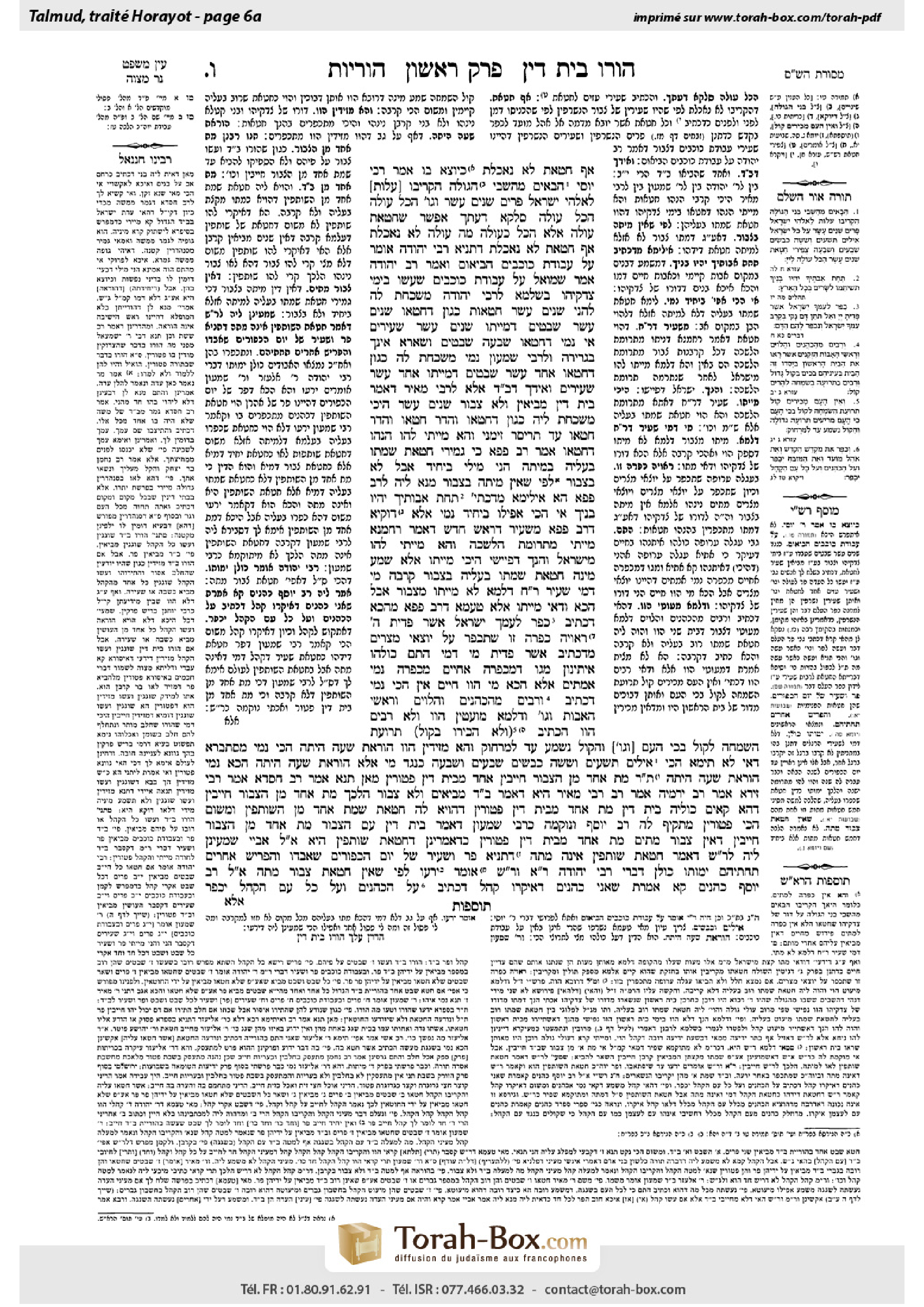
Horayot 6a: Talmud study for Daf Yomi
Study the Talmud for Daf Yomi with scanned pages, Hebrew text, English translations from Sefaria and AI-generated French translations.
Passage selection and English or AI-generated French translation are available where the scan has annotations. Daf Study is independent of Torah-Box and Sefaria.
Browse Horayot · הוריות · All tractatesHorayot 6a text and translations
This page of Horayot includes the Aramaic text, an English translation and an AI-generated French translation, alongside the scan above.
הוריות ו׳ א · Aramaic and Hebrew text
אַף חַטָּאת לֹא נֶאֱכֶלֶת.
כַּיּוֹצֵא בּוֹ, אָמַר רַבִּי יוֹסֵי: ״הַבָּאִים מֵהַשְּׁבִי הַגּוֹלָה הִקְרִיבוּ [עֹלוֹת] לֵאלֹהֵי יִשְׂרָאֵל פָּרִים שְׁנֵים עָשָׂר וְגוֹ׳ הַכֹּל עוֹלָה״. הַכֹּל עוֹלָה סָלְקָא דַּעְתָּךְ? אֶפְשָׁר שֶׁחַטָּאת עוֹלָה! אֶלָּא הַכֹּל כָּעוֹלָה: מָה עוֹלָה לֹא נֶאֱכֶלֶת – אַף חַטָּאת לֹא נֶאֱכֶלֶת. דְּתַנְיָא, רַבִּי יְהוּדָה אוֹמֵר: עַל עֲבוֹדָה זָרָה הֱבִיאוּם, וְאָמַר רַב יְהוּדָה אָמַר שְׁמוּאֵל: עַל עֲבוֹדָה זָרָה שֶׁעָשׂוּ בִּימֵי צִדְקִיָּהוּ.
בִּשְׁלָמָא לְרַבִּי יְהוּדָה, מַשְׁכַּחַתְּ לַהּ לְהָנֵי שְׁנֵים עָשָׂר חַטָּאוֹת כְּגוֹן דְּחָטְאוּ שְׁנֵים עָשָׂר שְׁבָטִים, דְּמַיְיתוּ שְׁנֵים עָשָׂר שְׂעִירִים. אִי נָמֵי דְּחָטְאוּ שִׁבְעָה שְׁבָטִים וּשְׁאָרָא אִינָךְ בִּגְרִירָה. וּלְרַבִּי שִׁמְעוֹן נָמֵי מַשְׁכַּחַתְּ לַהּ, כְּגוֹן דְּחָטְאוּ אַחַד עָשָׂר שְׁבָטִים, דְּמַיְיתוּ אַחַד עָשָׂר שְׂעִירִים וְאִידַּךְ דְּבֵית דִּין. אֶלָּא לְרַבִּי מֵאִיר דְּאָמַר: בֵּית דִּין מְבִיאִין וְלֹא צִבּוּר, שְׁנֵים עָשָׂר הֵיכִי מַשְׁכַּחַתְּ לֵיהּ? כְּגוֹן דְּחָטְאוּ וַהֲדַר חָטְאוּ וַהֲדַר חָטְאוּ, עַד תְּרֵיסַר זִימְנֵי.
וְהָא מַיְיתֵי לְהוּ הָנְהוּ דְּחָטְאוּ!
אָמַר רַב פָּפָּא: כִּי גְּמִירִי חַטָּאת שֶׁמֵּתוּ בְּעָלֶיהָ בְּמִיתָה – הָנֵי מִילֵּי בְּיָחִיד, אֲבָל לֹא בְּצִבּוּר, לְפִי שֶׁאֵין מִיתָה בְּצִבּוּר. מְנָא לֵיהּ לְרַב פָּפָּא הָא? אִילֵּימָא מִדִּכְתִיב: ״תַּחַת אֲבוֹתֶיךָ יִהְיוּ בָנֶיךָ״, אִי הָכִי אֲפִילּוּ בְּיָחִיד נָמֵי!
אֶלָּא דּוּקְיָא דְּרַב פָּפָּא מִשָּׂעִיר דְּרֹאשׁ חֹדֶשׁ, דְּאָמַר רַחֲמָנָא: מַיְיתֵי מִתְּרוּמַת הַלִּשְׁכָּה. וְהָא מַיְיתֵי לְהוּ מִיִּשְׂרָאֵל, וְהָנָךְ דְּפָיְישִׁי הֵיכִי מַיְיתוּ! אֶלָּא שְׁמַע מִינַּהּ: חַטָּאת שֶׁמֵּתוּ בְּעָלֶיהָ בְּצִבּוּר קְרֵבָה.
מִי דָּמֵי? שָׂעִיר דְּרֹאשׁ חֹדֶשׁ, דִּלְמָא לָא מַיְיתוּ מִצִּבּוּר, אֲבָל הָכָא וַדַּאי מַיְיתוּ! אֶלָּא טַעְמָא דְּרַב פָּפָּא מֵהָכָא, דִּכְתִיב: ״כַּפֵּר לְעַמְּךָ יִשְׂרָאֵל אֲשֶׁר פָּדִיתָ ה׳״ – רְאוּיָה כַּפָּרָה זוֹ שֶׁתְּכַפֵּר עַל יוֹצְאֵי מִצְרַיִם, מִדִּכְתִיב: ״אֲשֶׁר פָּדִיתָ״.
מִי דָּמֵי? הָתָם, כּוּלְּהוּ אִיתִינוּן מִגּוֹ דִּמְכַפְּרָה אַחַיִּים, מְכַפְּרָה נָמֵי אַמֵּתִים. אֶלָּא הָכָא מִי הֲווֹ חַיִּים? אִין, הָכִי נָמֵי, דִּכְתִיב: ״וְרַבִּים מֵהַכֹּהֲנִים וְהַלְוִיִּם וְרָאשֵׁי הָאָבוֹת וְגוֹ׳״.
וְדִלְמָא מוּעָטִין הֲווֹ וְלָא רַבִּים הֲווֹ! הָכְתִיב: ״(וְלֹא הִכִּירוּ בְּקוֹל) [וְאֵין הָעָם מַכִּירִים קוֹל] תְּרוּעַת הַשִּׂמְחָה לְקוֹל בְּכִי הָעָם [וְגוֹ׳] וְהַקּוֹל נִשְׁמַע עַד לְמֵרָחוֹק״.
וְהָא מְזִידִין הֲווֹ! הוֹרָאַת שָׁעָה הָיְתָה. הָכִי נָמֵי מִסְתַּבְּרָא, דְּאִי לָא תֵּימָא הָכִי – ״אֵילִים תִּשְׁעִים וְשִׁשָּׁה כְּבָשִׂים שִׁבְעִים וְשִׁבְעָה״, כְּנֶגֶד מִי? אֶלָּא הוֹרָאַת שָׁעָה הָיְתָה, הָכָא נָמֵי הוֹרָאַת שָׁעָה הָיְתָה.
תָּנוּ רַבָּנַן: מֵת אֶחָד מִן הַצִּבּוּר – חַיָּיבִין, אֶחָד מִבֵּית דִּין – פְּטוּרִין. מַאן תַּנָּא? אָמַר רַב חִסְדָּא אָמַר רַבִּי זֵירָא אָמַר רַב יִרְמְיָה אָמַר רַב, רַבִּי מֵאִיר הִיא, דְּאָמַר: בֵּית דִּין מְבִיאִים וְלֹא צִבּוּר, הִלְכָּךְ מֵת אֶחָד מִן הַצִּבּוּר – חַיָּיבִין, דְּהָא קָאֵים כּוּלֵּיהּ בֵּית דִּין, מֵת אֶחָד מִבֵּית דִּין – פְּטוּרִין, דְּהָוְיָא לַהּ חַטָּאת שֶׁמֵּת אֶחָד מִן הַשּׁוּתָּפִין, וּמִשּׁוּם הָכִי פְּטוּרִין.
מַתְקֵיף לַהּ רַב יוֹסֵף: וְנוֹקְמַהּ כְּרַבִּי שִׁמְעוֹן, דְּאָמַר: בֵּית דִּין עִם הַצִּבּוּר, מֵת אֶחָד מִן הַצִּבּוּר – חַיָּיבִין, דְּאֵין צִבּוּר מֵתִים. מֵת אֶחָד מִבֵּית דִּין – פְּטוּרִין, כִּדְאָמְרִינַן דְּחַטָּאת שׁוּתָּפִין הִיא!
אֲמַר לֵיהּ אַבָּיֵי, שָׁמְעִינַן לֵיהּ לְרַבִּי שִׁמְעוֹן דְּאָמַר: חַטַּאת שׁוּתָּפִין אֵינָהּ מֵתָה, דְּתַנְיָא: פַּר וְשָׂעִיר שֶׁל יוֹם הַכִּפּוּרִים שֶׁאָבְדוּ, וְהִפְרִישׁ אֲחֵרִים תַּחְתֵּיהֶם – יָמוּתוּ כּוּלָּן, דִּבְרֵי רַבִּי יְהוּדָה. רַבִּי אֶלְעָזָר וְרַבִּי שִׁמְעוֹן אוֹמֵר: יִרְעוּ, לְפִי שֶׁאֵין חַטַּאת צִבּוּר מֵתָה.
אֲמַר לֵיהּ רַב יוֹסֵף: כֹּהֲנִים קָא אָמְרַתְּ? שָׁאנֵי כֹּהֲנִים, דְּאִיקְּרוּ קָהָל, דִּכְתִיב: ״עַל הַכֹּהֲנִים וְעַל כׇּל עַם הַקָּהָל יְכַפֵּר״.
Horayot 6a · English translation
so too, this sin-offering is not eaten.
Similarly, Rabbi Yosei said that it is stated with regard to those who returned to Zion from Babylonia in the days of Ezra: “The children of the captivity who came out of exile sacrificed burnt-offerings to the God of Israel, twelve bulls for all Israel, ninety-six rams, seventy-seven lambs, twelve goats as a sin-offering; all this was a burnt-offering unto the Lord” (Ezra 8:35). The question arises: Does it enter your mind to say: “All this was a burnt-offering”? Is it possible that a sin-offering is a burnt-offering? Rather, say: All this was like a burnt-offering. Just as a burnt-offering is not eaten, so too, this sin-offering is not eaten, as it is taught in a baraita that Rabbi Yehuda says: It was as atonement for idol worship that they brought them; and Rav Yehuda says that Shmuel says: It was atonement for the idol worship that they practiced during the days of Zedekiah.
The Gemara clarifies: Granted, according to Rabbi Yehuda, whose opinion is cited in the mishna, you find liability for these twelve sin-offerings in a case where twelve tribes sinned by engaging in idol worship, as in that case they bring twelve goats. Alternatively, you find liability in a case where seven tribes sinned, and the rest of these tribes that did not sin are drawn after the majority of tribes that sinned and each brings a sin-offering. And according to Rabbi Shimon as well, you find liability for these twelve sin-offerings in a case where eleven tribes sinned, as in that case they bring eleven goats and the other goat is brought by the court. But according to Rabbi Meir, who says that the court brings an offering and the public does not, and only one bull is sacrificed, how do you find this a case of liability to bring twelve offerings? The Gemara answers: It is in a case where they sinned, and then sinned again, and then sinned again, until they sinned twelve times.
The Gemara asks: But didn’t those who sinned by engaging in idol worship during the time of Zedekiah and the Babylonian exile already die? How can their descendants bring a sin-offering on their behalf? The status of those animals is that of a sin-offering whose owner has died, which is disqualified from sacrifice on the altar.
Rav Pappa said: When it is learned as a tradition that the fate of a sin-offering whose owners have died is to allow the animal to die without its being sacrificed, this matter applies specifically with regard to an individual who died but not with regard to a congregation, because there is no death with regard to a congregation; the entity of the congregation remains even when specific members die. The Gemara asks: From where does Rav Pappa derive this? If we say that he derives it from that which is written: “Instead of your fathers shall be your sons” (Psalms 45:17), indicating that as long as the sons are alive it is as though the fathers are alive, then if so, the same should be true even with regard to an individual as well, and sons should be able to sacrifice the sin-offerings of their dead fathers.
Rather, the inference of Rav Pappa is from the goat of the New Moon, as the Merciful One states: Bring those sin-offerings from the collection of the Temple treasury chamber, where the half-shekels contributed by the Jewish people every Adar are stored. But haven’t some of the Jewish people died since Adar? If so, how can those who remain bring a sin-offering if some of the owners of the offering have died? Rather, learn from it that a sin-offering whose owners have died may be sacrificed in the case of a communal offering.
The Gemara asks: Are these matters comparable? In the case of the goat of the New Moon, perhaps no one from the public died in the interim. But here, in the case of those who returned to Zion from Babylonia, those who engaged in idol worship in the days of Zedekiah certainly died, as many years have passed since then. Rather, the reason for the opinion of Rav Pappa is from here, as it is written in the confession recited by the Sages during the rite of the heifer whose neck is broken: “Atone for Your people Israel whom You have redeemed, Lord” (Deuteronomy 21:8). This atonement is fit to atone even for those who emerged from Egypt, from the fact that it is written: “Whom You have redeemed.” The reference is to those whom God redeemed from Egypt, even though they died long ago.
The Gemara asks: Are these matters comparable? There, in the case of the heifer whose neck is broken, all the residents of the city on whose behalf the rite was performed are present when they perform the rite, and since it atones for the living, it also atones for the dead. But here, in the case of those returning from Zion, are any of the people who worshipped idols during the time of Zedekiah alive when the offering is sacrificed? The Gemara answers: Yes, it is indeed so that there were people from that period still alive, as it is written: “Many of the priests and Levites and heads of patrilineal houses, the elders that had seen the first house standing on its foundation, wept with a loud voice when this house was before their eyes. And many shouted aloud for joy” (Ezra 3:12).
The Gemara challenges: But perhaps those elders were few in number, and were not many, and the majority of those present consisted of people who were not alive during the days of Zedekiah. The Gemara answers: Isn’t it written: “And the people could not discern the noise of the shout of joy from the noise of the weeping of the people; as the people shouted with a loud shout, and the noise was heard far off” (Ezra 3:13)? This indicates that the weeping elders who survived from the era of Zedekiah outnumbered the younger people.
The Gemara asks: But didn’t those who engaged in idol worship in the era of Zedekiah do so intentionally? Sin-offerings are brought for unwitting, not intentional sins. The Gemara answers: It was a provisional edict issued in exigent circumstances to enable them to sacrifice a sin-offering to atone for an intentional sin. The Gemara comments: So too it is reasonable, as if you do not say so, then with regard to these “ninety-six rams, seventy-seven lambs,” to what do they correspond? Rather, the sacrifice of those rams and lambs was a provisional edict. Here too, concerning sin-offerings for intentional transgressions, it was a provisional edict.
§ On a related note, the Sages taught: If the court unwittingly issued a ruling and the congregation performed a transgression on the basis of that ruling, and before the offering was brought one member of the public died, they are liable to bring an offering. If one member of the court died, they are exempt. The Gemara asks: Who is the tanna who stated this halakha? Rav Ḥisda said that Rabbi Zeira said that Rav Yirmeya said that Rav said: It is Rabbi Meir, who says: The court, and not the public, brings the offering. Therefore, if one member of the public died the court is liable, as the entire court remains intact. If one member of the court died the court is exempt, as the halakha here is like the halakha of a sin-offering that one of the partners who co-own the offering died, and due to that reason the court is exempt.
Rav Yosef objects to this: And let us establish this halakha in accordance with the opinion of Rabbi Shimon, who says: The court, together with the public, brings the offering. Therefore, if one member of the public died the court is still liable, as the public does not die. But if one member of the court died the court is exempt, in accordance with that which we say, that it is a sin-offering belonging to partners.
Abaye said to Rav Yosef: We heard with regard to Rabbi Shimon that he says: A sin-offering belonging to partners is not left to die, as it is taught in a baraita: In a case where a bull and a goat of Yom Kippur were lost, and one designated other animals in their place, and then the lost animals were found, they shall all be left to die; this is the statement of Rabbi Yehuda. Rabbi Elazar and Rabbi Shimon say: They shall graze until they develop a blemish, due to the fact that a communal sin-offering is not left to die. The bull sacrificed on Yom Kippur belongs to the priests, and is therefore a sin-offering belonging to partners; nevertheless, Rabbi Shimon holds that its status is not that of a bull whose owners died.
Rav Yosef said to Abaye: Priests, you say? Priests are different, as they are characterized as a congregation in and of themselves, as it is written: “And for the priests and for all the people of the congregation he shall atone” (Leviticus 16:33).
Horayot 6a · Traduction française (IA)
De même, ce sacrifice de culpabilité n'est pas mangé.
De même, Rabbi Yosei a dit que cela est mentionné concernant ceux qui sont revenus à Jérusalem depuis Babylone aux jours d'Esdras : « Les enfants de la captivité qui sont sortis de l'exil sacrifièrent des holocaustes à Dieu d'Israël, douze taureaux pour tout Israël, quatre-vingt-seize agnelles, soixante-dix-sept brebis, douze boucs comme sacrifice de culpabilité ; tout cela était un holocauste pour l'Éternel » (Esdras 8:35). La question se pose : Est-ce que cela entre dans votre esprit de dire : « Tout cela était un holocauste » ? Est-il possible qu'un sacrifice de culpabilité soit un holocauste ? Plutôt, dites : tout cela était comme un holocauste. Tout comme un holocauste n'est pas mangé, de même ce sacrifice de culpabilité n'est pas mangé, comme il est enseigné dans une baraïta que Rabbi Yéhuda dit : Ils l'apportèrent comme expiation pour l'idolâtrie ; et Rav Yéhuda dit que Shmuel dit : C'était l'expiation pour l'idolâtrie qu'ils pratiquaient aux jours de Zédéquias.
La Guemara clarifie : C'est évident selon Rabbi Yéhuda, dont l'opinion est citée dans la mitsva, que vous trouvez une responsabilité pour ces douze sacrifices de culpabilité dans un cas où douze tribus ont péché en pratiquant l'idolâtrie, comme dans ce cas-là ils apportent douze boucs. Alternativement, vous trouvez une responsabilité dans un cas où sept tribus ont péché, et les autres tribus qui n'ont pas péché suivent la majorité des tribus qui ont péché et chacun apporte un sacrifice de culpabilité. Et selon Rabbi Shimon également, vous trouvez une responsabilité pour ces douze sacrifices de culpabilité dans un cas où onze tribus ont péché, comme dans ce cas-là ils apportent onze boucs et le bouc restant est apporté par le tribunal. Mais selon Rabbi Méir, qui dit que le tribunal apporte un sacrifice et que le public n'apporte pas, et qu'un seul taureau est sacrifié, comment trouvez-vous ce cas une responsabilité d'apporter douze sacrifices ? La Guemara répond : C'est dans un cas où ils ont péché, puis ont péché à nouveau, puis ont péché à nouveau, jusqu'à ce qu'ils aient péché douze fois.
La Guemara pose la question : Mais ne sont-ce pas ceux qui ont péché en pratiquant l'idolâtrie pendant la période de Zédéquias et de l'exil babylonien qui sont déjà morts ? Comment leurs descendants peuvent-ils apporter un sacrifice expiatoire à leur place ? Le statut de ces animaux est celui d'un sacrifice expiatoire dont l'owner est mort, ce qui les disqualifie de sacrifice sur l'autel.
Rav Pappa a dit : Lorsqu'il est appris comme une tradition que le sort d'un sacrifice expiatoire dont les propriétaires sont morts est de permettre à l'animal de mourir sans être sacrifié, cette affaire s'applique spécifiquement à un individu, mais pas à une communauté, car il n'y a pas de mort dans le cas d'une communauté ; l'entité de la communauté subsiste même lorsque ses membres individuels meurent. La Guemara pose la question : D'où Rav Pappa tire-t-il cette conclusion ? Si nous disons qu'il le tire de ce qui est écrit : « Au lieu de vos pères seront vos fils » (Psaumes 45:17), indiquant que tant que les fils sont vivants, cela est comme si les pères étaient vivants, alors si c'est le cas, cela devrait être vrai également pour un individu, et les fils devraient pouvoir sacrifier les sacrifices expiatoires de leurs pères morts.
Plutôt, l'inférence de Rav Pappa est tirée du bouc de la nouvelle lune, car l'Éternel dit : Apportez ces sacrifices expiatoires de la collection de la chambre du trésor du Temple, où les demi-shekels contribués par le peuple juif chaque Adar sont conservés. Mais n'ont-ils pas eu des morts parmi le peuple juif depuis Adar ? Si oui, comment peuvent ceux qui restent apporter un sacrifice expiatoire si certains propriétaires du sacrifice sont morts ? Plutôt, apprenez-en que le sacrifice expiatoire dont les propriétaires sont morts peut être sacrifié dans le cas d'un sacrifice communautaire.
La Guemara pose la question : Sont-ils comparables ? Dans le cas du bouc de la nouvelle lune, peut-être personne n'est mort parmi le public pendant l'intervalle. Mais ici, dans le cas de ceux qui sont revenus à Jérusalem depuis Babylone, ceux qui ont pratiqué l'idolâtrie pendant les jours de Zédéquias sont certainement morts, car beaucoup d'années se sont écoulées depuis lors. Plutôt, la raison de l'opinion de Rav Pappa est tirée d'ici, comme il est écrit dans la confession prononcée par les Sages lors de la cérémonie de la bête dont le cou est brisé : « Pardonnez votre peuple Israël que vous avez racheté, Seigneur » (Deutéronome 21:8). Cette expiation est adaptée pour expier même ceux qui sont sortis d'Égypte, du fait qu'il est écrit : « Que vous avez racheté », ce qui fait référence à ceux que Dieu a rachetés d'Égypte, même s'ils sont morts depuis longtemps.
La Guemara pose la question : Sont-ils comparables ? Là, dans le cas de la bête dont le cou est brisé, tous les habitants de la ville dont la cérémonie a été accomplie sont présents lorsqu'ils accomplissent la cérémonie, et puisque cela expie pour les vivants, cela expie aussi pour les morts. Mais ici, dans le cas de ceux qui sont revenus de Jérusalem, y a-t-il des personnes qui ont adoré des dieux pendant les jours de Zédéquias encore vivantes lorsqu'on sacrifie le sacrifice ? La Guemara répond : Oui, c'est effectivement le cas que des personnes de cette époque étaient encore vivantes, comme il est écrit : « Beaucoup des prêtres et des Lévites et des chefs des familles, les anciens qui avaient vu la première maison sur sa fondation, pleurèrent avec un cri fort lorsqu'ils virent cette maison. Et beaucoup crièrent de joie » (Esdras 3:12).
La Guemara conteste : Mais peut-être ces anciens étaient peu nombreux, et n'étaient pas nombreux, et la majorité des personnes présentes étaient des personnes qui n'étaient pas vivantes pendant les jours de Zédéquias. La Guemara répond : N'est-il pas écrit : « Et le peuple ne pouvait distinguer le bruit du cri de joie du bruit des larmes du peuple ; car le peuple cria avec un cri fort, et le bruit fut entendu loin » (Esdras 3:13) ? Cela indique que les anciens pleurant qui sont survivants de l'époque de Zédéquias surpassaient en nombre les jeunes gens.
La Guemara pose la question : Mais ne sont-ils pas ceux qui ont pratiqué l'idolâtrie durant l'époque de Zédéquias, qui l'ont fait intentionnellement ? Les sacrifices expiatoires sont offerts pour les péchés involontaires, pas pour les péchés intentionnels. La Guemara répond : C'était un édit provisoire émis dans des circonstances urgentes afin de permettre à ces personnes de présenter un sacrifice expiatoire pour expier un péché intentionnel. La Guemara commente : De même, c'est raisonnable, car si l'on ne le dit pas, à quoi correspondent ces « quatre-vingt-six béliers, soixante-dix-sept agneaux » ? Plutôt, le sacrifice de ces béliers et agneaux était un édit provisoire. De même, concernant les sacrifices expiatoires pour des transgressions intentionnelles, c'était un édit provisoire.
§ En lien avec cela, les Sages enseignent : Si la cour a émis un jugement involontaire et que la communauté a commis un péché en se basant sur ce jugement, et avant que l'offrande ne soit présentée, un membre du public est mort, ils doivent présenter un sacrifice. Si un membre de la cour est mort, ils sont exemptés. La Guemara pose la question : De quel tanna provient cette halakha ? Rav Ḥisda a dit que Rabbi Zéria a dit que Rav Yirméya a dit que Rav a dit : C'est Rabbi Méir, qui dit : La cour, et non le public, présente l'offrande. Ainsi, si un membre du public est mort, la cour est tenue responsable, car la cour entière reste intacte. Si un membre de la cour est mort, la cour est exemptée, car la halakha ici est comme celle d'un sacrifice expiatoire dont l'un des associés qui possède l'offrande est mort, et pour cette raison la cour est exemptée.
Rav Yosef s'oppose à cela : Et établisons cette halakha selon l'opinion de Rabbi Shimon, qui dit : La cour, ensemble avec le public, présente l'offrande. Ainsi, si un membre du public est mort, la cour reste responsable, car le public ne meurt pas. Mais si un membre de la cour est mort, la cour est exemptée, conformément à ce que nous disons, que c'est un sacrifice expiatoire appartenant à des associés.
Abaye a dit à Rav Yosef : Nous avons entendu concernant Rabbi Shimon qu'il dit : Un sacrifice expiatoire appartenant à des associés ne doit pas être laissé mourir, comme il est enseigné dans une baraïta : Dans un cas où un taureau et un bouc de Yom Kippur ont été perdus, et qu'un autre animal a été désigné à leur place, et que les animaux perdus ont été retrouvés, ils doivent tous être laissés mourir ; c'est la déclaration de Rabbi Yéhouda. Rabbi Eléazar et Rabbi Shimon disent : Ils doivent paître jusqu'à ce qu'ils développent une tache, en raison du fait qu'un sacrifice expiatoire communautaire ne doit pas être laissé mourir. Le taureau sacrifié le Yom Kippur appartient aux prêtres et est donc un sacrifice expiatoire appartenant à des associés ; néanmoins, Rabbi Shimon considère que son statut n'est pas celui d'un taureau dont les propriétaires sont morts.
Rav Yosef a dit à Abaye : Les prêtres, vous dites cela ? Les prêtres sont différents, car ils sont caractérisés comme une congrégation en soi, comme il est écrit : « Et pour les prêtres et pour toute la communauté du peuple il expiera » (Lévitique 16:33).
Traduction française générée par IA à partir de l’édition anglaise de Sefaria. Vérifie toujours un passage avec le texte source.
Text from Sefaria: William Davidson Edition - Vocalized Aramaic (CC BY NC); William Davidson Edition - English (CC BY NC).