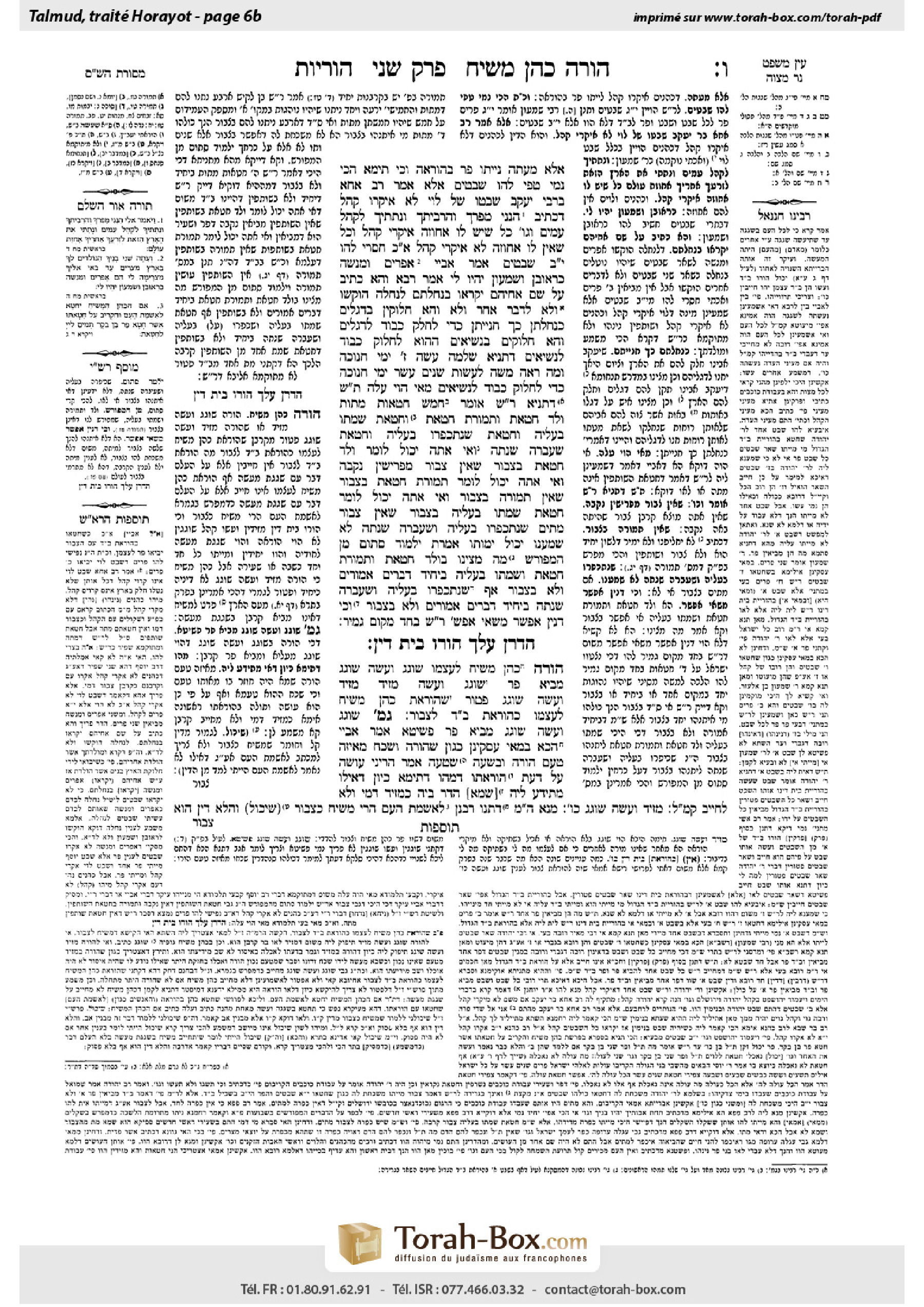
Horayot 6b: Talmud study for Daf Yomi
Study the Talmud for Daf Yomi with scanned pages, Hebrew text, English translations from Sefaria and AI-generated French translations.
Passage selection and English or AI-generated French translation are available where the scan has annotations. Daf Study is independent of Torah-Box and Sefaria.
Browse Horayot · הוריות · All tractatesHorayot 6b text and translations
This page of Horayot includes the Aramaic text, an English translation and an AI-generated French translation, alongside the scan above.
הוריות ו׳ ב · Aramaic and Hebrew text
אֶלָּא מֵעַתָּה נַיְיתוֹ פַּר בְּהוֹרָאָה! וְכִי תֵּימָא, הָכִי נָמֵי – טָפִי לְהוּ שְׁבָטִים.
אֶלָּא אָמַר רַב אַחָא בְּרַבִּי יַעֲקֹב: שִׁבְטוֹ שֶׁל לֵוִי לָא אִיקְּרוּ קָהָל, דִּכְתִיב: ״הִנְנִי מַפְרְךָ וְהִרְבִּיתִךָ וּנְתַתִּיךָ לִקְהַל עַמִּים וְגוֹ׳״. כֹּל שֶׁיֵּשׁ לוֹ אֲחוּזָּה – אִיקְּרִי קָהָל, וְכֹל שֶׁאֵין לוֹ אֲחוּזָּה – לָא אִיקְּרִי קָהָל.
אִם כֵּן, חָסְרִי לְהוּ שְׁנֵים עָשָׂר שְׁבָטִים! אָמַר אַבָּיֵי: ״אֶפְרַיִם וּמְנַשֶּׁה כִּרְאוּבֵן וְשִׁמְעוֹן יִהְיוּ לִי״. אָמַר רָבָא, וְהָא כְּתִיב: ״עַל שֵׁם אֲחֵיהֶם יִקָּרְאוּ בְּנַחֲלָתָם״, לְנַחֲלָה הוּקְשׁוּ וְלֹא לְדָבָר אַחֵר!
וְלָא? וְהָא חֲלוּקִין בַּדְּגָלִים! כְּנַחֲלָתָן כָּךְ חֲנִיָּיתָן, כְּדֵי לְחַלֵּק כָּבוֹד לַדְּגָלִים.
וְהָא חֲלוּקִים בַּנְּשִׂיאִים! הָהוּא, לַחֲלוֹק כָּבוֹד לַנְּשִׂיאִים. דְּתַנְיָא: שְׁלֹמֹה עָשָׂה שִׁבְעָה יְמֵי חֲנוּכָּה, וּמָה רָאָה מֹשֶׁה לַעֲשׂוֹת שְׁנֵים עָשָׂר יְמֵי חֲנוּכָּה? כְּדֵי לַחֲלוֹק כָּבוֹד לַנְּשִׂיאִים.
מַאי הָוֵי עֲלַהּ?
תָּא שְׁמַע, דְּתַנְיָא: רַבִּי שִׁמְעוֹן אוֹמֵר, חָמֵשׁ חַטָּאוֹת מֵתוֹת: וְלַד חַטָּאת, וּתְמוּרַת חַטָּאת, וְחַטָּאת שֶׁמֵּתוּ בְּעָלֶיהָ, וְחַטָּאת שֶׁנִּתְכַּפְּרוּ בְּעָלֶיהָ, וְחַטָּאת שֶׁעָבְרָה שְׁנָתָהּ. וְאִי אַתָּה יָכוֹל לוֹמַר וְלַד חַטָּאת בְּצִבּוּר, שֶׁאֵין צִבּוּר מַפְרִישִׁין נְקֵבָה. וְאִי אַתָּה יָכוֹל לוֹמַר תְּמוּרַת חַטָּאת בְּצִבּוּר, שֶׁאֵין תְּמוּרָה בְּצִבּוּר. וְאִי אַתָּה יָכוֹל לוֹמַר חַטָּאת שֶׁמֵּתוּ בְּעָלֶיהָ בְּצִבּוּר, שֶׁאֵין צִבּוּר מֵתִים.
שֶׁנִּתְכַּפְּרוּ בְּעָלֶיהָ וְשֶׁעָבְרָה שְׁנָתָהּ – לֹא שָׁמַעְנוּ, יָכוֹל יָמוּתוּ? אָמַרְתָּ: יִלְמוֹד סָתוּם מִן הַמְפוֹרָשׁ, מַה מָּצִינוּ בִּוְלַד חַטָּאת וּתְמוּרַת חַטָּאת וְשֶׁמֵּתוּ בְּעָלֶיהָ – בְּיָחִיד דְּבָרִים אֲמוּרִים וְלֹא בְּצִבּוּר, אַף שֶׁנִּתְכַּפְּרוּ בְּעָלֶיהָ וְשֶׁעָבְרָה שְׁנָתָהּ – בְּיָחִיד דְּבָרִים אֲמוּרִים וְלֹא בְּצִבּוּר.
וְכִי דָּנִין אֶפְשָׁר מִשֶּׁאִי אֶפְשָׁר? רַבִּי שִׁמְעוֹן בְּחַד מָקוֹם גְּמִיר.
הַדְרָן עֲלָךְ הוֹרוּ בֵּית דִּין
מַתְנִי׳ הוֹרָה כֹּהֵן מָשִׁיחַ לְעַצְמוֹ שׁוֹגֵג וְעָשָׂה שׁוֹגֵג – מֵבִיא פַּר. שׁוֹגֵג וְעָשָׂה מֵזִיד, מֵזִיד וְעָשָׂה שׁוֹגֵג – פָּטוּר, שֶׁהוֹרָאַת כֹּהֵן מָשִׁיחַ לְעַצְמוֹ כְּהוֹרָאַת בֵּית דִּין לַצִּבּוּר.
גְּמָ׳ שׁוֹגֵג וְעָשָׂה שׁוֹגֵג – מֵבִיא פַּר. פְּשִׁיטָא!
אָמַר אַבָּיֵי: הָכָא בְּמַאי עָסְקִינַן? כְּגוֹן שֶׁהוֹרָה, וְשָׁכַח מֵאֵיזֶה טַעַם הוֹרָה, וּבְשָׁעָה שֶׁטָּעָה אָמַר: הֲרֵינִי עוֹשֶׂה עַל דַּעַת הוֹרָאָתוֹ, דְּמַהוּ דְּתֵימָא: כֵּיוָן דְּאִילּוּ מִתְיְדַע לֵיהּ, [שֶׁמָּא] הָדַר בֵּיהּ – כְּמֵזִיד דָּמֵי וְלָא לִחַיַּיב, קָא מַשְׁמַע לַן.
מֵזִיד וְעָשָׂה שׁוֹגֵג כּוּ׳. מְנָא הָנֵי מִילֵּי? דְּתָנוּ רַבָּנַן: ״לְאַשְׁמַת הָעָם״, הֲרֵי מָשִׁיחַ כְּצִבּוּר. שֶׁיָּכוֹל, וַהֲלֹא דִין הוּא:
Horayot 6b · English translation
The Gemara challenges: If that is so, that the priests are characterized as a congregation, let them bring a bull as an unwitting communal offering if they perform a transgression on the basis of the ruling of the court. And if you would say indeed it is so, that is difficult, as the number of tribes has increased to thirteen.
Rather, Rav Aḥa, son of Rabbi Ya’akov, said: The tribe of Levi is not characterized as a congregation, as it is written: “Behold, I will make you fruitful and multiply you, and I will make of you a congregation of peoples; and I will give this land to your descendants after you for an everlasting possession” (Genesis 48:4). It is derived from here that any tribe that has an ancestral possession bequeathed to it is characterized as a congregation, and any tribe that does not have an ancestral possession bequeathed to it is not characterized as a congregation. The tribe of Levi has no ancestral land, and the priests who are from the tribe of Levi have no ancestral land.
The Gemara challenges: If so, the twelve tribes are lacking in number, as without the tribe of Levi there are only eleven. Abaye said that it is stated: “Ephraim and Manasseh shall be like Reuben and Simeon to me” (Genesis 48:5), and they are counted as two tribes. Rava said: But isn’t it written: “After the name of their brethren shall they be called in their inheritance” (Genesis 48:6), indicating that it is with regard to inheritance that they are likened to tribes, but not with regard to another matter?
The Gemara challenges: And are they not considered independent tribes concerning other matters as well? But aren’t they separate with regard to the banners under which the Jewish people traveled in the wilderness? There were three tribes represented by each banner, and the three tribes under the banner of Manasseh were Manasseh, Ephraim, and Benjamin. The Gemara answers: In accordance with the division of the tribes according to their inheritances, so was the division of the tribes in their encampment around the Tabernacle. This was in order to honor the banners, so that there would be three tribes affiliated with each banner.
The Gemara asks: But aren’t they separate with regard to the matter of princes of the tribes, as the tribes of Ephraim and Manasseh had separate princes? The Gemara answers: That was in order to honor the princes, and there is no proof that they are two different tribes with regard to other matters. This is as it is taught in a baraita: Solomon set seven days of dedication of the Holy Temple, and what did Moses see that led him to set twelve days of dedication for the Tabernacle? He did so in order to honor the tribal princes, so that the prince of each tribe would bring his offering on his own day. Due to the honor each prince deserved, Ephraim and Manasseh are considered two tribes.
The Gemara asks: What conclusion was reached about Rabbi Shimon’s opinion? Does he hold that a sin-offering brought by several partners is different from a communal sin-offering, as Rav Yosef explained, or does he hold that there is no difference between them, as Abaye explained?
The Gemara suggests: Come and hear proof, as it is taught in a baraita that Rabbi Shimon says: There are five sin-offerings that are left to die, as they may not be sacrificed: The offspring of a sin-offering born after its mother was consecrated as a sin-offering; the substitute of a sin-offering, which assumes sacred status but may not be sacrificed; a sin-offering whose owners have died; a sin-offering whose owners’ sin was atoned for with another offering; and a sin-offering whose first year has passed, as a sin-offering may be brought only within the animal’s first year. And you cannot state a case of the offspring of a communal sin-offering, as the congregation does not designate a female as a sin-offering, And you cannot state a case of a substitute of a communal sin-offering, as there is no substitute for a communal offering. And you cannot state a case of a sin-offering whose owners have died in the case of a communal sin-offering, as the public does not die.
With regard to a sin-offering whose owners’ sin was atoned for and a sin-offering whose first year has passed, we did not hear whether the halakha applies to communal sin-offerings as well. One might have thought they too shall be left to die. You say: One shall derive the vague from the explicit. What did we find with regard to the offspring of a sin-offering, the substitute of a sin-offering, and a sin-offering whose owners died? We found that these matters are stated only with regard to an individual sin-offering, but not with regard to a communal sin-offering. So too, these matters of a sin-offering whose owners’ sin was atoned for and a sin-offering whose first year has passed are stated only with regard to an individual sin-offering, but not with regard to a communal sin-offering. Likewise, one may derive that an individual’s sin-offering must be left to die, while a sin-offering owned by partners is not left to die.
The Gemara asks: And does one derive the halakha of the possible from the impossible? Some of these cases are by their very nature not relevant to communal sin-offerings. One cannot derive the halakha from them with regard to cases that could be relevant to communal sin-offerings. The Gemara answers: Rabbi Shimon learns all these halakhot of sin-offerings that are left to die as a tradition in one place, i.e., as a single halakha. In cases where not all the categories of sin-offerings left to die apply, no category of sin-offerings that are left to die applies.
MISHNA: In a case where an anointed priest, i.e., the High Priest, issued an erroneous ruling for himself permitting performance of an action prohibited by Torah law, if he issued the ruling unwittingly and then unwittingly performed the transgression in accordance with his ruling, he is liable to bring a bull as a sin-offering for an unwitting transgression by the anointed priest. If he issued the ruling unwittingly, and performed the transgression intentionally, or if he issued the ruling intentionally and performed the transgression unwittingly, he is exempt from liability to bring any offering, as there is a principle: The legal status of the ruling of an anointed priest for himself is like that of the ruling of the court for the general public. Therefore, the High Priest is liable to bring the bull as a sin-offering for his unwitting transgression in a case when the court would be liable to bring the bull as a communal sin-offering for an unwitting transgression performed by the general public.
GEMARA: The mishna teaches: If he issued the ruling unwittingly and then unwittingly performed the transgression in accordance with his ruling, he is liable to bring a bull. The Gemara asks: Isn’t this obvious? This is certainly a case of an unwitting transgression, for which the Torah deems him liable to bring an offering.
Abaye said: What are we dealing with here? We are dealing with a case where he issued an erroneous ruling and forgot the reason that was the basis upon which he issued the ruling, and at the moment that he erred and performed the transgression, he said: I am hereby performing this action with my ruling in mind. As, lest you say: Since if the reason that was the basis upon which he issued the ruling became known to him at that moment, perhaps he would have retracted his ruling, therefore if he nevertheless performed his transgression, his status is like that of an intentional transgressor, and let him not be liable to bring an offering; to counter this, the tanna teaches us that this too is a case of an unwitting transgression.
§ The mishna teaches: If he issued the ruling unwittingly, and performed the transgression intentionally, or if he issued the ruling intentionally and performed the transgression unwittingly, he is exempt. The Gemara asks: From where are these matters, the halakhot unique to the sin-offering for an unwitting transgression by the anointed priest, derived? They are derived from a verse, as the Sages taught in a baraita: It is written: “If the anointed priest shall sin so as to bring guilt upon the people” (Leviticus 4:3), from which it is derived that the liability of the anointed priest is incurred like that of the general public. The Gemara discusses this derivation. As one might have thought that the verse is superfluous: Could this not be derived through logical inference?
Horayot 6b · Traduction française (IA)
La Guemara questionne : Si c’est ainsi, que les prêtres sont considérés comme une communauté, qu’ils apportent un taureau comme offrande communautaire involontaire s’ils commettent une transgression sur la base de la décision du tribunal. Et si vous dites effectivement que c’est ainsi, c’est difficile, car le nombre des tribus a augmenté à treize.
Au contraire, Rav Acha, fils de Rabbi Jacob, dit : La tribu de Lévi n’est pas considérée comme une communauté, car il est écrit : « Voici que je ferai de toi une multitude de peuples, et je donnerai cette terre à tes descendants après toi pour une possession éternelle » (Genèse 48 : 4). On en déduit ici que toute tribu qui possède une terre héréditaire est considérée comme une communauté, et toute tribu qui n’a pas une terre héréditaire n’est pas considérée comme une communauté. La tribu de Lévi n’a pas de terre héréditaire, et les prêtres issus de la tribu de Lévi n’ont pas de terre héréditaire.
La Guemara questionne : Si c’est ainsi, les douze tribus manquent en nombre, car sans la tribu de Lévi, il n’y a que onze. Abaye dit que cela est dit : « Ephraïm et Manassé seront comme Rouben et Siméon pour moi » (Genèse 48 : 5), et ils sont comptés comme deux tribus. Rava dit : Mais n’est-il pas écrit : « Selon le nom de leurs frères, ils seront appelés dans leur héritage » (Genèse 48 : 6), indiquant qu’il s’agit de l’héritage, mais pas d’autre chose ?
La Guemara pose un défi : Et ne sont-ils pas considérés comme des tribus indépendantes concernant d’autres matières également ? Mais ne sont-ils pas séparés concernant les drapeaux sous lesquels le peuple juif marchait dans le désert ? Il y avait trois tribus représentées par chaque drapeau, et les trois tribus sous le drapeau de Manassé étaient Manassé, Ephraïm et Benjamin. La Guemara répond : Selon la division des tribus selon leurs héritages, ainsi était divisée la division des tribus dans leur campement autour du Tabernacle. Cela avait pour but d’honorer les drapeaux, afin qu’il y ait trois tribus affiliées à chaque drapeau.
La Guemara demande : Mais ne sont-ils pas séparés concernant la question des princes des tribus, car les tribus d’Ephraïm et de Manassé avaient des princes séparés ? La Guemara répond : Cela avait pour but d’honorer les princes, et il n’y a pas de preuve qu’ils soient deux tribus différentes concernant d’autres matières. C’est ce qui est enseigné dans une baraïta : Salomon a institué sept jours de consécration du Temple Saint, et que vit Moïse qui l’a conduit à instituer douze jours de consécration pour le Tabernacle ? Il l’a fait afin d’honorer les princes des tribus, afin que le prince de chaque tribu apporte son offrande un jour de son choix. En raison de l’honneur que chaque prince méritait, Ephraïm et Manassé sont considérés comme deux tribus.
La Guemara demande : Quelle était la conclusion concernant l’opinion de Rabbi Shimon ? Tient-il compte que l’offrande expiatoire apportée par plusieurs partenaires est différente de l’offrande expiatoire communautaire, comme Rav Yosef l’a expliqué, ou tient-il compte qu’il n’y a pas de différence entre eux, comme Abaye l’a expliqué ?
La Guemara suggère : Viens entendre la preuve, car il est enseigné dans une baraïta que Rabbi Shimon dit : Il y a cinq offrandes expiatoires qui doivent être laissées mourir, car elles ne peuvent être sacrifiées : L’enfant d’une offrande expiatoire né après que sa mère ait été consacrée comme offrande expiatoire ; le remplaçant d’une offrande expiatoire, qui assume un statut sacré mais ne peut être sacrifié ; une offrande expiatoire dont les propriétaires sont décédés ; une offrande expiatoire dont le péché des propriétaires a été expié par une autre offrande ; et une offrande expiatoire dont l’année première est passée, car une offrande expiatoire ne peut être apportée qu’au cours de la première année de l’animal. Et vous ne pouvez pas établir un cas d’enfant d’une offrande expiatoire communautaire, car la communauté ne désigne pas une femelle comme offrande expiatoire. Et vous ne pouvez pas établir un cas de remplaçant d’une offrande expiatoire communautaire, car il n’y a pas de remplaçant pour une offrande communautaire. Et vous ne pouvez pas établir un cas d’offrande expiatoire dont les propriétaires sont décédés dans le cas d’une offrande expiatoire communautaire, car la population ne meurt pas.
Concernant une offrande expiatoire dont le péché des propriétaires a été expié et une offrande expiatoire dont l’année première est passée, nous n’avons pas entendu si la halakha s’applique également aux offrandes expiatoires communautaires. On pouvait penser qu’ils aussi devaient être laissés mourir. Vous dites : On doit déduire l’indéterminé de l’explicit. Qu’avons-nous trouvé concernant l’enfant d’une offrande expiatoire, le remplaçant d’une offrande expiatoire et une offrande expiatoire dont les propriétaires sont décédés ? Nous avons trouvé que ces matières sont énoncées uniquement concernant une offrande expiatoire individuelle, mais pas concernant une offrande expiatoire communautaire. De même, ces matières concernant une offrande expiatoire dont le péché des propriétaires a été expié et une offrande expiatoire dont l’année première est passée sont énoncées uniquement concernant une offrande expiatoire individuelle, mais pas concernant une offrande expiatoire communautaire. De même, on peut déduire que l’offrande expiatoire d’un individu doit être laissée mourir, tandis que l’offrande expiatoire appartenant à des partenaires ne doit pas être laissée mourir.
La Guemara demande : Et ne déduit-on pas la halakha du possible à partir de l’impossible ? Certains de ces cas sont, par leur nature, non pertinents pour les offrandes expiatoires communautaires. On ne peut pas déduire la halakha à partir d’eux concernant des cas qui pourraient être pertinents pour les offrandes expiatoires communautaires. La Guemara répond : Rabbi Shimon apprend toutes ces halakhot des offrandes expiatoires qui doivent être laissées mourir comme une tradition dans un seul endroit, c’est-à-dire comme une seule halakha. Dans les cas où ne s’appliquent pas toutes les catégories des offrandes expiatoires laissées mourir, aucune catégorie des offrandes expiatoires laissées mourir ne s’applique.
MICHNA : Dans un cas où un prêtre consacré, c'est-à-dire le grand prêtre, a rendu un jugement erroné concernant lui-même, permettant l'accomplissement d'une action interdite par la loi divine, s'il a rendu ce jugement sans connaissance et a ensuite accompli la transgression en conséquence de ce jugement sans connaissance, il est tenu de présenter un taureau comme sacrifice expiatoire pour une transgression involontaire commise par le prêtre consacré. S'il a rendu ce jugement sans connaissance et a accompli la transgression intentionnellement, ou s'il a rendu ce jugement intentionnellement et a accompli la transgression sans connaissance, il est exempt de toute obligation de présenter un sacrifice, car il existe un principe : Le statut juridique du jugement du prêtre consacré concernant lui-même est comme celui du jugement du tribunal concernant le public. Par conséquent, le grand prêtre est tenu de présenter le taureau comme sacrifice expiatoire pour sa transgression involontaire dans le cas où le tribunal serait tenu de présenter le taureau comme sacrifice communautaire pour une transgression involontaire commise par le public.
GUEMARA : La mésorah enseigne : S'il a rendu le jugement sans connaissance et a ensuite accompli la transgression en conséquence de ce jugement sans connaissance, il est tenu de présenter un taureau. La Guemara demande : N'est-ce pas évident ? C'est certainement un cas de transgression involontaire, pour laquelle la Torah considère qu'il est tenu de présenter un sacrifice.
Abaye dit : De quoi sommes-nous en train de parler ? Nous parlons d'un cas où il a rendu un jugement erroné et a oublié la raison sur laquelle il a rendu ce jugement, et au moment où il s'est trompé et a accompli la transgression, il a dit : Je m'apprête à accomplir cette action selon mon jugement. Car, afin de ne pas dire : Si la raison sur laquelle il a rendu le jugement était connue à ce moment, peut-être aurait-il rétracté son jugement, donc si malgré cela il a accompli sa transgression, son statut est celui d'un transgresseur intentionnel, et qu'il ne soit pas tenu de présenter un sacrifice ; pour contrecarrer cela, le tanna nous enseigne que cela aussi est un cas de transgression involontaire.
§ La mésorah enseigne : S'il a rendu le jugement sans connaissance et a accompli la transgression intentionnellement, ou s'il a rendu le jugement intentionnellement et a accompli la transgression sans connaissance, il est exempt. La Guemara demande : D'où sont tirées ces questions, les halakhot spécifiques au sacrifice expiatoire pour une transgression involontaire commise par le prêtre consacré ? Elles sont tirées d'un verset, comme les Sages l'ont enseigné dans une baraïta : Il est écrit : « Si le prêtre consacré commet un péché de sorte de porter un blâme sur le peuple » (Lévitique 4:3), d'où on tire que la responsabilité du prêtre consacré est comme celle du public. La Guemara discute cette dérivation. Car on aurait pu penser que ce verset est superflu : Ne pourrait-on pas en déduire par raisonnement logique ?
Traduction française générée par IA à partir de l’édition anglaise de Sefaria. Vérifie toujours un passage avec le texte source.
Text from Sefaria: William Davidson Edition - Vocalized Aramaic (CC BY NC); William Davidson Edition - English (CC BY NC).