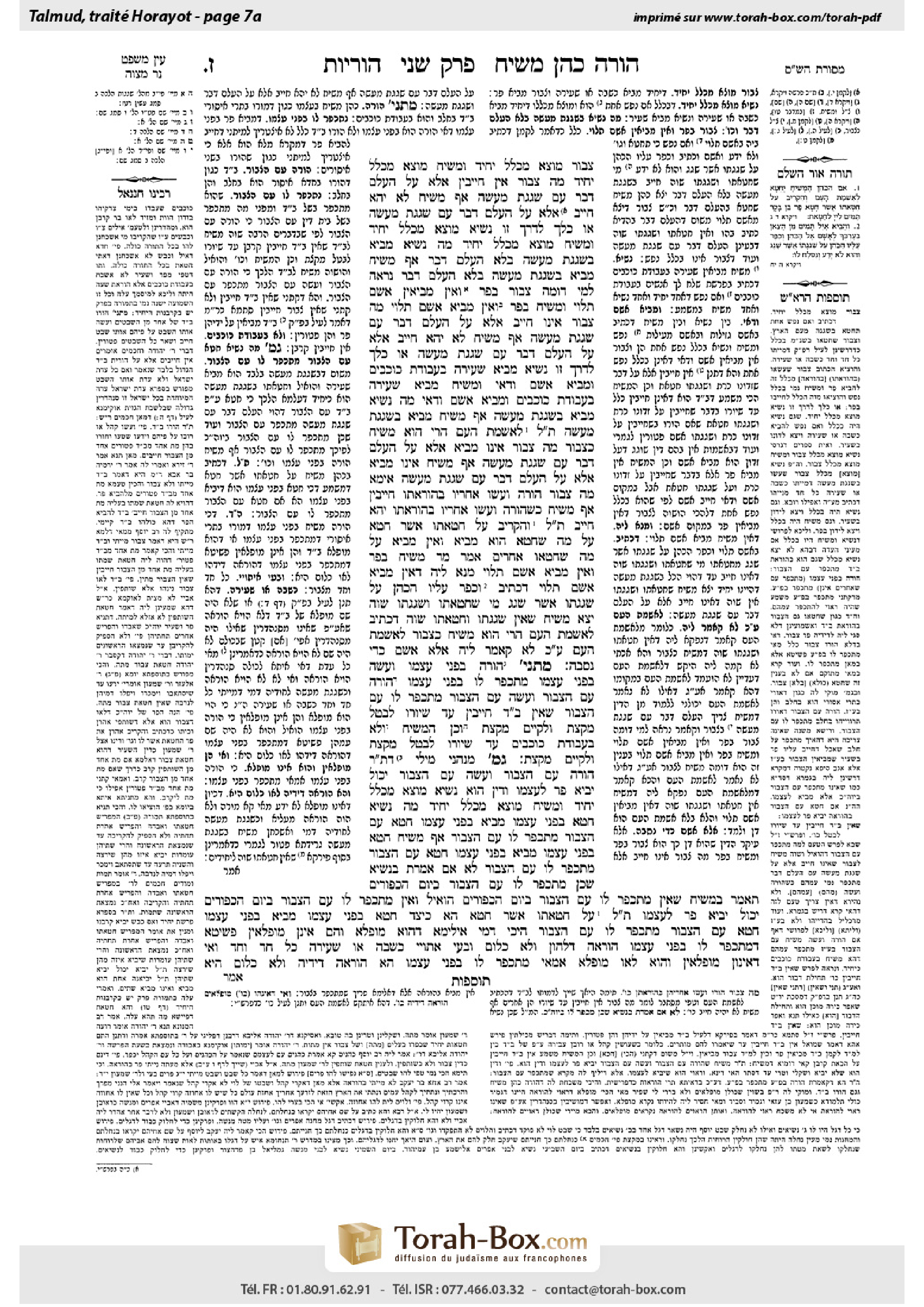
Horayot 7a: Talmud study for Daf Yomi
Study the Talmud for Daf Yomi with scanned pages, Hebrew text, English translations from Sefaria and AI-generated French translations.
Passage selection and English or AI-generated French translation are available where the scan has annotations. Daf Study is independent of Torah-Box and Sefaria.
Browse Horayot · הוריות · All tractatesHorayot 7a text and translations
This page of Horayot includes the Aramaic text, an English translation and an AI-generated French translation, alongside the scan above.
הוריות ז׳ א · Aramaic and Hebrew text
צִבּוּר מוּצָא מִכְּלַל יָחִיד, וּמָשִׁיחַ מוּצָא מִכְּלַל יָחִיד. מָה צִבּוּר אֵין חַיָּיבִין אֶלָּא עַל הֶעְלֵם דָּבָר עִם שִׁגְגַת מַעֲשֶׂה, אַף מָשִׁיחַ לֹא יְהֵא חַיָּיב אֶלָּא עַל הֶעְלֵם דָּבָר עִם שִׁגְגַת מַעֲשֶׂה.
אוֹ כְּלָךְ לְדֶרֶךְ זוֹ: נָשִׂיא מוּצָא מִכְּלַל יָחִיד, וּמָשִׁיחַ מוּצָא מִכְּלַל יָחִיד. מָה נָשִׂיא מֵבִיא בְּשִׁגְגַת מַעֲשֶׂה בְּלֹא הֶעְלֵם דָּבָר, אַף מָשִׁיחַ מֵבִיא בְּשִׁגְגַת מַעֲשֶׂה בְּלֹא הֶעְלֵם דָּבָר!
נִרְאֶה לְמִי דּוֹמֶה? צִבּוּר – בְּפַר וְאֵין מְבִיאִין אָשָׁם תָּלוּי, וּמָשִׁיחַ – בְּפַר וְאֵין מֵבִיא אָשָׁם תָּלוּי. מָה צִבּוּר אֵינוֹ חַיָּיב אֶלָּא עַל הֶעְלֵם דָּבָר עִם שִׁגְגַת מַעֲשֶׂה, אַף מָשִׁיחַ לֹא יְהֵא חַיָּיב אֶלָּא עַל הֶעְלֵם דָּבָר עִם שִׁגְגַת מַעֲשֶׂה.
אוֹ כְּלָךְ לְדֶרֶךְ זוֹ: נָשִׂיא מֵבִיא שְׂעִירָה בַּעֲבוֹדָה זָרָה וּמֵבִיא אָשָׁם וַדַּאי, וּמָשִׁיחַ מֵבִיא שְׂעִירָה בַּעֲבוֹדָה זָרָה וּמֵבִיא אָשָׁם וַדַּאי. מָה נָשִׂיא מֵבִיא בְּשִׁגְגַת מַעֲשֶׂה, אַף מָשִׁיחַ מֵבִיא בְּשִׁגְגַת מַעֲשֶׂה.
תַּלְמוּד לוֹמַר: ״לְאַשְׁמַת הָעָם״, הֲרֵי הוּא מָשִׁיחַ כְּצִבּוּר. מָה צִבּוּר אֵינוֹ מֵבִיא אֶלָּא עַל הֶעְלֵם דָּבָר עִם שִׁגְגַת מַעֲשֶׂה, אַף מָשִׁיחַ אֵינוֹ מֵבִיא אֶלָּא עַל הֶעְלֵם דָּבָר עִם שִׁגְגַת מַעֲשֶׂה.
אֵימָא: מָה צִבּוּר הוֹרָה וְעָשׂוּ אַחֲרָיו בְּהוֹרָאָתוֹ – חַיָּיבִין, אַף מָשִׁיחַ כְּשֶׁהוֹרָה וְעָשׂוּ אַחֲרָיו בְּהוֹרָאָתוֹ – יְהֵא חַיָּיב! תַּלְמוּד לוֹמַר: ״וְהִקְרִיב עַל חַטָּאתוֹ אֲשֶׁר חָטָא״, עַל מָה שֶׁחָטָא הוּא מֵבִיא, וְאֵין מֵבִיא עַל מָה שֶׁחָטְאוּ אֲחֵרִים.
אָמַר מָר: מָשִׁיחַ בְּפַר וְאֵין מֵבִיא אָשָׁם תָּלוּי. מְנָא לֵיהּ דְּאֵין מֵבִיא אָשָׁם תָּלוּי?
דִּכְתִיב: ״וְכִפֶּר עָלָיו הַכֹּהֵן עַל שִׁגְגָתוֹ אֲשֶׁר שָׁגָג״, מִי שֶׁחַטָּאתוֹ וְשִׁגְגָתוֹ שָׁוָה, יָצָא מָשִׁיחַ שֶׁאֵין שִׁגְגָתוֹ וְחַטָּאתוֹ שָׁוָה, דִּכְתִיב: ״לְאַשְׁמַת הָעָם״, הֲרֵי הוּא מָשִׁיחַ כְּצִבּוּר.
״לְאַשְׁמַת הָעָם״, עַד כָּאן לָא קָאָמַר לֵיהּ. אֶלָּא אָשָׁם כְּדִי נַסְבַהּ.
מַתְנִי׳ הוֹרָה בִּפְנֵי עַצְמוֹ וְעָשָׂה בִּפְנֵי עַצְמוֹ – מִתְכַּפֵּר לוֹ בִּפְנֵי עַצְמוֹ. הוֹרָה עִם הַצִּבּוּר וְעָשָׂה עִם הַצִּבּוּר – מִתְכַּפֵּר לוֹ עִם הַצִּבּוּר, שֶׁאֵין בֵּית דִּין חַיָּיבִין עַד שֶׁיּוֹרוּ לְבַטֵּל מִקְצָת וּלְקַיֵּים מִקְצָת, וְכֵן הַמָּשִׁיחַ, וְלֹא בַּעֲבוֹדָה זָרָה עַד שֶׁיּוֹרוּ לְבַטֵּל מִקְצָת וּלְקַיֵּים מִקְצָת.
גְּמָ׳ מְנָהָנֵי מִילֵּי? דְּתָנוּ רַבָּנַן: הוֹרָה עִם הַצִּבּוּר וְעָשָׂה עִם הַצִּבּוּר, יָכוֹל יָבִיא פַּר לְעַצְמוֹ?
וְדִין הוּא: נָשִׂיא מוּצָא מִכְּלַל יָחִיד וּמָשִׁיחַ מוּצָא מִכְּלַל יָחִיד, מָה נָשִׂיא, חָטָא בִּפְנֵי עַצְמוֹ – מֵבִיא בִּפְנֵי עַצְמוֹ, חָטָא עִם הַצִּבּוּר – מִתְכַּפֵּר לוֹ עִם הַצִּבּוּר. אַף מָשִׁיחַ, חָטָא בִּפְנֵי עַצְמוֹ – מֵבִיא בִּפְנֵי עַצְמוֹ, חָטָא עִם הַצִּבּוּר – מִתְכַּפֵּר לוֹ עִם הַצִּבּוּר!
לֹא, אִם אָמַרְתָּ בְּנָשִׂיא – שֶׁכֵּן מִתְכַּפֵּר לוֹ עִם הַצִּבּוּר בְּיוֹם הַכִּפּוּרִים. תֹּאמַר בְּמָשִׁיחַ – שֶׁאֵין מִתְכַּפֵּר לוֹ עִם הַצִּבּוּר בְּיוֹם הַכִּפּוּרִים!
הוֹאִיל וְאֵין מִתְכַּפֵּר לוֹ עִם הַצִּבּוּר בְּיוֹם הַכִּפּוּרִים, יָכוֹל יָבִיא פַּר לְעַצְמוֹ? תַּלְמוּד לוֹמַר: ״עַל חַטָּאתוֹ אֲשֶׁר חָטָא״, הָא כֵּיצַד? חָטָא בִּפְנֵי עַצְמוֹ – מֵבִיא בִּפְנֵי עַצְמוֹ, חָטָא עִם הַצִּבּוּר – מִתְכַּפֵּר לוֹ עִם הַצִּבּוּר.
הֵיכִי דָמֵי? אִילֵּימָא דְּהוּא מוּפְלָא וְהֵם אֵינָן מוּפְלָאִין, פְּשִׁיטָא דְּמִתְכַּפֵּר לוֹ בִּפְנֵי עַצְמוֹ, הוֹרָאָה דִּלְהוֹן וְלֹא כְּלוּם. וּבָעֵי אֵתוֹיֵי כִּשְׂבָּה אוֹ שְׂעִירָה כֹּל חַד וְחַד! וְאִי דְּאִינּוּן מוּפְלָאִין וְהוּא לָאו מוּפְלָא, אַמַּאי מִתְכַּפֵּר לוֹ בִּפְנֵי עַצְמוֹ? הָא הוֹרָאָה דִּידֵיהּ וְלֹא כְּלוּם הִיא.
Horayot 7a · English translation
The general public is removed from the category of an individual, as an individual brings a ewe or female goat as a sin-offering, whereas when the general public sins the sin-offering is a bull. And likewise, an anointed priest is removed from the category of an individual, as his sin-offering is also a bull. Therefore, just as the general public is liable only for absence of awareness of the matter by the court together with unwitting performance of an action by the people, so too, an anointed priest will be liable only for absence of awareness of the matter together with unwitting performance of an action.
Or perhaps go this way and draw a different analogy: A king [Nasi] is removed from the category of an individual, as his sin-offering is a goat. And an anointed priest is removed from the category of an individual. Therefore, just as a king brings an offering for unwitting performance of an action, even without absence of awareness of the matter leading to an erroneous ruling, like any individual liable to bring a sin-offering, so too, an anointed priest brings an offering for unwitting performance of an action, even without absence of awareness of the matter leading to an erroneous ruling. It is possible to liken the anointed priest to either the general public or to the king.
The Gemara considers these two comparisons: Let us see to which of them, the general public or the king, an anointed priest is similar. The general public achieves atonement with a bull and does not bring a provisional guilt-offering, and an anointed priest achieves atonement with a bull and does not bring a provisional guilt-offering. Therefore one might say: Just as the general public is liable only for absence of awareness of the matter by the court together with unwitting performance of an action by the people, so too, an anointed priest will be liable only for absence of awareness of the matter together with unwitting performance of an action.
Or perhaps go this way and draw a different analogy: The king brings a female goat for unwitting idol worship and brings a definite guilt-offering for certain other transgressions where there is liability to bring a guilt-offering, e.g., misuse of consecrated property and robbery, and an anointed priest brings a female goat for unwitting idol worship and brings a definite guilt-offering for the same transgressions as the king. This is in contrast to the general public, which brings a bull as a sin-offering for unwitting idol worship and does not bring a definite guilt-offering at all. Therefore conclude: Just as a king brings an offering for unwitting performance of an action without absence of awareness of the matter, like any individual liable to bring a sin-offering, so too, an anointed priest brings an offering for unwitting performance of an action without absence of awareness of the matter.
Since either conclusion can be derived logically, another source is necessary. Therefore, the verse states: “If the anointed priest shall sin so as to bring guilt upon the people” (Leviticus 4:3), indicating that the status of the anointed priest is like that of the general public. Therefore, just as the general public brings an offering only for absence of awareness of the matter by the court with unwitting performance of an action by the people, so too, an anointed priest brings an offering only for absence of awareness of the matter with unwitting performance of an action.
The Gemara challenges the comparison: Based on the comparison between the anointed priest and the general public, why not say: Just as with regard to the general public, if the court issued a ruling and the general public performed the transgression after its ruling and in accordance with its ruling, the court is liable, so too, with regard to an anointed priest, when he issued a ruling and the general public performed the transgression after his ruling and in accordance with his ruling, he should be liable. Therefore, the verse states with regard to the anointed priest: “Then he shall offer for his sin that he has sinned” (Leviticus 4:3), from which it is derived: He brings an offering for that sin that he sinned on the basis of his ruling, but he does not bring an offering for that sin that others sinned on the basis of his ruling.
The Gemara elaborates on that which the Master said: An anointed priest achieves atonement with a bull and does not bring a provisional guilt-offering. The Gemara asks: From where does the tanna derive that an anointed priest does not bring a provisional guilt-offering?
The Gemara answers: It is derived from a verse, as it is written with regard to the halakhot of the guilt-offering: “And the priest shall atone for him for his unwitting act that he performed unwittingly” (Leviticus 5:18), from which it is derived that this halakha applies only to one whose transgression and his unwitting action are equal, i.e., an ordinary person, whose unwitting act is the very transgression that he performed unwittingly. This serves to exclude an anointed priest, whose unwitting action and his transgression are not equal, as his unwitting act is the erroneous ruling and he is liable to bring an offering only if he performed the transgression on the basis of that ruling. As it is written about the anointed priest: “So as to bring guilt upon the people” (Leviticus 4:3), indicating that the status of the anointed priest is like that of the general public.
The Gemara questions this proof: How can the Gemara base the halakha on an interpretation of the verse: “So as to bring guilt upon the people”? To this point, the tanna of the baraita did not state this verse. The tanna first states that the anointed priest does not bring a provisional guilt-offering and only then cites the verse from which he proves the halakha that an anointed priest brings an offering only for absence of awareness of the matter together with unwitting performance of an action. Rather, he stated the halakha of the provisional guilt-offering for no reason. Although the halakha is correct, there was no reason to cite it in the baraita.
MISHNA: If the anointed priest issued a ruling by himself and performed a transgression by himself, he achieves atonement by himself by bringing a bull as his sin-offering. If he issued a ruling with the general public, i.e., the Sanhedrin, and performed a transgression with the general public, i.e., the Jewish people, he achieves atonement with the general public. As, the court is not liable unless the judges issue a ruling to nullify part of a commandment and to sustain part of that commandment, and likewise with regard to the ruling of the anointed priest. And the court and the priest are not liable for a ruling with regard to idol worship unless they issue a ruling to nullify part of that commandment and to sustain part of it.
GEMARA: Concerning the halakha that there is a difference between an unwitting transgression that the anointed priest performs by himself and one that he performs with the general public, the Gemara asks: From where is this matter derived? The Gemara explains: It is as the Sages taught in a baraita: If the anointed priest issued a ruling with the general public and performed a transgression with the general public, one might have thought that he is liable to bring a bull as a sin-offering for himself.
The baraita continues: And there is a logical inference to support this: A king is removed from the category of an individual and an anointed priest is removed from the category of an individual, as each brings a different sin-offering than an individual. Just as with regard to a king, if he sinned by himself he brings his sin-offering of a goat by himself, and if he sinned with the general public, he achieves atonement with the general public, so too, with regard to an anointed priest, if he sinned by himself he brings his sin-offering of a bull by himself, and if he sinned with the general public, he achieves atonement with the general public.
The baraita rejects this: No, if you said with regard to a king that he achieves atonement with the general public, that is logical, as he achieves atonement with the general public on Yom Kippur. Shall you also say the same with regard to an anointed priest, who does not achieve atonement with the general public on Yom Kippur but rather brings his own atonement offering?
The baraita continues: Since he does not achieve atonement with the general public on Yom Kippur, one might have thought that he will bring a bull for himself even if he unwittingly performed a transgression with the general public. Therefore, the verse states: “Then he shall offer for his sin that he has sinned” (Leviticus 4:3), indicating that he sinned alone, not with the general public. How so? If he sinned by himself he brings his sin-offering of a bull by himself; if he sinned with the general public, he achieves atonement with the general public.
The Gemara elaborates: What are the circumstances of an anointed priest issuing a ruling for himself? If we say that it is a case where the High Priest is a distinguished scholar and the judges of the court are not distinguished scholars, it is obvious that he achieves atonement by himself, as their ruling is nothing at all, since they did not consult the generation’s most prominent scholar. And accordingly, each and every one who performed a transgression needs to bring a ewe or female goat as an individual sin-offering. And if it is a case where the judges are distinguished scholars and he is not a distinguished scholar, why does he achieve atonement by himself? Isn’t his ruling nothing at all, and his transgression is an unwitting performance of an action alone, rather than a transgression performed on the basis of a ruling?
Horayot 7a · Traduction française (IA)
Le public en général est exclu de la catégorie d'un individu, car un individu offre une agnelle ou une chèvre femelle comme sacrifice expiatoire, tandis que lorsque le public en général péche, le sacrifice expiatoire est un taureau. De même, un prêtre consacré est exclu de la catégorie d'un individu, car son sacrifice expiatoire est également un taureau. Par conséquent, tout comme le public en général est responsable uniquement en cas d'ignorance de la part du tribunal accompagnée d'une action involontaire de la part du peuple, de même, un prêtre consacré sera responsable uniquement en cas d'ignorance de la part du tribunal accompagnée d'une action involontaire.
Ou peut-être prendre une autre voie et établir une autre comparaison : un roi [Nasi] est exclu de la catégorie d'un individu, car son sacrifice expiatoire est une chèvre. Et un prêtre consacré est exclu de la catégorie d'un individu. Par conséquent, tout comme un roi offre un sacrifice pour une action involontaire, même sans ignorance de la part du tribunal entraînant une décision erronée, comme tout individu responsable d'offrir un sacrifice expiatoire, de même, un prêtre consacré offre un sacrifice pour une action involontaire, même sans ignorance de la part du tribunal entraînant une décision erronée. Il est possible de comparer le prêtre consacré à l'un ou à l'autre, le public en général ou le roi.
La Guemara examine ces deux comparaisons : voyons à quel des deux, le public en général ou le roi, le prêtre consacré est comparable. Le public en général obtient l'atonement avec un taureau et ne présente pas un sacrifice de culpabilité provisoire, et le prêtre consacré obtient l'atonement avec un taureau et ne présente pas un sacrifice de culpabilité provisoire. Par conséquent, on pourrait dire : tout comme le public en général est responsable uniquement en cas d'ignorance de la part du tribunal accompagnée d'une action involontaire de la part du peuple, de même, le prêtre consacré sera responsable uniquement en cas d'ignorance de la part du tribunal accompagnée d'une action involontaire.
Ou peut-être prendre une autre voie et établir une autre comparaison : le roi offre une chèvre femelle pour l'idolâtrie involontaire et offre un sacrifice de culpabilité définitif pour d'autres transgressions où il y a responsabilité d'offrir un sacrifice de culpabilité, par exemple, l'abus de biens consacrés et le vol, et le prêtre consacré offre une chèvre femelle pour l'idolâtrie involontaire et offre un sacrifice de culpabilité définitif pour les mêmes transgressions que le roi. Cela contraste avec le public en général, qui offre un taureau comme sacrifice expiatoire pour l'idolâtrie involontaire et ne présente aucun sacrifice de culpabilité définitif. Par conséquent, conclure : tout comme le roi offre un sacrifice pour une action involontaire sans ignorance de la part du roi, comme tout individu responsable d'offrir un sacrifice expiatoire, de même, le prêtre consacré offre un sacrifice pour une action involontaire sans ignorance de la part du roi.
Puisque l'une ou l'autre conclusion peut être dérivée logiquement, une autre source est nécessaire. Par conséquent, le verset dit : « Si le prêtre consacré péche de sorte à attirer la culpabilité sur le peuple » (Lévitique 4:3), indiquant que le statut du prêtre consacré est comme celui du public en général. Par conséquent, tout comme le public en général offre un sacrifice uniquement en cas d'ignorance de la part du tribunal accompagnée d'une action involontaire de la part du peuple, de même, le prêtre consacré offre un sacrifice uniquement en cas d'ignorance de la part du tribunal accompagnée d'une action involontaire.
La Guemara conteste cette comparaison : sur la base de la comparaison entre le prêtre consacré et le public en général, pourquoi ne pas dire : tout comme concernant le public en général, si le tribunal a rendu un jugement et que le public a commis la transgression après ce jugement et conformément à ce jugement, le tribunal est responsable, de même, concernant le prêtre consacré, lorsque celui-ci a rendu un jugement et que le public a commis la transgression après ce jugement et conformément à ce jugement, il devrait être responsable. Par conséquent, le verset dit concernant le prêtre consacré : « Alors il offrira pour son péché qu'il a commis » (Lévitique 4:3), d'où il est dérivé : il offre un sacrifice pour ce péché qu'il a commis sur la base de son jugement, mais il ne présente pas de sacrifice pour ce péché que d'autres ont commis sur la base de son jugement.
La Guemara développe ce que le Maître a dit : le prêtre consacré obtient l'atonement avec un taureau et ne présente pas un sacrifice de culpabilité provisoire. La Guemara demande : d'où le tanna dérive-t-il que le prêtre consacré ne présente pas un sacrifice de culpabilité provisoire ?
La Guemara répond : il est dérivé d'un verset, car il est écrit concernant les halakhot du sacrifice de culpabilité : « Et le prêtre atonera pour lui pour son acte involontaire qu'il a commis involontairement » (Lévitique 5:18), d'où il est dérivé que cette halakha s'applique uniquement à celui dont la transgression et son acte involontaire sont égaux, c'est-à-dire un individu ordinaire, dont l'acte involontaire est la transgression même qu'il a commise involontairement. Cela exclut le prêtre consacré, dont l'acte involontaire et sa transgression ne sont pas égaux, car son acte involontaire est le jugement erroné et il est tenu responsable d'offrir un sacrifice uniquement s'il a commis la transgression sur la base de ce jugement. Comme il est écrit concernant le prêtre consacré : « afin d'attirer la culpabilité sur le peuple » (Lévitique 4:3), indiquant que le statut du prêtre consacré est comme celui du public en général.
La Guemara questionne cette preuve : comment la Guemara peut-elle baser la halakha sur une interprétation du verset : « afin d'attirer la culpabilité sur le peuple » ? À ce point, le tanna de la baraïta n'a pas encore mentionné ce verset. Le tanna a d'abord affirmé que le prêtre consacré ne présente pas un sacrifice de culpabilité provisoire et n'a ensuite cité le verset à partir duquel il démontre la halakha que le prêtre consacré offre un sacrifice uniquement en cas d'ignorance du tribunal accompagnée d'une action involontaire. En revanche, il a affirmé la halakha du sacrifice de culpabilité provisoire sans raison. Bien que la halakha soit correcte, il n'y avait pas de raison de la citer dans la baraïta.
MICHNA : Si le prêtre consacré a rendu un jugement seul et a commis une transgression seul, il obtient la rédemption seul en apportant un taureau comme sacrifice expiatoire. Si il a rendu un jugement avec la foule, c'est-à-dire le Sanhédrin, et a commis une transgression avec la foule, c'est-à-dire le peuple juif, il obtient la rédemption avec la foule. En effet, la cour n'est pas responsable à moins que les juges rendent un jugement pour annuler une partie d'un commandement et pour maintenir une autre partie de ce commandement, et de même concernant le jugement du prêtre consacré. Et la cour et le prêtre consacré ne sont pas responsables d'un jugement concernant l'idolâtrie à moins qu'ils rendent un jugement pour annuler une partie de ce commandement et pour maintenir une autre partie.
GUEMARA : Concernant la halakha qui distingue entre une transgression involontaire que le prêtre consacré commet seul et une transgression involontaire qu'il commet avec la foule, la Guemara pose la question : D'où cette matière est-elle dérivée ? La Guemara explique : C'est comme les Sages ont enseigné dans une baraïta : Si le prêtre consacré a rendu un jugement avec la foule et a commis une transgression avec la foule, on pourrait penser qu'il est tenu de présenter un taureau comme sacrifice expiatoire pour lui-même.
La baraïta continue : Et il y a une déduction logique pour soutenir cela : Un roi est exclu de la catégorie d'un individu et un prêtre consacré est exclu de la catégorie d'un individu, car chacun apporte un sacrifice expiatoire différent de l'individu. Tout comme concernant un roi, s'il a péché seul il apporte son sacrifice expiatoire d'un bouc seul, et s'il a péché avec la foule il obtient la rédemption avec la foule, de même concernant un prêtre consacré, s'il a péché seul il apporte son sacrifice expiatoire d'un taureau seul, et s'il a péché avec la foule il obtient la rédemption avec la foule.
La baraïta rejette cela : Non, si vous dites concernant un roi qu'il obtient la rédemption avec la foule, cela est logique, car il obtient la rédemption avec la foule le jour de l'Expiation. Pourriez-vous dire la même chose concernant un prêtre consacré, qui ne obtient pas la rédemption avec la foule le jour de l'Expiation mais plutôt apporte son propre sacrifice expiatoire ?
La baraïta continue : Puisque il ne obtient pas la rédemption avec la foule le jour de l'Expiation, on pourrait penser qu'il apportera un taureau pour lui-même même s'il a involontairement commis une transgression avec la foule. Ainsi, le verset dit : « Alors il offrira pour son péché qu'il a commis » (Lévitique 4:3), indiquant qu'il a péché seul, pas avec la foule. Comment cela ? S'il a péché seul il apporte son sacrifice expiatoire d'un taureau seul ; s'il a péché avec la foule, il obtient la rédemption avec la foule.
La Guemara développe : Quels sont les cas d'un prêtre consacré qui rend un jugement seul ? Si nous disons que c'est un cas où le grand prêtre est un savant distingué et les juges de la cour ne sont pas des savants distingués, il est évident qu'il obtient la rédemption seul, car leur jugement est rien du tout, puisqu'ils n'ont pas consulté le savant le plus distingué de la génération. Et ainsi, chaque personne qui a commis une transgression doit apporter une agnelle ou une chèvre femelle comme sacrifice expiatoire individuel. Et si c'est un cas où les juges sont des savants distingués et il n'est pas un savant distingué, pourquoi obtient-il la rédemption seul ? N'est-ce pas que son jugement est rien du tout, et sa transgression est une performance involontaire d'une action seule, plutôt qu'une transgression accomplie sur la base d'un jugement ?
Traduction française générée par IA à partir de l’édition anglaise de Sefaria. Vérifie toujours un passage avec le texte source.
Text from Sefaria: William Davidson Edition - Vocalized Aramaic (CC BY NC); William Davidson Edition - English (CC BY NC).