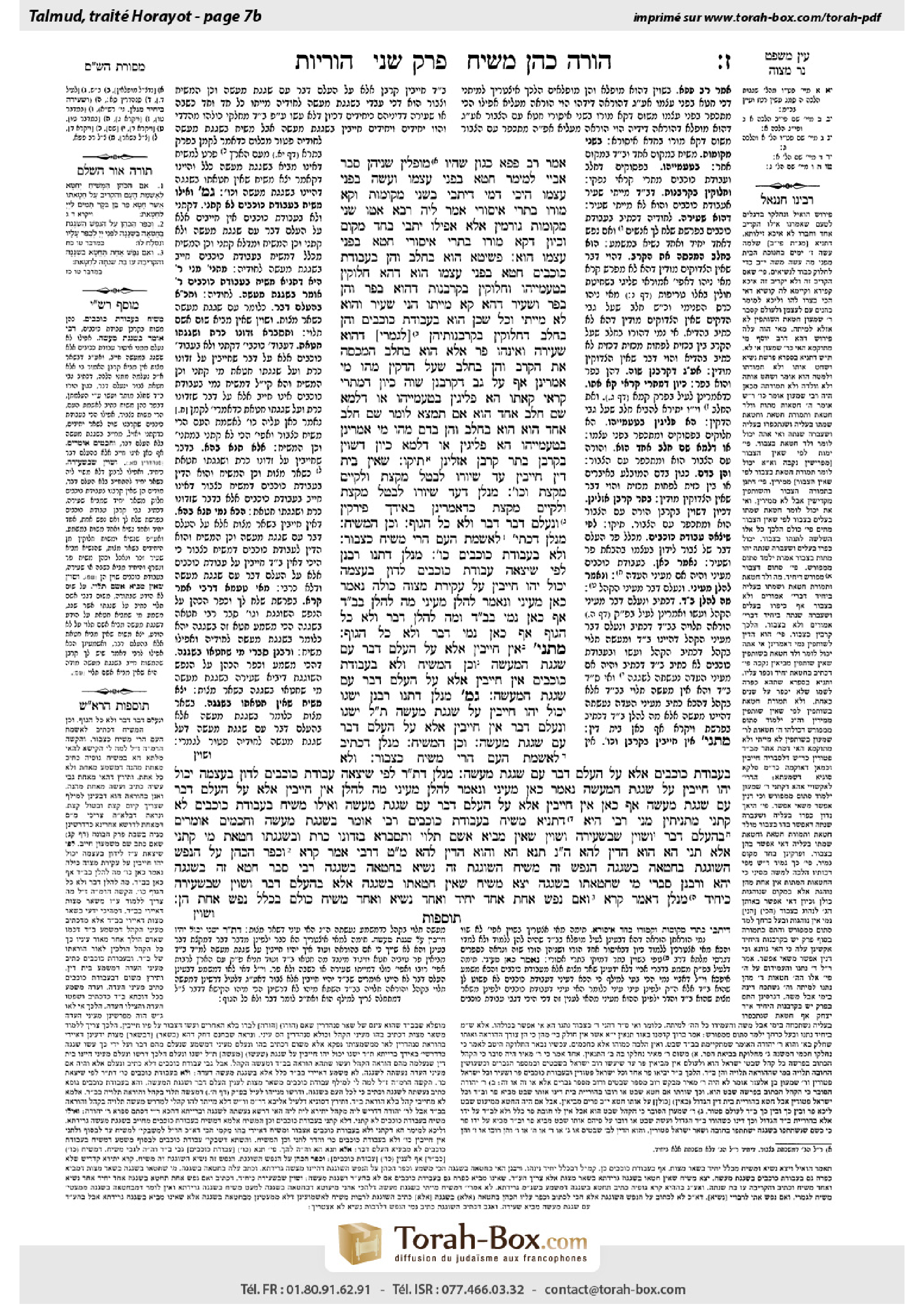
Horayot 7b: Talmud study for Daf Yomi
Study the Talmud for Daf Yomi with scanned pages, Hebrew text, English translations from Sefaria and AI-generated French translations.
Passage selection and English or AI-generated French translation are available where the scan has annotations. Daf Study is independent of Torah-Box and Sefaria.
Browse Horayot · הוריות · All tractatesHorayot 7b text and translations
This page of Horayot includes the Aramaic text, an English translation and an AI-generated French translation, alongside the scan above.
הוריות ז׳ ב · Aramaic and Hebrew text
אָמַר רַב פָּפָּא: כְּגוֹן שֶׁהָיוּ מוּפְלִין שְׁנֵיהֶן.
סָבַר אַבָּיֵי לְמֵימַר: חָטָא בִּפְנֵי עַצְמוֹ וְעָשָׂה בִּפְנֵי עַצְמוֹ הֵיכִי דָּמֵי? דְּיָתְבִי בִּשְׁנֵי מְקוֹמוֹת וְקָא מוֹרוּ בִּתְרֵי אִיסּוּרֵי, אֲמַר לֵיהּ רָבָא: אַטּוּ שְׁנֵי מְקוֹמוֹת גּוֹרְמִין? אֶלָּא אֲפִילּוּ יָתְבִי בְּחַד מָקוֹם, וְכֵיוָן דְּקָא מוֹרוּ בִּתְרֵי אִיסּוּרֵי – חָטָא בִּפְנֵי עַצְמוֹ הוּא.
פְּשִׁיטָא: הוּא בְּחֵלֶב וְהֵן בַּעֲבוֹדָה זָרָה – חָטָא בִּפְנֵי עַצְמוֹ הוּא, דְּהָא חֲלוּקִין בְּטַעְמַיְיהוּ, וַחֲלוּקִין בְּקׇרְבָּנוֹת. דְּהוּא בְּפַר, וְהֵן בְּפַר וְשָׂעִיר – דְּהָא קָא מַיְיתוּ הָנֵי שָׂעִיר, וְהוּא לָא מַיְיתֵי. וְכׇל שֶׁכֵּן הוּא בַּעֲבוֹדָה זָרָה וְהֵן בְּחֵלֶב, דַּחֲלוּקִין בְּקׇרְבְּנוֹתֵיהֶן [לִגְמָרֵי] – דְּהוּא שְׂעִירָה, וְאִינְהוּ פַּר,
אֶלָּא הוּא בְּחֵלֶב הַמְכַסֶּה אֶת הַקֶּרֶב, וְהֵן בְּחֵלֶב שֶׁעַל הַדַּקִּין, מַהוּ? מִי אָמְרִינַן: אַף עַל גַּב דְּקׇרְבָּנָן שָׁוֶה, כֵּיוָן דְּמִתְּרֵי קְרָאֵי קָאָתוּ, הָא פְּלִיגִין בְּטַעְמַיְיהוּ, אוֹ דִלְמָא שֵׁם חֵלֶב אֶחָד הוּא?
אִם תִּמְצָא לוֹמַר שֵׁם חֵלֶב אֶחָד הוּא, הוּא בְּחֵלֶב וְהֵן בְּדָם, מַהוּ? מִי אָמְרִינַן: בְּטַעְמַיְיהוּ הָא פְּלִיגִין, אוֹ דִלְמָא כֵּיוָן דְּשָׁוִין בְּקׇרְבָּן בָּתַר קׇרְבָּן אָזְלִינַן? תֵּיקוּ.
שֶׁאֵין בֵּית דִּין חַיָּיבִין עַד שֶׁיּוֹרוּ לְבַטֵּל מִקְצָת וּלְקַיֵּים מִקְצָת וְכוּ׳. מְנָלַן דְּעַד שֶׁיּוֹרוּ לְבַטֵּל מִקְצָת וּלְקַיֵּים מִקְצָת? כִּדְאָמְרִינַן בְּאִידַּךְ פִּירְקִין: ״וְנֶעֱלַם דָּבָר״ – ״דָּבָר״ – וְלֹא כָּל הַגּוּף.
וְכֵן הַמָּשִׁיחַ. מְנָלַן? דִּכְתִיב: ״לְאַשְׁמַת הָעָם״, הֲרֵי מָשִׁיחַ כְּצִבּוּר.
וְלֹא בַּעֲבוֹדָה זָרָה כּוּ׳. מְנָלַן? דְּתָנוּ רַבָּנַן: לְפִי שֶׁיָּצְאָה עֲבוֹדָה זָרָה לָדוּן בְּעַצְמָהּ, יָכוֹל יְהוּ חַיָּיבִין עַל עֲקִירַת מִצְוָה כּוּלָּהּ?
נֶאֱמַר כָּאן ״מֵעֵינֵי״, וְנֶאֱמַר לְהַלָּן ״מֵעֵינֵי״. מָה לְהַלָּן בְּבֵית דִּין, אַף כָּאן נָמֵי בְּבֵית דִּין. וּמָה לְהַלָּן ״דָּבָר״ וְלֹא כׇּל הַגּוּף, אַף כָּאן נָמֵי ״דָּבָר״ וְלֹא כׇּל הַגּוּף.
מַתְנִי׳ אֵין חַיָּיבִין אֶלָּא עַל הֶעְלֵם דָּבָר עִם שִׁגְגַת הַמַּעֲשֶׂה, וְכֵן הַמָּשִׁיחַ, וְלֹא בַּעֲבוֹדָה זָרָה – אֵין חַיָּיבִין אֶלָּא עַל הֶעְלֵם דָּבָר עִם שִׁגְגַת הַמַּעֲשֶׂה.
גְּמָ׳ מְנָלַן? דְּתָנוּ רַבָּנַן: ״יִשְׁגּוּ״ – יָכוֹל יְהוּ חַיָּיבִין עַל שִׁגְגַת מַעֲשֶׂה? תַּלְמוּד לוֹמַר: ״יִשְׁגּוּ וְנֶעֱלַם דָּבָר״, אֵין חַיָּיבִין אֶלָּא עַל הֶעְלֵם דָּבָר עִם שִׁגְגַת מַעֲשֶׂה.
וְכֵן הַמָּשִׁיחַ. מְנָלַן? דִּכְתִיב: ״לְאַשְׁמַת הַעָם״, הֲרֵי מָשִׁיחַ כְּצִבּוּר.
וְלֹא בַּעֲבוֹדָה זָרָה אֶלָּא עַל הֶעְלֵם דָּבָר עִם שִׁגְגַת מַעֲשֶׂה. מְנָלַן?
דְּתָנוּ רַבָּנַן: לְפִי שֶׁיָּצְאָה עֲבוֹדָה זָרָה לָדוּן בְּעַצְמָהּ, יָכוֹל יְהוּ חַיָּיבִין עַל שִׁגְגַת הַמַּעֲשֶׂה? נֶאֱמַר כָּאן ״מֵעֵינֵי״ וְנֶאֱמַר לְהַלָּן ״מֵעֵינֵי״, מָה לְהַלָּן אֵין חַיָּיבִין אֶלָּא עַל הֶעְלֵם דָּבָר עִם שִׁגְגַת מַעֲשֶׂה, אַף כָּאן אֵין חַיָּיבִין אֶלָּא עַל הֶעְלֵם דָּבָר עִם שִׁגְגַת מַעֲשֶׂה.
וְאִילּוּ מָשִׁיחַ בַּעֲבוֹדָה זָרָה לָא קָתָנֵי, מַתְנִיתִין מַנִּי? רַבִּי הִיא.
דְּתַנְיָא: מָשִׁיחַ בַּעֲבוֹדָה זָרָה – רַבִּי אוֹמֵר: בְּשִׁגְגַת מַעֲשֶׂה. וַחֲכָמִים אוֹמְרִים: בְּהֶעְלֵם דָּבָר. וְשָׁוִין שֶׁבִּשְׂעִירָה, וְשָׁוִין שֶׁאֵין מֵבִיא אָשָׁם תָּלוּי.
וְתִסְבְּרַאּ: בִּזְדוֹנוֹ כָּרֵת וּבְשִׁגְגָתוֹ חַטָּאת מִי קָתָנֵי?
אֶלָּא תָּנֵי הָא הוּא הַדִּין לְהָא. הָכָא נָמֵי תְּנָא הָא וְהוּא הַדִּין לְהָא.
מַאי טַעְמָא דְּרַבִּי? אָמַר קְרָא: ״וְכִפֶּר הַכֹּהֵן עַל הַנֶּפֶשׁ הַשֹּׁגֶגֶת בְּחֶטְאָה בִשְׁגָגָה״. ״הַנֶּפֶשׁ״ – זֶה מָשִׁיחַ, ״הַשֹּׁגֶגֶת״ – זֶה נָשִׂיא, ״בְּחֶטְאָה בִּשְׁגָגָה״ – רַבִּי סָבַר: חֵטְא זֶה בִּשְׁגָגָה יְהֵא.
וְרַבָּנַן סָבְרִי: מִי שֶׁחַטָּאתוֹ בִּשְׁגָגָה, יָצָא מָשִׁיחַ שֶׁאֵין חַטָּאתוֹ בִּשְׁגָגָה אֶלָּא בְּהֶעְלֵם דָּבָר.
וְשָׁוִין שֶׁבִּשְׂעִירָה כְּיָחִיד. מְנָלַן? דְּאָמַר קְרָא: ״וְאִם נֶפֶשׁ אַחַת״ – אֶחָד יָחִיד וְאֶחָד נָשִׂיא וְאֶחָד מָשִׁיחַ – כּוּלָּם בִּכְלַל ״נֶפֶשׁ אַחַת״ הֵן.
Horayot 7b · English translation
Rav Pappa says: The reference is to a case where both the anointed priest and the court, i.e., the judges, were distinguished Torah scholars with the authority to issue rulings.
§ Abaye thought to say that with regard to the cases in the mishna: If the anointed priest sinned by himself and performed a transgression by himself, what are the circumstances? It is a case where the priest and the court were convened in two different places and issuing rulings with regard to two different prohibitions. Rava said to Abaye: Is that to say that the fact that there are two places determines that he sinned by himself? Rather, it is even in a case where the High Priest and the court are convened in one place. But since they are issuing rulings with regard to two different prohibitions, it is a case where the anointed priest sinned by himself.
The Gemara continues: It is obvious that in a case where the anointed priest issued a ruling with regard to forbidden fat and the judges issued a ruling with regard to idol worship, it is a case where the anointed priest sinned by himself. As in this case the rulings are distinct in terms of their reasons, as each ruling is based on a different Torah source, and they are also distinct in terms of their offerings, since the priest achieves atonement with a bull as a sin-offering, and the judges achieve atonement with a bull and a goat as a sin-offering for unwitting idol worship, as these judges bring a goat and the priest does not bring a goat. And all the more so in a case where the anointed priest issued a ruling with regard to idol worship and the judges issued a ruling with regard to forbidden fat, it is a case where the anointed priest sinned by himself, as these rulings are totally distinct in terms of their offerings, since the priest brings a female goat as a sin-offering and the judges bring a bull.
But in a case where the anointed priest issued a ruling with regard to forbidden fat that covers the innards, for example, and the judges issued a ruling with regard to forbidden fat that is on the small intestines, what is the halakha? Do we say: Although their offerings are equal, nevertheless, since it is from two different verses that the prohibitions come, the rulings are distinct in terms of their reasons? Or perhaps, the category of forbidden fat is one designation, and all types of forbidden fat are considered one transgression.
The Gemara continues: If you say that the category of forbidden fat is one designation, then in a case where the priest issues a ruling with regard to forbidden fat and the judges issue a ruling with regard to blood, what is the halakha? Do we say they are distinct in terms of their reasons, as each prohibition has a different Torah source? Or perhaps, since forbidden fat and blood are equal in terms of the atonement offering that one is liable to bring for unwitting consumption, we follow the offering, so that the rulings of the priest and the judges are considered one ruling? The Gemara concludes: The dilemma shall stand unresolved.
§ The Gemara analyzes the halakhot stated in the mishna: As the court is not liable unless the judges issue a ruling to nullify part of a mitzva and to sustain part of that mitzva. The Gemara asks: From where do we derive that there is no liability unless the judges issue a ruling to nullify part of a mitzva and to sustain part of it? The Gemara answers: It is as we say in the other chapter of this tractate (3b): From the verse: “And the matter is hidden” (Leviticus 4:13), it is derived that there is liability if only a matter, a single detail, is hidden, but not if the entire essence of a mitzva is hidden.
The mishna teaches: And likewise with regard to the ruling of the anointed priest. The Gemara asks: From where do we derive this halakha? It is derived from a verse, as it is written: “If the anointed priest shall sin so as to bring guilt upon the people” (Leviticus 4:3), indicating that the status of an anointed priest is like that of the general public.
The mishna continues: And the court and the priest are not liable for a ruling with regard to idol worship unless they issue a ruling to nullify part of that mitzva and to sustain part of it. The Gemara asks: From where do we derive this? It is derived as the Sages taught in a baraita: Due to the fact that idol worship left the category of unwitting transgressions, to be discussed by itself (see Numbers, chapter 15), one might have thought that the court and the anointed priest would be liable even for nullifying the mitzva in its entirety.
Therefore, the term “from the eyes of” is stated here, with regard to idol worship (Numbers 15:24), and the term “from the eyes of” is stated there, with regard to an unwitting communal sin-offering for all other mitzvot (Leviticus 4:13). Just as there the reference is to nullifying the mitzva in court, so too here, the reference is to nullifying the mitzva in court. And just as there, with regard to an unwitting communal sin-offering, the reference is to nullifying a matter, but not the entire essence, so too here, the reference is to nullifying a matter, but not the entire essence.
MISHNA: The court is liable only for absence of awareness of the matter, leading to an erroneous ruling, together with unwitting performance of the action by the general public on the basis of that ruling. And likewise, the anointed priest is liable only for an erroneous ruling and his unwitting performance of an action on the basis of that ruling. And the court and the priest are liable for a ruling with regard to idol worship only for absence of awareness of the matter, leading to an erroneous ruling, together with unwitting performance of the action on the basis of that ruling.
GEMARA: With regard to the halakha that the court is liable only for absence of awareness of the matter together with unwitting performance of an action, the Gemara asks: From where do we derive this halakha? It is derived from a verse, as the Sages taught in a baraita that it is stated: “And if the entire congregation of Israel shall act unwittingly” (Leviticus 4:13). One might have thought that they will be liable to bring a bull for every case of unwitting performance of an action. Therefore, the verse states: “Shall act unwittingly, and the matter was hidden” (Leviticus 4:13), from which it is derived that the court is liable only for absence of awareness of the matter, leading to an erroneous ruling, together with unwitting performance of an action on the basis of that ruling.
The mishna continues: And likewise the anointed priest. The Gemara asks: From where do we derive this? It is derived from a verse, as it is written with regard to the anointed priest: “If the anointed priest shall sin so as to bring guilt upon the people” (Leviticus 4:3), indicating that the status of an anointed priest is like that of the general public.
The mishna continues: And the court and the priest are liable for a ruling with regard to idol worship only for absence of awareness of the matter, leading to an erroneous ruling, together with unwitting performance of an action on the basis of that ruling. The Gemara asks: From where do we derive this?
The Gemara answers: It is derived as the Sages taught: Due to the fact that idol worship left the category of unwitting transgressions to be discussed by itself (see Numbers, chapter 15), one might have thought that the court and the priest would be liable for a mere unwitting performance of the action. Therefore, the term “from the eyes of” is stated here, with regard to idol worship (Numbers 15:24), and “from the eyes of” is stated there, with regard to an unwitting communal sin-offering for all other mitzvot (Leviticus 4:13). Just as there they are liable only for absence of awareness of the matter, leading to an erroneous ruling, together with unwitting performance of an action on the basis of that ruling, so too here, they are liable only for absence of awareness of the matter, leading to an erroneous ruling, together with unwitting performance of an action on the basis of that ruling.
The Gemara notes: Whereas, the halakha that the status of an anointed priest who issues a ruling with regard to idol worship is like that of the court is not taught in the mishna. Whose opinion is expressed in the mishna? It is the opinion of Rabbi Yehuda HaNasi.
The Gemara explains: This is as it is taught in a baraita: If an anointed priest unwittingly engages in idol worship, Rabbi Yehuda HaNasi says: He brings an offering for unwitting performance of an action, like any other Jew. And the Rabbis say: He brings an offering for absence of awareness of the matter, leading to an erroneous ruling. And they agree that the atonement of an anointed priest is with a female goat as a sin-offering, and they agree that he does not bring a provisional guilt-offering. Since the mishna omitted the halakha of an anointed priest who engages in idol worship, apparently it is in accordance with the opinion of Rabbi Yehuda HaNasi, who says that the status of the anointed priest in this regard is like that of any other Jew.
The Gemara rejects this: And how can you understand the mishna in that manner? In the mishna (8a) that teaches that the court is not liable to bring an offering for absence of awareness of the matter unless they issue a ruling with regard to a matter for whose intentional violation one is liable to receive excision from the World-to-Come [karet] and for whose unwitting violation one is liable to bring a sin-offering, does it teach the halakha concerning an anointed priest in the latter clause of that mishna?
The Gemara explains: Rather, the tanna on 8a teaches this halakha, that in the first clause the anointed priest has the same halakha as the court, and the same is true with regard to that halakha, i.e., that in the latter clause the anointed priest has the same halakha as the court. Here too, the tanna taught this halakha, that in the first clause the anointed priest has the same halakha as the court, and the same is true with regard to that halakha, i.e., that in the latter clause the anointed priest has the same halakha as the court. Therefore, there is no proof that the mishna is not in accordance with the opinion of the Rabbis.
The Gemara asks: What is the reason for the opinion of Rabbi Yehuda HaNasi? It is as the verse states with regard to idol worship: “And the priest shall atone for the soul that acted unwittingly, when he sins unwittingly” (Numbers 15:28). With regard to the term “the soul,” that is referring to an anointed priest; with regard to the term “that acted unwittingly,” that is referring to a king; and due to the phrase “when he sins unwittingly,” Rabbi Yehuda HaNasi holds this sin shall be one performed unwittingly, not the result of absence of awareness of the matter, leading to an erroneous ruling.
And the Rabbis hold: This phrase serves to teach that the halakha that this offering is brought for an unwitting sin applies to one whose sin-offering for all other transgressions is for an unwitting act. This serves to exclude an anointed priest, whose liability to bring a sin-offering for an unwitting act is only for absence of awareness of the matter, leading to an erroneous ruling, together with unwitting performance of an action on the basis of that ruling.
The baraita teaches: And they agree that the atonement of an anointed priest is with a female goat as a sin-offering, as in the case of an ordinary individual. The Gemara asks: From where do we derive this halakha? The Gemara answers: It is derived from a verse, as the verse states: “And if one soul sins unwittingly, then he shall offer a female goat of the first year as a sin-offering” (Numbers 15:27). An ordinary individual, a king, and an anointed priest are all liable to bring an offering, as they are all included in the category of “one soul.”
Horayot 7b · Traduction française (IA)
Rav Pappa dit : La référence est à un cas où à la fois le prêtre consacré et la cour, c'est-à-dire les juges, étaient des savants de la Torah distingués, ayant la compétence d'élaborer des décisions.
§ Abaye avait l'intention de dire que concernant les cas mentionnés dans la mitsna : Si le prêtre consacré a péché seul et a commis une transgression seul, quels sont les circonstances ? Il s'agit d'un cas où le prêtre et la cour étaient convoqués à deux endroits différents et établissaient des décisions concernant deux prohibitions différentes. Rava a dit à Abaye : Est-ce que cela signifie que le fait d'être dans deux lieux détermine qu'il a péché seul ? Plutôt, même dans un cas où le grand prêtre et la cour sont convoqués à un seul endroit. Mais puisque les décisions sont établies concernant deux prohibitions différentes, il s'agit d'un cas où le prêtre consacré a péché seul.
La Guemara continue : Il est évident qu'en un cas où le prêtre consacré établit une décision concernant la graisse prohibée et les juges établissent une décision concernant l'idolâtrie, il s'agit d'un cas où le prêtre consacré a péché seul. Car dans ce cas, les décisions diffèrent en termes de leurs raisons, puisque chaque décision est fondée sur une source différente de la Torah, et elles diffèrent également en termes de leurs offrandes, puisque le prêtre obtient l'atonement avec un taureau comme offrande expiatoire, et les juges obtiennent l'atonement avec un taureau et un bouc comme offrande expiatoire pour l'idolâtrie involontaire, car ces juges offrent un bouc et le prêtre n'offre pas de bouc. Et encore davantage dans un cas où le prêtre consacré établit une décision concernant l'idolâtrie et les juges établissent une décision concernant la graisse prohibée, il s'agit d'un cas où le prêtre consacré a péché seul, car ces décisions diffèrent totalement en termes d'offrandes, puisque le prêtre offre une femelle bouc comme offrande expiatoire et les juges offrent un taureau.
Mais dans un cas où le prêtre consacré établit une décision concernant la graisse prohibée qui recouvre les viscères, par exemple, et les juges établissent une décision concernant la graisse prohibée qui est sur les intestins, quelle est la halakha ? Disons-nous : Bien que leurs offrandes soient égales, néanmoins, puisque les prohibitions proviennent de deux versets différents, les décisions diffèrent en termes de leurs raisons ? Ou peut-être, la catégorie de la graisse prohibée est une désignation unique, et toutes les sortes de graisse prohibée sont considérées comme une seule transgression.
La Guemara continue : Si vous dites que la catégorie de la graisse prohibée est une désignation unique, alors dans un cas où le prêtre établit une décision concernant la graisse prohibée et les juges établissent une décision concernant le sang, quelle est la halakha ? Disons-nous qu'elles diffèrent en termes de leurs raisons, puisque chaque prohibition a une source différente de la Torah ? Ou peut-être, puisque la graisse prohibée et le sang sont égaux en termes de l'offrande d'atone pour la consommation involontaire, nous suivons l'offrande, de sorte que les décisions du prêtre et des juges sont considérées comme une seule décision ? La Guemara conclut : Ce dilemme restera sans solution.
§ La Guemara analyse les halakhot énoncées dans la mitsna : Comme la cour n'est pas responsable à moins que les juges établissent une décision pour annuler une partie d'une mitsva et pour maintenir une partie de celle-ci. La Guemara demande : D'où dérivons-nous que la responsabilité n'existe pas à moins que les juges établissent une décision pour annuler une partie d'une mitsva et pour maintenir une partie de celle-ci ? La Guemara répond : C'est comme nous le disons dans un autre chapitre de ce traité (3b) : D'après le verset : « Et l'affaire est cachée » (Lévitique 4:13), on dérive que la responsabilité existe si seulement une affaire, un détail, est caché, mais pas si l'essence entière d'une mitsva est cachée.
La mitsva enseigne : Et de même concernant la décision du prêtre consacré. La Guemara demande : D'où dérivons-nous cette halakha ? Elle est dérivée d'un verset, comme il est écrit : « Si le prêtre consacré péche de sorte à porter un blâme sur le peuple » (Lévitique 4:3), indiquant que le statut du prêtre consacré est comme celui du public en général.
La mitsva continue : Et la cour et le prêtre ne sont pas responsables pour une décision concernant l'idolâtrie à moins qu'ils établissent une décision pour annuler une partie de cette mitsva et pour maintenir une partie de celle-ci. La Guemara demande : D'où dérivons-nous cela ? Elle est dérivée comme les Sages ont enseigné dans une baraïta : En raison du fait que l'idolâtrie a quitté la catégorie des transgressions involontaires, à discuter à part (voir Nombres, chapitre 15), on aurait pu penser que la cour et le prêtre consacré seraient responsables même pour annuler entièrement la mitsva.
Par conséquent, le terme « d'après les yeux de » est mentionné ici, concernant l'idolâtrie (Nombres 15:24), et le terme « d'après les yeux de » est mentionné là, concernant une offrande expiatoire pour une transgression involontaire commune pour toutes les mitsvot (Lévitique 4:13). Tout comme là, concernant l'annulation de la mitsva en cour, ainsi ici, la référence est à l'annulation de la mitsva en cour. Et tout comme là, concernant une offrande expiatoire pour une transgression involontaire commune, la référence est à l'annulation d'une affaire, mais pas l'essence entière, ainsi ici, la référence est à l'annulation d'une affaire, mais pas l'essence entière.
MICHNA : La cour est responsable uniquement pour l'absence de connaissance du sujet, entraînant une décision erronée, conjointement avec la performance involontaire de l'action par le public en général sur la base de cette décision. Et de même, le prêtre consacré est responsable uniquement pour une décision erronée et sa performance involontaire d'une action sur la base de cette décision. Et la cour et le prêtre sont responsables pour une décision concernant l'idolâtrie uniquement pour l'absence de connaissance du sujet, entraînant une décision erronée, conjointement avec la performance involontaire de l'action sur la base de cette décision.
GUEMARA : Concernant la halakha selon laquelle la cour est responsable uniquement en cas d'ignorance du fait et d'accomplissement involontaire d'une action, la Guemara se demande : D'où dérive cette halakha ? Elle est dérivée d'un verset, comme les Sages l'ont enseigné dans une baraïta, en disant : « Et si toute la congrégation d'Israël agit involontairement » (Lévitique 4:13). On aurait pu penser qu'ils étaient responsables de présenter un taureau pour chaque cas d'accomplissement involontaire d'une action. Ainsi, le verset dit : « Agit involontairement, et la chose était cachée » (Lévitique 4:13), d'où on déduit que la cour est responsable uniquement en cas d'ignorance du fait, entraînant une décision erronée, accompagnée d'un accomplissement involontaire d'une action sur la base de cette décision.
La mishna continue : Et de même le prêtre consacré. La Guemara se demande : D'où dérive-t-on cela ? Elle est dérivée d'un verset, comme il est écrit concernant le prêtre consacré : « Si le prêtre consacré commet un péché de sorte à attirer la culpabilité du peuple » (Lévitique 4:3), indiquant que le statut du prêtre consacré est comme celui du peuple.
La mishna continue : Et la cour et le prêtre sont responsables d'une décision concernant l'idolâtrie uniquement en cas d'ignorance du fait, entraînant une décision erronée, accompagnée d'un accomplissement involontaire d'une action sur la base de cette décision. La Guemara se demande : D'où dérive-t-on cela ?
La Guemara répond : C'est tiré comme les Sages l'ont enseigné : En raison du fait que l'idolâtrie a été sortie de la catégorie des transgressions involontaires pour être discutée à part (voir Nb 15), on aurait pu penser que la cour et le prêtre étaient responsables d'un simple accomplissement involontaire de l'action. Ainsi, le terme « des yeux de » est mentionné ici concernant l'idolâtrie (Nb 15:24), et « des yeux de » est mentionné là concernant un péché commun de sacrifice expiatoire involontaire pour tous les mitsvot (Lévitique 4:13). Tout comme là ils sont responsables uniquement en cas d'ignorance du fait, entraînant une décision erronée, accompagnée d'un accomplissement involontaire d'une action sur la base de cette décision, ainsi ici aussi, ils sont responsables uniquement en cas d'ignorance du fait, entraînant une décision erronée, accompagnée d'un accomplissement involontaire d'une action sur la base de cette décision.
La Guemara note : En revanche, la halakha selon laquelle le statut du prêtre consacré qui rend une décision concernant l'idolâtrie est comme celui de la cour n'est pas enseignée dans la mishna. Quel est l'opinion exprimée dans la mishna ? C'est l'opinion de Rabbi Yehuda HaNasi.
La Guemara explique : C'est comme il est enseigné dans une baraïta : Si un prêtre consacré agit involontairement en matière d'idolâtrie, Rabbi Yehuda HaNasi dit : Il présente un sacrifice pour l'accomplissement involontaire d'une action, comme tout autre Juif. Et les Rabbins disent : Il présente un sacrifice pour l'ignorance du fait, entraînant une décision erronée. Et ils s'accordent sur le fait que l'at-onement du prêtre consacré est avec une chèvre femelle comme sacrifice expiatoire, et qu'il ne présente pas un sacrifice provisoire de culpabilité. Puisque la mishna a omis la halakha concernant un prêtre consacré qui agit en matière d'idolâtrie, apparemment elle est en conformité avec l'opinion de Rabbi Yehuda HaNasi, qui dit que le statut du prêtre consacré dans ce cas est comme celui d'un Juif ordinaire.
La Guemara rejette cela : Et comment pouvez-vous comprendre la mishna ainsi ? Dans la mishna (8a) qui enseigne que la cour n'est pas tenue responsable de présenter un sacrifice en raison de l'ignorance du fait, à moins qu'ils rendent une décision concernant une matière dont la violation intentionnelle entraîne l'excision du monde à venir [karet], et dont la violation involontaire entraîne la présentation d'un sacrifice expiatoire, enseigne-t-elle la halakha concernant un prêtre consacré dans la seconde partie de cette mishna ?
La Guemara explique : Plutôt, le tanna du 8a enseigne cette halakha, que dans la première clause le prêtre consacré a la même halakha que la cour, et c'est pareil concernant cette halakha, c'est-à-dire que dans la seconde clause le prêtre consacré a la même halakha que la cour. Ici aussi, le tanna a enseigné cette halakha, que dans la première clause le prêtre consacré a la même halakha que la cour, et c'est pareil concernant cette halakha, c'est-à-dire que dans la seconde clause le prêtre consacré a la même halakha que la cour. Ainsi, il n'y a pas de preuve que la mishna ne soit pas en conformité avec l'opinion des Rabbins.
La Guemara se demande : Quel est le fondement de l'opinion de Rabbi Yehuda HaNasi ? C'est comme le verset dit concernant l'idolâtrie : « Et le prêtre atonera l'âme qui agit involontairement, lorsqu'il commet un péché involontaire » (Nb 15:28). Concernant le terme « l'âme », cela fait référence à un prêtre consacré ; concernant le terme « qui agit involontairement », cela fait référence à un roi ; et en raison de la phrase « lorsqu'il commet un péché involontaire », Rabbi Yehuda HaNasi considère que ce péché est un accomplissement involontaire, pas le résultat de l'ignorance du fait, entraînant une décision erronée.
Et les Rabbins affirment : Cette phrase sert à enseigner que la halakha selon laquelle un sacrifice est offert pour un péché involontaire s'applique à celui dont le sacrifice expiatoire pour toutes les transgressions est pour un acte involontaire. Cela sert à exclure le prêtre consacré, dont la responsabilité de présenter un sacrifice expiatoire pour un acte involontaire est uniquement en cas d'ignorance du fait, entraînant une décision erronée, ainsi que l'accomplissement involontaire d'une action sur la base de cette décision.
La baraïta enseigne : Et ils s'accordent sur le fait que l'atonement du prêtre consacré est avec une chèvre femelle comme sacrifice expiatoire, comme dans le cas d'un individu ordinaire. La Guemara se demande : D'où dérive cette halakha ? La Guemara répond : Elle est dérivée d'un verset, comme le verset dit : « Et si une âme commet un péché involontaire, alors il offrira une chèvre femelle de première année comme sacrifice expiatoire » (Lévitique 15:27). Un individu ordinaire, un roi et un prêtre consacré sont tous tenus de présenter un sacrifice, car ils sont tous inclus dans la catégorie de « une âme ».
Traduction française générée par IA à partir de l’édition anglaise de Sefaria. Vérifie toujours un passage avec le texte source.
Text from Sefaria: William Davidson Edition - Vocalized Aramaic (CC BY NC); William Davidson Edition - English (CC BY NC).