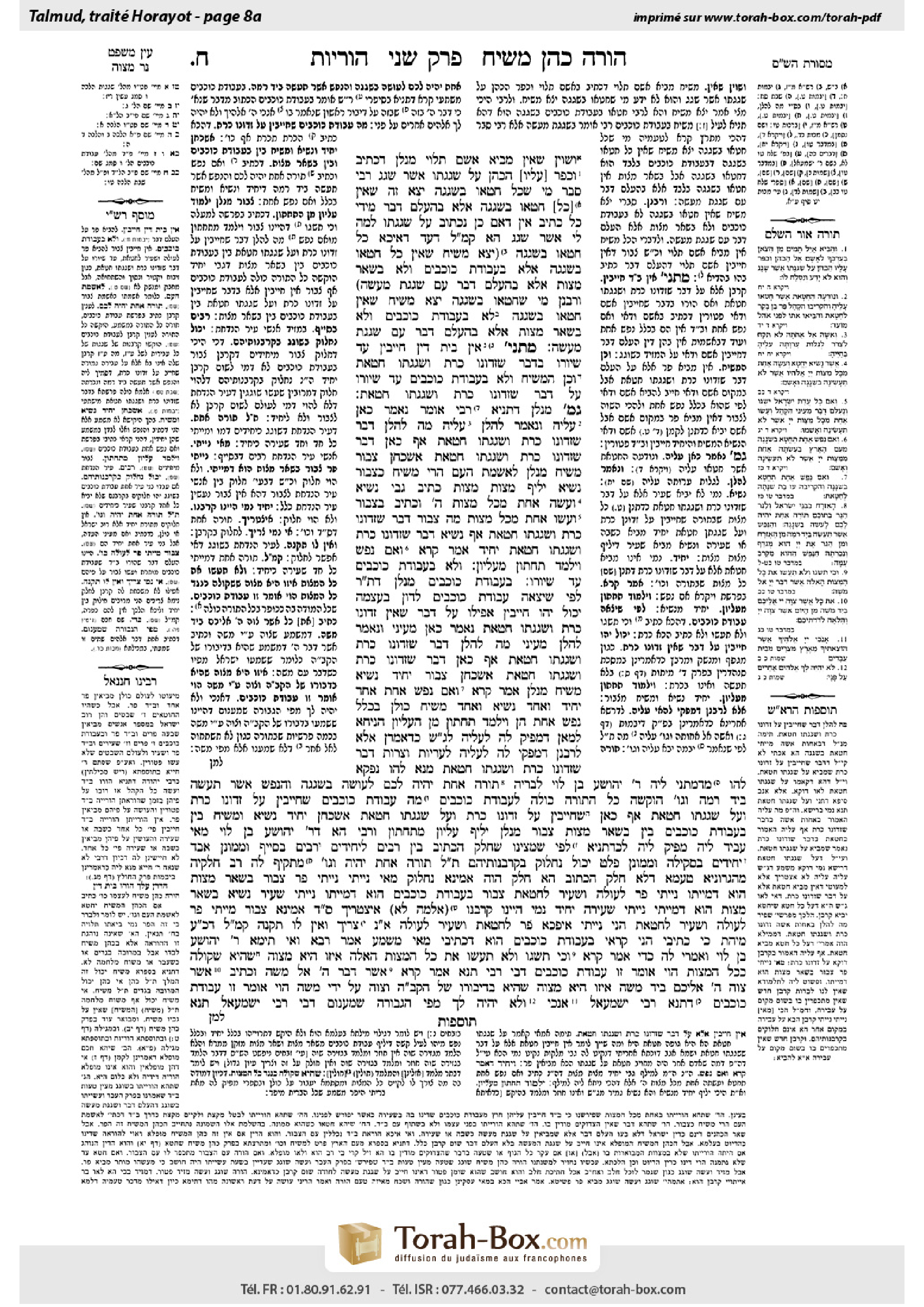
Horayot 8a: Talmud study for Daf Yomi
Study the Talmud for Daf Yomi with scanned pages, Hebrew text, English translations from Sefaria and AI-generated French translations.
Passage selection and English or AI-generated French translation are available where the scan has annotations. Daf Study is independent of Torah-Box and Sefaria.
Browse Horayot · הוריות · All tractatesHorayot 8a text and translations
This page of Horayot includes the Aramaic text, an English translation and an AI-generated French translation, alongside the scan above.
הוריות ח׳ א · Aramaic and Hebrew text
וְשָׁוִין שֶׁאֵין מֵבִיא אָשָׁם תָּלוּי. מְנָלַן? דִּכְתִיב: ״וְכִפֶּר [עָלָיו] הַכֹּהֵן עַל שִׁגְגָתוֹ אֲשֶׁר שָׁגָג״. רַבִּי סָבַר: מִי שֶׁכׇּל חֶטְאוֹ בִּשְׁגָגָה, יָצָא זֶה שֶׁאֵין [כׇּל] חֶטְאוֹ בִּשְׁגָגָה, אֶלָּא בְּהֶעְלֵם דָּבָר.
מִידֵּי ״כׇּל״ כְּתִיב? אִין דְּאִם כֵּן נִכְתּוֹב ״עַל שִׁגְגָתוֹ״. לְמָה לִי ״אֲשֶׁר שָׁגָג״ הָא קָא מַשְׁמַע לַן דְּעַד דְּאִיכָּא כׇּל חֶטְאוֹ בִּשְׁגָגָה. יָצָא מָשִׁיחַ שֶׁאֵין כׇּל חֶטְאוֹ בִּשְׁגָגָה אֶלָּא בַּעֲבוֹדָה זָרָה, וְלֹא בִּשְׁאָר מִצְוֹת אֶלָּא בְּהֶעְלֵם דָּבָר עִם שִׁגְגַת מַעֲשֶׂה.
וְרַבָּנַן: מִי שֶׁחֶטְאוֹ בִּשְׁגָגָה, יָצָא מָשִׁיחַ, שֶׁאֵין חֶטְאוֹ בִּשְׁגָגָה לֹא בַּעֲבוֹדָה זָרָה וְלֹא בִּשְׁאָר מִצְוֹת, אֶלָּא בְּהֶעְלֵם דָּבָר עִם שִׁגְגַת מַעֲשֶׂה.
מַתְנִי׳ אֵין בֵּית דִּין חַיָּיבִין עַד שֶׁיּוֹרוּ בְּדָבָר שֶׁזְּדוֹנוֹ כָּרֵת וְשִׁגְגָתוֹ חַטָּאת, וְכֵן הַמָּשִׁיחַ, וְלֹא בַּעֲבוֹדָה זָרָה – עַד שֶׁיּוֹרוּ עַל דָּבָר שֶׁזְּדוֹנוֹ כָּרֵת וְשִׁגְגָתוֹ חַטָּאת.
גְּמָ׳ מִנָּלַן?
דְּתַנְיָא, רַבִּי אוֹמֵר: נֶאֱמַר כָּאן ״עָלֶיהָ״ וְנֶאֱמַר לְהַלָּן ״עָלֶיהָ״. מָה לְהַלָּן – דָּבָר שֶׁזְּדוֹנוֹ כָּרֵת וְשִׁגְגָתוֹ חַטָּאת, אַף כָּאן – דָּבָר שֶׁזְּדוֹנוֹ כָּרֵת וְשִׁגְגָתוֹ חַטָּאת.
אַשְׁכְּחַן צִבּוּר, מָשִׁיחַ מְנָלַן? ״לְאַשְׁמַת הַעָם״, הֲרֵי מָשִׁיחַ כְּצִבּוּר.
נָשִׂיא? יָלֵיף ״מִצְוֹת״ ״מִצְוֹת״, כְּתִיב גַּבֵּי נָשִׂיא: ״וְעָשָׂה אַחַת מִכׇּל מִצְוֹת ה׳״, וּכְתִיב בְּצִבּוּר: ״וְעָשׂוּ אַחַת מִכׇּל מִצְוֹת״ – מָה צִבּוּר – דָּבָר שֶׁזְּדוֹנוֹ כָּרֵת וְשִׁגְגָתוֹ חַטָּאת, אַף נָשִׂיא – דָּבָר שֶׁזְּדוֹנוֹ כָּרֵת וְשִׁגְגָתוֹ חַטָּאת.
יָחִיד? אָמַר קְרָא: ״וְאִם נֶפֶשׁ״, וְיִלְמַד תַּחְתּוֹן מֵעֶלְיוֹן.
וְלֹא בַּעֲבוֹדָה זָרָה עַד שֶׁיּוֹרוּ. בַּעֲבוֹדָה זָרָה מְנָלַן? דְּתָנוּ רַבָּנַן: לְפִי שֶׁיָּצְאָה עֲבוֹדָה זָרָה לָדוּן בְּעַצְמָהּ, יָכוֹל יְהוּ חַיָּיבִין אֲפִילּוּ עַל דָּבָר שֶׁאֵין זְדוֹנוֹ כָּרֵת וְשִׁגְגָתוֹ חַטָּאת?
נֶאֱמַר כָּאן ״מֵעֵינֵי״, וְנֶאֱמַר לְהַלָּן ״מֵעֵינֵי״. מָה לְהַלָּן דָּבָר שֶׁזְּדוֹנוֹ כָּרֵת וְשִׁגְגָתוֹ חַטָּאת, אַף כָּאן דָּבָר שֶׁזְּדוֹנוֹ כָּרֵת וְשִׁגְגָתוֹ חַטָּאת.
אַשְׁכְּחַן צִבּוּר. יָחִיד, נָשִׂיא, מָשִׁיחַ מְנָלַן? אָמַר קְרָא: ״וְאִם נֶפֶשׁ אַחַת״, אֶחָד יָחִיד וְאֶחָד נָשִׂיא וְאֶחָד מָשִׁיחַ כּוּלָּן בִּכְלַל ״נֶפֶשׁ אַחַת״ הֵן, וְיִלְמַד תַּחְתּוֹן מִן הָעֶלְיוֹן.
הָנִיחָא לְמַאן דְּמַפֵּיק לַהּ לְ״עָלֶיהָ״ לִגְזֵרָה שָׁוָה, כְּדַאֲמַרַן. אֶלָּא לְרַבָּנַן דְּמַפְּקִי לַהּ לְ״עָלֶיהָ״ לַעֲרָיוֹת וְצָרוֹת, דָּבָר שֶׁזְּדוֹנוֹ כָּרֵת וְשִׁגְגָתוֹ חַטָּאת – מְנָא לְהוּ?
נָפְקָא לְהוּ מִדְּמַתְנֵי לֵיהּ רַבִּי יְהוֹשֻׁעַ בֶּן לֵוִי לִבְרֵיהּ: ״תּוֹרָה אַחַת יִהְיֶה לָכֶם לָעֹשֶׂה בִּשְׁגָגָה וְהַנֶּפֶשׁ אֲשֶׁר תַּעֲשֶׂה בְּיָד רָמָה וְגוֹ׳״ – הוּקְּשָׁה כׇּל הַתּוֹרָה כּוּלָּהּ לַעֲבוֹדָה זָרָה. מָה עֲבוֹדָה זָרָה שֶׁחַיָּיבִין עַל זְדוֹנוֹ כָּרֵת וְעַל שִׁגְגָתוֹ חַטָּאת, אַף כָּאן שֶׁחַיָּיבִין עַל זְדוֹנוֹ כָּרֵת וְעַל שִׁגְגָתוֹ חַטָּאת.
אַשְׁכְּחַן יָחִיד, נָשִׂיא, וּמָשִׁיחַ, בֵּין בַּעֲבוֹדָה זָרָה בֵּין בִּשְׁאָר מִצְוֹת. צִבּוּר מְנָלַן? יָלֵיף עֶלְיוֹן מִתַּחְתּוֹן.
וְרַבִּי, הָא דְּרַבִּי יְהוֹשֻׁעַ בֶּן לֵוִי מַאי עָבֵיד לֵיהּ? מַפֵּיק לֵיהּ, לְכִדְתַנְיָא: לְפִי שֶׁמָּצִינוּ שֶׁחִלֵּק הַכָּתוּב בֵּין רַבִּים לִיחִידִים – רַבִּים בְּסַיִיף וּמָמוֹנָן אָבֵד, יְחִידִים בִּסְקִילָה וּמָמוֹנָן פָּלֵט, יָכוֹל נַחְלוֹק בְּקׇרְבְּנוֹתֵיהֶם? תַּלְמוּד לוֹמַר: ״תּוֹרָה אַחַת יִהְיֶה וְגוֹ׳״.
מַתְקֵיף לַהּ רַב חִלְקִיָּה מֵהַגְרוֹנְיָא: טַעְמָא דְּלֹא חָלַק הַכָּתוּב. הָא חָלַק, הֲוָה אָמֵינָא נַחְלוֹק. מַאי נַיְיתֵי?
נַיְיתֵי פַּר, צִבּוּר בִּשְׁאָר מִצְוֹת הוּא דְּמַיְיתוּ! נַיְיתֵי פַּר לְעוֹלָה וְשָׂעִיר לְחַטָּאת, צִבּוּר בַּעֲבוֹדָה זָרָה הוּא דְּמַיְיתוּ! נַיְיתֵי שְׂעִיר, נָשִׂיא בִּשְׁאָר מִצְוֹת הוּא דְּמַיְיתֵי! נַיְיתֵי שְׂעִירָה, יָחִיד נָמֵי הַיְינוּ קׇרְבָּנוֹ!
אַלְּמָה לָא אִיצְטְרִיךְ? סָלְקָא דַּעְתָּךְ אָמֵינָא: צִבּוּר מַיְיתֵי פַּר לְעוֹלָה וְשָׂעִיר לְחַטָּאת, הָנֵי נַיְיתֵי אִיפְּכָא – פַּר לְחַטָּאת וְשָׂעִיר לְעוֹלָה. אִי נָמֵי: צָרִיךְ וְאֵין לוֹ תַּקָּנָה, קָא מַשְׁמַע לַן.
דְּכוּלֵּי עָלְמָא מִיהַת כִּי כְּתִיבִי הָנֵי קְרָאֵי – בַּעֲבוֹדָה זָרָה הוּא דִּכְתִיבִי, מַאי מַשְׁמַע? אָמַר רָבָא, וְאִי תֵּימָא רַבִּי יְהוֹשֻׁעַ בֶּן לֵוִי, וְאָמְרִי לַהּ כְּדִי. אָמַר קְרָא: ״וְכִי תִשְׁגּוּ וְלֹא תַעֲשׂוּ אֵת כׇּל הַמִּצְוֹת הָאֵלֶּה״, אֵיזוֹ הִיא מִצְוָה שֶׁהִיא שְׁקוּלָה כְּכׇל הַמִּצְוֹת? הֱוֵי אוֹמֵר: זוֹ עֲבוֹדָה זָרָה.
דְּבֵי רַבִּי תָּנָא, אָמַר קְרָא: ״אֲשֶׁר דִּבֶּר ה׳ אֶל מֹשֶׁה״, וּכְתִיב: ״אֲשֶׁר צִוָּה ה׳ אֲלֵיכֶם בְּיַד מֹשֶׁה״, אֵיזוֹ הִיא מִצְוָה שֶׁהִיא בְּדִיבּוּרוֹ שֶׁל הַקָּדוֹשׁ בָּרוּךְ הוּא וְצִוָּה עַל יְדֵי מֹשֶׁה? הֱוֵי אוֹמֵר: זוֹ עֲבוֹדָה זָרָה. דְּתָנָא רַבִּי יִשְׁמָעֵאל: ״אָנֹכִי״ וְ״לֹא יִהְיֶה לְךָ״ מִפִּי הַגְּבוּרָה שְׁמַעְנוּם.
דְּבֵי רַבִּי יִשְׁמָעֵאל תָּנָא:
Horayot 8a · English translation
The baraita teaches: And they agree that he does not bring a provisional guilt-offering. The Gemara asks: From where do we derive this halakha? It is derived from a verse, as it is written with regard to the provisional guilt-offering: “And the priest shall atone for him for his unwitting act that he performed unwittingly” (Leviticus 5:18). Rabbi Yehuda HaNasi and the Rabbis disagree with regard to the interpretation of this verse, in accordance with their opinions. Rabbi Yehuda HaNasi holds: This is referring to one whose sin-offering for all transgressions is for an unwitting act. This serves to exclude that anointed priest, as all of his sin-offerings are not for an unwitting act alone; rather, he brings a sin-offering only if that unwitting act is performed on the basis of absence of awareness of the matter, leading to an erroneous ruling.
The Gemara asks: Is it written in the verse: For all his unwitting acts that he performed unwittingly? Only the phrase “for his unwitting act that he performed unwittingly” is written. The Gemara answers: Yes, it is as though the word: All, is written. As if it were so that the verse is not referring to all unwitting acts, let the Torah write only: “For his unwitting act.” Why do I need the additional phrase: “That he performed unwittingly”? This teaches us that there is no liability to bring a provisional guilt-offering unless liability to bring all his sin-offerings is for unwitting acts. This serves to exclude an anointed priest, all of whose liability to bring a sin-offering for an unwitting act alone is only in cases of idol worship, but in cases involving the rest of the mitzvot there is liability only for absence of awareness of the matter, leading to an erroneous ruling, together with unwitting performance of an action on the basis of that ruling.
And the Rabbis interpret the verse in accordance with their opinion that an anointed priest, even in cases of idol worship, brings a sin-offering only for absence of awareness of the matter, leading to an erroneous ruling, together with unwitting performance of an action on the basis of that ruling. They hold: This teaches us that there is liability to bring a provisional guilt-offering only for one whose liability to bring his sin-offerings is for an unwitting act. This serves to exclude an anointed priest, whose liability to bring a sin-offering is not for an unwitting act alone, neither in cases of idol worship, nor in cases involving the rest of the mitzvot, but rather for absence of awareness of the matter, leading to an erroneous ruling, together with unwitting performance of an action on the basis of that ruling.
MISHNA: The court is not liable to bring an offering for absence of awareness of the matter unless they issue a ruling with regard to a matter for whose intentional violation one is liable to receive karet and for whose unwitting violation one is liable to bring a sin-offering. And likewise the anointed priest is liable only for such a ruling. Neither is the court liable to bring a sin-offering for idol worship unless the judges issue a ruling with regard to a matter for whose intentional violation one is liable to receive karet, and for whose unwitting violation one is liable to bring a sin-offering.
GEMARA: With regard to the statement in the mishna that the court is liable only for a ruling with regard to a matter for whose intentional violation one is liable to receive karet and for whose unwitting violation one is liable to bring a sin-offering, the Gemara asks: From where do we derive this halakha?
The Gemara answers: It is derived as it is taught in a baraita that Rabbi Yehuda HaNasi says: The word “that” is stated here in the verse: “And the sin that they sinned” (Leviticus 4:14), with regard to the offering brought by the court for the transgression of the public based on their erroneous ruling, and the word “that” is stated there in the verse: “And you shall not take a woman to her sister, to be a rival to her, to uncover her nakedness, that is in her lifetime” (Leviticus 18:18), with regard to the prohibition against marrying two sisters. It is derived: Just as there it is a matter for whose intentional violation one is liable to receive karet and for whose unwitting violation one is liable to bring a sin-offering, so too here, the reference is to a matter for whose intentional violation one is liable to receive karet and for whose unwitting violation one is liable to bring a sin-offering.
We found a source for the court bringing an offering for a transgression of the general public based on their erroneous ruling. From where do we derive that this is the halakha for an anointed priest? The Gemara answers: It is derived from the verse: “If the anointed priest shall sin so as to bring guilt upon the people” (Leviticus 4:3), indicating that the status of an anointed priest is like that of the transgression of the general public.
The Gemara asks: From where is it derived that this is the halakha with regard to the king? The Gemara answers: The tanna derives a verbal analogy between the term “commandments” written with regard to a king and the term “commandments” written with regard to the general public. It is written with regard to a king: “And he performed one of all the commandments of the Lord his God that are not to be performed” (Leviticus 4:22), and it is written with regard to the general public: “And performed one of all the commandments of the Lord that are not to be performed” (Leviticus 4:13). Just as with regard to the general public there is liability only for a matter for whose intentional violation one is liable to receive karet and for whose unwitting violation one is liable to bring a sin-offering, so too, in the case of a king there is liability only for a matter for whose intentional violation one is liable to receive karet and for whose unwitting violation one is liable to bring a sin-offering.
The Gemara asks further: From where is it derived that an individual is liable to bring a sin-offering only for a matter for whose intentional violation one is liable to receive karet? The Gemara answers: The verse with regard to an individual states: “And if one soul from among the common people shall sin unwittingly” (Leviticus 4:27). The verse begins with the conjunction “and,” represented by the letter vav. This indicates that one shall derive the halakha with regard to the lower verse, i.e., the verse written later in the passage, from that which is written in the upper verses, i.e., those written earlier. Just as in those verses earlier in the passage, addressing the public, priest, and king, there is liability only for a matter for whose intentional violation one is liable to receive karet, so too, in the case of the individual addressed in this verse, there is liability only for a matter for whose intentional violation one is liable to receive karet.
§ The mishna teaches: Neither is the court liable to bring a sin-offering for idol worship unless the judges issue a ruling with regard to a matter for whose intentional violation one is liable to receive karet, and for whose unwitting violation one is liable to bring a sin-offering. The Gemara asks: In the case of idol worship, from where do we derive this halakha? It is derived as the Sages taught: Due to the fact that idol worship left the category of unwitting transgressions to be discussed by itself (see Numbers, chapter 15), one might have thought that the court and the priest would be liable even if it is not for a matter for whose intentional violation one is liable to receive karet and for whose unwitting violation one is liable to bring a sin-offering.
The baraita continues: Therefore, the term “from the eyes of” is stated here, with regard to idol worship (Numbers 15:24), and “from the eyes of” is stated there, with regard to an unwitting communal sin-offering for all other mitzvot (Leviticus 4:13). Just as there the court is liable only for a matter for whose intentional violation one is liable to receive karet and for whose unwitting violation one is liable to bring a sin-offering, so too here, the court is liable only for a matter for whose intentional violation one is liable to receive karet and for whose unwitting violation one is liable to bring a sin-offering.
The baraita concludes: We found a source for the court bringing an offering for a transgression of the general public based on their erroneous ruling; but from where do we derive that this is the halakha for an individual, a king, and an anointed priest who engage in idol worship? It is derived from a verse, as the verse states: “And if one soul sins unwittingly, then he shall offer a female goat of the first year as a sin-offering” (Numbers 15:27). And with regard to an individual, a king, and an anointed priest, they all are included in the category of “one soul.” And one shall derive the halakha with regard to that which is written in the lower verse, i.e., the verses concerning an individual, a king, and an anointed priest, from that which is written in the upper verse, i.e., the verse concerning the transgression of the general public.
The Gemara challenges: This works out well according to the one who derives the halakha by using the term “that” for a verbal analogy to teach that the court is liable only for a ruling with regard to a matter for whose intentional violation one is liable to receive karet, in accordance with that which we stated. But according to the Rabbis, who derive the halakha by using the term “that” to teach the halakhot of those with whom relations are forbidden and rival wives with regard to a yevama (see Yevamot 3b), from where do they derive the halakha of a matter for whose intentional violation one is liable to receive karet and for whose unwitting violation one is liable to bring a sin-offering in the case of the transgression of the general public?
The Gemara answers: They derive it from that which Rabbi Yehoshua ben Levi taught to his son based on the verse: “There shall be one Torah for you for the one who acts unwittingly. And the soul that performs with an upraised hand, he blasphemes the Lord; and that soul shall be cut off [venikhreta] from among his people” (Numbers 15:29–30). The Sages understood the phrase “with an upraised hand” to be referring to idol worship (see Sanhedrin 99a). The entire Torah is juxtaposed to idol worship: Just as idol worship is a prohibition for which one is liable for its intentional violation to receive karet and for its unwitting violation to bring a sin-offering, so too here, for the entire Torah one is liable for its intentional violation to receive karet and for its unwitting violation to bring a sin-offering.
The Gemara challenges: We found a source for this halakha with regard to an individual, a king, and an anointed priest, both with regard to idol worship and with regard to the rest of the mitzvot, as all those are included in the category of “one soul” and are juxtaposed to idol worship. But from where do we derive that the general public is liable to bring a sin-offering only for a matter for whose intentional violation one is liable to receive karet? The Gemara answers: One derives the halakha with regard to that which is written in the upper verse, i.e., the verse concerning the general public, from that which is written in the lower verse, i.e., the verse concerning an individual.
The Gemara asks: And Rabbi Yehuda HaNasi, who derives this matter from the term “that,” what does he do with this verse, from which Rabbi Yehoshua ben Levi taught a halakha to his son? The Gemara answers: He derives a halakha, using the verse to teach that which is taught in a baraita: Due to the fact that we found that the verse distinguished with regard to idol worship between the many, who constitute the majority of a city, and individuals, as the many are executed through beheading with a sword and their property is lost, as the court destroys it, while individuals are executed through stoning and their property is spared, one might have thought that in the case of unwitting idol worship we would distinguish between the offerings that they are liable to bring. Therefore, the verse states: “There shall be one Torah for you for the one who acts unwittingly. And the soul that performs with an upraised hand, he blasphemes the Lord” (Numbers 15:29–30).
Rav Ḥilkiya of Hagronya objects to it: The reason that both individuals and the general public are liable to bring the same offering for unwitting idol worship is that the verse did not distinguish between them. But had the verse distinguished between them, I would say: Let us distinguish between individuals and the general public, and the general public would bring a different offering for their unwitting idol worship. What different offering shall they bring?
If one would say: Let them bring a bull, that is difficult, as it is for unwitting violation of the rest of the mitzvot that the general public brings a bull. If one would say: Let them bring a bull for a burnt-offering and a goat for a sin-offering, that is difficult, as it is for unwitting idol worship that the general public brings those offerings in the case of an absence of awareness leading to an erroneous ruling by the court. If one would say: Let them bring a goat, that is difficult, as it is for unwitting violation of the rest of the mitzvot that a king brings a goat. If one will say: Let them bring a female goat, that is difficult, as that is the offering for an individual, too.
The Gemara rejects this: Why do you say that the verse that equates the offerings of the individuals and the public is not necessary? Were it not for the verse, it might enter your mind to say: The general public brings a bull for a burnt-offering and a goat for a sin-offering, but this majority of a city that unwittingly engaged in idol worship shall bring the opposite: A bull for a sin-offering and a goat for a burnt-offering. Alternatively, perhaps the majority of a city that unwittingly engaged in idol worship must bring an offering, but it has no remedy, because there is no unique offering that it can bring. Therefore, the verse teaches us that there is no distinction between many people and individuals in this case.
§ In any event, everyone agrees that where these verses are written, it is with regard to idol worship that they are written. The Gemara asks: As the verse does not mention idol worship explicitly, from where is this inferred? Rava said, and some say it was Rabbi Yehoshua ben Levi who said, and some say that the statement is unattributed, that the verse states: “And when you act unwittingly, and do not perform all these commandments [kol hamitzvot] that the Lord spoke to Moses” (Numbers 15:22). Which is the mitzva that is the equivalent of all the mitzvot? You must say: It is the prohibition against idol worship.
The school of Rabbi Yehuda HaNasi taught that the verse states: “That the Lord spoke to Moses” (Numbers 15:22), and it is written: “That the Lord has commanded you by the hand of Moses” (Numbers 15:23). Which is the mitzva that was introduced in the speech of the Holy One, Blessed be He, heard by the Jewish people, and which He commanded in the Torah by means of Moses? You must say: This is idol worship, as Rabbi Yishmael taught concerning the first two commandments: “I am the Lord your God” (Exodus 20:2), and: “You shall have no other gods before Me” (Exodus 20:3): We, the Jewish people, heard them from the mouth of the Almighty.
The school of Rabbi Yishmael taught
Horayot 8a · Traduction française (IA)
La baraïta enseigne : Ils s'entendent sur le fait qu'il ne présente pas un sacrifice de culpabilité provisoire. La Guemara pose la question : D'où dérivons-nous cette halakha ? Elle est dérivée d'un verset, comme il est écrit concernant le sacrifice de culpabilité provisoire : « Et le prêtre expiera pour lui son acte involontaire qu'il a commis involontairement » (Lévitique 5:18). Rabbi Yehuda HaNasi et les Rabbins s'opposent quant à l'interprétation de ce verset, selon leurs opinions. Rabbi Yehuda HaNasi affirme : Cela concerne celui dont le sacrifice expiatoire pour toutes les transgressions est pour un acte involontaire. Cela sert à exclure le prêtre consacré, car tous ses sacrifices expiatoires ne sont pas pour un acte involontaire seul ; plutôt, il présente un sacrifice expiatoire uniquement si cet acte involontaire est commis sur la base d'une ignorance de la matière, entraînant une décision erronée.
La Guemara pose la question : Est-il écrit dans le verset : « Pour tous ses actes involontaires qu'il a commis involontairement » ? Seul la phrase « pour son acte involontaire qu'il a commis involontairement » est écrite. La Guemara répond : Oui, c'est comme si le mot « tous » était écrit. Comme si le verset ne faisait pas référence à tous les actes involontaires, la Torah n'aurait besoin d'écrire que : « Pour son acte involontaire ». Pourquoi ai-je besoin de la phrase supplémentaire : « Qu'il a commis involontairement » ? Cela nous apprend que l'on n'est pas tenu de présenter un sacrifice de culpabilité provisoire à moins que la responsabilité de présenter tous ses sacrifices expiatoires soit pour des actes involontaires. Cela sert à exclure le prêtre consacré, dont la responsabilité de présenter un sacrifice expiatoire pour un acte involontaire seul est uniquement dans les cas d'idolâtrie, mais dans les cas concernant les autres mitsvot, la responsabilité est uniquement pour l'ignorance de la matière, entraînant une décision erronée, conjointement avec l'accomplissement involontaire d'une action sur la base de cette décision.
Et les Rabbins interprètent le verset selon leur opinion, à savoir que le prêtre consacré, même dans les cas d'idolâtrie, présente un sacrifice expiatoire uniquement pour l'ignorance de la matière, entraînant une décision erronée, conjointement avec l'accomplissement involontaire d'une action sur la base de cette décision. Ils affirment : Cela nous apprend que la responsabilité de présenter un sacrifice de culpabilité provisoire est uniquement pour celui dont la responsabilité de présenter ses sacrifices expiatoires est pour un acte involontaire. Cela sert à exclure le prêtre consacré, dont la responsabilité de présenter un sacrifice expiatoire n'est pas pour un acte involontaire seul, ni dans les cas d'idolâtrie, ni dans les cas concernant les autres mitsvot, mais plutôt pour l'ignorance de la matière, entraînant une décision erronée, conjointement avec l'accomplissement involontaire d'une action sur la base de cette décision.
MICHNA : La cour n'est pas tenue de présenter un sacrifice pour l'ignorance de la matière à moins qu'elle émette un avis concernant une matière dont la violation intentionnelle entraîne la karet et dont la violation involontaire entraîne la présentation d'un sacrifice expiatoire. De même, le prêtre consacré est tenu uniquement d'un tel avis. La cour n'est pas tenue de présenter un sacrifice expiatoire pour l'idolâtrie à moins que les juges émettent un avis concernant une matière dont la violation intentionnelle entraîne la karet et dont la violation involontaire entraîne la présentation d'un sacrifice expiatoire.
GUEMARA : Concernant l'affirmation de la mishna que la cour est tenue uniquement d'un avis concernant une matière dont la violation intentionnelle entraîne la karet et dont la violation involontaire entraîne la présentation d'un sacrifice expiatoire, la Guemara pose la question : D'où dérivons-nous cette halakha ?
La Guemara répond : Elle est dérivée comme il est enseigné dans une baraïta que Rabbi Yehuda HaNasi dit : Le mot « que » est utilisé ici dans le verset : « Et le péché qu'ils ont péché » (Lévitique 4:14), concernant l'offrande présentée par la cour pour la transgression publique basée sur leur décision erronée, et le mot « que » est utilisé là dans le verset : « Et tu ne prendras pas une femme à sa sœur, pour être une rivale d'elle, pour découvrir sa nudité, que c'est en sa vie » (Lévitique 18:18), concernant l'interdiction de marier deux sœurs. Elle est dérivée : Comme si là c'était une matière dont la violation intentionnelle entraîne la karet et dont la violation involontaire entraîne la présentation d'un sacrifice expiatoire, ainsi ici, la référence est à une matière dont la violation intentionnelle entraîne la karet et dont la violation involontaire entraîne la présentation d'un sacrifice expiatoire.
Nous avons trouvé une source concernant la cour présentant un sacrifice pour une transgression de la communauté basée sur leur décision erronée. D'où dérivons-nous que c'est la halakha concernant le prêtre consacré ? La Guemara répond : Elle est dérivée du verset : « Si le prêtre consacré péche de sorte à attirer le péché sur le peuple » (Lévitique 4:3), indiquant que le statut du prêtre consacré est comme celui de la transgression de la communauté.
La Guemara pose la question : D'où dérivons-nous que c'est la halakha concernant le roi ? La Guemara répond : Le tanna dérive une analogie verbale entre le terme « commandements » utilisé concernant le roi et le terme « commandements » utilisé concernant la communauté. Il est écrit concernant le roi : « Et il a accompli l'un de tous les commandements du Seigneur son Dieu qui ne doivent pas être accomplis » (Lévitique 4:22), et il est est écrit concernant la communauté : « Et il a accompli l'un de tous les commandements du Seigneur qui ne doivent pas être accomplis » (Lévitique 4:13). Comme avec la communauté il y a responsabilité uniquement pour une matière dont la violation intentionnelle entraîne la karet et dont la violation involontaire entraîne la présentation d'un sacrifice expiatoire, ainsi aussi avec le roi il y a responsabilité uniquement pour une matière dont la violation intentionnelle entraîne la karet et dont la violation involontaire entraîne la présentation d'un sacrifice expiatoire.
La Guemara pose une question supplémentaire : D'où dérive-t-on que seul un individu est tenu de présenter un sacrifice expiatoire pour une matière dont la violation intentionnelle entraîne la karet ? La Guemara répond : La parabole concernant un individu dit : « Et si une âme parmi le peuple ordinaire péche involontairement » (Lévitique 4:27). La parabole commence par la conjonction « et », représentée par la lettre vav. Cela indique que l'on doit déduire la halakha concernant la parabole suivante, c'est-à-dire celle écrite plus tard dans le passage, à partir de celle qui précède, c'est-à-dire celle écrite plus tôt. Tout comme dans ces paraboles précédentes, concernant le public, le prêtre et le roi, il y a responsabilité uniquement pour une matière dont la violation intentionnelle entraîne la karet, de même, dans le cas de l'individu mentionné dans cette parabole, il y a responsabilité uniquement pour une matière dont la violation intentionnelle entraîne la karet.
§ La mitsva enseigne : Le tribunal n'est pas tenu de présenter un sacrifice expiatoire pour l'idolâtrie, sauf si les juges rendent un jugement concernant une matière dont la violation intentionnelle entraîne la karet, et dont la violation involontaire entraîne la présentation d'un sacrifice expiatoire. La Guemara pose une question : Dans le cas de l'idolâtrie, d'où dérive cette halakha ? Elle est dérivée selon ce que les Sages ont enseigné : En raison du fait que l'idolâtrie a sorti la catégorie des transgressions involontaires pour être discutée à part (cf. Nb 15), on aurait pu penser que le tribunal et le prêtre seraient responsables même si ce n'est pas pour une matière dont la violation intentionnelle entraîne la karet et dont la violation involontaire entraîne la présentation d'un sacrifice expiatoire.
La baraïta continue : Par conséquent, le terme « des yeux de » est mentionné ici, concernant l'idolâtrie (Nb 15:24), et « des yeux de » est mentionné là, concernant un sacrifice expiatoire communautaire involontaire pour tous les autres mitsvot (Lévitique 4:13). Tout comme là, le tribunal est tenu uniquement pour une matière dont la violation intentionnelle entraîne la karet et dont la violation involontaire entraîne la présentation d'un sacrifice expiatoire, de même ici, le tribunal est tenu uniquement pour une matière dont la violation intentionnelle entraîne la karet et dont la violation involontaire entraîne la présentation d'un sacrifice expiatoire.
La baraïta conclut : Nous avons trouvé une source pour que le tribunal présente un sacrifice pour une transgression du peuple général basée sur leur décision erronée ; mais d'où dérive-t-on que c'est la halakha pour un individu, un roi et un prêtre sacré qui pratiquent l'idolâtrie ? Elle est dérivée d'une versette, comme la versette dit : « Et si une âme péche involontairement, il offrira une jeune bouc femelle comme sacrifice expiatoire » (Nb 15:27). Et concernant un individu, un roi et un prêtre sacré, ils sont tous inclus dans la catégorie de « une âme ». Et l'on déduit la halakha concernant celle qui est écrite dans la versette inférieure, c'est-à-dire les versettes concernant un individu, un roi et un prêtre sacré, à partir de celle qui est écrite dans la versette supérieure, c'est-à-dire la versette concernant la transgression du peuple général.
La Guemara conteste : Cela fonctionne bien selon celui qui déduit la halakha en utilisant le terme « que » pour enseigner une analogie verbale afin de dire que le tribunal est tenu uniquement pour un jugement concernant une matière dont la violation intentionnelle entraîne la karet, conformément à ce que nous avons dit. Mais selon les Rabbins, qui déduisent la halakha en utilisant le terme « que » pour enseigner les halakhot concernant ceux avec qui des relations sont interdites et les épouses rivales concernant une yevama (cf. Yevamot 3b), d'où dérivent-ils la halakha d'une matière dont la violation intentionnelle entraîne la karet et dont la violation involontaire entraîne la présentation d'un sacrifice expiatoire dans le cas de la transgression du peuple général ?
La Guemara répond : Ils la dérivent de ce que Rabbi Yehoshua ben Levi a enseigné à son fils, basé sur la parole : « Il y aura une Torah pour vous pour celui qui agit involontairement. Et l'âme qui agit avec une main levée, il blasphème l'Éternel ; et cette âme sera coupée [venikhreta] du milieu de son peuple » (Nb 15:29–30). Les Sages ont compris la phrase « avec une main levée » comme faisant référence à l'idolâtrie (cf. Sanhédrin 99a). L'ensemble de la Torah est juxtaposé à l'idolâtrie : Tout comme l'idolâtrie est une interdiction pour laquelle l'on est tenu de la violation intentionnelle à recevoir la karet et pour la violation involontaire à présenter un sacrifice expiatoire, de même ici, pour toute la Torah, l'on est tenu de la violation intentionnelle à recevoir la karet et pour la violation involontaire à présenter un sacrifice expiatoire.
La Guemara conteste : Nous avons trouvé une source pour cette halakha concernant un individu, un roi et un prêtre sacré, à la fois concernant l'idolâtrie et concernant les autres mitsvot, comme tous ceux-ci sont inclus dans la catégorie de « une âme » et sont juxtaposés à l'idolâtrie. Mais d'où dérive-t-on que le peuple général est tenu de présenter un sacrifice expiatoire uniquement pour une matière dont la violation intentionnelle entraîne la karet ? La Guemara répond : On déduit la halakha concernant celle qui est écrite dans la parabole supérieure, c'est-à-dire la parabole concernant le peuple général, à partir de celle qui est écrite dans la parabole inférieure, c'est-à-dire la parabole concernant l'individu.
La Guemara pose la question : Et Rabbi Yéhuda haNasi, qui tire cette halakha du terme « que », que fait-il avec cette versette, d'après laquelle Rabbi Yéhoshua ben Lévi a enseigné une halakha à son fils ? La Guemara répond : Il tire une halakha, en utilisant la versette pour enseigner ce qui est enseigné dans une baraïta : En effet, nous avons trouvé que la versette distingue, en ce qui concerne l'idolâtrie, entre les nombreux, qui constituent la majorité d'une ville, et les individus, car les nombreux sont exécutés par la tête avec une épée et leurs biens sont perdus, car le tribunal les détruit, tandis que les individus sont exécutés par la pierre et leurs biens sont préservés, on pourrait penser que dans le cas d'une idolâtrie involontaire, nous devrions distinguer entre les offrandes qu'ils sont tenus de présenter. Ainsi, la versette dit : « Il y aura une Torah unique pour vous, pour celui qui agit involontairement. Et l'âme qui agit avec une main levée, il blasphème l'Éternel » (Nombres 15 : 29-30).
Rav Ḥilkiya de Hagronya s'oppose à cela : La raison pour laquelle tant les individus que la population générale sont tenus de présenter la même offrande pour l'idolâtrie involontaire est que la versette ne distingue pas entre eux. Mais si la versette avait distingué entre eux, je dirais : Faisons la distinction entre les individus et la population générale, et la population générale présenterait une offrande différente pour son idolâtrie involontaire. Quelle offrande devraient-ils présenter ?
Si l'on disait : Faisons-leur présenter un taureau, cela serait difficile, car c'est pour l'involontaire violation des autres commandements que la population générale présente un taureau. Si l'on disait : Faisons-leur présenter un taureau pour un holocauste et un bouc pour un sacrifice expiatoire, cela serait difficile, car c'est pour l'idolâtrie involontaire que la population générale présente ces offrandes dans le cas d'une absence de conscience entraînant une décision erronée du tribunal. Si l'on disait : Faisons-leur présenter un bouc, cela serait difficile, car c'est pour l'involontaire violation des autres commandements que le roi présente un bouc. Si l'on disait : Faisons-leur présenter une femelle bouc, cela serait difficile, car c'est l'offrande pour l'individu également.
La Guemara rejette cela : Pourquoi dis-tu que la versette qui égale les offrandes des individus et de la population générale n'est pas nécessaire ? S'il n'y avait pas cette versette, on pourrait penser : La population générale présente un taureau pour un holocauste et un bouc pour un sacrifice expiatoire, mais cette majorité d'une ville qui a involontairement participé à l'idolâtrie devrait présenter l'inverse : un taureau pour un sacrifice expiatoire et un bouc pour un holocauste. Alternativement, peut-être la majorité d'une ville qui a involontairement participé à l'idolâtrie doit présenter une offrande, mais il n'y a pas de remède, car il n'y a pas d'offrande unique qu'elle puisse présenter. Ainsi, la versette nous apprend que la distinction entre les nombreux et les individus n'existe pas dans ce cas.
§ En tout cas, tout le monde convient que ces versets sont écrits en ce qui concerne l'idolâtrie. La Guemara pose la question : Comme la versette ne mentionne pas explicitement l'idolâtrie, d'où en déduit-on cela ? Rava a dit, et certains disent que c'était Rabbi Yéhoshua ben Lévi qui a dit, et d'autres disent que cette déclaration est anonyme, que la versette dit : « Et quand tu agis involontairement, et que tu n'accomplis pas toutes ces commandements [kol hamitzvot] que l'Éternel a parlé à Moïse » (Nombres 15 : 22). Quelle est la mitsva équivalente à toutes les mitsvot ? Tu dois dire : C'est la prohibition contre l'idolâtrie.
L'école de Rabbi Yéhuda haNasi enseignait que la versette dit : « Que l'Éternel a parlé à Moïse » (Nombres 15 : 22), et il est écrit : « Que l'Éternel a commandé par la main de Moïse » (Nombres 15 : 23). Quelle est la mitsva qui a été introduite dans la parole du Saint, béni soit-Il, entendue par le peuple juif, et qui a été commandée dans la Torah par Moïse ? Tu dois dire : C'est l'idolâtrie, comme Rabbi Yishmael a enseigné concernant les deux premières commandements : « Je suis l'Éternel votre Dieu » (Exode 20 : 2), et : « Tu n'auras pas d'autres dieux devant Moi » (Exode 20 : 3) : Nous, le peuple juif, l'avons entendu de la bouche de l'Éternel.
L'école de Rabbi Yishmael enseignait
Traduction française générée par IA à partir de l’édition anglaise de Sefaria. Vérifie toujours un passage avec le texte source.
Text from Sefaria: William Davidson Edition - Vocalized Aramaic (CC BY NC); William Davidson Edition - English (CC BY NC).