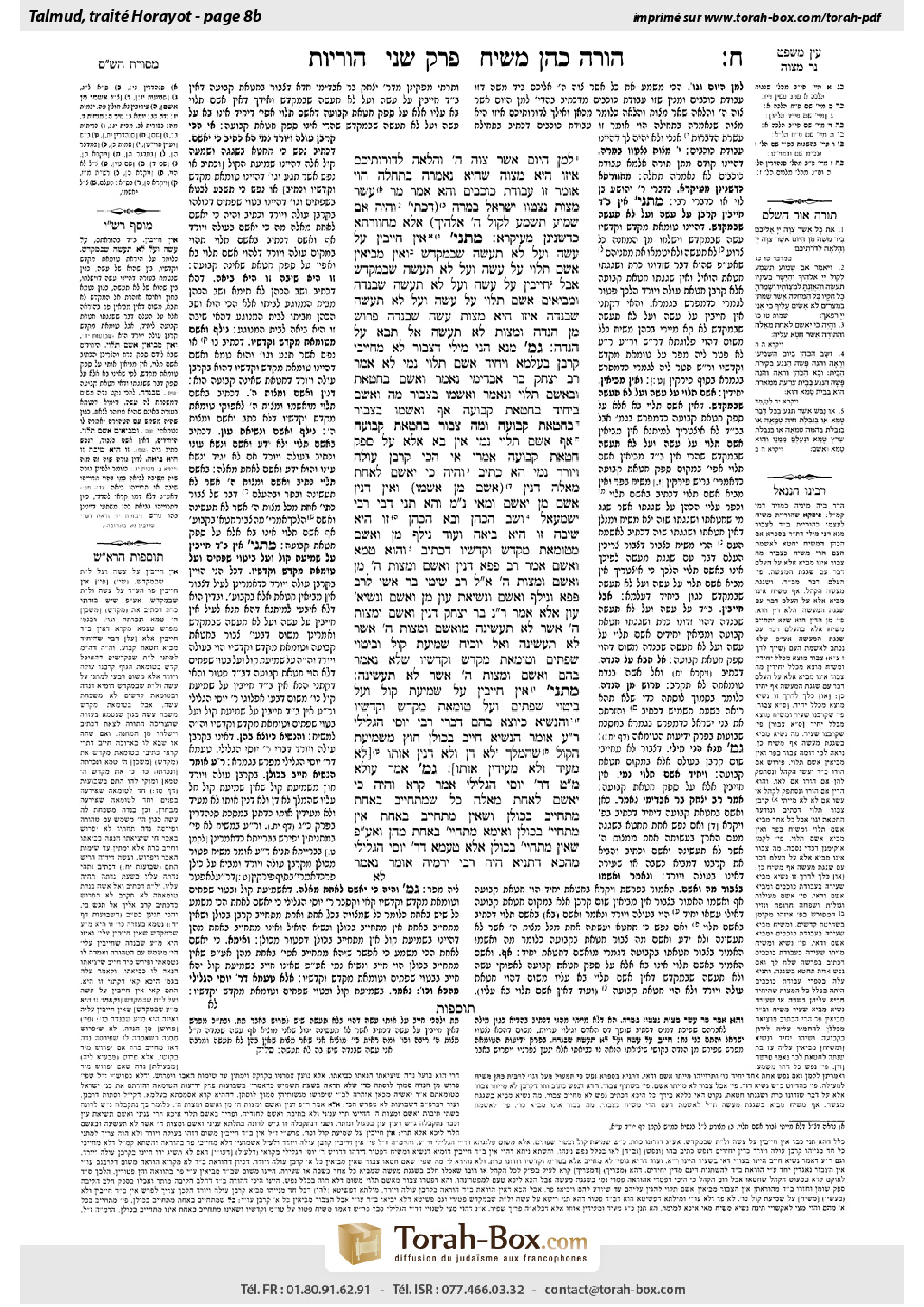
Horayot 8b: Talmud study for Daf Yomi
Study the Talmud for Daf Yomi with scanned pages, Hebrew text, English translations from Sefaria and AI-generated French translations.
Passage selection and English or AI-generated French translation are available where the scan has annotations. Daf Study is independent of Torah-Box and Sefaria.
Browse Horayot · הוריות · All tractatesHorayot 8b text and translations
This page of Horayot includes the Aramaic text, an English translation and an AI-generated French translation, alongside the scan above.
הוריות ח׳ ב · Aramaic and Hebrew text
״לְמִן הַיּוֹם אֲשֶׁר צִוָּה ה׳ וָהָלְאָה לְדוֹרוֹתֵיכֶם״, אֵיזוֹ הִיא מִצְוָה שֶׁהִיא נֶאֶמְרָה בִּתְחִלָּה? הֱוֵי אוֹמֵר: זוֹ עֲבוֹדָה זָרָה. וְהָא אָמַר מָר: עֶשֶׂר מִצְוֹת נִצְטַוּוּ יִשְׂרָאֵל בְּמָרָה (דִּכְתִיב: ״וְהָיָה אִם שָׁמוֹעַ תִּשְׁמַע לְקוֹל ה׳ אֱלֹהֶיךָ״)? אֶלָּא מְחַוַּורְתָּא כִדְשַׁנִּינַן מֵעִיקָּרָא.
מַתְנִי׳ אֵין חַיָּיבִין עַל עֲשֵׂה וְעַל לֹא תַעֲשֶׂה שֶׁבַּמִּקְדָּשׁ, וְאֵין מְבִיאִין אָשָׁם תָּלוּי עַל עֲשֵׂה וְעַל לֹא תַעֲשֶׂה שֶׁבַּמִּקְדָּשׁ.
אֲבָל חַיָּיבִין עַל עֲשֵׂה וְעַל לֹא תַעֲשֶׂה שֶׁבַּנִּדָּה, וּמְבִיאִים אָשָׁם תָּלוּי עַל עֲשֵׂה וְעַל לֹא תַעֲשֶׂה שֶׁבַּנִּדָּה. אֵיזוֹ הִיא מִצְוַת עֲשֵׂה שֶׁבַּנִּדָּה? פְּרוֹשׁ מִן הַנִּדָּה. וּמִצְוַת לֹא תַעֲשֶׂה? אַל תָּבֹא עַל הַנִּדָּה.
גְּמָ׳ מְנָא הָנֵי מִילֵּי דְּצִבּוּר לָא מְחַיְּיבִי קׇרְבָּן בְּעָלְמָא, וְיָחִיד אָשָׁם תָּלוּי נָמֵי לָא?
אָמַר רַב יִצְחָק בַּר אַבְדִּימִי: נֶאֱמַר ״וְאָשֵׁם״ בְּחַטָּאת וּבְאָשָׁם תָּלוּי, וְנֶאֱמַר ״וְאָשֵׁמוּ״ בְּצִבּוּר. מָה ״וְאָשֵׁם״ בְּיָחִיד – בְּחַטָּאת קְבוּעָה, אַף ״וְאָשֵׁמוּ״ בְּצִבּוּר – בְּחַטָּאת קְבוּעָה,
וּמָה צִבּוּר בְּחַטָּאת קְבוּעָה, אַף אָשָׁם תָּלוּי נָמֵי אֵין בָּא אֶלָּא עַל סְפֵק חַטָּאת קְבוּעָה. אָמְרִי: אִי הָכִי, קׇרְבָּן עוֹלֶה וְיוֹרֵד נָמֵי, הָא כְּתִיב: ״וְהָיָה כִּי יֶאְשַׁם לְאַחַת מֵאֵלֶּה״! דָּנִין (״אָשֵׁם״ מִן ״אָשֵׁמוּ״) [״אָשֵׁמוּ״ מִן ״אָשֵׁם״], וְאֵין דָּנִין ״אָשֵׁם״ מִן ״יֶאְשַׁם״.
וּמַאי נָפְקָא מִינַּהּ? וְהָא תָּנֵי דְּבֵי רַבִּי יִשְׁמָעֵאל: ״וְשָׁב הַכֹּהֵן״ וּבָא הַכֹּהֵן״ – זוֹ הִיא שִׁיבָה, זוֹ הִיא בִּיאָה! וְעוֹד: נֵילַף מִן ״וְאָשֵׁם״ מִטּוּמְאַת מִקְדָּשׁ וְקָדָשָׁיו, דִּכְתִיב: ״וְהוּא טָמֵא וְאָשֵׁם״!
אָמַר רַב פָּפָּא: דָּנִין ״וְאָשֵׁם״ וּ״מִצְוֹת ה׳״ מִן ״וְאָשֵׁם״ וּ״מִצְוֹת ה׳״. אֲמַר לֵיהּ רַב שִׁימִי בַּר אָשֵׁי לְרַב פָּפָּא: וְנֵילַף ״וְאָשֵׁם״ וּנְשִׂיאַת עָוֹן מִן ״וְאָשֵׁם״ וּנְשִׂיאַת עָוֹן!
אֶלָּא אָמַר רַב נַחְמָן בַּר יִצְחָק: דָּנִין ״וְאָשֵׁם״ וּ״מִצְוֹת ה׳ אֲשֶׁר לֹא תֵעָשֶׂינָה״ – מִ״וְאָשֵׁם וּמִצְוֹת ה׳ אֲשֶׁר לֹא תֵעָשֶׂינָה״. וְאַל יוֹכִיחַ שְׁמִיעַת קוֹל וּבִיטּוּי שְׂפָתַיִם וְטוּמְאַת מִקְדָּשׁ וְקָדָשָׁיו, שֶׁלֹּא נֶאֱמַר בָּהֶם ״וְאָשֵׁם״ וּ״מִצְוֹת ה׳ אֲשֶׁר לֹא תֵעָשֶׂינָה״.
מַתְנִי׳ אֵין חַיָּיבִין עַל שְׁמִיעַת קוֹל, וְעַל בִּיטּוּי שְׂפָתַיִם, וְעַל טוּמְאַת מִקְדָּשׁ וְקָדָשָׁיו. וְהַנָּשִׂיא כַּיּוֹצֵא בָּהֶם, דִּבְרֵי רַבִּי יוֹסֵי הַגְּלִילִי. רַבִּי עֲקִיבָא אוֹמֵר: הַנָּשִׂיא חַיָּיב בְּכוּלָּן חוּץ מִשְּׁמִיעַת הַקּוֹל, שֶׁהַמֶּלֶךְ לֹא דָּן וְלֹא דָּנִין אוֹתוֹ [לֹא מֵעִיד וְלֹא מְעִידִין אוֹתוֹ].
גְּמָ׳ אָמַר עוּלָּא: מַאי טַעְמָא דְּרַבִּי יוֹסֵי הַגְּלִילִי? אָמַר קְרָא: ״וְהָיָה כִי יֶאְשַׁם לְאַחַת מֵאֵלֶּה״, כֹּל שֶׁמִּתְחַיֵּיב בְּאַחַת – מִתְחַיֵּיב בְּכוּלָּן, וְשֶׁאֵין מִתְחַיֵּיב בְּאַחַת – אֵין מִתְחַיֵּיב בְּכוּלָּן.
וְאֵימָא: מִתְחַיֵּיב בְּאַחַת מֵהֶן, וְאַף עַל פִּי שֶׁאֵין מִתְחַיֵּיב בְּכוּלָּן!
אֶלָּא טַעְמָא דְּרַבִּי יוֹסֵי הַגְּלִילִי מֵהָכָא, דְּתַנְיָא, הָיָה רַבִּי יִרְמְיָה אוֹמֵר: נֶאֱמַר
Horayot 8b · English translation
that it is derived from the verse: “All that the Lord has commanded you by the hand of Moses, from the day that the Lord commanded and onward throughout your generations” (Numbers 15:23). Which is the mitzva that was stated at the beginning of all the mitzvot? You must say: This is idol worship, as it is the first mitzva in the Ten Commandments. The Gemara asks: But didn’t the Master say: The Jewish people were commanded ten mitzvot in Marah soon after leaving Egypt, prior to the revelation at Sinai, as it is written: “If you shall hearken to the voice of the Lord your God…and listen to His mitzvot” (Exodus 15:26)? Evidently, there were mitzvot that preceded the prohibition against idol worship. Rather, it is clear as we initially answered.
MISHNA: The court is not liable to bring a bull as an unwitting communal sin-offering for issuing a ruling with regard to a positive mitzva or a prohibition related to the defiling of the Temple by one being there while ritually impure, or the defiling of its sacrificial foods by one partaking of them while ritually impure. There is a positive mitzva to remove impure people from the Temple, and there is a prohibition against entering the Temple while in a state of ritual impurity. And one does not bring a provisional guilt-offering for a positive mitzva or a prohibition related to the defiling of the Temple or its sacrificial foods.
But the court is liable to bring a bull for a positive mitzva or for a prohibition that is related to a menstruating woman, and one brings a provisional guilt-offering for a positive mitzva or for a prohibition that is related to a menstruating woman. What is the positive mitzva that is related to a menstruating woman? Distance yourself from the menstruating woman. If a man engages in intercourse with a woman and she begins menstruating, he is required to separate from her. And what is the prohibition? Do not engage in intercourse with a woman whom you know is a menstruating woman.
GEMARA: The Gemara asks: From where are these matters derived? That is, from where is it derived that the general public is not liable to bring any offering at all for a sin like the defiling of the Temple, which carries no liability for an individual to bring a fixed sin-offering for violating it unwittingly, and from where is it derived that an individual too is not liable to bring a provisional guilt-offering for the defiling of the Temple?
Rav Yitzḥak bar Avdimi says: The term “and he is guilty” is stated with regard to a sin-offering (Leviticus 4:27) and with regard to a provisional guilt-offering (Leviticus 5:17), and the similar term: “And they are guilty” (Leviticus 4:13), is stated with regard to the general public. Just as the term “and he is guilty” that is stated with regard to an individual is concerning a transgression for which one is liable to bring a fixed sin-offering, as it is written there, so too, the term “and they are guilty” that is stated with regard to the general public is concerning a transgression for which one is liable to bring a fixed sin-offering. For the defiling of the Temple or its sacrificial foods one is liable to bring a sliding-scale offering, not a fixed offering.
And just as with regard to a transgression performed by the general public the liability is to bring a fixed sin-offering, so too, a provisional guilt-offering comes only for uncertainty with regard to a transgression that renders one obligated to bring a fixed sin-offering. This is the source for the fact that there is no liability to bring a sin-offering if the general public defiles the Temple or its sacrificial foods, and individuals are not liable to bring a provisional guilt-offering for those transgressions. The Sages say: If so, and the derivation is based on that term, this is difficult, as isn’t it also written with regard to a sliding-scale offering: “And it shall be when he shall be guilty of one of these matters” (Leviticus 5:5)? The Gemara responds: One derives the meaning of “they are guilty” from the meaning of “he is guilty,” but one does not derive the meaning of “he is guilty” from the meaning of “he shall be guilty,” even though both are stated in the singular.
The Gemara asks: And what difference is there between the different verb conjugations? But didn’t the school of Rabbi Yishmael teach a verbal analogy with regard to leprosy of houses? The verse states: “And the priest shall return [veshav]” (Leviticus 14:39), and another verse with regard to the priest’s visit seven days later states: “And the priest shall come [uva] and look” (Leviticus 14:44). This returning and this coming have the same meaning and one can therefore derive by verbal analogy that the halakha that applies if the leprosy had spread at the conclusion of the first week applies if it had spread again by the end of the following week. If a verbal analogy can be derived between two different terms, it can certainly be derived from two conjugations of the same term. And furthermore, let us derive the halakha from the term “and he is guilty,” written with regard to the defiling of the Temple or its sacrificial foods, as it is written: “And he is ritually impure and he is guilty” (Leviticus 5:2), which is a verbal analogy between identical terms.
Rav Pappa says: One derives the meaning of: “And he is guilty,” and: “The commandments of the Lord” (Leviticus 5:17), which are written with regard to a provisional guilt-offering, from the meaning of: “And they are guilty,” and: “The commandments of the Lord” (Leviticus 4:13), which are written with regard to the unwitting communal sin-offering. The phrase: The commandments of the Lord, is not written with regard to the sliding-scale offering. Rav Shimi bar Ashi said to Rav Pappa: Let us derive the meaning of: “And he is guilty and bearing of iniquity” (see Leviticus 5:1, 4), from the meaning of: “And he is guilty and bearing of iniquity” (Leviticus 5:17).
Rather, Rav Naḥman bar Yitzḥak says: One derives the meaning of “and he is guilty” and “the commandments of the Lord that shall not be done” written with regard to a provisional guilt-offering, from the meaning of: “And he is guilty,” and: “The commandments of the Lord that shall not be done” (Leviticus 4:27), written with regard to a fixed sin-offering. And the cases of hearing of a voice, i.e., an oath of testimony, and a statement of the lips, i.e., an oath on an utterance, and the defiling of the Temple or its sacrificial foods, for which one is liable to bring a sliding-scale offering, shall not prove otherwise, as it is not stated concerning them: And he is guilty, and: The commandments of the Lord that shall not be done.
MISHNA: The court is not liable for issuing a ruling with regard to hearing of a voice, i.e., a false oath of testimony taken by a witness who refuses to testify on behalf of a litigant who demands that he testify, or for an utterance of the lips, i.e., a false oath stated about some matter, or for the defiling of the Temple or its sacrificial foods. And the status of the king is like that of the court, and he is exempt from bringing an offering in those cases; this is the statement of Rabbi Yosei HaGelili. Rabbi Akiva says: The king is liable in all of those cases except for the case of hearing of a voice, and even in that case, his exemption is not intrinsic to the mitzva. Rather, it is for technical reasons, as the king neither judges others nor do others judge him; he does not testify nor do others testify against him. Therefore, a demand that he testify is not applicable.
GEMARA: Ulla said: What is the reason for the opinion of Rabbi Yosei HaGelili? It is as the verse states with regard to a sliding-scale offering: “And it shall be when he shall be guilty of one of these matters” (Leviticus 5:5), indicating that anyone who becomes liable in every one of the instances for which one brings a sliding-scale offering becomes liable in all of those instances; and anyone who does not become liable in every one of the instances to bring a sliding-scale offering does not become liable in any of those instances. Since the king is exempt from taking an oath of testimony, he is exempt in the other cases as well.
The Gemara asks: Why say this? And say an alternative interpretation of the verse: Anyone who becomes liable in any one of these instances brings a sliding-scale offering, and this is the halakha even though he does not become liable in all of them.
Rather, the reason for the opinion of Rabbi Yosei HaGelili is from here, as it is taught in a baraita that Rabbi Yirmeya would say: It is stated:
Horayot 8b · Traduction française (IA)
que cela découle de la parole : « Tout ce que l'Éternel a commandé à vous par la main de Moïse, depuis le jour où l'Éternel a commandé et en avant, à travers vos générations » (Nombres 15:23). Quelle est la Mitsva qui a été énoncée au début de toutes les Mitsvot ? Tu dois dire : C'est l'idolâtrie, car c'est la première Mitsva des Dix Commandements. La Guemara demande : Mais n'a-t-il pas dit le Maître : Le peuple juif a été commandé dix Mitsvot à Marah peu après avoir quitté l'Égypte, avant la révélation du Sinaï, comme il est écrit : « Si tu écoutes la voix de l'Éternel ton Dieu… et écoutes Ses Mitsvot » (Exode 15:26) ? Évidemment, il y avait des Mitsvot qui précédaient l'interdiction de l'idolâtrie. En effet, c'est clair comme nous l'avons dit initialement.
MICHNA : La cour n'est pas tenue de présenter un taureau comme offrande de péché involontaire pour avoir rendu un jugement concernant une Mitsva positive ou une interdiction liée à la souillure du Temple par une personne y étant présente en état de souillure rituelle, ou à la souillure de ses aliments sacrés par une personne consommant ces aliments en état de souillure rituelle. Il y a une Mitsva positive de chasser les personnes souillées du Temple, et il y a une interdiction d'entrer dans le Temple en état de souillure rituelle. Et l'on ne présente pas une offrande de culpabilité provisoire pour une Mitsva positive ou une interdiction liée à la souillure du Temple ou à celle de ses aliments sacrés.
Mais la cour est tenue de présenter un taureau pour une mitsva positive ou pour une interdiction liée à une femme en cours de menstruation, et l'on présente une offrande de culpabilité provisoire pour une mitsva positive ou pour une interdiction liée à une femme en cours de menstruation. Quelle est la mitsva positive liée à une femme en cours de menstruation ? C'est de se tenir à distance de la femme en cours de menstruation. Si un homme a des relations sexuelles avec une femme et elle commence à avoir ses règles, il est tenu de se séparer d'elle. Et quelle est l'interdiction ? Ne pas avoir des relations sexuelles avec une femme que l'on sait être en cours de menstruation.
GUEMARA : La Guemara demande : D'où ces choses sont-elles dérivées ? C'est-à-dire, d'où découle-t-il que le public n'est pas tenu de présenter aucune offrande du tout pour un péché comme la souillure du Temple, qui ne génère pas de responsabilité pour un individu de présenter une offrande de péché fixe pour l'avoir commis involontairement, et d'où découle-t-il que l'individu lui-même n'est pas tenu de présenter une offrande de culpabilité provisoire pour la souillure du Temple ?
Rav Yitzḥak bar Avdimi dit : Le terme « et il est coupable » est mentionné concernant une offrande de péché (Lévitique 4:27) et concernant une offrande de culpabilité provisoire (Lévitique 5:17), et le terme similaire : « et ils sont coupables » (Lévitique 4:13), est mentionné concernant le public. Tout comme le terme « et il est coupable » mentionné concernant un individu est concernant une transgression pour laquelle l'on est tenu de présenter une offrande de péché fixe, comme il est écrit là, ainsi le terme « et ils sont coupables » mentionné concernant le public est concernant une transgression pour laquelle l'on est tenu de présenter une offrande de péché fixe. Pour la souillure du Temple ou de ses aliments sacrés, l'on est tenu de présenter une offrande variable, pas une offrande fixe.
Et tout comme, en ce qui concerne une transgression commise par le public, la responsabilité est de présenter un sacrifice expiatoire fixe, ainsi un sacrifice de culpabilité provisoire vient uniquement en cas d'incertitude concernant une transgression qui rend l'individu tenu de présenter un sacrifice expiatoire fixe. C'est la source du fait qu'il n'y a pas de responsabilité à présenter un sacrifice expiatoire si le public souille le Temple ou ses aliments sacrés, et les individus ne sont pas tenus de présenter un sacrifice de culpabilité provisoire pour ces transgressions. Les Sages disent : Si tel est le cas, et la dérivation est basée sur ce terme, cela est difficile, car n'est-il pas aussi écrit concernant un sacrifice variable : « Et il sera quand il aura commis l'un de ces péchés » (Lévitique 5:5) ? La Guemara répond : On dérive le sens de « ils sont coupables » du sens de « il est coupable », mais on ne dérive pas le sens de « il est coupable » du sens de « il sera coupable », même si les deux sont mentionnés au singulier.
La Guemara demande : Et quelle différence y a-t-il entre les conjugaisons verbales différentes ? Mais n’a-t-il pas enseigné la scolion de Rabbi Yishmael concernant l’analogie verbale concernant la lèpre des maisons ? La parole dit : « Et le prêtre reviendra [veshav] » (Lévitique 14:39), et une autre parole concernant la visite du prêtre sept jours plus tard dit : « Et le prêtre viendra [uva] et regardera » (Lévitique 14:44). Ce retour et ce venir ont le même sens et l’on peut donc dériver par analogie verbale que la halakha qui s’applique si la lèpre s’est étendue à la fin de la première semaine s’applique si elle s’est étendue à nouveau à la fin de la semaine suivante. Si une analogie verbale peut être dérivée entre deux termes différents, elle peut certainement être dérivée de deux conjugaisons du même terme. Et de plus, faisons dériver la halakha du terme « et il est coupable », mentionné concernant la souillure du Temple ou de ses aliments sacrés, comme il est écrit : « Et il est impur rituellement et il est coupable » (Lévitique 5:2), qui est une analogie verbale entre des termes identiques.
Rav Pappa dit : On dérive le sens de : « Et il est coupable », et : « Les commandements de l’Éternel » (Lévitique 5:17), qui sont mentionnés concernant une offrande de culpabilité provisoire, du sens de : « Et ils sont coupables », et : « Les commandements de l’Éternel » (Lévitique 4:13), qui sont mentionnés concernant l’offrande de péché involontaire communautaire. La phrase : « Les commandements de l’Éternel », n’est pas mentionnée concernant l’offrande variable. Rav Shimi bar Ashi a dit à Rav Pappa : Faisons dériver le sens de : « Et il est coupable et porteur de péché » (voir Lévitique 5:1, 4), du sens de : « Et il est coupable et porteur de péché » (Lévitique 5:17).
En effet, Rav Naḥman bar Yitzḥak dit : On déduit la signification de « et il est coupable » et « les commandements du Seigneur qui ne doivent pas être faits » écrits en référence à un sacrifice de culpabilité provisoire, de la signification de « et il est coupable » et « les commandements du Seigneur qui ne doivent pas être faits » (Lévitique 4:27), écrits en référence à un sacrifice expiatoire fixe. Et les cas de l'entendre d'une voix, c'est-à-dire d'un serment de témoignage, et d'une déclaration des lèvres, c'est-à-dire d'un serment sur une parole, et la souillure du Temple ou de ses aliments sacrés, pour lesquels on est tenu de présenter un sacrifice variable, ne peuvent pas prouver le contraire, car il n'est pas dit à leur sujet : « et il est coupable », et « les commandements du Seigneur qui ne doivent pas être faits ».
MICHNA : La cour n'est pas tenue de présenter un sacrifice en cas d'erreur dans l'entendre d'une voix, c'est-à-dire d'un faux serment de témoignage donné par un témoin qui refuse de témoigner en faveur d'un litigeant qui exige qu'il témoigne, ou en cas d'erreur dans l'expression des lèvres, c'est-à-dire d'un faux serment concernant une affaire, ou en cas de souillure du Temple ou de ses aliments sacrés. Et le statut du roi est comme celui de la cour, et il est exempt de présenter un sacrifice dans ces cas ; c'est la position de Rabbi Yosei HaGelili. Rabbi Akiva dit : le roi est tenu dans tous ces cas sauf celui de l'entendre d'une voix, et même dans ce cas, son exemption n'est pas intrinsèque à la mitsva. En effet, c'est pour des raisons techniques, car le roi ne juge pas les autres ni les autres ne le jugent, il ne témoigne pas ni les autres ne témoignent contre lui. Par conséquent, une demande qu'il témoigne n'est pas applicable.
GUEMARA : Ulla dit : Quelle est la raison de l'opinion de Rabbi Yosei HaGelili ? C'est comme la parole du texte concernant un sacrifice variable : « Et il sera coupable d'un de ces cas » (Lévitique 5:5), indiquant que celui qui devient tenu de présenter un sacrifice variable pour chaque cas parmi ceux pour lesquels on présente un sacrifice variable devient tenu de présenter un sacrifice variable pour tous ces cas ; et celui qui ne devient pas tenu de présenter un sacrifice variable pour chaque cas parmi ceux pour lesquels on présente un sacrifice variable ne devient pas tenu de présenter un sacrifice variable pour aucun de ces cas. Puisque le roi est exempt de prendre un serment de témoignage, il est exempt dans les autres cas également.
La Guemara demande : Pourquoi dire cela ? Et dire une autre interprétation de la parole : celui qui devient tenu de présenter un sacrifice variable pour un seul de ces cas présente un sacrifice variable, et c'est la halakha même s'il ne devient pas tenu de présenter un sacrifice variable pour tous ceux-ci.
En effet, la raison de l'opinion de Rabbi Yosei HaGelili vient d'ici, comme il est enseigné dans une baraïta que Rabbi Yirmeya disait : Il est dit :
Traduction française générée par IA à partir de l’édition anglaise de Sefaria. Vérifie toujours un passage avec le texte source.
Text from Sefaria: William Davidson Edition - Vocalized Aramaic (CC BY NC); William Davidson Edition - English (CC BY NC).