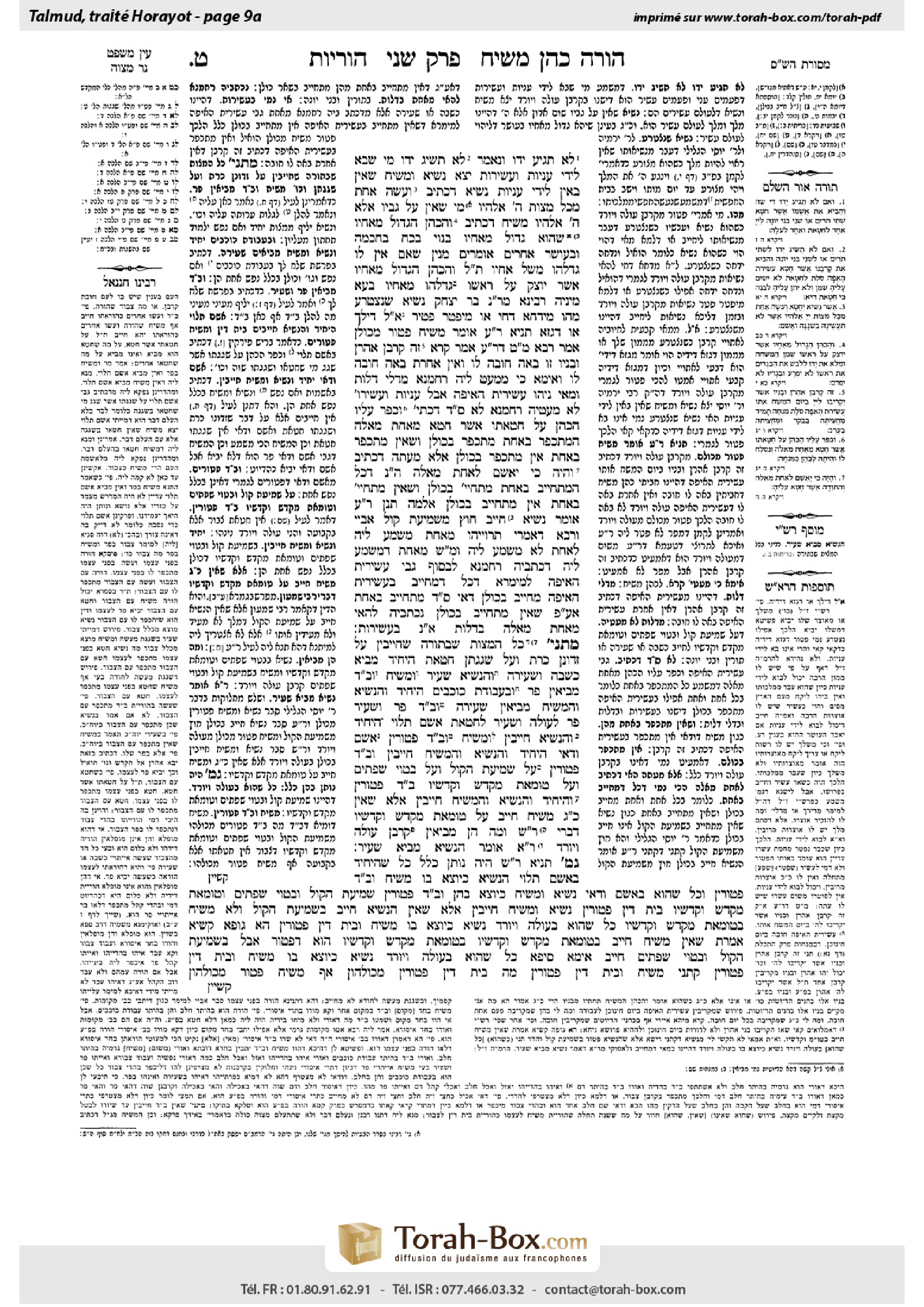
Horayot 9a: Talmud study for Daf Yomi
Study the Talmud for Daf Yomi with scanned pages, Hebrew text, English translations from Sefaria and AI-generated French translations.
Passage selection and English or AI-generated French translation are available where the scan has annotations. Daf Study is independent of Torah-Box and Sefaria.
Browse Horayot · הוריות · All tractatesHorayot 9a text and translations
This page of Horayot includes the Aramaic text, an English translation and an AI-generated French translation, alongside the scan above.
הוריות ט׳ א · Aramaic and Hebrew text
״לֹא תַגִּיעַ יָדוֹ״, וְנֶאֱמַר ״לֹא תַשִּׂיג יָדוֹ״ – מִי שֶׁבָּא לִידֵי עֲנִיּוּת וַעֲשִׁירוּת. יָצָא נָשִׂיא וּמָשִׁיחַ, שֶׁאֵין בָּאִין לִידֵי עֲנִיּוּת,
נָשִׂיא – דִּכְתִיב: ״וְעָשָׂה אַחַת מִכׇּל מִצְוֹת ה׳ אֱלֹהָיו״. מִי שֶׁאֵין עַל גַּבָּיו אֶלָּא ה׳ אֱלֹהָיו. מָשִׁיחַ – דִּכְתִיב: ״וְהַכֹּהֵן הַגָּדוֹל מֵאֶחָיו״, שֶׁהוּא גָּדוֹל מֵאֶחָיו בְּנוֹי, בְּכֹחַ, בְּחָכְמָה וּבְעוֹשֶׁר. אֲחֵרִים אוֹמְרִים: מִנַּיִן שֶׁאִם אֵין לוֹ גַּדְּלֵהוּ מִשֶּׁל אֶחָיו? תַּלְמוּד לוֹמַר: ״וְהַכֹּהֵן הַגָּדוֹל מֵאֶחָיו אֲשֶׁר יוּצַק עַל רֹאשׁוֹ״ – גַּדְּלֵהוּ מֵאֶחָיו.
בְּעָא מִינֵּיהּ רָבִינָא מֵרַב נַחְמָן בַּר יִצְחָק: נָשִׂיא שֶׁנִּצְטָרַע, מַהוּ? מִידְחָא דְּחֵי, אוֹ מִיפְטָר פְּטִיר? אֲמַר לֵיהּ: דִּילָךְ, אוֹ דְּגַזָּא?
תַּנְיָא, רַבִּי עֲקִיבָא אוֹמֵר: מָשִׁיחַ פָּטוּר מִכּוּלָּן. אָמַר רָבָא: מַאי טַעְמָא דְּרַבִּי עֲקִיבָא? אָמַר קְרָא: ״זֶה קׇרְבַּן אַהֲרֹן וּבָנָיו״. זוֹ בָּאָה חוֹבָה לוֹ, וְאֵין אַחֶרֶת בָּאָה חוֹבָה לוֹ.
וְאֵימָא: כִּי מְמַעֵט לֵיהּ רַחֲמָנָא – מִדַּלֵּי דַלּוּת, וּמַאי נִיהוּ? עֲשִׂירִית הָאֵיפָה. אֲבָל עֲנִיּוּת וַעֲשִׁירוּת, לָא מַעֲטֵיהּ רַחֲמָנָא! לָא סָלְקָא דַּעְתָּךְ, דִּכְתִיב: ״וְכִפֶּר עָלָיו הַכֹּהֵן עַל חַטָּאתוֹ אֲשֶׁר חָטָא מֵאַחַת מֵאֵלֶּה״. הַמִּתְכַּפֵּר בְּאַחַת – מִתְכַּפֵּר בְּכוּלָּן, וְשֶׁאֵין מִתְכַּפֵּר בְּאַחַת – אֵין מִתְכַּפֵּר בְּכוּלָּן.
אֶלָּא מֵעַתָּה, דִּכְתִיב: ״וְהָיָה כִּי יֶאְשַׁם לְאַחַת מֵאֵלֶּה״, הָכִי נָמֵי: דְּכׇל הַמִּתְחַיֵּיב בְּאַחַת – מִתְחַיֵּיב בְּכוּלָּן, וְשֶׁאֵין מִתְחַיֵּיב בְּאַחַת – אֵין מִתְחַיֵּיב בְּכוּלָּן. אַלְּמָה תְּנַן, רַבִּי עֲקִיבָא אוֹמֵר: נָשִׂיא חַיָּיב חוּץ מִשְּׁמִיעַת קוֹל!
אַבָּיֵי וְרָבָא דְּאָמְרִי תַּרְוַיְיהוּ: ״מֵאַחַת״ מַשְׁמַע לֵיהּ, ״לְאַחַת״ לָא מַשְׁמַע לֵיהּ. וּמַאי שְׁנָא ״מֵאַחַת״ דְּמַשְׁמַע לֵיהּ?
דְּכַתְבֵיהּ רַחֲמָנָא לְבַסּוֹף גַּבֵּי עֲשִׂירִית הָאֵיפָה, לְמֵימְרָא דְּכֹל דְּמִחַיַּיב בַּעֲשִׂירִית הָאֵיפָה – מִחַיַּיב בְּכוּלָּן, דְּאִי סָלְקָא דַעְתָּךְ מִתְחַיֵּיב בְּאַחַת אַף עַל פִּי שֶׁאֵין מִתְחַיֵּיב בְּכוּלָּן, נִכְתְּבֵיהּ לְהַאי ״מֵאַחַת מֵאֵלֶּה״ בְּדַלּוּת, אִי נָמֵי בַּעֲשִׁירוּת.
מַתְנִי׳ כׇּל הַמִּצְוֹת שֶׁבְּתוֹרָה שֶׁחַיָּיבִין עַל זְדוֹנָן כָּרֵת וְעַל שִׁגְגָתָן חַטָּאת – הַיָּחִיד מֵבִיא כִּשְׂבָּה וּשְׂעִירָה, וְהַנָּשִׂיא שָׂעִיר, וּמָשִׁיחַ וּבֵית דִּין מְבִיאִין פַּר. וּבַעֲבוֹדָה זָרָה – הַיָּחִיד וְהַנָּשִׂיא וְהַמָּשִׁיחַ מְבִיאִין שְׂעִירָה, וּבֵית דִּין פַּר וְשָׂעִיר; פַּר לְעוֹלָה וְשָׂעִיר לְחַטָּאת.
אָשָׁם תָּלוּי – הַיָּחִיד וְהַנָּשִׂיא חַיָּיבִין, וּמָשִׁיחַ וּבֵית דִּין פְּטוּרִין. אָשָׁם וַדַּאי – הַיָּחִיד וְהַנָּשִׂיא וְהַמָּשִׁיחַ חַיָּיבִין, וּבֵית דִּין פְּטוּרִין.
עַל שְׁמִיעַת הַקּוֹל, וְעַל בִּטּוּי שְׂפָתַיִם, וְעַל טוּמְאַת מִקְדָּשׁ וְקָדָשָׁיו – בֵּית דִּין פְּטוּרִין, וְהַיָּחִיד וְהַנָּשִׂיא וְהַמָּשִׁיחַ חַיָּיבִין, אֶלָּא שֶׁאֵין כֹּהֵן גָּדוֹל מָשִׁיחַ חַיָּיב עַל טוּמְאַת מִקְדָּשׁ וְקָדָשָׁיו, דִּבְרֵי רַבִּי שִׁמְעוֹן. וּמָה הֵן מְבִיאִין? קׇרְבַּן עוֹלֶה וְיוֹרֵד. רַבִּי אֱלִיעֶזֶר אוֹמֵר: הַנָּשִׂיא מֵבִיא שָׂעִיר.
גְּמָ׳ תַּנְיָא, רַבִּי שִׁמְעוֹן הָיָה נוֹתֵן כְּלָל: כֹּל שֶׁהַיָּחִיד בְּאָשָׁם תָּלוּי – הַנָּשִׂיא כַּיּוֹצֵא בּוֹ, מָשִׁיחַ וּבֵית דִּין פְּטוּרִין. וְכֹל שֶׁהוּא בְּאָשָׁם וַדַּאי – נָשִׂיא וּמָשִׁיחַ כַּיּוֹצֵא בָּהֶן, וּבֵית דִּין פְּטוּרִין.
שְׁמִיעַת הַקּוֹל, וּבִטּוּי שְׂפָתַיִם, וְטוּמְאַת מִקְדָּשׁ וְקָדָשָׁיו – בֵּית דִּין פְּטוּרִין, נָשִׂיא וּמָשִׁיחַ חַיָּיבִין, אֶלָּא שֶׁאֵין הַנָּשִׂיא חַיָּיב בִּשְׁמִיעַת הַקּוֹל, וְלֹא מָשִׁיחַ בְּטוּמְאַת מִקְדָּשׁ וְקָדָשָׁיו. כׇּל שֶׁהוּא בְּעוֹלֶה וְיוֹרֵד – נָשִׂיא כַּיּוֹצֵא בּוֹ, מָשִׁיחַ וּבֵית דִּין פְּטוּרִין.
הָא גּוּפַהּ קַשְׁיָא, אָמְרַתְּ: שֶׁאֵין מָשִׁיחַ חַיָּיב בְּטוּמְאַת מִקְדָּשׁ וְקָדָשָׁיו, בְּטוּמְאַת מִקְדָּשׁ וְקָדָשָׁיו – הוּא דְּפָטוּר, אֲבָל בִּשְׁמִיעַת הַקּוֹל וּבִטּוּי שְׂפָתַיִם – חַיָּיב. אֵימָא סֵיפָא: כֹּל שֶׁהוּא בְּעוֹלֶה וְיוֹרֵד – נָשִׂיא כַּיּוֹצֵא בּוֹ, מָשִׁיחַ וּבֵית דִּין פְּטוּרִין, קָתָנֵי: מָשִׁיחַ וּבֵית דִּין פְּטוּרִין, מָה בֵּית דִּין פְּטוּרִין מִכּוּלְּהוֹן – אַף מָשִׁיחַ פָּטוּר מִכּוּלְּהוֹן.
Horayot 9a · English translation
“And if his means suffice not” (Leviticus 5:7), and it is stated: “And if his means not suffice” (Leviticus 5:11), indicating that the sliding-scale offering applies only to one who can come to a state of poverty and wealth. This serves to exclude a king and an anointed priest, who cannot come to a state of poverty.
The king cannot become poor, as it is written concerning him: “And he performed one of all the mitzvot of the Lord his God” (Leviticus 4:22), referring to the king as one who has only the Lord his God upon him. He is greater than the entire nation and is not a poor person dependent on others. An anointed priest cannot become poor, as it is written: “And the priest that is greatest among his brethren” (Leviticus 21:10), meaning that he is greater than his brethren in beauty, in power, in wisdom, and in wealth, not a poor person. Others say: From where is it derived that if the High Priest does not have personal wealth, one should make him great from the property of his brethren? The verse states: “And the priest that is greatest among his brethren upon whose head the anointing oil is poured” (Leviticus 21:10), from which it is derived: Make him great from the property of his brethren, who will provide him with enough property to render him wealthy.
Ravina raised a dilemma before Rav Naḥman bar Yitzḥak: In the case of a king who was afflicted with leprosy and unfit to serve as king during his affliction, what is his status with regard to the sliding-scale offering? Previously, during his reign, was he completely eliminated from the obligation to bring a sliding-scale offering to the extent that even now, when he is no longer king, he remains exempt? Or was he merely exempted, so that now that he is no longer king he is obligated to bring the offering? Rav Naḥman bar Yitzḥak said to Ravina: Does he bring the offering from your property, i.e., public property, or does he bring the offering from his personal treasure [degazza]? Since he obviously would bring the offering from his own personal treasure, he remains exempt from bringing the offering.
§ It is taught in a baraita that Rabbi Akiva says: An anointed priest is exempt from bringing an offering in all the cases where one is liable to bring a sliding-scale offering. Rava said: What is the reason for the opinion of Rabbi Akiva? It is as the verse states: “This is the offering of Aaron and of his sons that they shall offer unto the Lord on the day that he is anointed: One-tenth part of an ephah of fine flour as a meal-offering” (Leviticus 6:13). One can infer: It is this tenth of an ephah that comes as an obligation for him, and no other such offering comes as an obligation for him.
The Gemara asks: But why not say that when the Merciful One excludes an anointed priest, it is particularly from the type of sliding-scale offering brought due to extreme poverty? And what is it? The one-tenth of an ephah meal-offering mentioned in the verse. But the Merciful One did not exclude him from the dove brought as a sliding-scale offering due to poverty and the sheep brought as a sliding-scale offering by one with wealth. The Gemara rejects this: That should not enter your mind, as it is written with regard to the sliding-scale offering: “And the priest shall atone for him for his sin that he has committed from one of these” (Leviticus 5:13), from which it is derived: One who gains atonement with every one of the types of a sliding-scale offering gains atonement with any of the types of the sliding-scale offering, and one who does not gain atonement with every one of the types of a sliding-scale offering does not gain atonement with any of the types of the sliding-scale offering.
The Gemara asks: But if that is so, and the verse is interpreted in that manner, then that which is written there: “And it shall be when he shall be guilty of one of these matters” (Leviticus 5:5), so too shall be interpreted: Anyone who becomes liable in every one of the instances for which one brings a sliding-scale offering can become liable in any of those instances, and anyone who does not become liable in every one of the instances to bring a sliding-scale offering cannot become liable in any of those instances. Why, then, did we learn in the mishna that Rabbi Akiva says: The king is liable in all of these cases except for the case of hearing of a voice, indicating that he can become liable in the rest of the instances even if he is exempt in one?
Abaye and Rava both say to resolve this difficulty: Rabbi Akiva learns this inference from the term: “From one” (Leviticus 5:13). He does not learn anything from the term: “Of one” (Leviticus 5:5). The Gemara asks: And what is different about the term “from one” that he learns a halakha from it?
The Gemara answers: The difference is that the Merciful One wrote it at the end of the passage discussing the sliding-scale offering, with regard to the one-tenth of an ephah meal-offering, to say that anyone who can become liable to bring the one-tenth of an ephah can become liable to bring any of them. As, if it enters your mind to say that one can become liable to bring one even though he cannot become liable to bring any one of them, let the Torah write this phrase: From one of these, with regard to the offering brought due to poverty, or alternatively, with regard to the offering brought by one with wealth. Since this term does not appear with regard to one of the other offerings, apparently, it is specifically with regard to the offering brought due to extreme poverty that one who cannot become liable for that offering is exempt from the entire matter.
MISHNA: In summation: For all mitzvot that are in the Torah for whose intentional violation one is liable to receive karet and for whose unwitting violation one is liable to bring a sin-offering, the individual brings a ewe or female goat for their unwitting transgression, and the king brings a male goat for their unwitting transgression, and an anointed priest and a court who issued an erroneous ruling bring a bull. And for unwittingly engaging in idol worship, the individual, and the king, and the anointed priest bring a female goat, and the court brings a bull and a goat: A bull for a burnt-offering and a goat for a sin-offering.
With regard to a provisional guilt-offering, the individual and the king are liable, and an anointed priest and a court are exempt. With regard to a definite guilt-offering, the individual, the king, and the anointed priest are liable, and a court is exempt.
For hearing of a voice, i.e., a false oath of testimony, and for a false oath on an utterance of the lips, and for the defiling of the Temple or its sacrificial foods, a court is exempt, and the individual, the king, and the anointed priest are liable. But an anointed High Priest is not liable for the defiling of the Temple or its sacrificial foods; this is the statement of Rabbi Shimon. And what offering are they liable to bring? It is a sliding-scale offering based on their financial circumstances, as delineated in the Torah (see Leviticus 5:1–13). Rabbi Eliezer says: The king brings a goat.
GEMARA: It is taught in a baraita that Rabbi Shimon would posit a principle: For any case in which the individual is liable to bring a provisional guilt-offering, the status of the king is like that of the individual, and an anointed priest and a court are exempt. And for any case in which an individual is liable to bring a definite guilt-offering, the status of a king and an anointed priest is like that of the individual, and the court is exempt.
He continues: For hearing of a voice, i.e., a false oath of testimony, and for a false oath on an utterance of the lips, and for the defiling of the Temple or its sacrificial foods, a court is exempt, and a king and an anointed priest are liable. But the king is not liable in a case of hearing of a voice, and an anointed priest is not liable for the defiling of the Temple or its sacrificial foods. In general, for any case for which an individual is liable to bring a sliding-scale offering, the status of a king is like that of the individual, and an anointed priest and a court are exempt.
The Gemara expresses surprise: This baraita itself is difficult. You said that an anointed priest is not liable for the defiling of the Temple or its sacrificial foods, and by inference: It is for the defiling of the Temple or its sacrificial foods that he is exempt, but he is liable for hearing of a voice and for a statement of the lips. Say the latter clause of the baraita: For any case for which an individual is liable to bring a sliding-scale offering, the status of a king is like that of the individual, and an anointed priest and a court are exempt. He teaches: An anointed priest and a court are exempt; just as a court is exempt from all of the sliding-scale offerings, so too, an anointed priest is exempt from all of them, not only from the offering for the defiling of the Temple or its sacrificial foods.
Horayot 9a · Traduction française (IA)
«Et si ses moyens ne suffisent pas» (Lévitique 5:7), et il est dit : «Et si ses moyens ne suffisent pas» (Lévitique 5:11), indiquant que l'offrande selon les moyens s'applique uniquement à celui qui peut passer d'une pauvreté à une richesse. Cela sert à exclure le roi et le prêtre consacré, qui ne peuvent pas passer d'une pauvreté à une richesse.
Le roi ne peut pas devenir pauvre, car il est écrit à son sujet : «Et il exécuta l'une des commandements du Seigneur son Dieu» (Lévitique 4:22), ce qui fait référence au roi comme à celui qui a seulement le Seigneur son Dieu sur lui. Il est supérieur à toute la nation et n'est pas une personne pauvre dépendante des autres. Le prêtre consacré ne peut pas devenir pauvre, car il est écrit : «Et le prêtre qui est le plus grand parmi ses frères» (Lévitique 21:10), ce qui signifie qu'il est supérieur à ses frères en beauté, en pouvoir, en sagesse et en richesse, pas une personne pauvre. D'autres disent : D'où vient-on que si le grand prêtre n'a pas de richesse personnelle, on doit le rendre riche à partir des biens de ses frères ? La parole dit : «Et le prêtre qui est le plus grand parmi ses frères sur lequel est versé l'huile d'immersion» (Lévitique 21:10), d'où on déduit : Faites-le riche à partir des biens de ses frères, qui lui fourniront suffisamment de biens pour le rendre riche.
Ravina posa un dilemme à Rav Naḥman bar Yitzḥak : Dans le cas d'un roi atteint de la maladie de la peste et inapte à régner pendant sa maladie, quel est son statut concernant l'offrande selon les moyens ? Pendant son règne, était-il totalement exclu de l'obligation d'apporter une offrande selon les moyens, à tel point que même maintenant, lorsqu'il n'est plus roi, il reste exempt ? Ou était-il simplement exempté, de sorte que maintenant qu'il n'est plus roi, il est tenu de présenter l'offrande ? Rav Naḥman bar Yitzḥak dit à Ravina : Apporte-t-il l'offrande à partir de tes biens, c'est-à-dire des biens publics, ou apporte-t-il l'offrande à partir de son trésor personnel [degazza] ? Puisqu'il est évident qu'il apporterait l'offrande à partir de son trésor personnel, il reste exempt d'apporter l'offrande.
§ Il est enseigné dans une baraïta que Rabbi Akiva dit : Le prêtre consacré est exempt d'apporter une offrande dans tous les cas où l'on est tenu d'apporter une offrande selon les moyens. Rava dit : Quelle est la raison de l'opinion de Rabbi Akiva ? C'est comme la parole dit : « C'est l'offrande d'Aaron et de ses fils qu'ils offriront au Seigneur le jour où il sera consacré : un dixième d'ephah de farine fine comme offrande de farine » (Lévitique 6:13). On peut en déduire : C'est ce dixième d'ephah qui est une obligation pour lui, et aucune autre offrande n'est une obligation pour lui.
La Guemara pose la question : Mais pourquoi ne pas dire que lorsque le Miséricordieux exclut le prêtre consacré, c'est particulièrement concernant l'offrande selon les moyens apportée en raison de la pauvreté extrême ? Et quelle est cette offrande ? L'offrande de farine d'un dixième d'ephah mentionnée dans la parole. Mais le Miséricordieux n'a pas exclu lui de l'offrande de la colombe apportée en raison de la pauvreté et de l'agneau apporté en raison de la richesse. La Guemara rejette cela : Ce ne devrait pas entrer dans votre esprit, car il est écrit concernant l'offrande selon les moyens : «Et le prêtre atonera pour lui son péché qu'il a commis à l'égard d'un de ces» (Lévitique 5:13), d'où on déduit : Celui qui obtient l'atonement avec chaque type d'offrande selon les moyens obtient l'atonement avec n'importe quel type d'offrande selon les moyens, et celui qui n'obtient pas l'atonement avec chaque type d'offrande selon les moyens n'obtient pas l'atonement avec n'importe quel type d'offrande selon les moyens.
La Guemara pose la question : Mais si c'est ainsi, et que la parole est interprétée ainsi, alors que la parole dit : «Et il sera quand il aura péché contre l'un de ces» (Lévitique 5:5), devrait aussi être interprétée : Tout celui qui devient tenu de s'acquitter de l'un de ces cas peut devenir tenu de s'acquitter de n'importe quel cas, et tout celui qui ne devient pas tenu de s'acquitter de l'un de ces cas ne peut pas devenir tenu de s'acquitter de n'importe quel cas. Pourquoi alors avons-nous appris dans la mitsva que Rabbi Akiva dit : Le roi est tenu de s'acquitter de tous ces cas sauf celui de l'entendre d'une voix, indiquant qu'il peut devenir tenu de s'acquitter des autres cas même s'il est exempt d'un cas ?
Abaye et Rava disent tous les deux pour résoudre cette difficulté : Rabbi Akiva tire cette déduction du terme : «De l'un» (Lévitique 5:13). Il ne tire rien du terme : «De l'un» (Lévitique 5:5). La Guemara pose la question : Et quelle est la différence du terme «de l'un» qui permet de tirer une halakha de lui ?
La Guemara répond : La différence est que le Miséricordieux l'a écrit à la fin du passage concernant l'offrande selon les moyens, concernant l'offrande de farine d'un dixième d'ephah, pour dire que celui qui peut devenir tenu d'apporter l'offrande d'un dixième d'ephah peut devenir tenu d'apporter n'importe laquelle d'entre elles. Ainsi, si vous pensez que l'on peut devenir tenu d'apporter l'une même s'il ne peut devenir tenu d'apporter aucune d'entre elles, que la Torah écrive cette phrase : «De l'un de ces», concernant l'offrande apportée en raison de la pauvreté extrême, ou alternativement, concernant l'offrande apportée par celui qui est riche. Puisque ce terme n'apparaît pas concernant l'une des autres offrandes, apparemment, c'est spécifiquement concernant l'offrande apportée en raison de la pauvreté extrême que celui qui ne peut devenir tenu d'apporter cette offrande est exempt de toute la question.
MICHNA : En résumé : Pour toutes les commandements de la Torah pour lesquels l'intentionnel est tenu de recevoir la karet et pour lesquels l'ignorant est tenu d'apporter un sacrifice expiatoire, l'individu apporte une chèvre ou une bouclette pour son péché ignoré, et le roi apporte un bouc pour son péché ignoré, et le prêtre consacré et le tribunal qui a rendu un jugement erroné apportent un taureau. Et pour l'engagement ignoré dans l'idolâtrie, l'individu, le roi et le prêtre consacré apportent une bouclette, et le tribunal apporte un taureau et une chèvre : un taureau pour un holocauste et une chèvre pour un sacrifice expiatoire.
En ce qui concerne un sacrifice de culpabilité provisoire, l'individu et le roi sont tenus responsables, tandis que le prêtre consacré et la cour sont exemptés. En ce qui concerne un sacrifice de culpabilité définitif, l'individu, le roi et le prêtre consacré sont tenus responsables, tandis que la cour est exemptée.
Pour l'audition d'une voix, c'est-à-dire une fausse serment de témoignage, et pour un fausse serment sur une parole émise par la bouche, et pour la souillure du Temple ou de ses aliments sacrés, la cour est exemptée, tandis que l'individu, le roi et le prêtre consacré sont tenus responsables. Mais le grand prêtre consacré n'est pas tenu responsable de la souillure du Temple ou de ses aliments sacrés ; c'est la déclaration du Rabbi Simon. Et quel sacrifice doivent-ils apporter ? C'est un sacrifice variable selon leurs circonstances financières, comme indiqué dans la Torah (cf. Lévitique 5:1–13). Le Rabbi Éliezer dit : Le roi apporte un bouc.
GUEMARA : Il est enseigné dans une baraïta que le Rabbi Simon énonce un principe : Pour tout cas où l'individu est tenu de présenter un sacrifice de culpabilité provisoire, le statut du roi est comme celui de l'individu, et le prêtre consacré et la cour sont exemptés. Et pour tout cas où l'individu est tenu de présenter un sacrifice de culpabilité définitif, le statut du roi et du prêtre consacré est comme celui de l'individu, et la cour est exemptée.
Il continue : Pour l'audition d'une voix, c'est-à-dire une fausse serment de témoignage, et pour un faux serment sur une parole émise par la bouche, et pour la souillure du Temple ou de ses aliments sacrés, la cour est exemptée, tandis que le roi et le prêtre consacré sont tenus responsables. Mais le roi n'est pas tenu responsable dans le cas d'audition d'une voix, et le prêtre consacré n'est pas tenu responsable de la souillure du Temple ou de ses aliments sacrés. En général, pour tout cas où l'individu est tenu de présenter un sacrifice variable, le statut du roi est comme celui de l'individu, et le prêtre consacré et la cour sont exemptés.
La Guemara exprime une surprise : cette baraïta elle-même est difficile. Vous avez dit que le prêtre consacré n'est pas tenu responsable de la souillure du Temple ou de ses aliments sacrés, et par conséquent : c'est pour la souillure du Temple ou de ses aliments sacrés qu'il est exempté, mais il est tenu responsable pour l'audition d'une voix et pour une déclaration de la bouche. Dites la dernière partie de la baraïta : Pour tout cas où l'individu est tenu de présenter un sacrifice variable, le statut du roi est comme celui de l'individu, et le prêtre consacré et la cour sont exemptés. Il enseigne : le prêtre consacré et la cour sont exemptés ; tout comme la cour est exemptée de tous les sacrifices variables, ainsi le prêtre consacré est exempté de tous les sacrifices variables, pas seulement de celui lié à la souillure du Temple ou de ses aliments sacrés.
Traduction française générée par IA à partir de l’édition anglaise de Sefaria. Vérifie toujours un passage avec le texte source.
Text from Sefaria: William Davidson Edition - Vocalized Aramaic (CC BY NC); William Davidson Edition - English (CC BY NC).