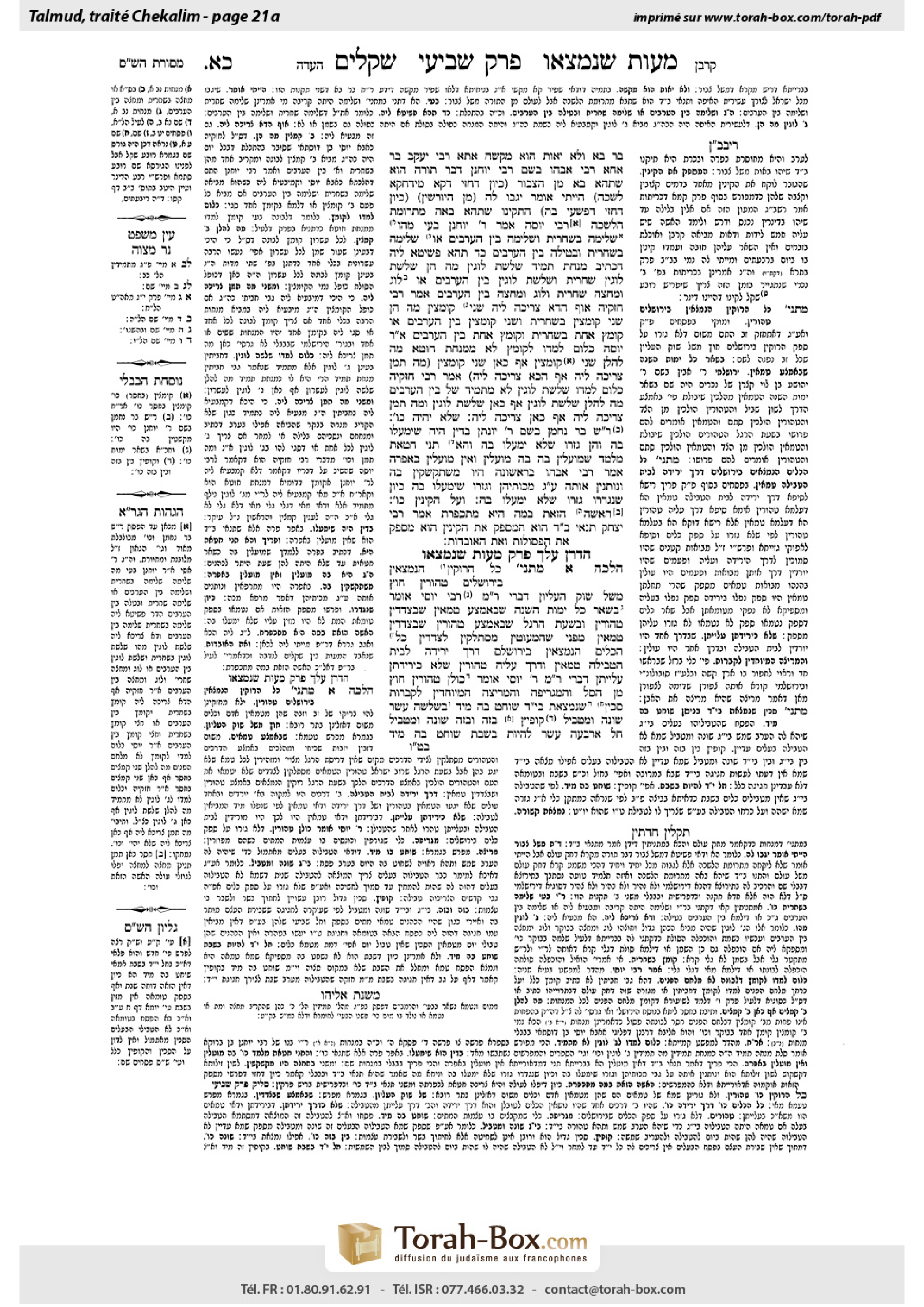
Shekalim 21a: Talmud study for Daf Yomi
Study the Talmud for Daf Yomi with scanned pages, Hebrew text, English translations from Sefaria and AI-generated French translations.
Passage selection and English or AI-generated French translation are available where the scan has annotations. Daf Study is independent of Torah-Box and Sefaria.
Browse Shekalim · שקלים · All tractatesShekalim 21a text and translations
This page of Shekalim includes the Aramaic text and an English translation, alongside the scan above.
שקלים כ״א א · Aramaic and Hebrew text
רִבִּי בָּא בַּר מָמָל בָּעֵי . מִחְלְפָא שִׁיטָּתֵיהּ דְּרִבִּי שִׁמְעוֹן. תַּמָּן הוּא אָמַר. מִשֶּׁלְיוֹרְשִׁין. וְהָכָא הוּא אָמַר מִשֶּׁלְצִיבּוּר. אָמַר רִבִּי חִיָיה בַּר בָּא. וְלֹא יְאוּת הוּא מַקְשֵׁי. אֲתַא רִבִּי יַעֲקֹב בַּר אָחָא רִבִּי אַבָּהוּ בְשֵׁם רִבִּי יוֹחָנָן. דְּבַר תוֹרָה הוּא שֶׁתְּהֵא בָאָה מִן הַצִּיבּוּר. הָיִיתִי אוֹמֵר. יִגְבּוּ לָהּ. הִתְקִינוּ שֶׁתְּהֵא בָאָה מִתְּרוּמַת הַלִּשְׁכָּה.
רִבִּי יוֹסֵה אָמַר. רִבִּי יוֹחָנָן בָּעֵי. מָה. שְׁלֵימָה בְשַׁחֲרִית וּשְׁלֵימָה בֵין הָעַרְבָּיִם. אוֹ מֶחֱצָה בְשַׁחֲרִית וּמֶחֱצָה בֵין הָעַרְבָּיִם. [אוֹ שְׁלֵימָה שַׁחֲרִית וּבְטֵילָה בֵין הָעַרְבָּיִם.] כַּד תְּהֵא פְשִׁיטָא לֵיהּ. שְׁלֹשֶׁת לוּגִין מָה הֵן. שְׁלֹשֶׁת לוּגִין בְּשַׁחֲרִית וּשְׁלשֶׁת לוּגִין בֵּין הָעַרְבָּיִם. אוֹ לוֹג וּמֶחֱצָה בְשַׁחֲרִית וְלוֹג וּמֶחֱצָה בֵין הָעַרְבָּיִם. אָמַר רִבִּי חִזְקִיָּה. אוֹף הָדָא צְרִיכָה לֵיהּ שְׁנֵי קְמָצִין מָה הֵן. שְׁנֵי קְמָצִין בְּשַׁחֲרִית וּשְׁנֵי קְמָצִין בֵּין הָעַרְבָיִם. אוֹ קוֹמֶץ אֶחָד בְּשַׁחֲרִית וְקוֹמֶץ אֶחָד בֵּין הָעַרְבָּיִם. אָמַר רִבִּי יוֹסֵה. כְּלוּם לָמְדוּ לַקוֹמֶץ לֹא מִמִּנְחַת חוֹטֵא. מַה לְהַלָּן שְׁנֵי קְמָצִין אַף כָּאן שְׁנֵי קְמָצִין. מַה תַמָּן צְרִיכָה לֵיהּ. אַף הָכָא צְרִיכָה לֵיהּ. אָמַר רִבִּי חִזְקִיָּה. כְּלוּם לָמְדוּ שְׁלֹשֶׁת לוּגִין לֹא מִתָּמִיד שֶׁלְבֵּין הָעַרְבָּיִם. מַה לְהַלָּן שְׁלֹשֶׁת לוּגִין. אַף כָּאן שְׁלשֶׁת לוּגִין. [וּמַה] תַמָּן צְרִיכָה לֵיהּ. (וְהָכָא פְשִׁיטָא) [אַף כָּאן צְרִיכָה] לֵיהּ.
רִבִּי שְׁמוּאֵל בַּר נַחְמָן בְּשֵׁם רִבִּי יוֹנָתָן. בְּדִין הָיָה שֶׁיִּמְעֲלוּ בָהּ. וְהֵן גָּזְרוּ שֶׁלֹּא יִמְעֲלוּ בָהּ. וְהָא תַנֵּי חַטָּאת. מְלַמֵּד שֶׁמּוֹעֲלִין בָּהּ. [בָּהּ מוֹעֲלִין] וְאֵין מוֹעֲלִין בַּאֲפָרָהּ. אָמַר רִבִּי אָבָּהוּ. בָּרִאשׁוֹנָה הָיוּ מִשְׁתַּקְשְׁקִין בָּהּ וְנוֹתְנִין אוֹתָהּ גַּבֵּי מַכּוֹתֵיהֶן וְגָזְרוּ שֶׁיִּמְעֲלוּ בָהּ. כֵּיוָן שֶׁנִּגְדְּרוּ גָּזְרוּ שֶׁלֹּא יִמְעֲלוּ בָהּ.
הָאִשָּׁה הַזֹּאת בַּמֶּה הִיא מִתְכַּפֶּרֶת. אָמַר רִבִּי יִצְחָק. תְּנַיי בֵית דִּין הוּא הַמְסַפֵּק אֶת הַקִּינִּים הוּא מְסַפֵּק אֶת הַפְּסוּלוֹת וְאֵת הָאוֹבְדוֹת.
משנה: כָּל הָרוּקִּין הַנִּמְצָאִין בִּירוּשָׁלַיִם טְהוֹרִין חוּץ מִשֶּׁל שׁוּק הָעֶלְיוֹן דִּבְרֵי רִבִּי מֵאִיר. רִבִּי יוֹסֵי אוֹמֵר בִּשְׁאָר כָּל יְמוֹת הַשָּׁנָה שֶׁבָּאֶמְצַע טְמֵאִין שֶׁבַּצְּדָדִין טְהוֹרִין. וּבִשְׁעַת הָרֶגֶל שֶׁבָּאֶמְצַע טְהוֹרִין שֶׁבַּצְּדָדִין טְמֵאִין שֶׁמִּפְּנֵי שֶהַמּוּעָטִין מִסְתַּלְּקִין לַצְּדָדִין: כָּלַ הַכֵּלִים הַנִּמְצָאִין בִּירוּשָׁלַיִם דֶּרֶךְ יְרִידָה לְבֵית הַטְּבִילָה טְמֵאִין וְדֶרֶךְ עֲלִיָּה טְהוֹרִין שֶׁלֹּא כִּירִידָתָן עֲלִיָיתָן דִּבְרֵי רִבִּי מֵאִיר. רִבִּי יוֹסֵי אוֹמֵר כּוּלָּן טְהוֹרִין חוּץ מִן הַסַּל וְהַמַּגְרֵיפָה הַמְיוּחָדִין לַקְּבָרוֹת: סַכִּין שֶׁנִּמְצֵאת בְּאַרְבָּעָה עָשָׂר שׁוֹחֵט בָּהּ מִיָּד. בִּשְׁלְֹשָׁה עָשָׂר שׁוֹנֶה וּמַטְבִּיל. קוֹפִיץ בֵּין בָּזֶה וּבֵין בָּזֶה שׁוֹנֶה וּמַטְבִּיל. חָל אַרְבָּעָה עָשָׂר לִהְיוֹת בְּשַׁבָּת שׁוֹחֵט בָּהּ מִיָּד. בַּחֲמִשָּׁה עָשָׂר שׁוֹחֵט בָּהּ מִיָּד. נִמְצֵאת קְשׁוּרָה לְסַכִּין הֲרֵי זוֹ כַּסַּכִּין:
Shekalim 21a · English translation
Rebbi Abba bar Mamal asked, the system of Rebbi Simeon seems inverted. There he says, from the heirs, but here he says, from the public he deduces the rule from a biblical verse.. Rebbi Ḥiyya bar Abba said, is that not a pertinent question? There came Rebbi Jacob bar Aḥa, Rebbi Abbahu in the name of Rebbi Joḥanan: It is a word from the Torah that it should be brought from the public. I could say, one should tax for it he deduces the rule from a biblical verse.; they instituted that it should come from what is taken from the lodge.
Rebbi Yose said, Rebbi Joḥanan asked: Entire in the morning and entire in the evening, or half in the morning and half in the evening, [or entire in the morning and nothing in the evening] 6:13). If the High Priest is dead or disabled and according to the Mishnah his flour offering has to be brought entire, does that mean two offerings per day, or only one in the morning? It is clear that the sentence about bringing two halves has to be deleted and the corrector’s addition from B accepted.? Then it should be obvious to him, what about three log. 15:4) or from the specifics indicated for the daily sacrifice (Num. 28:5) that a tenth of an ephah of flour requires a quarter of a hin, 3 log, of olive oil. This therefore is the quantity of oil required here, even though it is used for frying, not for mixing as in the cases where the quantities are specified. Sifra Ṣaw Pereq4:1–5; cf. Babli Menaḥot52b.? Three log in the morning and three log in the afternoon, or a log and a half in the morning and a log and a half in the afternoon? Rebbi Ḥizqiah said, also the following was a problem for him: Two handful52a, R. Joḥanan reports that the Tenth of the High Priest also requires addition of a handful of incense like other flour offerings. He also reports that there is a dispute whether the living High Priest has to bring one handful, which is split into two, or two separate handfuls for morning and evening services. But since here the question is about the Tenth for the absent or incapacitated High Priest, one infers that the Yerushalmi holds that the living High Priest only brings one handful. in the morning and two handful in the evening or one handful in the morning and one handful in the evening? Rebbi Yose said, did they not the two handful infer from the sinner’s flour offering 5:11) is brought without oil and incense. The commentators conjecture an emendation “from the shew bread” which is put onto the table in two rows, each one with a cup of incense.? Just as there two handful, also here two handful. Just as there it was problematic for him, so here it is problematic for him. Rebbi Ḥizqiah said, did one not infer the three log from the daily afternoon sacrifice. 15:4) or from the specifics indicated for the daily sacrifice (Num. 28:5) that a tenth of an ephah of flour requires a quarter of a hin, 3 log, of olive oil. This therefore is the quantity of oil required here, even though it is used for frying, not for mixing as in the cases where the quantities are specified. Sifra Ṣaw Pereq4:1–5; cf. Babli Menaḥot52b.? Since there {are} three log, so also here three log. [Just as] there it was problematic for him, [so] here it is (obvious) [problematic] for him1.
Rebbi Samuel ben Naḥman in the name of Rebbi Jonathan: It would have been logical, it is clear that until its ashes are collected as required in Num. 19:9, any action not in accordance with the procedure prescribed in vv. 2–9 will invalidate the procedure and usufruct of correct procedure will be larceny of sacra. According to the general principle that once the required procedures are executed, there can be no longer larceny of sacra, the problem is to decide whether the correct preparation of the ashes is the final step in this regard, or the sprinkling on a person impure in the impurity of the dead, as described in the verses following. To say that it would be logical is tantamount to a statement that one could argue the second position but, since the answer is not clear from the biblical text, it is up to the Court overseeing the Temple to decide which opinion to follow. that one commit larceny with them, but they decided that one does not commit larceny with them. But did we not state51b/52a.: “it is ḥattat, this teaches that one commits larceny with it. [With it one commits larceny,] with its ashes one does not commit larceny.” Rebbi Abbahu said, at the beginning they were using it as a disinfectant and were putting it on their wounds and therefore they decided that one would commit larceny with it.. When they were fenced in, they decided that one does not commit larceny with it.
By what is that woman atoned for? The sentence and the next are reproduced at the end of the Chapter (7).? Rebbi Isaac said, it is a stipulation of the Court that the providers of nests also provide the disqualified and the lost ones.
MISHNAH: All spittle4:5). By rabbinic usage, all Gentiles are considered to be in this category. In Jerusalem, where people are used to eat sancta the entire year according to R. Meïr, or on the holidays according to R. Yose, one may assume that impure people are careful not to contaminate their pure neighbors. This is a reconstruction by authors living two generations after the destruction of the Temple. found in Jerusalem is pure except on the Upper Market, the words of Rebbi Meïr. Rebbi Yose says, on all other days of the year, those in the middle of the road are impure, and those on the sides pure. On holidays, those in the middle of the road are pure and those on the sides impure since the minority will remove themselves to the sides.
All implements which are found in Jerusalem on the road descending to the place of immersion are impure, on the way ascending they are pure since they were brought down on a way different from that on which they were brought up, the words of Rebbi Meïr. Rebbi Yose says, all are pure except the bag and the rake set apart for graves.
If a knife was found on the Fourteenth sacrifice. Even though the previous Mishnah stated that all implements found in Jerusalem are presumed to be pure, for use on sancta one is restrictive and requires immersion in a miqweh and waiting for the following sundown. The only time this requirement is waived is the 14 of Nisan, the day of mass slaughter, where it is presumed that every knife which is qualified to be used for ritual slaughter was immersed in a miqweh the previous day., one may slaughter with it immediately; on the Thirteenth one has to repeat and immerse.. A dagger. in either case one has to repeat and immerse. If the Fourteenth falls on a Sabbath, one may slaughter with it immediately; on the Fifteenth one may slaughter with it immediately. If it was tied to a knife its status is that of the knife.
Text from Sefaria: The Jerusalem Talmud, edition by Heinrich W. Guggenheimer. Berlin, De Gruyter, 1999-2015 (CC BY); The Jerusalem Talmud, translation and commentary by Heinrich W. Guggenheimer. Berlin, De Gruyter, 1999-2015 (CC BY).