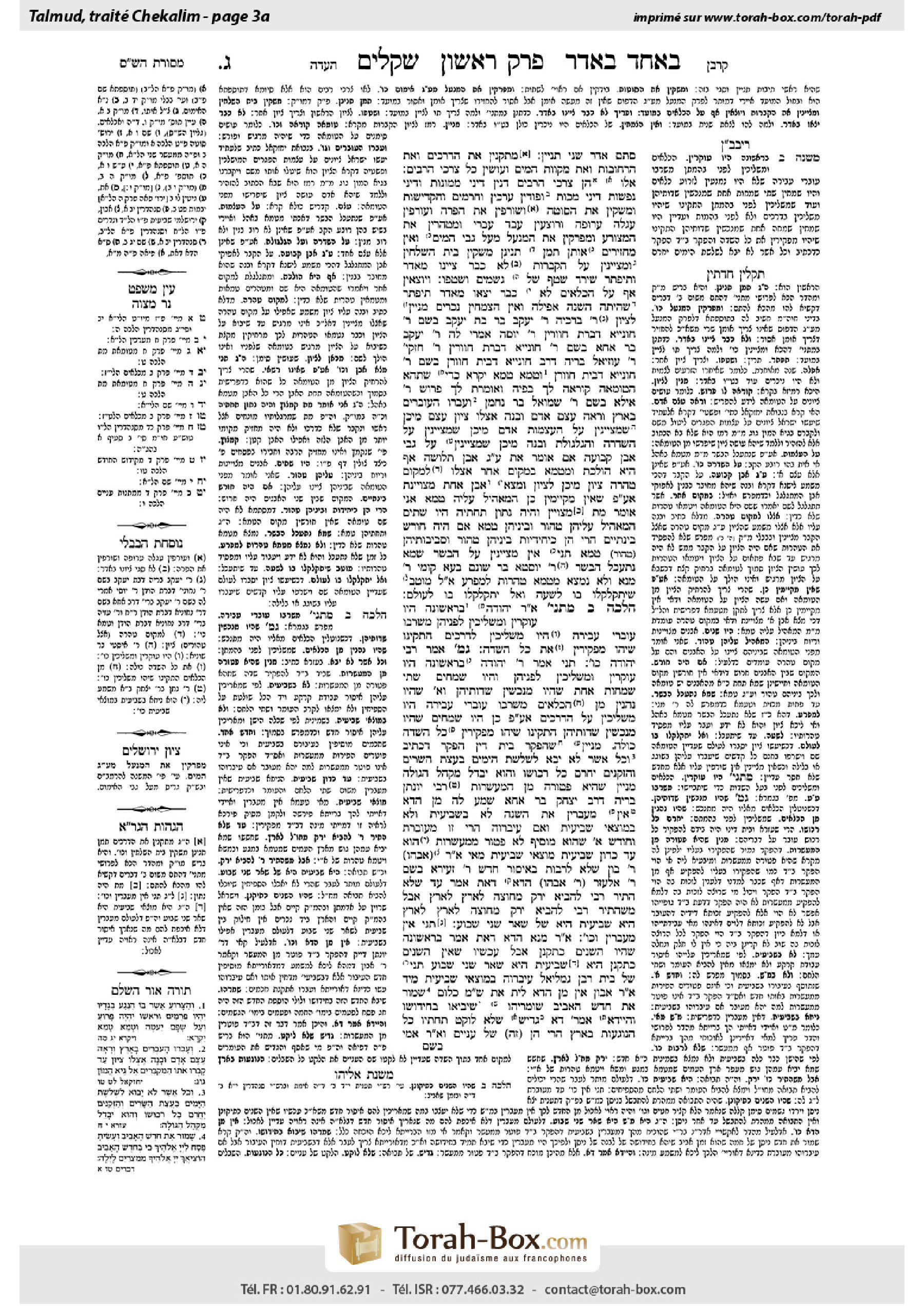
Shekalim 3a: Talmud study for Daf Yomi
Study the Talmud for Daf Yomi with scanned pages, Hebrew text, English translations from Sefaria and AI-generated French translations.
Passage selection and English or AI-generated French translation are available where the scan has annotations. Daf Study is independent of Torah-Box and Sefaria.
Browse Shekalim · שקלים · All tractatesShekalim 3a text and translations
This page of Shekalim includes the Aramaic text and an English translation, alongside the scan above.
שקלים ג׳ א · Aramaic and Hebrew text
אֲבָל לְעִנְיָין שְׁטָרוֹת כּוֹתְבִין אֲדָר הָרִאשׁוֹן וַאֲדָר הַשֵּׁינִי. אֶלָּא שֶׁכּוֹתְבִין אֲדָר הַשֵּׁינִי תִינְיָין. רִבִּי יוּדָה אוֹמֵר. אֲדָר הַשֵּׁינִי כוֹתֵב וְדַיּוֹ.
מְתַקְּנִין אֶת הַדְּרָכִים וְאֶת הָרְחוֹבוֹת וְאֶת מִקְווֹת הַמַּיִם וְעוֹשִׂין כָּל צוֹרְכֵי הָרַבִּים. אֵילּוּ הֵן צוֹרְכֵי הָרַבִּים. דָּנִין דִּינֵי מָמוֹנוֹת וְדִינֵי נְפָשׁוֹת דִּינֵי מַכּוֹת וּפוֹדִין עֲרָכִין וַחֲרָמִין וְהֶקְדֵּישׁוֹת וּמַשְׁקִין אֵת הַסּוֹטָה וְשׂוֹרְפִין אֶת הַפָּרָה וְעוֹרְפִין עֶגְלָה עֲרוּפָה וְרוֹצְעִין עֶבֶד עִבְרִי וּמְטָהֲרִין אֵת הַמְּצוֹרָע וּמְפָרְקִין אֶת הַמִּנְעָל מֵעַל גַּבֵּי הָאֵימוּם וְאֵין מַחֲזִירִין אוֹתוֹ.
וּמְצַיְּינִין עַל הַקְּבָרוֹת. לֹא כְבָר צִיְינוּ מֵאֲדָר. תִּיפְתָּר שֶׁיָּרַד שֶׁטֶף שֶׁלְגְּשָׁמִים וּשְׁטָפוֹ.
וְיוֹצְאִין אַף עַל הַכִּלְאָיִם. לֹא כְבָר יָצְאוּ בַּאֲדָר. תִּיפְתָּר שֶׁהָיְתָה הַשָּׁנָה אֲפֵילָה וְאֵין הַצְּמָחִין נִיכָּרִין.
מְנַיִין לְצִיּוּן. רִבִּי בֶּרֶכְיָה רִבִּי יַעֲקֹב בַּר בַּת יַעֲקֹב בְשֵׁם רִבִּי חוּנְיָיא דִבְרַת חַוְורָן רִבִּי יוֹסֵה אָמְרֵי לָהּ רִבִּי יָעֲקֹב בַּר אָחָא בְשֵׁם רִבִּי חוּנְיָיא דִבְרַת חַוְורָן רִבִּי חִזְקִיָּה רִבִּי עוּזִּיאֵל בְּרֵיהּ דְּרִבִּי חוּנְיָיה דְּבֵית חַוְורָן בְּשֵׁם רִבִּי חוּנְיָיא דְּבֵית חַוְורָן. טָמֵא טָמֵא יִקְרָא. כְּדֵי שֶׁתְּהֵא הַטּוּמְאָה קוֹרְאָה לָךְ בְּפִיהָ וְאוֹמֶרֶת לָךְ. פְּרוֹשׁ. רִבִּי אִילָא בְשֵׁם רִבִּי שְׁמוּאֵל בַּר נַחְמָן. וְעָבְרוּ הָעוֹבְרִים בָּאָרֶץ וְרָאָה עֶצֶם אָדָם וּבָנָה אֶצְלוֹ צִיּוּן. מִיכָן שֶׁמְצַיְינִין עַל הָעֲצָמוֹת. אָדָם. מִיכָן שֶׁמְצַיְינִין עַל הַשִּׁזְרָה וְעַל הַגּולְגּוֹלֶת. וּבָנָה. מִיכָן שֶׁמְצַיְינִין עַל גַּבֵּי אֶבֶן קְבוּעָה. אִם אוֹמֵר אַתְּ עַל גַּבֵּי אֶבֶן תְּלוּשָׁה. אַף הִיא הוֹלֶכֶת וּמְטַמֵּא בְמָקוֹם אַחֵר. אֶצְלוֹ. לִמְקוֹם טַהֲרָה. צִיּוּן. מִיכָן לְצִיּוּן.
וּמָצָא אֶבֶן אַחַת מְצוּיֶינֶת. אַף עַל פִּי שֶׁאֵין מְקַיְימִין כֵּן הַמַּאֲהִיל עָלֶיהָ טָמֵא. אֲנִי אוֹמֵר. מֵת מְצוּיָין וְהָיָה נָתוּן תַּחְתֶּיהָ. הָיוּ שְׁתַיִם. הַמַּאֲהִיל עָלֶיהֶן טהוֹר וּבֵינֵיהֶן טָמֵא. אִם הָיָה חוֹרֶשׁ בֵּנְתַּיִים הֲרֵי הֵן כִּיחִידִיּוֹת. בֵּינֵיהֶן טָהוֹר וּסְבִיבוֹתֵיהֶן טָמֵא.
תַּנֵּי אֵין מְצַיְינִין עַל הַבָּשָׂר שֶׁמָּא נִתְאַכֵּל הַבָּשָׂר. רִבִּי יוּסְטָא בַּר שׁוּנֵם בְּעָא קוֹמֵי רִבִּי מָנָא. וְלֹא נִמְצָא מְטַמֵּא טַהֲרוֹת לְמַפְרֵעַ. אָמַר לֵיהּ. מוטָּב שֶׁיִּתְקַלְקְלוּ בוֹ לְשָׁעָה וְאַל יִתְקַלְקְלוּ בוֹ לְעוֹלָם.
משנה: אָמַר רִבִּי יְהוּדָה בָּרִאשׁוֹנָה הָיוּ עוֹקְרִין וּמַשְׁלִיכִין לִפְנֵיהֶן. מִשֶּׁרַבּוּ עוֹבְרֵי עֲבֵירָה הָיוּ עוֹקְרִין וּמַשְׁלִיכִין לַדְּרָכִים. הִתְקִינוּ שֶׁיְּהוּ מַבְקִירִין אֶת כָּל הַשָּׂדֶה.
הלכה: רִבִּי יְהוּדָה אוֹמֵר. תַּנֵּי אָמַר רִבִּי יְהוּדְה. בָּרִאשׁוֹנָה הָיוּ עוֹקְרִין וּמַשְׁלִיכִין לִפְנֵיהֶן וְהָיוּ שְׂמֵיחִין שְׁתֵּי שְׂמָחוֹת. אַחַת שֶׁהָיוּ מְנַכְשִׁין שָׂדוֹתֵיהֶן וְאַחַת שֶׁהָיוּ נֶהֱנִין מִן (הַגֶּזֶל) [הַכִּלְאַיִם]. מִשֶּׁרַבּוּ עוֹבְרֵי עֲבֵירָה הָיוּ מַשְׁלִיכִין עַל הַדְּרָכִים. אַף עַל פִּי כֵן הָיוּ שְׂמִחִים שֶׁהָיוּ מְנַכְשִׁין שָׂדוֹתֵיהֶן. הִתְקִינוּ שֶׁיְּהוּ מַבְקִירִין אֶת כָּל הַשָּׂדֶה.
מִנַיִיִן שֶׁהֶבְקֵר בֵּית דִּין הֶבְקֵר. כָּתוּב וְכֹל אֲשֶׁר לֹא יָבֹא לִשְׁלשֶׁת הַיָּמִים כַּעֲצַת הַשָּׂרִים וְהַזְּקֵנִים יָחֳרַם כָּל רְכוּשׁוֹ וְהוּא יִבָּדֵל מִקְּהַל הַגּוֹלָה. מְנַיִין שֶׁהִיא פְטוּרָה מִן הַמַּעְשְׂרוֹת. רִבִּי יוֹנָתָן בְּרֵיהּ דְּרִבִּי יִצְחָק בַר אָחָה שָׁמַע לָהּ מִן הָדָא. אֵין מְעַבְּרִין אֶת הַשָּׁנָה לֹא בַשְּׁבִיעִית וְלֹא בְמוֹצָאֵי שְׁבִיעִית. וְאִם עִיבְּרוּהָ הֲרֵי זוֹ מְעוּבֶּרֶת. וְחוֹדֶשׁ אֶחָד שֶׁהוּא מוֹסִיף לֹא פָטוּר מִמַּעְשְׂרוֹת הוּא. עַד כְדוֹן שְׁבִיעִית. מוֹצָאֵי שְׁבִיעִית [מַאי]. אָמַר רִבִּי אָבוּן. שֶׁלֹּא לְרַבּוֹת בְּאִיסּוּר חָדָשׁ. רִבִּי זְעוּרָה בְשֵׁם רִבִּי אַבָּהוּ. הָדָא דְאַתְּ אָמַר. עַד שֶׁלֹּא הִתִּיר רִבִּי לְהָבִיא יָרָק מֵחוּצָה לָאָרֶץ לָאֲרֶץ. אֲבָל מִשֶּׁהִתִּיר רִבִּי לְהָבִיא יָרָק מִחוּץ לָאָרֶץ לָאֲרֶץ הִיא שְׁבִיעִית הִיא שֶׁל שְׁאָר שְׁנֵי שָׁבוּעַ.
תַּנֵּי. אֵין מְעַבְּרִין אֶת הַשָּׁנָה בַשְּׁבִיעִית [וְלֹא בְמוֹצָאֵי שְׁבִיעִית] אֶלָּא בִשְׁאָר שְׁנֵי שָׁבוּעַ. [וְ]אִם עִיבְּרוּהָ הֲרֵי זֶה מְעוּבֶּרֶת. אָמַר רִבִּי מָנָא. הָדָא דְאַתְּ אָמַר. בָּרִאשׁוֹנָה כְּשֶׁהָיוּ הָשָּׁנִים כְּתִיקֻנָן. אֲבָל עַכְשָׁיו שֶׁאֵין הָשָּׁנִים כְּתִיקֻנָן הִיא שְׁבִיעִית הִיא שְׁאָר שְׁנֵי שָׁבוּעַ. תַּנֵּי. שֶׁלְבֵּית רַבָּן גַּמְלִיאֵל עִיבְּרוּהָ בְמוֹצָאֵי שְׁבִיעִית מִיָּד. אָמַר רִבִּי אָבוּן. אִין מִן הָדָא לֵית שְׁמַע מִינָּהּ כְלוּם. שָׁמוֹר אֶת חוֹדֶשׁ הָאָבִיב. שָׁמְרֵיהוּ שֶׁיָּבוֹא בְחִידּוּשׁוֹ.
וְהֵיי דָא אָמְרָה דָא. גָּדִישׁ שֶׁלֹּא לוּקַּט תַּחְתָּיו כָּל הַנּוֹגְעוֹת בָּאָרֶץ הֲרֵי הֵן שֶׁלְעֲנִיִּים. וְאָמַר רִבִּי אִמִּי בְשֵׁם רִבִּי שׁמְעוֹן בֵּן לָקִישׁ. דְּבֵית שַׂמַּי הִיא. וְאָמַר לֵיהּ רִבִּי יוֹסֵי. שָׁמַעְנוּ שֶׁהוּא פָטוּר מִמַּעְשְׂרוֹת דִּבְרֵי הַכֹּל מִשּׁוּם קְנָס. וּכְבֵית הִלֵּל עֲנִיִים מְעַשְּׂרִין וְאוֹכְלִין.
Shekalim 3a · English translation
But in matters of documents one writes the First Adar, the Second Adar. only that for the Second Adar one writes תִינייָן. Rebbi Jehudah says, the Second Adar one writes, and it is enough(and Tosephta Megillah1:6). In the anonymous opinion (ascribed in B to R. Meïr), for both months one writes Adar, but the second one is qualified by “second” (in Aramaic, the language of contracts in both Talmudim.) R. Jehudah agrees that “Adar” alone means the First Adar in an intercalary year, but the Second may be indicated by a single letter ת֗, first letter of the Aramaic word “second”..
“One repairs the roads, and the streets, and water pools or to water supply for the pilgrims. Both kinds of pools may contain dust deposited there by the rains of the winter months., and one looks after all public needs.” “2:11. From here to the end of the Halakhah the text is from Mo`ed Qaṭan1:1 (80b 66), with no or little relevance here. The Mo`ed Qaṭan text of the ms. is indicated by ק; in addition there exist an Ashkenazic text of the Yerushalmi (A) edited by J. Sussman in Kobez al Yad12 (1994), pp. 62–63.
Most of the activities permitted in the baraita are for the benefit of individuals, not the public, most clearly delivering a new pair of shoes on the semi-holiday, mentioned last in the baraita. The only reason for its inclusion here is the identity of the expression “public needs”, applied both to public works in preparation for the holiday and permitted activities during the intermediate days of an extended holiday. The following are the public needs: One judges civil suits, and capital crimes, and cases of flogging, and one redeems valuations 27:2–6., and bans. 18:14., and dedications, one lets the suspected adulteress drink. 5:11–31., and burns the Cow. 19., and one breaks the neck of the calf whose neck was to be broken. 21:1–9., and one pierces the ear of a Hebrew slave, and one purifies the sufferer from skin disease, and removes the shoe from the block but one may not return it.”
“One marks the graves.” Were they not already marked in Adar? Explain it if there was a flood caused by rain which rinsed it off. The question is why one should hire people to mark graves (or in the next paragraph to check for kilaim) on the semi-holidays approximately on the spring and fall equinoxes (Mishnah Mo`ed Qaṭan1:2) when they already had been checked in late winter. The reason that one tries to have all public works done on semi-holidays is that at that time most journeymen are without work and ready to work for lower wages. One provides work for the poor and saves taxpayer’s money at the same time. Cf. Babli Mo`ed Qaṭan6a..
“And also one goes to inspect for kilaim.” Did they not already go in Adar? Explain it if the year was late and the plants not recognizable.
5:1, :Notes 17–25, ש) and Sotah9:1 (Notes 29–31, ס). Babli Mo`ed Qatan6a. The biblical roots for the duty of the authorities to mark the places of graves with taxpayers’ money. From where about marks? Rebbi Berekhiah, Rebbi Jacob the son of the daughter of Jacob, in the name of Rebbi Onias from Hauran. Rebbi Yose said it, Rebbi Jacob bar Aḥa in the name of Rebbi Onias from Hauran. Rebbi Ḥizqiah, Rebbi Uziel the son of Rebbi Onias from Hauran in the name of Rebbi Onias from Hauran: impure, impure, he shall call out 13:46. An inappropriate reference since the verse refers to the impurity of the sufferers from skin disease, not of corpses.; the impurity itself has to call out and say to you: go away! Rebbi Hila in the name of Rebbi Samuel bar Naḥman: The emissaries shall crisscross the land; if one sees a bone of a human he builds a sign near it.. 39:15. {A bone}., from here that one makes signs for bones. A human, from here that one makes signs for spine and skull. He builds, from here that one makes signs on fixed stones. If you say on loose ones, it would move and make other places impure. Near it, on a place of purity. A sign, from here the marks.
1:5. If one found a single marked stone, even though one should not keep it so, if somebody forms a tent over it he is impure; I say a marked corpse. 19, Babli Yebamot61a); only the texts in Ma`aser Šeni and the Tosephta follow R. Simeon who restricts tent (and any kind of biblical) impurity to Jewish bodies. was under it. If there were two, he who forms a tent over any one of them is pure; between them he is impure. If between them was a ploughed strip they are single stones, between them the area is pure and around them impure.
It was stated1:5.: One does not mark flesh, for perhaps it will decompose. Rebbi Justus bar Shunem asked before Rebbi Mana: Will that not cause pure food to be retroactively made impure? He said to him, it is better that these should become unusable for a limited time than that {the earth} become unusable forever.
MISHNAH: Rebbi Jehudah says, originally they were uprooting and throwing down tore out all kilaim growth and left it lying on the fields.. When the number of transgressors rose themselves since the public employees not only weeded the fields for them but also provided them with animal fodder., they were uprooting and throwing on the roadways; they instituted that they were declaring the entire field as ownerless.
HALAKHAH: “Rebbi Jehudah said.” It was stated: Rebbi Jehudah said, originally they were uprooting and throwing down before them; they were twice happy, first that they weeded their fields and second that they could use (the robbery) [the kilaim ]. When the number of transgressors rose, they were throwing it on the roadways, and still they were happy that they weeded their fields. They instituted that they were declaring the entire field as ownerless.
From where that a declaration of forfeiture by a court makes it ownerless? 5:1 (פ). From the middle of the text there are two Genizah sources edited by Ginzberg without noting the readings differing from the editio princeps(Yerushalmi Fragments from the Genizah, New York 1909), one noted G (pp. 120,122,129,131), the other ג (pp. 121, 123–128,130,132–139). It is written10:8. Babli Yebamot89b.: Anybody who will not come within three days conforming to the decree of the rulers and the elders, all his property shall be devoted to destruction and he shall be separated from the community of the Diaspora. From where that it; they have no relevance here. is free from tithes? Rebbi Jonathan, the son of Rebbi Isaac bar Aḥa understood it from the following2:9, Sanhedrin Yerushalmi 1:2 (Note 207), Babli 12a; Nedarim6:13 Note 83.: “One intercalates(Jason Aronson, Northvale NJ, 1998). years neither in the Sabbatical year, nor in the year following the Sabbatical; but if they did intercalate it is intercalated.” The one month he adds, is it not free from tithes and, hence, biblically free from heave and tithes even if taken by the owner of the land. If the Supreme Court declared the year intercalary against the rules, it is nevertheless a valid 13 months year and all produce is legally abandoned property.? That refers to the Sabbatical year. What about the year after the Sabbatical? Rebbi Abun said, not to prolong the prohibition of new grain sacrifice on the 16th of Nisan, Lev. 23:14. The intercalation of a month, which always falls in Adar, unnecessarily postpones the harvest of new grain.. 6:4, also Nedarim6:13. It explains why our calendar today does not take the Sabbatical year into consideration when determining intercalary months in the 19 year cycle. Rebbi Ze`ira in the name of Rebbi Abbahu: That is only before Rebbi permitted the importation of vegetables from outside the Land. But after Rebbi permitted the importation of vegetables from outside the Land, the Sabbatical year is as any other year7:17). In former times Jews did not use vegetables from outside the Land since it might have particles of soil still clinging to it. But after the last remnants of the ashes of the Red Cow disappeared, these laws became inoperative and it was possible for everybody, even the most scrupulous, to eat imported vegetables. This has to be dated to the times of Rebbi. Cf. commentary to Mishnah Berakhot 1:1..
It was stated: One does not intercalate in the Sabbatical Year [nor in the year following the Sabbatical;]. but only in other years of a Sabbatical period, but if they did intercalate it is intercalated. Rebbi Mana said, that refers to earlier times when years were in order, but now that years are not in order, the Sabbatical year is like any other year. It was stated: The house of Rabban Gamliel intercalated immediately after the end of the Sabbatical year. Rebbi Avin said, from this you do not infer anything. watch the spring month. 16:1.. Watch it that it should come in its renewal.
What text implies this? “For a grain stack under which gleanings were not collected, all ears that touch the ground are for the poor.”5:1. Rebbi Immi in the name of Rebbi Simeon ben Laqish: This is from the House of Shammai. Rebbi Yose one has to read R. Yasa, contemporary of R. Immi, not R. Yose who has to be dated 2 generations later. said to him: We understand that according to everybody, this is a fine5:1, Note 4. There is no biblical reason why the ears touching the ground should be given to the poor; the farmer is fined since he put his sheaf on a place where the poor could not yet have taken the gleanings. The disagreement between the Houses of Shammai and Hillel is explained in ג: The House of Shammai hold that things abandoned exclusively for the use of the poor are legally abandoned whereas the House of Hillel hold that only things unconditionally abandoned are legally abandoned and therefore exempt from heave and tithes (Mishnah Peah6:1).. Following the House of Hillel, the poor give tithes and eat.
Text from Sefaria: The Jerusalem Talmud, edition by Heinrich W. Guggenheimer. Berlin, De Gruyter, 1999-2015 (CC BY); The Jerusalem Talmud, translation and commentary by Heinrich W. Guggenheimer. Berlin, De Gruyter, 1999-2015 (CC BY).