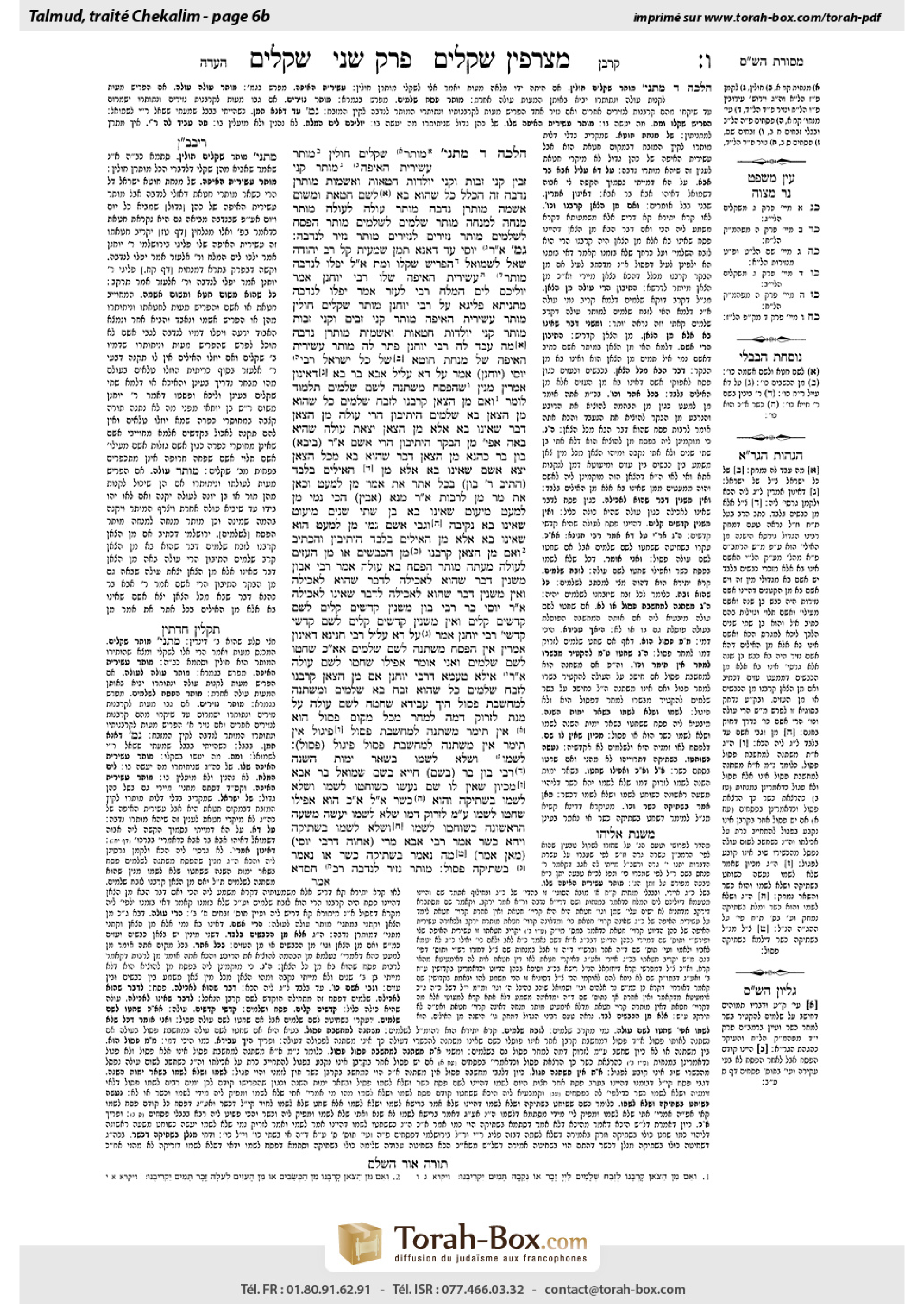
Shekalim 6b: Talmud study for Daf Yomi
Study the Talmud for Daf Yomi with scanned pages, Hebrew text, English translations from Sefaria and AI-generated French translations.
Passage selection and English or AI-generated French translation are available where the scan has annotations. Daf Study is independent of Torah-Box and Sefaria.
Browse Shekalim · שקלים · All tractatesShekalim 6b text and translations
This page of Shekalim includes the Aramaic text and an English translation, alongside the scan above.
שקלים ו׳ ב · Aramaic and Hebrew text
משנה: מוֹתַר שְׁקָלִים חוּלִין. מוֹתַר עֲשִׂירִית הָאֵיפָה מוֹתַר קִינֵּי זָבִים קִינֵּי זָבוֹת קִינֵּי יוֹלְדוֹת חַטָּאוֹת וַאֲשָׁמוֹת מוֹתָרָן נְדָבָה. זֶה הַכְּלָל כָּל שֶׁהוּא בָּא לְשֵׁם חֵטּ ומִשֵּׁם אַשְׁמָה מוֹתָרָן נְדָבָה. מוֹתַר עוֹלָה לָעוֹלָה. מוֹתַר מִנְחָה לַמִּנְחָה. מוֹתַר שְׁלָמִים לַשְּׁלָמִים. מוֹתַר פֶּסַח לַשְּׁלָמִים. מוֹתַר נְזִירִים לַנְּזִירִים. מוֹתַר נָזִיר לַנְּדָבָה.
הלכה: מוֹתַר שְׁקָלִים חוּלִין כול׳. אָמַר רִבִּי יוֹסָה. עַד דַּאֲנָא תַמָּן שְׁמָעִית קָל רַב יְהוּדָה שְׁאַל לִשְׁמוּאֵל. הִפְרִישׁ שִׁקְלוֹ וָמֵת. אֲמַר לֵיהּ. יִפְּלוּ לִנְדָבָה. מוֹתַר עֲשִׂירִית הָאֵיפָה שֶׁלּוֹ. רִבִּי יוֹחָנָן אָמַר. יוֹלִיכֵם לְיַם הַמֶּלַח. רִבִּי לָעְזָר אָמַר. יִפְּלוּ לִנְדָבָה. מַתְנִיתָא פְלִיגָא עַל רִבִּי יוֹחָנָן. מוֹתַר שְׁקָלִים חוּלִין. מוֹתַר עֲשִׂירִית הָאֵיפָה מוֹתַר קִינֵּי זָבִים קִינֵּי זָבוֹת מוֹתַר קִינֵּי יוֹלְדוֹת חַטָּאוֹת וַאֲשָׁמוֹת מוֹתָרָן נְדָבָה. מַה עֲבַד לָהּ רִבִּי יוֹחָנָן. פָּתַר לָהּ מוֹתַר עֲשִׂירִית הָאֵיפָה שֶׁלְמִנְחַת חוֹטֵא שֶׁלְכָּל יִשְׂרָאֵל.
רִבִּי יוֹחָנָן אָמַר. עַל דָּעֲלִי אָבָּא בַּר בָּא. דְּאִינּוּן אָמְרִין. מְנַיִין שֶׁהַפֶּסַח מִשְׁתַּנֶּה לְשֵׁם שְׁלָמִים. תַּלְמוּד לוֹמַר. אִם מִן הַצֹּאן קָרְבָּנוֹ לְזֶבַח שְׁלָמִים. כָּל שֶׁהוּא מִן הַצֹּאן בָּא שְׁלָמִים. הָתִיבוּן. הֲרֵי עוֹלָה מִן הַצֹּאן. דָּבָר שֶׁאֵינוֹ בָא אֶלָּא מִן הַצֹּאן. יָצָאת עוֹלָה שֶׁהִיא בָאָה אֲפִילוּ מִן הַבָּקָר. הָתִיבוּן. הֲרֵי אָשָׁם. אָמַר רִבִּי בּוּן בַּר כַּהֲנָא. מִן הַצֹּאן. דָּבָר שֶׁהוּא בָּא מִכָּל הַצֹּאן. יָצָא אָשָׁם שֶׁאֵינוֹ בָא אֶלָּא מִן הָאֵלִים בִּלְבַד. בְּכָל אָתָר אַתְּ אָמַר. (מִלְּרַבּוֹת) [מִן לְמָעֵט]. וְהָכָא אַתְּ אָמַר. (מִלְּמָעֵט) [לְרַבּוֹת]. אָמַר רִבִּי מָנָא. (מִיעֲטוֹ) [הָכָא נַמֵּי מִן לְמָעֵט. מִיעוט שֶׁאֵינוֹ בָא בֶּן שְׁנֵי שָׁנִים. מִיעוט שֶׁאֵינוֹ בָא נְקֵבָה. וְגַבֵּי אָשָׁם נַמֵּי מִן לְמָעֵט הוּא.] שֶׁאֵינוֹ בָא אֶלָּא מִן הָאֵלִים בִּלְבַד. הָתִיבוּן. וְהָכְתִיב וְאִם מִן הַצֹּאן קָרְבָּנוֹ מִן הַכְּשָׂבִים אוֹ מִן הָעִזִּים לְעוֹלָה. מֵעַתָּה מוֹתַר הַפֶּסַח בָּא עוֹלָה. אָמַר רִבִּי אָבּוּן. מְשַׁנִּין דָּבָר שֶׁהוּא לַאֲכִילָה לְדָבָר שֶׁהוּא לַאֲכִילָה וְאֵין מְשַׁנִּין דָּבָר שֶׁהוּא לַאֲכִילָה לְדָבָר שֶׁאֵינוֹ לַאֲכִילָה. אָמַר רִבִּי יוֹסֵי בֵּירִבִּי בּוּן. מְשַׁנִּין קֳדָשִׁים קַלִּים לְשֵׁם קֳדָשִׁין קַלִּין וְאֵין מְשַׁנִּין קֳדָשִׁים קַלִּין לְשֵׁם קָדְשֵׁי קָדָשִׁים. רִבִּי יוֹחָנָן אָמַר. עַל דָּאעֲלִי רִבִּי חֲנִינָה. דְּאִינּוּן אָמְרִין. אֵין הַפֶּסַח מִשְׁתַּנֶּה לְשֵׁם שְׁלָמִים אֶלָּא אִם כֵּן שְׁחָטוֹ לְשֵׁם שְׁלָמִים. וַאֲנִי אוֹמֵר. אֲפִילוּ שְׁחָטוֹ לְשֵׁם עוֹלָה. אָמַר רִבִּי אִילָא. טַעֲמֵיהּ דְּרִבִּי יוֹחָנָן. אִם מִן הַצֹּאן קָרְבָּנוֹ לְזֶבַח שְׁלָמִים. כֹּל שֶׁהוּא זֶבַח בָּא שְׁלָמִים. וּמִשְׁתַּנֶּה לְמַחֲשֶׁבֶת פְּסוּל. הֵיךְ עֲבִידָה. שְׁחָטוֹ לְשֵׁם עוֹלָה עַל מְנָת לִזְרוֹק דָּמוֹ לְמָחָר. מִכָּל מָקוֹם פָּסוּל הוּא. אִין תֵּימַר. מִשְׁתַּנֶּה לְמַחֲשֶׁבֶת פְּסוּל. פִּיגּוּל. אִין תֵּימַר. אֵינוֹ מִשְׁתַּנֶּה לְמַחֲשֶׁבֶת פְּסוּל. פָסוּל.
לִשְׁמוֹ וְשֶׁלֹּא לִשְׁמוֹ בִּשְׁאָר יְמוֹת הַשָּׁנָה. רִבִּי בּוּן בַּר חִיָיה בְשֵׁם שְׁמוּאֵל בַּר אַבָּא. מִכֵּיוָן שֶׁאֵין לוֹ שֵׁם נַעֲשֶׂה כְשׁוֹחְטוֹ לִשְׁמוֹ וְשֶׁלֹּא לִשְׁמוֹ בִשְׁתִיקָה וְהוּא כָשֵׁר. אָמְרוּ לֵיהּ. וְאִם כֵּן הוּא אֲפִילוּ שְׁחָטוֹ לִשְׁמוֹ לִזְרוֹק דָּמוֹ שֶׁלֹּא לִשְׁמוֹ יֵעָשֶׂה מִשָּׁעָה הָרִאשׁוֹנָה כְשׁוֹחְטוֹ לִשְׁמוֹ וְשֶׁלֹּא לִשְׁמוֹ וִיהֵא כָשֵׁר. אָמַר רִבִּי אַבָּא מָרִי. מָאן אָמַר בִּשְׁתִּיקָה כָשֵׁר. אוֹ נֹאמַר. בִּשְׁתִּיקָה פָּסוּל.
רַב חִסְדָּא אָמַר. וְהוּא שֶׁקָּרְבָה חַטָּאתוֹ בַסּוֹף. אֲבָל אִם קָרְבוּ שְׁלָמִים בַּסּוֹף מוֹתָרָן שְׁלָמִים. אָמַר רִבִּי זְעוּרָה. וַאֲפִילוּ קָרְבוּ שְׁלָמִים בַּסּוֹף הֲלָכָה אַחַת הִיא בְנָזִיר שֶׁתְּהֵא מוֹתָרָהּ נְדָבָה. מַתְנִיתָא מְסַיְיעָה לְדֵין וּמַתְנִיתָא מְסַיְיעָא לְדֵין. מַתְנִיתָא מְסַיְיעָה לְרִבִּי זְעוּרָה. אֲפִילוּ הֵן מָעוֹת סְתוּמִין. כָּל שֶׁדְּמֵי חַטָּאוֹת מֵיתוֹת מְעוּרָבוֹת בָּהֵן. וַאֲפִילוּ הִפְרִישׁ דְּמֵי חַטָּאוֹת מֵיתוֹת מִתּוֹכָהּ מָעוֹת סְתוּמִין הֵן. מַתְנִיתָא מְסַיְיעָא לְרַב חִסְדָּא. אֵילּוּ לְחַטָּאתִי וְהַשְּׁאָר לִשְׁאָר נְזִירוּתִי. וָמֵת. מוֹעֲלִין בְּכוּלָּן וְאֵין מוֹעֲלִין מִקְצָתָן. וְלֹא אָמַר. אִם מַתִּי יִפְּלוּ לִנְדָבָה.
Shekalim 6b · English translation
MISHNAH: The excess of sheqalim is profane. The excess of a tenth of an ephah 5:11., the excess of nests. of male sufferers from gonorrhea 15:14., the nests of female sufferers from flux 15:29., the nests of women after childbirth 12:8., or purification offerings, or reparation offerings, their excesses are gift.. This is the principle: of anything brought for a sin or as reparation the excess is gift.
The excess of elevation sacrifices is for elevation sacrifices, the excess of flour offerings is for flour offerings, the excess of well-being sacrifices is for well-being sacrifices, the excess of Pesaḥ is for well-being sacrifices. The excess of nezirim is for nezirim, the excess of a nazir who might apply for a subsidy for the cost of his sacrifices, the money remain in its status even if not used in the time frame originally envisaged. But if money either was set aside by a nazir himself or it was given to him personally for his sacrifices and not completely used, the excess goes to the Temple’s gift account. is for gift.
HALAKHAH: “The excess of sheqalim is profane,” etc. Rebbi Yasa said, when I still was there, I heard the voice of Rav Jehudah asking Samuel, if somebody had set his sheqel apart and died? He told him, they shall fall to gift and “a promise to Heaven is like delivery to an individual” (Mishnah Qiddušin1:6), they are Temple property. Since they are not sheqalim they must be given to the Temple account into which all Temple monies not otherwise specified are collected.. The excess of his tenth of an ephah, Rebbi Joḥanan said, one shall bring them to the Dead Sea. Rebbi Eleazar said, it shall fall to gift. The Mishnah disagrees with Rebbi Joḥanan: “The excess of sheqalim is profane The excess of a tenth of an ephah, the excess of nests of male sufferers from gonorrhea, the nests of female sufferers from flux, the nests of women after childbirth, or purification offerings, or reparation offerings, the excesses are gift.”. What does Rebbi Joḥanan do with this? He explains it as excess from the tenth of an ephah of the purification offering of any one in Israel is Temple property but allows only excess of purification or reparation sacrifices to be so taken. The High Priest’s flour offering is neither of these; therefore the Mishnah cannot include it.
The reading of B implies that R. Eleazar identifies that tenth of an ephah as the High Priest’s offering..
5:1, Notes 80–97, where also the readings of B are noted (ג is unreadable or lacunary for the present paragraph.) Only the most necessary notes are given here, the remainder should be consulted there. Rebbi Joḥanan said, about this Abba bar Abba enlightened me, for they are saying, from where that Pesaḥ is changed into the denomination of well-being sacrifices? The verse says 3:6., and if his sacrifice be from small cattle as meal well-being offering; anything from small cattle comes as well-being offering. They objected, is there not an elevation offering from small cattle? Anything which only comes from small cattle; this eliminates the elevation offering which even may come from large cattle. They objected, is there not reparation offering? Rebbi Abun bar Cahana said, “from small cattle”. this eliminates the reparation offering, which only comes from rams. Everywhere you are saying that מִן (is to include) [is to exclude], but here you are saying that (מִן is to exclude) [is to include] or מִן as privative, excluding certain categories (cf. Šabbat7 Note 26, Ševuot1:2 Note 75, Bava Meṣia`4:8 Note 122, Nazir5:4 Note 105). Also in the next sentence, R. Mana gives the interpretation that here מִן is privative. On the other hand, the testimony of the scribe’s two texts, the Genizah fragment available for Pesaḥim, and the Munich ms. of Šeqalim do not permit emendation. It seems that here “every where” is derogatory, meaning Babylonian. The sequence of arguments leads to a contradiction. Abba bar Abba treats מִן as inclusive, R. Abun bar Cahana as exclusive. R. Mana explains that מִן always is partitive; automatic switch to well-being offerings is possible only for sacrifices that totally correspond to the declaration צאן, i. e., both sheep and goats, male and female.. Rebbi Mana said, (it excludes it,) [here also מִן is to exclude: It excludes in that it may not be brought two years old; it excludes that it cannot be brought female; and for a reparation offering also it excludes] since it only comes from rams. They objected, is there not written, 1:10. and if his sacrifice be from small cattle, from sheep or goats, as elevation offering; then excess Pesaḥ should become elevation offering? Rebbi Abun said, one changes something to be eaten into something to be eaten, but one does not change something to be eaten into something not to be eaten. Rebbi Yose ben Rebbi Abun said, one changes simple sancta into simple sancta, but one does not change simple sancta into most holy sacrifices. Rebbi Joḥanan said, about what Rebbi Ḥanina enlightened, that they are saying, Pesaḥ is changed into a well-being offering only if he slaughtered it for the purpose of well-being offering; but I am saying, even for the purpose of an elevation offering. Rebbi Illa said, the reason of Rebbi Joḥanan: And if his sacrifice be from small cattle as meal well-being offering 3:6.; anything to be consumed as sanctum is a well-being offering. Does it change with respect to disqualifying thoughts is used against the rules for something other than a well-being offering, do the rules of the other kind apply or is it disqualified and no rules of intent apply?? How is this? If he slaughtered it for the purpose of an elevation offering in order to pour its blood the next day. In any case, it is disqualified. If you are saying that it changes with respect to disqualifying thoughts, it is piggul, a deadly sin causing extirpation.. If you are saying that it does not change with respect to disqualifying thoughts, it is disqualified.
For its purpose and not for its purpose on the other days of the year? Rebbi Abun bar Ḥiyya in the name of Samuel bar Abba: Since it is left without a name it is as if from the start he slaughtered for its purpose and not for its purpose in silence and is qualified. They said to him. if it is so, even if he slaughtered for its purpose to pour the blood not for its purpose it should be treated as if from the start he slaughtered for its purpose and not for its purpose in silence and be qualified. Rebbi Abba Mari said, who says that in silence it is qualified? Or may we say, in silence it is disqualified?
4:4 (Notes 61–72, נ) which probably was the source. Mishnah Nazir4:4 deals with the case of a married woman who made a vow of nazir and started putting aside money for her required sacrifices when her husband dissolved her vow. Then she no longer is nezirah and therefore cannot bring the sacrifices, but the monies remain dedicated. The Mishnah states: “If she had money not designated, it should be given to the gift account. If the monies were designated, the value of the purification offering shall be thrown into the Dead Sea; one may not use it but there can be no me`ilah. For the value of the elevation offering, they shall bring an elevation offering; it is subject to the law of me`ilah. For the value of the well-being offering, they shall bring a well-being offering, to be eaten on one day; it does not need bread.” Money not designated is money for which it never was decided for which kind of sacrifice it should be used. Rav Ḥisda said, only if his purification offering was presented last. But if his well-being offering was presented last, what is left over is for a well-being offering with the expenses of their sacrifices but not all was used, the remainder has to be kept in trust to be used in the future for the same purpose. But if a person dedicated his own money for his sacrifices and had money left over, if the last sacrifice bought was of the most holy kind, the leftover money is of the same kind and has to go to the account for elevation offerings. But if the leftovers are of a well-being sacrifice, a “simple sanctum” which may be consumed by lay people, the monies have to be used for a simple sanctum.. Rebbi Ze`ira said, even if his well-being offering was presented last, it is a general rule for a nazir that his leftover be for the gift account3:2, overriding the general rule of Mishnah 2:6. In the Babli, Nazir25a, the statement is attributed to R. Joḥanan.. A baraita supports one and a baraita supports the other. A baraita supports Rebbi Ze`ira: “The following are not designated monies: any which contain money for purification offerings should be left to die. Even if he designated money for purification offerings that should be left to die, it remains not designated3:2, overriding the general rule of Mishnah 2:6. In the Babli, Nazir25a, the statement is attributed to R. Joḥanan..” A baraita supports Rav Ḥisda: “This is for my purification offering and the rest for my nezirut. Then he died. One commits larceny with all of them but not with part of them.” It does not say, when he died it should be given to the gift account100.
Text from Sefaria: The Jerusalem Talmud, edition by Heinrich W. Guggenheimer. Berlin, De Gruyter, 1999-2015 (CC BY); The Jerusalem Talmud, translation and commentary by Heinrich W. Guggenheimer. Berlin, De Gruyter, 1999-2015 (CC BY).